A lot of telecom projects don’t fail in the design set. They fail in the handoff between plan and field.
You’ve probably seen the pattern. A fiber build looks clean on paper, permits are moving, material is staged, and the subcontractor says they can start Monday. Two weeks later, the bore path doesn’t match field conditions, traffic control is inconsistent, splice documentation is late, and nobody can tell you whether the redlines reflect what was built. The schedule hasn’t slipped because of one dramatic event. It’s slipping because the wrong construction sub contractors were allowed to mobilize with vague expectations and weak oversight.
Telecom makes this worse because the margin for sloppiness is small. Fiber routes cross public right-of-way. Wireless upgrades depend on strict safety discipline and exact equipment handling. Data center work demands clean documentation, controlled sequencing, and close coordination with active systems. If your subcontractor strategy is loose, the field will expose it fast.
The High Stakes of Subcontractor Management in Telecom
In telecom, subcontractor management isn’t back-office paperwork. It’s a field execution discipline.
A bad choice at the subcontract level can derail a fiber-to-the-home deployment, a small cell rollout, or a data center fit-out long before anyone talks about liquidated damages. The warning signs usually show up early. Crews arrive without the right telecom-specific experience. Supervisors can’t explain testing requirements. Someone treats as-builts like an admin task instead of a turnover requirement. That’s when costs start moving in the wrong direction.
The scale of the issue is bigger than many owners and operators admit. The subcontracting market itself is enormous. The construction subcontracting sector is projected to reach $1.68 trillion by 2030, and subcontractors shoulder about 77 percent of construction costs on average in the broader market, according to Plunkett Research industry analysis. In some sectors, builders use an average of 22 different subcontractors on a single project. Telecom jobs may not mirror homebuilding exactly, but the operating reality is similar. You’re relying on multiple specialist crews to deliver one integrated network outcome.
Poor subcontractor oversight doesn’t stay isolated to one trade. It spreads into schedule, safety, restoration, quality testing, and customer turn-up.
That’s why strong management of construction sub contractors has to start before the first truck rolls. You need a repeatable system for qualification, scope definition, onboarding, field control, and payment administration. When that system is in place, subcontractors become force multipliers. When it isn’t, they become the source of your most expensive surprises.
Building Your A-Team Mastering Subcontractor Qualification
The first mistake people make is treating qualification like a bid tab exercise. Lowest number wins, insurance cert gets emailed over, and everyone hopes the foreman knows what “telecom ready” means. That approach creates avoidable risk.
In fiber and wireless construction, qualification has three parts. Financial stability, technical fit, and safety discipline. If one of those is weak, the job will feel it.
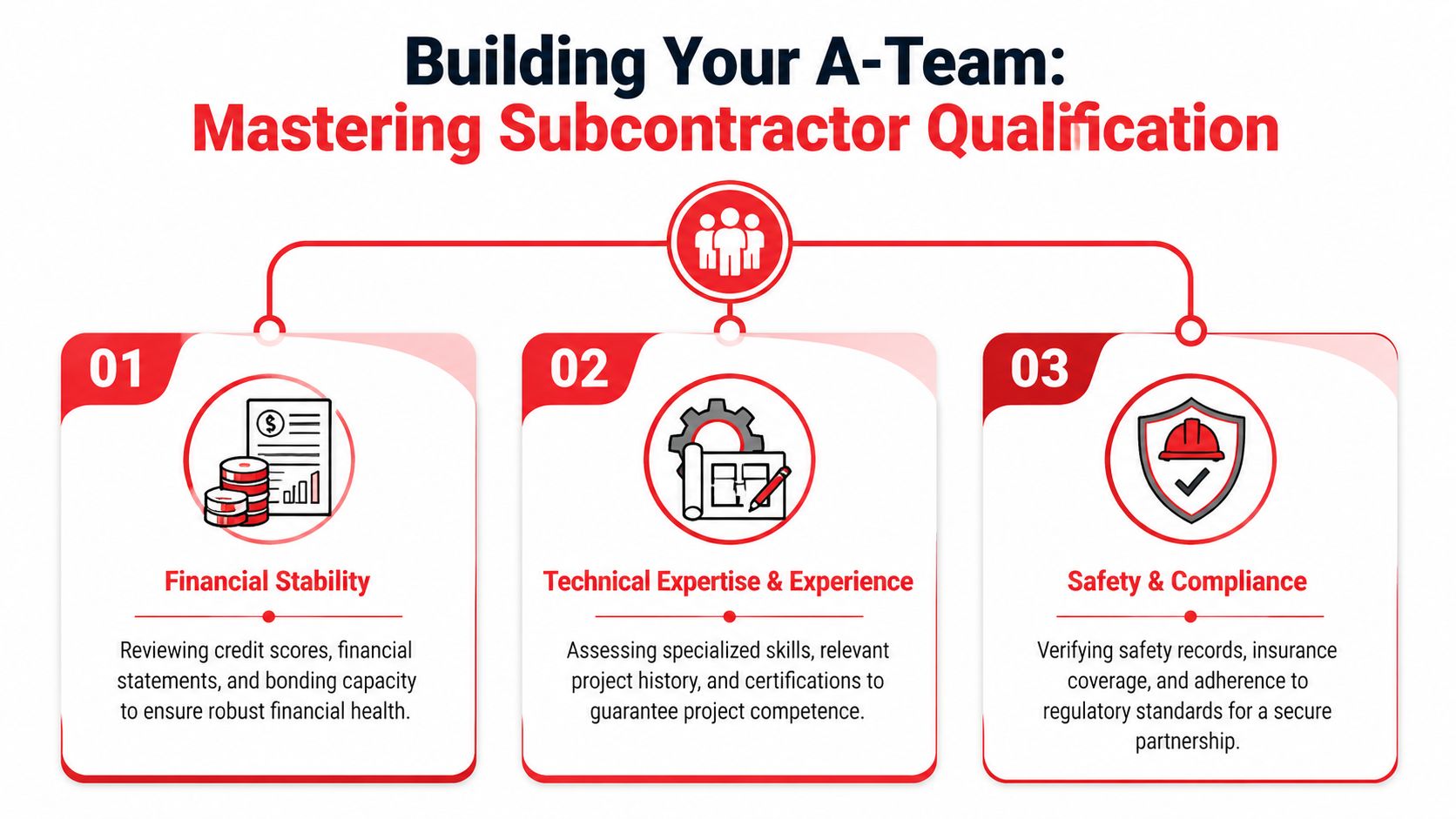
Financial review before field review
A subcontractor can look sharp in an interview and still be one delayed payment away from a crew shortage.
Start with current financial statements, cash flow visibility, banking relationships, and bonding capacity. For telecom work, I also want to know how they handle long material lead times, payroll during owner billing gaps, and whether they rely heavily on advances to stay moving. A contractor that needs immediate front-loaded cash on every project may be warning you that they’re undercapitalized.
Telecom schedules don’t tolerate weak working capital. If a fiber splicing crew can’t be paid on time or a wireless team can’t float travel and lodging, production drops before anyone says there’s a financial problem.
A practical way to strengthen this review is to verify insurance and workers’ comp requirements against the state where the crews operate. If you’re working in Florida, this overview of Florida workers' comp for subcontractors is useful because it shows what compliant coverage should look like from a subcontractor perspective.
Safety metrics that actually matter
Every subcontractor says safety is a priority. Don’t score them on slogans.
A better benchmark is EMR, or Experience Modification Rating. A subcontractor with an EMR below 1.0 is generally performing better than average on injury cost experience. The same guidance notes that poor subcontractor qualification contributes to 30-40% of construction disputes, while rigorous pre-qualification is associated with 15-20% higher on-time completion rates, according to GoContractor’s guidance on avoiding expensive construction pitfalls.
For telecom, I don’t stop at EMR. I also want to see whether the company’s safety program reflects the work they’re bidding. Tower work, traffic control, confined spaces, energized environments, and bucket operations each require different habits and documentation. A generic safety manual isn’t enough.
Practical rule: If the safety director can’t explain how field audits work on a fiber bore crew or a tower crew, the paper program is stronger than the field program.
Telecom specialization is non-negotiable
A good commercial electrician isn’t automatically a good small cell installer. A general underground crew isn’t automatically a good fiber placement partner.
Look for evidence tied to the actual work package:
- Fiber crews: splice experience, OTDR familiarity, redline discipline, restoration quality, and experience with make-ready coordination
- Wireless crews: rigging competence, equipment swap sequencing, grounding practices, and closeout package quality
- Data center crews: structured cabling standards, labeling discipline, pathway coordination, and work in active environments
Reference checks should be specific. Ask previous clients what the subcontractor did when field conditions changed, when permits constrained access, or when as-built turnover lagged. General praise doesn’t tell you much.
If you need a benchmark for what a telecom-ready field partner looks like, reviewing examples of specialized telecom construction crews can help sharpen your qualification standard.
Defining Success Through Ironclad Scopes and Contracts
Most subcontract disputes start long before the argument. They start in scope language that sounds clear until the field tests it.
“Install fiber from Point A to Point B” is not a workable telecom scope. It leaves out route assumptions, restoration boundaries, traffic control responsibility, test deliverables, permit conditions, utility conflict handling, and document turnover. Then everyone acts surprised when the invoice and the field report tell different stories.

Write the scope the way the field will execute it
A strong telecom Statement of Work describes the work in production terms, not broad trade terms.
For fiber, spell out route type, placement method, handhole expectations, restoration requirements, test submission format, redline update cadence, and final as-built standards. For wireless, define equipment lists, swap sequence, rigging assumptions, grounding expectations, sweep or PIM responsibilities where applicable, and punch-list response requirements. For data center work, define labeling conventions, pathway ownership, patching responsibilities, commissioning support, and turnover package content.
That level of detail helps control estimating error. TCLI’s discussion of estimating mistakes notes that scope overlaps or bid variances can account for up to 15% in errors, and that integrated estimating software plus historical cross-checking can improve bid accuracy from ±15-20% variance down to ±5%.
Contract terms that prevent field confusion
The contract should answer the questions that usually turn into friction.
Use a short table when reviewing your subcontract template:
| Contract area | What should be explicit in telecom work |
|---|---|
| Insurance | Required coverages, additional insured status, and timing for renewals |
| Schedule | Start conditions, access assumptions, working hours, and recovery expectations |
| Change management | Who can authorize changes, what documentation is required, and when pricing is due |
| Documentation | Redlines, test results, photos, as-builts, and closeout package standards |
| Compliance | Permit rules, site-specific safety requirements, utility coordination, and public right-of-way obligations |
One more point matters. Your subcontract should tie payment milestones to accepted deliverables, not just claimed progress. In telecom, “installed” and “complete” are often very different conditions.
Avoid legal ambiguity early
Field teams don’t need legal theory. They need clear rules they can follow.
That means no soft language around change orders, no assumptions about cleanup, and no gray area about who owns permit compliance at the crew level. If the project has special indemnity language, active-site restrictions, or heightened insurance obligations, get them into the subcontract package before mobilization. This kind of construction legal support framework is useful as a checklist for issues many teams forget until there’s already a dispute.
If a scope item can affect schedule, testing, restoration, or final billing, put it in writing before work starts.
Launching the Project with a Strong Onboarding Program
I’ve watched two subcontractors start the same kind of fiber job in very different ways.
One showed up after a vague kickoff call. The superintendent had one set of prints, the locator had another, traffic control wasn’t confirmed, and the city inspector had never been told work was starting. The first week turned into explanation, cleanup, and apology.
The other crew started after a real onboarding process. By midmorning on day one, everyone knew the route priorities, restoration limits, escalation contacts, and documentation rhythm. The difference wasn’t talent alone. It was preparation.
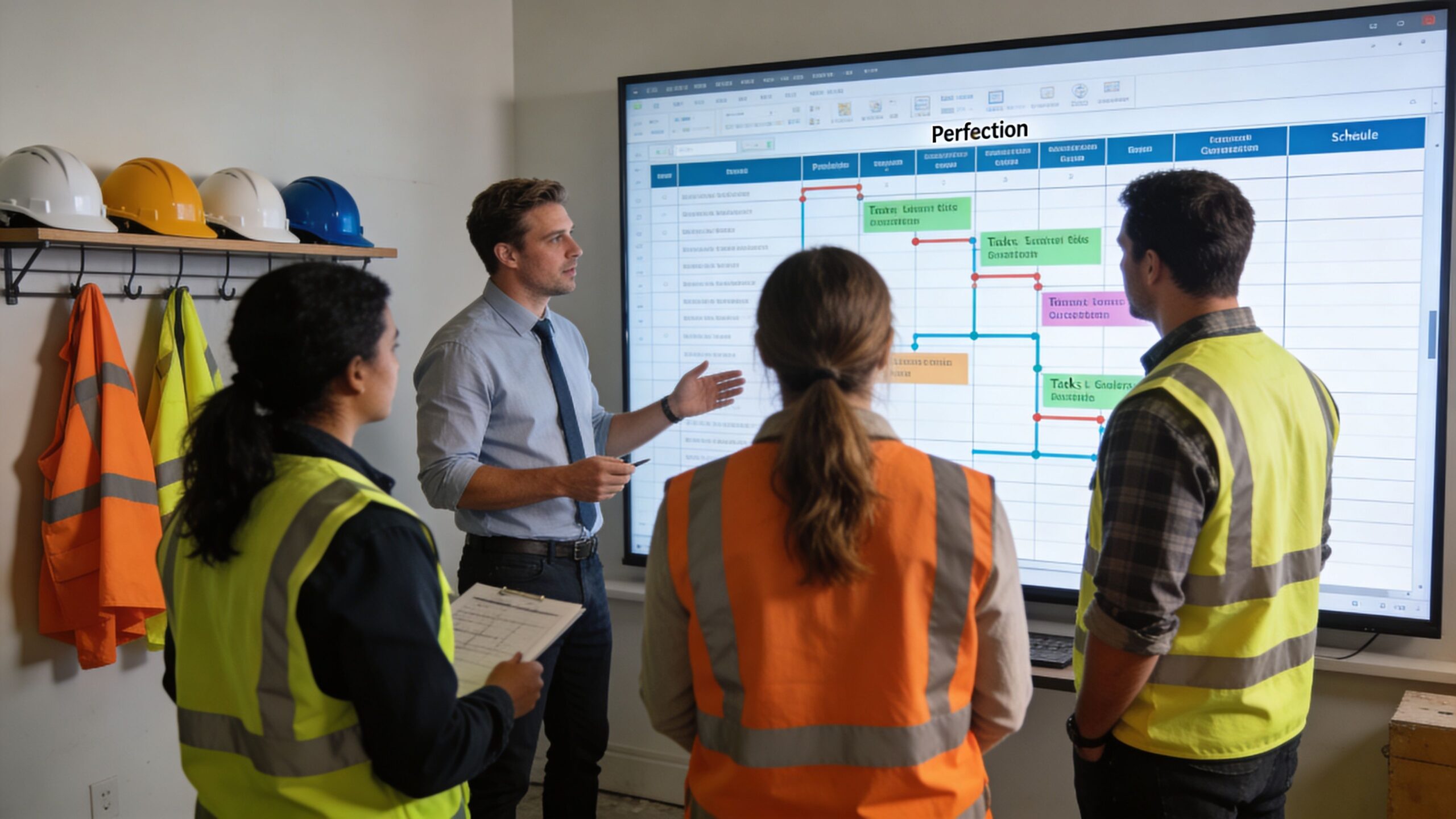
What a clean mobilization looks like
Good onboarding starts before field production. The PM, superintendent, safety lead, and subcontractor foreman should walk the job together where practical. That walk should cover access, laydown, traffic exposure, utility conflict zones, restoration sensitivities, and any customer-facing risks.
Then hold a kickoff that does more than review the schedule. It should lock down:
- Key contacts: who approves field decisions, who handles permits, who receives daily reports
- Safety expectations: emergency procedures, escalation paths, and site-specific hazards
- Documentation rules: photo standards, redlines, production logs, and test file naming
- Material control: who receives, stores, and signs off on critical material
When teams skip this, the field creates its own system. That system is rarely a good one.
The first week sets the tone
The first week tells you whether the subcontractor understood the assignment or just accepted the PO.
I want to see supervisors asking clarifying questions early, not improvising unilaterally. I want to see daily reporting start immediately. I want to know the crew understands not only what to build, but how the owner wants it documented and handed over.
A short visual briefing often helps reinforce that discipline:
Chaos leaves fingerprints
Poor onboarding leaves a predictable trail. Missing access badges. Material staged in the wrong place. Safety forms completed after work begins. Crews calling the wrong person for a field change. Redlines that start late and never catch up.
The cure isn’t more meetings. It’s a tighter mobilization package and a kickoff process that treats telecom work like the specialized infrastructure job it is.
Managing Performance Quality and Documentation in Real Time
Once crews are active, management has to move from planning to rhythm. At this point, many telecom projects drift. People assume the subcontractor knows what “good” looks like, but nobody checks consistently enough to prove it.
Daily control matters more than occasional intervention. If your field leadership only reacts when something goes wrong, you’re managing damage, not performance.
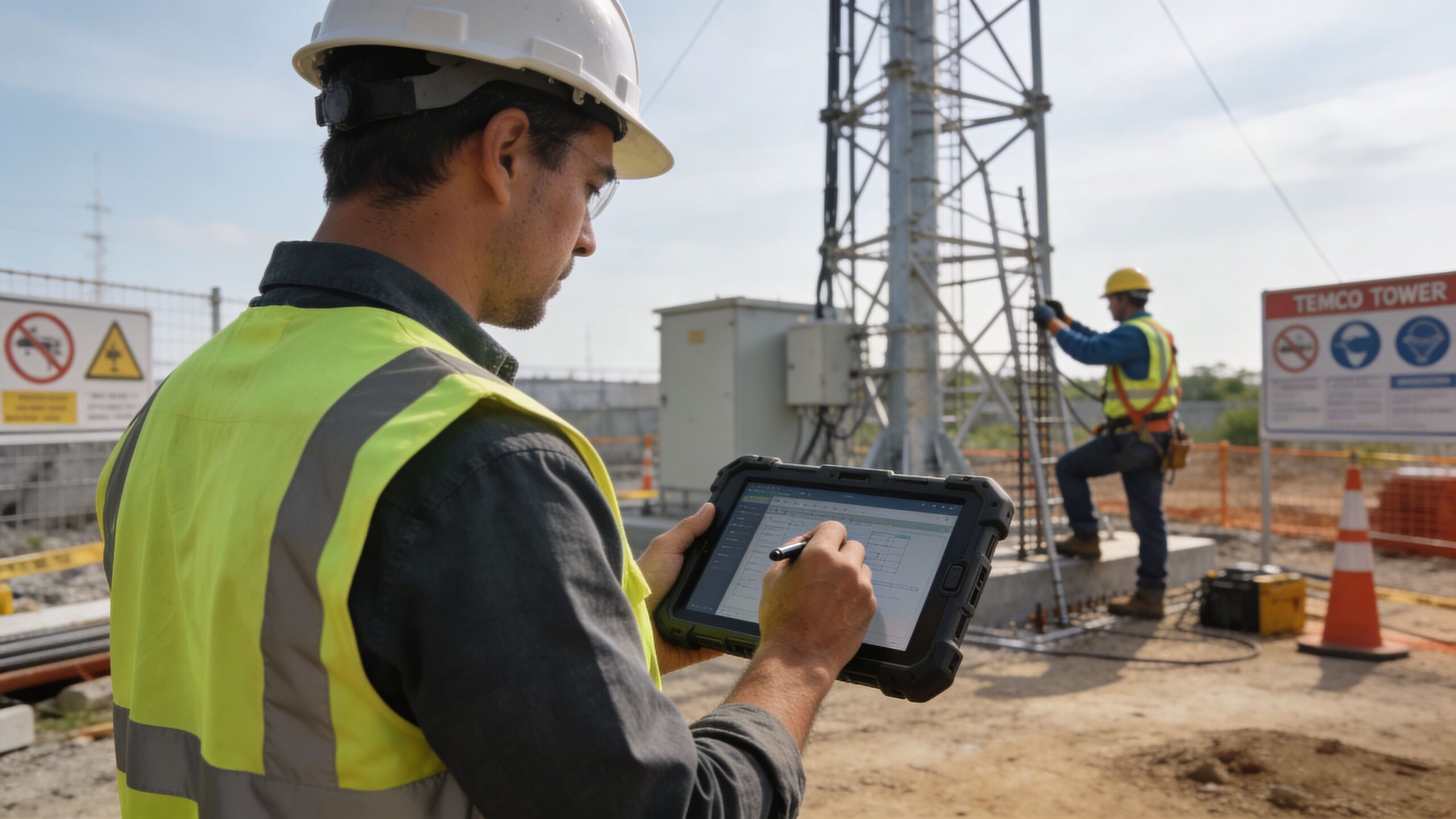
Build a repeatable field cadence
For active construction sub contractors, a simple operating rhythm works better than an overbuilt reporting system nobody follows.
Use three layers of control:
- Daily huddle: confirm plan of day, crew count, access issues, safety concerns, inspection needs, and blockers
- Weekly review: compare installed work to schedule, review open RFIs or changes, and verify documentation status
- Milestone inspection: stop and verify critical deliverables before the next phase hides the work
In telecom, milestone checks often matter more than broad progress percentages. A conduit run that can’t be documented properly, a splice enclosure closed without complete records, or a wireless install missing final photo standards can create rework long after the crew has moved on.
QA and as-builts need field ownership
Quality control gets weak when teams treat it as office cleanup. It isn’t. It belongs in the field, in real time.
For fiber builds, that means checking route alignment, installation condition, handhole condition, restoration quality, and whether redlines reflect actual field deviations as they happen. For wireless work, verify mount details, cable dressing, grounding, labeling, and closeout photos while the crew still has access. For data center jobs, confirm labeling, pathway cleanliness, rack-level organization, and turnover records before the next trade obscures the work.
A lot of teams improve consistency when they standardize their process documents instead of relying on memory. If your foremen and PMs need a cleaner way to align instructions and field handoffs, this guide on how to improve team alignment with process guides is a useful model for documenting repeatable workflows.
Documentation delayed is usually documentation degraded. Field notes written from memory at the end of the week don’t protect schedule or billing.
Watch for the small signs
Most quality problems announce themselves without fanfare.
Look for these early signals:
- Reporting drift: daily reports get shorter, vaguer, or arrive late
- Redline lag: route changes happen in the field but never make it into marked drawings
- Supervisor dependency: one strong foreman is carrying all coordination while others are guessing
- Punch-list repetition: the same corrections show up across multiple sites or segments
A subcontractor doesn’t need to be perfect. They need to be manageable, transparent, and coachable. If they respond quickly, document accurately, and fix defects the first time they’re called out, you can keep production moving. If they hide field variance, quality problems compound.
Navigating Payments Milestones and Project Closeout
A lot of owners and prime contractors still treat payment terms as a lever to protect themselves. In practice, blunt payment structures often damage the job.
Subcontractors finance a large part of field execution. They staff crews, buy material, and carry payroll while waiting to bill and collect. In construction, the median Days Sales Outstanding reached 90 days in 2019, and in 2022 only 15 percent of construction businesses reported always being paid in full, according to Levelset’s construction payment statistics. If you want reliable production, you can’t ignore that pressure.
Better payment terms create better field behavior
Prompt, milestone-based payment is not generosity. It’s project control.
When subcontractors know exactly what triggers billing, what backup is required, and how quickly approved invoices move, they can plan labor and material more reliably. That reduces the chance of crew interruptions, rushed documentation, or arguments about percent complete.
For telecom work, tie billing to objective milestones such as accepted route segments, approved testing packages, completed site upgrades, or accepted closeout bundles. Don’t tie payment to vague language like “substantially complete” if the project depends on redlines, as-builts, test results, lien waivers, or restoration signoff.
Closeout should start before the last day
If you wait until the end to ask for turnover documents, you’ve waited too long.
Closeout runs smoother when the team collects required items throughout the job:
- As-builts and redlines: updated continuously, not recreated at the end
- Invoice support: clear schedule of values, backup, and approved change documentation
- Waivers and warranties: gathered in sequence so final payment doesn’t stall
- Insurance and compliance records: current through project completion
Insurance is part of closeout discipline too, especially when active projects shift scope or duration. Teams often use telecom contractor insurance checklists to verify they haven’t missed a requirement that could hold up final acceptance.
Disputes get smaller when the rules are clear
Disputes happen. The key is keeping them narrow.
Use written notice requirements, documented field directives, and a clear approval path for changes. If you work across jurisdictions, payment rules can vary significantly. For teams dealing with Australian projects, a practical overview of understanding NSW payment legislation is a good example of how statutory payment frameworks shape billing and dispute timing.
Pay slowly and you don’t just strain the subcontractor. You increase the odds of turnover delays, documentation gaps, and unstable staffing on the next phase.
Frequently Asked Questions About Subcontractor Management
Should you allow subcontractors to use lower-tier subs
Only with written approval and full visibility.
In telecom, hidden lower-tiering creates risk fast because the crew that shows up may not be the company you qualified. Require disclosure of all lower-tier participants, their scope, insurance compliance, and who supervises them. If the work involves specialized splicing, tower climbing, testing, or active-site data center tasks, don’t allow substitution without a formal review.
What’s the best way to handle scope changes in the field
Document first, argue later.
If field conditions change, issue written direction that captures what changed, why it changed, who authorized temporary action, and what pricing is pending. Keep crews moving only when the change is necessary for safety, schedule protection, or site preservation. Then convert that field direction into a formal change order quickly. Verbal change approval is where margin and accountability disappear.
How detailed should telecom as-builts be
Detailed enough that another team can operate, maintain, or troubleshoot the asset without calling the original foreman.
That means field deviations, route changes, handhole or equipment identifiers, labeling consistency, and any information needed for turnover and future maintenance. If the project owner has a format standard, enforce it from the first week rather than trying to reformat everything at closeout.
When should you remove a subcontractor from a project
Act when the pattern is clear, not just when the frustration is high.
Warning signs include repeated safety misses, chronic documentation failures, inability to staff the work, hidden lower-tiering, or recurring quality defects after correction. One bad day can be fixed. A repeated pattern usually gets more expensive the longer you tolerate it.
Should retainage be used aggressively
Use it carefully.
Retainage can protect final performance, but if it becomes the primary management tool, something upstream is already weak. Better results usually come from clear milestones, fast punch-list closeout, and objective acceptance criteria. Retainage should reinforce discipline, not replace management.
From Liability to Asset Your Subcontractor Strategy
The best telecom builders don’t treat subcontractors as interchangeable labor sources. They treat them as controlled extensions of the delivery team.
That shift changes how projects run. Qualification gets tighter. Scopes get sharper. Onboarding becomes deliberate. Field management focuses on quality, communication, and documentation while the work is happening. Payment and closeout support stable performance instead of creating avoidable friction.
Construction sub contractors can either magnify risk or increase delivery capacity. The difference comes down to how you choose them, how clearly you define the work, and how consistently you manage the details that matter in fiber, wireless, and data center environments.
Telecom work rewards discipline. Not just technical discipline, but operational discipline. If your subcontractor strategy is built around that reality, you’ll see fewer surprises in the field and cleaner handoffs at the end.
If you need a telecom infrastructure partner that understands what qualified crews, tight scopes, field documentation, and accountable execution look like, Southern Tier Resources is worth a look. They support wireline, wireless, and data center projects with the kind of end-to-end operational discipline that helps carriers, ISPs, and network operators keep builds moving.