Fiber optic network design is the meticulous process of planning and engineering the physical and logical blueprint for a fiber-based communication system. It’s the critical first step that dictates the success, reliability, and future scalability of everything from a local ISP's network to a massive hyperscale data center.
The Blueprint for Digital Infrastructure
Think of fiber optic network design like creating the master plan for a city's highway system. Before a single shovel hits the dirt, engineers have to map out the most efficient routes, anticipate future traffic growth, and design every interchange for peak performance. A rushed or sloppy plan leads to bottlenecks, costly rebuilds, and angry commuters—the exact same principles apply to data networks.
Without a solid design, a fiber project is doomed to suffer from budget overruns, operational headaches, and an inability to handle future demand. This is the stage where high-level goals—like bringing gigabit speeds to a new community or upgrading a data center backbone—get translated into precise, actionable engineering plans. It turns an idea into a resilient, scalable asset.
Core Phases of a Successful Fiber Project
Any successful fiber deployment follows a structured lifecycle. This isn't about adding bureaucracy; it's about making sure nothing gets missed and that every piece of the puzzle fits together perfectly to deliver a network that's built to last.
The key phases typically look something like this:
- Initial Concept and Strategic Planning: This is where it all starts. You define the project’s goals, scope, the specific service areas you're targeting, and the capacity you'll need on day one and beyond.
- Detailed Engineering and Design: Here, you get into the nitty-gritty of selecting network architectures, plotting the exact cable routes, and creating the construction-ready documents.
- Deployment and Construction: Time to get your hands dirty. This is the physical installation of conduits, cables, and hardware out in the field.
- Testing and Validation: Once built, you have to prove it works as designed. This involves certifying that the network meets all performance specs, like signal loss (loss budget) and bandwidth.
- Documentation and As-Builts: Creating the final, accurate maps and records of what was actually built. This is non-negotiable for future maintenance, troubleshooting, and operations.
Getting this process right is more important than ever. The global optical fiber connectivity market, valued at USD 3.6 billion in 2025, is on a trajectory to hit an incredible USD 8.8 billion by 2035. That explosive growth is driven by the relentless demand for more data from telecom carriers, ISPs, and data centers. You can read the full research on this market's impressive 9.3% projected CAGR.
A well-designed network is an inherently more secure and reliable one. When you anticipate potential points of failure and build in redundancies from the very beginning, you create an infrastructure that can withstand outages and adapt to new threats without disrupting service.
Ultimately, great fiber optic network design is about more than just connecting Point A to Point B. It’s about building a future-proof foundation that can support economic growth and whatever technological advancements come next. To ensure your digital infrastructure is truly robust from day one, it’s smart to integrate principles from a secure system development life cycle. This approach weaves security into every phase of the project, from the first sketch to the final splice.
Choosing the Right Network Architecture
Every great fiber network starts with a foundational choice: its architecture. Think of it like deciding whether to build a private highway, a shared express bus system, or a city-wide beltway. Each solves a different problem, and the path you choose will define your network's performance, cost, and future scalability.
Getting this right means understanding the core models—Point-to-Point (P2P), Passive Optical Network (PON), and Ring topologies. Your decision really boils down to the specific goals of your project. Are you connecting a handful of high-demand enterprise clients, or are you lighting up an entire residential community? The answer dictates the architecture.
The decision-making process for any fiber project follows a logical sequence, from high-level planning all the way through to completion.
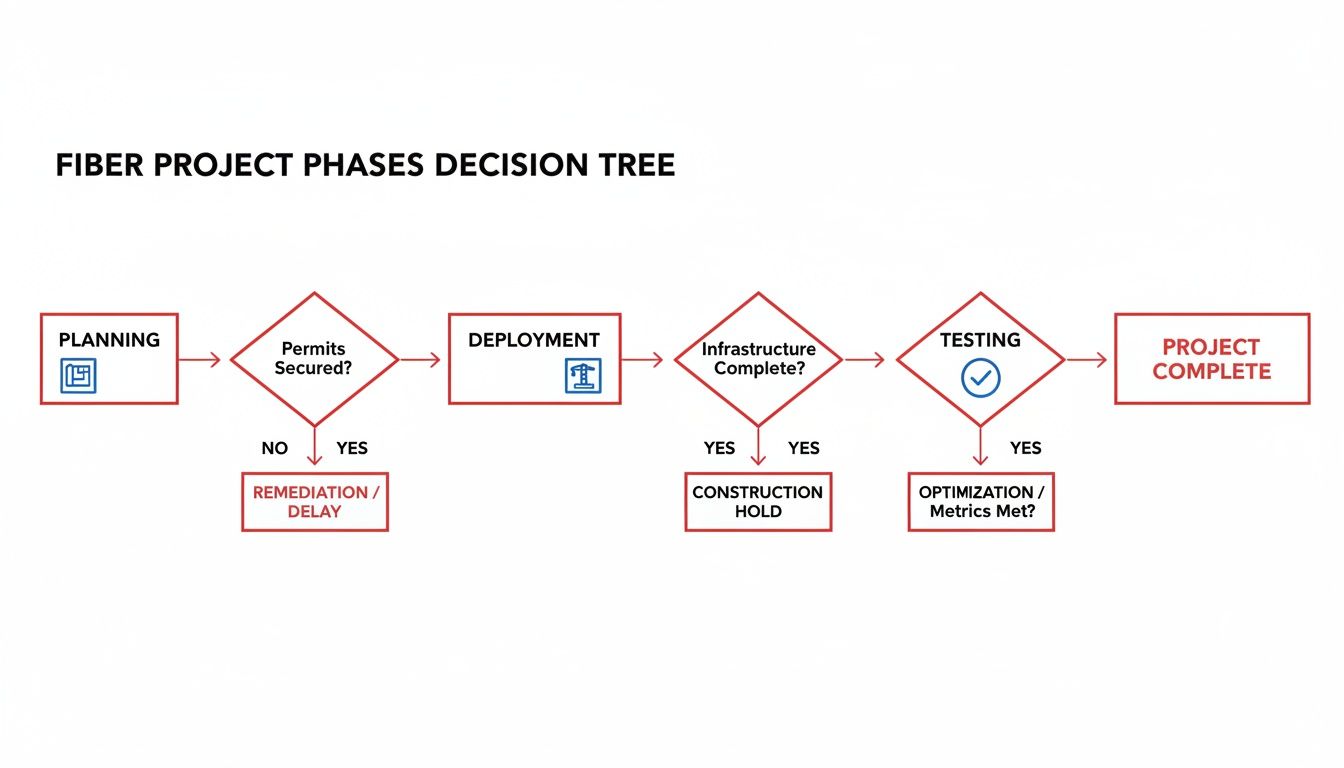
As you can see, each phase builds on the last. A solid plan from the start is what separates a successful, reliable deployment from a problematic one.
Comparing Core Fiber Network Topologies
To help you decide, this table breaks down the key characteristics of P2P, PON, and Ring architectures. Think of it as a cheat sheet for guiding your initial design choice based on what you’re trying to achieve.
| Topology | Best For | Key Advantage | Key Disadvantage | Typical Application |
|---|---|---|---|---|
| Point-to-Point (P2P) | Guaranteed bandwidth and maximum security | Dedicated, uncontended connection per user | High cost (fiber count, port density) | Data center interconnects, enterprise SLAs, cell backhaul |
| Passive Optical Network (PON) | High-density residential deployments (FTTH) | Cost-effective due to shared infrastructure | Bandwidth is shared among multiple users | Residential broadband, business parks, MDU buildings |
| Ring | Mission-critical services requiring high uptime | Automatic redundancy and "self-healing" paths | More complex to design and implement initially | Metro backbones, municipal networks, carrier transport |
Ultimately, the right choice aligns your technical needs with your business case. P2P is about raw performance, PON is about cost-effective scale, and Rings are all about resilience.
Point-to-Point (P2P): The Dedicated Highway
A Point-to-Point (P2P) architecture is exactly what it sounds like: a dedicated, unshared fiber strand running directly from your central hub to each end-user. It's the equivalent of giving every home or business its own private, multi-lane highway straight to the internet. No traffic jams, no sharing lanes—just guaranteed, symmetrical bandwidth and ironclad security.
This is the gold standard for any application where performance and reliability are non-negotiable. We see it used most often for:
- Data Center Interconnects: Linking facilities that need to move massive amounts of data without a single hiccup.
- Enterprise Clients: Serving businesses that have strict Service Level Agreements (SLAs) for speed and uptime.
- Wireless Backhaul: Providing the dedicated fiber links to cell towers that are absolutely critical for 5G performance.
Of course, that unparalleled performance comes at a price. The main drawback of P2P is cost. It demands significantly more fiber and port capacity at the central office, making it a tough business case for widespread residential rollouts. For more on the nuts and bolts, you might find our resources on network cabling infrastructures useful.
Passive Optical Network (PON): The Shared Express Lane
On the other end of the spectrum is the Passive Optical Network (PON), which relies on a shared-fiber model. This is more like an efficient bus rapid transit system. A single fiber leaves the central hub and is split using simple, unpowered optical splitters to serve multiple subscribers—typically anywhere from 16 to 128 per fiber.
This shared approach is a game-changer for cost. It dramatically cuts down on the amount of fiber and active equipment needed, which is why PON has become the go-to solution for most Fiber-to-the-Home (FTTH) deployments.
By using optical splitters, a PON architecture pushes the active electronics out of the field and back to the central office. This doesn't just lower the initial build cost; it also slashes ongoing operational expenses for power and maintenance.
This inherent efficiency is precisely why PON dominates the residential broadband market. It's the most practical way to deliver gigabit speeds to an entire neighborhood without the prohibitive cost of a dedicated P2P connection to every single home.
Ring Topologies: The Resilient Beltway
Finally, a Ring topology connects network nodes in a continuous loop, creating two distinct paths for data to travel between any two points. Its superpower is automatic redundancy. If a backhoe accidentally severs a fiber cable somewhere on the ring, traffic is instantly and automatically rerouted in the opposite direction, usually so fast that no one notices a service interruption.
This "self-healing" capability makes ring architectures perfect for mission-critical networks where downtime is simply not an option. You’ll find them used frequently for:
- Metropolitan or regional backbones that connect multiple central offices or data centers.
- Municipal networks serving critical infrastructure like traffic signals, water treatment plants, and emergency services.
- Carrier-grade networks that demand extreme fault tolerance to meet their own SLAs.
The engine behind these high-capacity, long-distance architectures is almost always single-mode optical fiber. Its global market stood at USD 3.02 billion in 2017 and is forecasted to reach USD 6.81 billion by 2025. This impressive 10.8% compound annual growth rate is fueled by its crucial role in everything from 5G backhaul to the massive FTTH deployments we see today.
A brilliant fiber network design on paper is one thing. Turning that blueprint into a real-world, buildable plan is where the real work begins. This is the stage where many projects get bogged down by costly delays, because it's all about navigating the messy reality of the physical world—a landscape full of hidden obstacles, regulatory red tape, and logistical puzzles.
Getting this right means forgetting about the shortest path. The straight line from Point A to Point B almost never works. That "direct" route might cut through protected wetlands, hit a solid rock shelf just beneath the surface, or require months of painful negotiations to get property access. This is why meticulous fieldwork is the bedrock of any successful deployment.
Conducting Comprehensive Site Surveys
Before you even think about digging a trench, a thorough site survey is non-negotiable. It's the project's reconnaissance mission. Survey teams physically walk or drive every foot of the proposed route, gathering on-the-ground intelligence that CAD drawings and satellite maps will always miss.
The main goals here are pretty straightforward:
- Identify Existing Utilities: You have to know where every gas line, water main, and existing telecom cable is buried. Hitting one isn't just expensive; it's incredibly dangerous.
- Assess Right-of-Way (ROW): Who owns the land? Is it private property, a city easement, or federal land? Figuring this out tells you exactly who you need to talk to for permission.
- Evaluate Environmental Factors: A surveyor's eye will catch potential showstoppers like river crossings, protected wildlife habitats, or historical sites that can bog a project down in permitting for years.
This upfront diligence isn't an expense; it's an investment. Finding just one of these issues after construction starts can throw your schedule and budget completely off the rails.
A classic rookie mistake is underestimating how much time right-of-way and permitting will take. Seasoned pros know that building good relationships with local agencies and property owners early on is just as critical as the engineering itself.
The Two Paths: Aerial vs. Underground
Once you’ve vetted the route, you have to decide how the fiber will be physically installed. It usually boils down to two options: stringing it on existing utility poles (aerial) or burying it in conduit (underground).
Make-Ready for Aerial Builds
When you go aerial, the process of getting utility poles ready for your cable is called make-ready engineering. It's not as simple as just hanging a new line. Engineers have to perform a pole loading analysis to make absolutely sure each pole can handle the added weight and wind stress without failing. If a pole is already overloaded or just too old, it has to be replaced.
On top of the physical work, securing the legal attachment rights from the pole owner—usually the local power or phone company—is a bureaucratic process that can move at a glacial pace.
Complexities of Underground Construction
Burying your fiber offers fantastic protection from storms and accidental damage, but it introduces a whole different set of challenges. Traditional trenching gets the job done but tears everything up in the process. For sensitive areas, a much better option is horizontal directional drilling (HDD), or boring. This technique lets crews install conduit deep under roads, rivers, and other obstacles without digging an open trench.
Choosing between trenching and boring comes down to the local geology, how much surface disruption is acceptable, and of course, the budget. Expertly planned and executed fiber network services are what keep these logistical hurdles from becoming project-killing roadblocks. Ultimately, mastering these pre-construction steps is how a great design becomes a real, high-performance network.
Building and Splicing a High-Performance Network
Once the detailed plans are finalized and the path is cleared, the real work begins. This is where engineering diagrams become tangible, light-speed infrastructure. The quality of execution in the field—the physical construction—is what ultimately determines if your network will live up to its performance potential.
The two main approaches, aerial and underground installation, each have their own rulebook for getting it right.
Aerial builds mean stringing fiber cable along existing utility poles. It’s often faster and cheaper than digging, but it demands a delicate touch. Technicians have to maintain exact tension levels; too loose and the cable sags, too tight and you risk stressing the fragile glass fibers inside, especially over long distances.
Underground construction, on the other hand, gives the cable a much safer home, protecting it from weather and accidental damage. You can go the traditional route with open trenching or use less disruptive methods like directional boring. No matter how you get it in the ground, the crew absolutely must respect the cable's bend radius. Bending it too sharply creates micro-fractures in the glass, which leads to signal loss and a slow degradation of network performance.
The Art and Science of Fiber Splicing
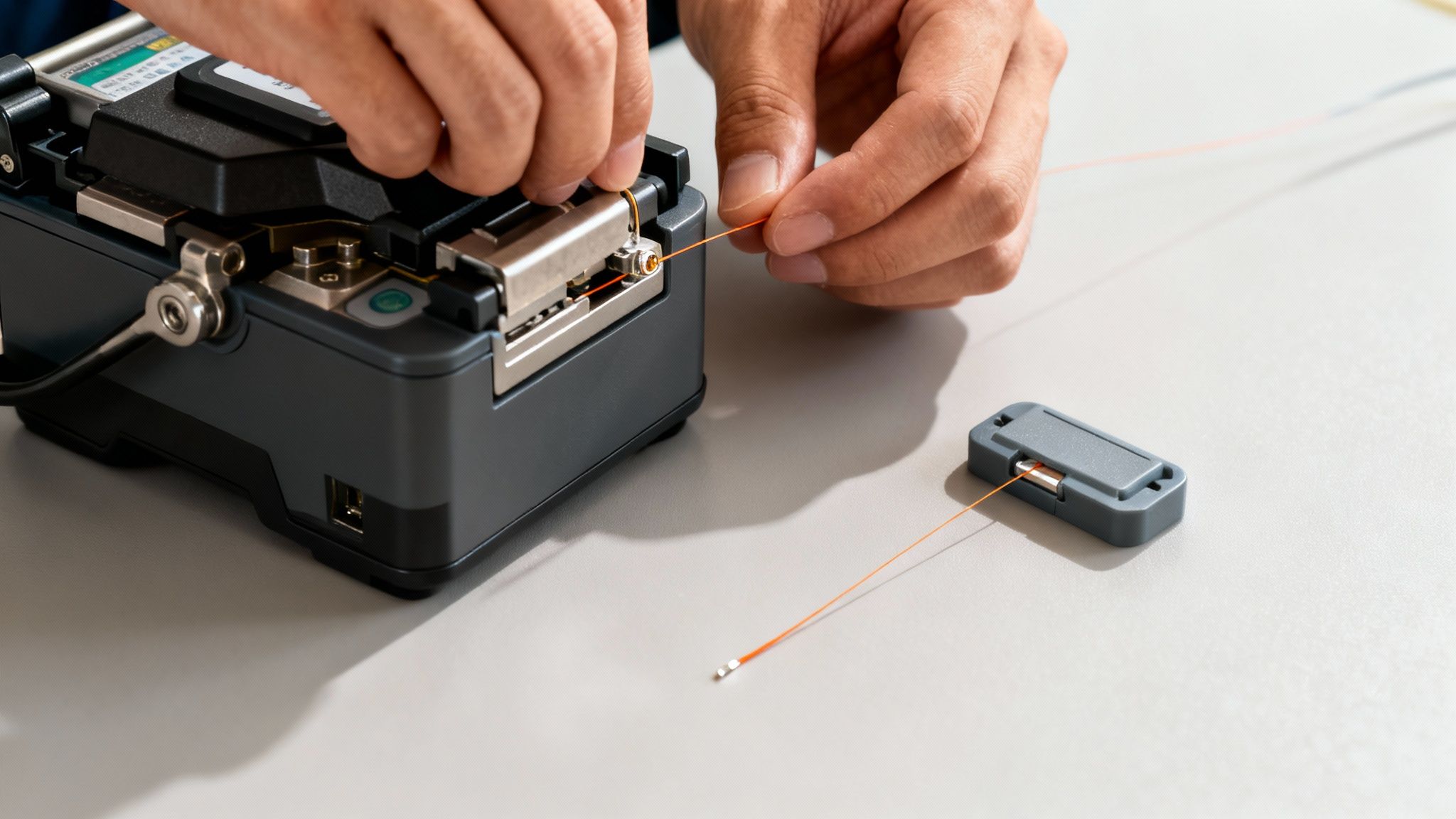
The single most critical step in the entire build is fiber splicing—the process of permanently joining two fiber optic cables. You can think of it as microscopic surgery. A single strand of glass fiber is thinner than a human hair, and a bad splice acts like a bottleneck, creating enough signal loss to cripple an entire section of the network.
There are two ways to do it, but only one is the professional standard for new builds.
- Fusion Splicing: This is the gold standard for a reason. A specialized machine called a fusion splicer perfectly aligns the two fiber ends, then uses a precise electric arc to melt them together. The result is a nearly seamless connection with almost no signal loss (typically less than 0.05 dB).
- Mechanical Splicing: This technique uses a small alignment device and an index-matching gel to hold the fibers together. It’s much faster and the equipment is cheaper, but the splices have higher signal loss and just aren't as reliable long-term. You'll typically see these used for quick, temporary repairs, not for building a permanent network.
For a deeper look into the nitty-gritty of the process, you can learn more about how to splice fiber optic cable in our dedicated guide.
Installing Essential Network Hardware
It’s not just about the cable. Properly installing the passive hardware is just as vital for building a network that lasts. This means correctly deploying splice closures, cabinets, and termination panels that protect all those delicate connections and give you clean access points for future work.
- Splice Closures: These are the environmentally sealed cases that shield splices from moisture, dirt, and physical damage. A poorly sealed closure is a time bomb; once water gets in, it will slowly degrade the splices and cause network failures down the road.
- Cabinets and Panels: These are the hubs where large fiber counts are organized and terminated. Meticulous cable management is non-negotiable here. A "spaghetti mess" isn't just unprofessional—it turns future troubleshooting or upgrades into an absolute nightmare.
Quality craftsmanship is everything. An experienced splicing technician can perform hundreds of perfect splices a day, ensuring the network is built not just for speed, but for decades of reliability. A single bad splice can compromise an entire circuit.
The demand for this level of precision is exploding. The fiber optics market is projected to swell from USD 10.76 billion in 2025 to USD 17.95 billion by 2033. This surge is overwhelmingly driven by telecom operators racing to replace their old copper lines to support 5G, cloud services, and our insatiable demand for data. You can see more on these market dynamics from Grand View Research. This massive investment shows exactly why getting the physical build right from the very first splice is so critical for long-term success.
Testing and Documenting for Long-Term Success
A newly built fiber network is just a collection of glass and plastic until you can prove it works. This is where testing and documentation come in. This final phase isn't just about ticking boxes; it's the quality-control step that turns a construction project into a reliable, long-term asset ready for decades of service.
Think of it as the network's final exam. It’s how you verify that every splice is solid, every connection is clean, and the entire system meets the strict performance targets established in the design. Without this validation, you're essentially flying blind, hoping that minor installation flaws don't turn into major service outages down the road.
Validating Performance with Precision Testing
Certifying a new fiber network really boils down to two essential types of tests. Each gives you a different—but equally critical—piece of the performance puzzle.
-
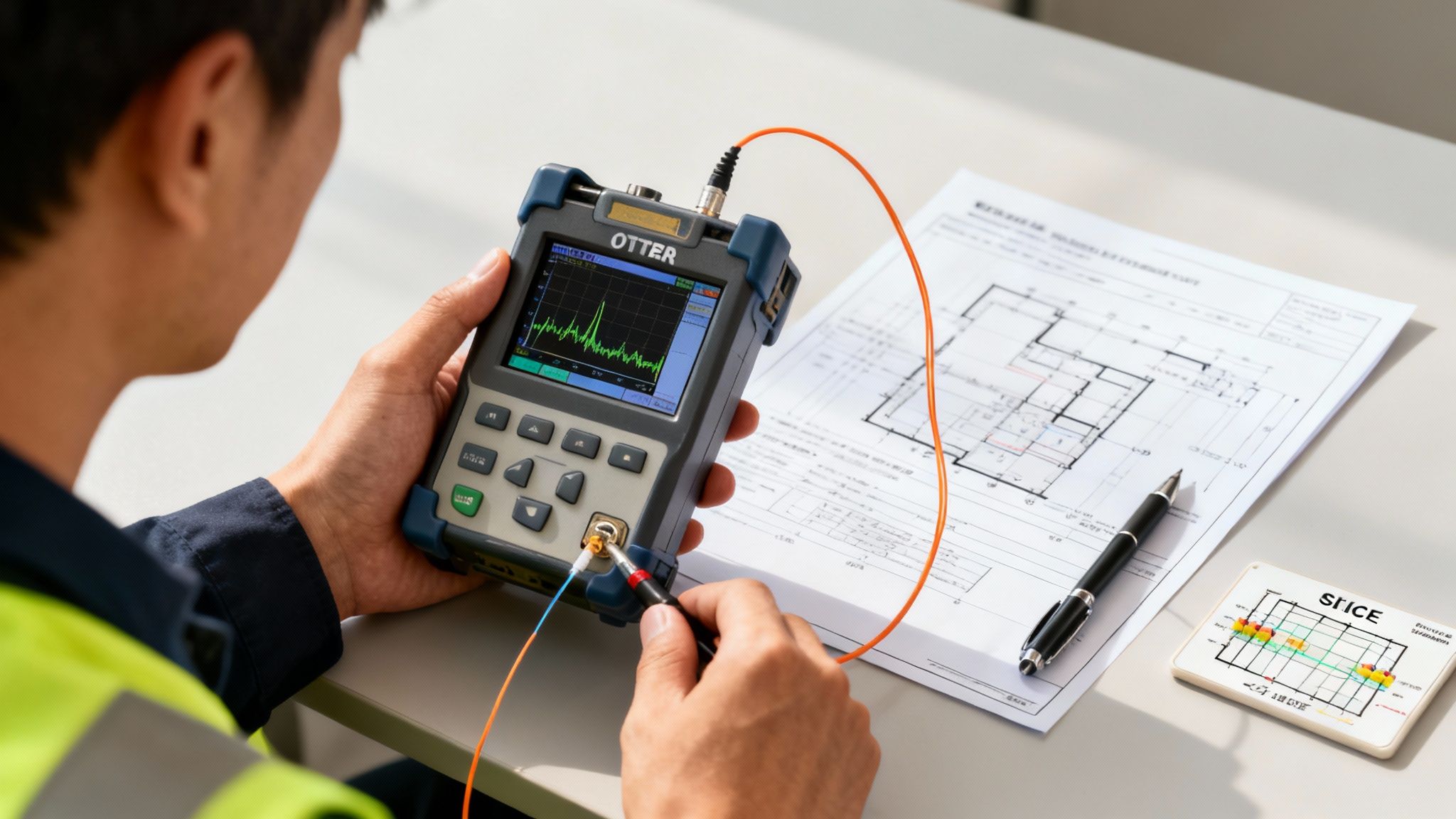
OTDR Testing: An Optical Time-Domain Reflectometer (OTDR) is like a sophisticated radar for fiber optic cable. It shoots a high-powered pulse of light down a strand and then measures the timing and strength of the light that reflects back. This creates a "trace," or a signature, that lets a technician see everything along that fiber's path—pinpointing the exact location of splices, connectors, and even stressful bends. It’s an indispensable tool for quality control and future troubleshooting.
-
Optical Loss Testing: This is a more direct measurement. Using a light source on one end and a power meter on the other, this test quantifies the total amount of signal loss (attenuation) across an entire link. The result is then checked against the "loss budget"—the maximum acceptable signal degradation calculated during the design phase. Passing this test confirms the link can carry data from point A to point B without a problem.
Key Takeaway: Passing both OTDR and loss budget tests is non-negotiable. It's the definitive proof that the physical network was built to spec and is ready for live traffic.
To understand how these methods fit into the big picture, here’s a quick breakdown of the essential tests you'll encounter.
Table: Essential Fiber Optic Testing Methods
| Test Method | Primary Purpose | What It Measures or Identifies | When It Is Used |
|---|---|---|---|
| OTDR Testing | Quality control & fault location | Distance to events (splices, connectors, bends), loss of individual events, reflectance. | After construction, for final certification, and during troubleshooting to find faults. |
| Optical Loss Testing | End-to-end performance validation | Total signal loss (insertion loss) across an entire fiber link. | For final acceptance testing to ensure the link meets its design loss budget. |
| Visual Fault Locator (VFL) | Basic continuity check & fault finding | Uses a bright red laser to visibly identify breaks, sharp bends, or bad connectors in patch cords or near-field. | During initial installation, patch panel work, and quick troubleshooting checks. |
| Fiber Inspection Scope | Connector cleanliness verification | Provides a magnified view of connector end-faces to identify dirt, debris, or scratches. | Before every single connection is made to prevent contamination and damage. |
These tests work together to paint a complete picture of the network's health, ensuring every component is performing exactly as intended before a single customer is connected.
The Power of As-Built Documentation
Once the network is tested, certified, and lit up, there’s one last crucial step: creating the as-built documentation. These aren't the original design blueprints. They are the final, definitive records of what was actually built in the field, reflecting every small change and real-world adjustment.
Think of as-builts as the network's official owner's manual. They capture every detail with geographic precision, including:
- The exact GPS coordinates of splice closures and loss measurements for each splice.
- The final, true cable routes, including the burial depth of underground conduit.
- Specific hardware details, from cabinet model numbers to slack loop locations.
- A complete record of all certification test results for every single fiber.
This documentation is priceless. Three years from now, when a backhoe accidentally cuts a cable, the as-builts will tell the repair crew exactly where to dig and which fibers need attention. When you’re ready to expand, these documents provide the baseline data for the new design. Without them, every maintenance task becomes a slow, expensive exercise in guesswork.
Having a solid process for mastering documentation workflow management ensures this critical information remains accessible, up-to-date, and useful for the entire life of the network. Ultimately, rigorous testing and documentation are what transform your fiber network from a construction project into a fully manageable, high-performance asset.
Designing a Network That’s Built to Last
When you're designing a fiber optic network, it’s easy to get tunnel vision and focus only on today's needs. But a truly successful design has one eye fixed firmly on the horizon. It anticipates the exponential data growth we know is coming and bakes in the capacity to handle it right from the start.
This isn't about extravagance. It's about smart, calculated decisions that prevent incredibly disruptive—and expensive—retrofits down the road. After all, the lion's share of a fiber project's cost isn't the glass strands themselves. It's the immense effort of digging trenches, boring under roads, and rolling fleets of bucket trucks. You only want to pay for that once.
Understanding the Real Cost Drivers
To plan a network that stands the test of time, you first have to grasp where the money actually goes. The major expenses in a typical fiber deployment might surprise you.
- Labor: Without a doubt, the single biggest line item is often the skilled labor required for construction, splicing, and testing. These are highly trained professionals, and their time is valuable.
- Civil and Make-Ready Work: This is the heavy lifting. It covers everything from trenching and directional boring for underground builds to negotiating pole attachment agreements and even replacing old poles for aerial routes.
- Permitting and Right-of-Way (ROW): Getting permission to build is a project in itself. Navigating the complex web of local, state, and sometimes federal approvals requires time, patience, and often specialized legal and environmental expertise.
- Materials: Of course, the materials cost money. But beyond the fiber optic cable, you have to account for conduit, splice closures, cabinets, handholes, and all the other physical hardware that makes up the network.
When you realize that civil work and labor dominate the budget, it completely changes how you should think about network capacity. The incremental cost of adding more fiber during the initial build is almost negligible compared to the astronomical cost of coming back to do it later.
Weaving in Scalability from Day One
Building for the future means embedding scalability directly into the core of your network design. This often involves a bit of strategic overbuilding—installing more infrastructure today than you currently need to gracefully accommodate the demands of tomorrow. This isn't wasteful; it's one of the smartest investments you can make.
"The fastest way from Point A to Point B is a straight line, right? That is not always the case with fiber networks. When our team plots a route, we look for landscape features and habitats that may pose permitting obstacles."
This insight from the field is a perfect example of long-term thinking. Just as you'd plan a route to avoid future permitting headaches, you should plan your physical infrastructure to avoid future capacity bottlenecks.
Here are a few of the most effective strategies for building a future-ready network:
- Install Dark Fiber: Laying extra, unlit fiber strands (dark fiber) during initial construction is incredibly cheap but offers massive future potential. You can light these strands up later to expand your own services or even lease them to other carriers, opening up entirely new revenue streams.
- Use Higher-Count Cables: The price difference between a 144-count and a 288-count fiber cable is a drop in the bucket compared to the overall cost of installation. Always opting for higher counts is cheap insurance against running out of capacity as your network grows.
- Deploy Multi-Conduit Infrastructure: This is a game-changer. By installing a duct system with several empty inner conduits, you create a future-proof highway. Years from now, you can simply pull or jet new fiber cables through the existing pathway without a single shovel hitting the ground.
Answering Common Fiber Optic Network Design Questions
Even with a solid plan, every fiber project has its share of head-scratchers. Getting past these hurdles often comes down to having clear answers for the common technical and logistical problems that pop up. Here are a few of the questions we see time and time again.
Single-Mode vs. Multi-Mode Fiber: Which One Do I Need?
This is one of the first decisions you'll make, and it really comes down to how light travels through the glass. The key difference between single-mode and multi-mode fiber is the size of the core.
Think of single-mode fiber as a precision laser beam. Its tiny core (just 9 microns) forces light down a single, straight path. This keeps the signal incredibly clean over massive distances, which is why it’s the standard for long-haul networks, metro rings, and connecting cities.
Multi-mode fiber has a much beefier core (either 50 or 62.5 microns), allowing light to bounce around in multiple paths as it travels. All that bouncing around creates signal distortion (called modal dispersion), limiting its effective range to a few hundred meters. It’s a great, cost-effective choice for short runs, like connecting servers inside a data center or wiring up a single campus building.
How Do I Calculate a Fiber Loss Budget?
A loss budget is a critical calculation in any design. It's essentially the total amount of signal degradation, or loss, that a fiber link can handle before the equipment at the other end can't make sense of the data.
To figure it out, you have to add up every potential point of signal loss along the path. It's an accounting exercise for light.
- Cable Attenuation: Every kilometer of fiber has a tiny, predictable amount of signal loss.
- Splice Loss: Each point where two fibers are fused together introduces a minuscule loss.
- Connector Loss: Every connection point, like at a patch panel, adds a bit more loss to the total.
The goal is simple: your total calculated loss has to be lower than the power budget of your transceivers. This confirms the signal arriving at the receiver will be strong enough to be understood, ensuring a reliable connection.
What Really Causes Project Delays?
While everyone focuses on the technical details, the real timeline-killers are almost always the logistical hurdles you face before a single foot of fiber is laid. From what we've seen in the field, the biggest delays nearly always come from pre-construction headaches.
These are the usual suspects:
- Right-of-Way (ROW) and Permitting: This is the big one. Underestimating how long it takes to get legal access to property and secure permits from dozens of different agencies is the most common pitfall. You have to start these conversations early.
- Make-Ready Engineering: If you're building an aerial network, you're at the mercy of the pole owners. Waiting for them to survey their infrastructure and make necessary upgrades can stall a project for months.
- Utility Locates: A project can come to a dead stop because of an unmarked gas line or water main. Inaccurate underground utility records lead to dangerous, expensive strikes that halt all work for investigations and repairs.
Getting ahead of these non-technical issues is just as crucial as getting the engineering right. A proactive approach here is what separates a smooth deployment from a project that’s constantly fighting fires.
At Southern Tier Resources, we transform complex engineering challenges into reliable, high-performance networks. From initial design and permitting to expert construction and final documentation, our end-to-end services ensure your infrastructure is built to last. Partner with us to bring your next fiber project to life.