When you think about the power grid, you're picturing the work of a power line construction contractor. These are the specialized crews that build, repair, and upgrade the vast network of wires and poles that keep our world running—from the massive transmission towers marching across the countryside to the distribution lines in our neighborhoods.
They are the bedrock of reliable energy delivery, and their job is anything but simple.
Why Your Choice of Contractor Matters
In an age defined by always-on connectivity and power-hungry data centers, picking the right power line contractor is one of the most critical decisions you'll make for an infrastructure project. These crews aren't your typical electricians. They're specialists operating in one of the most challenging and unforgiving construction environments out there.
Think of the electrical grid like the circulatory system of our entire economy. The huge transmission lines are the main arteries, pumping high-voltage power over hundreds of miles. The smaller, local distribution lines are the capillaries, delivering that power with precision to every home, business, and server rack. The contractor is the surgeon entrusted with keeping that entire system healthy and functional.
A single mistake doesn't just cause a flicker. It can trigger widespread blackouts, cascade into huge financial losses, and, most importantly, create catastrophic safety hazards. Vetting a contractor for their track record isn't just good practice; it's a fundamental requirement for any serious project.
The Growing Demand for Specialized Expertise
The need for truly skilled power line contractors is surging, driven by two powerful trends. First, our national grid is undergoing a massive overhaul to support renewable energy sources like wind and solar. Second, the explosive growth of data centers and the rollout of 5G networks are creating an insatiable appetite for power.
This guide will walk you through everything you need to know to navigate this complex world. We’ll break down:
- Core Services: What these contractors actually do day-to-day, from transmission and distribution to specialized work for telecom infrastructure.
- Safety and Compliance: A look at the non-negotiable standards that keep workers and the public safe.
- Cost and Timeline Drivers: The real-world factors that will shape your budget and schedule.
- Evaluation Criteria: How to craft a solid RFP and confidently choose a partner you can trust.
Getting a handle on these key areas will empower you to make a smart decision, ensuring your critical infrastructure is built correctly, safely, and for the long haul.
What Power Line Contractors Actually Do
When you think of a power line contractor, the first image that probably comes to mind is a lineworker high up on a utility pole. While that’s part of the job, it’s only a small piece of a much larger, more complex puzzle. These specialized teams are the architects and caretakers of our electrical grid, and their work is far more nuanced than simply stringing wires.
To really get it, it helps to think of the grid like our road system. You have the massive interstate highways that move massive amounts of traffic over long distances, and then you have the local city streets that bring that traffic right to your doorstep. Power line contractors work on both, but the skills, equipment, and challenges are completely different for each.
Understanding this distinction is the first step in figuring out what kind of contractor your project actually needs.
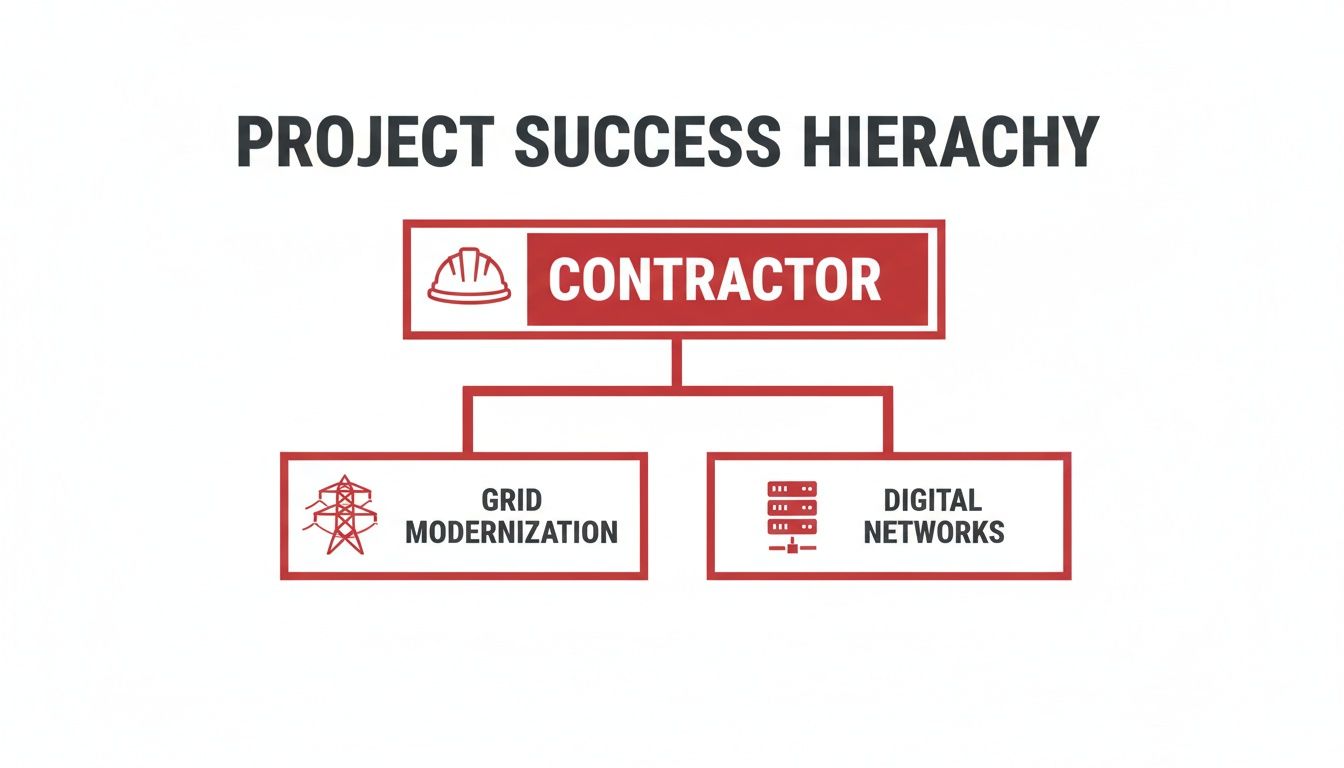
As you can see, the right contractor sits at a critical intersection, balancing the heavy-duty demands of traditional grid modernization with the precision needed for modern digital networks.
High-Voltage Transmission Services
Let’s stick with the highway analogy. Transmission lines are the superhighways of the electrical grid. We're talking about those giant steel lattice towers you see marching across the countryside, carrying immense amounts of high-voltage power from generating plants to major population centers.
This is heavy-duty, large-scale construction. It demands massive equipment, helicopter and drone support, and crews with highly specialized training to work safely at extreme heights and with dangerous voltages. Their job isn’t just about building new lines; it’s about managing the entire lifecycle of this critical infrastructure.
A transmission contractor's core services usually involve:
- New Tower Erection: Building and setting up those massive steel towers or single-pole structures, often in really tough terrain like mountains, forests, or even wetlands.
- Conductor Stringing and Sagging: This is a surprisingly precise science. Crews use helicopters or specialized drones to pull the heavy electrical cables (conductors) from one tower to the next, then carefully tension them to account for things like heat expansion and safe ground clearance.
- Right-of-Way (ROW) Management: Clearing and maintaining the strip of land directly under the transmission lines. This is a huge deal for preventing vegetation-related outages and, critically, for mitigating wildfire risks.
- Substation Construction: Building the complex "on-ramps and off-ramps" for the electrical highway. Substations are where voltage is stepped up for long-distance travel or stepped down for local delivery.
This isn't a small corner of the market. The U.S. transmission line construction sector has ballooned to an estimated $125.5 billion industry. In 2023 alone, utilities poured $11.8 billion into burying lines underground and another $6.1 billion into substation upgrades, all driven by the urgent need for a more resilient and modern grid.
Local Distribution and Specialized Services
If transmission lines are the highways, then distribution lines are the local streets that bring power to every home, business, and data center. These are the familiar wooden utility poles lining our neighborhoods and business parks. The work here is less about massive scale and more about surgical precision, often happening in crowded urban environments where a mistake can have immediate consequences.
This is also where the worlds of power and telecommunications collide. On these poles, power lines share space with fiber optic and coaxial cables, creating a need for contractors who understand both worlds. Every connection matters, and a deep knowledge of electrical components is non-negotiable. For instance, mastering contactor installation is a fundamental skill that ensures the integrity and reliability of power delivery at the local level.
Specialized services at the distribution level often include:
- Pole Setting and Replacement: Installing new utility poles and swapping out old, weathered, or damaged ones to keep the local grid safe and reliable.
- Underground Conduit Installation: Trenching and laying the protective pipes (conduits) for underground power and fiber optic cables. This is standard practice in new real estate developments and a growing trend in cities looking to improve aesthetics and storm resilience.
- Emergency Storm Restoration: This is where these crews really shine. They mobilize around the clock after hurricanes, ice storms, or other disasters to rapidly repair damage and restore power to communities and critical facilities like hospitals and data centers.
Crucial for Telecom and Data Centers: For any company deploying fiber, one service stands above the rest: make-ready construction. This is the intricate work of preparing existing utility poles for new attachments. It can involve moving existing electrical and communication wires, adding new anchor supports, or even replacing an entire pole just to create the legally-mandated safe space for a new fiber optic cable. It is the absolute first step for any aerial fiber project, and it can make or break your deployment timeline.
Power Line Construction Services at a Glance
To make it even clearer, here's a quick breakdown of how these different service types fit into the bigger picture, especially for projects related to digital infrastructure.
| Service Type | Primary Function | Typical Voltage | Relevance for Telecom/Data Centers |
|---|---|---|---|
| Transmission | Bulk power transport over long distances (the "grid backbone") | 69kV – 765kV+ | Indirect: Ensures reliable bulk power supply to the regional grid that feeds data centers. |
| Distribution | Final power delivery to end-users (homes, businesses) | 4kV – 35kV | Direct: Provides the final power connection to facilities; poles are used for aerial fiber routes. |
| Make-Ready | Modifying existing poles to accommodate new attachments | Low Voltage | Essential: The foundational step for attaching fiber optic cables to utility poles for network expansion. |
| Undergrounding | Placing power and telecom lines below the surface | Varies | High: Critical for new builds and urban areas where pole access is limited or aesthetics are key. |
This table shows that while all power line work is related, the specific service you need depends entirely on whether you're powering a massive facility or running the communication lines that connect it to the world.
Navigating Safety and Regulatory Standards
There's no sugarcoating it: working with high-voltage electricity, often at great heights, is one of the most dangerous jobs on the planet. For a power line construction contractor, safety isn't just a line item in a proposal; it's the bedrock of their entire operation. One mistake can lead to devastating accidents, bring a project to a screeching halt, and result in fines that can cripple a company.
This is why your evaluation of a contractor's safety culture and regulatory discipline is arguably the most critical part of the selection process. In this industry, safety rules aren't just guidelines—they're as fundamental and non-negotiable as the laws of physics.
Core Regulatory Frameworks
In the United States, two major frameworks govern virtually every aspect of power line work. A top-tier contractor doesn't just know these rules; they live by them.
The first is the Occupational Safety and Health Administration (OSHA). Think of OSHA as the guardian of the worker. Its regulations, especially standard 1926 Subpart V, lay out the specific rules for building and maintaining electric power lines. This covers everything from the precise way equipment must be grounded to the minimum safe working distances from energized, or "hot," lines.
The second is the National Electrical Safety Code (NESC). While OSHA protects the crew, the NESC protects the public and the grid itself. It dictates the engineering and construction standards for the infrastructure—things like how high lines must be suspended over a road or the proper spacing between utility poles.
What a True Safety Culture Looks Like
Compliance isn't about having a dusty rulebook on a shelf. The best contractors cultivate a proactive, "safety-first" culture that’s visible in everything they do. This is more than just avoiding penalties; it’s a deeply ingrained commitment to making sure every single crew member goes home safely at the end of every shift.
You can spot this commitment in a few key practices:
- Continuous Training and Certification: Lineworkers and ground crews should have a robust, ongoing training schedule that covers not just technical skills but crucial safety protocols like pole-top rescue, first aid, and CPR.
- Daily Job Safety Analyses (JSAs): Before any work starts, the crew holds a "tailgate meeting" to walk through a JSA. They talk through the specific hazards of that day’s job—bad weather, tricky terrain, nearby traffic—and map out a clear plan to handle them.
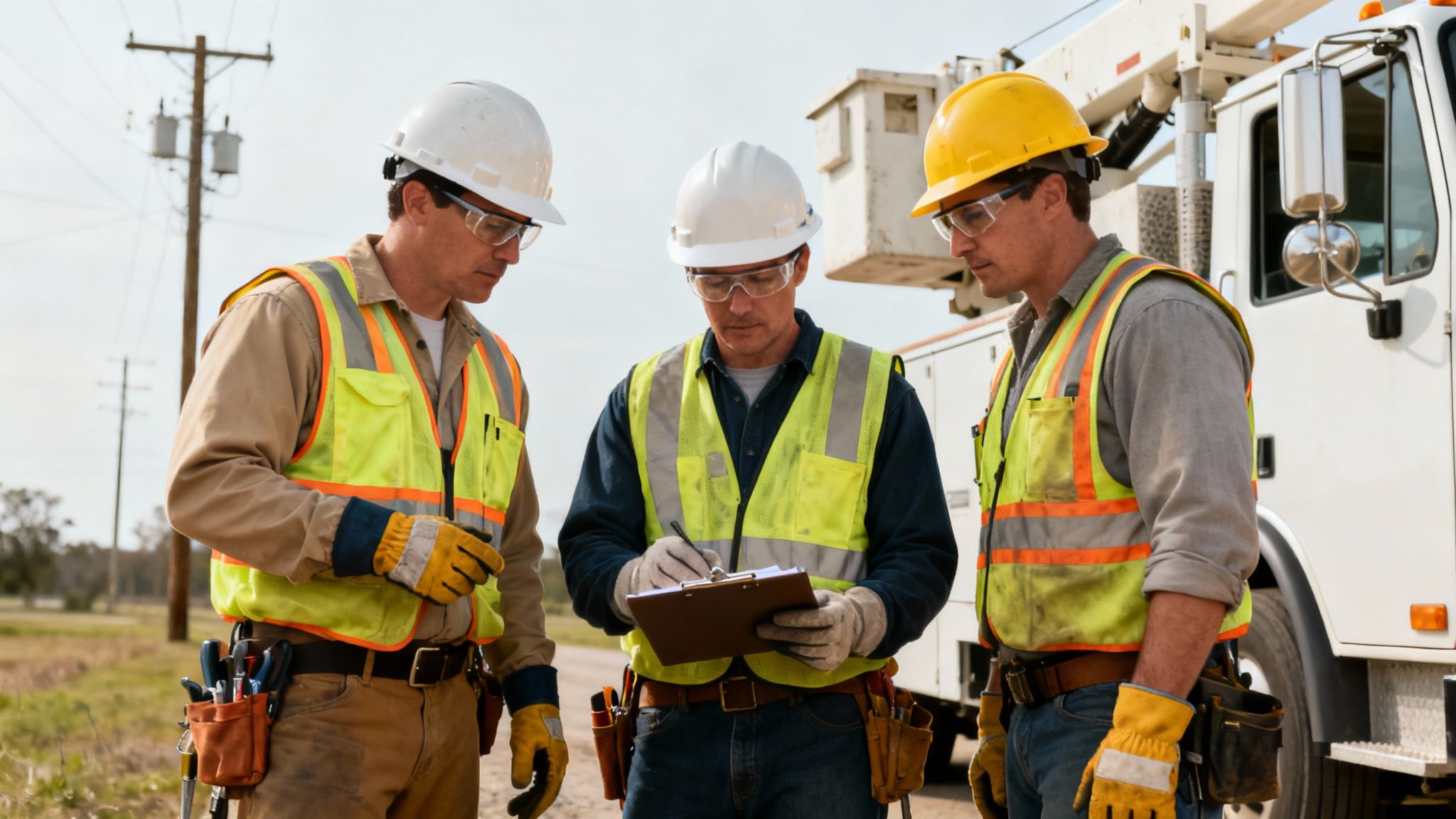
- Proper Personal Protective Equipment (PPE): This is absolutely non-negotiable. Crews must be outfitted with flame-retardant (FR) clothing, insulated gloves and sleeves rated for the voltage they’re handling, hard hats, safety glasses, and proper fall protection harnesses.
A contractor with a strong safety culture won't just tell you they're safe—they'll show you. Ask for their Experience Modification Rate (EMR), a number insurance companies use to benchmark their safety performance. An EMR below 1.0 signals a better-than-average safety record.
Beyond Construction Safety and into Maintenance
Safety doesn't stop once the last line is strung. A huge part of a power line contractor's work involves ongoing maintenance to prevent future problems, especially environmental ones. For overhead lines, this means managing the strip of land they run through, known as the right-of-way.
Overgrown trees and vegetation are a primary cause of power outages and can pose a serious fire risk, particularly in dry climates. That’s why top contractors are skilled in understanding vegetation management strategies to keep rights-of-way clear, ensuring both grid reliability and public safety.
When you're vetting a contractor, dig deep into their safety program. Ask about their emergency action plans, how they handle incident reporting, and whether they empower crews to stop work if they spot an unsafe condition. Their answers will tell you everything you need to know about whether safety is just a checkbox for them or a core, unshakeable value.
Understanding Project Costs and Timelines
No two power line construction projects are the same, and that’s a critical thing to remember. Costs and timelines can swing wildly from one job to the next. What might look simple on a blueprint can quickly spiral in complexity and cost once you’re dealing with real-world conditions. Getting a firm grip on what drives your budget and schedule is the first step to planning a successful project.
Think of it like planning a cross-country road trip. The total cost and how long it takes depends on the car you drive, the route you map out, the weather you hit, and any unexpected detours you’re forced to take. A power line project is no different—the final bill is a product of materials, labor, equipment, and the ground you have to cover.
The best power line construction contractors are masters at spotting these variables early on. They help you build a realistic plan that sees challenges coming long before they turn into expensive delays.
Major Cost Drivers in Power Line Construction
The final price tag on a power line project isn't one single number; it's a mix of several key components. Each one has its own set of variables that can make costs jump or fall. Knowing what they are helps you budget more accurately and have a much clearer conversation with your contractor.
Here are the biggest factors that will shape your project's cost:
- Materials Selection: The choice between steel and wood poles is one of the first big cost decisions. Wood poles are cheaper upfront, no question. But steel structures last longer and are far more resilient, especially if you’re building in an area prone to harsh weather. On top of that, the cost of the conductors (the actual wires), insulators, and all the associated hardware adds up fast.
- Specialized Labor: Lineworkers are highly skilled professionals, and that expertise doesn't come cheap. If your project involves specialized tasks like live-line maintenance or requires helicopters to set poles in remote areas, you can expect labor costs to be significantly higher.
- Equipment Mobilization: We're not talking about a few pickup trucks. Heavy-duty equipment—from bucket trucks and digger derricks to massive tensioners and pullers—is incredibly expensive to own, maintain, and move. Just getting this fleet to a remote or difficult-to-access job site is a major line item on any budget.
- Site Complexity and Terrain: There's a world of difference between running a distribution line through a flat, open suburb and stringing a transmission line over a mountain range or through a dense swamp. Tough terrain demands more site prep, specialized equipment, and a lot more person-hours to get the same work done.
Navigating Timelines and Potential Delays
Beyond the physical work, a number of outside factors can stretch a project’s timeline from a few months into a few years. These administrative hurdles and "soft costs" are often the most unpredictable—and frustrating—parts of a project, and they can wreak havoc on your schedule.
One of the biggest hurdles right now is the workforce itself. The industry is facing a major skills gap just as demand is exploding. U.S. utilities are looking at 10,700 job openings for line installers every single year due to retirements, while construction wages have climbed 4.2% year-over-year. This talent shortage, combined with massive investments—like the $7.5 billion spent on transformers in 2023—means that experienced crews are a hot commodity. You can explore more on how these trends are shaping the American energy sector.
The most meticulously planned construction schedule can be completely derailed by a single delayed permit. A great contractor not only builds the line but also helps you expertly navigate the bureaucracy required to get the project approved and underway.
Here are the most common culprits behind project delays:
- Permitting and Environmental Reviews: Before anyone can even think about digging, projects often need a whole battery of local, state, and federal permits. Environmental impact studies, historical site assessments, and community approvals can easily add months—or even years—to a timeline.
- Right-of-Way (ROW) Acquisition: Getting the legal right to build and maintain a power line across private land is a notoriously complex and slow process. Having to negotiate with dozens, sometimes hundreds, of individual landowners can bring a project to a standstill.
- Supply Chain Bottlenecks: This has become a huge challenge across the entire industry. The lead times for critical grid components are longer than ever. A large power transformer, for instance, can take two years or more to arrive, forcing the entire project schedule to revolve around one piece of equipment.
By truly understanding these drivers of cost and time, you can work side-by-side with your contractor to develop a project plan that is not just ambitious, but actually achievable.
How to Select the Right Contractor
Picking a power line construction partner is a high-stakes decision. It’s not just about finding a crew to dig holes and string wire. You’re choosing a partner whose expertise, safety record, and financial stability will make or break your project's long-term success. Get it right, and your project runs on time, stays on budget, and is built to last. Get it wrong? You’re looking at costly rework, dangerous safety issues, and crippling delays.
Think of this process less like hiring a vendor and more like bringing on a key long-term member of your team. This contractor becomes an extension of your own crew, and their performance is a direct reflection on you. That’s why a deep dive into their qualifications is not just a good idea—it's absolutely essential.
Assessing Technical Capabilities and Experience
First things first, you need to make sure a potential contractor has the specific technical chops for your project. A company that’s fantastic at building overhead distribution lines in rural areas might be completely out of its depth with complex underground work in a dense city or the detailed make-ready work needed for a fiber optic deployment. Their experience has to be relevant.
Here’s what to zero in on when evaluating their skills:
- Local Utility Experience: Have they worked with the power and communications utilities in your project area before? Every utility has its own unique set of construction standards, permitting quirks, and inspection routines. A contractor who already knows the local rules and has relationships with the right people will save you countless headaches and delays.
- Crew Qualifications: Don't be shy about asking about the training and certifications of their lineworkers. You want to see proof of formal apprenticeships and any specialized training that applies to your job, like handling fiber optics or working on energized lines. A well-trained, experienced crew is your best insurance policy against accidents and sloppy work.
- Equipment Fleet: Take a look at their equipment. A contractor’s fleet of trucks and machinery tells you a lot about how they run their business. Ask for a list of their primary equipment, its age, and how they maintain it. A modern, well-kept fleet of bucket trucks, digger derricks, and tensioners signals a professional operation that isn’t likely to be sidelined by constant breakdowns.
A contractor’s ability to provide detailed as-built documentation is a critical, yet often overlooked, capability. These final documents are precise maps and records of the completed work, which are invaluable for future maintenance, troubleshooting, and asset management. Without them, you're essentially flying blind years down the road.
Evaluating Financial Health and Project Management
Beyond their technical skills, you need a partner with the financial horsepower to see a big project through to the end. Just as important are the management systems they have in place to keep everything on track. A contractor teetering on financial instability is a massive risk to your project’s continuity.
Their project management style is just as crucial. It dictates how smoothly the work will flow from day to day. A transparent contractor should have no problem providing a Certificate of Insurance, details on their bonding capacity, and even banking references. For expert guidance on managing telecom infrastructure projects, you can explore the end-to-end services offered by seasoned partners like Southern Tier Resources, who handle everything from initial design to final testing.
Clear, consistent communication is the glue that holds a project together. The contractor must be able to clearly outline how they’ll communicate with you—who your main point of contact is, how often you’ll get updates, and what those updates will include. This ensures you’re never in the dark and that problems get solved quickly. Solid project management and open communication are the keys to a successful partnership.
Contractor Evaluation Checklist
To help you stay organized during the vetting process, use this checklist. It’s designed to guide you through the key areas you need to investigate to ensure you’re choosing a reliable and capable partner for your critical infrastructure project.
| Evaluation Category | Key Questions to Ask | Why It Matters |
|---|---|---|
| Safety & Compliance | What is your EMR? Can you provide your OSHA 300 logs for the past 3 years? How do you ensure compliance with NESC and local codes? | A low EMR and clean safety record indicate a disciplined, professional crew. Strong compliance knowledge prevents costly violations and ensures long-term asset integrity. |
| Technical Expertise | Can you provide case studies of similar projects? Who are the local utilities you've worked with? What are your crews' certifications? | This verifies that their experience is directly relevant to your project's specific challenges, reducing the risk of a steep learning curve on your dime. |
| Financial Stability | What is your bonding capacity? Can you provide a Certificate of Insurance and references from your bank or surety company? | Confirms they have the financial resources to complete the project without interruption and to cover any potential liabilities, protecting you from risk. |
| Project Management | What project management software do you use? What is your communication plan? How do you handle change orders and unexpected delays? | A well-defined process for communication and problem-solving ensures the project stays on track and you remain informed, preventing scope creep and budget overruns. |
| Equipment & Resources | Can you provide a list of your primary equipment fleet? Do you own or rent your equipment? What is your plan for scaling resources if needed? | A well-maintained, owned fleet indicates investment and reliability. Understanding their resource plan shows they can handle the project's scale and adapt to changes. |
Ultimately, choosing the right contractor comes down to due diligence. By systematically evaluating each potential partner against these criteria, you can move forward with confidence, knowing you have a team on board that is truly capable of bringing your project to a successful conclusion.
The Future of Integrated Infrastructure
The lines between power and connectivity are blurring. What used to be two entirely separate worlds—the electrical grid and the data network—are now merging into a single, cohesive ecosystem. This shift is driven by our simultaneous hunger for renewable energy and high-speed data, creating incredible new efficiencies. We're no longer looking at two distinct construction projects; we're looking at one unified effort.
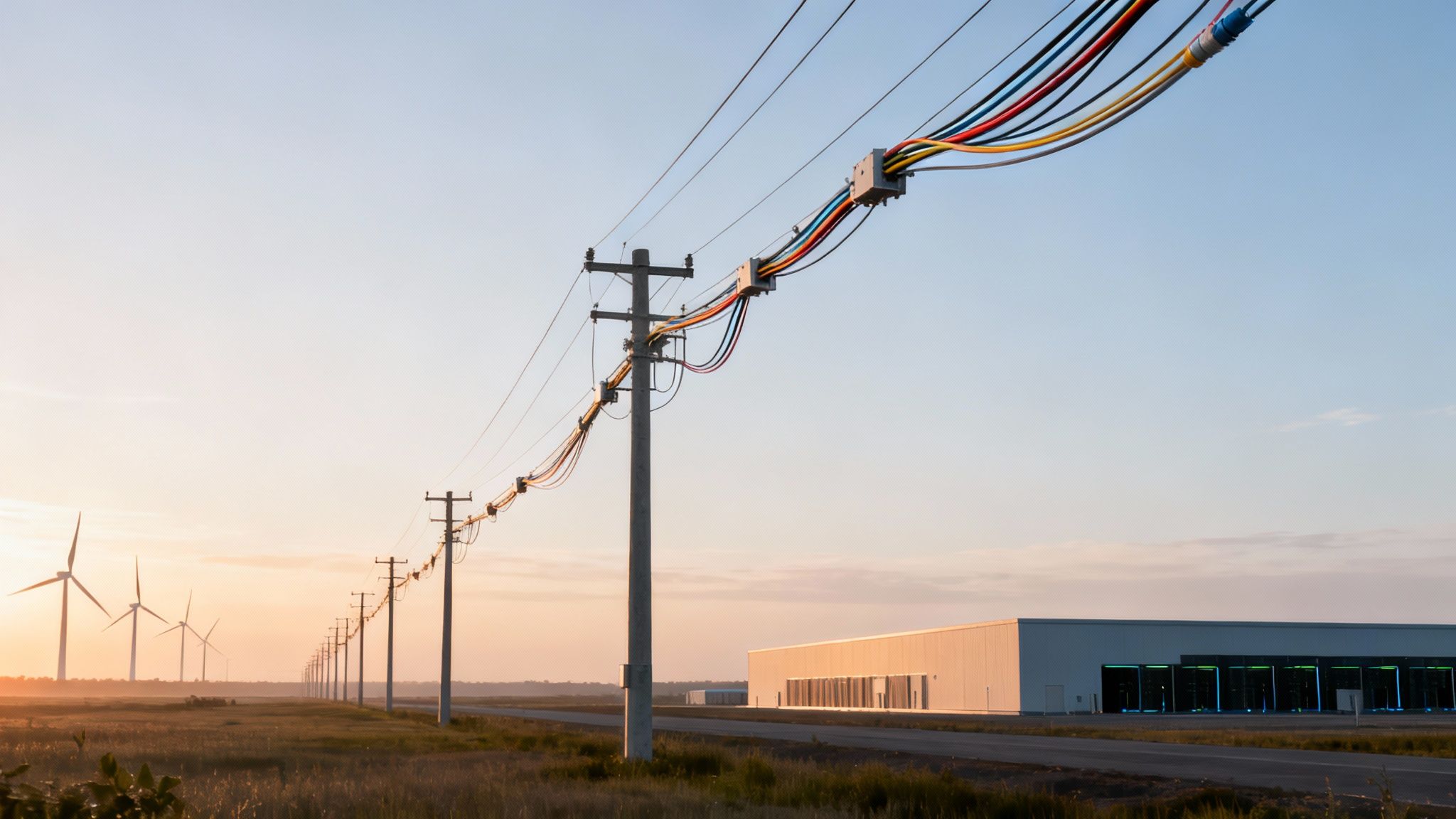
Here’s a practical way to think about it: every new transmission line run from a wind farm or solar field to a substation is also a perfect, ready-made route for fiber optic cables. Instead of trenching or boring twice—once for power, once for data—a smart, integrated approach gets both done at the same time. This is where a versatile power line construction contractor proves their real worth.
Powering the Digital Age
Data centers have become the new industrial giants of our time. Fueled by cloud computing, AI, and the rollout of 5G, their appetite for electricity is immense, and their need for reliability is absolute. Of course, they also require a massive pipeline of fiber connectivity to function.
A contractor who genuinely understands both of these needs brings a major strategic advantage to the table. They can engineer and build the high-voltage infrastructure that guarantees uptime while, in the same project, laying the fiber backbone the facility depends on. This dual-capability approach unlocks some serious benefits:
- Reduced Costs: A single project means one set of permits, one right-of-way negotiation, and one mobilization of heavy equipment and specialized crews.
- Faster Deployment: Combining the work shaves months, sometimes years, off the timeline for getting both power and data services operational.
- Future-Proofing: Installing fiber alongside new power lines creates a resilient, high-capacity communications network that’s ready for whatever comes next.
This isn’t a niche trend; it’s a massive market shift. The global pipeline for power generation construction projects is currently valued at an incredible $8.27 trillion. A huge slice of that is dedicated to renewables—wind power projects alone account for $3.23 trillion—all of which will need thousands of miles of new transmission lines to connect to the grid. Here in the U.S., federal initiatives are set to fund over 28,000 miles of new transmission projects in the next decade. This opens a huge window of opportunity for contractors who can deliver turnkey solutions that include fiber. Discover more insights on the global power construction pipeline on businesswire.com.
In a connected world, power and data infrastructure are two sides of the same coin. The most successful projects will be those that recognize this synergy from day one, leveraging a single, expert partner to build both with precision and foresight.
The Turnkey Partner Advantage
When it comes down to it, the future belongs to contractors who can see the whole board. They're not just stringing wire; they're laying the physical groundwork for our entire digital economy. They bring a rare combination of skills to the job—the expertise to manage the extreme demands of high-voltage systems and the delicate, technical precision required for fiber optic networks.
When you select a partner who excels in both arenas, you’re doing more than just hiring a construction company. You are bringing on a strategic asset capable of delivering a complete, integrated solution that is more efficient, more cost-effective, and fundamentally prepared for the opportunities of tomorrow.
Frequently Asked Questions
What Is Make-Ready Construction For ISPs?
Think of it as preparing the way. Make-ready construction is the essential groundwork required to modify existing utility poles so they can safely support new attachments, like the fiber optic cables an ISP needs to expand its network. It’s the first, and arguably most important, step in any aerial fiber project.
A seasoned contractor handles everything from the initial engineering survey to getting the green light from pole owners and, finally, doing the physical work. This might mean shifting existing wires around or even swapping out an entire pole to make sure the new fiber lines meet strict safety codes. Getting this right from the start is how you avoid major headaches and costly delays down the road.
You simply can't build an aerial fiber network without it. Proper make-ready work is the foundation—it ensures the entire project is safe, compliant, and ready for service.
How Does Local Utility Experience Affect A Project?
Working with a contractor who knows the local utility landscape is a game-changer. Every utility company has its own set of rules—unique construction specs, specific safety procedures, and an inspection process that’s often full of unwritten expectations.
A contractor with deep local roots has already navigated this maze. They understand the nuances that can derail a project, which makes getting permits and approvals much faster. Their established relationships with the local utility crews mean coordination is seamless, especially when it's time to connect to the main grid. That local knowledge is often the deciding factor between a project that finishes on schedule and one that gets stuck in bureaucratic limbo.
What Should I Look For In An Emergency Response Plan?
When your operations depend on constant uptime, like a data center, you need a contractor who is ready for anything. The key is to find a partner with 24/7 mobilization capabilities and a well-defined plan for storm restoration and other emergencies.
Ask to see the details. How large is their on-call emergency crew? Is their equipment staged and ready to go at a moment's notice? What does their performance history look like after major storms? A truly reliable partner will have dedicated teams ready to roll out, assess the damage, and get the power back on, protecting your business when the unexpected happens.
At Southern Tier Resources, we provide the end-to-end expertise needed to build and maintain modern power and telecom infrastructure. Our skilled crews and safety-first culture ensure your projects are delivered to the highest standards. Partner with us to build reliable, high-performance networks by visiting us at https://southerntierresources.com.