
Think of the initial blueprints for a telecom or data center project as the "best-laid plans." They're the detailed, theoretical guide created before a single shovel hits the dirt. But in the real world, things change.
That's where as-built documentation comes in. It’s the final, authoritative record of what was actually built. It's the "on-the-ground reality" that captures every deviation, every field modification, and every on-the-fly adjustment made during construction.
From Blueprint To Reality
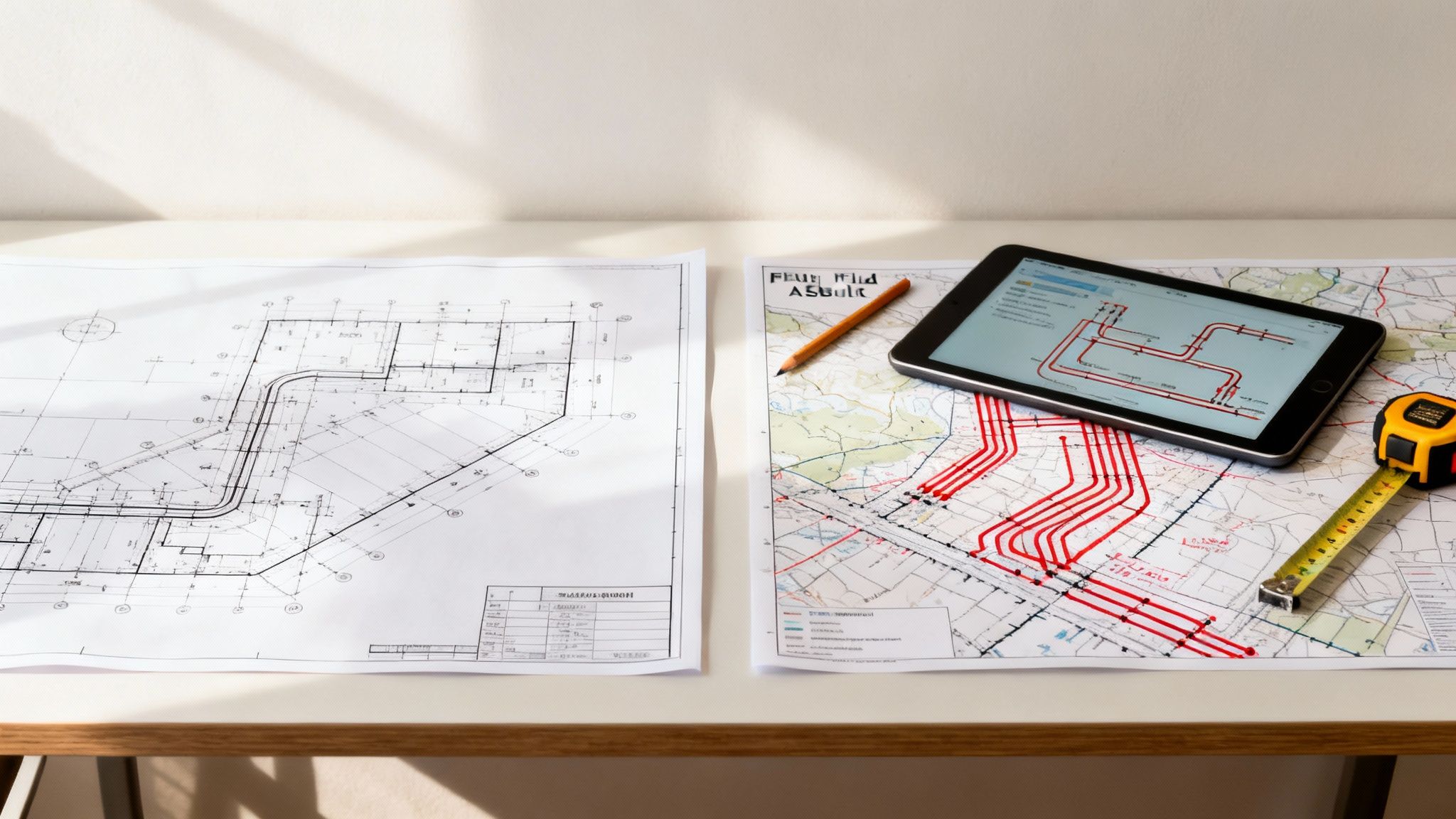
I like to use a road trip analogy. The design drawing is the route you map out on your kitchen table—it looks perfect. But once you're driving, you hit unexpected detours, find a scenic shortcut, or run into a road closure.
The as-built document is the map of the route you actually took, complete with notes on every change. For complex telecom and data center builds where a single misplaced cable can cause major headaches down the line, this final, accurate map isn't just helpful—it's absolutely essential.
The Plan Versus The Reality
The original designs are the ideal, the engineer's vision laid out before work starts. As-builts, on the other hand, are created as the project unfolds, meticulously tracking the real-world outcome.
Deviations are a normal part of any project, often due to:
- Unforeseen Obstructions: A crew digging a trench for fiber might hit a previously uncharted utility pipe, forcing them to reroute the conduit.
- Material Substitutions: The specified server rack might be on backorder, so an approved alternative with slightly different dimensions is used instead.
- Field-Driven Optimizations: An experienced technician on-site might see a better way to run cabling to improve airflow and future access.
To better understand their distinct roles, let’s compare them side-by-side.
Design Drawings vs As Built Documentation At a Glance
| Attribute | Design Drawings (The Plan) | As Built Documentation (The Reality) |
|---|---|---|
| Purpose | To guide construction and secure permits. | To record the final constructed state for operations and maintenance. |
| Timing | Created before construction begins. | Created during and finalized immediately after construction. |
| Content | Shows the intended design, layout, and specifications. | Shows the actual, final locations, dimensions, and materials used. |
This table highlights a crucial point: one is a guide for building, the other is a record of what was built.
As-built documents are the official "source of truth" for the finished infrastructure. They are the project's living legacy, becoming indispensable for anyone who needs to operate, maintain, or upgrade the system years from now.
This "record of reality" is precisely what makes as-built documentation so valuable. You can see these principles in action when you explore the basics here: https://southerntierresources.com/goodscode/basics/1022554677. While the initial plans get the project started, the as-builts provide the critical data needed for long-term operational success. For a wider view on documentation best practices, you can also explore these general documentation resources.
The Core Components of Telecom As-Builts
Think of a top-notch as-built documentation package not as a single, updated map, but as a complete encyclopedia for your network. A simple red-lined drawing gives you a snapshot, but a comprehensive as-built tells the entire story—from where a cable is buried to how well it performs. Each piece has a specific job, and together, they create a living, functional record.
When that record is incomplete, operations teams are essentially flying blind. A single missing document, like a test report or a splice map, can turn a routine maintenance call into a costly, time-sucking investigation.
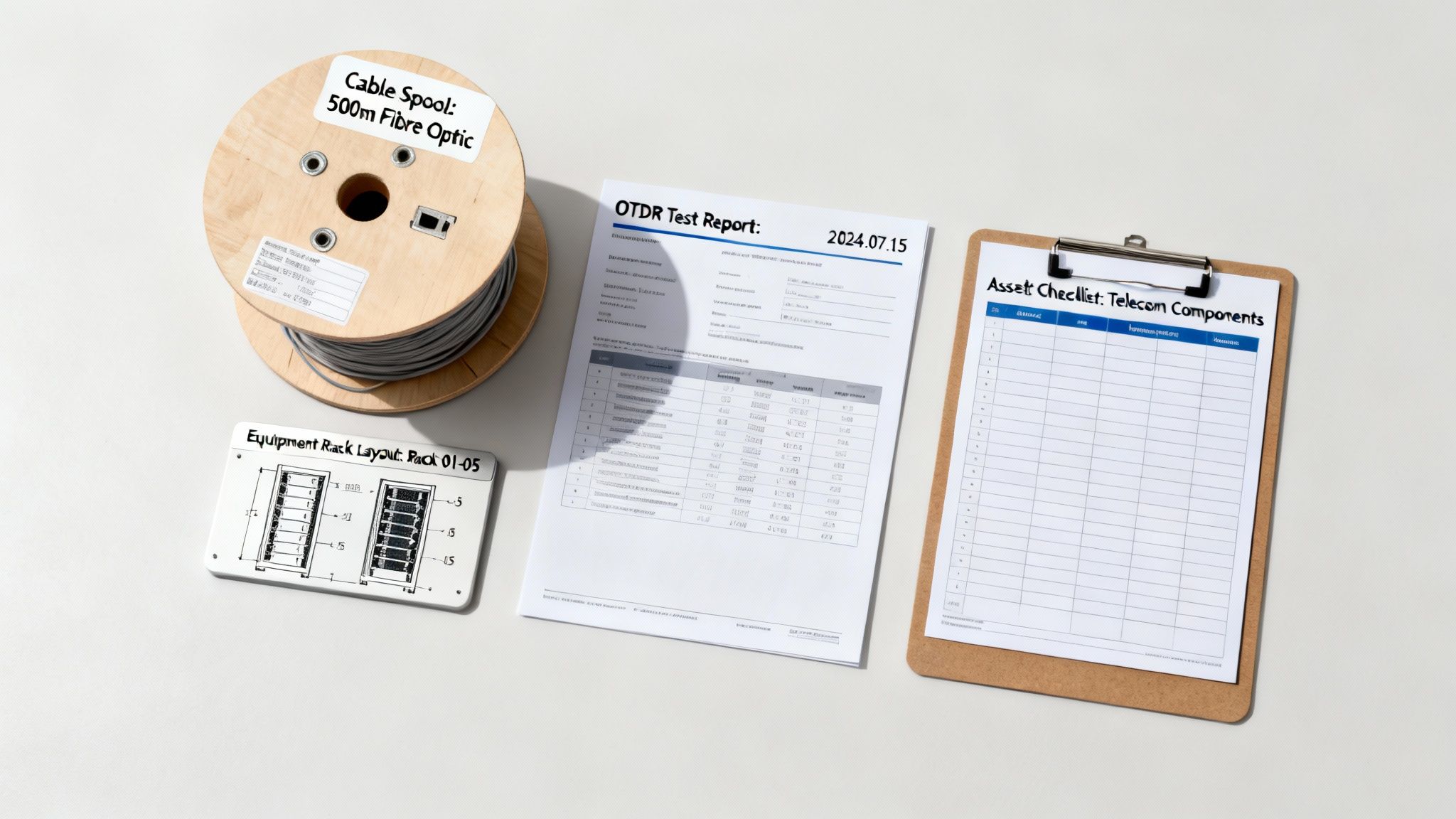
As-Built Drawings: The Visual Foundation
The first thing most people picture is the as-built drawing. This is the master visual record, showing the exact physical placement of every single asset. It’s not the plan; it’s the reality. These drawings capture the final, real-world locations of conduits, cables, splice enclosures, cabinets, and equipment racks—where they actually ended up after construction.
Today, these are almost always delivered in digital formats like CAD (Computer-Aided Design) or, even better, integrated directly into a GIS (Geographic Information System) platform. Going digital is non-negotiable for modern network management. It allows teams to overlay infrastructure data with other geographic information, which is a game-changer for planning and analysis. For a deeper dive into reading these technical graphics, you can find a helpful primer here: https://southerntierresources.com/goodscode/graphics/2960091396.
Cable and Splice Schedules: The Connectivity Map
Drawings show you where things are. Cable and splice schedules tell you how they're connected. For any fiber optic network, these documents are the absolute lifeblood, providing a granular, strand-by-strand map of every connection.
- Cable Schedules: This is the master log of every cable that went into the ground or onto a pole. It includes unique IDs, cable types (like a 288-count single-mode fiber), measured lengths, and the start and end points of each run.
- Splice Schedules: This document is the microscopic view inside each splice closure. It meticulously details which colored fiber from an incoming cable connects to which fiber in an outgoing one. This is what guarantees the light path continues uninterrupted across the network.
Without an accurate splice schedule, troubleshooting a "dark" fiber is pure guesswork. Technicians end up having to re-open closures and manually trace connections, burning through time and money.
An as-built package is only as strong as its weakest link. A perfect drawing is useless if the corresponding test report is missing or the splice schedule is wrong. Each piece validates and enriches the others.
Test and Commissioning Reports: Performance Validation
If the drawings are the map, the test reports are the proof of performance. They provide the hard data showing that the newly built network meets every technical specification. Think of them as the official "health certificate" for your infrastructure, signed off before the project is handed over.
These reports are non-negotiable and must include:
- OTDR (Optical Time-Domain Reflectometer) Traces: These scans are like an EKG for fiber. They send light pulses down a strand to measure its exact length, pinpoint splice locations, and detect any signal loss or faults. Every OTDR trace is a unique signature for that fiber.
- Power Meter Readings: These tests confirm that the light signal arriving at the far end is strong enough for reliable data transmission.
- Continuity Tests: A simple but critical check to ensure there are no physical breaks in the cables.
This documentation creates the baseline. When a problem pops up months or years later, technicians can compare new test results against the original as-builts to instantly see where things went wrong.
Equipment and Asset Lists: A Complete Inventory
Finally, a truly complete as-built package includes a comprehensive inventory of all installed equipment and major assets. This goes beyond just the fiber and conduits to include every active and passive component that makes the network tick.
The list should detail the manufacturer, model number, serial number, and installation date for items like patch panels, routers, switches, and power distribution units. This data is gold for asset management, warranty tracking, and planning for future upgrades and replacements.
Why Accurate As-Builts Are a Critical Business Asset
It’s easy to dismiss as-built documentation as just another project deliverable—a final box to check before moving on. But that’s a shortsighted view. In reality, accurate as-builts are a powerful strategic asset for any network operator or data center manager. Investing in them isn't about closing out a project neatly; it's about protecting future revenue, slashing operational risk, and getting the most value out of your infrastructure for years to come.
Think of your network as a complex city. Without a precise, up-to-date map, every repair or expansion becomes a costly expedition into the unknown. This is where the true business value of reliable documentation comes into focus, transforming it from a simple file into a core operational tool.
Drastically Reduce Troubleshooting Times
When an outage hits, the clock starts ticking—loudly. With accurate as-builts, a technician arrives on-site armed with a perfect map. They know the exact location of the splice enclosure, the specific fiber pair in question, and what the OTDR readings should look like. This turns a potentially hours-long fault-finding mission into a swift, surgical repair.
Now, imagine the alternative. A team working from outdated or nonexistent records is flying blind. They're forced to guess, manually trace lines, and re-test entire segments, burning through time and frustrating customers. This direct hit to your Mean Time to Repair (MTTR) is one of the most immediate and tangible returns you'll see from investing in quality as-builts.
"Incomplete documentation is a direct tax on your operations. Every minute a technician spends searching for an asset instead of fixing it is a minute of lost revenue and degraded customer trust. As-builts pay for themselves by eliminating that guesswork."
Streamline Future Upgrades and Expansions
Growth is always the goal, but unplanned growth is just chaos. When you know the true state of your existing infrastructure, you can plan network upgrades with confidence. This is where accurate what is as built documentation provides the bedrock for smart, strategic evolution.
This clarity makes a real difference by enabling:
- Smarter Capacity Planning: You'll know exactly which conduits have spare capacity or where you can place new hardware without causing conflicts.
- Accurate Cost Estimation: Budgets for future projects become far more precise when they're based on known asset locations and conditions, which means fewer financial surprises.
- Less Rework: New construction won't accidentally interfere with existing, undocumented assets. That alone avoids some of the most expensive and time-consuming rework imaginable.
Without this single source of truth, every expansion project has to start with costly and time-consuming field verification just to figure out what you’re working with.
Enhance Worksite Safety and Mitigate Risk
Out in the field, what you don't know can be incredibly dangerous. Inaccurate records are a primary cause of utility strikes, where crews accidentally dig into buried gas lines, water mains, or other critical communication cables. These incidents don't just cause service disruptions; they pose serious safety risks to crews and the public.
Poor as-builts contribute to a staggering 25% of all underground utility strikes globally each year, costing the industry an estimated $30 billion worldwide. Inside data centers, rigorous as-built reviews can cut downtime risks by 35%—a vital advantage when managing today's massive data demands. You can find more insights about how telecom analytics drive efficiency on vetrofibermap.com.
Ensure Regulatory and Funding Compliance
Many large-scale infrastructure projects, especially those tied to public funds or rights-of-way, come with a mountain of documentation requirements. Government bodies and regulatory agencies often mandate the submission of detailed as-built records to verify that a project was completed to spec and to ensure public assets are correctly mapped.
Failing to provide this proof can lead to significant penalties, project delays, or even the clawback of funding. High-quality as-builts are not just an operational asset; they are a critical tool for staying compliant and securing the financial health of major builds. They provide the auditable record you need to satisfy stakeholders and unlock future opportunities.
The As-Built Workflow: From Field Markups to Final Record
Creating accurate as-built documentation isn't something that just happens at the very end of a project. It’s a disciplined process, a journey that turns raw field observations into a permanent, trustworthy record. Think of it as a relay race, where the baton is passed from field crews to drafters and engineers, with the goal of getting that crucial data from the trench to the database without dropping it.
This flow is everything. It begins the second a technician has to deviate from the original design. Capturing that change accurately, right at the source, is the first and most critical step in producing documentation you can actually rely on.
The Initial Redline Markup in the Field
It all starts with what we call redline markups. This is the first draft of the project's real-world history. Imagine a crew laying conduit hits an uncharted utility line and has to reroute. They'll grab their design drawings and mark up the change, traditionally with a red pen—hence the name.
These redlines are the bedrock of the entire as-built process. For years, this was all done on paper, which was a recipe for disaster. Plans could get muddy, lost, or scribbled on so poorly they were impossible to read back at the office.
Thankfully, things are more digital now. Crews often use tablets with mobile GIS apps to mark up changes directly on the design files. They can even attach geotagged photos and precise GPS coordinates, which adds a whole new level of accuracy and virtually eliminates the "lost in translation" problem.
Transforming Field Notes Into Drafted Records
Once those marked-up drawings and notes get back to the office, they land on the desk of a drafter, CAD tech, or GIS specialist. Their job is to act as a translator, taking every single field change and meticulously updating the master project files.
This is a critical handoff. The process of turning messy field notes into a clean, professional record is a systematic one.
Here’s a quick overview of the key stages involved in this workflow.
Key Stages in the As Built Documentation Workflow
A step-by-step summary of the process for creating accurate as-built records, from field data capture to final delivery and system integration.
| Stage | Key Activities | Primary Stakeholder |
|---|---|---|
| 1. Field Data Capture | Crews mark up deviations from design plans on-site (redlining). Capture photos, GPS points, and notes for context. | Field Technicians/Construction Crew |
| 2. Data Collection & Submission | Field markups and all related data are submitted to the project office, often digitally through mobile apps or cloud storage. | Field Supervisor/Project Foreman |
| 3. Drafting & Integration | CAD/GIS technicians transfer redline changes into the master design files, updating drawings and spatial data. | Drafter/CAD or GIS Technician |
| 4. Internal Review & QA/QC | Engineers and project managers review the drafted as-builts against field notes and test reports to verify accuracy. | Project Manager/Engineer |
| 5. Finalization & Approval | Once verified, drawings are finalized, stamped as "Record Drawings" or "As-Builts," and prepared for handover. | Lead Engineer/Project Lead |
| 6. Client Handover & System Update | The final documentation package is delivered to the client. Data is imported into their asset management or GIS/OSS platforms. | Client/Network Operations Team |
This structured approach ensures that the information gathered in the field maintains its integrity all the way through to the final deliverable.
A common failure point in the as-built workflow is a breakdown in communication between the field and the office. If redlines are unclear, incomplete, or delayed, the final documentation will inherit those flaws, diminishing its value.
Leveraging Modern Technology for Data Capture
To make this workflow even tighter, teams are increasingly using advanced tools that capture reality with incredible precision. These technologies are fundamentally changing how as-builts are created.
- Laser Scanning (LiDAR): In dense, complex environments like a data center, laser scanners create a 3D "point cloud" of the entire space. This captures the exact location of every rack, cable tray, and piece of equipment with millimeter-level accuracy.
- Drone Photogrammetry: For sprawling outside plant projects, drones can quickly survey huge areas, producing high-resolution aerial maps that show precisely where fiber routes were laid.
- Mobile GIS Apps: As mentioned, these apps are a game-changer. They connect field crews directly to the central project database for real-time updates. You can learn more about how to use field guides and codes in our related article.
Final Review and Official Handover
The very last step is a final, comprehensive review. The updated draft drawings are meticulously checked against all the field notes, splice diagrams, and test reports one last time.
Once everything is confirmed, the documents are officially stamped as the "as-built" or "record" drawings. This complete package is then handed over to the client, becoming the official source of truth for that new piece of infrastructure. A well-run workflow ensures this final record isn’t just a formality—it’s a valuable, functional asset for years to come.
Best Practices for Managing Your As-Built Data
Creating a solid set of as-builts is a huge milestone, but their real value comes from how you manage them over the long haul. Without a smart strategy, these crucial records can get lost in the shuffle, become outdated, or just plain disappear. Good management turns them from a simple project sign-off into a living, breathing asset that supports your network for years to come.
It all starts with getting everyone on the same page by setting clear, consistent standards. This means locking down a universal naming convention for files and deciding on required formats, like specific CAD layers, PDF versions, or GIS data schemas. When everyone follows the same playbook, any field tech or network planner can find what they need and understand it instantly.
The basic flow from capturing data in the field to delivering the final documents is the bedrock of this whole process.
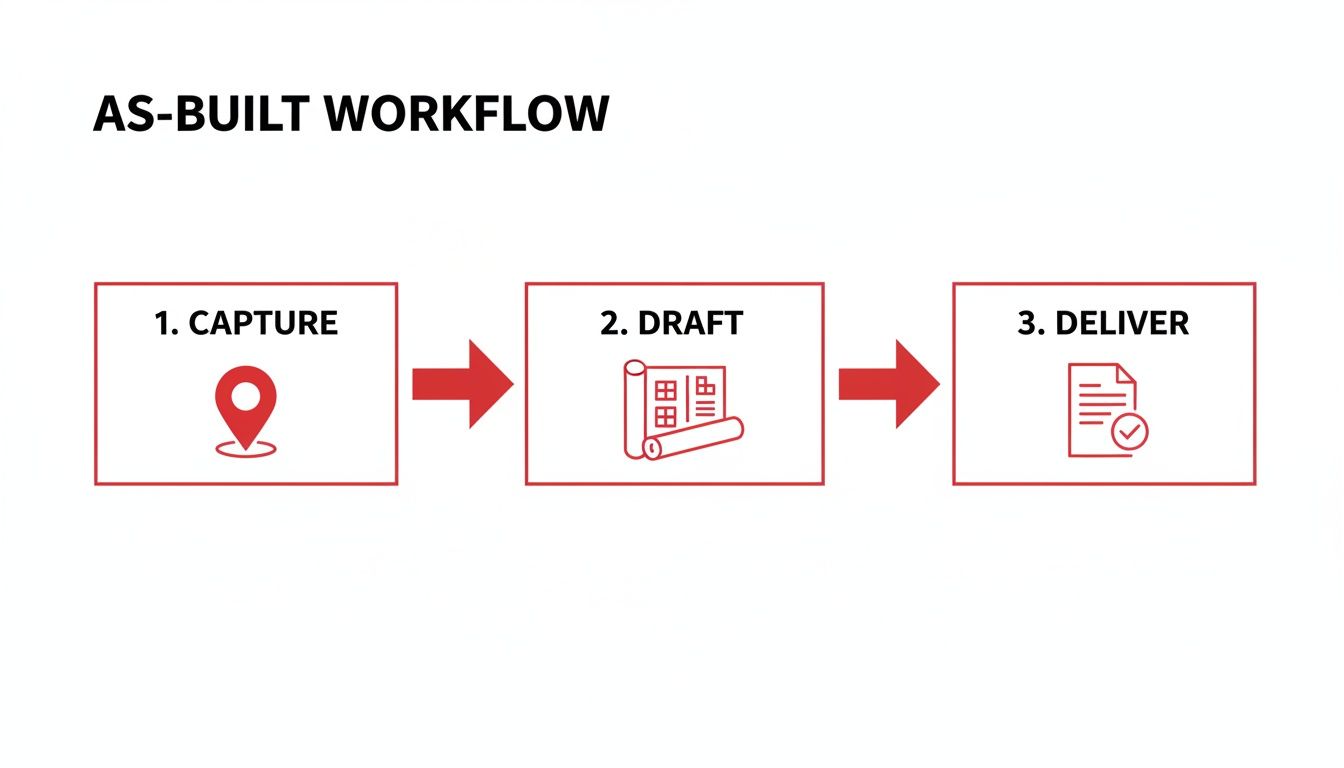
This workflow shows just how critical it is to maintain data integrity at every single step.
Centralize and Control Your Data
With your standards in place, the next logical step is to create a single, centralized digital home for everything. This "single source of truth" completely eliminates the chaos of teams using different versions of a document found on local drives or buried in old emails. A cloud-based platform is usually the best bet, giving you secure access from anywhere with clear permission controls.
Inside this central hub, version control is an absolute must. Every single time a change happens on the network—whether it's a minor repair or a massive upgrade—the as-built documentation has to be updated to match. A good version control system logs these changes, keeps old versions archived, and makes sure everyone is working from the most current, accurate record.
Think of your as-built documentation as a "living" record. This mindset shifts its purpose from a historical snapshot to a real-time operational tool. It becomes the reliable foundation for all future maintenance, troubleshooting, and expansion work.
Integrate for Maximum Impact
To get the most out of your as-built data, you need to connect it with your other essential operational systems. Following solid document management best practices is the key to keeping your data clean and accessible as you build these integrations. This is how you turn static files into actionable intelligence.
Here are a few key integrations to focus on:
- GIS Platforms: Linking as-built drawings to your Geographic Information System (GIS) gives you powerful spatial context. Teams can actually see network assets on a map and understand how they relate to the surrounding infrastructure.
- Asset Management Systems: Connecting equipment lists and serial numbers from your as-builts to an asset management database helps streamline maintenance schedules, track warranties, and plan for the entire equipment lifecycle.
- Operational Support Systems (OSS): For carriers and ISPs, feeding as-built data into your OSS can automate network provisioning and help pinpoint faults faster, giving your operational efficiency a serious boost.
This level of integration is make-or-break in high-stakes environments like data centers. Today, an incredible 85% of Fortune 500 data centers require as-builts for their critical infrastructure. A recent survey even found that errors in these documents were behind 12% of major outages, proving just how much is on the line.
Thankfully, new tech like LiDAR is making it easier than ever to capture hyper-accurate data, often achieving sub-1cm accuracy. By investing in these best practices, you ensure your as-built documentation isn't just a file—it's one of your most valuable operational assets.
Let's Build a Foundation for Your Network's Future
Throughout this guide, we've hammered home one critical point: as-built documentation is far more than just a box-ticking exercise at the end of a project. Think of it as the operational bible for your network—the definitive record that underpins its reliability, scalability, and long-term value. Getting it right is about protecting your investment and empowering your teams for years to come.
This isn't something you can afford to leave to chance. Achieving this "single source of truth" requires a partner who sees documentation as a core deliverable, woven into the project from day one. It means integrating every piece of the puzzle we've talked about—from the updated CAD and GIS data to the final splice maps and OTDR reports that prove performance. It demands a seamless workflow that connects the field crews making changes to the engineers who need to record them.
Experience You Can Count On
Delivering turnkey projects in the high-stakes worlds of telecom, data centers, and wireless infrastructure takes a specific blend of expertise. It's a mix of deep engineering know-how, a culture that puts safety above all else, and an absolute refusal to compromise on quality. The right partner gets it: the final handover isn't just about flipping a switch on a new network. It's about delivering the complete, accurate documentation needed to run it like a well-oiled machine.
This commitment brings real, tangible advantages to your operations:
- Slash Operational Risk: When your records are spot-on, troubleshooting times plummet and the risk of costly utility strikes drops dramatically.
- Plan for Growth: Clear documentation is your blueprint for future upgrades and expansions, taking the guesswork out of scaling.
- Improve Crew Safety: Knowing exactly what’s in the ground and in the racks protects your most valuable assets—your people.
- Maximize Asset Value: Your infrastructure becomes a transparent, well-managed asset, not a black box of potential problems.
Ultimately, this is all about ensuring operational continuity. When a project wraps up, your team should have everything they need to manage, maintain, and grow the network with absolute confidence. That's the real measure of success.
Your End-to-End Documentation Partner
From the first design sketches and permitting battles to the final commissioning tests and ongoing maintenance, working with a single, accountable partner makes all the difference. It cuts through the complexity and ensures your documentation is consistent and accurate across the entire lifecycle.
This integrated approach means your as-builts aren't just a static snapshot at handover; they become a living, breathing asset for your entire organization.
If you’re ready to solidify your network's foundation with a documentation strategy that actually works, we’re here to help. Let's talk about how our end-to-end services can take the risk out of your next project and deliver the clarity you need to succeed for the long haul.
Answering Your Questions About As-Built Documentation
Even after laying out the basics, there are always those practical, on-the-ground questions that pop up. Let's tackle some of the most common ones I hear from project managers and field teams to clear up any confusion and help you sidestep common traps.
As-Builts vs. Record Drawings: What's the Real Difference?
This is easily the most common point of confusion. People often use these terms interchangeably, but in the world of engineering and construction, they represent two distinct stages of the documentation process.
Here’s a simple way to think about it:
- As-Built Drawings are the contractor's marked-up prints. These are the "redlines" created right there in the field, capturing every deviation, reroute, and on-the-fly change made during construction. They are the raw, immediate record of what actually happened on site.
- Record Drawings are the polished, official documents. An architect or engineer takes the contractor's as-built redlines, verifies them, and incorporates them into a clean, final set of drawings. This becomes the official, permanent record of the project.
In short, as-builts are the field notes, and record drawings are the final, published version.
"A huge mistake is treating field redlines as the final word. The step of creating formal record drawings is a critical quality control check. It means an engineer has put their eyes on every change, validating it before it becomes part of the official project history."
How Often Should We Be Updating Our As-Builts?
The best way to think about as-built documentation is as a living, breathing map of your network. The second it no longer reflects reality, its value starts to drop—fast.
So, the rule is simple: you update the documentation every single time a physical change is made to the network. This isn't a task you schedule for the end of the quarter; it's triggered by action.
- During a new build or major upgrade: The updates should be happening constantly, flowing right into the project management workflow.
- For routine maintenance and repairs: Even if a tech just replaces a piece of gear or moves a short cable run, that change needs to be captured and synced with the master documents right away.
If you let the small changes slide, you fall victim to "documentation drift." This is where your records slowly diverge from the truth, one small change at a time, until they're eventually too unreliable to be useful.
What are the Most Common Mistakes People Make?
Aside from letting documents get stale, a few other common missteps can completely torpedo the value of your as-builts. Knowing what they are ahead of time can help you build a much stronger process.
Watch out for these three big pitfalls:
- Incomplete or Messy Field Markups: If a technician’s redlines are sloppy, vague, or missing crucial measurements, that garbage data gets carried all the way into the final record. You have to stress the importance of clear, detailed notes right from the source.
- No Central Source of Truth: As-builts saved on local laptops, in random email threads, or across a dozen different project folders is a recipe for chaos. A single, universally accessible repository with solid version control isn't just a nice-to-have; it's essential.
- Forgetting the Small Stuff: It's easy to focus on the big things, like main fiber routes and cabinet locations. But what about the specific patch panels, power receptacles, or grounding points? Forgetting to document these "minor" assets can turn future troubleshooting or upgrade tasks into a massive headache.
Avoiding these traps is what makes the difference between documentation that’s an asset and documentation that’s a burden. It’s how you ensure all the effort you put into creating your what is as built documentation actually pays off for the entire lifecycle of your network.
At Southern Tier Resources, we believe that meticulous documentation is the cornerstone of a reliable network. Our end-to-end services ensure your as-built records are accurate, accessible, and integrated from day one. Build your network's future on a foundation of clarity and precision. Learn how we deliver turnkey infrastructure projects.