When you make a call, stream a video, or send a quick text, you probably don't think about the journey that data takes. It all happens through a vast, unseen network of cell towers—the silent workhorses of our digital age. But when one of those towers has a problem, the consequences are immediate. That's where cell tower repair comes in. It's the specialized work of diagnosing, fixing, and maintaining every part of that infrastructure to keep us all connected.
This isn't just about reacting to storm damage; it's also about proactive upgrades for new technologies like 5G, ensuring the network can handle whatever comes next.
The Unseen Work Behind Our Connected World
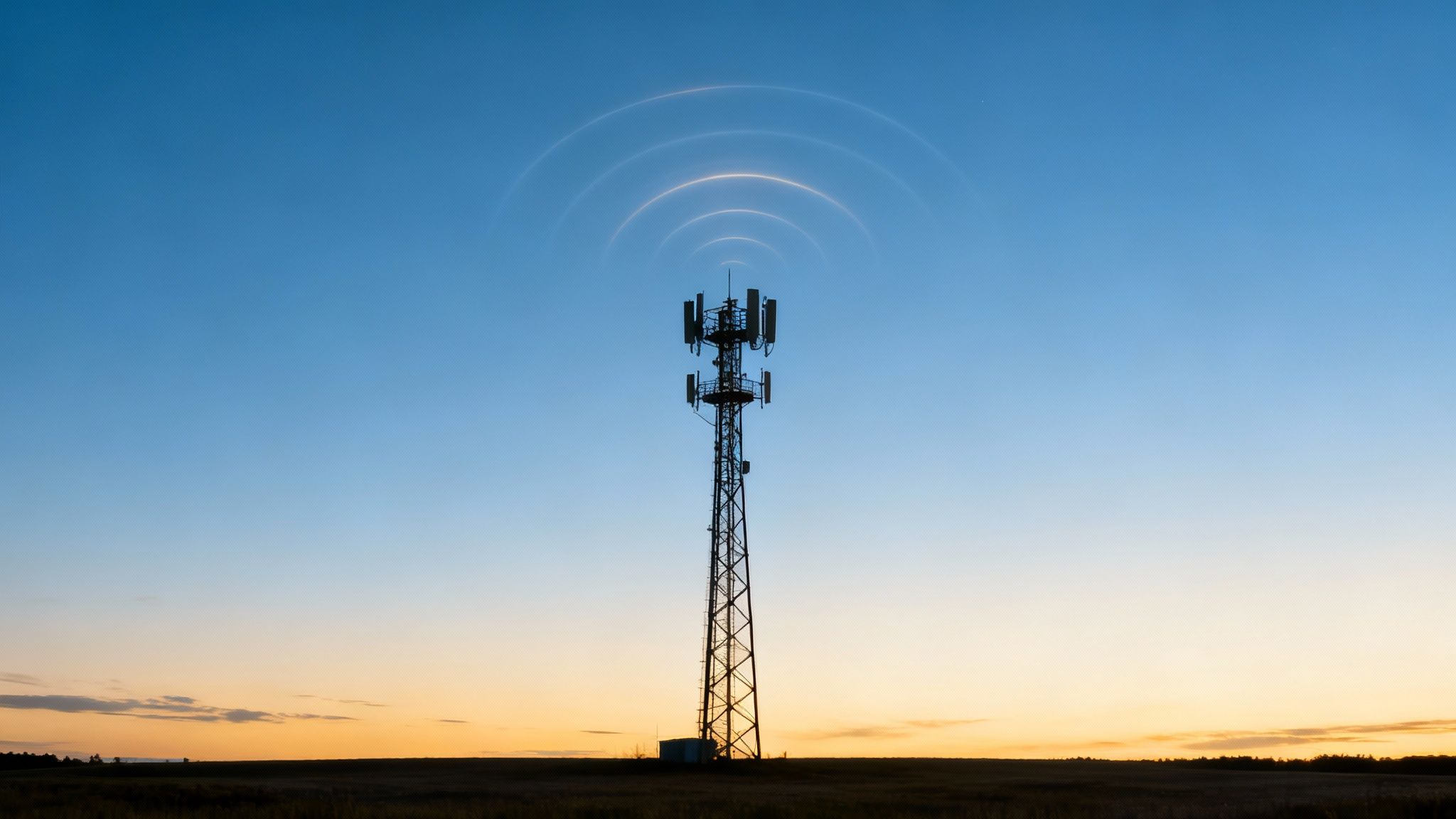
It’s easy to take cell towers for granted. They stand quietly in fields and on rooftops, but a single fault can create a ripple effect, causing dropped calls and frustrating dead zones for thousands of people.
Think of a tower less as a simple steel structure and more as a complex, living system. It has a skeleton (the structure), a nervous system (the antennas and radios), and a circulatory system (the power and backhaul). If any one of these fails, the whole system suffers. That's why this work is so much more than just fixing broken parts—it’s about safeguarding the connectivity our entire society depends on.
Why Proactive Repair is a Strategic Imperative
The demands on our wireless networks are exploding. The rollout of 5G and the ever-expanding Internet of Things (IoT) are putting immense pressure on the infrastructure we already have. This is driving huge investment and growth in the industry. In fact, the telecom tower market is projected to skyrocket from USD 57.7 billion in 2025 to USD 161.7 billion by 2034, much of it fueled by the need to modernize for 5G. You can see more data on this industry growth from Research and Markets.
For network operators, this rapid expansion sends a clear message: you can't afford to wait for something to break.
Proactive cell tower repair and maintenance aren't just line items on a budget. They're critical investments in network resilience, customer loyalty, and readiness for the future. Fixing a small issue today is how you prevent a massive outage tomorrow.
In this guide, we'll cut through the technical jargon to give you a clear, practical look at what it takes to keep a network healthy. We'll explore the core elements of a high-performing tower and show how a turnkey partner can make all the difference.
- Structural Integrity: The tower's ability to stand strong against wind, ice, and time.
- System Integrity: The health of the antennas, radios, and cables that actually send and receive signals.
- Power Integrity: The guarantee of constant power from the grid, batteries, or backup generators.
Getting these fundamentals right is the first step. To learn more about the specific components involved, you can explore our insights on modern telephony infrastructure.
What Really Goes Wrong with a Cell Tower?
From the ground, a cell tower looks simple enough—just a steel structure against the sky. But that view is deceiving. In reality, a tower is a sophisticated, high-performance system where one small failure can knock out service for thousands of people. A solid cell tower repair plan starts with knowing that the tower isn't a single object, but a collection of critical systems working together.
Think of it like a high-performance race car. The engine, suspension, electronics, and tires all have to work in perfect harmony. If one component fails, the entire car is out of the race. The same principle applies to a cell tower, and our technicians have to understand exactly what can go wrong with each part.
Structural Integrity: The Tower's Skeleton
The most obvious part of any cell site is the physical structure itself—the lattice tower or monopole, the concrete foundation, and every last nut, bolt, and guy wire holding it all together. This skeleton is in a constant battle with the environment. Fierce winds, the sheer weight of ice, and even subtle ground shifts can threaten its stability.
Corrosion is another relentless threat. Rust can quietly eat away at critical connection points, turning a solid structure into a serious safety risk. During an inspection, our crews might find something as simple as a few loose bolts or as serious as hairline cracks in the foundation. Catching these small things early is what prevents a catastrophic failure down the road.
RF Systems: The Tower's Voice and Ears
The Radio Frequency (RF) system is where the magic happens. This is the heart of the tower’s ability to communicate, encompassing the antennas sending and receiving signals, the radios processing them, and all the cables and connectors in between. When we talk about the tower's "voice and ears," this is it. Even a minor hiccup here can create major network headaches.
Some of the most common RF issues we see are:
- Antenna Misalignment: A powerful storm can nudge an antenna just a few degrees off-kilter, but that small shift can completely change its coverage pattern and create frustrating dead zones.
- Water Ingress: Moisture is the enemy. When it gets into coaxial cables or connectors, it's a primary cause of signal degradation, which technicians call "return loss," and eventual equipment failure.
- Passive Intermodulation (PIM): This is a nasty form of interference, often caused by something as simple as a loose or corroded connector. It introduces noise into the system that kills network speeds and call quality.
A corroded connector is like having static on a crystal-clear phone line. That tiny bit of interference introduces enough noise to make a clear conversation impossible, slowing down data for every single person connected to that tower sector.
Power Systems: The Tower's Lifeline
A cell tower is just a piece of metal without a reliable power source. Most sites are tied to the electrical grid, but they absolutely must have a backup plan for outages. That’s where the power system—battery backups, generators, and automatic transfer switches—comes in.
This is a frequent point of failure. Batteries wear out over time and won't hold enough charge when an outage hits. Generators might not start up because of a mechanical problem or an empty fuel tank. And if a transfer switch fails, the site won't be able to move from grid to backup power, leaving it completely dark. For a network operator, a power failure is an all-hands-on-deck emergency that demands immediate cell tower repair.
Backhaul: The Tower's Connection to the World
Finally, a tower needs a data pipeline to the core network. This link, called the backhaul, is usually a high-capacity fiber optic cable or a point-to-point microwave dish. It’s the tower's data highway to the rest of the internet and phone system.
When the backhaul goes down, the tower is effectively stranded, even if its own structure, RF, and power systems are running perfectly. This can be tricky to fix. A construction crew miles away might accidentally cut a fiber line, or a microwave dish could get knocked out of alignment in a storm. Fixing these problems often means coordinating with other providers to get that vital data link restored.
To put it all together, here’s a look at how different system failures cascade into real-world network problems.
Common Cell Tower Failure Points and Their Impact
This table breaks down the most frequent issues our technicians encounter in the field, showing how a single component failure can affect the entire network's performance.
| Tower System | Common Failure Points | Typical Causes | Network Impact |
|---|---|---|---|
| Structural | Loose bolts, corrosion, foundation cracks, guy wire tension | Weather (wind, ice), age, ground shifts, poor maintenance | Site safety risk, potential for catastrophic collapse, antenna misalignment. |
| RF Systems | Antenna misalignment, water in cables, PIM, faulty radios | Storms, installation errors, corrosion, equipment age | Dropped calls, slow data speeds, reduced coverage area (dead zones). |
| Power Systems | Dead batteries, generator failure, faulty transfer switch | Grid outages, depleted fuel, lack of maintenance, age | Complete site outage, total loss of service for all users in the area. |
| Backhaul | Fiber cuts, microwave dish misalignment, equipment failure | Accidental damage ("fiber seek"), storms, hardware age | Site becomes isolated; no data can be sent or received from the core network. |
Understanding these failure points is the first step in creating a proactive maintenance and rapid repair strategy that keeps networks online and customers connected.
From Initial Alert to Full Network Restoration
When a cell tower fails, it doesn't just go silent. It sends out a distress signal. This automated alarm, monitored 24/7 by a Network Operations Center (NOC), kicks off a rapid-response chain designed to get service back online as fast as humanly possible. The whole cell tower repair process is a well-orchestrated blend of precision, safety, and speed, turning a complex technical problem back into a seamless connection.
The journey starts the instant that alert flashes on a NOC engineer's screen. This isn't some vague "tower down" message; modern systems provide initial diagnostic data that immediately points toward the potential problem, whether it's a power failure, an RF system fault, or a backhaul connectivity issue. Think of it as the tower telling our technicians exactly where it hurts. This remote analysis is critical, as it allows the dispatch team to send the right crew with the right gear the first time.
This flowchart shows some of the most common reasons for a tower outage, from everyday wear and tear to environmental factors.
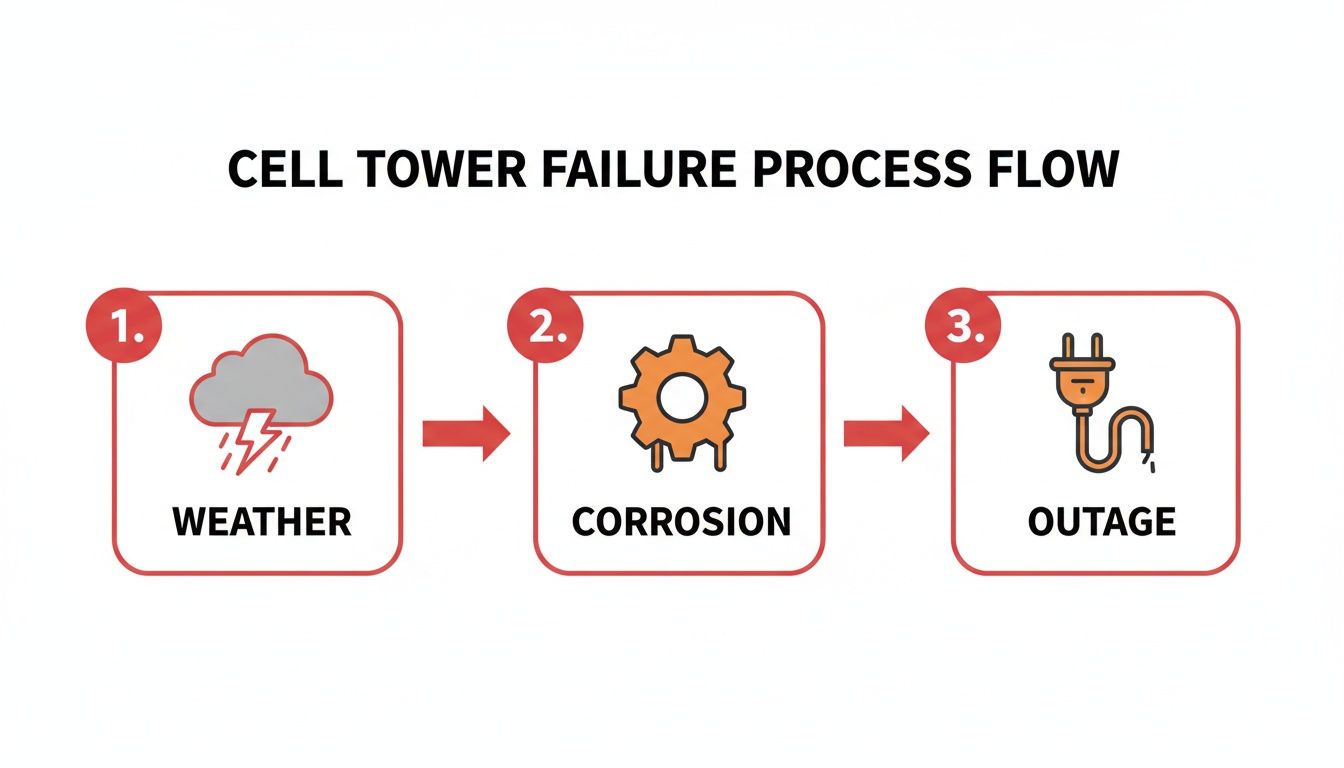
You can see how something like a big storm can trigger a cascade of issues, leading from physical stress and corrosion all the way to a service-impacting outage.
Mobilizing the Right Crew and Gear
Once a ticket is created, a certified technician crew is dispatched. These aren't general contractors. They are highly trained specialists whose truck is essentially a mobile workshop, stocked with everything from spectrum analyzers for hunting down interference to fiber optic testers for checking backhaul integrity.
Before a single tool comes out, the first priority on site is always safety. The crew runs a full Job Safety Analysis (JSA), assessing site conditions, identifying any overhead electrical hazards, and securing the work area. Only when the site is deemed 100% safe does the real diagnostic work begin.
Pinpointing the Exact Cause of Failure
On-site, our technicians turn into detectives. They use specialized equipment to gather clues and isolate the root cause, making sure they're fixing the actual problem, not just patching a symptom.
Here are a few key diagnostic techniques they use:
- Sweep Testing: Using a specialized device, technicians send signals down the coaxial cables to measure signal loss. This helps them find any damage, kinks, or water that might have gotten inside the line. It's a lot like a plumber using a camera to find a clog in a pipe.
- PIM Testing: Passive Intermodulation (PIM) is a nasty form of RF interference, often caused by something as simple as a loose or corroded connector. A PIM tester helps our crews locate the source of this "noise" that can seriously degrade network performance.
- Fiber Testing: If the backhaul link seems to be the problem, the team breaks out an Optical Time Domain Reflectometer (OTDR). This tool tests the fiber optic cable and can pinpoint the exact location of a break or weak spot, even if it's miles away from the tower itself.
- Grounding and Power Audits: For any power-related alarms, the crew will test the entire electrical system—from the main power feed and transfer switch to the battery backups and on-site generator.
This meticulous approach is non-negotiable. The global telecom market, valued at USD 61.46 billion in 2024, is projected to hit USD 165.61 billion by 2034, fueled by the relentless demand for 5G. With stakes this high, getting the repair right the first time is everything. For a closer look at these market trends, you can discover more insights about telecom tower growth on Precedence Research.
The final steps in any cell tower repair are just as critical as the repair itself. Verification and documentation are the bridge between fixing today's problem and preventing tomorrow's. This is where expertise truly shines.
Verification Testing and Closing the Loop
After the repair is done—whether that meant replacing a faulty radio, re-terminating a connector, or realigning a microwave dish—the job still isn't over. The crew performs a series of verification tests to confirm the fix was successful and that all systems are running within the carrier's strict performance standards.
This final phase includes creating detailed as-built documentation. These reports are a precise record of the work performed, complete with photos, test results, and notes on any changes to the site's configuration. This information is invaluable for future maintenance, troubleshooting, and upgrade planning. It effectively closes the loop, turning an emergency call-out into a valuable data point for managing the network over the long term. For a deeper look into our meticulous construction processes, you might be interested in our guide on large-scale renovation projects.
The High Stakes of Safety and Regulatory Compliance
Let's be blunt: cell tower repair is one of the most dangerous jobs out there. We're talking about technicians working hundreds of feet in the air, often battling wind, rain, and ice. In this line of work, there's absolutely no room for error. Safety isn't just a talking point; it's the bedrock of every single thing we do.
This is why rigorous, continuous training and certification are non-negotiable before a technician ever sets foot on a site.
Sending an uncertified or poorly trained crew to your tower is a massive gamble. You're not just risking their safety; you're putting your project timeline, your expensive network assets, and your company's reputation on the line. One mistake can trigger a cascade of problems, from catastrophic project delays and staggering regulatory fines to reputational damage that's hard to shake.
Essential Technician Certifications
Before anyone can even think about performing cell tower repair, they need a solid portfolio of industry-recognized certifications. These aren't just pieces of paper—they're proof that a technician knows how to handle the specific dangers of the job, from fall protection to navigating high-power radio frequency fields.
Here are the must-haves:
- NWSA TTT-1 & TTT-2: The National Wireless Safety Alliance Tower Technician certifications are the gold standard. They validate a tech’s skills in everything from general construction and rigging to advanced fall protection.
- OSHA 10/30: This training from the Occupational Safety and Health Administration is fundamental, teaching crews how to spot and manage common hazards on any construction site.
- RF Awareness: Technicians are constantly working near powerful antennas. This critical certification teaches them how to operate safely in Radio Frequency (RF) environments to prevent dangerous exposure.
- First Aid & CPR: When an emergency happens far from the ground, having certified first responders on the crew can mean the difference between a close call and a tragedy.
Choosing a certified partner is the single most important decision you can make to protect your project. It ensures that every person on site is trained to prioritize safety, follow established protocols, and execute their tasks with the highest degree of professionalism.
Navigating the Maze of Regulations
Beyond the immediate safety of the crew, a cell tower is a piece of highly regulated infrastructure. Following the rules isn't optional, and they cover far more than just the physical steel structure. A partner worth their salt knows how to manage this tangled web of local, state, and federal requirements, ensuring your project gets done legally and without expensive hiccups.
This regulatory landscape includes:
- FAA Lighting and Marking: The Federal Aviation Administration has strict rules for tower lighting to keep aircraft safe. A single burnt-out bulb can lead to significant fines if not addressed quickly.
- FCC Emissions Standards: The Federal Communications Commission keeps a close watch on RF emissions to prevent signal interference and protect the public. All equipment has to operate within its approved limits.
- Local Zoning and Permitting: Almost any change to a tower, whether it's an antenna swap or a new equipment cabinet on the ground, usually needs a permit from the local town or county. Forgetting this step can bring your project to a dead stop.
And when work involves digging, compliance means using smart, safe methods. For instance, using precision hydro excavation with a Vac Con truck is essential to avoid striking and damaging buried utility lines. These overlapping demands show why you need a partner who gets the entire regulatory picture, making sure every part of your cell tower repair is handled by the book.
Proactive Maintenance vs. Emergency Repair
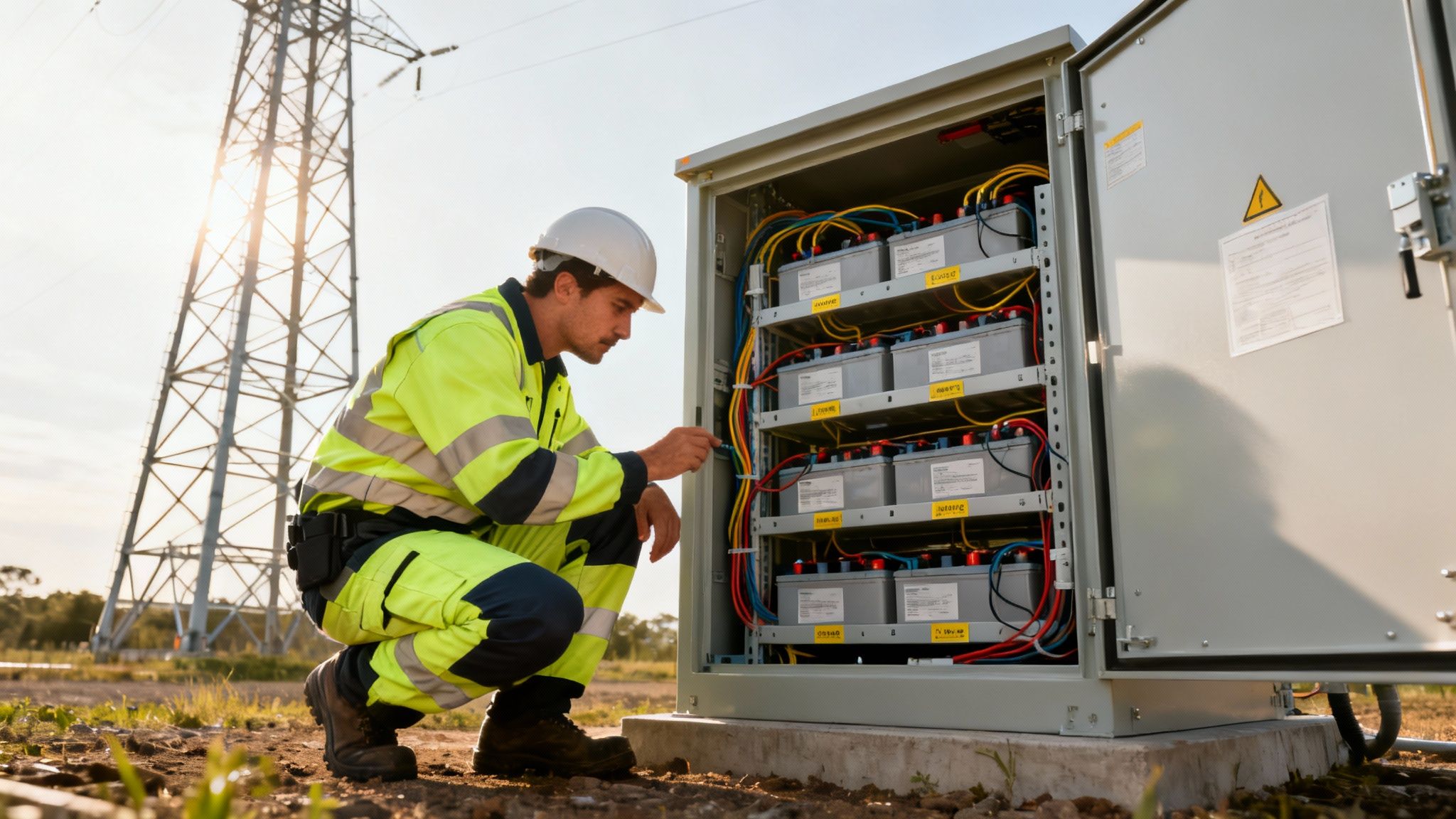
When it comes to keeping cell towers online, network operators essentially face a fork in the road. Do you stick to a schedule and change the oil, or do you wait for the engine to seize up on the freeway during rush hour? That's the core difference between proactive maintenance and reactive emergency repair, and the path you choose has massive consequences for your budget, network reliability, and the lifespan of your assets.
One approach is about planning and prevention. The other is a high-stakes, high-cost scramble to fix something that’s already broken. In our experience, the long-term ROI always, without question, favors a proactive strategy.
The Case for Proactive Maintenance
Proactive maintenance is all about spotting and fixing the small stuff before it can spiral into a network-down catastrophe. This disciplined approach means setting up a recurring schedule of thorough inspections and tune-ups, basically giving your most critical infrastructure a regular health check-up. Just like with a fleet of vehicles, a solid preventive maintenance service for your towers is the key to boosting uptime and sidestepping those incredibly expensive emergency calls.
A truly comprehensive maintenance plan should always include:
- Routine Structural Inspections: Checking for any signs of corrosion, loose bolts, or issues with the foundation.
- Grounding System Tests: Making sure the site is properly shielded from lightning strikes.
- Battery and Generator Health Checks: Confirming backup power systems are fully charged and ready to kick in the moment the grid goes down.
- Antenna and Line Sweeps: Running diagnostics on the RF systems to catch even minor signal degradation early.
By catching a corroded connector or a fading battery during a planned visit, you completely sidestep an unplanned outage and the five-alarm fire drill that comes with it.
Proactive maintenance flips the script on your budget. Instead of a reactive expense account drained by emergencies, it becomes a strategic investment. You get predictable costs, minimal downtime, and you squeeze every last bit of functional life out of your multi-million dollar infrastructure.
The High Cost of Emergency Repairs
An emergency repair, on the other hand, is controlled chaos. When a tower goes dark, the clock starts ticking. Every minute of downtime means lost revenue and frustrated customers, putting immense pressure on everyone involved. This reactive model is, by its very nature, far more expensive and disruptive.
For starters, emergency responses command premium rates for 24/7 mobilization. You're paying top dollar to get crews and specialized gear on-site immediately, often in the middle of the night or on a holiday. The diagnostic work happens under duress, which raises the chances of a misdiagnosis or a quick patch that doesn't solve the root problem. On top of that, you're often paying for expedited shipping on replacement parts, adding yet another layer of cost.
But the true price of an emergency goes way beyond the final invoice. A significant outage can tarnish a brand's reputation overnight and lead directly to customer churn. It only takes one bad service failure to wipe out months of goodwill you've built with subscribers.
Proactive Maintenance vs. Emergency Repair: A Cost-Benefit Analysis
When you put the two approaches side-by-side, the financial and operational benefits of a planned maintenance strategy become crystal clear. It's not just about avoiding problems; it's about running a smarter, more resilient network.
| Factor | Proactive Maintenance | Emergency Repair |
|---|---|---|
| Cost Structure | Predictable, budgeted operational expense. | Unpredictable, high-cost capital expense. |
| Network Downtime | Minimal, often scheduled during low-traffic hours. | Significant and unplanned, impacting peak usage. |
| Resource Allocation | Planned scheduling of crews and equipment. | Immediate, disruptive mobilization at premium rates. |
| Asset Lifespan | Maximized through consistent care and early intervention. | Shortened due to stress and run-to-failure cycles. |
| Brand Reputation | Strengthened by consistent network reliability. | Damaged by frequent or prolonged service outages. |
Ultimately, choosing to invest in proactive cell tower repair and maintenance is about more than just preventing failures. It's about optimizing performance, protecting your brand, and safeguarding the future of your network.
Choosing the Right Turnkey Repair Partner
Picking a partner to handle your cell tower repairs is one of the most critical decisions a network operator will make. Get it right, and you secure your network's reliability and protect a massive investment. Get it wrong, and you're in for a world of expensive delays, safety risks, and nagging performance problems. The goal isn't just to find a contractor; it's to find a true turnkey partner—a single team that owns every piece of the puzzle, from the first call to the final sign-off.
A turnkey solution takes an inherently messy process and makes it manageable. Instead of you having to coordinate separate teams for diagnostics, structural work, RF engineering, and closeout packages, you have one phone number to call. This single point of accountability eliminates the communication breakdowns and administrative headaches that plague multi-vendor projects, ensuring a smooth, efficient workflow.
Vetting for Proven Expertise and Safety
When you start evaluating potential partners, you need to look past the sales pitch and the shiny list of services. Real-world experience is what matters. Ask for detailed case studies and don't be shy about calling their references. You want to hear how they’ve navigated a catastrophic storm recovery or managed a complex, multi-site upgrade under a tight deadline. Their history should speak for itself.
Above all else, their commitment to safety must be absolute. This is the one area with zero room for compromise. Confirm that their technicians hold all the key certifications, like NWSA TTT-1 and OSHA 30. A company that invests heavily in safety and training is one that will protect your assets, your brand, and your people from unnecessary risk.
A true turnkey partner doesn’t just patch the immediate issue. They bring the strategic oversight and detailed documentation needed to prevent the next failure. That end-to-end ownership is what separates a good contractor from a great infrastructure partner.
End-to-End Capabilities and Rapid Mobilization
The right partner has the in-house talent and the right equipment to tackle any problem that comes their way. Their skill set needs to cover every critical system on that tower, so they can solve the problem without having to subcontract essential work, which just adds delays and complexity.
As you weigh your options, here’s what you should be looking for:
- Comprehensive Diagnostics: Do they have the gear and expertise for sophisticated PIM hunting, sweep testing, and fiber optic analysis?
- Multi-Disciplinary Crews: Are their field teams certified to work at height on structural components, configure sensitive RF systems, and troubleshoot complex power and backhaul issues?
- Emergency Response: Can they guarantee 24/7/365 mobilization? You need a team that can get boots on the ground well within your SLA window, no matter when the call comes in.
- Meticulous Documentation: Do they deliver the kind of detailed as-built reports and closeout packages your engineering and asset management teams need for future planning?
Ultimately, choosing a cell tower repair partner is about building trust. You need to be confident in their ability to execute under pressure when the stakes are high. The right team becomes a seamless extension of your own, wholly dedicated to the health and performance of your network.
To see how a single, accountable team can manage your infrastructure needs, you can explore our full range of turnkey telecom services. A partner with these qualities ensures your network stays strong, reliable, and ready for whatever comes next.
Your Top Cell Tower Repair Questions Answered
When you're managing a network, questions about tower repairs are bound to come up. We get it. Let’s walk through some of the most common ones we hear from project managers and operators, clearing up the key details you need to know.
What Is the Most Common Cause of Cell Tower Failure?
It’s easy to picture a tower getting zapped by lightning or twisted by a tornado, but the real day-to-day culprits are often much quieter. More often than not, it's a power system failure that takes a site offline. This could be anything from a utility grid issue to a backup battery bank giving out or a generator that just won't kick on when it's needed most.
Right behind power problems are issues within the Radio Frequency (RF) system. You’d be surprised how small the cause can be. A gust of wind might knock an antenna just slightly off-kilter, or a bit of moisture works its way into a coaxial cable. Sometimes, a single corroded connector is all it takes to degrade performance and disrupt service for thousands of people.
How Long Does a Typical Cell Tower Repair Take?
This is the big question, and the answer really depends on the complexity of the job. There's no single timeline, but we can break it down into a few common scenarios:
- Minor Fixes: Things like rebooting a stubborn radio or swapping out a simple component are usually quick. Once a tech is on site, they can often have the site back online in just a few hours.
- Moderate Repairs: A more involved job, like replacing a damaged antenna or hunting down a tricky interference problem, will likely take up a full day of focused work.
- Major Overhauls: This is where things get serious. Structural damage from a storm or a severed fiber backhaul line isn't a quick fix. These repairs can stretch over several days, especially if we need to bring in heavy equipment, coordinate with utility companies, or get specialized engineering approvals.
The most critical factor in any of these cases? Quick mobilization. Having a partner who can get a certified crew rolling immediately is the key to shrinking downtime, no matter how big or small the problem is.
The true measure of a repair's efficiency isn't just the time spent on-site. It includes the initial diagnosis, mobilization, verification, and final documentation. A seamless process from end to end is what defines a successful and rapid network restoration.
Why Is Backup Power So Important for Cell Towers?
Simply put, a cell tower is just a tall piece of steel without electricity. If the grid goes down and there's no reliable backup power, you've instantly created a coverage black hole. This is a huge problem anytime, but it becomes a public safety issue during emergencies when communication is absolutely vital.
The reliance on these backup systems is also a massive operational and environmental concern. To keep service uninterrupted, the telecom industry consumes over 2 billion liters of diesel every year just for backup power. That fuel can easily account for 40% to 50% of a site's total operational costs. These numbers show just how high the stakes are, making meticulous power system maintenance a financial and social responsibility. You can read the full analysis on telecom tower market trends to get a deeper look at these industry dynamics.
Can Any Contractor Perform Cell Tower Repairs?
Absolutely not. This is one area where you can't cut corners. Cell tower work is a highly specialized, high-risk profession. It demands specific training and certifications that a general contractor simply won't have. They won’t know how to work safely hundreds of feet in the air, handle high-power RF equipment, or troubleshoot a complex telecom system.
Hiring an unqualified crew puts your company at enormous risk for liability, jeopardizes worker safety, and often leads to shoddy work that causes even bigger network headaches down the road. You should always work with a firm whose technicians hold the right credentials, like NWSA TTT-1 and OSHA 30, as a baseline.
Keeping your network up and running demands a partner who has proven experience in every aspect of cell tower repair and maintenance. Southern Tier Resources delivers comprehensive, turnkey solutions—from emergency dispatch to proactive upkeep—all handled by certified professionals who put safety and performance first.
To see how we can safeguard your infrastructure and maximize your network's uptime, visit us at https://southerntierresources.com.