Fiber to the Home (FTTH) is all about running a dedicated fiber optic cable directly from our central office straight to a customer's doorstep—whether that's a home or a business. Think of it as the ultimate upgrade for internet connectivity. It completely replaces the old, tired copper wiring with a pure fiber line, delivering the kind of speed, reliability, and sheer bandwidth that modern life demands.
Why the Shift to FTTH is No Longer Optional
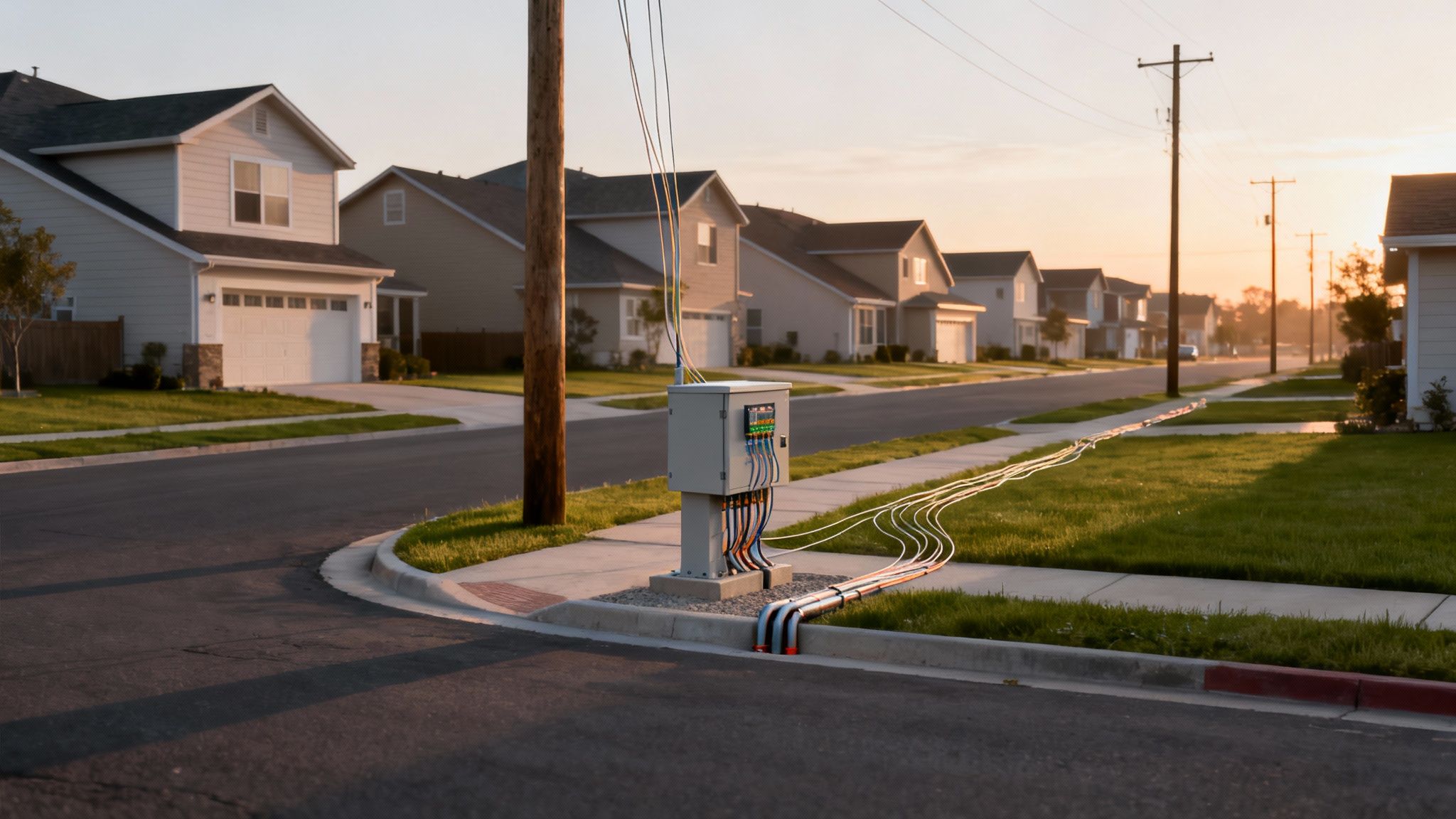
The push towards FTTH fiber to home isn't just another incremental network update; it's a foundational rebuild for our digital future. For telecom carriers, internet service providers, and even municipalities, running fiber directly to subscribers has become a critical move for staying relevant and competitive. This architecture gives each customer their own dedicated line, which means no more sharing bandwidth and no more frustrating slowdowns during peak hours.
It's like ripping out an old, narrow water pipe that serves an entire neighborhood and replacing it with a massive, high-pressure main for every single house. That's the kind of game-changing leap we're talking about with FTTH. It's an investment that prepares a network for whatever comes next, easily handling the ever-growing demands of 4K streaming, remote work, smart home ecosystems, and online gaming.
Why the Investment is Surging Now
The rush to build out fiber isn't happening in a vacuum—it's fueled by overwhelming market demand and undeniable strategic benefits. The global fiber-to-the-home market is exploding, projected to grow from USD 62.64 billion in 2024 to USD 199.40 billion by 2034. That growth represents a massive compound annual growth rate of 12.3%, a clear sign that serious capital is flowing into this infrastructure to meet customer expectations.
But this isn't just about offering faster downloads. It's about building a powerful network asset that delivers tangible advantages:
- Superior Performance: Fiber delivers incredibly low latency and symmetrical upload/download speeds. This is absolutely essential for real-time applications like smooth video calls, cloud computing, and competitive online gaming.
- Enhanced Reliability: Unlike copper, fiber is immune to electromagnetic interference and holds up much better against harsh weather. This translates to fewer service calls, less downtime, and lower long-term maintenance costs.
- Future-Proof Scalability: A single strand of fiber has almost limitless bandwidth capacity. The infrastructure you lay today will be more than capable of handling the applications and technologies of tomorrow without needing a costly rip-and-replace.
A well-planned FTTH deployment isn't just a capital expense—it's a lasting competitive advantage. You're building a scalable foundation that can support future revenue streams from 5G backhaul, edge computing, and advanced IoT services.
Understanding the Core Technology
At its core, an FTTH network simply sends data as pulses of light through a glass strand directly to the user. This direct path completely bypasses the bottlenecks and signal degradation that plague legacy copper or coaxial cable networks, especially over long distances. To really get a handle on this technology, exploring dedicated Fiber Optic Services can offer some great insights.
For any leader planning a deployment, getting a firm grasp of the technology is the crucial first step. This guide is designed to be your starting point, showing how the right partner can turn a complex infrastructure project into a high-performing asset that generates real revenue and meets the needs of our hyper-connected world.
Choosing Your FTTH Network Blueprint
Every great FTTH fiber to home network is built on a solid architectural decision. This choice is more than just a technical detail; it’s the blueprint that will define your network's cost, performance, and ability to grow for years to come. Before diving in, it’s helpful to have a firm grasp on the basics of network infrastructure, as these core principles are the foundation for everything we’ll discuss.
In the world of FTTH, two primary designs dominate the conversation: Passive Optical Networks (PON) and Active Ethernet (AE). Both can deliver incredible speeds, but they get there in very different ways. Understanding their unique philosophies is key to matching the right technology to your business case and target market.
The Efficiency of Passive Optical Networks
Think of a Passive Optical Network (PON) like a tree. You have one main fiber cable—the trunk—running from your central office. As it extends into a neighborhood, it’s split at various points using simple, unpowered optical splitters. These splitters act like branches, fanning out the signal to many different subscribers from that single trunk line.
This point-to-multipoint approach is the undisputed champion for residential FTTH. Why? It's incredibly cost-effective. By sharing one fiber among 32 or even 64 users, the model drastically cuts down on the amount of fiber you need to lay and the number of ports required back at your central office. This shared infrastructure is what makes large-scale deployments in dense suburban and urban areas economically feasible.
Key takeaways for PON:
- Shared Bandwidth: Everyone on a particular fiber branch shares the total available bandwidth. Modern PON standards provide plenty of speed for most homes, but it's a shared resource, not a dedicated one.
- Lower Equipment Cost: The biggest win is financial. Fewer central office ports and powerless splitters in the field mean lower capital and ongoing energy costs.
- Simplified Maintenance: With no powered electronics out in the field between you and the customer, there are simply fewer things that can break.
The Power of Active Ethernet
If PON is a shared tree, Active Ethernet (AE) is a private, dedicated highway built for one. Also known as point-to-point, this architecture dedicates an entire, unshared strand of fiber directly from the central office switch all the way to a single customer. No splitters, no sharing, no compromises.
This is the gold-standard for high-value business customers. Think data centers, hospitals, financial institutions, or any enterprise that can't afford to have their connection impacted by a neighbor's streaming habits. The dedicated, symmetrical bandwidth of AE is perfect for mission-critical services that come with strict service level agreements (SLAs).
Active Ethernet provides the ultimate in performance and security. By dedicating a fiber strand to each customer, you eliminate bandwidth contention and offer a service level agreement (SLA) with the highest possible confidence.
The benefits of Active Ethernet are crystal clear:
- Dedicated, Symmetrical Bandwidth: The speed you sell is the speed they get, period. Symmetrical upload and download speeds are guaranteed and completely unaffected by other users.
- Enhanced Security: A direct, physical connection is inherently more secure, as data isn't broadcast across a shared medium.
- Greater Scalability: Upgrading a single customer’s speed is a simple software change that has zero impact on anyone else.
Of course, this premium performance comes at a premium price. Active Ethernet requires significantly more fiber in the ground and a dedicated, and often expensive, port at the central office for every single subscriber.
PON vs Active Ethernet: A Strategic Comparison
Choosing between PON and AE isn't just a technical exercise; it's a strategic business decision. You're balancing the capital efficiency and scalability of PON against the raw, guaranteed performance of Active Ethernet. This table breaks down the key differences to help guide your choice.
| Attribute | Passive Optical Network (PON) | Active Ethernet (AE) |
|---|---|---|
| Architecture | Point-to-Multipoint (Shared) | Point-to-Point (Dedicated) |
| Best For | Residential, high-density areas, SMBs | Enterprise, data centers, mission-critical |
| Bandwidth | Shared among multiple users | Dedicated and guaranteed per user |
| Cost (CapEx) | Lower (less fiber, fewer CO ports) | Higher (more fiber, one CO port per user) |
| Cost (OpEx) | Lower (no powered field electronics) | Higher (powered switches, more ports) |
| Scalability | Good for adding many users at once | Excellent for upgrading individual users |
| Security | Good, with encryption | Excellent, due to physical isolation |
| Reach | Typically up to 20 km | Can extend over 100 km with optics |
Ultimately, the right choice depends entirely on your market. Are you connecting a sprawling suburban development or a high-tech business park? Many network operators find success with a hybrid approach, deploying PON for their residential footprint and reserving Active Ethernet for high-revenue commercial clients.
From Blueprint to Reality: The Deployment Journey
Taking an FTTH design off the page and turning it into a live, cash-flowing network is a marathon, not a sprint. This is where the real work begins—a multi-stage process that demands sharp planning, precision engineering, and expert hands on the ground to navigate the inevitable real-world hurdles. Frankly, this is where a project’s success or failure is decided.
The journey starts long before the first shovel ever hits the dirt. It kicks off with detailed engineering and route planning, where every single foot of the proposed network gets mapped out. This isn't just about drawing lines; it's about building a comprehensive construction plan that finds the best path for the fiber, factoring in everything from terrain and existing infrastructure to the impact on the local community.
Mastering the Pre-Construction Maze
One of the most consistently underestimated and time-consuming phases is make-ready engineering. This is the critical work of prepping existing utility poles and underground conduits for the new fiber attachments. It involves a ton of moving parts: structural analysis of poles, negotiating attachment rights with other utility owners, and coordinating any needed pole replacements or modifications.
Getting this right is a delicate dance of communication and negotiation. A single misstep here can trigger major delays and blow up your budget, which is why it's such a common bottleneck for FTTH projects.
Securing permits and rights-of-way is almost always the longest lead-time item in any deployment. Proactive engagement with municipalities, DOTs, and utility owners isn't just good practice—it's absolutely essential for keeping your project on schedule and avoiding costly standstills.
Successfully navigating this administrative maze requires deep local knowledge and established relationships. Without an experienced partner managing the process, even the most technically sound network design can get stuck in limbo for months, pushing back your time to market and weakening your business case.
A Closer Look at Network Architectures
The network architecture you choose—whether it's PON or Active Ethernet—directly shapes the deployment journey. This diagram illustrates how the data flows are distinct for each approach, all the way from the central office to the subscriber's home.
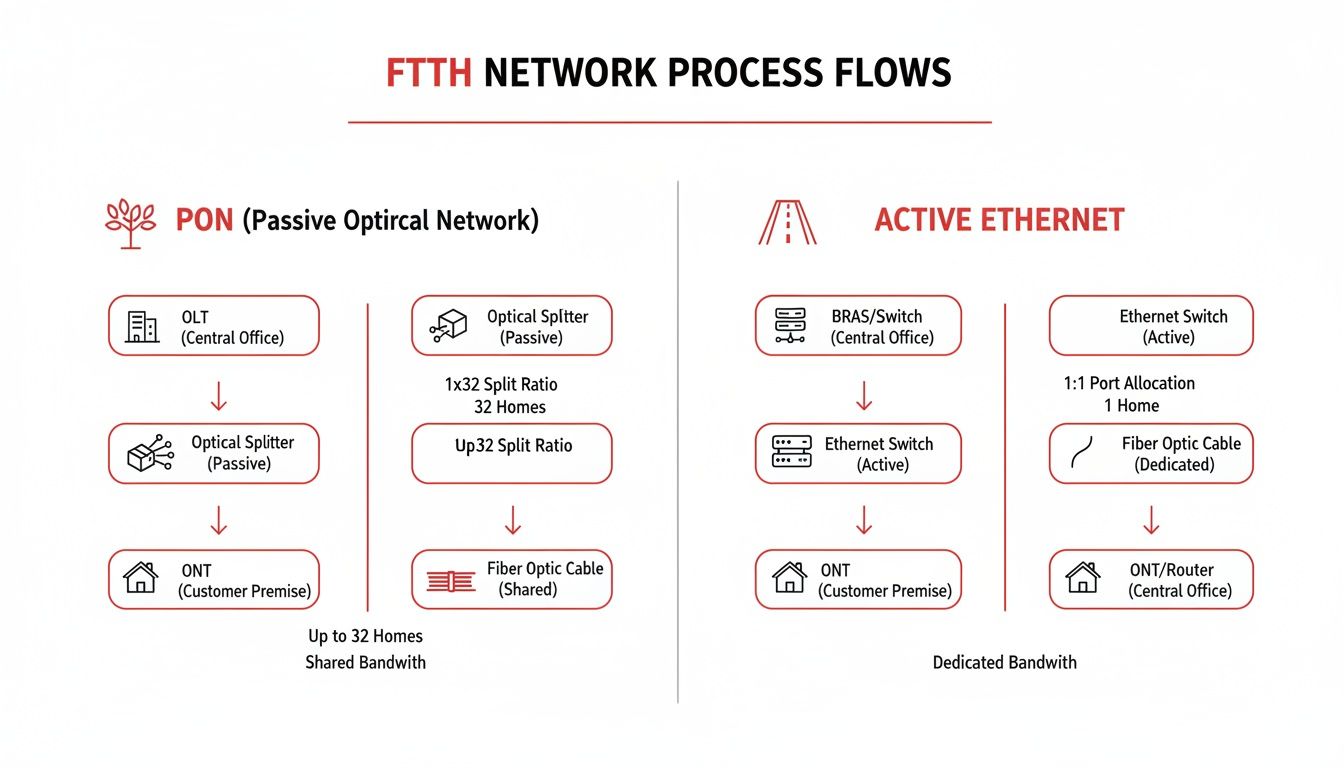
You can see how PON's efficient, tree-and-branch model is perfect for residential areas, while Active Ethernet's direct, dedicated connection is more like a private highway for business clients. Each design serves a very different strategic purpose.
The Acceleration of Fiber Deployment
The momentum behind FTTH is impossible to ignore. In the U.S., fiber deployments hit a new record, passing 10.3 million homes in 2024, a clear sign of an unprecedented acceleration in buildouts. This boom is fueled by public-private partnerships and major funding initiatives like the BEAD program, which are pushing the combined value of FTTH projects toward an estimated USD 30 billion by 2026.
This rapid expansion puts even more pressure on providers to execute flawlessly. The trick is managing the entire lifecycle seamlessly, from the first design concepts all the way to a fully tested and operational network. For a deeper look at what this entails, see our guide on end-to-end fiber deployment services.
Key Phases of the Deployment Lifecycle
A successful FTTH rollout isn’t one single action but a sequence of carefully managed stages. Each phase builds on the last, and each requires specialized expertise to maintain quality and keep costs in check.
- High-Level Design and Feasibility: This is the starting block. It involves market analysis, pinpointing target service areas, and creating a preliminary network design and budget. It answers the big question: "Does the business case for this build actually make sense?"
- Detailed Engineering and Route Planning: Here, engineers create the detailed construction prints that specify exact fiber routes, splice locations, and equipment placements. Think of it as the master plan that guides the entire construction effort.
- Permitting and Make-Ready: This is the administrative gauntlet. It involves securing all necessary permits, easements, and attachment agreements. It’s often the most unpredictable part of the timeline and requires relentless follow-up.
- Construction and Installation: Skilled crews bring the plan to life, whether they’re stringing aerial fiber on poles or using trenching and boring for underground routes. Safety and quality control are everything at this stage.
- Splicing, Testing, and Activation: Technicians meticulously fuse the glass fibers to create a continuous path for light. The network is then put through rigorous testing for signal loss and performance before it gets the green light for service.
- As-Built Documentation: Finally, detailed records are created that show exactly how the network was built in the real world. This documentation is invaluable for future maintenance, troubleshooting, and expansions.
Managing all these interconnected phases demands a unified approach. By working with a single, accountable partner like Southern Tier Resources to oversee the entire journey, you can minimize risk, simplify communication, and get to market much faster.
Building the Physical Network That Lasts
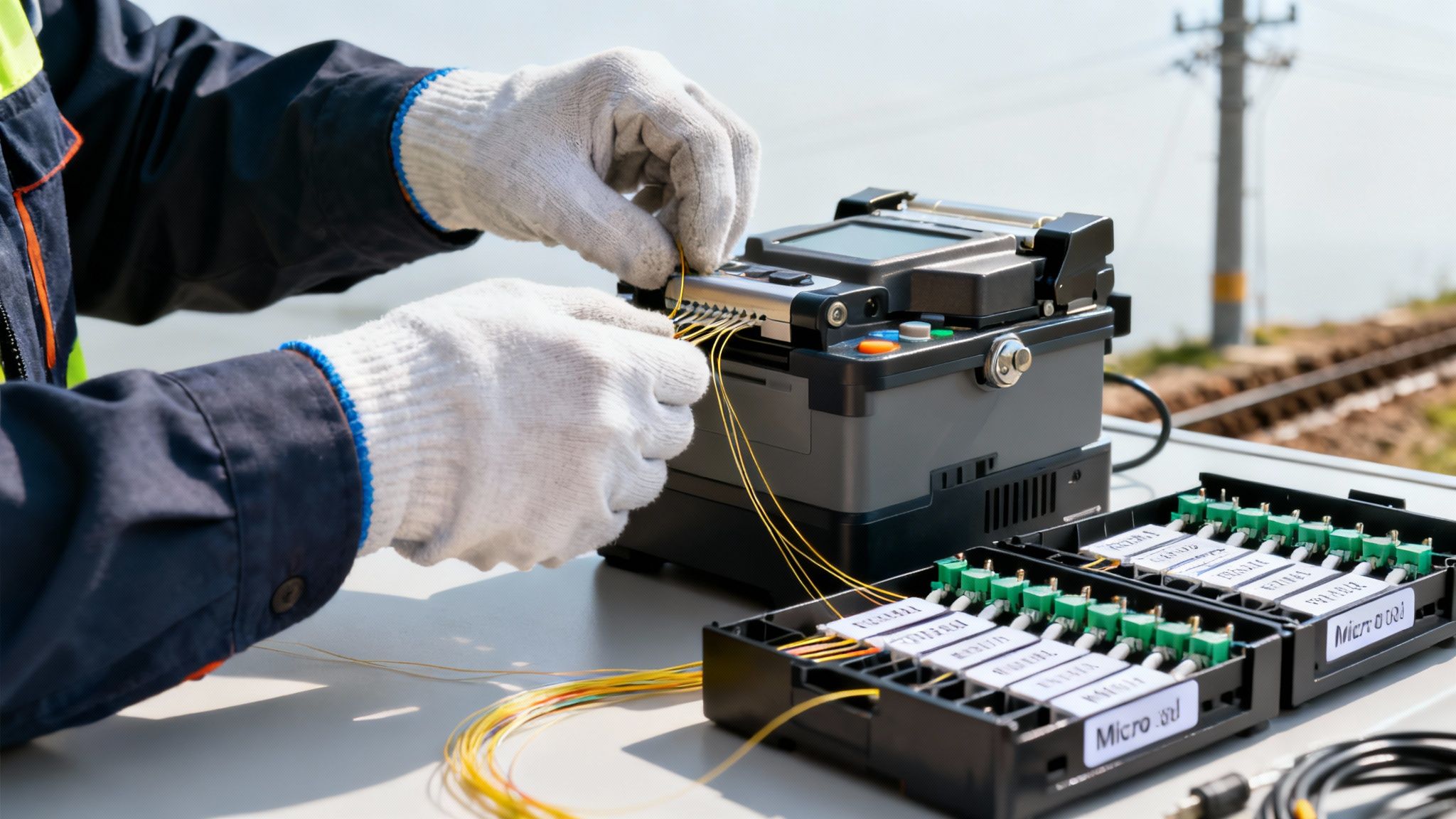
With the blueprints approved and the permits secured, it’s time for your ftth fiber to home network to leave the drawing board and enter the real world. This is the construction phase, where skilled execution is everything. It's the point where engineering designs become a tangible, high-performance asset built to last for decades.
The first major decision comes down to the physical path the fiber will take. Will it be suspended on utility poles or buried safely underground? This choice sets the stage for the entire construction strategy, and each path has its own set of trade-offs. The right answer often depends on the local terrain, what infrastructure already exists, and the project's bottom line.
Choosing the Right Construction Method
Aerial construction—lashing fiber to existing utility poles—is often the quickest and most cost-effective route, especially in suburban and rural areas where pole lines are already in place. The downside? The network is exposed to the elements, from ice storms and falling trees to vehicle accidents, which can drive up long-term maintenance costs.
Placing the fiber underground offers far greater protection and reliability. It's also the more aesthetically pleasing option and is often required in dense urban centers. Of course, this means more significant civil work, so picking the right underground technique is key to managing costs and keeping public disruption to a minimum.
There are two go-to methods for underground builds:
- Directional Boring: This is a precision technique. Crews can install conduits under roads, driveways, and even rivers with very little surface disturbance, making it perfect for navigating complex or congested areas.
- Micro-Trenching: A less invasive method where a very narrow, shallow slot is cut into pavement, usually along a curb. The fiber conduit is dropped in, and the trench is sealed up right away. It's a fast and efficient way to deploy fiber in dense city environments.
Choosing between them is a strategic call. Directional boring offers deeper, more protected placement, but micro-trenching delivers on speed and lower restoration costs. An experienced construction partner will analyze the route foot by foot to determine the best mix of techniques for a build that is both efficient and incredibly durable.
The Critical Art of Fiber Splicing
If the fiber optic cable is the network’s highway, then each splice is a critical interchange. Splicing is the painstaking process of joining two fiber optic cables to create a single, unbroken path for light to travel. A bad splice is a huge liability, introducing signal loss (attenuation) that kills performance and can knock out service for an entire neighborhood.
There are two main ways to splice fiber:
- Fusion Splicing: This is the industry gold standard. A specialized machine perfectly aligns the glass cores of the two fibers and then uses an electric arc to literally melt them together. The result is a nearly flawless connection with almost zero signal loss.
- Mechanical Splicing: This method uses a small mechanical clamp to hold the two fiber ends in perfect alignment. It's quicker and the equipment is cheaper, but it almost always results in higher signal loss and isn't as permanent as a fusion splice.
For a carrier-grade ftth fiber to home network, fusion splicing isn't just a preference; it's a requirement. Its precision minimizes signal degradation, which ensures the network runs at its full potential and drastically cuts down on future troubleshooting and expensive truck rolls.
This work demands highly skilled, certified technicians. Every splice is a potential point of failure. The best crews work in controlled environments, like specially equipped vans, to keep dust and moisture away from the delicate fibers. After each splice, they use advanced tools like an Optical Time Domain Reflectometer (OTDR) to test and verify the connection's quality before it’s sealed in a protective enclosure. You can see how these details fit into the bigger picture by reviewing our information on comprehensive fiber optic network construction.
In the end, the long-term value of your FTTH network is forged during the physical build. From choosing the right construction method to the precision of the final splice, every detail matters. Investing in experienced crews who live and breathe quality and safety ensures you’re not just building a network for today, but a reliable foundation that will serve your customers for decades.
Building the Business Case for Your FTTH Investment
For any leader, an investment as massive as an ftth fiber to home network has to stand on solid financial ground. The technology is impressive, sure, but the numbers have to make sense. Building a winning business case isn't just about acknowledging the initial sticker shock; it's about creating a clear, data-driven model that shows a real path to long-term profitability.
This means getting granular. You need a detailed analysis of every cost you'll incur and every dollar of revenue you can realistically expect. The end goal is a powerful Return on Investment (ROI) model that justifies the upfront capital and lays out a roadmap for sustainable growth.
Identifying Key Cost Drivers
The first step is getting a brutally honest look at your major cost drivers. These expenses run much deeper than just the price of fiber optic cable, and they can swing wildly depending on the project's scope, geography, and the construction methods you choose.
Any serious financial plan has to account for these four primary categories:
- Materials and Equipment: This is all the physical gear. Think fiber optic cables, conduits, central office electronics, and the optical network terminals (ONTs) that go into every subscriber's home.
- Labor: A huge chunk of your budget will go to skilled labor for construction, splicing, and testing. These costs are directly tied to local market rates and whether you can even find experienced crews.
- Permitting and Make-Ready: The administrative slog of securing rights-of-way, pole attachment agreements, and municipal permits is a classic source of budget overruns. It's often underestimated and can cause major delays if you're not on top of it.
- Construction: This is usually the single biggest line item. The actual physical build—whether you’re running it aerial, using directional boring, or micro-trenching—is where the bulk of the capital goes.
Here’s a critical mindset shift: stop focusing on upfront CapEx and start thinking about the long-term Total Cost of Ownership (TCO). A high-quality initial build might cost more today, but it will drastically slash your ongoing maintenance, minimize truck rolls, and lower your operational expenses for the next 20+ years.
Modeling Revenue and Profitability
Once you have a firm handle on costs, the conversation pivots to revenue. A strong business case lives or dies by how accurately you can forecast subscriber take rates and how much revenue each of those customers will generate. This is where your market analysis really has to shine.
Pay close attention to two metrics:
- Subscriber Acquisition Cost (SAC): This is your all-in cost to sign up a new customer—marketing, sales commissions, installation, the whole nine yards. The lower you can get this number, the faster you get to profitability.
- Average Revenue Per User (ARPU): This is simply the average monthly bill for your subscribers. A well-built FTTH network gives you the power to sell premium, high-margin services like gigabit speeds and managed Wi-Fi, which directly pumps up your ARPU.
The market demand is definitely there. For perspective, the U.S. ftth fiber to home market hit USD 10.7 billion in 2024 and is on track to nearly double to USD 21.5 billion by 2030. That growth, a compound annual rate of 12.7%, shows just how hungry homes and businesses are for real high-speed fiber. Digging into detailed market growth forecasts for fiber to the home can help you sharpen your own financial models.
From Cost Center to Profit Engine
A well-planned FTTH deployment isn't just a capital expense; you're creating a powerful, long-term asset. By meticulously planning for costs, forecasting revenue with real-world data, and focusing on a quality build that minimizes TCO, you can turn your network from a complex project into a reliable engine for growth.
The right turnkey partner helps you navigate every financial and operational detail, ensuring your business case is not only compelling on paper but actually achievable in the field. Learn more about how we help clients achieve their deployment and revenue goals.
Your FTTH Deployment Questions Answered
Even with a rock-solid plan, you’re bound to have questions when it comes to an ftth fiber to home network build. Let’s tackle some of the most common challenges and operational questions that pop up, pulling together the key ideas we've covered.
What Are the Biggest Challenges in an FTTH Deployment?
It’s rarely the technology that trips up a project; it's the logistics and red tape. The biggest headaches almost always come from securing rights-of-way and getting the right permits from cities, counties, and utility pole owners. These processes can drag on for months, bogging down even the most well-thought-out plans.
Then there's the make-ready engineering—getting existing utility poles ready for new fiber. This step is notorious for being more complex and expensive than teams initially expect. On top of that, finding enough skilled technicians for specialized jobs like construction and fiber splicing can seriously throw off your timeline and impact the quality of the final network.
A turnkey partner proves their worth here. By managing the entire process, they bring established relationships and seasoned crews to the table, helping you sidestep these administrative and logistical nightmares.
How Long Does It Take to Build an FTTH Network?
There’s no single answer for this—it all comes down to the project's scale, the local geography, and your deployment strategy. A small build in a single subdivision might take a few months, while a city-wide network could easily be a multi-year effort.
The timeline really hinges on a few key variables:
- Population Density: A dense urban core presents a completely different set of challenges than a sprawling rural deployment.
- Construction Method: Stringing aerial fiber on existing poles is almost always faster than digging trenches or boring for an underground build.
- Permitting Efficiency: How quickly and cooperatively local authorities move on permits can make or break your schedule.
Good, proactive planning and experienced project management are what make the difference between a predictable timeline and one that constantly shifts.
Why Is As-Built Documentation So Important?
Think of as-built documentation as the definitive, final blueprint of your network exactly as it exists in the real world. It contains the detailed maps of every fiber route, the precise location of every splice, and the placement of all your equipment. This isn't just paperwork; it's the operational lifeblood of your network.
Sooner or later, a service outage will happen. With accurate as-builts, technicians can pinpoint the problem in minutes, not days, drastically reducing costly downtime and keeping your customers satisfied. This documentation is also crucial for planning any future upgrades or expansions.
Without it, you're flying blind. Incomplete or sloppy records lead to expensive and frustrating "rediscovery" projects down the line, where crews have to manually re-map everything. That's why precise as-builts are a non-negotiable part of any professional ftth fiber to home deployment.
Ready to turn your FTTH blueprint into a high-performing network asset? The team at Southern Tier Resources has the end-to-end expertise to manage every phase of your deployment, from engineering and permitting to construction and splicing. Learn more about our turnkey fiber solutions.