When someone talks about Fiber-to-the-Home (FTTH), they’re describing the gold standard for residential internet. It means a fiber optic cable runs directly from the provider's central network all the way into a customer's house, completely replacing the old, slower copper lines.
The Superhighway to Your Digital Life
Think of your old internet connection as a bumpy, single-lane country road. Sure, it gets you there, but it’s slow, gets congested easily, and struggles with heavy traffic. FTTH is a completely different animal. It’s like having a dedicated, multi-lane superhighway built straight to your front door—no traffic jams, no slowdowns, just pure, unadulterated speed.
This isn't just a small step up; it’s a fundamental shift in how we connect to the digital world. That direct fiber line allows for symmetrical speeds, meaning your upload and download capabilities are equally fast. For anyone working from home, gaming, or creating content, this is an absolute game-changer.
Why FTTH is a Necessity, Not a Luxury
The way we live our lives online has created an insatiable demand for better, more reliable internet. The average household is now a busy hub of digital activity, juggling dozens of connected devices and bandwidth-heavy tasks all at once. An FTTH home is built from the ground up to handle this kind of load without breaking a sweat.
Here’s what’s driving the massive shift to fiber:
- The Work-From-Home Revolution: Crystal-clear video calls, instant cloud backups, and secure VPN connections all depend on the kind of stable, high-speed upload performance that only fiber can deliver consistently.
- Next-Generation Entertainment: Streaming movies in 4K or 8K, along with competitive online gaming, requires massive download capacity and ultra-low latency to eliminate frustrating lag and buffering.
- The Rise of the Smart Home: From smart thermostats and voice assistants to security cameras, the ever-growing ecosystem of Internet of Things (IoT) devices needs a robust network to function. A key benefit of FTTH is its ability to support sophisticated systems, including a modern home security system installation, ensuring everything runs smoothly and reliably.
This isn't just a niche trend; it's a market explosion. The global FTTH market is on track to grow from USD 77.89 billion in 2026 to an incredible USD 185.45 billion by 2031. That kind of rapid growth is a clear indicator of just how essential ultra-fast internet has become. You can dig deeper into the trends shaping the FTTH market to see the full picture.
An FTTH network isn't just about giving people faster downloads today. It's about laying a foundation that can handle the applications and technologies we haven't even dreamed of yet. The glass itself has nearly limitless potential, making it one of the smartest, most future-proof investments a community can make.
Navigating the FTTH Deployment Lifecycle
Bringing a Fiber-to-the-Home (FTTH) network to life is a marathon, not a sprint. It’s a complex, multi-stage journey that takes a network from a strategic vision to a high-performance reality, connecting entire communities. Each phase has its own unique hurdles, and every single one demands meticulous execution to keep the project on schedule, on budget, and on track to deliver an incredible FTTH home connection.
At its core, the whole process is about swapping out old, slow copper infrastructure for a modern fiber optic superhighway.
This is the fundamental shift we're talking about—moving from the slow lane of legacy copper to the high-speed autobahn of an FTTH home internet connection.
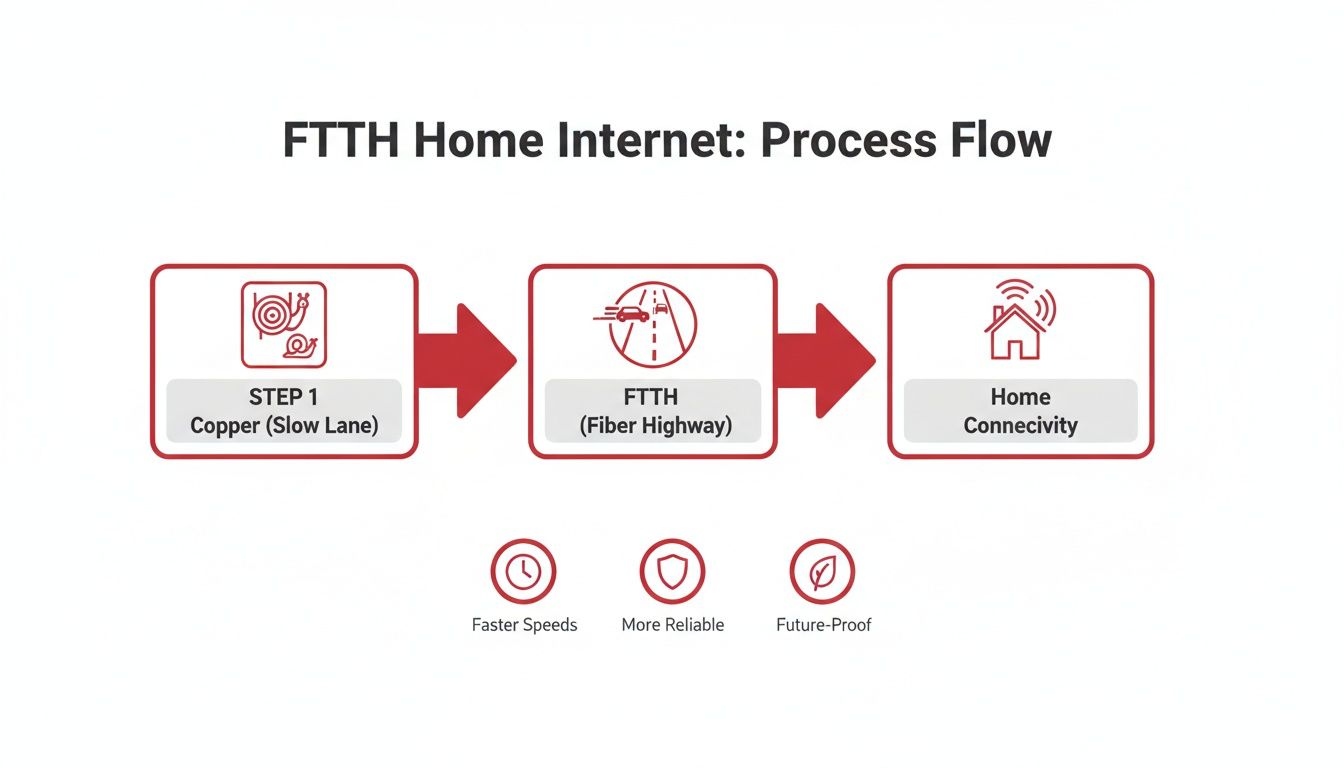
As you can see, fiber creates a direct, high-capacity path right to the user, completely eliminating the bottlenecks that plagued older technologies.
The Blueprint: Planning and Engineering
The lifecycle kicks off with the all-important Planning and Engineering stage. This is where the network is born, first on paper and then in sophisticated digital models, long before a single shovel ever hits the ground. It starts with detailed market analysis to pinpoint target deployment areas, demographic studies to forecast subscriber adoption, and high-level network design to map out the main fiber routes.
Engineers then create a meticulous Physical Network Inventory (PNI), which is an exact record of all physical assets like ducts, poles, and existing cables. A precise PNI is non-negotiable; without it, operators are flying blind and risk running into costly surprises and delays during construction. This phase locks in the network's architecture, capacity, and overall cost structure, setting the foundation for everything that follows.
Securing the Path Forward: Permitting
Once the blueprint is set, the next big hurdle is Permitting. This administrative phase can easily become one of the most time-consuming parts of any FTTH project. It's a complex dance of securing legal rights-of-way and permissions from a whole web of entities, including municipalities, county governments, departments of transportation, and other utility owners.
Every jurisdiction plays by its own set of rules and works on its own timeline, which makes this a massive logistical challenge. Success here really hinges on having strong relationships with local authorities and a deep, practical understanding of the regulatory landscape to keep the project from getting tangled in red tape.
Preparing the Groundwork: Make-Ready Construction
With permits finally in hand, the physical work can begin, starting with Make-Ready Construction. Think of this as the prep work needed to ensure existing infrastructure, like utility poles and underground conduits, is actually ready to accommodate the new fiber optic cables.
For aerial deployments, this often involves a few key steps:
- Moving existing telecom and power lines to create enough space for the new fiber.
- Replacing older utility poles that can't support the additional weight and tension of fiber cable.
- Ensuring every bit of work complies with strict safety standards and clearance regulations.
Make-ready is a critical preliminary phase that requires tight coordination with other utility companies to get the job done right without causing service disruptions.
From Blueprint to Reality: Full-Scale Construction
After the make-ready work is complete, Full-Scale Construction gets underway. This is the most visible and labor-intensive part of the project. You'll see crews out in the field, installing the physical fiber optic cables along the planned routes using different methods depending on the environment. This might mean aerial installation on utility poles, underground boring, or even micro-trenching to minimize disruption in dense urban areas.
Industry analysis shows that the civil works associated with construction—digging trenches, boring under roads, and placing aerial cable—can account for up to 80% of the total cost of an FTTH deployment. This is why sharp, efficient project management is absolutely vital to keeping these expenses under control.
This is the stage where the network truly takes shape, laying down the physical backbone that will eventually connect thousands of homes.
The Art of Connection: Fiber Splicing
Once the main fiber cables are in place, the delicate process of Fiber Splicing begins. This is a highly skilled craft where technicians use specialized equipment to precisely fuse individual glass fibers together. The goal is to create a seamless, continuous optical path from the central office all the way to the customer's neighborhood.
Every single splice has to be perfect to minimize signal loss and guarantee the network performs at its peak. Technicians use high-tech fusion splicers to align and melt the fibers, then protect the connection with a heat-shrink sleeve. This intricate work is what connects the massive backbone cables to the smaller distribution lines that will serve each individual FTTH home.
Ensuring Flawless Performance: Testing and Documentation
The final steps before lighting up the network are rigorous Testing and Documentation. Technicians use advanced equipment like Optical Time Domain Reflectometers (OTDRs) to send pulses of light down the fiber. This lets them verify signal strength and pinpoint the exact location of any faults or tiny imperfections from the splicing process.
At the same time, meticulous as-built documentation is created. These are the detailed, final maps and records of the network installation, and they are invaluable for future maintenance, troubleshooting, and upgrades. Accurate documentation ensures that operators can manage their new asset efficiently for decades to come. If you'd like to dive deeper, you can learn more about the importance of as-built documentation and see how it impacts long-term operational success.
Choosing The Right FTTH Network Architecture
When planning a fiber network for a residential area, one of the first big decisions is the underlying architecture. This choice isn't just a technical detail; it shapes everything from the initial build cost and timeline to the network's long-term performance and ability to grow. The two main models on the table are Passive Optical Network (PON) and Active Ethernet (AE).
Think of it like planning a city's transportation system.
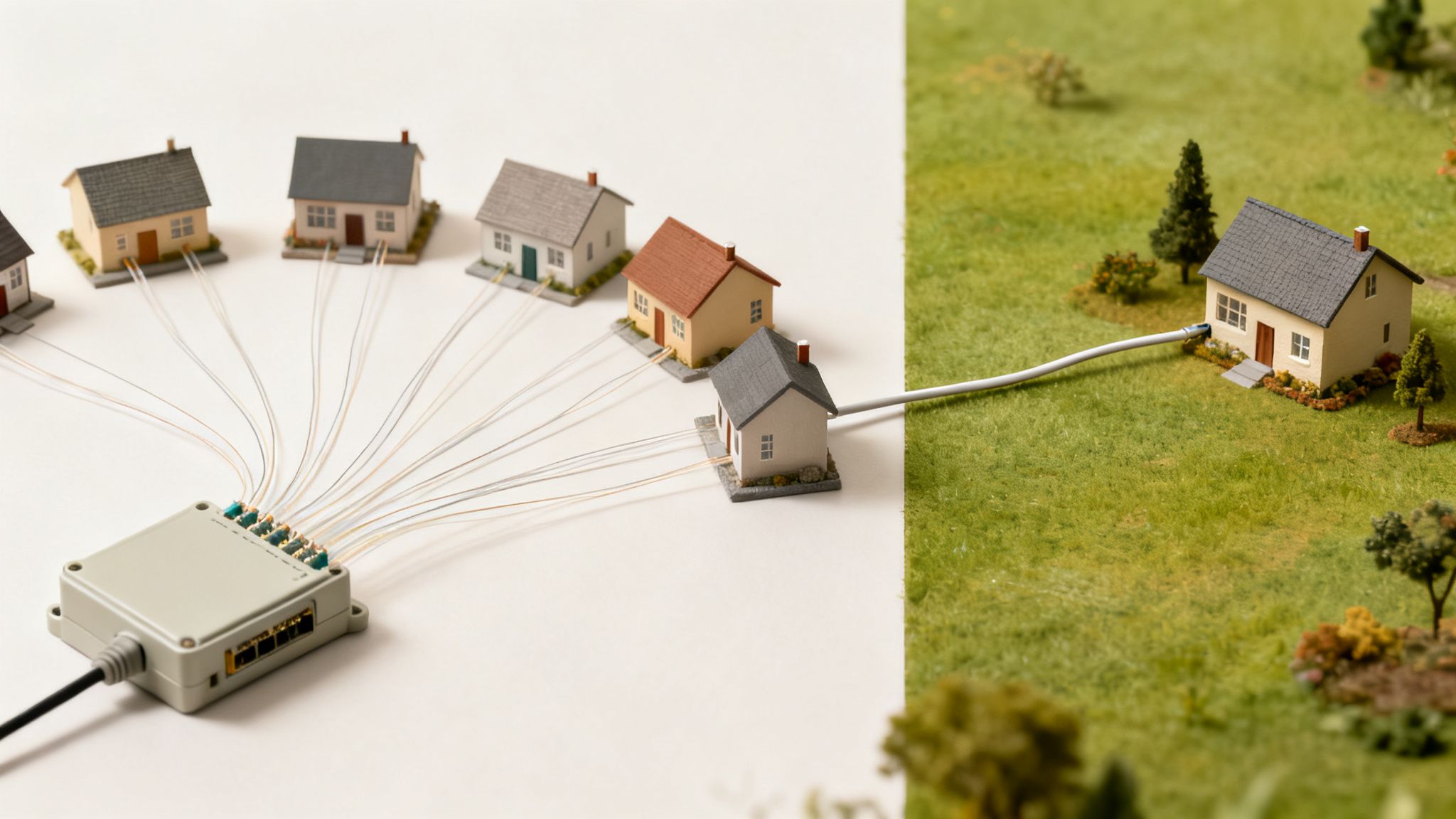
PON is a bit like a highly efficient city bus system. One main bus (a single fiber strand) leaves the central terminal and follows a set route, stopping at different points to let passengers (data) on and off at their destinations (homes). It’s a shared model that serves a lot of people in a very cost-effective way.
Understanding Passive Optical Network (PON)
The "passive" part of PON is what makes it so brilliant. This architecture uses unpowered optical splitters to take the light signal from a single fiber and divide it among multiple homes—usually up to 32 or 64 subscribers per fiber.
Because these splitters don't need electricity, you can install them just about anywhere—in cabinets, on utility poles, or inside underground vaults. There's no need for climate control or a power source, which dramatically cuts down on both the initial capital investment and ongoing maintenance costs.
PON's point-to-multipoint structure is the workhorse of modern residential FTTH deployments. Its economic efficiency makes it possible to deliver gigabit speeds to entire neighborhoods at a scale and price point that would be unfeasible with other technologies.
This cost-effectiveness is exactly why it's become the global standard for residential fiber. The push for better connectivity is massive, with the FTTH Council reporting that 21 countries now have over 50% household penetration. Some, like Spain, have even hit 78.9%, while the UK’s Openreach network just passed 15 million premises. You can dig deeper into these global FTTH penetration trends to see how quickly things are moving.
Exploring Active Ethernet (AE)
Going back to our transportation analogy, Active Ethernet is more like a fleet of private taxis. Each taxi (a dedicated fiber strand) provides a direct, non-stop ride from the central hub straight to a single destination, whether it's a home or a business. No sharing, no stops along the way.
AE networks use a point-to-point design, which means a dedicated fiber runs all the way from a switch in the central office directly to each customer. This approach obviously requires a lot more fiber and a lot more ports on the central switch, making it significantly more expensive to deploy than PON, especially in dense residential neighborhoods.
The big payoff for that extra cost, however, is guaranteed, dedicated bandwidth. Since the connection isn't shared with neighbors, performance is incredibly consistent and secure. This makes AE the go-to choice for business customers, data centers, and any high-demand user who needs symmetrical, uncontended speeds they can count on.
Comparing PON and Active Ethernet
Deciding between these two architectures always comes down to a trade-off between cost, scalability, and the performance you need to deliver. For the vast majority of FTTH home projects, PON strikes the right balance. For network planners, knowing the practical differences is crucial for making a smart investment. You might also want to look into the materials used for the physical infrastructure, like the conduit that protects these vital fiber optic lines.
To make the choice clearer, here's a side-by-side comparison of the two leading FTTH architectures. This table breaks down the key differences to help you see which one aligns best with your project's goals.
Comparing PON and Active Ethernet Architectures
| Attribute | Passive Optical Network (PON) | Active Ethernet (AE) |
|---|---|---|
| Structure | Point-to-multipoint (shared) | Point-to-point (dedicated) |
| Bandwidth | Shared among multiple users | Dedicated and guaranteed |
| Cost | Lower initial and operational costs | Higher initial and operational costs |
| Fiber Usage | Highly efficient; less fiber required | Requires significantly more fiber |
| Best Use Case | Residential deployments, dense areas | Business clients, high-demand users |
| Scalability | Scalable by upgrading end-point electronics | Scalable but requires more fiber runs |
In the end, there's no single "best" answer. The right architecture depends entirely on what the network needs to achieve, carefully balancing the project budget against the performance guarantees promised to your future customers.
Mastering the Final Connection Inside the Home
Getting a fiber optic line to the outside of a house is a huge milestone, but the job isn't done until that connection is humming perfectly inside. This final step, what we in the industry call the "last 100 feet," is where the real magic of an FTTH home network happens. It's the most hands-on part of the whole project and, frankly, the part that has the biggest impact on whether a customer is happy or not.
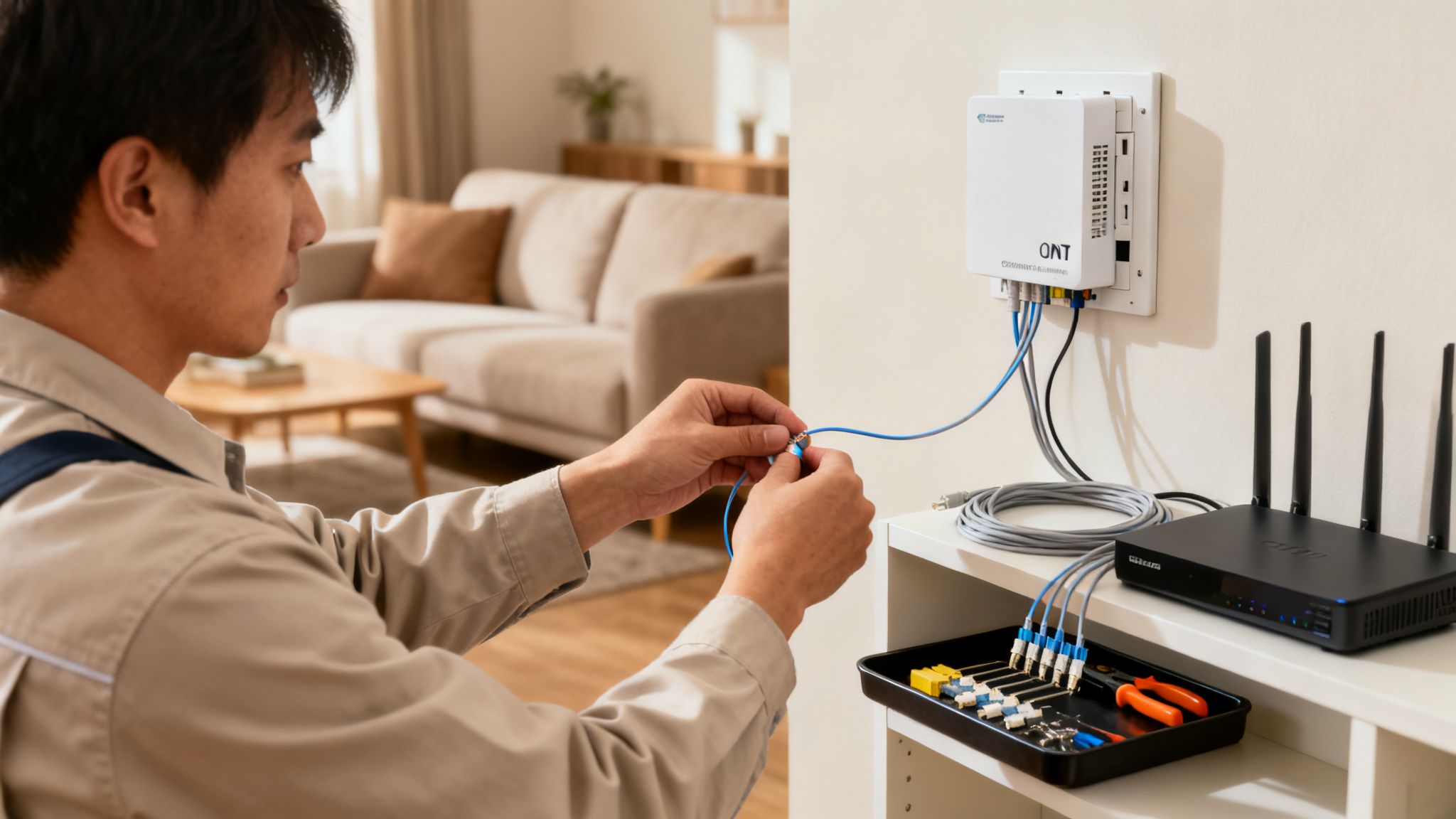
The key to a successful in-home setup is the Customer Premises Equipment (CPE). This is just the industry term for the hardware that sits inside the customer's home, acting as the bridge between our vast fiber network and the devices everyone uses every day—laptops, smart TVs, and phones.
The Role of the Optical Network Terminal
The workhorse of any FTTH home setup is the Optical Network Terminal (ONT). The easiest way to think of an ONT is as a special-purpose translator. It takes the light signals zipping through the fiber optic cable and converts them into the electrical signals that a standard router and other home electronics can actually use. Without it, the fiber line is just a piece of glass.
A technician's first order of business is to bring the fiber drop cable from outside the house to a good spot inside. This location needs to be secure, out of the way, and near a power outlet. Once the ONT is mounted, they'll connect the incoming fiber and then run a standard Ethernet cable from the ONT to the customer’s Wi-Fi router.
An expert technician is the face of the company during an installation. Their ability to cleanly run wiring, correctly place the ONT, and clearly explain the new setup to the homeowner is just as important as the technology itself. A positive installation experience is one of the biggest drivers of long-term customer loyalty.
Ensuring Whole-Home Coverage
Of course, just plugging everything in isn't enough. The goal is to deliver blazing-fast, multi-gigabit speeds to every corner of the house. This is where a technician's experience really shows, as they have to deal with all the common in-home wiring issues and structural quirks that can kill performance.
Here are a few best practices we insist on for a top-notch installation:
- Central Router Placement: The tech should work with the homeowner to find the most central spot for the Wi-Fi router. This gives the signal the best possible chance of reaching the entire home.
- Hardwired Connections: For things that don't move and need a ton of bandwidth, like a gaming console or a desktop PC, a direct Ethernet connection from the router is always the best bet for maximum speed and stability.
- Testing and Verification: Before packing up, the technician absolutely must run speed and signal strength tests to prove the connection is delivering what was promised. No exceptions.
A critical piece of the puzzle is knowing how to choose a WiFi router that can handle the sheer speed of an FTTH connection. A cheap, underpowered router will completely cripple a world-class fiber line.
Ultimately, the quality of the in-home installation is what makes a customer feel like they have a truly next-generation service, not just "average" internet. To see how these principles apply on the ground, you can review our detailed guide on residential installations and get a closer look.
The Three-Legged Stool: Balancing Costs, Timelines, and Performance
Rolling out a Fiber-to-the-Home network is a massive undertaking, both in terms of capital and sheer effort. It's a foundational investment in a community's future, but it demands a realistic grasp of the costs, timelines, and performance standards that will ultimately define success. One of the biggest hurdles is overcoming common misconceptions about where the money really goes.
Many people assume the fiber optic cable itself is the big-ticket item. In reality, it’s a surprisingly small fraction of the budget. The real cost driver—often consuming up to 80% of the total project expense—is the civil engineering and labor. We're talking about the hard, physical work: digging trenches, directional boring, hanging aerial cables, and navigating the complex process of securing rights-of-way.
Because the project is so construction-heavy, sharp project management and operational excellence are non-negotiable. Every permit delay, every unexpected underground utility, and every scheduling conflict has a direct and immediate impact on the budget and the go-live date for that first ftth home customer.
Decoding the Project Timeline
Just as crucial as a well-managed budget is a realistic timeline. An FTTH deployment isn't a weekend project; it can take several months for a small buildout or stretch across multiple years for a city-wide or regional network. A whole host of variables can influence how long it takes to get from plan to activated service.
Several key factors will always shape the project's duration:
- Permitting and Rights-of-Way: Working through the maze of local, county, and state regulations can cause serious delays. This step alone can involve months of paperwork and negotiation.
- Make-Ready Work: Before a single strand of fiber can be hung, existing utility poles and underground conduits have to be prepped. Coordinating with power companies and other utilities is often a slow, meticulous dance.
- Geography and Environment: The land itself plays a huge role. Building in a dense city, through rocky soil, or in regions with extreme weather is naturally going to take more time and effort than a straightforward suburban deployment.
- Labor and Equipment: Finding skilled construction crews and specialized equipment, like boring rigs, can become a bottleneck, especially if other large infrastructure projects are happening nearby.
The Power of a Promise: Service Level Agreements
While getting past the hurdles of cost and time is essential, the real prize is a high-performance network that customers can count on day in and day out. This is where Service Level Agreements (SLAs) enter the picture. An SLA is far more than a legal document; it’s a public promise from a provider to its customers, guaranteeing specific, measurable levels of performance and uptime.
Fiber’s incredible stability makes it the perfect technology for backing up strong SLAs. Unlike old copper or coaxial cable networks, which are vulnerable to electrical noise and signal loss over distance, a fiber network is exceptionally resilient. This gives providers the confidence to promise performance metrics that older technologies could never reliably deliver.
For any ISP or municipality, a rock-solid SLA becomes a major competitive advantage. It shifts the customer conversation from being just about price to being about true value and reliability. It’s how you justify the investment in a premium infrastructure that powers a premium ftth home experience.
A standard SLA for a fiber connection will clearly define key metrics, such as:
- Uptime Guarantee: This often promises 99.9% or even 99.99% network availability, which translates to just minutes of potential downtime per year.
- Latency (Ping): The agreement will pledge low-latency connections, something that’s absolutely critical for real-time uses like video calls and online gaming.
- Packet Loss: This ensures that a negligible number of data packets are dropped during transmission, resulting in a much smoother and more stable connection.
- Time to Repair: It also sets a clear window for how quickly any service issues will be fixed, giving customers valuable peace of mind.
At the end of the day, the central challenge of any FTTH project is balancing the significant upfront costs and long timelines against the promise of delivering exceptional, SLA-backed performance. A successful deployment isn't just about putting glass in the ground; it's about building a reliable, future-ready asset that provides lasting value to both the provider and the entire community.
How a Turnkey Partner Can Fast-Track Your FTTH Project
Getting an FTTH deployment off the ground is a massive undertaking. From the first engineering sketches to the final in-home installation, the path is loaded with potential landmines—think regulatory red tape, tricky construction logistics, and the need for absolute precision. Trying to juggle different vendors for each stage just adds to the chaos, creating communication bottlenecks and opening the door to expensive delays.
This piecemeal approach can easily become a logistical nightmare. Imagine a delay in make-ready work holding up your splicing crews, creating a domino effect that pushes back your entire timeline. A turnkey partner cuts through that complexity by serving as a single, accountable point of contact for the entire project.
The Power of a Single Source of Truth
A turnkey contractor like Southern Tier Resources takes a daunting list of separate jobs and turns it into one smooth, cohesive operation. By taking end-to-end responsibility, they ensure every phase flows logically into the next. The advantages of this unified model are huge, directly impacting your bottom line and how quickly you can start serving customers.
This single-source accountability is more than just a convenience; industry research consistently points to operational inefficiencies as a major drain on value for telecom companies. By integrating every step, a turnkey partner plugs those gaps.
Here’s what that looks like in practice:
- De-Risking the Investment: When one partner owns the entire process, there’s no finger-pointing. This clarifies accountability and lowers the financial and operational risks that come with managing a handful of independent contractors.
- Faster Time-to-Market: A unified project plan means work can happen in parallel. It gets rid of the communication delays between stages, getting your network lit up and generating revenue much faster.
- Guaranteed Quality and Consistency: A single, dedicated team ensures that engineering standards, construction methods, and safety protocols are followed to the letter across the entire build.
By consolidating project management, a turnkey partner doesn't just build a network; they deliver a fully documented, tested, and operational asset. Meticulous as-built documentation and verified performance data are part of the final deliverable, not an afterthought.
Experience Makes All the Difference
At the end of the day, the success of an FTTH home network comes down to execution. An experienced turnkey contractor brings years of industry know-how, established relationships with local municipalities, and an unwavering commitment to safety. That expertise is priceless when you hit the inevitable roadblocks of large-scale construction, whether it's an unexpected underground utility or a complex permitting issue.
The right partner turns the goal of connecting communities into a reality. By handling every detail—from the initial blueprint to lighting up the final customer—they free you up to focus on what you do best: delivering exceptional internet service. It’s the most effective way to build a future-proof network on time, on budget, and to the highest possible standard.
Frequently Asked Questions About FTTH Home Projects
Even the most detailed project plan can't anticipate every question. When it comes to something as complex as a community-wide fiber build, network planners, ISPs, and city leaders always have a few things on their minds. Here are some of the most common questions we hear.
What Is the Biggest Hurdle in a Typical FTTH Rollout?
Hands down, the biggest challenge is almost always the civil construction and securing the right-of-way. The fiber optic technology itself is proven and reliable. It’s the physical work of digging trenches, hanging aerial cable, and navigating the maze of permits with different authorities that consumes the bulk of the time and budget.
Ultimately, a project's success often comes down to solid project management and having strong, established relationships with local municipalities. These are the keys to navigating the inevitable delays and logistical headaches that come with any major construction effort.
How Can We Future-Proof Our FTTH Network Investment?
This is actually one of fiber's most powerful selling points. The glass strands in the cable have a nearly unlimited capacity for data. The real secret to future-proofing is building a high-quality network with plenty of extra fiber from the very start.
Today's electronics might deliver 1 or 10 Gbps speeds, but that same fiber in the ground can easily handle 100 Gbps or more down the road. You get there by simply swapping out the equipment at each end of the line. The most expensive and disruptive part—the physical installation—only has to be done once.
What Does Make-Ready Construction Involve?
Make-ready is all the prep work needed on existing utility poles or in underground conduits to make space for the new fiber optic cables. Think of it as clearing the path before the real installation can get underway.
For an aerial build, this could involve:
- Shifting existing telecom or power lines to create a safe zone for the new fiber.
- Replacing older poles that can't support the weight of an additional cable.
- Making sure every attachment meets strict safety and clearance codes.
This phase is critical and can take a surprising amount of time, as it requires careful coordination with other utility companies long before the first strand of fiber is ever pulled.
How Long Does a Standard In-Home Fiber Installation Take?
Once the fiber drop cable has been run to the outside of a house, the final in-home setup is pretty quick. A technician can usually get everything done in about 2 to 4 hours.
During that visit, they'll mount the Optical Network Terminal (ONT), connect it to power and the customer's Wi-Fi router, and run a full set of tests. This ensures the light levels are perfect and the internet speeds are hitting the mark, officially bringing that FTTH home online.
Partner with Southern Tier Resources to navigate the complexities of your next FTTH deployment with confidence. Our end-to-end services ensure your project is delivered on time, within budget, and to the highest quality standards. https://southerntierresources.com