Fibre to the Home (FTTH) is exactly what it sounds like: a pure, unadulterated fiber-optic internet connection that runs directly into your home or business. Unlike older technologies that switch to copper wires for the final stretch, FTTH uses incredibly thin strands of glass to send data as pulses of light. This delivers a level of speed and unwavering reliability that copper simply can't match.
Understanding Fibre to the Home (FTTH)
Think of your internet connection like a highway system. Traditional copper-based internet, like DSL or cable, is a lot like a small local road that eventually merges onto a fast-moving freeway. Even though the freeway itself (the provider’s core network) is fast, your actual speed is always limited by that slow, congested local road leading right up to your house.
By contrast, Fibre to the Home builds a private, multi-lane superhighway directly to your doorstep. This design completely eliminates the infamous "last-mile" bottleneck that plagues copper networks. Data can travel at the speed of light from the source straight to your devices, which is the secret to its incredible performance.
The Core Benefits of a Pure Fiber Connection
The advantages of a true FTTH network go far beyond just faster downloads. This technology fundamentally changes what's possible for homes and businesses, paving the way for new innovations and daily conveniences.
Symmetrical Speeds: FTTH delivers equally fast upload and download speeds. This is a game-changer for video conferencing, uploading large files to the cloud, and content creation, where sending data is just as important as receiving it.
Lower Latency: Data travels faster over fiber, which means there's almost no delay (or "ping") between your action and the server's response. This creates a completely lag-free experience for competitive online gaming and other real-time applications.
Enhanced Reliability: Fiber-optic cables are made of glass, making them immune to the electromagnetic interference that often disrupts copper lines. They are also far more resilient to harsh weather, ensuring a rock-solid, stable connection you can count on.
Future-Proof Capacity: A single fiber strand has a nearly limitless potential for bandwidth. It's already prepared to handle future demands like 8K streaming, immersive virtual reality, and complex smart home ecosystems without needing to run new cables.
To put it in perspective, let's look at a direct comparison.
FTTH vs. Traditional Copper at a Glance
| Feature | Fibre to the Home (FTTH) | Traditional Copper (DSL/Cable) |
|---|---|---|
| Connection Material | Glass Fiber-Optic Cable | Copper Coaxial/Twisted-Pair |
| Speed | Symmetrical (Up to 10 Gbps+) | Asymmetrical (Faster Download) |
| Reliability | High; immune to interference | Moderate; susceptible to weather/EMI |
| Latency | Extremely Low | Higher; varies by distance |
| Future Scalability | Virtually Unlimited | Limited by Copper's Capacity |
This side-by-side view makes it clear why FTTH is the gold standard for modern connectivity. It's not just an incremental improvement; it's a leap forward in every key performance metric.
"FTTH isn’t just a network upgrade; it’s a fundamental shift. It lays the groundwork for next-generation services, such as AI and 5G backhaul. Without fiber, these services simply don’t perform the way people expect."
This superior performance is driving massive global investment. The global Fiber-to-the-Home (FTTH) market is experiencing explosive growth, valued at USD 77.89 billion in 2026 and projected to skyrocket to USD 185.45 billion by 2031. You can read more about the FTTH market growth on mordorintelligence.com. For companies navigating this expansion, exploring comprehensive telecom industry solutions can provide the critical data and tools needed to succeed.
Inside an FTTH Network Architecture
When it comes to building a Fiber to the Home network, there isn't a single one-size-fits-all blueprint. The specific design, or architecture, a provider chooses has a huge impact on everything from performance and cost to future scalability. Getting a handle on these designs is the key to understanding how that blazing-fast connection actually makes it to your front door.
The two main approaches you'll see are Point-to-Point (P2P) and Passive Optical Network (PON). They each have their own strengths and are chosen based on the specific needs of the community or customers being served.
Point-to-Point: The Dedicated Connection
Imagine having a private, direct highway built just for you, running straight from your home to your internet provider's central office. That's the core idea behind a Point-to-Point (P2P) architecture. In this setup, every single customer gets their very own dedicated, unbroken strand of fiber.
This model delivers the ultimate in performance and security. Since you're not sharing your connection with any neighbors, your bandwidth is exclusively yours. That means you get guaranteed, consistent, and symmetrical speeds 24/7. This makes P2P the go-to choice for businesses, hospitals, and government agencies that can't afford any downtime and have mission-critical data needs.
The downside? This dedicated approach requires a whole lot more fiber and equipment in the field, making it a much more expensive way to connect residential neighborhoods on a large scale.
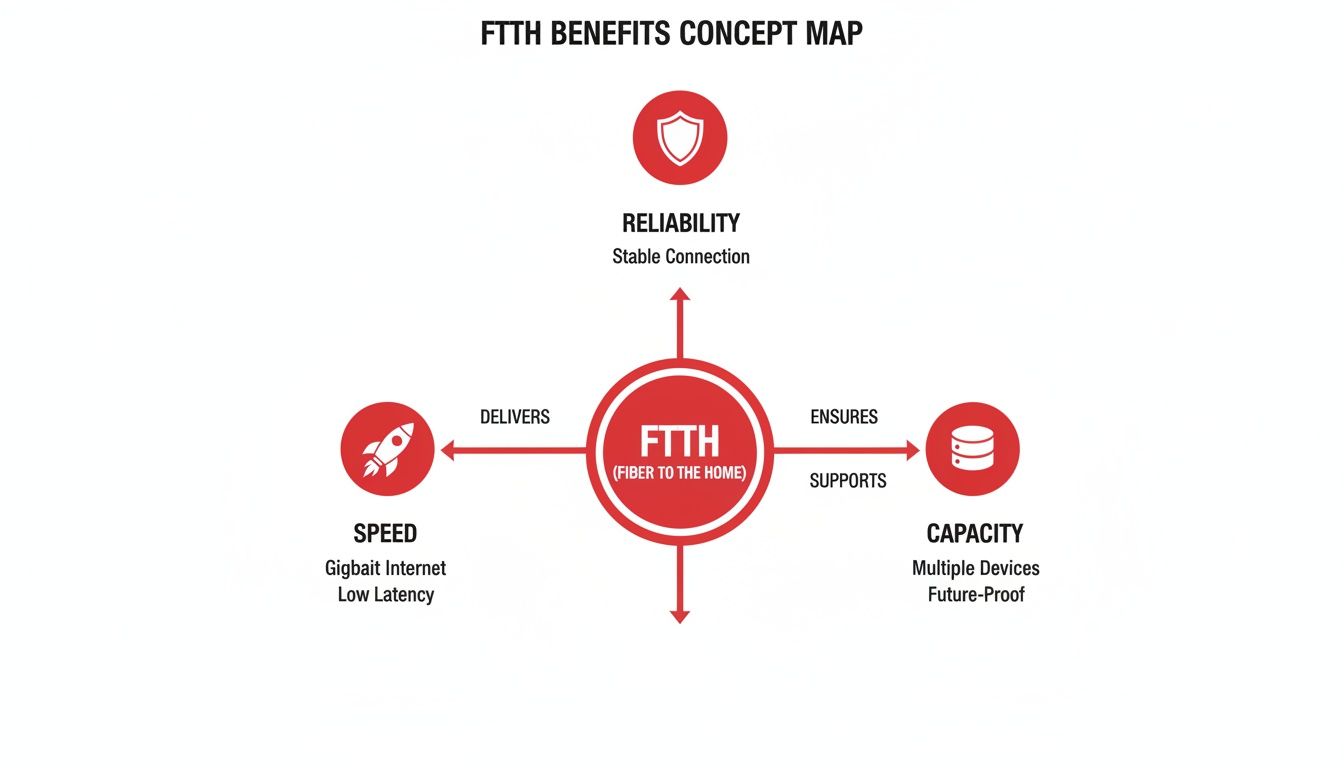
This image really drives home the foundational pillars of any FTTH deployment—speed, rock-solid reliability, and massive capacity—no matter which architecture is under the hood.
Passive Optical Networks: The Efficient Shared Model
If P2P is a private highway, then a Passive Optical Network (PON) is like a brilliantly engineered superhighway. In a PON design, one single fiber strand leaves the provider's central office and is shared among multiple homes or businesses in a given area.
So how does that work without slowing everyone down? Think of that main fiber highway having a series of dedicated off-ramps. Along the route, simple optical splitters divide the light signal from that single fiber, peeling off a portion for each individual subscriber. The "passive" part is the real genius here—these splitters don't need any electricity to work, which slashes maintenance costs and removes potential points of failure out in the field.
A single fiber in a PON system can typically serve 32 or 64 subscribers, making it an incredibly cost-effective way to deliver fiber services to entire communities. This efficiency is exactly why PON is the most popular architecture for residential broadband.
The PON family has evolved over the years, with each new generation offering a major speed boost.
- GPON (Gigabit Passive Optical Network): For a long time, this was the industry standard. It offers asymmetrical speeds, usually up to 2.5 Gbps downstream (for downloading) and 1.25 Gbps upstream (for uploading).
- XGS-PON (10-Gigabit Symmetrical Passive Optical Network): This is the next generation, and it's a massive leap forward. XGS-PON delivers symmetrical speeds of up to 10 Gbps for both downloads and uploads. It's built to handle the growing demand for serious upstream power, driven by things like HD video calls, constant cloud backups, and content creation.
When planning any FTTH network, you also have to consider the various pieces of home network connectivity equipment that get installed at the customer's location. Whether it’s P2P or PON, the fiber line has to terminate at a device inside the user’s home, and making sure everything is compatible is critical. The choice between these architectures ultimately lets providers strike the right balance between cost and performance for different markets.
Bringing an FTTH Network to Life
A fully functional Fibre to the Home (FTTH) network doesn't just appear overnight. It's the final product of an incredibly complex, multi-stage journey that turns detailed blueprints into the physical infrastructure that delivers light-speed internet. This whole process is a careful blend of civil engineering, precision technical work, and sharp project management.
The real work starts long before the first shovel ever hits the ground. It all begins with network design and engineering. This is the critical strategic phase where every single detail gets mapped out, from the provider's central office all the way to each potential customer's doorstep. Engineers figure out the smartest routes for the main fiber lines, pinpoint the best spots for splitters in a PON setup, and calculate the capacity needed to serve the community—both today and for years to come.
Getting this initial planning phase right is absolutely essential. A well-thought-out design keeps construction costs down, speeds up the deployment, and creates a solid foundation that can be easily upgraded later. On the other hand, cutting corners here almost always leads to expensive rework, frustrating service delays, and a network that's a nightmare to maintain.
Greenfield vs. Make-Ready Construction
Once the design is locked in, the physical construction kicks off. The approach taken usually falls into one of two categories, depending entirely on what's already on the ground.
Greenfield Construction: This is what we call deploying fiber in brand-new developments where there's no existing infrastructure. Picture a new housing subdivision. Crews can lay conduit and fiber right in open trenches before roads are even paved, which makes the whole process relatively straightforward and cost-effective.
Make-Ready Work: This is the much more common scenario. It involves prepping the infrastructure that's already there—usually utility poles or underground conduits—to make room for the new fiber optic cables. It's a logistical puzzle that demands close coordination with utility companies to ensure there's safe and adequate space on every pole.
Make-ready engineering can easily eat up a huge chunk of a project's timeline. It often involves shifting existing cables around, replacing entire poles, and making sure all the work meets strict safety and engineering codes before a single strand of fiber goes up.
This prep work is the unsung hero of a smooth and safe deployment in established neighborhoods.
The Art and Science of Fiber Splicing
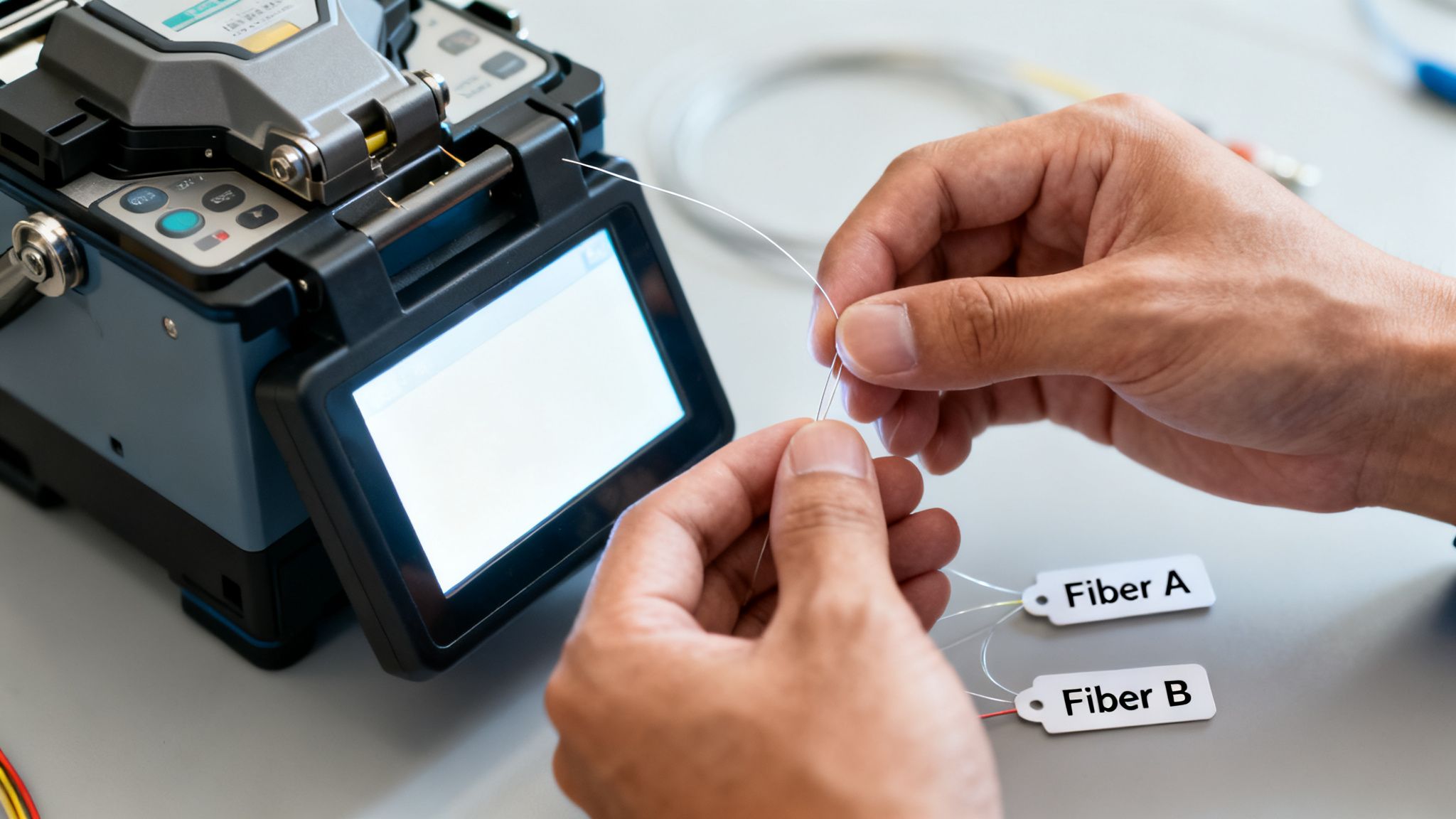
With the physical pathways ready, the next step is connecting the individual fiber strands. This delicate process, known as fiber splicing, is a highly skilled job that requires incredible precision. A single fiber optic strand is thinner than a human hair, so joining two ends together perfectly is both an art and a science.
Splicing technicians use a specialized tool called a fusion splicer. This machine meticulously aligns the two glass ends and then zaps them with an electric arc to melt, or "fuse," them into a single, seamless connection.
Even one bad splice can cause major signal loss, degrading internet performance for every customer downstream. That’s why skilled splicing technicians are absolutely invaluable to any FTTH project. They ensure the light signal travels with virtually no resistance, preserving the network's integrity and speed from end to end. You can learn more about how these physical connections become live services by exploring the details of telecom provisioning and service activation.
Critical Testing and Documentation
The final phase of construction is arguably one of the most important for the network's long-term health: rigorous testing and meticulous documentation. It’s one thing to lay the fiber; it’s another to prove it works flawlessly and to know exactly where every single component is located.
Crews rely on advanced tools to verify the quality of the network before it ever goes live.
Optical Time Domain Reflectometer (OTDR) Testing: This instrument is like a radar for fiber. It sends a pulse of light down the line and measures the reflection, pinpointing the exact location of any faults, sharp bends, or bad splices with amazing accuracy. It essentially creates a detailed "birth certificate" for each fiber strand.
Power Meter and Light Source Testing: This is a more straightforward test that measures the total signal loss across a fiber link. It confirms that the connection meets the design specs and is strong enough to deliver a reliable signal to the customer.
Just as important is creating as-built documentation. These are the definitive maps and records showing the precise location of every cable, splice point, and piece of equipment. This information is indispensable for any future maintenance, troubleshooting, or network expansion. Without it, finding and fixing a problem becomes a costly, time-consuming guessing game.
Navigating Permits and Regulatory Challenges
Putting fiber in the ground is about a lot more than just digging trenches and splicing cables. Before a single shovel hits the dirt, every FTTH project has to navigate a complex, and often frustrating, maze of paperwork and permissions. This phase—tackling permits, securing right-of-way access, and meeting regulatory rules—is honestly one of the biggest reasons projects get delayed.
Getting the green light means you’re dealing with a whole host of different groups, and each one has its own rulebook, timeline, and set of priorities. It’s not a single checkpoint; it's a layered approval process that can feel like a real bureaucratic headache. You'll need sign-off from city and county officials, the local power company, and even the department of transportation.
Understanding Who You're Dealing With
The real trick is keeping all these plates spinning at once. A snag with one agency can create a domino effect, pushing your entire schedule back and driving up costs. This is where having established relationships and deep local knowledge isn't just a nice-to-have, it's a game-changer.
You can expect to work with a mix of these key players:
- Municipal Governments: They’ll handle city construction permits, traffic control plans, and make sure you’re following local zoning laws.
- Utility Companies: You'll need their approval for any "make-ready" work to ensure there’s safe and adequate space on their utility poles for your new fiber lines.
- Transportation Departments: If your build crosses or runs alongside state highways, they'll have strict safety and traffic management protocols you have to follow.
- Environmental Agencies: They ensure your construction plan won't harm local ecosystems, which is especially critical if you're building near wetlands or protected areas.
This web of requirements is exactly why you need people who know the local landscape inside and out. Someone who understands the specific quirks of a particular township’s permitting process or knows the internal review schedule at the local utility can be the difference between getting an approval in weeks instead of months.
Securing the necessary permits and rights-of-way can easily eat up a huge chunk of a project's pre-construction timeline. Getting ahead of it with proactive engagement and meticulous paperwork is the only way to avoid months of expensive delays.
How to Get Through Permitting Without Losing Your Mind
A smart permitting strategy is all about solid preparation and constant communication. Instead of waiting for regulators to send you a list of questions, the best teams anticipate what each agency will need and submit perfect, complete applications right from the start. That simple step cuts out the endless back-and-forth that grinds so many projects to a halt.
One of the most effective things you can do is partner with someone who already has those local relationships. A team that has worked with the city’s engineering department before, or knows the pole attachment coordinator at the power company by name, can often clear up a problem with a quick phone call—bypassing weeks of formal, bureaucratic delays.
This hands-on, relationship-focused approach turns a potential minefield into a manageable part of the process. It helps ensure the administrative side of a fibre to the home ftth project doesn't fall behind the construction schedule, getting you to market faster. When you treat permitting with the same strategic importance as network design, you protect your timeline and your investment.
Understanding FTTH Deployment Costs and ROI
Let's be direct: deploying a fibre to the home ftth network is a serious infrastructure investment, not a minor upgrade. Getting a firm grip on the financials is non-negotiable for any provider or community heading down this path. The upfront numbers can look intimidating, but they have to be measured against the incredible long-term return that only pure fiber can deliver.
The final price tag on a project isn’t just one number; it’s the result of several key factors all playing off each other. These aren't simple line items—they're interconnected variables that can make the cost-per-home swing dramatically.
Breaking Down the Major Cost Drivers
Most of the primary expenses in an FTTH build fall into a few key buckets. You’ll often find that skilled labor is the single biggest piece of the pie, frequently eating up more than half the total budget. This covers everything from the crew in the field to the highly specialized fiber splicers.
- Materials and Equipment: This is all the physical gear—the fiber optic cable itself, conduits to protect it, connectors, splitters, and the active electronics like OLTs in the central office and ONTs at each customer’s home.
- Labor and Construction: This is the heavy lifting. It includes everything from digging trenches for underground builds to the detailed "make-ready" work required to safely hang fiber on existing utility poles.
- Permitting and Right-of-Way (ROW): Don't underestimate the back-office work. Securing legal access to build on public and private land, along with navigating the maze of local permits, can add significant time and money to the project.
Where you build matters immensely. A project in a dense urban neighborhood, with homes packed closely together, is naturally going to be more cost-effective per connection than serving a spread-out rural area where you might run miles of fiber just to reach one or two farms.
Shifting from Expense to Long-Term Asset
While the initial capital required for an FTTH network is significant, looking at it as a simple expense is missing the point. The real financial power of fiber is unlocked over time, driven by dramatically lower operating costs and the potential for new revenue streams.
Unlike aging copper networks that need constant upkeep and are susceptible to the elements, fiber optic infrastructure is incredibly resilient and largely passive. This means far lower operational expenses (OpEx) over the network's lifespan, which can easily be several decades.
This durability is fundamental to the value of FTTH. A well-constructed fiber network isn't just an internet pipe; it's a permanent piece of community infrastructure. For a closer look at how these project costs are broken down, you can explore our detailed guide on analyzing FTTH project costing.
Calculating the Return on Investment
The long-term financial upside of an FTTH build creates a powerful business case that goes far beyond the initial construction bill. These benefits build on each other year after year, turning the network into a formidable, revenue-generating asset. The market growth certainly reflects this, with North America's FTTH market valued at USD 19.52 billion in 2023 and projected to grow at a healthy 11.5% CAGR through 2033. You can explore more about these North American market trends on cognitivemarketresearch.com.
Several key elements work together to deliver a strong ROI:
- Higher Subscriber Take Rates: People want better internet. The promise of fiber's superior speed and unmatched reliability makes it a much easier sell, leading to faster customer adoption and a quicker path to profitability.
- Increased Average Revenue Per User (ARPU): With fiber, you can confidently offer premium, multi-gigabit speed tiers and other high-value services like crystal-clear VoIP or IPTV, all of which command higher monthly prices.
- Drastically Lower Maintenance Costs: Fiber is immune to the electromagnetic interference that plagues copper and is far more resistant to weather. This translates to fewer service calls, fewer "truck rolls," and massive operational savings over the life of the network.
- Future-Proof Scalability: This might be the most powerful benefit. When it's time to offer even faster speeds—like 25G-PON and beyond—you don't have to rip and replace the fiber. You just upgrade the electronics on each end. The physical infrastructure is already in place for generations to come.
When all is said and done, a fibre to the home ftth network evolves from a capital-heavy project into a sustainable, high-value community asset that pays for itself many times over.
Maintaining and Future-Proofing Your Network
Getting a fibre to the home ftth network up and running is a huge accomplishment, but it's really just the starting line. The real work begins now, shifting from the chaos of construction to the discipline of long-term operations. The goal is simple: keep the network healthy to maximize uptime, deliver an experience that keeps customers happy, and protect that massive infrastructure investment for years.
The good news is that fiber is built to last. Unlike old copper lines that degrade with every storm and require constant attention, glass fibers are naturally resistant to electromagnetic interference and tough enough to handle harsh weather. This inherent durability translates directly into lower operational costs and a far more reliable service for your subscribers.
Proactive Monitoring and Preventative Maintenance
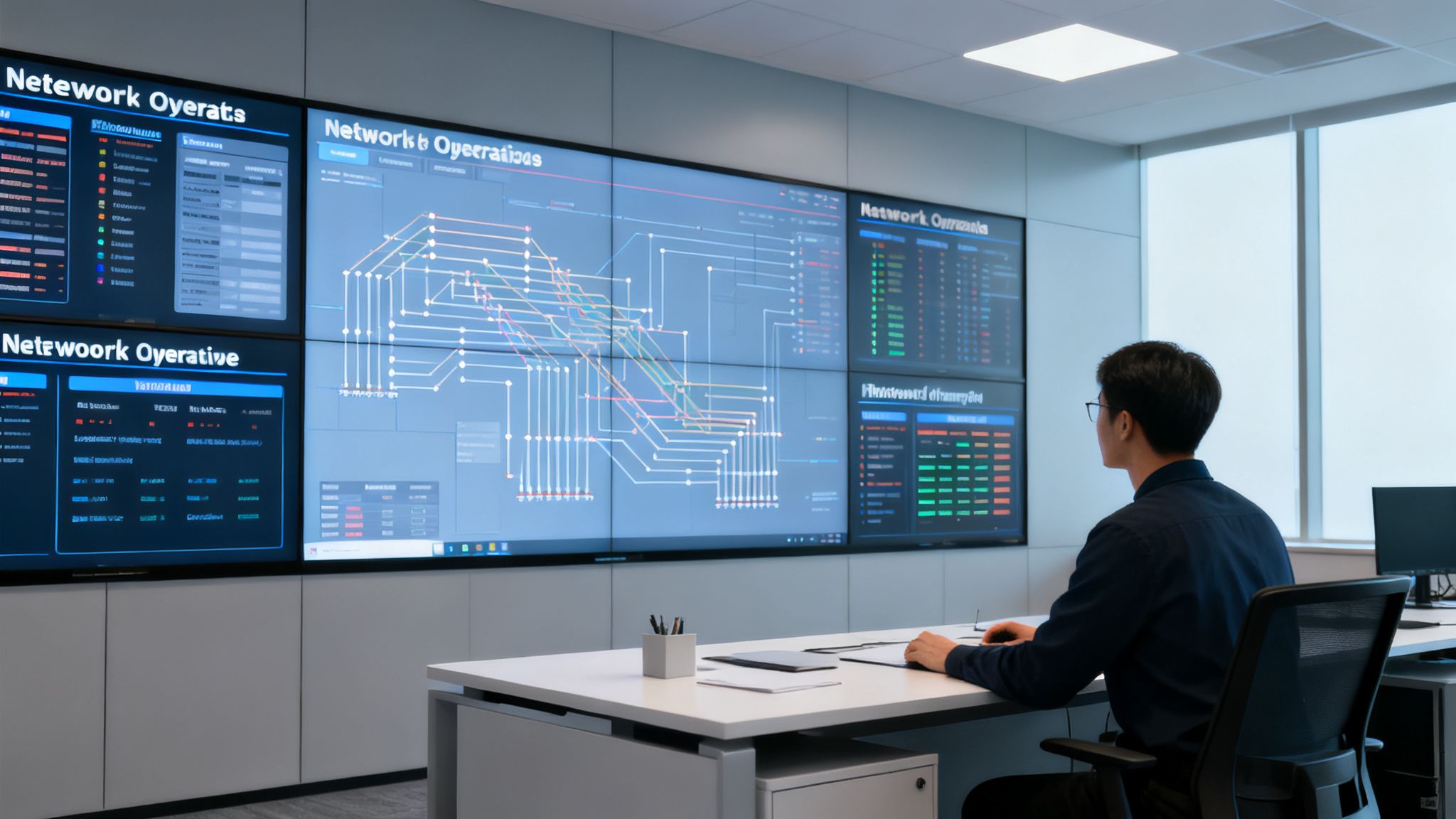
The secret to long-term reliability is finding the small problems before they turn into big outages. Modern FTTH networks are watched over by sophisticated monitoring systems that give operators a live, bird's-eye view of everything, from the central office to the subscriber's living room. These platforms keep a constant eye on signal strength, light levels, and equipment health.
This data-driven oversight allows you to get ahead of issues. Instead of waiting for an angry customer to call about a dead connection, your network operations center (NOC) can spot a weakening signal—maybe from a dusty connector or a slightly bent fiber—and send a technician to fix it before anyone even notices. We dive deeper into these response tactics in our guide to telecom network repair and restoration.
A well-maintained FTTH network is not just about preventing downtime; it’s about building a scalable foundation that supports future growth. Consistent design and accurate, as-built documentation are essential for efficient troubleshooting and long-term maintainability.
A solid maintenance plan comes down to a few key habits:
- Routine Physical Inspections: Periodically walking the routes to check enclosures, splice cases, and aerial lines for any signs of physical damage or wear.
- Scheduled Signal Testing: Using an OTDR to test key fiber routes and compare the light loss readings against the original baseline data. This helps spot gradual degradation over time.
- Emergency Restoration Planning: Having a clear, well-rehearsed plan—complete with pre-staged materials like spare fiber—to quickly fix a major issue like a fiber cut from a construction crew.
Designing a Network Built for Tomorrow
Maybe the best thing about an FTTH network is its incredible capacity for growth. The actual glass fiber you install today has nearly unlimited bandwidth potential. Think about that: you can roll out massive speed upgrades in the future without having to dig up a single street.
This concept of future-proofing is at the heart of the ROI for any fiber project. While today’s GPON and XGS-PON technologies are plenty fast for now, the industry is always moving forward. The next wave of standards is already on the horizon.
- 25G-PON: This technology offers symmetrical speeds of 25 Gbps—more than double XGS-PON—perfect for serving demanding businesses or high-density apartment buildings.
- 50G-PON and Beyond: Believe it or not, standards are already being developed for 50 Gbps and even 100 Gbps speeds, ensuring fiber can handle whatever we dream up for generations to come.
Making the jump to these next-gen speeds doesn't require a new construction project. It's mostly about swapping out the electronics—the OLT in your central office and the ONT in the customer’s home. The expensive fiber in the ground stays right where it is. This is what makes a fibre to the home ftth network a truly sustainable asset that can grow right alongside the community it serves.
Answering Your FTTH Questions
Even when you understand the big picture, the nuts and bolts of Fiber to the Home can spark a few more questions. Let's tackle some of the most common ones to clear things up.
How Is FTTH Different From "Regular" Fiber Internet?
This is a great question, and the answer gets to the heart of what makes FTTH so special. You've probably seen ads for "fiber internet" from cable companies. In many cases, they run fiber to a central box in the neighborhood, but then use the old copper coaxial cables—the same ones used for cable TV—to make the final connection to your house. This hybrid approach creates a bottleneck right at the end.
A true fibre to the home ftth connection is pure fiber, all the way. That glass strand runs directly from the central office right into your home or business, completely bypassing the outdated copper network. It's this uninterrupted, end-to-end fiber path that delivers the mind-blowing speeds and rock-solid reliability that other connections just can't match.
Is FTTH More Secure?
Absolutely. Fiber optic cables are fundamentally more secure than their copper counterparts. Because they transmit data as pulses of light contained within a glass core, they're incredibly difficult to tap into without physically disrupting the signal—an intrusion that is very easy to detect.
Copper cables, on the other hand, leak electromagnetic signals that can be intercepted without ever touching the wire.
Think of it like this: trying to tap a fiber line is like trying to steal a letter from a pneumatic tube without anyone noticing. It's nearly impossible. This makes FTTH a far more secure choice for handling sensitive information.
Can I Keep My Current Router With an FTTH Connection?
Most of the time, yes. The new fiber line will connect to a device called an Optical Network Terminal (ONT) inside your home. The ONT's job is to convert the light signals from the fiber into an electrical signal your devices can understand.
From there, you simply connect your existing Wi-Fi router to the ONT with a standard Ethernet cable. The only caveat is performance. If you're signing up for a gigabit-speed plan, you'll want to make sure your router is modern enough to handle that kind of throughput so it doesn't become the weak link in your setup.
How Long Does a Fiber Optic Network Last?
A properly installed FTTH network is a long-term investment in every sense of the word. The physical fiber optic cables are incredibly durable, with a typical lifespan of 25 to 40 years, and sometimes even longer.
Unlike copper, the glass fibers don't corrode or degrade from environmental exposure. The core infrastructure is truly built for generations. Best of all, future speed upgrades don't require digging up the old cables. You just swap out the electronics on either end of the line. This is what we mean when we say FTTH is a genuinely "future-proof" technology.
Bringing a fiber network to life involves a lot of moving parts, and you need a partner who has mastered every single one. Southern Tier Resources offers comprehensive engineering, construction, and maintenance services to guide your FTTH project from concept to completion. We make sure it’s done right, on schedule, and built to serve your community for decades.
Find out how we can help you achieve your network goals at https://southerntierresources.com.