At the core of every modern digital service—from cloud platforms and global finance to the incredible demands of artificial intelligence—is a fiber optics data center. These facilities aren't just buildings full of servers; they are the high-speed nervous systems of our digital world, transmitting data as pulses of light through hair-thin strands of glass.
The Unseen Engine of the Digital World
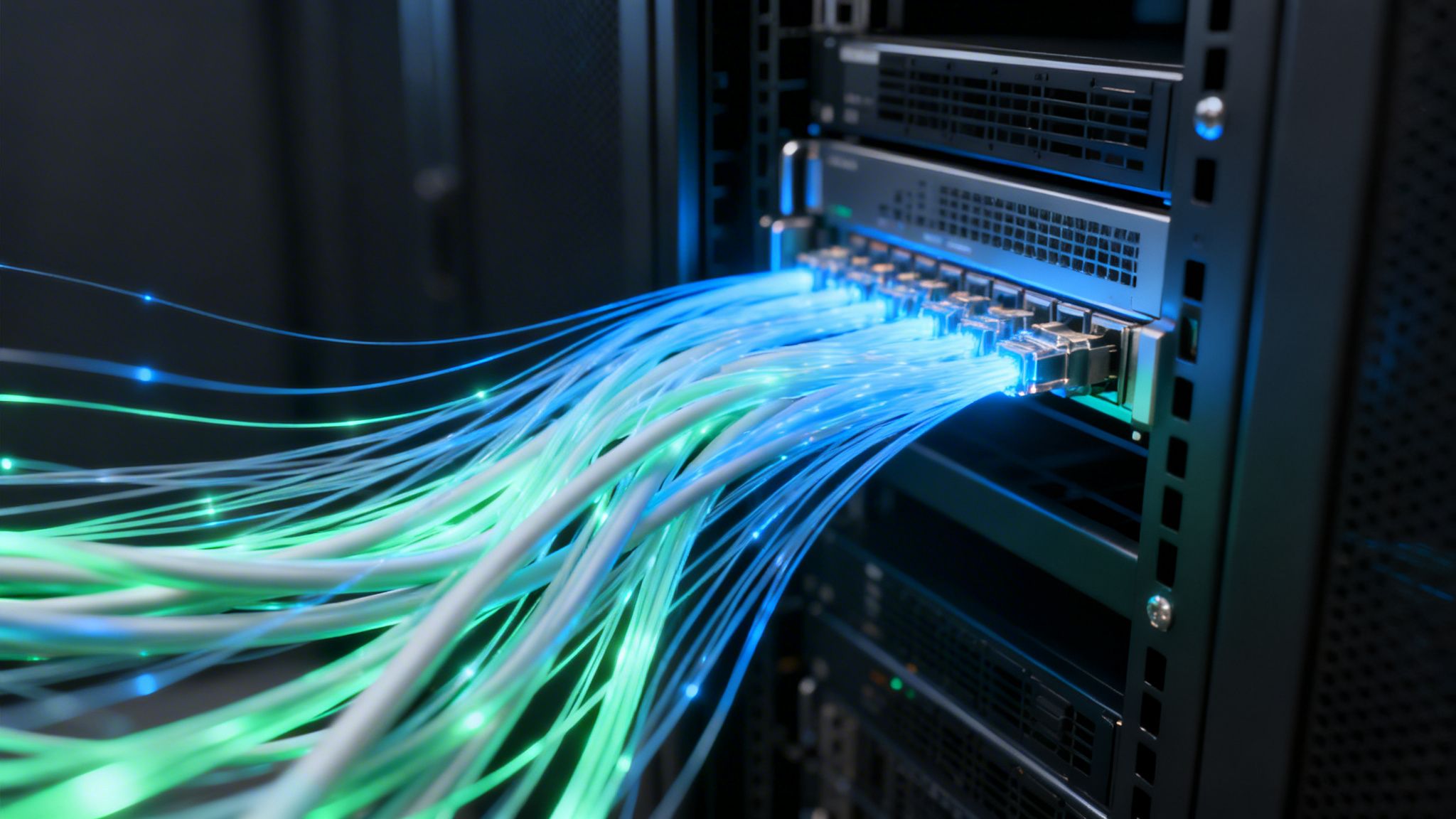
Think of it this way: data centers are the massive, bustling metropolitan hubs where all the digital work gets done. Every click, stream, and transaction is processed there. The fiber optic cables are the superhighways connecting these hubs, carrying trillions of signals across the globe at incredible speeds.
This is a world away from the old infrastructure. Traditional copper wiring is like a network of local country roads. It worked fine for a while, but it’s now completely choked by the traffic from today's hyperscale data centers. The sheer volume of information generated by AI models, 4K video, and real-time analytics needs a pathway that's faster, cleaner, and can handle immensely more capacity. Copper just can't keep up.
Why Fiber Optics Are Essential
Moving to a fiber optics data center is more than a simple upgrade. It’s a fundamental leap in what’s possible. From a practical standpoint, fiber offers a few non-negotiable advantages for any serious operation:
- Immense Bandwidth: A single, tiny fiber strand carries orders of magnitude more data than a thick copper cable. This is what makes 400G and 800G speeds not just possible, but standard practice.
- Superior Speed and Low Latency: Data travels through glass at nearly the speed of light. For applications like high-frequency trading or interactive AI, where every millisecond counts, this is a game-changer.
- Enhanced Reliability: In the power-hungry, electrically noisy environment of a data center, copper is susceptible to electromagnetic interference (EMI) that corrupts data. Fiber is made of glass, making it completely immune.
- Future-Ready Scalability: When you build with fiber, you're building for the future. You can light up more capacity on existing strands without ripping and replacing your core physical infrastructure.
Mastering fiber optics is the key to unlocking the scalability, speed, and reliability that define the digital age. It's the foundational layer upon which future innovation is built.
This reality is why we're seeing massive investment in the space. Look at Amazon's recent plan to invest $10 billion in North Carolina for data center expansion, driven largely by AI and cloud computing needs. Those facilities, and the high-skilled network and fiber optic jobs they create, are built entirely on a foundation of robust fiber networks.
If you're looking to dive deeper into how these complex systems are engineered and built, our guide on network engineering and infrastructure deployment is a great next step. For anyone building or managing the infrastructure that powers our world, a deep understanding of fiber is no longer a niche skill—it's absolutely essential.
Choosing Your Pathway: Single-Mode vs. Multimode Fiber
When you start laying out the physical infrastructure for a data center, one of your first forks in the road is choosing the right fiber optic cable. This isn't a minor detail—it's a foundational decision that directly impacts your network's speed, reach, and budget. The two primary options on the table are single-mode fiber (SMF) and multimode fiber (MMF), and knowing where each one shines is key to building an effective and future-ready facility.
A good way to think about the difference is to compare a laser pointer to a floodlight. Each tool is built for a specific job, and you wouldn't use one where you really need the other.
Understanding Single-Mode Fiber
Single-mode fiber is the laser pointer in our analogy. It's built with an incredibly narrow core, only about 9 micrometers wide, which forces light to travel down a single, straight path—a single "mode." This design creates a clean, concentrated light signal that suffers from very little distortion over distance.
Because the light beam stays so coherent, it can travel for miles with minimal signal degradation. This makes SMF the go-to choice for any connection that needs to cover serious ground.
You'll almost always see single-mode fiber used for:
- Connecting separate data center buildings, whether they're across the street or across the state.
- Linking your facility to the outside world through carrier networks and major internet exchanges.
- Spanning the massive distances inside today's hyperscale data centers, where a single cable run can easily stretch beyond the limits of other media.
The precision engineering behind SMF and the lasers required to light it up mean it typically comes with a higher upfront cost. But when distance and raw performance are non-negotiable, nothing else compares.
The Role of Multimode Fiber
If single-mode is the laser, then multimode fiber is the floodlight. Its much larger core—usually 50 or 62.5 micrometers—allows light to travel along many different paths, or "modes," all at once. The light bounces along the inside of the fiber, brightly illuminating the other end.
This approach is fantastic for pushing a lot of data over shorter distances. The trade-off is that because each light path has a slightly different travel time, the signal can start to get muddled over longer runs. This phenomenon, called modal dispersion, is what limits multimode's effective range.
Multimode fiber is the workhorse for the vast majority of connections inside the data center. It delivers a cost-effective and high-performance solution for the short, dense links between servers, storage, and switches.
This is why you'll find MMF everywhere inside the server rows, connecting servers to their Top-of-Rack switches or linking switch stacks together.
The market trends confirm this division of responsibilities. As AI and cloud computing fuel massive growth, data centers now account for 20% of all fiber cable demand. The overall U.S. fiber market is expected to climb at a 9.66% CAGR through 2033. While traditional glass fiber holds a commanding 85% revenue share, the multimode segment is actually growing even faster at a 10.2% CAGR, proving just how vital it is for internal data center builds. For a deeper dive, you can explore more data on the U.S. fiber market and see similar patterns in the European fiber market.
Single-Mode vs. Multimode Fiber At a Glance
So, how do you decide? The choice really boils down to distance and cost for a specific link. This table gives a quick snapshot of the key differences to help guide your decision-making process.
| Characteristic | Single-Mode Fiber (SMF) | Multimode Fiber (MMF) |
|---|---|---|
| Core Diameter | ~9 µm | ~50 µm (OM3/OM4/OM5) |
| Light Source | Lasers | LEDs or VCSELs |
| Typical Distance | Kilometers to 100+ km | Up to ~550 meters |
| Bandwidth | Virtually unlimited | Limited by modal dispersion |
| Primary Use Case | Long-haul, inter-building, carrier links | Intra-building, server-to-switch links |
| Cost | Higher (optics are more expensive) | Lower (optics are less expensive) |
Ultimately, you will end up using both fiber types in any modern data center. SMF will handle your long-distance connections, while MMF will be the backbone of your high-density server racks.
Practical Trade-Offs and Modern Standards
It’s also important to know that multimode fiber isn't standing still. Newer standards like OM5, often called wideband multimode fiber, are designed specifically for the high-speed needs of modern data centers.
OM5 is optimized for short-wavelength division multiplexing (SWDM), a technology that sends multiple light signals over a single fiber strand on different wavelengths. This dramatically increases the bandwidth of a single cable, making it a perfect match for short-reach 100G, 200G, and 400G links in dense spine-leaf networks.
Designing Modern Data Center Cabling Topologies
Think of your data center’s cabling as its central nervous system. How you lay out those pathways determines how quickly and reliably information moves. The old, rigid designs just can’t keep up anymore, which is why modern facilities have moved away from traditional three-tiered models to something far more agile.
The go-to architecture today is overwhelmingly the spine-leaf topology. Forget the old model where traffic could get stuck in a central bottleneck. Instead, picture a network where every server is just a couple of quick steps away from any other server. Every "leaf" switch (which connects directly to your servers) is linked to every single "spine" switch, creating a powerful, redundant mesh.
What this really means is that data traffic is never more than two "hops" from its destination. It goes from a server to its leaf switch, across to a spine switch, and down to the destination leaf. This design practically eliminates latency and bottlenecks. If one connection gets congested or fails, traffic instantly finds another route. It’s all about maintaining constant uptime and peak performance.
Practical Cabling Strategies In The Racks
Once you've settled on the spine-leaf blueprint, it's time to get practical: how are you actually going to run the cables? When it comes to connecting servers inside the racks, there are two dominant schools of thought: Top-of-Rack (ToR) and End-of-Row (EoR).
Top-of-Rack (ToR): With this approach, you place a smaller network switch right inside each server rack. All the servers in that rack plug directly into it with short, easy-to-manage cables. This keeps the cabling within each rack incredibly tidy and simplifies cooling, but it also means you're buying and managing a lot more switches.
End-of-Row (EoR): The alternative is to place one or two large, high-capacity switches at the end of a row of racks. Every server in that row then connects back to these centralized switches. While this consolidates your network hardware and can simplify switch management, it creates a real cable management challenge, with massive bundles running the length of the row.
Ultimately, the decision between ToR and EoR boils down to a trade-off. You have to balance port density needs, your budget, and what your operations team can realistically manage. For most hyperscale and large-scale data centers, the scalability and clean cabling of a ToR design often win out, despite the higher switch count.
The image below gives a great visual of the two main fiber types that form the backbone of these topologies. You can see how single-mode is built for distance, while multimode is the workhorse for shorter, high-bandwidth connections inside the data center.
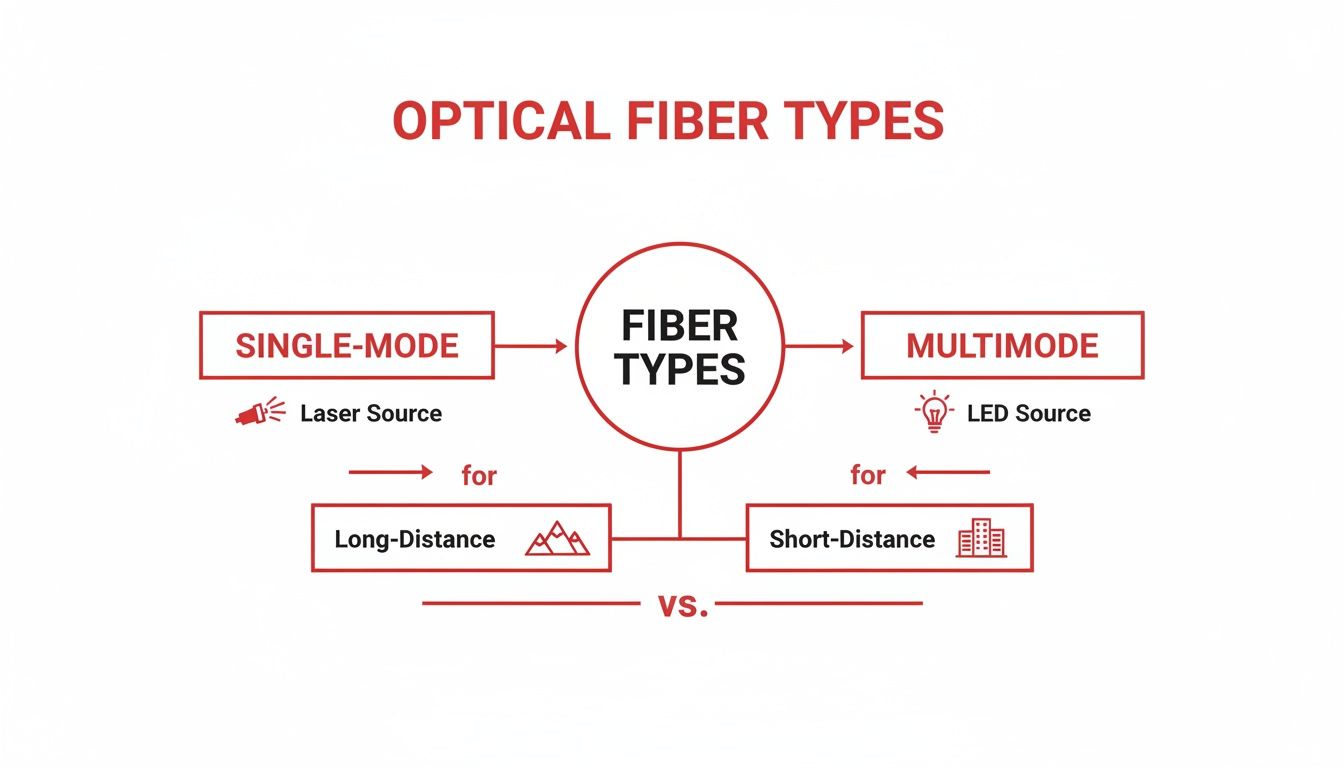
This distinction is key. While both are fiber optic cables, their internal design—one using precise lasers for long-haul and the other using cost-effective LEDs for short-reach—dictates where and how they're used.
Accelerating Deployment With High-Density Connectors
Building out these massive spine-leaf networks requires speed and precision. This is where MPO/MTP connectors have become indispensable. Instead of terminating individual fibers one by one—a slow and error-prone process—technicians can use a single MPO connector that bundles 12, 16, or even 24 fibers into a single, plug-and-play interface.
By using pre-terminated MPO/MTP trunk cables, teams can roll out high-capacity links between racks and rows with incredible speed. It's a modular, structured approach that slashes installation time and all but eliminates the risk of field termination errors. This is how you light up 100G and 400G connections at scale.
This kind of structured cabling is no longer a luxury; it’s a fundamental part of modern data center construction. When planning new builds or upgrades, it's also wise to think about the entire lifecycle, including end-of-life. Planning for future Data Center Cable Mining and Wire Removal Services can lead to smarter, more sustainable designs from day one.
In the end, designing the physical layer is about building a foundation that is both powerful and future-proof. Combining a spine-leaf architecture with smart cabling strategies and high-density connectors creates a network that not only meets today's needs but is ready to scale for whatever comes next. To dive deeper into the specific hardware, see our guide on https://southerntierresources.com/goodscode/crosslinks/3973581295.
Best Practices for Fiber Optic Deployment
Moving from a detailed blueprint to a living, breathing network takes more than just a plan—it takes discipline. A flawless fiber optic deployment is part art, part science, and all about building something that will last. Think of this as the contractor's field guide for forging the physical layer of your fiber optics data center.
The physical installation is where the real work begins and where a network's future reliability is decided. A sloppy job can completely undermine a brilliant design, leading to maddening intermittent failures, expensive troubleshooting, and a much shorter lifespan for your infrastructure. Success really comes down to getting the hands-on details right from the start.
Plan Your Pathways Meticulously
Before you even think about pulling a single cable, you need a crystal-clear plan for your cable pathways. This means mapping out the exact routes every fiber will take, from the building's point of entry all the way to the server racks. The goal is to create pathways that are clean, easy to access, and safe from any potential harm.
Here are a few key things to keep in mind when planning pathways:
- Avoiding Interference: While fiber is immune to electromagnetic interference (EMI), it's still smart to route it away from high-power electrical conduits. This prevents accidental cuts or damage during future electrical work.
- Ensuring Physical Separation: Keep your fiber in its own dedicated trays or conduits. Don't mix it with copper data or power cables. This separation makes management far simpler and reduces the risk of physical strain on the delicate fiber.
- Planning for Cooling: Be careful that your cable pathways don't block airflow. Poorly managed cables can create hot spots in your data center, which can damage equipment and drive up your energy bills.
This kind of careful, upfront planning pays huge dividends later, leading to an infrastructure that’s much easier to manage and scale.
Always Respect the Bend Radius
If there’s one golden rule in fiber deployment, it's this: respect the minimum bend radius. Every fiber cable has a specific limit on how tightly it can be bent before the glass core is damaged, causing signal loss (also known as attenuation).
Think of it like kinking a garden hose—a sharp bend chokes off the flow. With fiber, a bend that’s too tight actually causes light to leak out of the core, which can weaken the signal or kill it completely. Using bend-radius guides, proper cable management spools, and training technicians to be gentle with fiber are absolutely non-negotiable. A single violation can easily compromise a link that costs thousands of dollars.
A disciplined labeling and documentation system is the single most valuable tool for future troubleshooting and upgrades. It transforms a complex web of cables into a manageable and logical system.
Part of building out your best practices involves establishing clear operational procedures, such as runbooks and playbooks, which are crucial for keeping the network running smoothly. Meticulous documentation is the foundation of these procedures.
Field Termination vs. Pre-Terminated Assemblies
You’ll also need to decide whether to terminate your fiber ends on-site or use factory-made, pre-terminated assemblies. Both approaches have their pros and cons.
| Deployment Method | Pros | Cons |
|---|---|---|
| Pre-Terminated Fiber | Faster deployment, factory-tested quality and performance, reduced on-site labor and skill required. | Requires precise length measurements upfront, can be more expensive, less flexible for changes. |
| Field Termination | Maximum flexibility for custom lengths, lower material cost for the cable itself, ideal for repairs. | Slower installation, requires highly skilled technicians, higher risk of contamination or error. |
For big, new deployments in a fiber optics data center, pre-terminated MPO trunks are usually the way to go for speed and reliability. Field termination, on the other hand, is still a vital skill for making repairs and creating custom-length patch cords.
This entire ecosystem is absolutely booming. Driven by demand from hyperscale cloud providers and AI, the data center cabling market is set to explode from USD 7.7 billion in 2025 to a staggering USD 18.1 billion by 2035. This surge, detailed in recent market analyses, shows how fiber has become the undeniable backbone of modern data centers, making up nearly 60% of market revenue due to its incredible bandwidth and low signal loss. You can discover more insights on data center cabling market growth from industry reports.
How to Test and Certify Your Fiber Network
Don't be fooled by a green link light. In the world of high-performance fiber, a simple connection indicator tells you almost nothing about the quality of your installation. It's the bare minimum—proof that light is getting from point A to point B, but that’s it.
That light gives you zero insight into the real performance metrics that matter. It can't tell you about signal loss, reflections, or tiny physical imperfections that will cause intermittent, maddening errors when your network is trying to push 400G traffic. This is where professional certification comes in. It’s the step that moves you from a network that’s merely "on" to one that’s certified to perform under pressure.
Tier 1 and Tier 2 Certification Explained
To really know what’s going on inside that glass, technicians rely on two fundamental levels of certification.
Tier 1 Certification is your first-line, essential health check. It uses a tool called an Optical Loss Test Set (OLTS), which you can think of as a pressure gauge for your fiber link. The OLTS shoots a precise amount of light in one end and measures exactly how much comes out the other. The difference is your total signal loss, or attenuation. It’s a pass/fail test that answers one critical question: is the total light loss within the budget for the equipment you plan to run?
Tier 2 Certification, on the other hand, gives you the full story. This requires an Optical Time-Domain Reflectometer (OTDR), which acts more like a sophisticated radar for the fiber path. An OTDR sends a powerful pulse of light down the cable and meticulously analyzes the "echoes" that bounce back from every point along the way.
By reading the timing and strength of these reflections, an OTDR can build a complete map of the entire link, pinpointing the exact location and severity of any performance-impacting events. This includes:
- The signal loss at every single connector and splice
- Any tight bends in the cable that are causing light to leak out
- The exact, verified length of the cable run
- The precise location of any breaks or physical faults
This level of detail is a troubleshooter's dream. Instead of guessing where a problem might be, an OTDR tells you exactly where to look, turning a day-long hunt into a quick, targeted fix.
The Importance of Comprehensive Documentation
The reports generated by OLTS and OTDR tests are not just procedural paperwork. They are the birth certificate of your network, establishing an official performance baseline for every link you’ve deployed.
Don’t think of test reports as a formality. They are your infrastructure’s roadmap. This data is the key to rapid troubleshooting, smart capacity planning, and holding your contractors accountable.
Down the road, when a link inevitably starts to have problems—and everything does eventually—you can run a new test and compare it directly against that original report. The comparison immediately highlights what’s changed and where the fault lies. This baseline data transforms a potential crisis into a manageable repair.
This kind of detailed reporting, which we cover more in our guide on inspecting telecom infrastructure, is also your proof of a quality job. It confirms that the network you paid for is the network you actually received. Flying blind without it means you can neither verify the initial work nor efficiently solve the problems that are sure to come.
Future-Proofing Your Data Center for AI and Beyond
How do you build for a future you can’t fully predict? That's the real question when designing a modern fiber optics data center. The goal isn’t to have a crystal ball. It’s about building a modular, flexible foundation that can adapt to whatever comes next, protecting your investment for the long haul.
Right now, the explosive growth of artificial intelligence is putting an incredible strain on network infrastructure. AI workloads, particularly for training large models, generate massive amounts of east-west traffic between thousands of GPUs. The architectural choices you make today will absolutely determine whether your facility can keep up tomorrow.
Planning for Unprecedented Scale
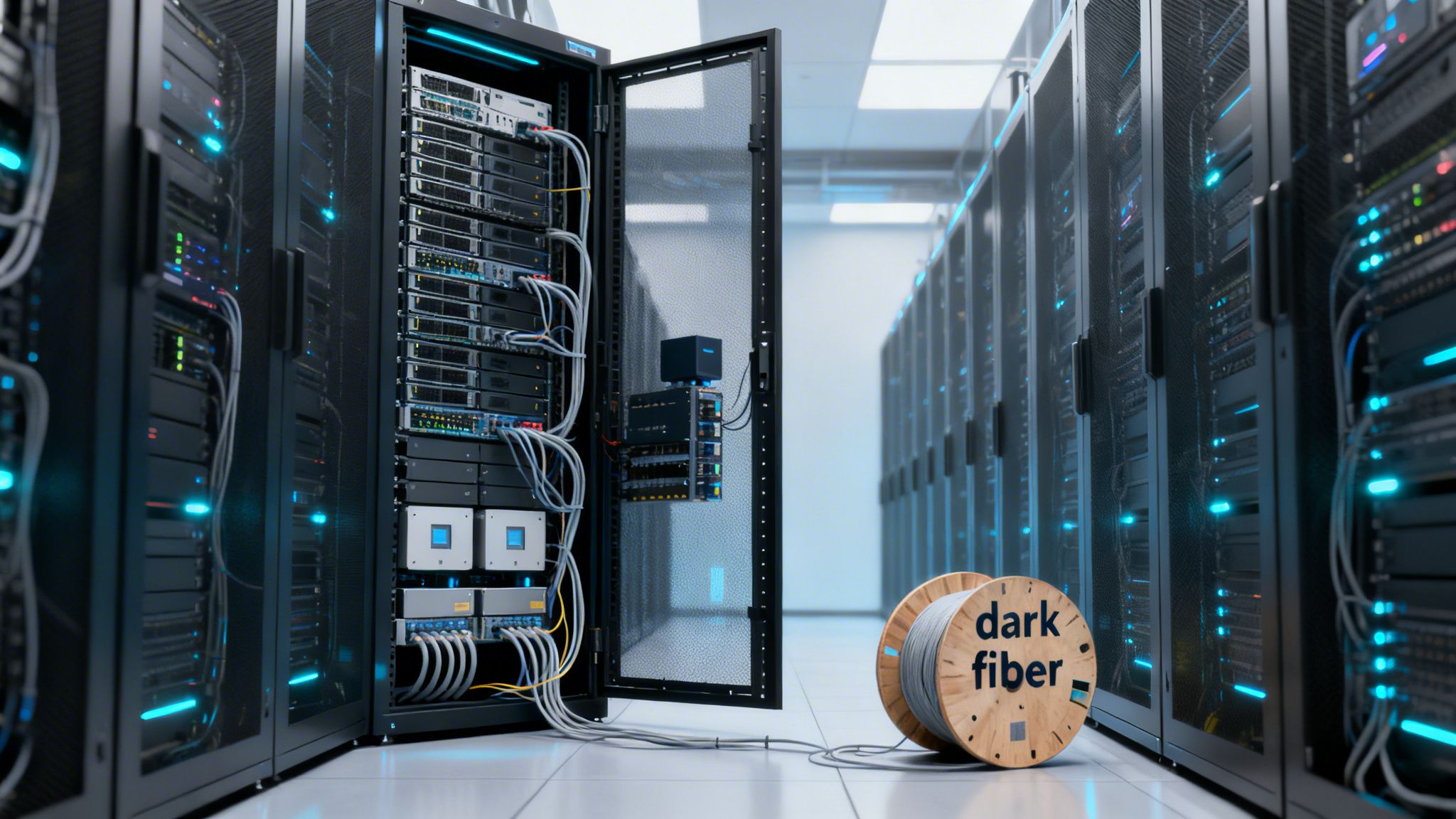
If you want to be ready for the future, you have to embrace scalability at every level. The smartest approach is to assume your future needs will dwarf your current projections. One of the most effective and surprisingly economical tactics for this is deploying dark fiber.
Simply put, dark fiber is unused fiber optic cable that you install right alongside your active lines. Think of it like pre-building extra lanes on a highway before the traffic gets bad. Anyone who's been in this business knows the biggest cost of deploying fiber isn't the cable itself—it's the labor for trenching, pulling conduit, and installation. Adding extra strands from the start is a small incremental expense that buys you enormous flexibility down the road.
When the inevitable demand for more bandwidth arrives, you can just "light up" those dark fibers with new equipment. This completely sidesteps the massive disruption and expense of pulling new cables through a live, operational facility.
Emerging Technologies for AI Workloads
As network speeds push toward 800G and even higher, we're running into new problems with power consumption and latency. Traditional pluggable optics have served us well, but they generate a lot of heat and draw significant power, especially when you have thousands of them packed into massive AI clusters.
This pressure has sparked a race for better solutions, and Co-packaged Optics (CPO) is emerging as a critical technology for what's next.
CPO integrates the optical connectivity directly onto the same package as the main processing chip (like an ASIC or GPU). This dramatically shortens the electrical distance the signal must travel, cutting both power consumption and latency.
This is a fundamental shift needed to build the next generation of huge AI training clusters. The market for optical interconnects in AI is already set to skyrocket, projected to leap from US$ 9.94 billion in 2025 to a staggering US$ 31.04 billion by 2033. This growth is driven by the switch from copper to optics, which can cut energy use by up to 40%. While pluggable modules are still dominant, CPO is expected to grow at an incredible 37% CAGR to handle the intense demands of GPU-powered AI. You can dig deeper into the future of optical interconnects in the AI data center market.
Creating Resilient Connectivity Hubs
Future-proofing isn't just about internal capacity; it's also about ensuring your facility is a robust and reliable hub for connectivity. This is where the design of your Meet-Me Room (MMR) becomes absolutely critical. The MMR is the nerve center where your data center connects to the rest of the world.
To build in maximum resilience and choice, a future-ready MMR needs a few key things:
- Diverse Carrier Entry Points: Don't let all your connectivity come through one hole in the wall. Ensure fiber from multiple carriers enters your building from physically separate locations. This protects you from a single incident, like a backhoe cutting a conduit, taking your entire site offline.
- High-Density Design: Plan the MMR with enough space, power, and cooling to host a wide range of carriers and partners. A thriving ecosystem of providers gives your tenants more options and keeps pricing competitive.
By weaving together strategies like installing dark fiber, preparing for technologies like CPO, and designing resilient MMRs, you're building a fiber optics data center that isn't just ready for today—it's engineered for tomorrow.
Frequently Asked Questions
When you're diving into a complex fiber project for a data center, a lot of questions pop up. We've fielded just about all of them over the years. Here are a few of the most common ones we hear from our partners, along with some straight-to-the-point answers.
What’s the Single Biggest Mistake You See in Data Center Fiber Design?
That’s an easy one. The most expensive mistake we see, hands down, is failing to plan for future growth. People build for what they need right now, and in three to five years, they've completely painted themselves into a corner.
Always, and I mean always, pull more capacity than you think you need. Install dark fiber. Make sure your pathways and conduits are accessible. The cost of doing it right the first time is a tiny fraction of what it costs to tear everything out and start over later.
How Does AI Change Cabling Needs?
Cabling for AI isn't just a small step up; it’s a completely different ballgame. Traditional data centers worry about traffic moving north-south (in and out of the facility). AI is all about the east-west traffic—the constant, high-volume chatter between thousands of GPUs working together.
This changes everything. To keep those AI clusters fed, you have to adopt:
- Much denser spine-leaf architectures to manage the massive internal data flows.
- Significantly higher fiber counts to support the move to 400G and 800G optics.
- Newer tech like co-packaged optics (CPO) that are being developed specifically to reduce the immense power draw and latency of these systems.
These aren't just nice-to-haves; they are fundamental requirements for any serious AI deployment.
While fiber is now dominant, copper cabling is not entirely obsolete. Its role has simply become more specialized and tactical within the modern data center.
For example, Direct Attach Copper (DAC) cables are still the workhorse for very short-run connections. They're a perfectly cost-effective and reliable way to link servers to a Top-of-Rack (ToR) switch inside the same cabinet. But the second you need to go from one rack to another, fiber is the only option that delivers the performance and scale you need.
Building a network that's not just reliable today but ready for whatever comes next takes experience. With over 20 years in the trenches designing and deploying high-performance fiber infrastructure for data centers and carriers, our team at Southern Tier Resources has seen it all. We handle the entire process, from engineering and construction to long-term maintenance.
Let’s start building your future-ready network together. Get in touch with our experts at https://southerntierresources.com.