
Before you even think about sending out a Request for Proposal (RFP), you need to get your own house in order. I've seen more telecom and data center projects go off the rails due to a weak scope of work than any other single factor. It's not just a document; it's the absolute bedrock of your project.
Get it right, and you get accurate bids and a smooth partnership. Get it wrong, and you're signing up for ambiguity, endless change orders, and a budget that balloons out of control.
Defining Your Project Scope With Precision
Your scope of work (SOW) is where your high-level business goals—like expanding a fiber network or bringing a new data hall online—get translated into the granular, technical language that contractors live and breathe. A strong SOW is the difference between a successful build and a failed one.
If your SOW just says, "Install a fiber optic network," you're asking for trouble. You'll get a stack of proposals that are impossible to compare because every bidder will have made their own assumptions. The real goal is to leave no room for guesswork.
From Business Goals to Technical Details
The trick is to deconstruct your big-picture objectives into specific, measurable tasks. Let’s say your goal is to "increase network capacity in the downtown district." What does that actually mean for a construction partner?
Here’s how that vague goal should break down in your SOW:
Telecom Project Example: Connect 500 new residential addresses to a greenfield fiber network.
- Provide detailed route plans identifying specific streets, underground conduit paths, and aerial pole attachments.
- Pinpoint the exact locations for 12 fiber distribution hubs (FDHs) and 48 splice closures.
- Specify the fiber type (e.g., G.652.D single-mode) and the required total strand count.
- Mandate specific OTDR testing standards and define the acceptable loss budgets per splice and for the total link.
Data Center Example: Fit-out a 2MW data hall for a new hyperscale cloud client.
- Include one-line diagrams for all electrical distribution, clearly specifying dual-path (A/B) power from the PDUs to every rack.
- Detail cooling requirements, including the installation of computer room air handler (CRAH) units with defined CFM and temperature setpoints.
- Provide a comprehensive structured cabling plan showing all fiber and copper runs from MMRs to server racks, calling out specific cable types and termination standards.
- Outline all security protocols, including specific hardware and software for access control at every entry point.
A highly detailed SOW does more than just guide potential partners—it forces them to prove they truly grasp the technical realities of your project. It's the best litmus test for vetting expertise right from the start.
This process—moving from a broad vision to rock-solid specs—is what enables a true partnership to form.
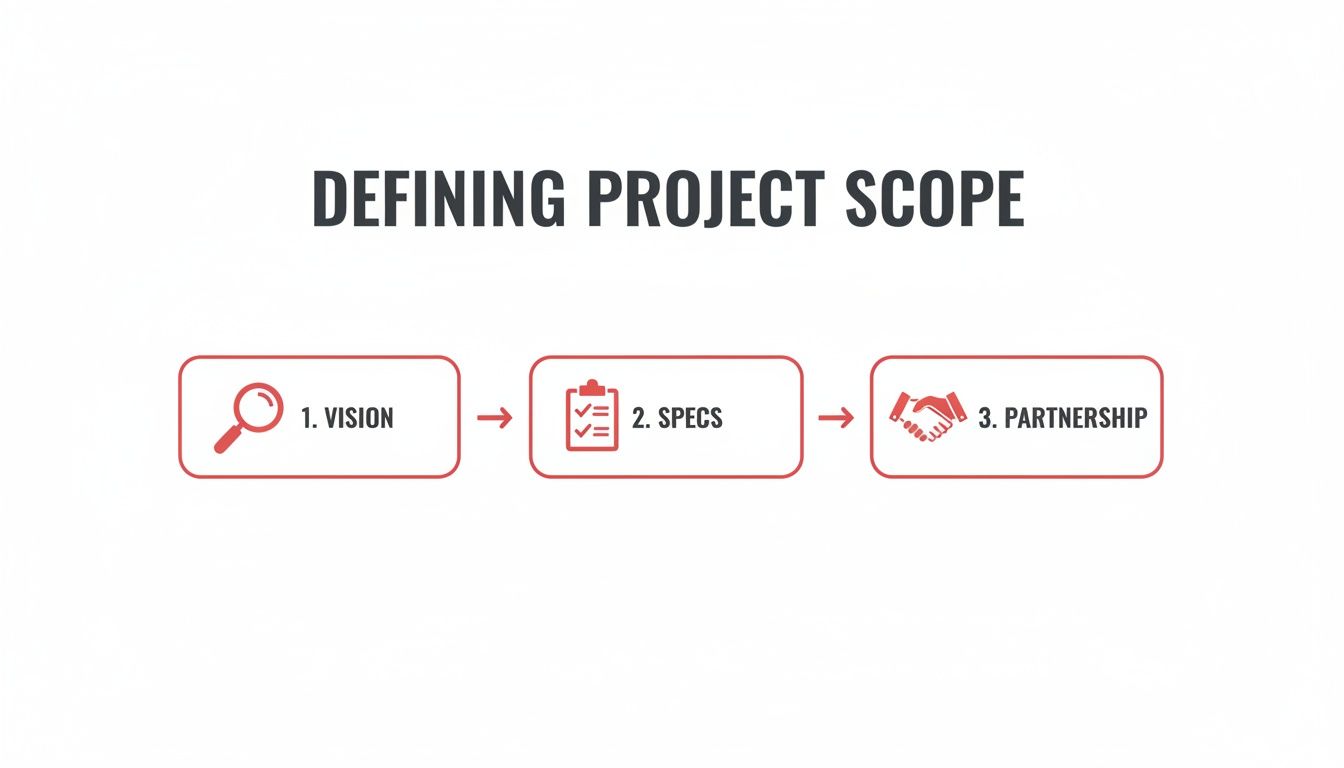
As you can see, a successful outcome isn't an accident. It’s the direct result of translating your high-level vision into exhaustive detail before you engage with a single contractor.
Eliminating Scope Creep Before It Starts
This level of upfront detail is your single best defense against project drift. When deliverables, boundaries, and performance metrics are locked in from day one, you close the door on the costly "misunderstandings" that lead to change orders and blown schedules. For a deeper dive, there are great resources on managing project scope creep that are well worth your time.
The stakes are massive. The global construction market was valued at $15.78 trillion in 2024 and is on track to hit $20.44 trillion by 2029. This explosive growth is driven by huge initiatives like the U.S. Infrastructure Investment and Jobs Act (IIJA), which is pumping billions into broadband and energy projects. To secure a piece of this action and deliver on time, project owners absolutely must begin with an airtight scope.
How to Properly Vet a Construction Partner
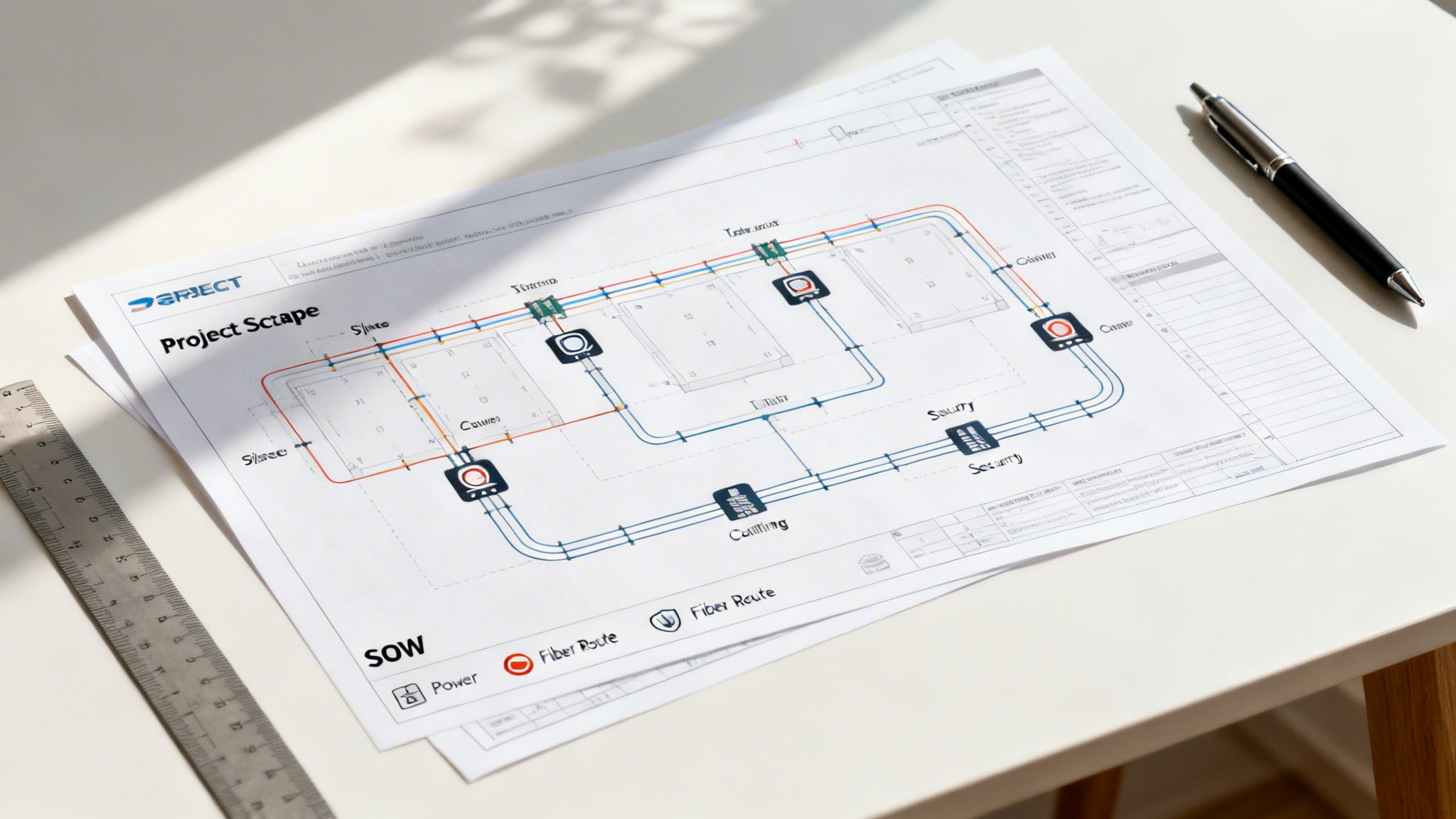
With a detailed scope of work in hand, the real work begins: finding an infrastructure construction company that can actually deliver. This is precisely where many promising projects go off the rails. Hiring a general contractor who lacks specialized telecom or data center experience is a classic, and costly, mistake.
Vetting has to be about more than just checking a few references. It's a deep-dive qualification process. The goal is simple—to filter out the generalists trying to get a piece of the digital infrastructure boom and identify the true specialists. A disciplined approach here is your single best defense against budget overruns, schedule slips, and painful rework.
Foundational Due Diligence: Safety and Financial Health
Before you even glance at a company’s project portfolio, you need to look at its safety record and financial stability. These are the absolute, non-negotiable pillars of a reliable partner. A contractor that’s loose with safety will be loose with quality, and a financially shaky partner is a flight risk who could disappear mid-project.
Start with the hard safety numbers. Ask for their Experience Modification Rate (EMR) for the last three years. An EMR below 1.0 shows their safety performance is better than the industry average; a number ticking much higher is a serious red flag. You should also request their OSHA 300 logs to see a documented history of workplace injuries.
A partner's commitment to safety directly reflects their operational discipline. A low EMR and a culture built around proactive safety aren't just metrics—they're leading indicators of a company's ability to manage complex work and protect your investment.
Financial health is just as critical. You can verify their stability and bonding capacity by requesting a Dun & Bradstreet (D&B) report or audited financial statements. A healthy balance sheet gives you confidence that they can handle material procurement, manage payroll, and absorb unexpected issues without putting your project’s timeline in jeopardy.
Verifying Technical Expertise and Certifications
Once you’ve confirmed a company is safe and stable, it’s time to zero in on their technical skills. Does this team have the specific, niche expertise your project demands? For telecom and data center builds, general construction experience just doesn’t cut it. You need to see tangible proof of specialized knowledge.
This is where you can use our Essential Vendor Qualification Checklist to systematically evaluate each potential partner. This checklist helps ensure you're asking the right questions and looking for the right green flags.
Essential Vendor Qualification Checklist
| Qualification Area | Key Questions to Ask | What to Look For (Green Flags) |
|---|---|---|
| Safety Record | What is your EMR for the past 3 years? Can we see your OSHA 300 logs? | EMR consistently below 1.0. A transparent and proactive safety culture. |
| Financial Stability | Can you provide a D&B report or financial statements? What is your bonding capacity? | A strong balance sheet. Sufficient bonding capacity for the project's total value. |
| Industry Certifications | Who on your team holds RCDD, CFOT, or PMP certifications? | Key personnel hold relevant, up-to-date certifications (e.g., BICSI RCDD, CFOT). |
| Relevant Experience | Can you provide case studies for 3 projects of similar scope and complexity? | Detailed project sheets that mirror your project's challenges. Specific, not generic, examples. |
| Splicing & Testing | What splicing and testing equipment do you own? Describe your QA/QC process for fiber tests. | Ownership of modern equipment (e.g., fusion splicers, OTDRs). A documented, multi-step QA/QC process. |
| Mobilization | What is your typical mobilization time? Can you provide an equipment list? | A clear, realistic mobilization timeline. Ownership of critical equipment like drills and bucket trucks. |
Using a structured checklist prevents you from glossing over critical details during the high-pressure vendor selection process.
Look for industry-recognized certifications held by their key people. These aren't just acronyms; they are proof of a commitment to standards and best practices.
- For Data Center Cabling: Having at least one BICSI Registered Communications Distribution Designer (RCDD) on staff is crucial for complex structured cabling.
- For Fiber Optic Work: Your crews should include Certified Fiber Optic Technicians (CFOTs) who are experts in splicing, testing, and troubleshooting.
- For Project Management: Look for leaders with a Project Management Professional (PMP) certification, which signals a disciplined approach to project controls.
Go beyond the paper qualifications and ask pointed questions about their actual experience. Don't settle for vague assurances. Ask for case studies on projects that are genuinely similar to yours in scale and complexity. Then, dig in: "What was the biggest unexpected challenge on that job, and how did your team solve it?" Their answer will tell you a lot. To get a better sense of what to look for, you can learn more about our robust internal screening processes that we apply to every project.
Assessing Mobilization and Equipment Readiness
Finally, a great plan means nothing if the company can't execute. You need to know if they have the crews and equipment ready to go.
Get a detailed breakdown of their equipment fleet. Do they own or lease their mission-critical machinery like directional drills, bucket trucks, and fiber splicing vans? Ownership is often a good sign of better availability and maintenance. Ask them what their typical mobilization time is for a project of this size. Can they get a full crew on-site within your required window? This conversation will reveal their true operational readiness and ability to scale—both of which are vital for getting your project started on time and keeping it there.
Crafting an RFP That Delivers Clarity

Your Request for Proposal (RFP) is the single most important document you will create in the hunt for a construction partner. A weak, vague RFP will get you exactly what you asked for: vague, incomparable bids that do more to obscure a contractor’s real abilities than reveal them. A great one, however, becomes a tool for precision. It forces potential partners to prove their expertise and gives you the clear, hard data needed to make a high-stakes decision.
This isn't just about collecting prices. A thoughtfully built RFP signals your own professionalism and sets a high bar for quality right from the start. It's a filter. The best contractors will appreciate the detail and rigor; the ones who complain or submit sloppy responses are telling you everything you need to know—they aren't the right fit for your critical project.
Structuring Your RFP for Comparable Bids
To get true apples-to-apples comparisons, your RFP must be meticulously structured. Ambiguity is the enemy here. Every section should be designed to pull out specific, measurable information that you can then score and weigh against your project’s top priorities.
You'll start with a concise project overview to set the stage, but the real meat is in the details that follow. The comprehensive Scope of Work (SOW) you've already developed becomes the heart of the document.
Beyond the SOW, you need to demand specific, non-negotiable information in several key areas:
- Company History and Financials: Ask for their business history, ownership structure, and proof of financial stability. Don't be afraid to request audited statements or a D&B report.
- Relevant Project Experience: A simple list of past jobs won't cut it. Require detailed case studies for at least three projects of similar scale and complexity that they've wrapped up in the last five years.
- Proposed Project Team: You need to know who will actually be on your job site. Ask for an org chart and resumes for the key personnel assigned to your project, not just a boilerplate list of their top executives.
- Safety Program and Records: Insist on seeing their EMR for the last three years, their OSHA 300 logs, and a full copy of their corporate safety manual.
- Quality Assurance/Quality Control (QA/QC) Plan: Have them describe their QA/QC methodology in detail. Ask for sample test reports and the documentation they use in the field.
A world-class RFP doesn’t just ask what a contractor will do; it demands they show you how they will do it. Ask for their specific processes for everything from safety incident reporting to material procurement and test documentation. The quality of their answers reveals their operational maturity.
This kind of structure turns your RFP from a simple request into a rigorous qualifying exam.
Asking Probing Questions to Reveal True Capabilities
The questions you ask are what will truly separate a top-tier infrastructure construction firm from the rest. If you ask generic questions, you'll get generic, marketing-heavy answers. You need to ask probing, specific questions that force bidders to show their work and provide concrete proof.
The digital infrastructure sector is in the middle of historic growth. Global spending on AI is projected to hit $749 billion by 2028, fueling an incredible surge in data center construction. With private infrastructure deals reaching nearly $520 billion in the first half of 2025 alone, the pressure to build faster and more efficiently is immense. For project owners like you, this makes picking a partner with proven safety and delivery records absolutely essential to success. You can explore more data on this infrastructure surge and its implications for more context.
Here are a few examples of probing questions that get you the real answers you need:
On Project Management:
- Describe your change order process in detail. How do you document, price, and communicate scope changes to maintain budget and schedule transparency?
- Provide a sample project schedule (Gantt chart) for a similar build. How do you track progress against the baseline and report on variances?
On Technical Expertise:
- For a fiber build, describe your splicing team's QA process. What are the specific steps a technician takes after completing a splice but before it is enclosed?
- For a data center fit-out, explain your process for Level III commissioning of the power distribution system.
On Mobilization and Logistics:
- Provide a detailed list of company-owned equipment that would be dedicated to this project.
- Describe your supply chain strategy for long-lead-time items like switchgear or fiber optic cable.
Questions like these require bidders to demonstrate their real-world processes. Their responses will paint a much clearer picture of their ability to execute than a simple price sheet ever could, giving you the confidence to choose a true partner.
Looking Past the Price Tag When Evaluating Bids
When you’ve got a stack of proposals, the temptation to jump straight to the price page is real. I’ve seen it happen time and time again, and it’s one of the biggest mistakes you can make in this business. For something as critical as a telecom or data center build, the lowest bid is almost never the best value.
The real story isn’t in the final number; it's buried in the details. You need to think of the total price as just one piece of a much bigger puzzle. The goal here is to find a true partner—a company that not only understands your scope but also has the technical chops and operational maturity to deliver. That means you need a structured way to evaluate them.
Create a Scoring Matrix to Keep Things Objective
Before you even open the first proposal, build a weighted scoring matrix. This simple tool is your best defense against being swayed by an attractive price tag. It forces you and your team to be objective and ensures every bidder is measured against the same yardstick.
Your matrix should be a direct reflection of what will make or break your project. For a mission-critical data center, for instance, the contractor's technical know-how and their quality control plan are probably far more important than a 10% price difference.
Here’s an example of how you might break down the weighting:
- Technical Approach & Plan (30%): Do they actually get it? Is their execution plan detailed, logical, and specific to your Statement of Work?
- Project Team & Relevant Experience (25%): Look at the résumés. Has this specific team done this exact type of work before? Are their certs up to date?
- Schedule & Mobilization (20%): Is the timeline they’ve proposed realistic or a fantasy? More importantly, do they have the crews and equipment ready to go, or are they scrambling?
- Total Cost (15%): How does the price stack up? Is it transparent? Are there hidden costs?
- Safety & Quality Programs (10%): What’s their EMR? Can they show you a documented QA/QC process that’s more than just lip service?
With a framework like this, a bidder can't win on price alone if they fall short on the things that truly matter for project success.
Digging into Cost Drivers and Mobilization Plans
Once you’re scoring, it’s time to put the numbers under a microscope. A single all-in price tells you nothing. Insist on a detailed cost breakdown so you can see exactly where your money is going.
Pay close attention to these line items:
- Labor Rates: Are their rates for PMs, foremen, and technicians in line with the local market? Rock-bottom rates can be a sign of an inexperienced, non-union, or under-qualified workforce—all of which introduce risk.
- Material Sourcing: How are they pricing major components like fiber, conduit, and switchgear? Do they have solid supplier relationships that can lock in pricing and guarantee availability?
- Equipment Costs: Are they using their own fleet or relying heavily on rentals? High rental costs can be a dead giveaway that they aren't properly equipped to handle your project efficiently.
A contractor’s mobilization plan is a fantastic litmus test for their preparedness. If it's vague or promises the moon, that's a huge red flag. A solid plan will name the crew leads, specify where equipment will be staged, and give you a clear Day 1 through Day 30 schedule of activities.
This level of financial scrutiny isn’t about nitpicking; it's about understanding their entire operational model. You'll often find that bidders who are transparent with their pricing are also the ones who are most transparent during project execution. If you want to dive deeper into this, our guide on how to outsmart the lowest bidder has more great strategies for finding real value.
How a bidder talks about quality is just as revealing. A generic promise to "ensure quality" is worthless. You want to see a detailed Quality Assurance/Quality Control (QA/QC) plan that spells out their process. For a fiber project, that means seeing their exact procedures for splice loss testing and submitting OTDR reports. For a data center, it means reviewing their commissioning checklists for power and cooling infrastructure.
By looking at proposals through this multidimensional lens, you change the game from picking the cheapest vendor to selecting the most capable partner. It's a disciplined approach, but it's the only way to ensure your project is done right—on time, on budget, and to the standard you expect.
Finalizing the Contract and Launching the Project

You’ve navigated the proposals, grilled the references, and made your choice. It's a huge relief, but don't pop the champagne just yet. Now comes the real work: turning that winning proposal into an ironclad contract.
This is where the foundation of your partnership is poured. The legal document you craft now will be your guide and your guardrail for the entire project. I’ve seen projects get derailed by weak contracts built on boilerplate language. Taking the time here to get the details right is the best investment you can make to avoid headaches and cost overruns later.
Negotiating the Nitty-Gritty
Your legal team will handle the legalese, but you, as the project owner, need to be the champion for the operational and commercial terms. A good contract is a story—it should clearly narrate how the project will run, who does what, and what happens when things go sideways. It should directly map back to what you asked for in your RFP and what the contractor promised in their proposal.
Zero in on these four areas. They are always the source of the biggest project conflicts.
- Payment Schedules and Milestones: This is simple: don’t pay for promises, pay for progress. Tie every single payment to a concrete, verifiable milestone. For example, release a payment only after the completion of 50% of the splicing work is verified, or after a power distribution unit passes commissioning tests.
- Change Order Protocol: Scope creep is a given. Uncontrolled scope creep is a budget killer. The contract absolutely must define a rigid, formal process for how change orders are requested, priced, reviewed, and approved. No more back-of-the-napkin agreements that somehow show up on an invoice.
- Insurance and Bonding: Don't just glance at the certificate of insurance. Define the exact coverage levels you need for General Liability, Worker's Comp, and E&O. More importantly, for any significant project, insist on a performance bond and a payment bond. This is your safety net if the contractor defaults or disappears without paying their subs.
- Dispute Resolution: How will you solve disagreements? Hoping they won't happen is not a strategy. The contract should lay out a clear escalation path, starting with informal talks between project managers and moving to formal mediation if needed. This keeps you out of the courtroom.
A strong contract isn't about one side winning. It's about creating mutual clarity and accountability so both you and your contractor can get the job done. It gives everyone the confidence to act, knowing the rules of engagement are set before the first shovel hits the ground.
By hammering out these details, you're not being difficult; you're being a professional. You're building a framework for collaboration, not conflict.
The Kickoff: From Paper to Action
Contract signed. Now what? It’s time to move from paper to pavement, and that starts with the project kickoff meeting. This isn't just a meet-and-greet; it’s the most critical alignment session of the entire project. A good kickoff builds momentum. A bad one creates confusion that can take weeks to untangle.
The goal here is to translate the legal language of the contract into a shared operational plan. You need all the key players in the room (or on the call)—from your project managers and engineers to the contractor's field supervisors and safety officers.
This is your chance to finalize the project governance framework. Cover these essentials:
- Roles and Responsibilities: Get granular. Use an organization chart to show who owns what. Who has the final say on change orders? Who is the go-to contact for daily field reports versus a safety incident? Remove all ambiguity.
- Communication Cadence: Agree on the rhythm of the project. Will there be daily huddles? Weekly status meetings with a standard agenda? A monthly executive review? Define the channels and the frequency right away.
- Walk Through Key Procedures: Don't assume everyone has read and understood the entire contract. Verbally walk through the most important workflows, like the Request for Information (RFI) process, the submittal review cycle, and the site safety and quality control plans.
This is where your meticulous planning pays off. When everyone leaves that meeting with a clear understanding of their role and how the team will operate, you’ve drastically reduced the friction that plagues the early days of a project. You’ve brought your contract to life.
Measuring Success with KPIs and Governance
Getting your new infrastructure online isn’t the end of the project; it’s just the beginning of its operational life. The real test of a construction partner’s value comes long after the last cable is pulled, and that long-term success hinges on strong project governance and clear metrics.Think of it this way: the contract outlines the rules of the game, but Key Performance Indicators (KPIs) and a solid governance framework are how you keep score day-to-day. Without them, you’re essentially flying blind, unable to catch small issues before they snowball into major budget or schedule blowouts.
Defining Your Project Health Metrics
Good KPIs are the vital signs of your project. They give you an objective, at-a-glance view of whether you're on track or heading for trouble. These aren’t just numbers for a weekly report; they are your early warning system.
For any data center or telecom build, I always insist on a dashboard that tracks these core metrics:
- Schedule Performance Index (SPI): This is your most direct measure of progress against your timeline. An SPI that dips below 1.0 is an immediate red flag that the project is falling behind schedule.
- Cost Performance Index (CPI): This is the budget equivalent of SPI. If your CPI is under 1.0, you're spending more money than you planned for the work completed. It’s a sign to dig into your costs immediately.
- Safety Incidents: You need to track everything. This includes the formal Total Recordable Incident Rate (TRIR) and, just as importantly, all near-misses. A pattern of minor incidents is often a precursor to a serious one.
- Quality Compliance: This is the pass/fail rate on quality checks. For a fiber project, a great example is tracking the percentage of splices that pass the loss budget on the first attempt.
Governance isn't about looking over your contractor’s shoulder. It's about establishing a predictable rhythm of communication and accountability that keeps everyone focused on the same outcome.
When you bring this data to your weekly meetings, conversations shift from subjective feelings to objective problem-solving. It’s no longer about "I think we're behind"; it’s about "Our SPI is 0.92, let's figure out why and get it back on track." Many of these safety and quality benchmarks are informed by established standards, which you can learn more about by reviewing our guide on navigating construction regulations.
Building Long-Term Value with SLAs
When the partnership extends beyond the initial build into ongoing maintenance, Service Level Agreements (SLAs) become critical. An SLA is your written guarantee that the infrastructure will perform as expected once it’s operational.
Don't settle for vague promises. A strong SLA is built on specific, measurable commitments with clearly defined penalties for failure. The metrics that really matter usually include:
- Response Time: How fast will a technician be on-site after a critical failure is reported? A 2-hour window is a common standard for major outages.
- Resolution Time: What is the maximum time allowed to fix a problem, like restoring service after a fiber cut?
- System Availability: This is the ultimate measure of reliability, typically expressed as a guarantee of 99.99% uptime or higher.
By putting these KPIs and SLAs in place from day one, you build a framework for shared accountability. This proactive approach ensures the high standards you demanded during construction are carried through the entire lifecycle of your asset.
Frequently Asked Questions
When you're about to invest heavily in a network build, you're bound to have questions. Getting the right answers upfront is the best way to sidestep common pitfalls and keep your project on track. Here are a few things we see clients ask all the time.
What's the Single Biggest Mistake People Make When Hiring a Contractor?
Without a doubt, it’s picking a partner based only on the lowest price tag. This approach almost always backfires, because it ignores the things that really determine a project's success: a contractor's safety record, their team's technical skill, and a proven history of actually hitting their deadlines.
A bid that looks great on paper can quickly balloon in cost from a mountain of change orders, frustrating schedule slips, and work that just doesn't meet professional standards. The smartest move is always to balance cost against qualifications and real-world experience. That’s where you find true value and minimize your risk.
Just How Important Are As-Built Drawings?
They are non-negotiable. Think of accurate as-built drawings as the official blueprint of your finished network. You will absolutely rely on this documentation for all future maintenance, troubleshooting, and any planned upgrades.
For telecom and data center projects, as-builts show you the precise physical location of every single conduit, fiber splice, and piece of gear. A quality partner won't just hand over a drawing; they'll provide meticulous documentation package, complete with OTDR test results and other QA data, to ensure your network is manageable for its entire lifecycle.
Should I Consider a Turnkey Provider?
For complex projects—think large-scale fiber deployments or a full data center fit-out—a turnkey provider can be a game-changer. When you put all phases of the project under one roof, you consolidate accountability, which dramatically cuts down on the kind of miscommunication that happens when multiple vendors are involved.
This end-to-end approach, which covers everything from engineering and permitting to construction and final testing, usually results in:
- Faster project delivery because you eliminate the delays between handoffs.
- Tighter budget control with a single point of financial oversight.
- A far more cohesive and reliable final network.
Having one dedicated team from start to finish simply provides a smoother, more accountable path to getting your network online.
Ready to build reliable network infrastructure with a partner you can trust? Southern Tier Resources provides end-to-end engineering, construction, and maintenance services for telecom and data center projects. Let's discuss your next project.