
Telecom infrastructure services are what bring our connected world to life. It's the skilled work of designing, building, and maintaining the physical nuts and bolts of digital communication. This includes everything from the fiber optic cables running under our streets to the wireless cell towers on the horizon and the highly secure data centers that house our digital lives.
Simply put, these services are the construction and engineering backbone of the entire digital economy.
The Building Blocks of Connectivity
Think of the internet as a massive, global highway system. The telecom infrastructure service providers are the crews who design the routes, lay the asphalt, build the bridges, and keep everything in working order. Without their specialized work, there’d be no video streaming, no cloud storage, and certainly no mobile apps.
At its heart, this field is all about creating the physical pathways for data to travel. Modern digital life really leans on four distinct but interconnected types of infrastructure.
What Are the Core Services?
Here's a breakdown of the four main categories of work that make up the bulk of telecom infrastructure projects.
Wireline and Fiber Infrastructure: This is the bedrock of high-speed, reliable internet. It’s all about the physical installation of thousands of miles of fiber optic cables, which carry data as pulses of light. These projects can be massive, like cross-country backbones, or hyper-local, like the Fiber-to-the-Home (FTTH) networks that bring gigabit speeds right to your doorstep.
Wireless Infrastructure: This is what makes our mobile world possible. It involves everything from erecting huge macro cell towers for wide-area coverage to deploying small cells in crowded city centers to handle heavy data traffic. It also includes installing Distributed Antenna Systems (DAS) to ensure you get a signal inside large buildings like stadiums, airports, and convention centers.
Data Center Infrastructure: Data centers are the fortified brains of the internet, where all the world's data is stored, processed, and managed. Infrastructure services here focus on the "fit-out"—the critical process of installing the complex power, cooling, and structured cabling systems that keep servers running 24/7. The goal is to build an incredibly resilient and secure environment for cloud services and enterprise data.
Maintenance and Operations: A network is a living thing; it can't just be built and forgotten. This side of the business involves everything from emergency fiber repairs after a storm to routine equipment upgrades and performance checks. Good maintenance is what guarantees reliability and protects the massive initial investment in the network.
To help clarify these distinct roles, here is a simple breakdown of the core components.
Core Components of Telecom Infrastructure
| Service Category | Primary Function | Common Use Cases |
|---|---|---|
| Wireline & Fiber | Creating high-capacity, physical data pathways using fiber optic cables. | Intercity backbones, metro rings, Fiber-to-the-Home (FTTH). |
| Wireless | Providing mobile connectivity and last-mile data access over the air. | Macro cell towers, urban small cells, indoor DAS installations. |
| Data Centers | Building the secure, powered, and cooled environment for servers. | New data center builds, colocation facility fit-outs, power/cooling upgrades. |
| Maintenance & Ops | Ensuring network uptime, performance, and longevity. | Emergency storm restoration, equipment upgrades, preventative maintenance. |
These services come together to form a complete, functioning network.
You can think of it this way: wireline and fiber are the interstate highways, wireless acts as the local roads getting data to your phone, and data centers are the massive warehouses and processing hubs where all the digital goods are stored.
Of course, a complete approach also has to consider what happens when network equipment gets old. That's where responsible end-of-life management, through services like IT Asset Disposition (ITAD), comes in to ensure old gear is retired securely and sustainably.
Ultimately, this isn't just about technology. It’s about enabling progress—helping a rural community get its first real broadband connection, or empowering a city to build a smart-grid powered by 5G. Telecom infrastructure services are how we turn digital blueprints into physical reality, one connection at a time.
The Journey of a Telecom Infrastructure Project
When a new cell tower pops up on the horizon or crews lay fiber in your neighborhood, it can feel like it happened overnight. But that's just the tip of the iceberg. These visible milestones are actually the final steps in a long, complex, and meticulously planned journey. Every telecom project—whether it’s for wireline, wireless, or a data center—follows a structured lifecycle to turn a business goal into a functioning network.
Understanding this process pulls back the curtain on the incredible effort that goes into the seamless connectivity we rely on every day. It’s a marathon, not a sprint, demanding precision and expertise at every stage. Think of it like building a custom home. You don't just show up with a pile of bricks and start building. You need architectural plans, city permits, a solid foundation, and rigorous inspections long before anyone moves in. Telecom projects are no different, just on a much larger and more technical scale.
These complex projects generally fall into one of three core domains.
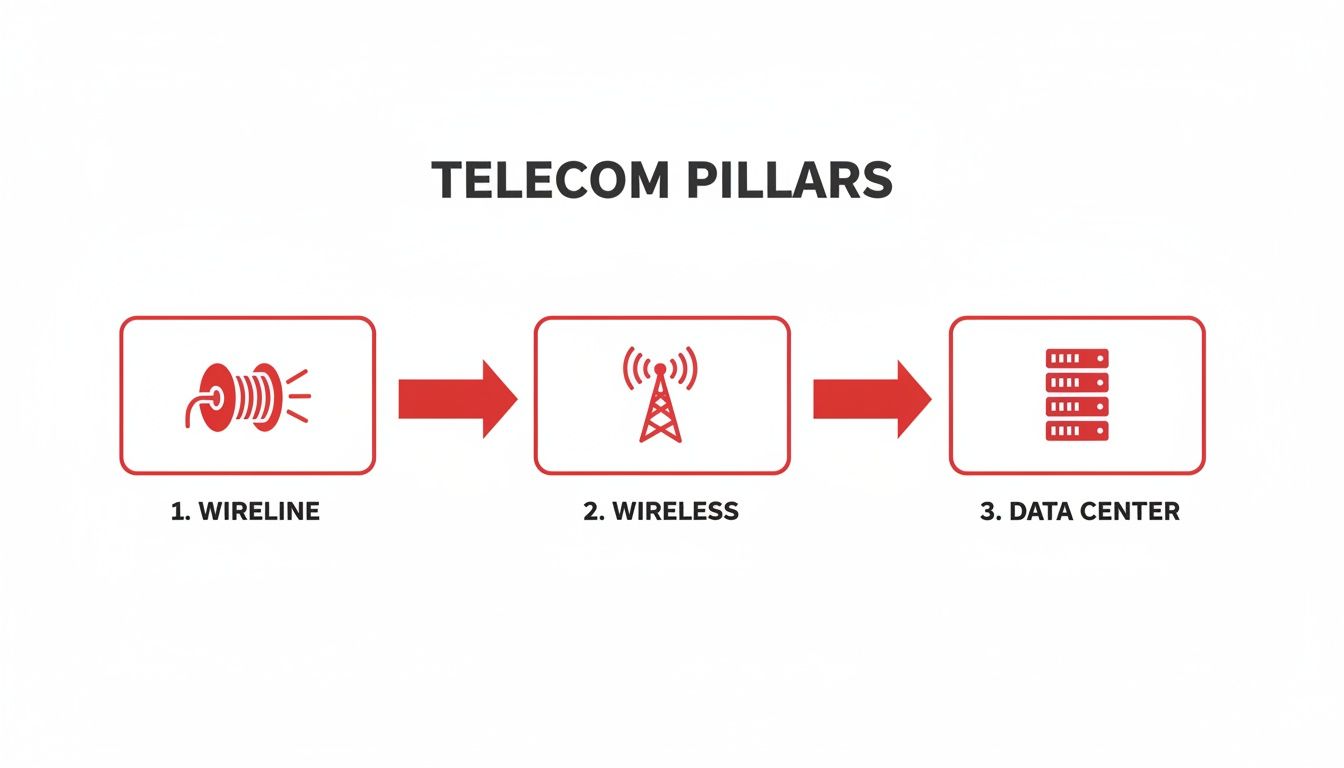
As you can see, telecom infrastructure services are the foundation for wireline, wireless, and data center environments. While each requires specialized know-how, the project journey itself follows a similar, interconnected path.
Phase 1: Strategic Design and Engineering
It all starts on paper. This is where the initial vision gets translated into a concrete engineering plan. For a new fiber network, engineers will map out the most efficient routes, calculate the necessary network capacity, and select the right cable and hardware. Any misstep here can lead to huge budget overruns and painful delays down the road.
For a wireless network, the focus is on RF (radio frequency) planning. This involves identifying the perfect spots for cell sites to maximize coverage while minimizing signal interference. Inside a data center, this phase means designing the intricate web of power, cooling, and structured cabling systems that will support thousands of high-performance servers.
Phase 2: Permitting and Right-of-Way
Before a single shovel can hit the dirt, every project has to navigate a maze of legal and regulatory hurdles. Honestly, this is often the most unpredictable and time-consuming part of the whole process.
Securing the necessary permits and rights-of-way can easily eat up a significant chunk of a project's timeline. It involves painstaking negotiations with municipalities, utility companies, private landowners, and regulatory agencies.
This is where having an experienced partner with deep local relationships becomes invaluable. They know the ins and outs of local ordinances and can help get approvals pushed through, keeping the project from getting bogged down in red tape.
Phase 3: Construction and Deployment
With plans approved and permits in hand, it's finally time to build. This is the most visible phase of providing telecom infrastructure services, where the designs come to life.
Crews mobilize to execute the plan. Depending on the project, this could involve:
- Trenching or directional boring to lay underground fiber conduit.
- Erecting new cell towers or mounting small cell equipment on existing structures like utility poles.
- Installing server racks, power distribution units, and fiber raceways inside a data center shell.
Throughout this phase, strict adherence to safety protocols and quality standards is non-negotiable. It’s all about protecting the crew and ensuring the infrastructure will stand the test of time.
Phase 4: Testing and Commissioning
Once construction wraps up, the network has to be put through its paces before it can go live. This is far more than just flipping a switch. Engineers use specialized equipment to test and verify that every single component is performing exactly as designed.
For a fiber network, this means testing for signal loss (attenuation) and reflection to guarantee data integrity. For wireless sites, crews conduct drive tests to confirm real-world coverage meets the design specs. This commissioning process is the final sign-off, certifying that the network is ready for service.
The last two steps—documentation and maintenance—are just as critical. Accurate as-built documents create a permanent record of what was installed and where, which is essential for future repairs or upgrades. And finally, ongoing operations and maintenance ensure the network performs reliably for years to come. To get a better sense of what this involves, you can explore the details of properly planning telecom construction projects in our guide. This end-to-end management, from a paper plan to a fully operational asset, is what defines a successful telecom infrastructure journey.
Navigating Technical Standards and Future Trends
Once you’ve mapped out a telecom project, the real work begins. Moving from a plan on paper to a fully operational network is where the technical details make all the difference. This isn’t just about putting up towers or pulling cable; it's about making deliberate engineering choices that will determine whether your network is a high-performance asset or a constant source of problems.
Think about it from the ground up. Early design decisions, like choosing a resilient ring topology over a simpler point-to-point layout, define how your network will survive a fiber cut. Or consider the intricate work of "make-ready engineering"—the process of preparing utility poles for new fiber. This isn't just about stringing a line; it's a detailed analysis to ensure the pole can handle the added weight and wind load without failing.
Every one of these steps is guided by a set of non-negotiable standards that form the backbone of a successful build.
The Bedrock of Quality and Safety
In telecom construction, you simply can't afford to cut corners. Following established standards isn't just about checking a box for compliance; it's what ensures the network performs as expected, that its components work together, and that everyone stays safe on the job.
This commitment to technical discipline shows up in a few critical areas:
Industry Standards: We rely on specifications from organizations like the Telecommunications Industry Association (TIA) and the Institute of Electrical and Electronics Engineers (IEEE). These guidelines cover everything from how structured cabling should perform to the proper construction of communications towers, ensuring that a cable from one vendor works perfectly with a switch from another.
Rigorous Testing Protocols: A network isn't "done" when the last cable is connected. It’s done when it's been proven to work. Technicians use specialized tools like Optical Time Domain Reflectometers (OTDRs) to hunt for tiny imperfections in fiber optic lines and spectrum analyzers to guarantee wireless signals are clean. This is the only way to certify the network actually delivers on its performance goals.
A Culture of Safety: A "safety-first" mindset has to be woven into every part of the operation. This means daily safety briefings, consistent use of personal protective equipment (PPE), and strict protocols for high-risk work like climbing towers or entering confined spaces. This protects our most valuable asset—our people—and keeps the project on track.
Building to code is not just about compliance; it's about building an asset that will reliably perform for decades. A network that passes stringent testing on day one is far less likely to cause expensive operational headaches on day one thousand.
While these fundamentals are timeless, the industry is also being reshaped by the biggest shift in a generation: the rollout of 5G.
Embracing the Future with 5G and Beyond
The move to 5G is so much more than just a speed bump over 4G. It's a fundamental reimagining of how networks are built. To deliver on its promise of near-instantaneous response times and massive device connectivity, 5G demands a far denser, smarter, and more intricate infrastructure. For more on this, check out our guide on how technology impacts telecommunications.
This transition is kicking off an incredible wave of new construction. The 5G infrastructure market is forecast to explode from USD 43.50 billion in 2025 to USD 675.9 billion by 2034, as carriers move from initial non-standalone (NSA) deployments to the more powerful standalone (SA) 5G architecture. You can dig into the numbers yourself by reviewing the latest 5G infrastructure market analysis.
Building for this new era means getting comfortable with some major architectural changes. For example, the industry is moving toward virtualized RAN (vRAN) architectures, which decouple network software from specialized hardware and give operators more flexibility. At the same time, Multi-access Edge Computing (MEC) is bringing processing power closer to the end-user—a critical step for enabling applications like autonomous vehicles and augmented reality.
Successfully navigating these technical standards while preparing for the future requires a partner with deep engineering expertise and the vision to build the networks of tomorrow, today.
Connecting Infrastructure to Business Growth and ROI

It’s easy to get lost in the technical details of a telecom infrastructure project—the concrete, steel, and fiber. But make no mistake, this is a strategic business investment, not just a line item in a CapEx budget. If you view infrastructure purely as a cost center, you're missing the whole point. It's the engine that drives competitive advantage, shores up customer loyalty, and unlocks new revenue.
For any organization, the decision to upgrade a network has to be tied directly to real business outcomes. A better network isn’t just about faster speeds. It's a powerful way to keep your customers happy, expand into new markets, and build a reputation for rock-solid reliability that attracts high-value clients.
This shift in perspective—seeing infrastructure as a strategic asset—is fueling massive investment worldwide. The telecom network infrastructure market is on a significant upward trend, projected to climb from USD 211.10 billion in 2025 to USD 355.00 billion by 2035. This growth is a direct reflection of the capital pouring in to meet the relentless demand for connectivity, especially with the global rollout of 5G. For a closer look at the numbers, the full telecom network infrastructure market forecast offers a detailed breakdown.
Translating Infrastructure into Tangible Business Value
When we talk about the return on investment (ROI) for telecom infrastructure services, the conversation has to go deeper than the initial price tag. The real value is unlocked over the entire life of the network, influencing everything from your daily operations to how your brand is perceived in the market.
This value looks a bit different depending on who you are.
Carriers and ISPs: For a service provider, a better network has a direct line to the bottom line. Faster speeds and fewer outages mean less customer churn, which is a notorious profit killer. A robust fiber or 5G backbone also opens the door to premium service tiers, creating new, high-margin revenue streams that simply weren't possible before.
Data Center Operators: In the world of cloud and colocation, uptime is king. Guaranteed connectivity isn't a feature; it's the absolute minimum requirement to attract serious enterprise clients. By investing in redundant, high-capacity fiber paths and reliable power, data centers can offer stronger service level agreements (SLAs), command premium prices, and lock in long-term contracts.
Municipalities and Cooperatives: For a city or a rural cooperative, building out broadband is an investment in the community's economic future. Reliable, high-speed internet access attracts businesses, enables remote work, supports modern education, and even increases property values. Here, the ROI is measured in jobs, growth, and opportunity.
An investment in telecom infrastructure is not just about connecting devices; it's about connecting with customers, securing critical operations, and empowering communities. It's the foundational layer upon which modern business is built.
Calculating the True Return on Your Investment
To get a real sense of your ROI, you need to look beyond a simple cost-benefit calculation. A proper model has to account for both the direct financial gains and the crucial, often-overlooked operational improvements.
Make sure you factor in these key elements:
Increased Revenue: This isn't just one number. It's a combination of new customers won over by better service, existing customers upgrading to faster plans, and expansion into entirely new territories.
Reduced Customer Churn: Put a real number on customer retention. Calculate the financial impact of keeping customers who would have otherwise jumped to a competitor with a better network. Even a small dip in churn can have a huge effect on long-term revenue.
Operational Savings: A modern, well-documented network is simply cheaper to run. Think about the savings from fewer emergency truck rolls, faster troubleshooting, and lower power bills from new, more efficient hardware.
At the end of the day, top-tier connectivity is one of the most powerful differentiators you can have. By investing strategically in your telecom infrastructure, you aren't just keeping up with the latest technology—you're building a solid foundation for sustainable growth and profitability.
Telecom Infrastructure in Action

The best way to understand the real-world impact of telecom infrastructure services is to see them in the field. Let's move past the project plans and technical specs to look at how seasoned partners solve concrete problems for different types of clients.
These are stories from the front lines, showing how expert engineering and deployment make modern connectivity possible.
Eliminating Dead Zones in a Packed City
A national wireless carrier had a classic, nagging problem: spotty coverage in a dense downtown core. Tall buildings were creating "urban canyons" that blocked signals from their large macro towers. For customers, this meant dropped calls and molasses-slow data right in the middle of a bustling business district.
The answer wasn't another massive tower. Instead, the solution called for a surgical approach using small cells. An infrastructure partner came in to handle the intricate deployment, which required:
- Conducting RF surveys to pinpoint exactly where signals were weak and why.
- Performing make-ready engineering to confirm each lamppost or utility pole could handle the new equipment's weight and power needs.
- Navigating the bureaucracy of coordinating with city officials to get permits for over 50+ individual locations.
The result? A web of low-power nodes seamlessly filled the coverage gaps. This boosted network capacity and fixed the user experience without the cost and visual impact of a new macro site.
Building a Fail-Safe Hyperscale Data Center
Now, picture a global cloud provider commissioning a new hyperscale data center. For this kind of business, even a few seconds of downtime can be catastrophic. Their goal was absolute dependability: five-nines reliability (99.999% uptime).
They brought in an infrastructure partner for the "fit-out"—the critical phase of installing all the power and connectivity inside the building's shell. This is a job where precision is everything. Crews methodically installed miles of high-density fiber in overhead trays, making sure every single server rack had redundant pathways to the network core.
At the same time, teams deployed heavy-duty power distribution units (PDUs) and uninterruptible power supply (UPS) systems. When deploying physical infrastructure components, such as modular data centers or remote cell sites, considering robust measures for securing shipping containers used in infrastructure is paramount to protect valuable equipment.
Every connection was tested, certified, and documented in detailed as-built plans. This created a fail-safe environment capable of supporting millions of users, where a single component failure would go completely unnoticed.
Launching a New Fiber Network in a Growing Suburb
Finally, think of an ambitious internet service provider (ISP) looking to blanket a growing suburb with a new Fiber-to-the-Home (FTTH) network. Their main challenge was speed. They had to connect thousands of potential customers before the established giants could react.
A turnkey telecom infrastructure services partner took on the entire project, from start to finish. It all began with route design and securing the right-of-way access needed to work along public roads. With the plans approved, crews used directional boring equipment to lay underground conduit with minimal disruption to the neighborhood.
As soon as a section of the fiber backbone was in place, other teams followed right behind, running individual fiber drops to homes and handling the final in-home installations. This parallel, highly coordinated workflow allowed the ISP to start signing up customers months ahead of schedule and grab a crucial foothold in a new market.
These projects underscore the tangible value that specialized services provide. They are the bedrock of a market with enormous economic importance. The global telecom services market, which is built on these infrastructure investments, was valued at USD 2.10 trillion in 2025 and is projected to hit USD 3.39 trillion by 2035. This explosive growth shows the direct line between building better networks and powering the digital economy. You can explore the data further in this detailed telecom services market report.
Whether for wireless, data centers, or fiber, each of these stories proves the same point: success hinges on finding a partner who can expertly turn a business objective into a physical, functioning reality.
How to Choose the Right Infrastructure Partner
Picking the right firm to build your telecom infrastructure is one of the highest-stakes decisions your business will make. The right partner delivers a high-performance network on time and on budget. The wrong one can saddle you with costly delays, safety nightmares, and an asset that just doesn't perform.
Let's be clear: the price tag is only one small part of the story. A dependable partner brings far more to the table than just technical skills. They have a proven history of success, a non-negotiable safety culture, and the financial stability to see a multi-million dollar project all the way through. Your vetting process needs to dig deep for these core qualities, not just skim the surface comparing bids.
Vetting for Proven Experience and Capability
First things first, look right past the sales pitch and straight into their project portfolio. A solid partner will have a well-documented track record of completing projects that mirror yours in both scale and complexity.
Don’t be shy—ask for specific examples and references. Have they actually deployed the type of telecom infrastructure services you need? Whether it’s a dense urban small cell network, a long-haul rural fiber build, or a complex data center fit-out, their past work is the best predictor of future success. A company with deep experience already knows the unique headaches your project will face before the first shovel even hits the ground.
You also need to gauge their end-to-end capabilities. A true turnkey partner can handle the entire project lifecycle, from initial engineering and permitting to construction, testing, and final documentation. This integrated approach is a game-changer, simplifying communication and ensuring critical details don't get lost in translation between different vendors. For a closer look at what separates the best from the rest, it’s worth reading about the qualities of a top-tier telecom engineering firm.
Think of it this way: a partner’s ability to self-perform the majority of the work is a powerful indicator of their control over quality and accountability. A heavy reliance on unknown subcontractors can introduce serious project risks and muddy the waters of responsibility.
Non-Negotiable Partnering Criteria
Once you’ve confirmed they have the right experience, it's time to run them through a checklist of operational must-haves. The best partners always shine in a few key areas that are directly tied to project success.
Key Evaluation Checklist:
- Safety Record: Ask for their Experience Modification Rate (EMR). A score below 1.0 is a strong sign of an effective safety program and fewer job-site incidents. This isn't just about compliance; it protects your project from expensive delays and liability.
- Financial Stability: Make sure they are bondable and have the capital to procure materials and manage cash flow for a project of your size. A financially weak partner puts your entire investment in jeopardy.
- Mobilization Speed: In today's market, speed is a real competitive edge. How quickly can they get skilled crews and the right equipment to your site?
- Transparent Communication: A great partner gives you clear, consistent updates and a dedicated point of contact. You should never have to wonder about the status of your project or chase down answers.
- Clear Service Level Agreements (SLAs): The contract needs to be crystal clear. It must explicitly define deliverables, quality standards, timelines, and a straightforward process for handling changes. Vague agreements are a recipe for conflict down the road.
Ultimately, choosing the right infrastructure partner is about mitigating risk and guaranteeing a positive return on your investment. By prioritizing a proven track record, a serious safety culture, and rock-solid operational standards, you're not just hiring a contractor—you're building a relationship that will deliver lasting value.
Frequently Asked Questions About Telecom Infrastructure
When you’re looking at a major investment in your network, a lot of practical questions come up. It's completely normal. Here are a few of the most common ones we hear from clients and our straightforward answers based on years of experience in the field.
What Is the Biggest Challenge in a Typical Fiber Deployment Project?
Without a doubt, the biggest hurdle is almost always permitting and securing right-of-way (ROW). It’s not the digging or the splicing that causes major delays; it’s the paperwork.
You're dealing with a web of city governments, utility companies, and sometimes dozens of private landowners. Each has its own rules and timelines. A partner who knows the local landscape and has existing relationships is your best bet for cutting through the red tape and keeping the project on schedule.
How Do You Ensure Network Reliability and Future Scalability?
You can't add reliability after the fact—it has to be designed in from day one. That means using top-tier materials and following strict industry standards (like those from TIA/EIA), but it’s more than that. It's about smart design, like building redundant fiber rings so a single cable cut doesn't take down your entire network.
We always plan for what's next. That means installing conduits with extra space for future fiber pulls or making sure a data center’s power and cooling can be scaled up without a complete overhaul.
Think of it as building a highway with extra, unopened lanes. Thorough testing and meticulous as-built documentation are the final pieces. This ensures the network you have today is solid and ready for the upgrades you'll need tomorrow.
What Does Turnkey or End-to-End Service Actually Mean?
"Turnkey" is a simple idea: you get one partner, one point of contact, and one team accountable for the entire project. From the first sketch on a napkin to the final test and handover, it’s all managed under one roof.
Instead of you having to coordinate between separate engineering firms, construction crews, and testing specialists, a turnkey provider handles all of that. It closes the gaps where mistakes, miscommunications, and budget overruns happen. Ultimately, it’s the most direct path to getting a complex project done right, on time, and on budget.
Ready to build a network that drives your business forward? The team at Southern Tier Resources has the end-to-end expertise to deliver reliable, scalable infrastructure from concept to completion. Let's discuss your project today by visiting us at https://southerntierresources.com.