Choosing the right civil construction contractors is probably the single most important decision you'll make for any major telecom or data center build. It’s the pivot point that determines whether your project hits its deadlines and budget or spirals into a mess of change orders, delays, and quality issues. The best partners bring much more to the table than a low price; they provide specialized expertise, a deeply ingrained safety culture, and the financial stability to back it all up.
What Separates Elite Contractors From The Rest
When you’re vetting partners for critical infrastructure, the gap between a standard contractor and a top-tier one is massive. It's not just about owning the right equipment. It's about a deep, institutional knowledge of the unique pressures and challenges that come with telecom and data center construction.
This is a big business. The global market for these services was valued at USD 154.8 billion in 2026 and is on track to hit USD 216.9 billion by 2034. That kind of growth attracts a lot of new players, but experience is what truly matters. An elite partner shows up with proven mastery in the areas that often get glossed over in a typical bidding process.
The table below breaks down the key differences you'll see when evaluating potential partners. It highlights how an enterprise-focused firm thinks and operates differently from a generalist contractor.
Key Differentiators in Enterprise-Grade Contractors
| Attribute | Standard Contractor Approach | Enterprise Partner Approach |
|---|---|---|
| Technical Expertise | General construction skills; may subcontract specialized work. | In-house experts in OSP, directional boring, and make-ready engineering. |
| Safety Culture | Focuses on meeting basic compliance and OSHA requirements. | Proactive safety culture with documented daily huddles, JSAs, and EMR below 1.0. |
| Problem Solving | Reacts to issues as they arise, often leading to delays and change orders. | Anticipates challenges like utility conflicts and permitting hurdles; plans ahead. |
| Project Management | Provides basic progress reports. | Utilizes advanced scheduling, cost controls, and transparent communication protocols. |
| Documentation | Delivers basic as-builts at project end. | Provides comprehensive, real-time documentation and a clean handoff package. |
Ultimately, an enterprise partner acts as an extension of your own team, invested in the long-term success of the asset, not just in completing the immediate build.
Deep Technical and Niche Expertise
The best civil construction firms immediately stand out with their proven skills in very specific, critical niches. For a fiber-optic network build, they don’t just dig trenches. They have certified experts in outside plant (OSP) construction who know how to navigate a maze of underground utilities and execute flawless directional boring. They truly get the complexities of make-ready engineering, deftly coordinating with multiple utility pole owners to prep a route for aerial fiber.
This is where you avoid catastrophic, yet common, mistakes. A less experienced crew might hit an unmarked water main or another utility's fiber line, causing service outages and setting your project back weeks. An enterprise-grade partner, on the other hand, lives by the 811 "call before you dig" process and uses advanced locating techniques to prevent these conflicts from ever happening. The best civil construction contractors also use modern tools like AI estimating software to dial in their accuracy right from the start.
A contractor’s ability to flawlessly execute make-ready engineering is a clear sign of their competence. It shows they can manage complex stakeholder relationships with utilities and municipalities, a skill that is just as important as their technical ability to lay conduit.
A Verifiable Commitment to Safety
Every contractor on the planet will tell you they prioritize safety. The elite ones prove it with data. You can cut through the talk by asking for their Experience Modification Rate (EMR), a number their insurance provider calculates based on past safety performance. Anything below a 1.0 is a strong indicator they have a better-than-average safety record.
Look for signs of a proactive safety culture, not just a reactive one. This isn't just a poster on the wall; it's a daily practice.
- Daily Safety Huddles: Does every crew start the day by discussing the specific hazards on that day's job?
- Job Safety Analysis (JSA): Ask to see their JSAs. These documents should formally identify the risks for each task and map out clear steps to mitigate them.
- Proper PPE Usage: When you visit a site, is every single person wearing the correct personal protective equipment, without exception?
A firm with a true safety-first mindset will have no problem showing you documentation and real-world examples. A company that’s just paying lip service will give you vague assurances. This commitment isn't just about protecting people—it directly protects your timeline and budget by preventing accidents and the costly work stoppages that follow.
Before you even think about asking for a price, you need a disciplined pre-qualification process. I can't stress this enough. This step acts as a critical filter, making sure you only spend time on serious, capable civil construction contractors who have the team and the financial backing to see your project through. Getting this right from the start saves an incredible amount of time and prevents the headache of weeding out unqualified firms later.
The whole thing kicks off with a well-designed Request for Information (RFI). The point of an RFI isn't to shop for the lowest bid; it's to gather cold, hard data so you can create a shortlist of the best potential partners. You're essentially building a detailed profile on each contractor, zeroing in on the metrics that truly define success for critical infrastructure projects.
You're looking for partners who excel in three key areas.
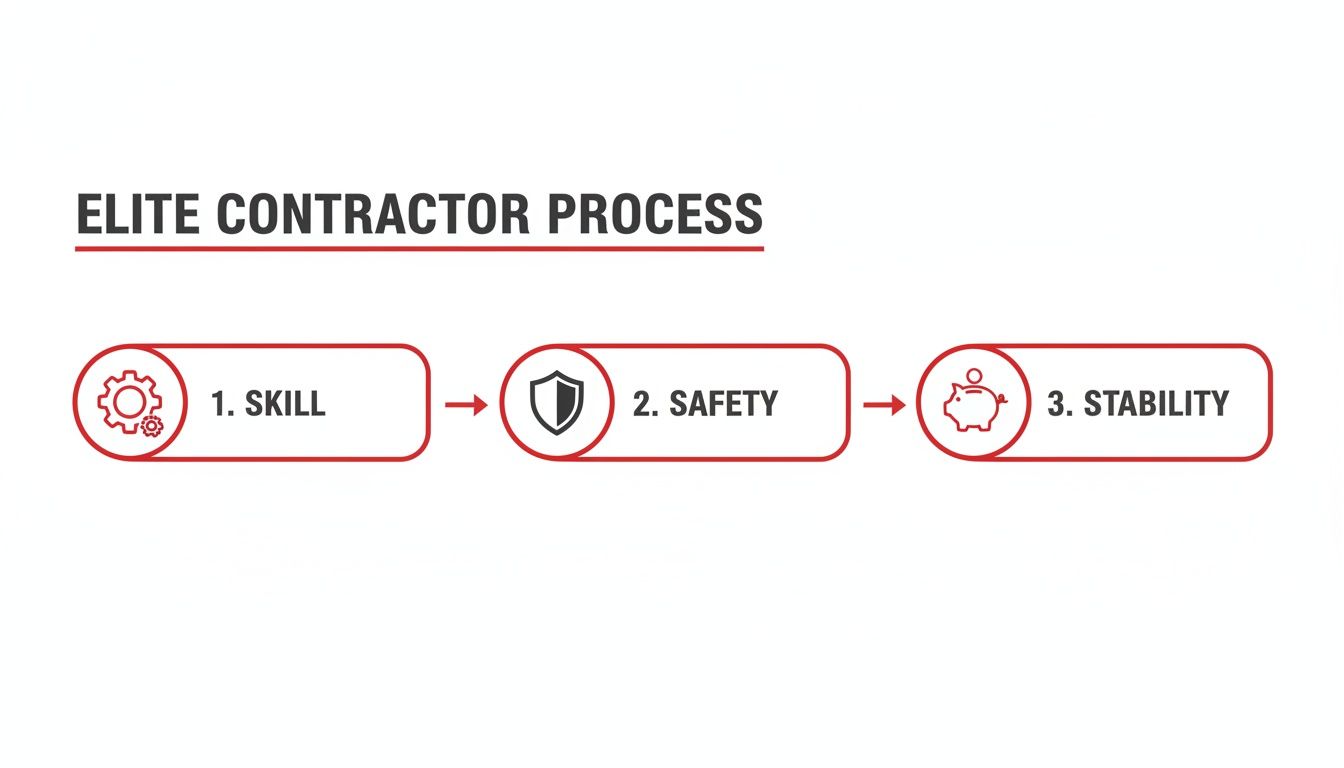
Elite partners are always built on this foundation: proven skill, a culture of safety, and unquestionable financial stability. Let's break down how to verify each one.
The Pre-Qualification Playbook
Your RFI needs to demand specific, verifiable answers. Vague questions get you vague, useless responses. Be direct and build your inquiry around these three pillars of competency.
Proven Safety Performance
Safety isn't just a talking point on a website; it's a number you can track. Your RFI has to demand objective proof of a contractor's safety culture.
- Experience Modification Rate (EMR): Ask for their EMR for the last three years, no exceptions. An EMR that's consistently below 1.0 is a strong sign they have a better-than-average safety record.
- OSHA 300 Logs: You need to see their OSHA 300 logs for the past three years. This gives you a raw, unfiltered look at the number and type of recordable injuries and illnesses on their jobs.
- Safety Program Documentation: Get a copy of their corporate safety manual. This is where you can review their actual, documented procedures for Job Safety Analysis (JSA), daily toolbox talks, and how they handle incident reporting.
Financial Solvency and Stability
A contractor’s financial health directly impacts their ability to run large projects and absorb the inevitable surprises that come up.
A contractor without sufficient bonding capacity is a massive red flag. Bonding is your project’s insurance policy. If the contractor goes under, the surety company is on the hook to find another firm to finish the work, protecting your investment.
Make them provide a letter from their surety company that clearly states their total bonding capacity and how much of it is currently available. This is a non-negotiable step that quickly weeds out firms that are overextended or can't secure the backing of a reputable surety.
Relevant Project Experience
"Construction experience" is too broad. You need proof they have successfully delivered projects with a similar scope, scale, and complexity to yours. For more on this, check out our guide on navigating the procurement process for specialized services.
- Project Portfolio: Require a detailed list of at least five similar projects they’ve wrapped up in the last five years. This list needs to include project value, duration, and a clear description of the work.
- Client References: For every project on that list, you need a contact—name, title, and phone number. Here’s the pro tip: actually call them. Don't just check a box. Ask real questions about their communication, how they solved problems, and the final quality of their work.
Crafting a Flawless Request for Proposal (RFP)
Once you've used your RFI to narrow the field to three to five highly qualified contractors, it’s time to issue the Request for Proposal (RFP). A well-written RFP gets rid of guesswork and forces an apples-to-apples comparison between bidders.
Your RFP has to be specific. Don't just ask for a price on "conduit installation." Instead, specify the conduit type (e.g., HDPE SDR 11), burial depth, backfill material and compaction requirements, and the exact specs for the tracer wire. The more detail you provide in your drawings and performance expectations, the more accurate and comparable your proposals will be.
This is also where you define your Service Level Agreements (SLAs). Be explicit about your expectations for communication response times, how often you expect reports, and the level of on-site supervision required. By setting these standards upfront, you make every bidder price their services based on the same high level of project management you demand. It’s the best way to avoid a low-ball bidder who wins the job and then fails to provide the support you need to keep the project on track.
How to Evaluate Bids Beyond the Price Tag
Once the proposals start rolling in from your shortlisted civil construction contractors, it's incredibly tempting to flip straight to the last page and compare the numbers. My advice? Don't. For critical infrastructure projects, the lowest bid is almost never the best value.
Real value isn't in the initial price tag; it's buried in the details. You'll find it in the project team's actual track record, the realism of their schedule, and the thoroughness of their risk planning. This is the moment you sort the partners from the bidders. A proposal that comes in 10% higher might actually save you a fortune by sidestepping the accidents, rework, and brutal delays that always seem to hit under-resourced jobs. Your task is to find the bid that promises the most certainty, not just the lowest cost.
Look Past the Company Resume and Meet the Actual Team
The team that will be living and breathing your project every day is far more important than the company's glossy corporate portfolio. You aren't hiring a brand; you're hiring a specific project manager and a site superintendent. Look for people who have direct, verifiable experience building projects just like yours.
Don't let them get away with just a list of names and titles. Demand their full resumes and be ready with pointed questions when you get them in the room.
- "Tell me about a telecom project where you hit an unexpected utility conflict underground. How did you get through it, and what did it do to your timeline?"
- "Walk me through how you managed multiple subs on that tight-deadline data center build you listed."
Their answers will tell you everything you need to know. An experienced pro will give you a specific, "boots-on-the-ground" story. A less-seasoned manager will give you a vague, textbook answer.
A contractor’s bid is only as strong as the team assigned to execute it. An all-star corporate resume means nothing if they put a junior team on your critical build. Insist on meeting the key personnel who will be on-site daily.
Is Their Schedule Realistic or a Recipe for Disaster?
An overly optimistic schedule is one of the biggest red flags you can find in a proposal. Any contractor who’s been around the block knows to build a timeline that accounts for the messy realities of construction. Dig into their proposed schedule. Are there realistic buffers for permitting approvals, utility coordination, material lead times, and mandatory quality control inspections?
If one contractor’s timeline is weeks or months shorter than everyone else’s, you need to find out why. Do they have a special relationship with the local power company that will accelerate the make-ready work? Or are they just hoping for the best and ignoring the potential for inspection delays? A schedule without any baked-in contingency is a work of fiction. For a deeper dive into what drives project success, review our analysis on improving performance in construction contracts.
Create an Objective Scorecard
To make a truly defensible decision, you have to move past simple cost comparisons. A weighted scoring matrix is the best tool for this. It forces you and your team to evaluate each proposal against a consistent set of criteria, giving more weight to the factors that matter most to your project’s success. This process transforms a subjective "gut feeling" into a concrete, data-driven choice.
Here’s a sample framework you can start with:
| Evaluation Category | Weight | Description |
|---|---|---|
| Price | 30% | The total bid price. |
| Technical Approach | 25% | The clarity and feasibility of their construction methodology. |
| Project Team Experience | 20% | The relevant experience of the proposed PM and superintendent. |
| Project Schedule | 15% | The realism and detail of the proposed project timeline. |
| Safety Record & Plan | 10% | EMR, OSHA logs, and a site-specific safety plan. |
By scoring each contractor on a scale of 1-5 in every category and then multiplying by the assigned weight, you'll get a total score that reflects true, holistic value. This disciplined approach is your best guarantee for selecting a partner who can deliver a high-quality build—safely, on time, and on budget.
Moving from Vetting to Contracting and Pre-Construction
Once you've narrowed down your list of contractors, the real work begins. This is where you shift from evaluating proposals to hammering out the details of execution. A solid contract and a proactive approach to pre-construction are what separate a smooth project from a costly, delay-ridden nightmare.
Getting these early stages right is everything. It’s about building a project playbook that anticipates problems and defines how they’ll be solved before they happen.
Bulletproofing Your Contract
Your legal team will handle the jargon, but you, as the project owner, need to drive the substance. Don't just glance at the price and signature line. For critical infrastructure projects, a vague contract is an open invitation for disputes.
First, let's talk about indemnification. This isn't just boilerplate. This clause is your shield, ensuring the contractor is financially responsible for any claims, damages, or injuries that arise from their work or their subs' work. In the world of telecom construction, where crews operate in public rights-of-way, this is non-negotiable.
Next, get granular on insurance. A generic Certificate of Insurance is not enough. Your contract has to demand specific types and coverage limits. Insist on seeing proof of:
- Commercial General Liability: The coverage amount should be appropriate for the total value and risk of your project.
- Automobile Liability: Make sure it covers every vehicle their team brings to your site.
- Worker’s Compensation: This is required by law, but you should also demand an Experience Modification Rate (EMR) below 1.0, which indicates a better-than-average safety record.
- Umbrella/Excess Liability: This provides a crucial extra layer of financial protection if a major incident exhausts the primary policy limits.
These details matter. When something goes wrong, a well-defined contract ensures the responsibility—and the cost—lands with the party doing the work. For a deeper dive, we’ve put together a guide on key contractual clauses that protect project owners.
Finally, you must lock down the change order process. Uncontrolled scope creep is a budget killer. Your contract must define, with absolute clarity, what qualifies as a change, how it must be documented, and who has the authority to approve it—all before any additional work starts. This one procedure can save you from six-figure surprises at closeout.
Winning the Pre-Construction Race
With the contract signed, the clock starts ticking. But the first phase of the project doesn't involve a single shovel; it’s a strategic push through permitting and make-ready engineering. This is where a seasoned contractor truly shows their value.
This "paper chase" involves a complex web of municipalities, utility pole owners, and other carriers, all of whom operate on their own schedules. A top-tier contractor doesn't just submit paperwork and wait. They act as your agent, building relationships and relentlessly driving the approval process forward. With the North American construction market poised for significant growth through 2030, the best contractors have already mastered navigating these varied regulatory landscapes. You can learn more about these global construction market trends and why this local expertise is so critical.
The permitting and make-ready phase is the number one source of project delays. A contractor who waits for approvals will fail. A contractor who actively drives them is an invaluable partner.
For an underground build, this means managing meticulous utility locates (811 calls), submitting detailed bore plans, and securing the necessary right-of-way (ROW) permits from local authorities.
For an aerial build, it's a complicated dance with the pole owners. The contractor is responsible for conducting pole-loading calculations, submitting attachment applications, and then coordinating the "make-ready" work. This is where other utilities—like the power company or cable provider—have to physically move their existing lines to create space for your new fiber.
This work is often sequential and can be painfully slow. The key is a contractor who provides a detailed pre-construction schedule that accounts for these external dependencies. They should be able to tell you which permits are on the critical path and what their backup plan is if one gets stuck. This isn't just admin work; it’s the strategic blocking and tackling that keeps your project moving long before the first trench is ever dug.
Managing On-Site Execution for Safety and Quality
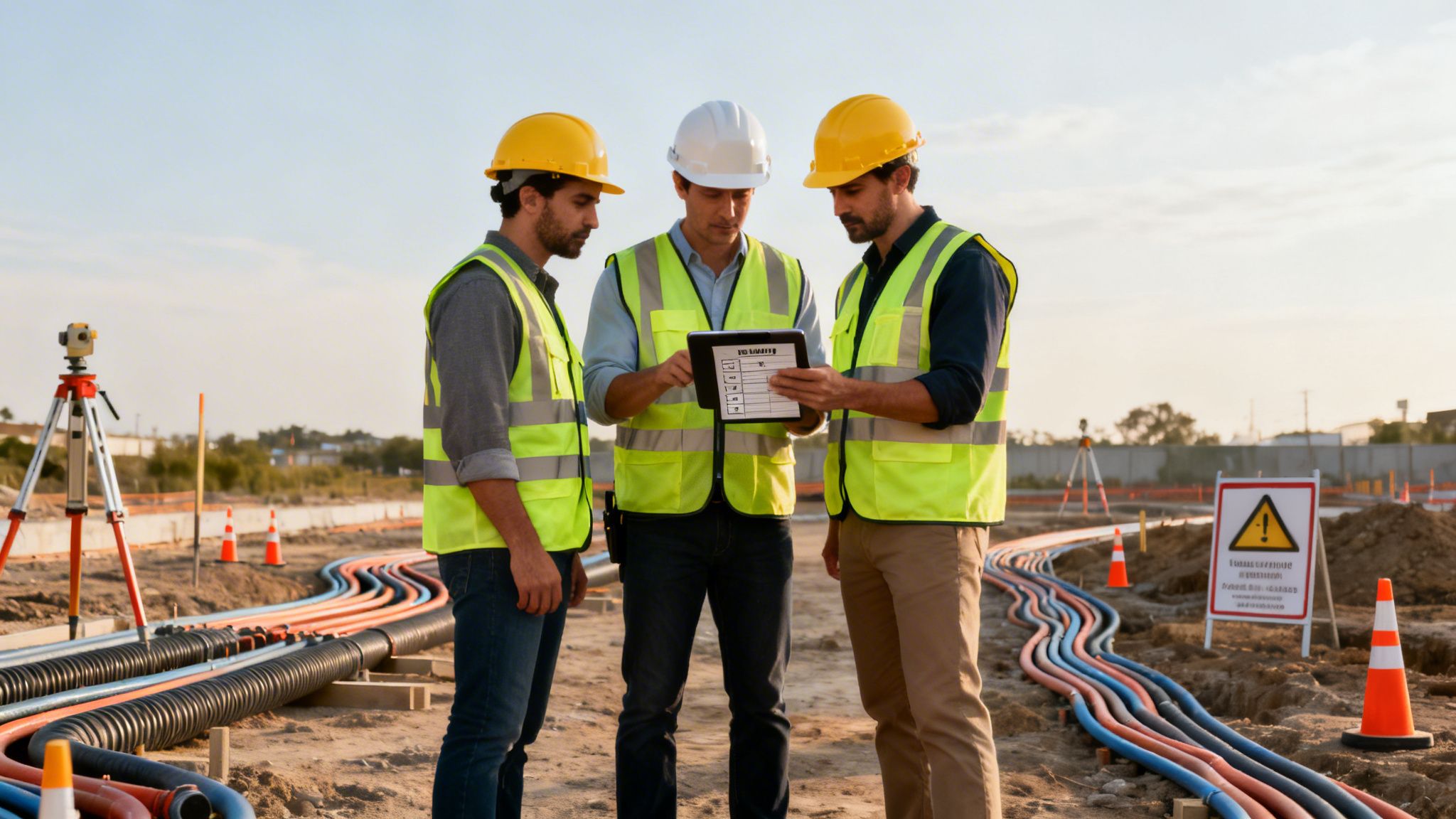
Once your chosen civil construction contractors break ground, the project enters its most critical phase. This is where your careful planning meets the reality of the field, and where active, intelligent oversight becomes paramount. Your role now shifts from evaluator to manager, ensuring the safety and quality standards you built into the contract are executed flawlessly.
The key isn't micromanagement. It's about establishing a predictable rhythm of communication that brings transparency to the forefront. A well-run project operates on this cadence, turning potential blow-ups into manageable issues before they can derail your schedule.
Establishing a Communication Cadence
I've always found that a non-negotiable weekly progress meeting is the bedrock of a healthy project. These aren't just status updates; they are structured, data-driven sessions. You should be reviewing the past week's performance against the schedule, confirming the next week's goals, and tackling any new roadblocks head-on. This is where your contractor reports on progress and, just as importantly, where you can probe for details on potential delays or resource gaps.
Beyond the formal sit-down, insist on daily safety huddles. Before a single shovel hits the dirt each morning, the entire crew should gather. They need to talk through the day's specific tasks, identify the hazards involved, and confirm the plan to mitigate them. This simple, five-minute ritual does more to build a safety-first culture than any manual ever could, and its impact on reducing incidents is undeniable.
Together, these two touchpoints—weekly progress reviews and daily safety talks—create the foundation for effective communication and a culture of accountability.
Enforcing Safety Without Micromanaging
On any job site, safety is non-negotiable. You've already vetted the contractor's safety program, but on-site execution is where their commitment is truly tested. Your job isn't to be their safety officer; it's to verify that they are living up to their own documented plan.
When you walk the site, you need to know what to look for. The signs of a strong safety program are tangible.
- Universal PPE: Is every single person—from the foreman to a delivery driver—in a hard hat, safety glasses, and a high-visibility vest? No exceptions.
- Trenching & Excavation: Are trenches over five feet deep properly shored or sloped to prevent a collapse? Look for a ladder or ramp for safe access. This is a life-or-death detail.
- Site Housekeeping: A clean site is a safe site. Pay attention to organized material storage, clear walkways, and proper debris management. These aren't minor details; they prevent the trips and falls that account for so many injuries.
A good construction site safety inspection checklist can give you a solid framework, ensuring you don’t miss these critical checks.
A contractor's true commitment to safety shines through in how they handle a minor issue. If you point out a small hazard, do they fix it immediately and thank you? Or do they get defensive? The first response signals a partner; the second is a massive red flag.
When you spot a problem, talk to the site superintendent. Don't accuse—ask. Frame it around the safety plan you both agreed to: "I noticed the excavation doesn't have an access ramp. Can you walk me through the safety protocol for that area?" This reinforces their ownership and keeps the conversation productive.
Driving a Robust Quality Assurance Program
Beyond keeping everyone safe, your other primary goal is getting exactly what you paid for. A strong Quality Assurance (QA) program isn't a final punch-list; it's a series of checks and balances that happen throughout the build.
Your contractor has their own Quality Control (QC) team responsible for their work. Your role is to perform QA audits to verify their QC process is working. This means knowing the critical milestones and what to inspect.
Examples of QA Spot Checks:
- Conduit Installation: Before a trench is backfilled, get in there. Verify the conduit depth, confirm the tracer wire is present and continuous, and check that warning tape is laid at the specified height above it.
- Fiber Splicing: Ask to see the OTDR (Optical Time-Domain Reflectometer) test results for a few recent splices. A good splice from a skilled technician will have a low-loss reading, typically under 0.1 dB.
- Data Center Foundations: Before the concrete trucks arrive, get your eyes on the rebar. Does the placement—size, spacing, and clearance—match the engineering drawings exactly?
This "trust but verify" approach builds a partnership where your contractor knows you're engaged and that details matter. It holds them accountable for delivering the quality you need, ensuring the long-term integrity of your infrastructure.
Getting to the Finish Line: Nailing the Project Closeout and Handoff

The last piece of conduit is in the ground, and the site is clean. It’s easy to think the job is done, but the final phase—project closeout and handoff—is where the long-term success of your telecom or data center build is truly cemented.
Getting this part wrong can create a world of pain for your operations team down the road. I've seen it happen: missing test results, shoddy documentation, and unresolved liens that turn routine maintenance into a costly forensic investigation. A smooth transition from your civil construction contractors isn't just a formality; it's what turns a multimillion-dollar build into a reliable, manageable asset.
The Closeout Package: Your Asset’s Birth Certificate
Before you even think about releasing that final payment, you need a comprehensive closeout package. This isn't just a stack of paper; it's the official record of your new asset and the primary playbook for your operations and maintenance (O&M) team for years to come. A professional contractor will have this organized, but you need to be the one driving the requirements.
Here’s what absolutely must be in that package, whether it's a physical binder or a shared digital folder:
- Final As-Built Drawings: These are not the design plans you started with. As-builts show the actual, final location of every single component—conduit runs, vault placements, and any on-the-fly changes made in the field. Insist on getting them in both PDF and native CAD formats. Your future engineering teams will thank you.
- Complete Fiber Test Results: For any fiber project, this is the ultimate proof of quality. You need the original OTDR (Optical Time-Domain Reflectometer) traces and power meter readings for every strand. This data is your performance baseline, proving the installation meets spec and making future troubleshooting infinitely easier.
- All Warranty Documentation: This includes manufacturer warranties for everything from the fiber optic cable itself to the conduit and handholes. If a component fails prematurely, this paperwork is your only recourse for a claim.
- Final, Unconditional Lien Waivers: This is a critical piece of legal and financial protection. You need a signed waiver from the general contractor and every major subcontractor and supplier, confirming they've been paid in full.
A missing lien waiver is a ticking time bomb. It exposes you to financial claims from subs you didn't even know were on the project. Make the collection of every single waiver a non-negotiable condition for releasing final payment and retainage.
Without this complete package, a simple fiber cut can become a four-day crisis of digging up old emails and guessing at splice points. With it, that same repair becomes a predictable, efficient fix.
From Documents to Day-One Readiness
Handing over a USB drive is not a handoff. The real goal is knowledge transfer. You need to bridge the gap between the construction crew that built the network and the operations team that will own it for the next 20 years.
The best way to do this is with a formal closeout meeting. Get your project manager, the contractor's PM, and supervisors from your network operations and field teams in the same room. This is where the institutional knowledge actually gets transferred.
Making the Handoff Stick
To make this transition truly effective, build these activities into your project plan from the start:
A Joint Site Walk-Through
Walk the entire route or facility one last time with the contractor’s foreman and your O&M lead. This is the chance for the builder to physically point out key access points, splice locations, and any tricky areas your team needs to be aware of.
The "Show-Me" Documentation Review
Don't just accept the files; open them together in the closeout meeting. Have your team confirm they can read the as-builts and make sense of the OTDR traces. This is the time to ask questions—not three months later when the contractor’s team is on another job in another state.
Exchanging Emergency Contacts
Finally, establish a clear warranty support channel. Your team needs a name and a number to call at the contracting firm if an installation-related issue pops up.
By treating the project closeout with this level of rigor, you ensure your network is truly operational from day one. You’re not just closing a project; you’re launching a long-term asset and setting your team up for success.
At Southern Tier Resources, we believe a project is only complete when our clients are fully equipped to operate and maintain the infrastructure we build. Our commitment to detailed documentation and seamless handoffs is part of our end-to-end partnership approach.
Learn how we deliver turnkey engineering, construction, and maintenance for critical network infrastructure at https://southerntierresources.com.