
Telecom infrastructure partners are the companies that do the heavy lifting in our industry. They’re the specialized engineering, construction, and maintenance crews who take network blueprints and turn them into physical, working assets. Whether you're a carrier, a data center operator, or a municipality, these are the hands-on experts who build everything from sprawling fiber optic networks to the latest cell tower upgrades.
Defining Your Project Before You Search for Partners

Before you even start a Google search for potential partners, pause. The most critical work happens right now, well before you send out a single Request for Proposal (RFP). You have to get crystal clear on exactly what you want to build.
Without this clarity, you’re essentially asking a contractor to build a house with no blueprint. This initial planning phase is where you translate big business goals into a concrete, actionable project plan. It’s the difference between a vague objective like "we need to improve rural coverage" and a defined project to deploy 50 miles of fiber-to-the-home (FTTH) in a specific county, with a target budget of $2 million and an 18-month completion timeline.
From Business Goals to a Tangible Scope
Your first job is to develop a solid Scope of Work (SOW). Think of a well-defined SOW as your project's compass; it guides every decision and becomes the yardstick against which you'll measure every potential partner. It needs to plainly answer the what, where, when, and how of your initiative.
Here are the key pieces to nail down in your preliminary SOW:
- Geographical Boundaries: Don't just say "the metro area." Pinpoint the exact service areas, cities, or even the specific routes for your network build. Use detailed maps to define precise start and end points.
- Technical Specifications: What are you actually building? Is it a greenfield fiber network from scratch, a data center fit-out, or an upgrade to your existing macro cell towers? Get specific about the technology and the performance outcomes you expect.
- Project Timelines: Set realistic milestones. What's your target for completing the design phase? Permitting? Construction and final testing? This sets clear expectations from day one.
- Budgetary Constraints: You need a firm budget. This immediately helps filter out partners who aren't a good fit for a project of your financial scale, saving everyone a lot of time.
Getting this right is more important than ever. The global telecom network infrastructure market was valued at USD 211.10 billion in 2025 and is on track to hit USD 355.00 billion by 2035. This massive growth means more competition for capable partners, so having a clear plan is your first advantage. You can read more about the telecom network infrastructure market trends to see what’s fueling this expansion.
Before diving deep into vetting individual companies, it's helpful to have a high-level checklist. The table below summarizes the core pillars to consider when you begin assessing potential telecom infrastructure partners.
Key Partner Evaluation Criteria at a Glance
| Criteria Pillar | What to Look For | Why It Matters |
|---|---|---|
| Technical Capability | Proven experience with your specific technology (e.g., FTTH, small cell, data center cabling). | You need a team that has successfully done this exact type of work before, not one learning on your dime. |
| Project Management | Strong processes for communication, scheduling, and budget tracking. | A lack of organization leads to delays, cost overruns, and endless frustration. |
| Safety & Compliance | A documented safety program (e.g., EMR score) and relevant industry certifications. | A strong safety culture protects workers, the public, and your company from liability. |
| Financial Stability | Solid financial history and the ability to secure bonding for your project size. | You can't risk a partner going under mid-project, leaving you with a half-finished network. |
| Scalability & Resources | Access to sufficient labor, equipment, and a reliable supply chain. | The partner must be able to scale their resources to meet your timeline without cutting corners. |
This table provides a quick reference for your initial screening process. As you move forward, you'll flesh out each of these areas with much more detail during your formal RFP and interview stages.
Tailoring Your Requirements to Your Organization
The fine points of your project will, of course, depend entirely on who you are. An ISP launching a competitive overbuild in a crowded suburb has completely different priorities than a municipality trying to connect underserved rural communities with public broadband.
A partner that excels at rapid small cell deployments in urban cores may not be the best fit for a long-haul fiber route that requires extensive right-of-way negotiations. Defining your unique needs ensures you attract and select a partner whose expertise directly aligns with your project type.
For instance, a data center operator needs a partner who lives and breathes structured cabling, power systems, and cooling. On the other hand, a wireless carrier will look for deep expertise in antenna and radio installation and optimization.
By meticulously defining your project scope first, you create a powerful filter. It automatically weeds out mismatched candidates and shines a spotlight on the telecom infrastructure partners who are truly equipped to bring your vision to life.
Finding the Right Contenders: How to Identify and Shortlist Partners
Alright, you’ve got your project specs nailed down. Now comes the real work: finding the right telecom infrastructure partners to bring it to life. This isn't about a quick Google search. You're looking to build a short, powerful list of candidates who have a proven track record, not just a flashy website.
So, where do you start? Forget the search bar for a moment and turn to your own industry. Your professional network is one of the most powerful tools you have. Think about regional trade shows and industry association meetings. These are the places where you can have frank, face-to-face conversations, get a real feel for a company's culture, and ask those initial gut-check questions.
Dig Deeper Than the Homepage
Once you do start looking at company websites, your job is to play detective. The marketing copy is nice, but the proof is in the portfolio. A truly experienced partner will have detailed project histories and case studies right on their site.
Look for projects that feel like yours in size, scope, and technical complexity. If you're planning a massive fiber-to-the-home build, you need to see evidence they’ve done it before. Did their case studies mention navigating tricky permitting processes or dealing with tough terrain? That’s the kind of gritty detail that screams real-world experience.
A few things that signal you're on the right track:
- Specific Case Studies: Are they talking about specific fiber splicing jobs, turnkey small cell deployments, or complex data center fit-outs? Vague descriptions are a major red flag.
- A Focus on Safety: Look for a dedicated section on their safety program, culture, and metrics. This shows they take care of their people, which means they'll take care of your project.
- Real People, Real Experience: Can you see the leadership team and project managers? Reading their bios gives you a sense of the expertise and stability you’d be buying into.
A partner’s website is their digital handshake. If it's short on details, filled with stock photography, and lacks concrete examples of their work, it probably reflects a similar lack of depth in their actual operations.
Ask Around: The Power of a Good Referral
Online research is one thing, but nothing beats a solid referral from someone you trust. Reach out to your peers at other carriers, ISPs, or municipalities who have recently finished a similar project. Find out who they used and—more importantly—what it was really like working with them.
When you're asking for a referral, get specific.
- How was their communication from start to finish? Were you ever left in the dark?
- Did the project stay on schedule and on budget?
- What happened when something went wrong? How did they handle it?
- Bottom line: Would you hire them again?
The answers here give you a level of insight you'll never find in a brochure. A fantastic review from a respected peer is one of the best green lights you can get. You can explore our guide on finding the right systems integrator to understand more about the qualification process for technical partners.
Your goal here is to get from a long list of possibilities down to a tight shortlist of 3-5 highly qualified companies. These are the contenders that have shown they align with your technical needs, operational scale, and geographic footprint. By being methodical now, you ensure the time you spend on formal vetting is focused only on genuinely viable telecom infrastructure partners.
You've narrowed the field and have a shortlist of three to five companies that look promising on paper. Now the real work begins. This is where you move past the glossy brochures and slick case studies to truly vet a partner’s capabilities, safety culture, and financial footing.
Frankly, this is the most critical phase. Getting this wrong can lead to a world of hurt—costly delays, shoddy workmanship, and liabilities you never saw coming.
Starting with the Non-Negotiables
Before you get into the finer details, you need to confirm the basics. We’re talking about the absolute must-haves: licenses, insurance, and bonding. Don't even continue the conversation if a company can't produce these documents immediately.
Ask for their Certificate of Insurance (COI) to verify they hold sufficient General Liability, Auto, and Workers’ Compensation coverage. A legitimate partner won't bat an eye at this request. Equally important is their bonding capacity. You need to know they can secure a bond for the full value of your project, which is your financial backstop if they fail to complete the job.
This entire process is about systematically reducing your risk. A well-defined Vendor Risk Management Framework is invaluable here. It provides a structured approach to ensure you're evaluating every potential partner with the same level of scrutiny, leaving no stone unturned.
Decoding the Safety Record
Let me be blunt: nothing matters more than a partner's commitment to safety. A poor safety culture is a giant red flag. It doesn't just put people at risk; it's a clear symptom of a disorganized operation, and that sloppiness will absolutely find its way into your project's quality and timeline.
You need to look past the safety slogans on their trucks and get to the hard data.
The single most important number to ask for is their Experience Modification Rate (EMR).
- An EMR of 1.0 is the industry average. It's baseline.
- An EMR below 1.0 indicates a safety record that's better than average. This is the mark of a disciplined, well-run company.
- An EMR above 1.0 is a serious problem. It means their rate of workplace injuries is higher than their peers, and you should be very cautious.
Demand to see their EMR letter from their insurance carrier. While you're at it, ask for their OSHA 300 logs from the last three years. These documents don't lie. A partner who takes pride in their safety record will be eager to share this with you.
A low EMR isn't just a number; it's a direct reflection of a company's discipline, training, and operational excellence. Partners who prioritize safety are inherently more organized and reliable, which translates directly to better project outcomes.
The journey to this point, from initial research to your current vetting stage, is a deliberate process of elimination.
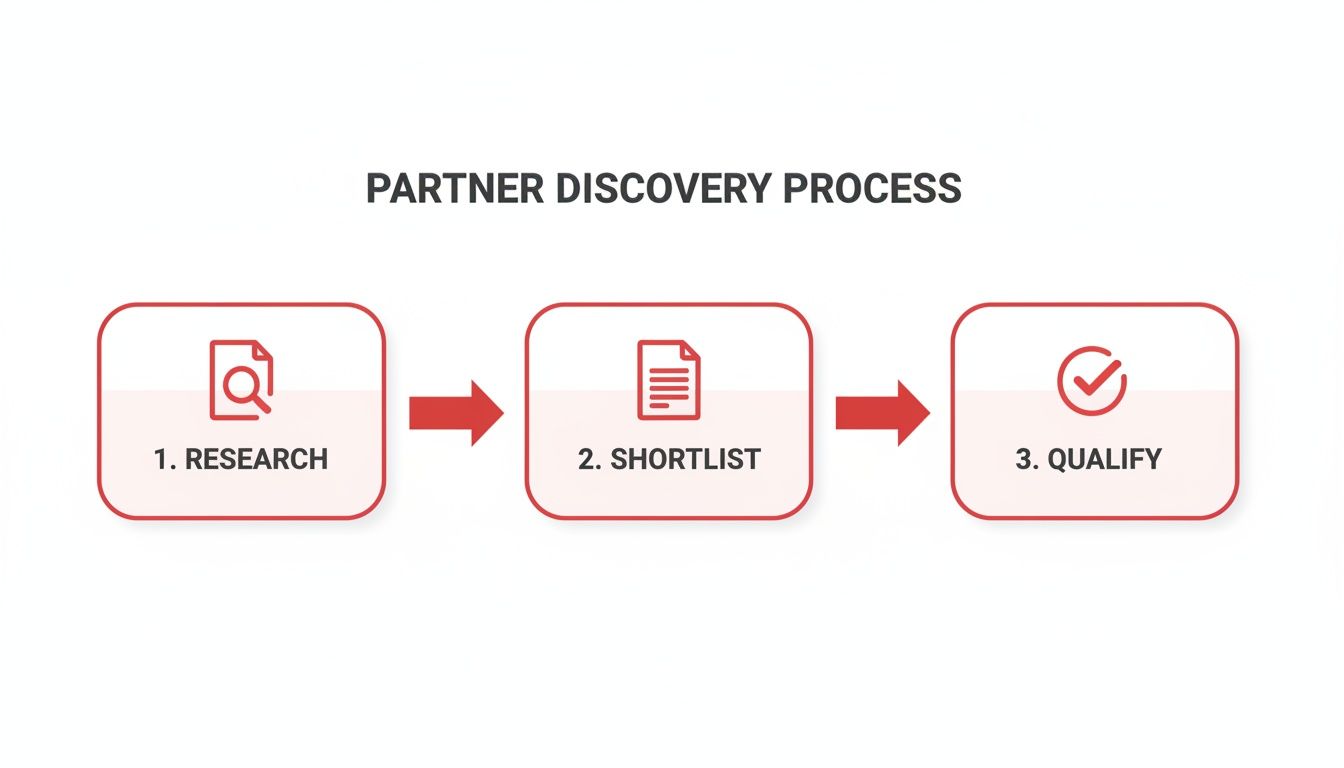
This method ensures that by the time you're this deep in the weeds, you're only spending time on the most qualified contenders.
Conducting Meaningful Reference Checks
Reference checks are your chance to get the real story. This is where you find out what it's really like to work with this company, especially when things don't go according to plan.
Forget the softball questions. You need to dig for specifics that reveal how they operate under pressure. Instead of asking, "Were you happy with them?" get to the heart of the matter with questions like these:
- Communication: "Walk me through an instance when there was a schedule delay or a technical problem. How did their PM communicate it? Were they upfront, or did you have to chase them for answers?"
- Problem-Solving: "Tell me about a time something went wrong. What was it, how did their team fix it, and who ended up paying for the mistake?"
- Quality: "Did you have any punch-list items or need rework done? How did they handle the final quality control and closeout process?"
- Team: "What were their field crews like? Were they professional? Did they respect your property and the community they were working in?"
The answers you get here are worth more than any proposal or presentation. You’re getting a preview of the partner experience you can expect.
Assessing Technical Capabilities and Crew Expertise
Finally, you need to see their technical skills in action. A partner can look great on paper, but if their crews are inexperienced or their equipment is subpar, your project will suffer.
The best way to do this? Arrange a visit to one of their active job sites. There's no substitute for seeing their team work. Pay attention to how they manage the site, the condition of their tools and vehicles, and whether they're actually following the safety rules. Look closely at the quality of their splicing, their cable management, and the overall tidiness of the work area.
If a site visit isn't practical, dig into their training and certification programs. Ask what certifications their technicians and project managers hold. A strong commitment to continuing education shows that a partner is serious about quality and staying on top of industry best practices. Taking these steps is how you find true telecom infrastructure partners—the ones who will deliver your network on time, on budget, and to a standard you can be proud of.
Crafting Contracts and SLAs That Protect Your Project
You’ve done the hard work of vetting your partners. Now comes the most critical step: getting it all down in writing. A solid contract isn't just a legal formality; it's the operational blueprint for your entire project. It’s what you’ll turn to when you need to align expectations, define what success looks like, and navigate the challenges that will inevitably pop up.
This is your chance to move beyond generic legal templates. Your contract should be a practical tool, built around the specific realities of your network build. This is where you transform all those conversations and proposal details into firm, binding commitments.
Nailing Down the Scope and Managing Change
The heart of any good partnership agreement is an airtight Scope of Work (SOW). This section needs to be exhaustive, leaving zero room for interpretation. It should spell out every single deliverable, from the initial site surveys and engineering designs all the way to the final as-built documentation.
But let's be realistic—even the most detailed plans encounter surprises. That’s why a clearly defined change order process is your project’s best friend. This process creates a formal pathway for documenting, approving, and pricing any work that falls outside the original SOW.
A vague change order clause is an open invitation to scope creep and budget blowouts. A strong one forces every change to be put in writing, complete with a clear cost and schedule impact analysis, before any extra work begins.
I saw this play out on a make-ready construction project for a new fiber route. The crew discovered an unexpected underground utility conflict that wasn't on any of the plans. Because the contract had a solid change order process, the partner immediately paused work, documented the issue, and submitted a detailed proposal for the reroute. It prevented a chaotic "we'll figure it out later" mess and kept the budget transparent. The client avoided what could have easily become a surprise five-figure bill at closeout.
Setting Service Level Agreements That Actually Mean Something
Service Level Agreements (SLAs) are how you give your performance expectations real teeth. These are the measurable, time-bound promises your partner makes, with clear financial penalties if they don’t deliver. Forget generic SLAs; they need to be tied directly to what’s most critical for your project's success.
Focus on a few key areas for specific SLAs:
- Project Milestones: Set hard deadlines for major project phases. For example, all pole attachment applications must be submitted by a specific date, or a certain percentage of the network must be lit by the end of each quarter.
- Network Performance: Once the network is live, what are the standards? Get specific with metrics like minimum network uptime guarantees, maximum latency thresholds, and acceptable packet loss percentages.
- Maintenance & Response: For ongoing support, you need tiered response times. A critical network outage might demand a 4-hour on-site response, while a non-critical service issue could have a 24-hour response window.
These SLAs do more than just hold your telecom infrastructure partners accountable; they ensure the project moves forward with the urgency and quality your organization demands.
Overlooked Clauses That Offer Critical Protection
Beyond the scope and SLAs, a few other clauses provide crucial protection and should never be glossed over. These sections address the day-to-day realities of quality, safety, and risk that come with any complex construction project.
First, your contract absolutely needs a Quality Assurance (QA) clause. This should specify the exact standards for both materials and workmanship, referencing industry benchmarks like BICSI standards for cabling. Critically, it must also grant you the right to inspect work at any time and outline the process for rejecting and correcting substandard work at the partner's expense.
Second, a Safety Compliance clause is non-negotiable. This section contractually obligates the partner to follow all federal, state, and local safety regulations. It should also require them to maintain their documented safety program for the entire project lifecycle, reinforcing the safety commitments you vetted during the selection process. As you map out your own internal standards, it can be helpful to check out our guide on subleasing infrastructure to better understand shared responsibilities.
Finally, make sure you have strong language around Risk Mitigation and Dispute Resolution. This section outlines how unforeseen events are managed and establishes a clear, tiered process for resolving disagreements. A good clause will start with project-level discussions before escalating to formal mediation, which helps solve problems efficiently without immediately jumping to costly legal battles and torching the partnership.
Managing the Partnership for Long-Term Success

The contract is signed and the project has the green light. It’s easy to breathe a sigh of relief and think the hardest part is over. In my experience, this is where the real work begins. Getting a project over the finish line smoothly depends entirely on how you manage the relationship from this point forward.
This isn’t about just overseeing a vendor; it’s about building a genuine partnership. You can’t just “set it and forget it.” Proactive engagement and crystal-clear communication are what will keep your project on schedule, within budget, and up to the quality standards you expect. Adopting solid vendor management best practices helps turn a simple transactional agreement into a strategic alliance that can last for years.
Kicking Things Off the Right Way
A strong partnership starts with a structured kickoff. This initial onboarding phase sets the tone for the entire project, so it’s absolutely critical to nail the details from day one. This isn't just a single meeting—it’s a series of focused sessions designed to get both teams perfectly aligned.
Your kickoff should cover a few key things:
- Clarify Roles and Contacts: Make sure everyone knows exactly who to call for technical issues, billing questions, or project updates. Putting faces to names and mapping out a clear communication hierarchy prevents confusion down the road.
- Walk Through the SOW and SLAs: Go through the contract and Scope of Work together, line by line. This is your chance to ensure both sides have the exact same interpretation of the deliverables and timelines.
- Agree on Communication Tools: Decide how you’ll handle day-to-day updates. Will it be a shared project management platform? A dedicated Slack channel? Simple weekly status emails? Get it agreed upon upfront.
A classic mistake is assuming everyone has read and understood all 100 pages of the contract. The kickoff meeting is your opportunity to turn that dense document into a shared, verbal agreement and iron out any ambiguities before they become real problems in the field.
After the kickoff, settle into a consistent communication rhythm. A weekly progress meeting with all the key players is standard practice for a reason. It creates accountability and gives everyone a dedicated forum to raise red flags, review milestones, and plan for the weeks ahead.
Defining and Tracking Key Performance Indicators
You can't manage what you don't measure. Key Performance Indicators (KPIs) are the vital signs of your project, giving you hard data on whether things are on track or starting to drift. Your KPIs should be tied directly to the business goals of the project and the SLAs you defined in the contract.
For a typical telecom infrastructure build, your dashboard should be tracking metrics like these:
- Cost Per Foot/Meter: For any fiber installation, this is a must-have metric. It helps you monitor your budget efficiency almost in real-time.
- Schedule Adherence: How closely are you sticking to the major construction and testing milestones? Tracking variance here is the best way to spot potential delays early.
- Safety Incidents: The only acceptable KPI here is zero. Tracking this—even when it's zero—reinforces the safety-first culture you worked so hard to vet.
- Quality Control Pass Rate: What percentage of the work is passing inspection on the first go? A low pass rate is a major red flag that points to workmanship issues needing immediate correction.
This level of detailed tracking is non-negotiable, especially with how fast network technology is evolving. The 5G infrastructure market alone is expected to explode from USD 43.50 billion in 2025 to USD 675.9 billion by 2034, fueled by a 41.7% compound annual growth rate. Carriers are counting on partners to deploy small cells and macro towers at an incredible pace, and tight KPI tracking is the only way to ensure that speed doesn't come at the expense of quality.
When you treat your partner as a true extension of your own team and manage the project with data-driven diligence, you build a foundation for success that extends far beyond a single project. To get a better handle on what happens as you approach project completion, our article on https://southerntierresources.com/goodscode/commissioning/1733532227 is a great resource. This collaborative approach fosters the trust you'll need for future network expansions and keeps you ready to meet the relentless demand for better connectivity.
Frequently Asked Questions
Choosing the right infrastructure partner is a big decision, and it's normal to have a lot of questions. We've been in this business for decades, and these are the questions that come up time and time again from carriers, data centers, and city planners. Let's get them answered.
What Are the Biggest Red Flags When Vetting a Partner?
When you’re sizing up potential partners, a few things should set off alarm bells immediately. The first and most critical is a poor safety record. Don't be shy about asking for their Experience Modification Rate (EMR) and Total Recordable Incident Rate (TRIR). If those numbers are high, it's a non-starter.
Another huge warning sign is a lack of transparency. If a company gets cagey during reference checks, can't show you concrete examples of projects like yours, or drags their feet on providing proof of insurance and bonding capacity, walk away. They're either hiding something or just don't have their act together.
Be extremely cautious if a potential partner is pushing hard for a signature before the scope of work is nailed down in granular detail. This is a classic move to lock you into a low-ball bid, only to bleed you dry with expensive change orders down the road.
Finally, look at their portfolio. Does it actually match the scale and complexity of what you need? A crew that excels at small cell installations might be completely out of its depth trying to manage a multi-state fiber backbone deployment. Make sure their experience is your experience.
How Should We Structure Payments to an Infrastructure Partner?
You need to protect your capital while keeping the project moving forward, which means you should never pay the full contract amount upfront. The only way to go is a payment structure tied to clear, verifiable project milestones. This keeps your partner focused and ensures you're only paying for tangible progress.
Here’s a milestone-based payment schedule we’ve seen work time and again:
- 10% at mobilization, once equipment and crews have arrived on-site.
- 25% after the engineering and permitting phase is fully complete.
- 40% paid out in stages as major construction milestones are hit (e.g., after each 25% of a fiber route is deployed and passes initial testing).
- 25% held until final network acceptance, successful testing, and you have all the as-built documentation in your hands.
This model keeps everyone motivated and aligned. Crucially, holding back that final payment gives you the leverage you need to ensure the network performs exactly as promised and you have the documentation to prove it.
What Is More Important: Technical Skill or Communication?
It’s a fair question, but they're really two sides of the same coin. You absolutely can't have a successful project without both. That said, I've seen technically brilliant teams with terrible communication cause far more damage and delays than a competent team that is honest and proactive.
Technical skill is the price of admission—it ensures the work gets done right and meets industry standards. But strong communication is what ensures the project gets done on time, on budget, and to your exact specifications.
Think of it this way: technical expertise prevents defects, but great communication prevents surprises. A top-tier partner will give you a dedicated project manager—a single point of contact—who provides regular, candid updates. They won't be afraid to deliver bad news early, giving you time to adapt. That’s the glue that holds a complex project together.
The need for this blend of hard and soft skills is exploding. Global telecom services revenue hit USD 2.10 trillion in 2025 and is on track to hit USD 3.39 trillion by 2035. That growth is fueled by massive 5G, cloud, and IoT rollouts, where flawless execution is everything. You can learn more about the drivers of telecom service growth and see why finding a partner who masters both is non-negotiable.
How Do We Ensure Quality Control Throughout the Project?
Quality control isn't a final inspection; it's a continuous process you bake into the project from the very beginning. Your most powerful tool here is the contract itself. It must include a robust and detailed Quality Assurance (QA) section.
This clause should explicitly define:
- Material Standards: Name the specific grade, type, and manufacturer of materials you expect, from the fiber optic cable itself down to the conduit and connectors.
- Workmanship Standards: Don't leave quality to interpretation. Reference established benchmarks, like BICSI standards for structured cabling, to define exactly what "good work" looks like.
- Testing Procedures: Require specific tests, like OTDR and power meter testing on every fiber strand, and clearly state the pass/fail criteria for each.
- Inspection Rights: Your contract must give you the right to inspect work at any point and outline the process for documenting and fixing deficiencies at the partner's expense.
Beyond the ink on the page, the best way to keep everyone honest is to have your own project manager or a trusted third-party inspector conduct random site visits. This ensures the standards you agreed to on paper are actually being followed in the field. This hands-on oversight is essential for any successful engagement with telecom infrastructure partners.
Ready to build a reliable, high-performance network with a partner you can trust? Southern Tier Resources provides end-to-end engineering, construction, and maintenance with a safety-first culture and a commitment to quality. Let's discuss your project today.
Learn more at https://southerntierresources.com.