
Choosing the right computer network companies is one of the most important infrastructure decisions you’ll make. This choice directly shapes everything from your project's timeline to its long-term reliability. Think of these partners as the architects and builders of your digital foundation—picking the right one from the start is the best way to avoid costly rework and future headaches.
Your Blueprint for Choosing Computer Network Companies
Trying to navigate the world of computer network companies can feel like exploring a new city without a map. You’ll find massive telecom carriers, niche infrastructure contractors doing the physical work, and a whole range of specialists in between.
The first step to a successful project is simply understanding who does what. This guide is your map. We'll start with a high-level look at the key players you'll encounter, helping you match the right kind of partner to your specific project needs. After all, a large-scale fiber optic build requires a very different team than a data center fit-out or a 5G wireless upgrade.
To help you get started, this table gives you a quick-reference guide to the major types of network partners and where they fit in.
Key Types of Computer Network Companies and Their Primary Functions
| Company Type | Primary Function | Ideal For Projects Like… |
|---|---|---|
| Carriers & ISPs | Provide network access and transport services (e.g., internet, DIA, wavelength). | Buying connectivity for a business, connecting multiple office locations, or acquiring backbone transport. |
| Integrators & MSPs | Design, install, and manage on-site network hardware and software. | Setting up a new office network, managing enterprise Wi-Fi, or handling outsourced IT operations. |
| Infrastructure Contractors | Perform the physical construction and installation of network infrastructure. | Laying underground fiber optic cable, erecting cell towers, or installing conduit and cabling pathways. |
| Data Center Specialists | Build, equip, and maintain data center facilities. | Fitting out a server room with racks and cabling, installing cooling systems, or building a new data hall. |
| Wireless & Tower Vendors | Specialize in wireless network deployment, from equipment to physical towers. | Upgrading to 5G, deploying a private cellular network, or installing point-to-point microwave links. |
This table should help you quickly narrow down your search. As we'll see, aligning the partner's core business with your project's goals is the most critical part of the selection process.
Distinguishing Between Partner Types
Making a smart choice starts with understanding these fundamental differences. One of the most common missteps is hiring a company that isn't truly equipped for your specific challenge. For example, asking a major telecom carrier to handle the detailed structured cabling inside your new office is a classic mismatch; you’d be better off with a specialist.
The core idea is to align the partner’s primary function with your project’s primary need. A mismatch here can create significant friction, delays, and budget overruns down the line.
Doing your homework is essential. Before building a vendor list, it’s wise to consult guides that compare the best managed IT service providers and other specialists. This kind of research ensures your choices are based on proven capabilities, not just flashy marketing.
A Framework for Your Project Needs
To simplify things, start by asking what your project really needs. Are you building something from scratch or just improving what you already have?
For New Infrastructure Builds: If your project involves creating new physical networks—like laying fiber or putting up cell towers—you need a partner with deep experience in engineering, construction, and heavy-duty project management. Their job is to turn a design into a real-world, functioning asset.
For System Integration and Upgrades: If you're focused on connecting new gear inside an existing building, like a data center, you need a specialist in structured cabling, power systems, and equipment racking. Their work is all about precision and reliability within a controlled environment.
For Network Services and Connectivity: If you just need to buy access to an existing network—like getting internet service for your business—your conversation will be with an Internet Service Provider (ISP) or a carrier.
With this lay of the land, you're much better prepared to make smart, informed decisions from day one. Understanding these distinctions gives you the confidence to move forward and find the perfect partner for the job.
Understanding the Ecosystem of Network Partners
Trying to find the right network partner can feel overwhelming. You’ll quickly discover that the term "computer network company" covers a huge range of businesses with very different skill sets. It's a bit like building a national highway system—you need to know who owns the land, who can actually pave the roads, and who builds the interchanges.
Getting this wrong is a classic pitfall. Hiring the wrong type of partner for a job outside their real expertise is a surefire way to blow your budget, miss deadlines, and cause a lot of headaches. This industry is an ecosystem of specialists, and knowing who does what is the first step.
The Four Pillars of Network Infrastructure
To make sense of it all, it helps to break down the players into four main groups. Each one handles a distinct piece of the puzzle, from owning the digital highways to physically building them. This simple framework will help you zero in on the exact kind of partner you need.
- Carriers and ISPs: These companies own and operate the networks. They're the ones selling internet access and data transport services to homes and businesses.
- Infrastructure Contractors: These are the builders. They have the engineering expertise and hands-on crews to construct and maintain the physical parts of the network, whether it's laying fiber or putting up towers.
- Data Center Specialists: This group is laser-focused on the incredibly complex environments inside data centers. They manage everything from the structured cabling to the critical power and cooling systems that keep it all running.
- Wireless and Tower Companies: As the name suggests, these are the specialists who build the physical infrastructure for our mobile and wireless world, including cell towers and small cell networks.
Most projects start with the two most foundational partners: the carriers who own the network and the contractors who build it.
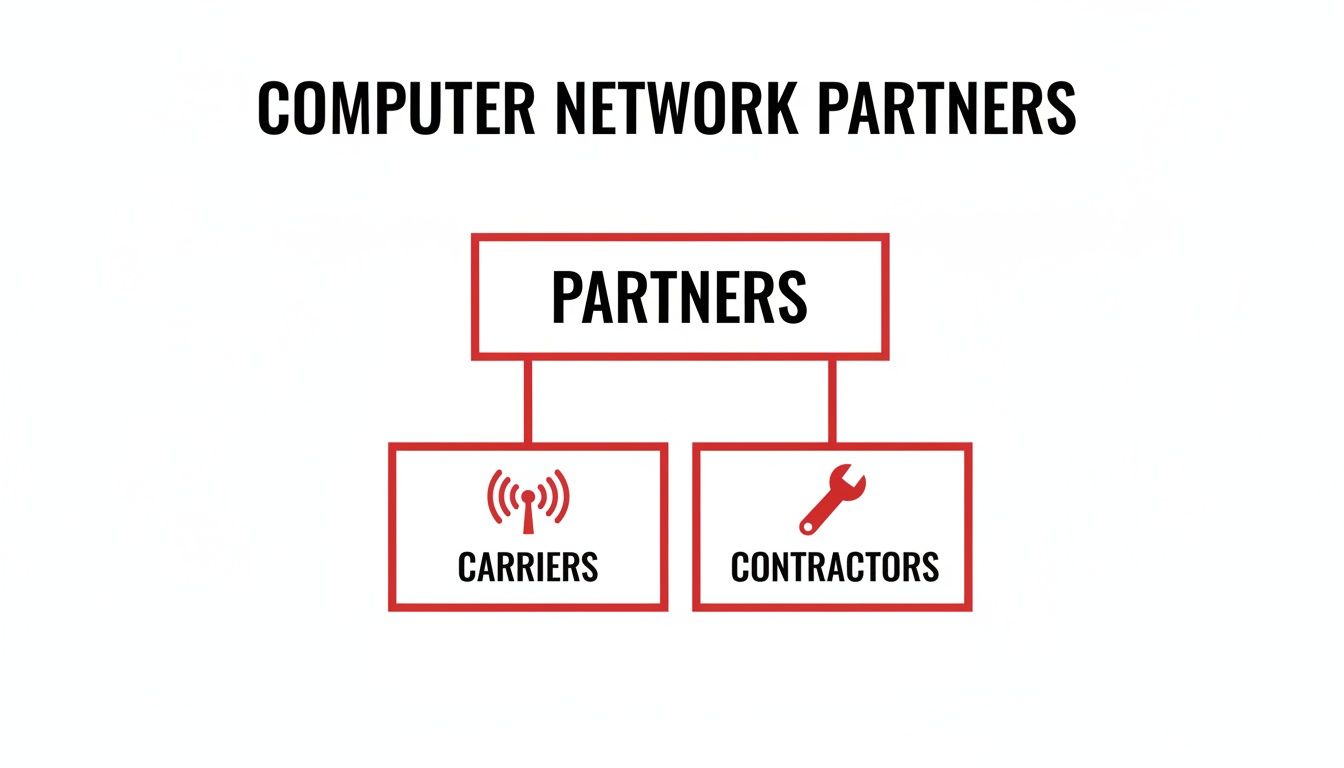
While the other specialists are crucial, this core relationship between the network owner and the construction expert is where everything begins.
From Network Owners to Expert Builders
When you think of a network company, you're probably picturing a Carrier or an Internet Service Provider (ISP). They're the household names that own the vast fiber and wireless infrastructure we all rely on. Their main business is selling access to the networks they own.
But here’s the key: carriers rarely build these massive networks themselves. For that, they rely on infrastructure contractors. These are the boots on the ground—the companies with the specialized equipment, skilled crews, and engineering talent to turn a network blueprint into a high-performing reality. You can get a much deeper look into their critical work in our guide to telecom infrastructure consulting services.
A simple way to think about it is this: The carrier is like a real estate developer who owns a huge tract of land and has a grand vision for a new subdivision. The infrastructure contractor is the construction firm they hire to actually build the roads, lay the utility lines, and put up the houses.
Understanding this division of labor is essential. Both are critical computer network companies, but they perform entirely different functions. Knowing what you need to accomplish will tell you which one to call.
The Role of Technology and Equipment Vendors
Of course, none of this happens without the hardware and software that powers it all. Behind the carriers and contractors is a massive industry of technology vendors. In this fiercely competitive market, giants like Dell Technologies have pulled ahead, reporting an incredible $102 billion in recent annual revenue and even surpassing networking-focused titans like Cisco Systems. These companies provide everything from the servers in the data center to the routers and switches at the network edge.
Ultimately, a successful network project hinges on all these partners working together smoothly. The carrier provides the vision, the vendors supply the technology, and the infrastructure contractor brings the hands-on expertise to connect it all. Once you grasp how this ecosystem fits together, you're in a much better position to make smart, confident decisions for your own project.
How Hyperscale Growth Is Reshaping Network Demands
The effortless way we stream movies, tap into cloud applications, and rely on AI hides a massive physical reality. This digital world isn't just code; it's built on a foundation of concrete and fiber, all powered by hyperscale data centers that are completely rewriting the rules for computer network companies.

It helps to think of a hyperscale data center like a city’s power grid. Just as a major metropolis needs enormous, redundant power lines to keep the lights on, these facilities require colossal network pipes to handle the nonstop torrent of data. The sheer amount of information being moved creates an insatiable demand for physical network infrastructure.
The scale of this growth is stunning. The data center systems segment is the fastest-growing part of worldwide IT spending, which is on track to blow past $6 trillion by 2026. This boom is fueled by just a handful of cloud giants, with Amazon Web Services (AWS) projected to command a 30-31% market share, followed by Microsoft Azure and Google Cloud. You can see just how these players control over two-thirds of the market in this detailed 2026 market analysis.
This explosive expansion creates a huge ripple effect, placing incredible pressure on the contractors who build the networks that hold it all together.
The New Standard Is Speed and Density
It wasn't long ago that 100Gbps (gigabits per second) was the benchmark for top-tier network speed. For hyperscalers, that’s already history. The new baseline is 400Gbps and climbing, a speed that’s absolutely essential for linking massive data center campuses to each other and connecting them to the global internet backbone.
But this isn't just about a single big pipe; it’s about density. A single hyperscale facility might need thousands of individual fiber strands, each one carrying a mind-boggling amount of data. This has major consequences for how networks are actually built.
- High-Density Fiber: Contractors now need to be experts at deploying high-count fiber optic cables, often with 1,728 or 3,456 strands packed into a single sheath.
- Scalable Backhaul: The connections between data centers, known as backhaul, have to be incredibly robust and easy to expand without having to rip everything up and start over.
- Meticulous Structured Cabling: Inside the data center itself, every single connection matters. Flawless structured cabling is non-negotiable for guaranteeing reliability and simplifying maintenance in these incredibly complex environments.
These technical demands mean that data center operators and large enterprises have to find infrastructure partners with proven, hands-on experience in the hyperscale world.
What Hyperscale-Ready Infrastructure Looks Like
Building for a hyperscaler is about much more than just pulling fiber. It demands an integrated approach where connectivity, power, and cooling are designed as a single, cohesive system. A partner has to deliver a truly "hyperscale-ready" environment.
A hyperscale-ready network isn't just about raw speed; it's about predictable performance, massive scalability, and operational resilience. It requires a level of precision engineering and construction where there is zero room for error, because one point of failure can affect millions of users.
For example, laying conduit for fiber has to be perfectly coordinated with the installation of high-voltage power lines and complex cooling systems. This job requires a turnkey partner who sees the whole picture, not just one piece of the puzzle. These partners become a single point of accountability, managing the entire project from initial engineering to final commissioning. A deep understanding of building network resiliency is crucial to ensure the infrastructure can handle faults and outages without a hiccup.
Ultimately, the rise of hyperscale computing has elevated the infrastructure contractor from a simple builder to a mission-critical partner. Their ability to deliver dense, scalable, and perfectly documented networks is no longer just a nice-to-have—it’s an absolute necessity for powering the next generation of digital services.
How to Evaluate and Select Your Infrastructure Partner
Picking the right infrastructure partner is one of the most critical decisions you'll make for your network project. This goes way beyond just comparing price tags; it's about finding a team whose expertise, reliability, and safety culture truly align with your long-term goals.
The right partner acts like a true extension of your own team. The wrong one can saddle you with expensive delays, safety incidents, and a network that just doesn't perform.
This is a high-stakes choice that calls for a structured, no-nonsense evaluation. You have to look past the sales pitch and dig into the hard proof of a company's capabilities. A methodical approach is the only way to ensure you pick one of the best computer network companies for the job, setting yourself up for a successful and lasting partnership.
Building Your Request for Proposal
Your Request for Proposal (RFP) is the single most important tool you have for vetting potential partners. A well-written RFP forces bidders to put concrete, comparable data on the table, which allows you to make an informed decision instead of a gut call. It needs to be thorough, covering the technical, operational, and commercial ground.
A great RFP demands solid proof of a company's qualifications. This is how you separate the seasoned pros from the rest of the pack. Key things to ask for include:
- Technical Certifications: Don't just take their word for it. Ask for documentation proving their team has specialized credentials, like FOA certifications for fiber splicing or specific data center training.
- Project Management Methodology: How do they actually run a project? Ask about their tracking software, their communication plans, and exactly how they manage scope creep or the inevitable surprise challenge.
- Safety and Compliance Records: This is an absolute deal-breaker. You need to see their Experience Modification Rate (EMR) and other safety metrics. This tells you if they just talk about safety or if they actually live it.
Ultimately, a detailed RFP acts as a powerful filter, quickly weeding out any company that can’t back up its claims with the right documentation and processes.
Scrutinizing Service Level Agreements
A Service Level Agreement (SLA) is where a partner’s promises get put down in writing. But here's the catch: not all SLAs are created equal. You have to comb through the fine print to make sure the terms actually protect you and reflect the reality of your operations.
Pay close attention to the metrics and definitions. Vague language can make an SLA completely useless when you need it most.
An SLA is much more than just an uptime guarantee. It’s a direct reflection of a partner's confidence in their own abilities. If a company gets cagey about committing to specific, measurable results, it’s often a red flag for a lack of operational maturity.
When you're reviewing an SLA, zoom in on these areas:
- Response and Resolution Times: What are the hard-and-fast timelines for both acknowledging an issue and getting it fixed? Are there different tiers for different levels of severity?
- Penalties and Remedies: What actually happens if they fail to meet the SLA? The penalties need to be significant enough to matter, otherwise, the guarantee is meaningless.
- Exclusions: Carefully read what is not covered. Some SLAs have huge loopholes and broad exclusions that can leave you high and dry during a real outage.
A rock-solid SLA is the mark of a professional, accountable partner. It shows they're committed to your success and gives you a clear rulebook for managing the relationship down the road.
Demanding Tangible Proof of Performance
Anyone can make a great promise in a sales meeting. Consistently delivering high-quality work in the field is another story entirely. Your final evaluation step is to demand real, tangible proof that a potential partner can walk the walk.
This means getting past the claims and asking for verifiable evidence of their past work. For example, a key part of selecting your infrastructure partner involves assessing how they manage the full lifecycle of IT assets. A comprehensive guide can help you understand the process of choosing IT asset disposition companies to ensure your retired network hardware is handled securely and responsibly. This is another area where you need tangible proof, not just promises.
Your due diligence checklist should include asking for:
- Detailed Case Studies: Request examples of projects that are similar to yours in size and scope. Focus on the specific challenges they ran into and the solutions they came up with.
- Client References: Don't be shy. Ask to speak directly with their past clients to get an honest, unvarnished opinion on their communication, problem-solving, and overall performance.
- As-Built Documentation Examples: The quality of their as-built drawings is a direct reflection of their attention to detail. These documents are absolutely vital for future maintenance, so you need to know they're done right. You can learn more about why it's so important to digitize and streamline your network assets.
By combining a tough RFP process, a meticulous SLA review, and a firm demand for real-world proof, you can confidently choose a partner who won't just build your network, but will help ensure it thrives for years to come.
Navigating the Full Project Lifecycle with Your Partner
Flipping the switch on a new network isn't the finish line; it's the starting gun for its operational life. The best computer network companies don't just build and walk away. They are partners who stick with you through every phase, offering true end-to-end accountability from the first sketch to long-term care.

Viewing the project as a continuous journey is crucial, especially when you're managing long-term infrastructure. This perspective makes it clear why partners with a culture of open communication and the ability to mobilize resources at a moment's notice are so invaluable. Let's break down the four stages of this journey.
Stage 1: Engineering and Design
Everything starts on paper. This is where your vision gets translated into a detailed, actionable blueprint. A great infrastructure partner works with you to understand not just your immediate needs but also where you're headed, ensuring the final design is both practical and ready for future growth.
This is the nitty-gritty planning stage that includes:
- Route Planning: Mapping the most efficient physical paths for fiber or wireless gear.
- Permitting and Right-of-Way: Handling the complex legal and administrative maze to secure access for construction.
- Structural Analysis: Confirming that existing structures like utility poles or towers can safely handle the new equipment.
Getting this right from the start prevents expensive changes later on. It’s what separates a project that runs like clockwork from one that’s full of costly "surprises."
Stage 2: Make-Ready and Construction
With a solid plan in hand, the project moves into the real world. This phase is all about prepping the site and then building the physical infrastructure. It’s where execution matters most, demanding skilled crews and tight project management to keep everything on schedule and on budget.
For a fiber project, this means make-ready engineering to prepare utility poles for new attachments. For a wireless build, it could involve tower modifications or site prep. The construction itself—whether it's trenching for underground conduit or erecting a cell tower—requires an absolute focus on safety and quality.
A partner’s commitment to safety isn’t just a talking point. It’s a direct reflection of their discipline and professionalism, protecting their crews, your property, and your timeline from preventable accidents.
Stage 3: Splicing, Testing, and Commissioning
Once the physical assets are in place, the technical magic happens. For fiber networks, highly skilled technicians perform fusion splicing, painstakingly joining individual glass strands to create a seamless path for light. Each splice has to be virtually perfect to prevent signal degradation.
Afterward, every connection is put through its paces with specialized equipment like Optical Time-Domain Reflectometers (OTDRs). This testing verifies the quality of each splice and proves the network performs to spec. Finally, commissioning is the last step—the network is officially activated and handed over. This is the moment a pile of components becomes a live, working asset.
This level of precision is more important than ever. The global market for data center networking is expected to skyrocket from $45.8 billion in 2025 to $103 billion by 2030, largely because of the intense demands from AI and cloud computing. You can learn more about the market forces fueling this unprecedented growth in connectivity demand.
Stage 4: Ongoing Maintenance and Support
The job isn't done when the network goes live. Ongoing maintenance is essential to protect your investment and maintain maximum uptime. A top-tier partner provides support that covers both preventative care and emergency response.
This support should always include:
- Proactive Maintenance: Scheduled inspections and preventative work to catch potential problems before they cause an outage.
- Emergency Response: The ability to get skilled crews on-site 24/7/365 to fix service disruptions from storms, fiber cuts, or other unexpected events.
When you choose a partner that offers this full lifecycle support, you get a single point of accountability. They know your network inside and out because they built it, which translates to faster problem-solving and a more resilient network for years to come.
Your Essential Partner Evaluation Checklist
You’ve mapped out your project and understand the landscape. Now comes the most important decision you'll make: choosing the right partner to bring it all to life. It’s a high-stakes choice, and a flashy sales pitch can easily obscure what really matters.
We’ve built this checklist to help you cut through the noise. Think of it as your quick-reference guide for vetting computer network companies, focusing on the concrete proof of their ability to deliver—not just promises.
Technical and Project Management Expertise
First things first, you need to confirm they have the technical chops and organizational skills to get the job done right. A team's real-world experience and disciplined project management are what separates a smooth deployment from a chaotic one.
- Verifiable Certifications: Do they hold current, relevant certifications for the work you need, like fiber splicing (FOA), data center design, or specific vendor gear?
- Think of certifications as more than just paper. They're a clear signal that a team invests in training and is committed to industry standards.
- Proven On-Time Delivery: Ask for specific case studies or references that show a consistent track record of hitting deadlines.
- A history of finishing on time means they have their processes dialed in and know how to navigate the inevitable surprises that pop up.
- Transparent Reporting: How will they keep you in the loop? Ask to see the tools and reporting formats they use for tracking progress.
- Good, regular communication is the antidote to project anxiety. It keeps everyone aligned and ensures there are no last-minute bombshells.
Safety, Compliance, and Long-Term Value
Technical skill gets a project built, but a commitment to safety and long-term thinking is what makes for a truly great partner. This is where you separate the good contractors from the partners you’ll want to work with for years to come.
Anyone can build a network. The real test of a partner is their dedication to making it safe, reliable, and easy to service for its entire lifespan. That focus on long-term value is the hallmark of true operational excellence.
Here are the final, non-negotiable items to dig into:
- Verifiable Safety Record: Don't just ask if they're "safe." Ask for their Experience Modification Rate (EMR) and to see their formal safety program documentation.
- Permitting Experience: Can they show you a portfolio of projects where they successfully managed the local permitting and right-of-way maze?
- Quality of As-Built Plans: Request examples of their as-built documentation. Are the plans clean, detailed, and something your own team could easily use years from now?
- 24/7 Maintenance Capabilities: Do they actually offer around-the-clock emergency support, and more importantly, do they have the crews on standby to make it happen?
Frequently Asked Questions
When you're dealing with complex network projects, questions are inevitable. We've gathered some of the most common ones we hear from clients to give you a clearer picture of how to choose and manage your infrastructure partners.
What Is the Difference Between a Network Carrier and an Infrastructure Contractor?
It helps to think of it like an airline versus an airplane manufacturer.
A network carrier, like Verizon or AT&T, is the airline. They own and operate the network, selling services like internet access and data transport directly to you. They sell the tickets for the journey.
An infrastructure contractor, on the other hand, is the company that physically builds the planes—or in this case, the network. They are the hands-on specialists hired by the carrier for the engineering, construction, fiber splicing, and tower work. These are the folks in the field turning a network blueprint into a real, functioning asset.
How Important Is a Partner's Safety Record?
It's everything. A vendor's safety record is a non-negotiable part of the evaluation process and a direct reflection of their professionalism and operational discipline.
Look for a low Experience Modification Rate (EMR) and ask about their safety programs. A partner with a sterling safety record dramatically reduces project risks, prevents costly delays, and can even lower your insurance liabilities. More importantly, it shows they are an organization that protects its people, your property, and your company's reputation. Taking a chance on a partner with a poor safety record is a gamble no project can afford.
A partner’s safety record isn’t just a number on a page; it’s a direct reflection of their corporate character. It tells you how they’ll perform when no one is watching—and on a high-stakes infrastructure project, that’s what truly matters.
Why Are Detailed As-Built Plans So Critical?
As-built plans are the definitive, final map of what was actually constructed in the field, documenting the precise location of every conduit, fiber splice, and piece of equipment. Without them, any future work on the network becomes a nightmare.
These documents are absolutely vital for all future maintenance, troubleshooting, and upgrades. Accurate as-builts mean technicians can work efficiently, saving time and money while reducing downtime. Trying to repair or expand a network without them is like performing surgery blindfolded. It's slower, infinitely riskier, and far more expensive.
When a partner delivers meticulous and easy-to-read as-built plans, they are providing immense long-term value. It’s the mark of a true professional who understands the entire lifecycle of your investment.
Partner with Southern Tier Resources for end-to-end network infrastructure solutions. Learn more about how we can help.