
Your choice of a pipeline construction company is the most critical decision you’ll make when expanding your network. This isn’t just about hiring a crew to dig trenches. You're entrusting them with building the very foundation of your service—the physical infrastructure that will determine your network's reliability for decades to come.
Get this right, and you're on track for a smooth, on-time rollout. Get it wrong, and you could be facing a project bogged down by costly delays, change orders, and persistent operational headaches.
Choosing Your Telecom Pipeline Construction Partner
The success of any broadband expansion comes down to the crew you have on the ground. It's time to stop thinking in terms of low bids and start thinking about strategic partnerships. This guide is built for telecom decision-makers like you, helping you see past the initial price tag to evaluate what really counts: deep engineering expertise, an impeccable safety record, and a genuine commitment to building a network that lasts.
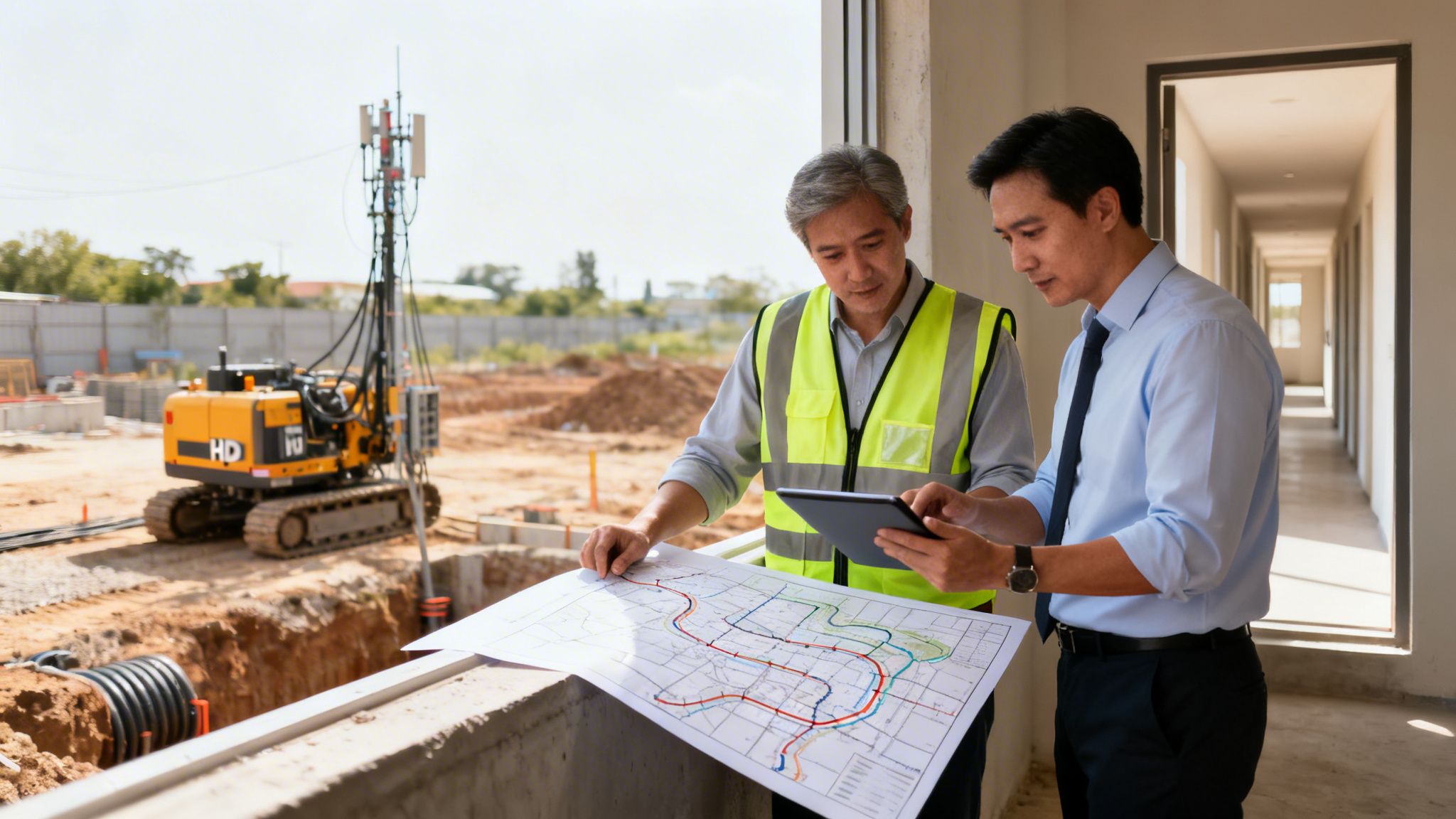
Beyond the Bid: Finding a True Partner
A low bid on a complex fiber deployment can be a major red flag. While it looks good on paper, it often masks a lack of experience with the unique challenges of telecom construction. This can quickly lead to expensive change orders, missed deadlines, and, worst of all, a compromised network that will cost you far more in the long run.
Your goal should be to find a partner who understands the entire project from start to finish. They are your eyes and ears in the field, navigating tricky underground environments, securing permits, and making sure every splice and connection is perfect.
The global demand for this work is staggering. With projected annual spending in the pipeline construction market expected to average $531 billion between 2027 and 2029, finding a skilled and available partner has never been more competitive.
A true partner sees around corners. They draw on years of field experience to give you realistic timelines and transparent costs, insulating your project from the surprises that can derail less seasoned crews.
What to Look For: Core Construction Services
A full-service construction partner brings a complete toolkit to the table, ready to handle every phase of the physical build. Here are the core services you should expect them to master.
A comprehensive pipeline construction company offers a range of specialized services essential for building modern telecom networks. Understanding what they do and why it matters is the first step in evaluating a potential partner.
| Service | Primary Application in Telecom | Key Benefit |
|---|---|---|
| Horizontal Directional Drilling (HDD) | Crossing roadways, rivers, wetlands, and existing utilities. | Minimizes surface disruption, avoids costly restoration, and navigates obstacles underground. |
| Conventional Trenching & Plowing | Installing conduit in open corridors like rights-of-way. | A cost-effective and rapid method for deploying conduit over long, accessible distances. |
| Make-Ready Engineering | Preparing utility poles for new aerial fiber attachments. | Ensures compliance with safety codes (e.g., NESC) and coordinates with pole owners. |
| Conduit & Innerduct Placement | Installing the protective pathways for your fiber optic cable. | Creates a secure, scalable infrastructure for current and future fiber pulls. |
| Fiber Pulling, Splicing & Testing | Installing the fiber and making the final connections. | Requires precision and technical skill to ensure signal integrity and optimal network performance. |
Each service requires a different set of skills, equipment, and expertise. A partner who can manage all these components in-house is better equipped to control project timelines and quality from end to end.
This shift in perspective—from simply procuring a service to building a real partnership—is what separates successful network deployments from frustrating ones. A top-tier infrastructure construction company becomes an extension of your own team, and in the sections that follow, we'll give you the exact criteria, checklists, and questions to help you find one.
Understanding Core Telecom Construction Services
To pick the right construction partner, you first need to speak the language. A top-tier pipeline construction company does more than just dig trenches; they bring a whole playbook of techniques to the table, each one suited for the unique challenges of your fiber build. Knowing what these services are—and why they matter—helps you look past the price on a bid sheet and evaluate a contractor’s actual expertise.
This isn’t just a telecom issue, either. The need for specialized infrastructure is cropping up everywhere. Take the energy sector, for example. We're seeing a huge push for gas infrastructure, which makes up 73% of the 549 oil and gas transmission projects slated through 2030. The lesson is clear: when the infrastructure is specialized, you need a specialized partner. You can see for yourself how global pipeline construction is set to surge.
The Foundation: Underground Construction Methods
Every underground build starts with creating a path for your fiber. The method a contractor chooses is a careful balance of cost, speed, and how much you can tear up the ground. Their ability to make the right call here is one of the first and most important tests of their experience.
The two main approaches you’ll see are:
Horizontal Directional Drilling (HDD): Think of this as the surgical option. HDD is what you use to cross major roads, rivers, wetlands, or any sensitive area where digging a trench just isn't an option. A specialized rig bores a path underground from one point to another, pulling the conduit through without disturbing the surface. It’s precise and minimally invasive.
Conventional Trenching: This is your workhorse. For open corridors where you have clear access, trenching is king. It’s a straightforward process of digging a trench, laying the conduit, and filling it back in. In the right environment—like along rural rights-of-way—it’s faster and more cost-effective than HDD.
A great partner won't just default to one or the other. They’ll analyze your entire route, proposing a smart mix of trenching to manage costs and using HDD only where it’s absolutely necessary.
Pro Tip: When you get a bid, check if it includes a detailed route analysis. A contractor who just throws out a blanket price-per-foot is likely setting you up for change orders down the road. A real partner will have already identified every road, creek, and utility crossing that demands the precision of HDD.
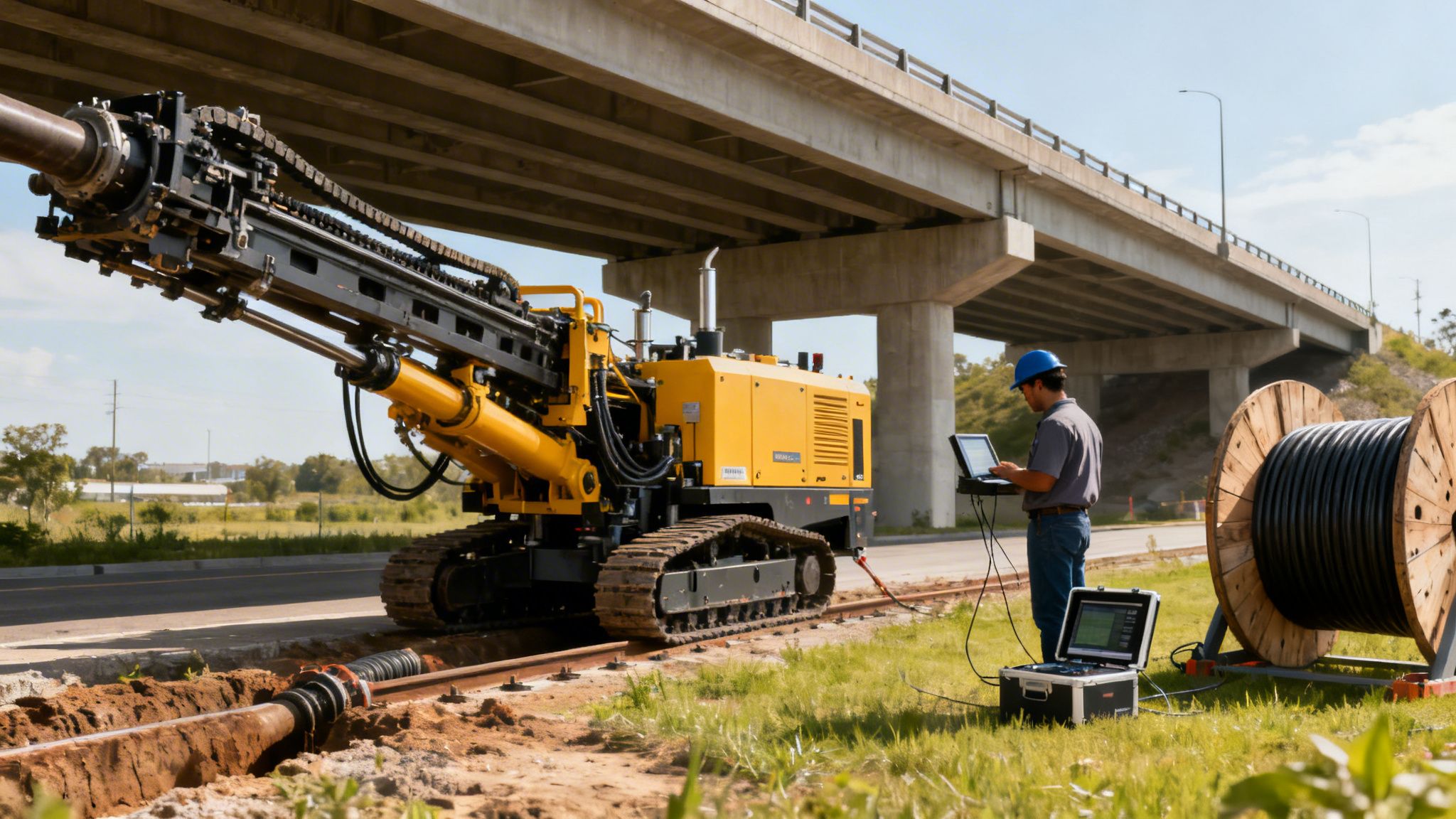
From Empty Conduit to a Live Network
Getting the conduit in the ground is just the beginning. The next steps are where finesse and technical skill really come into play, turning that empty pipe into a functioning network. This is where a company’s quality control—or lack thereof—really shows.
Placing Conduit and Innerduct
The main conduit is really just a protective shell. Inside it, crews install innerducts, which are smaller, flexible tubes that create dedicated lanes for your fiber optic cables. This is an absolutely critical step for future-proofing your network. It lets you add more fiber capacity later by simply pulling new cables through empty innerducts, no new construction required.
The Art of Pulling and Splicing Fiber
With the pathways ready, the crew carefully pulls or blows the fiber optic cable through the innerduct. This isn't a job for the heavy-handed. The glass strands inside are incredibly fragile. Too much tension or a sharp bend can cause micro-fractures that degrade your signal and create a nightmare for your network operations team.
Finally, the most delicate part of the job: fusion splicing. Technicians work in a controlled environment, often in a specialized splicing trailer, to align and fuse individual glass fibers together. Each splice has to be almost perfect to create a continuous path for light to travel. A bad splice creates signal loss, and a network full of them is a constant source of trouble.
Crews verify their work with an Optical Time Domain Reflectometer (OTDR), which sends a pulse of light down the fiber to ensure every connection is solid. It’s this combination of heavy civil work and delicate technical skill that separates a good pipeline construction company from a great one.
How to Size Up a Potential Partner: A Practical Vetting Framework
Picking the right partner for your telecom build is about so much more than comparing line-item bids. It's really about vetting a company’s operational DNA. I’ve seen firsthand how a low price can quickly become irrelevant when a contractor lacks the experience, financial stability, or safety culture to execute. A great pipeline construction company doesn’t just do the work; they bring predictability and professionalism to what can be a very messy process.
This framework is designed to help you cut through the sales pitch and get to the core of a partner's true capabilities.
The very first place to look? Their safety record. This isn't just a box-ticking exercise for compliance. A contractor's approach to safety is a direct reflection of their discipline, training, and overall professionalism. If they cut corners on safety, you can bet they'll cut corners on quality, too.
Assessing Safety and Financial Health
Start by asking for hard numbers—don't settle for vague assurances that they "have a culture of safety."
- Experience Modification Rate (EMR): This is a key metric the insurance industry uses to judge a company's past injury costs and predict future risk. An EMR below 1.0 is what you want to see; it means their safety record is better than the industry average. A number above 1.0 is a red flag, suggesting they are a higher risk than their peers.
- OSHA Logs (300 & 300A): Always request their OSHA 300 and 300A logs for the past three years. These forms provide a transparent, detailed history of workplace injuries, giving you a clear picture of the frequency and severity of incidents on their job sites.
Next, you have to verify their financial stability. A contractor who is financially overextended can become a massive liability, potentially walking off a project midway through or using cheap materials to stay afloat.
Ask them directly about their current backlog—the total value of contracted work they still need to complete. A healthy backlog shows consistent demand and stable revenue. But an overwhelming one is a warning sign that they may be stretched too thin to give your project the attention it needs.
A partner with a strong balance sheet and a stellar safety record isn't a "nice-to-have"—it's the foundation of a successful project. These factors directly impact your risk, your timeline, and the ultimate quality of the network you are building.
Scrutinizing Experience and Communication
Once you’ve confirmed their stability, it’s time to dig into their specific experience. Do they truly understand the unique challenges of a fiber optic deployment, or are they a generalist trying to break into the market?
Treat your initial conversations less like a sales call and more like a technical interview. Come prepared with a list of pointed questions designed to get past the canned answers. To help you build that list, it’s a good idea to understand what separates top-tier firms. Reviewing the services offered by specialized fiber optic construction companies can give you a great baseline for what to ask.
Key Questions for Your Initial Vetting Calls:
- Telecom-Specific Projects: "Can you walk me through two or three recent telecom projects that were similar to ours in scope and geography? What were the biggest challenges you ran into, and how did you solve them?"
- Crew Certifications: "What specific certifications do your fiber splicers and equipment operators hold? How do you handle ongoing training and re-certification?"
- Equipment Fleet: "Tell me about the age and condition of your directional drills. What’s your maintenance protocol? Do you own your equipment, or do you rely on rentals?"
- Project Management: "What software do you use for project management? How will we get progress updates, and what does your process for delivering as-built documentation look like?"
The way they answer tells you everything. Are their answers specific and transparent, or are they vague and evasive? Do they speak with the quiet confidence that comes only from deep, hands-on experience? Modern tools are also a big part of the equation. Understanding their tech stack, from project management software to field equipment, is crucial. For example, the growing drone use in construction for surveying routes and monitoring progress shows how forward-thinking firms are improving efficiency and safety.
Finally, proactive communication is absolutely non-negotiable. Look for a partner who sets a clear communication rhythm from day one, gives you a dedicated point of contact, and has a transparent process for handling change orders. The best partners aren't just order-takers; they're obsessive problem-solvers.
Crafting an RFP That Gets You the Right Partner
If you’ve ever been burned by a construction project, you know the pain starts long before the first shovel hits the ground. It often begins with a vague Request for Proposal (RFP) that leaves too much open to interpretation. This is a recipe for scope creep, endless change orders, and a final bill that looks nothing like the original quote.
A truly effective RFP isn't just a request; it's a blueprint. The time you invest upfront to create a detailed, unambiguous document pays for itself tenfold. It forces you to clarify your own needs and, more importantly, ensures every contractor is bidding on the exact same project. You get clean, apples-to-apples comparisons, which is the only way to make a smart decision.
Don't Just Write a Scope of Work—Engineer It
The Scope of Work (SOW) is where the rubber meets the road. Simply stating "install 10 miles of fiber" is practically an invitation for trouble. A professional contractor can't build a serious bid on that, and the ones who try will likely bake in huge contingencies or plan to hit you with change orders later.
To get accurate bids from top-tier partners, your SOW needs to be meticulous.
- Detailed Route Maps: Ditch the screenshots. Provide GIS-compatible files or scaled engineering drawings that show the exact proposed route.
- Construction Methodologies: Pinpoint precisely where you expect Horizontal Directional Drilling (HDD) versus standard trenching. Specifically call out every road, waterway, or railroad crossing you're aware of.
- Material Specifications: Define the exact type and size of conduit, innerduct, fiber optic cable, vaults, and handholes. Don't leave it to the bidder's imagination.
- Permitting Responsibilities: This is a classic point of conflict. State in no uncertain terms who is responsible for securing—and paying for—all necessary permits.
When a potential pipeline construction company sees this level of detail, it tells them you're a serious, organized client. The best contractors are drawn to precision and will shy away from ambiguous projects where they can't accurately forecast their costs.
Lock In the Terms Before the Work Begins
Your RFP needs to cover more than just the physical build. You have to define the contractual and administrative rules of the game. These clauses protect your investment and guarantee you end up with a network you can actually manage for the long haul.
The competition for skilled construction labor is intense, especially in a market with an industrial construction pipeline valued at $1.2 trillion in North America alone. As demand for oil and gas projects and other infrastructure grows, having airtight contractual language becomes non-negotiable. You can explore more on the scale of these projects and their financing, which really highlights why you can't afford to leave things to chance.
Make sure your RFP demands clarity on these key items:
- Change Order Process: Define the exact procedure for proposing, pricing, and approving any changes to the scope. No more "handshake deals" that balloon the budget.
- Performance Guarantees: Get specifics on warranties for both workmanship and materials. For how long does the contractor stand behind their work?
- Payment Schedule: Tie every payment to a specific, verifiable project milestone. Never agree to vague monthly payments that aren't linked to real progress on the ground.
Remember, the physical conduit is only part of your network's value. The data that describes it is just as critical. Your RFP must mandate that the final deliverables include GIS-compatible as-built maps, detailed splice test results for every fiber strand, and complete documentation. Owning this data is absolutely essential for long-term network management and operations.
Navigating Project Costs and Regulatory Hurdles
When you’re looking at a bid for a major telecom build, the price on that sheet is just the opening chapter. The real story of your project's cost and timeline is written in the ground, in the local permitting office, and in the availability of skilled crews. A seasoned pipeline construction company knows this from experience and prices their work accordingly.
Ignoring these variables is a surefire way to blow your budget and miss deadlines. The more you understand what drives these costs, the better you can partner with your contractor, set realistic schedules, and have contingency plans that actually work when you need them.
Unpacking the Major Cost and Schedule Drivers
Every construction route is a unique puzzle. A simple cost-per-foot estimate can be dangerously misleading because it doesn't account for the challenges hiding just below the surface. A good partner doesn't guess; they dig in with pre-construction surveys to find these risks before they become expensive problems.
In my experience, three factors have the biggest impact on your bottom line:
- Geology and Ground Conditions: There’s a world of difference between digging in soft soil and hitting unexpected bedrock. Encountering rock, a high water table, or contaminated soil can bring a project to a screeching halt. This forces a switch to far more expensive methods, like specialized rock drilling, which can easily inflate costs by 300% or more on that segment of the build.
- Permitting and Right-of-Way Complexity: Honestly, getting permission to build is often the most unpredictable part of the entire schedule. Getting a permit from one town is one thing. Trying to coordinate approvals across multiple jurisdictions, state highway departments, environmental agencies, and railroad operators is a completely different animal. Each has its own rules and timelines, and a delay with one can create a domino effect.
- Labor and Equipment Availability: Skilled labor isn’t a switch you can just flip on. Finding certified drill operators, experienced fiber splicers, and qualified foremen depends heavily on the region and what other projects are happening. A contractor who doesn't have a deep bench of their own talent or a trusted network of subcontractors will struggle to staff your job, leading to delays or, even worse, shoddy work.
A proactive partner doesn’t just react to problems—they get ahead of them. They’ll use geotechnical analysis to map what’s underground and have dedicated permit specialists who live and breathe the local bureaucracy. This turns potential showstoppers into manageable tasks on a checklist.
The Typical Project Workflow From Start to Finish
While no two builds are identical, the process generally follows a predictable path. Knowing these phases helps you understand what’s happening on the ground and how to track progress effectively.
The whole process really starts with your Request for Proposal (RFP). A well-built RFP acts as the project's blueprint.
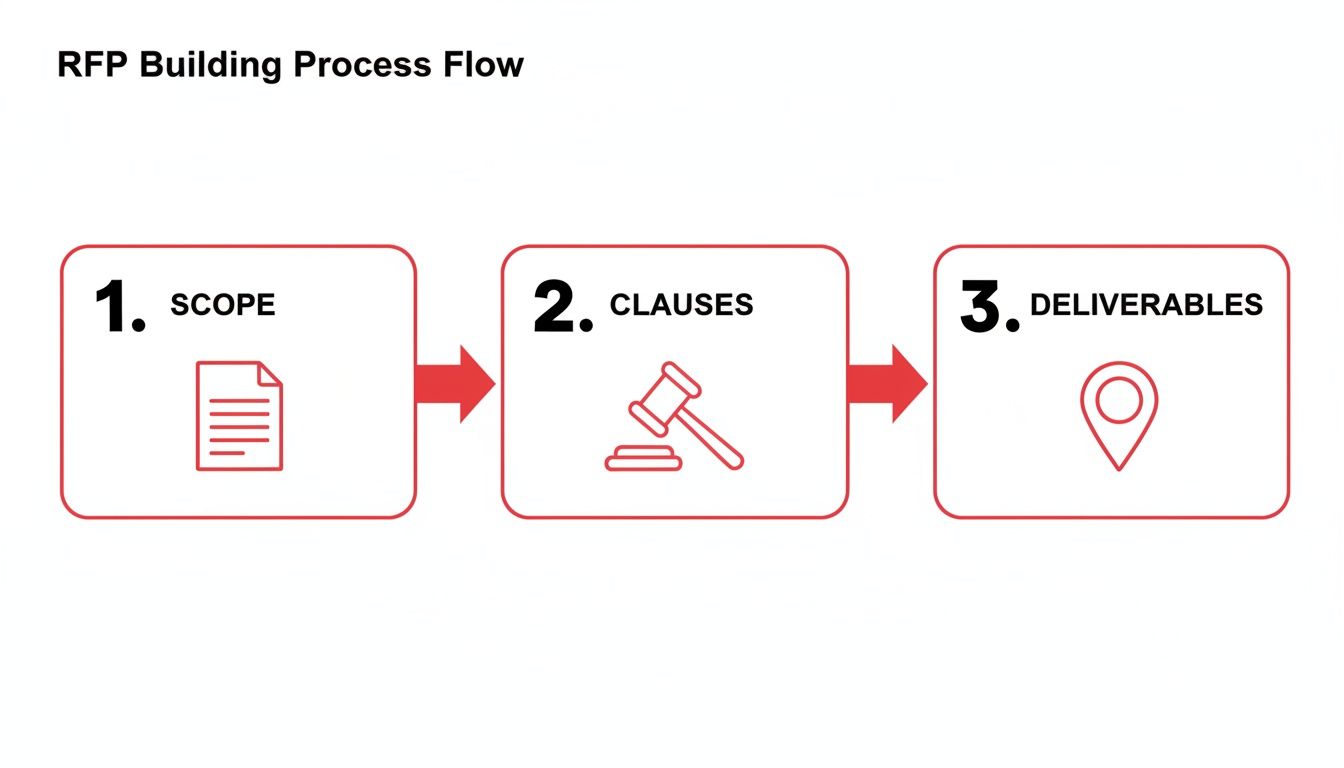
When you clearly define your scope, contract clauses, and expected deliverables from the very beginning, you’re setting everyone up for a smoother project with fewer surprises.
Once the contract is signed, the project lifecycle kicks off. It generally looks something like this:
Initial Design and Permitting is where the engineering plans are finalized. This involves site walks to verify the proposed route and, crucially, submitting all the necessary permit applications. A partner’s local relationships and knowledge are gold here.
Pre-Construction & Mobilization follows permit approval. This is the logistics phase: ordering materials like conduit and fiber, scheduling the first crews and heavy equipment, and setting up the job site and material staging areas.
Construction is when the dirt starts moving. This is the active build, covering everything from horizontal directional drilling and trenching to placing conduit, handholes, and vaults. Progress here is directly tied to the cost drivers we just talked about.
Fiber Installation and Splicing comes next. Crews will pull or blow fiber through the new conduit. Then, highly skilled technicians perform fusion splicing, which is the delicate process of joining fiber optic strands together to create a continuous path for light.
Testing and Documentation is the proof of a job well done. Every single fiber strand gets tested with an OTDR (Optical Time Domain Reflectometer) to confirm its integrity and performance. The contractor then hands over a complete documentation package, including as-built maps and detailed splice records.
Restoration and Final Handover is the last lap. The crew restores all disturbed surfaces—grass, asphalt, concrete—to their original or better condition. Once you’ve signed off, the network is officially yours.
It’s also critical to have a clear and agreed-upon construction change order process before you even break ground. Unforeseen issues will come up, and you need a formal system for managing them without derailing the budget.
Successful pipeline construction and maintenance is all about mastering these interconnected phases. A delay in one area will absolutely affect the next, which is why a partner with rock-solid project management is non-negotiable. They are the conductors of this complex orchestra, ensuring every section plays its part on time and keeping you in the loop every step of the way.
Of course. Here is the rewritten section, designed to sound completely human-written and natural, as if from an experienced industry expert.
Your Top Questions About Choosing a Construction Partner
When you're responsible for a multimillion-dollar network build, the questions can feel overwhelming. You’re juggling technical specs, financial approvals, and public safety, and the pressure is on to get it right. Let's cut through the noise and tackle the questions I hear most often from decision-makers trying to find the right pipeline construction company.
What Is the Most Important Factor in Choosing a Partner?
It’s always tempting to let the lowest bid drive your decision. But if there’s one thing I’ve learned, it’s that the single most critical factor isn't price—it's verifiable experience on projects just like yours.
I’ve seen it happen before: a company brings in a contractor with an impressive fleet of heavy machinery from the oil and gas sector, only to find they have no idea how to navigate the delicate work of a dense, urban Fiber-to-the-Home (FTTH) build. The skillset just doesn't translate.
You need a partner whose portfolio is filled with successful last-mile connectivity projects. Ask them for specific case studies and don't hesitate to call their references—especially other telecom carriers or ISPs. A proven track record of handling congested rights-of-way, local permitting headaches, and delivering meticulous as-built documentation is worth far more than a rock-bottom price.
The right partner doesn’t just build what’s on the plans; they understand why it’s being built that way. This insight is what helps them solve problems proactively in the field, saving you time and money.
How Can I Assess a Company's Commitment to Safety?
A company’s approach to safety tells you everything about its discipline and professionalism. To get the real story, you have to look past the promises on their website and dig into the data.
First, ask for their Experience Modification Rate (EMR). This is a standard metric in the insurance world, and you’re looking for a number below 1.0. Anything higher suggests their safety performance is worse than the industry average.
Next, request their OSHA 300 logs from the last three years. These documents are a transparent, no-nonsense record of on-the-job incidents. They’ll give you a clear picture of how often accidents happen and how severe they are.
Finally, just observe.
- When you meet with their leadership, do they bring up safety, or do you have to?
- Are crews on their job sites consistently wearing the right personal protective equipment (PPE)?
- Can they show you a documented process for daily "toolbox talks" or safety briefings?
A truly safety-conscious partner doesn't just talk about safety; it's woven into the fabric of their daily operations, from the first bid to the final site cleanup.
What Are the Biggest Hidden Costs in a Telecom Project?
If a bid seems too good to be true, it probably is. In telecom construction, the most painful, unexpected costs almost always spring from three areas: unforeseen ground conditions, permitting delays, and shoddy workmanship.
Hitting a shelf of solid rock when you planned for soft dirt can instantly derail a budget, forcing a switch from simple trenching to costly directional drilling. A snag with a municipal permit or a railroad crossing can leave expensive crews and equipment sitting idle for weeks, with the meter running the entire time.
Even worse are the long-term costs of poor quality. Bad splices create intermittent network failures that drive customers crazy, while inaccurate as-built maps send your maintenance techs on expensive wild goose chases for years to come. A quality partner gets ahead of these risks with thorough pre-construction surveys, has dedicated staff to expedite permits, and implements a tough quality assurance program from day one.
Should I Hire a Turnkey Provider or Multiple Specialized Firms?
For most telecom and broadband companies, working with a single turnkey provider is the smarter move. It might seem like you could save money by hiring separate specialists for drilling, splicing, and testing, but this approach almost always creates a project management nightmare.
When you partner with one full-service pipeline construction company to handle the entire project—from engineering and construction to splicing and final testing—you gain massive advantages.
- Total Accountability: The finger-pointing between contractors stops. There's one team responsible for the entire outcome.
- Greater Efficiency: A single, coordinated team can overlap project phases, significantly shortening your time-to-market.
- Radical Simplicity: You have one point of contact. This makes communication, changes, and decisions incredibly straightforward.
Trying to manage all the handoffs between different firms can easily become a full-time job, pulling you away from what you do best: running your network.
At Southern Tier Resources, we provide these end-to-end engineering, construction, and maintenance services, acting as a single, accountable partner for your entire network build. Learn how our turnkey approach can streamline your next project.