A fiber program can look healthy in the dashboard while the field team has nothing productive to build. The design package is approved, contractors are mobilized, and the forecast still shows activation on target. Then the permit aging report reveals that pole attachment applications have been waiting for review, make-ready surveys haven't started, and the construction sequence was built on assumptions nobody formally accepted.
That failure pattern is common because telecom delivery depends on organizations outside the PMO. A carrier, ISP, municipality, utility, railroad, engineering firm, general contractor, and specialist field crews may all control different pieces of the same route. Telecom project management works when those dependencies are sequenced before crews are scheduled, not merely logged after they become risks.
What Telecom Project Management Really Means
A 240-mile middle-mile fiber build can reach month nine with the route designed, materials ordered, and construction contracts signed, yet remain stalled because pole attachment permits are already 11 weeks old and make-ready surveys haven't begun. The project manager may have a polished schedule and daily dashboard, but neither tool can authorize a pole owner to release work.
That's the distinction between generic project management and telecom project management. The telecom PM governs the physical and operational chain that turns network intent into an activated service. That includes outside plant design, inside plant design, make-ready engineering, permitting, right-of-way coordination, splicing, testing, NESC compliance, integration, and customer activation.
The work serves more than traditional telephone carriers. An effective control model must fit:
- ILEC and CLEC carriers: Network expansion, modification, interconnection, and service activation.
- ISPs and broadband builders: FTTH deployment, homes passed, customer drops, and turn-up.
- Municipal and utility networks: Public broadband, joint-use infrastructure, and community connectivity.
- Data center operators: Campus fiber, structured cabling, power coordination, and fit-outs.
- Wireless operators and tower companies: Small cells, macro sites, backhaul, radio upgrades, and tower work.
- Public-sector broadband programs: Grant-driven construction with strict documentation and acceptance obligations.
The regulatory environment can multiply delivery complexity quickly. The U.S. Telecommunications Act of 1996 opened local telecom networks to competition and helped create competitive local-exchange carriers in all 50 states and the District of Columbia. More than 1,200 certificates were issued and more than 2,400 interconnection agreements were signed, illustrating how a policy change can expand project volume and coordination demands across an industry. (Historical telecom project management paper)
Practical rule: If a schedule doesn't show who controls the next approval, it isn't a delivery schedule. It's an internal task list.
Property ownership and parcel information also affect route feasibility, access, easements, and stakeholder identification. Teams can use property records for telecom planning as one input when validating route assumptions and preparing outreach, but records don't replace jurisdictional review or utility confirmation.
The central question is therefore not, “Which PM platform are we using?” It's, “Which external party can stop this segment, and what evidence will release it?”
The Telecom Project Lifecycle and Its Deliverables
A telecom program moves through recognizable gates, but each gate needs a tangible handoff. A status of “design complete” means little if the PM doesn't have an approved package that a permitting team and construction contractor can use without interpretation.
Seven gates from concept to activation
Concept and business case: Define the service objective, target geography, customer or facility requirements, funding constraints, and success criteria. The output is an approved charter and business case.
Engineering and OSP or ISP design: Produce the high-level design and low-level design, route maps, splice architecture, cabinet locations, bill of materials, pole data, underground details, and facility pathways. The release document is an approved HLD and LLD.
Permitting and make-ready: Submit jurisdiction-specific applications, coordinate pole-owner reviews, complete utility surveys, resolve conflicts, and secure construction clearance. The gate requires jurisdictional permits and NTP-ready make-ready packets.
Procurement and materials staging: Match the bill of materials to released segments, confirm long-lead equipment, kit materials by construction area, and verify storage and logistics. The deliverable is a material-readiness report tied to the build sequence.
Construction: Release only buildable segments with issued-for-construction drawings, cleared locates, traffic controls, safety documentation, and an accountable field supervisor. The key handoff is the IFC drawing package plus daily production records.
Testing and activation: Complete splicing, OTDR testing, power and continuity checks, wireless sweep and PIM testing where applicable, integration, and customer or facility acceptance. Construction completion isn't the commercial milestone. Activation is. Revenue, connected premises, and operational service depend on the network being tested, accepted, and turned up.
Closeout: Reconcile redlines, test results, permit conditions, asset records, photos, punch-list closure, warranties, and acceptance signatures. The final deliverables are accurate as-builts and the complete acceptance package.
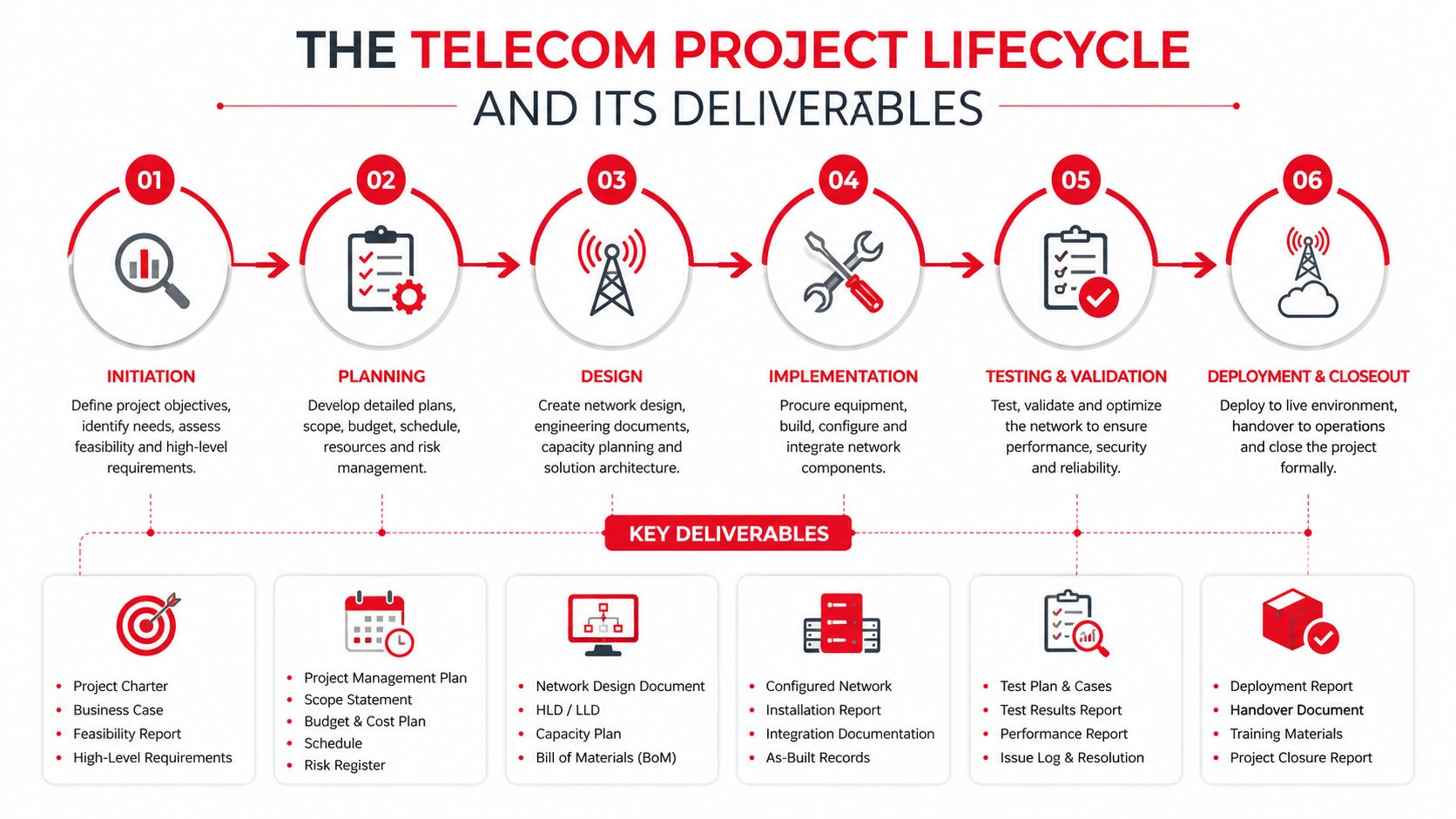
The lifecycle should appear in the program charter, but the handoffs deserve equal attention. The designer must identify unresolved assumptions. The PM must verify that the GC understands them. The OSP crew needs construction-ready information, not a presentation deck. The splicing vendor needs fiber counts, closure assignments, test criteria, and labeling conventions before arriving in the field.
A common mistake is to treat construction completion as the finish line. A route can be trenched, lashed, or placed and still lack a passing test, a corrected splice record, a customer order path, or an operations handoff. Build the schedule backward from activation, then make every earlier gate produce the evidence required by the next team.
Roles and Responsibilities Across Carriers, ISPs, and Field Partners
Telecom programs rarely fail because nobody was assigned a task. They fail because two people believe the other person owns the decision. The project charter should use a RACI-style model, then name the individual with authority for each accountable role.
| Workstream | Accountable owner | Responsible contributors | Consulted parties | Acceptance or escalation |
|---|---|---|---|---|
| Scope and funding | Carrier sponsor or ISP executive | Program manager and finance lead | Municipality, design lead, operations | Sponsor approves baseline and material scope changes |
| Engineering design | Carrier or ISP engineering owner | OSP/ISP designer and survey team | Utility, ROW owner, GC | Design authority approves HLD, LLD, and IFC drawings |
| Permits and ROW | Jurisdictional liaison or ROW owner | Permit runner and design team | Municipality, railroad, highway, environmental agencies | Authorized applicant signs submissions and resolves comments |
| Pole attachments and make-ready | Asset owner or carrier attachment lead | Make-ready vendor and utility coordinators | Pole owner, engineering, OSP contractor | Pole owner issues construction clearance |
| Construction schedule | ISP or carrier PM | GC superintendent and OSP subcontractor | Material manager, inspectors, utility representatives | PM controls baseline changes and recovery actions |
| Safety | GC safety lead | Foremen and every field crew | Carrier safety manager, traffic-control provider | Competent person and PM release each work phase |
| Splicing and testing | Network engineering owner | Splicer crew and test technician | QA/QC inspector, operations | Network owner accepts splice and test package |
| Closeout | Carrier or ISP asset owner | PM, GIS specialist, GC, and vendors | Operations, finance, permitting authority | Owner signs final acceptance and asset handoff |
The seams need explicit answers. Who signs the permit? The authorized applicant, not whichever contractor happens to submit the PDF. Who owns the pole attachment application? One named attachment lead who tracks every pole, owner response, survey result, and construction clearance. Who accepts the splice package? The network owner or delegated engineering authority, with written criteria established before testing begins.
A program manager can use a project manager AI platform to organize records, action items, and recurring follow-ups, but automation doesn't create authority. The charter still needs escalation thresholds, signature rights, and a defined response path when a municipality, utility, or contractor misses a commitment.
Keep the RACI near the weekly review. If an issue has sat unresolved for two meetings, the problem usually isn't visibility. It's that the accountable decision-maker was never identified.
Permitting, Make-Ready, and Right-of-Way as the Real Critical Path
A fiber route can be fully designed and still have no buildable work. The crew remains idle if the city has not approved excavation, a railroad has not granted right-of-entry, or a pole owner has not cleared the attachment. Treat these external dependencies and available field labor as the schedule's controlling constraints, not as administrative tasks recorded after design.
Divide the route by approval environment before setting construction dates. One program may require municipal encroachment permits, county or state highway permissions, railroad access, environmental and historic-preservation reviews, utility joint-use authorization, traffic-control approval, and private easements. Each authority needs its own evidence package. Comments from one reviewer can also change the design sequence for another approval.
Build the schedule around approval reality
Permit windows can range from 8 weeks to 18 months, depending on jurisdiction and dependency complexity. The Fiber Broadband Association and Cartesian fiber deployment report supports treating that range as a planning condition rather than an exception. Baseline submission, review, comment response, resubmission, approval, and construction release as separate activities.
For aerial work, manage make-ready at pole level. Record:
- Survey status: Whether the pole was inspected and documented.
- Owner review: Which utility or pole owner must respond.
- Required work: Transfer, guying, replacement, clearance, or engineering revision.
- Construction clearance: Whether the pole is released for the crew.
- Aging and escalation: How long the item has remained open and who acts next.
A 2025 industry report found that nearly half of respondents experienced material fiber deployment delays and that permitting timelines were about 20% longer than in previous years. It associated those delays with roughly two additional months in many cases and up to 18 months in severe cases. Keep the cited report attached to the risk review, but use the project's own permit aging and clearance data to make release decisions.
Protect cash flow and field productivity
Do not mobilize a full construction spread against uncleared poles. Release work by buildable segment, match progress billing to verifiable approvals and installed assets, and reserve contingency for design revisions, utility conflicts, and seasonal access limits. Fiber civil works can represent 60% to 80% of total investment, while typical FTTH deployment can take 12 to 18 months, with smaller commercial builds sometimes taking six months and large urban districts extending to 24 months, according to this telecom project management and fiber rollout analysis.
The schedule improves through disciplined handoffs. Hold pre-application meetings, issue GIS-driven packages with consistent naming and exhibits, assign dedicated permit runners, and review aging weekly. Escalate before a delayed submission reaches the activation milestone, and release skilled crews only where permits, make-ready, access, materials, and traffic controls are all confirmed.
People Before Platforms in Telecom Delivery
A permit may clear in the morning, yet the build can still stop because the qualified splicer is assigned elsewhere, the make-ready crew has not finished, or the test technician is unavailable. A dashboard can flag that blockage. It cannot splice a closure, certify a lineman, or place a crew safely on a pole. In fiber, wireless, and data-center work, specialized field capability is often the binding constraint, especially when programs compete for splicers, linemen, tower crews, testers, and foremen.
A 2025 study of digital technologies and project management found that digital tools improved collaboration and data access, while their broader effect on project effectiveness remained limited. The practical lesson is clear: software supports coordination, but it does not remove an uncleared pole, train a climber, resolve a utility conflict, or replace an experienced foreman.
Start with the people and handoffs that keep work buildable.
Practices that protect scarce crews
- Walk the route before release: A pre-construction walkout checks design assumptions against actual poles, vaults, access points, obstructions, and customer interfaces. Record exceptions before the crew arrives.
- Kit materials by segment: Package closures, hardware, labels, lashing materials, and consumables together. A missing component can idle an entire spread.
- Standardize repeatable assemblies: Consistent cabinets, splice closures, labeling, and test forms reduce interpretation and variation between crews.
- Overlap critical crews: A second trained crew can follow the first, absorb turnover, and keep the next segment moving without placing the whole program on one specialist.
- Protect rest and continuity: Fatigue, rushed handoffs, and constant reassignment create rework that ordinary productivity reports rarely show.
Sequence releases around verified capability, not nominal headcount. Pair less experienced personnel with qualified leads, maintain a current skills matrix, and confirm who owns each handoff from design to construction, testing, and acceptance. A crew that is available but lacks the required qualification is not available for that work.
Use the platform to show readiness, constraints, and ownership. Keep the release decision with the PM and field leads.
Software tracks the work. Trained, rested crews deliver it.
Risk, Quality, and Safety Controls for Outside Plant and Wireless Work
The PM should release each phase only when safety, quality, and authorization evidence is present. A crew starting early may appear productive, but if the locate ticket is unresolved or the traffic plan isn't approved, the program has converted schedule pressure into exposure.
For underground OSP, verify locate tickets, markings, tolerance requirements under applicable state 811 rules, excavation limits, and escalation for mismatches. Vault and manhole work requires confined-space evaluation, atmospheric testing, attendant controls, and an approved rescue approach. A signed daily tailboard and job safety analysis should match the actual site, not a copied route template.
Aerial and wireless work needs a different control set. Confirm fall protection, climbing qualifications, rigging plans, weather limits, rescue arrangements, grounding and bonding, and electrical hazard controls. For energized or potentially energized work, the PM should coordinate the responsible electrical authority and require procedures consistent with the applicable NESC and NFPA 70E requirements. Teams reviewing apparel and electrical PPE can also use these NFPA 70E PPE compliance tips as a practical reference, while site-specific rules and qualified-person decisions remain controlling.
Acceptance must be designed before construction
For fiber, the acceptance package should include OTDR traces, documented loss budgets, fusion-splice records, labeling verification, continuity results, photos, and GIS redlines. For wireless, require sweep and PIM results, grounding records, antenna and feeder documentation, integration status, and site acceptance evidence.
| Work Type | Safety Controls | Quality Acceptance | Required Sign-Off |
|---|---|---|---|
| Underground OSP | Locate clearance, excavation controls, confined-space review for vaults and manholes | Placement records, depth evidence, duct continuity, photos, GIS redlines | Foreman, safety lead, inspector, owner representative |
| Aerial fiber | Pole access controls, fall protection, traffic control, grounding and clearance review | Attachment clearance, sag and tension records, strand and cable inspection | Foreman, utility or pole owner, QA/QC inspector |
| Fiber splicing | Electrical and site controls, clean work area, approved closure procedure | Fusion-splice records, OTDR traces, loss budget, labeling | Splicing lead, test technician, network owner |
| Wireless site work | Fall protection, rigging, RF controls, grounding, weather review | Sweep and PIM results, antenna records, alarm and integration checks | Tower lead, RF engineer, QA/QC, operator |
| Data center fit-out | Electrical isolation, hot-work controls, access and housekeeping | Cable certification, labeling, pathway inspection, test package | Electrical lead, structured cabling lead, facility owner |
Before releasing a phase, verify that locates are cleared, traffic plans are approved, tailboards are held, JSAs are signed, materials are staged, drawings are current, and test sheets are ready. The PM's signature should mean the program has accepted the remaining risk, not that the crew has arrived.
KPIs and Reporting That Telecom Leadership Actually Uses
Leadership needs a short view of whether external dependencies, field production, and acceptance will support activation, remain within the approved plan, and produce a reliable asset. A dashboard that only counts installed cable hides the work still waiting on permits, make-ready, testing, or customer drops.
Build the report around leading indicators and lagging outcomes. Permit submissions, application aging, cleared poles, utility responses, material readiness, crew availability, and released segments show where future slippage is forming. Homes connected, passing test rates, accepted sites, and activated services show what customers and operations can use.
| KPI | What It Measures | Cadence | Leadership Signal |
|---|---|---|---|
| Permits issued versus aging | Approval throughput and stalled submissions | Weekly, with daily exception review | Whether external approvals threaten the baseline |
| Make-ready backlog | Pole count, owner response, clearance status, and aging | Weekly | Whether aerial construction can be released |
| Homes passed versus connected | Network reach compared with customer activation | Weekly or monthly | Whether build output is converting into service |
| Splice completion and test pass rate | Field completion and acceptance quality | Daily field view, weekly program view | Whether production is creating usable plant |
| Change-order frequency and cost variance | Scope stability and commercial control | Weekly | Whether design or field assumptions are failing |
| Schedule performance by phase | Planned work compared with earned progress | Weekly and monthly | Where recovery action belongs |
| TRIR and DART | Recordable and restricted or lost-work safety outcomes | Monthly, with immediate incident escalation | Whether production pressure is increasing exposure |
Match the reporting rhythm to the decision. A daily field huddle clears blocked permits, unsafe conditions, missing materials, and crew conflicts. A weekly program review resolves carrier, utility, municipality, and contractor dependencies, then assigns recovery actions. A monthly steering review handles funding, scope, customer impact, and executive escalation.
Treat “miles placed” as a production measure, not a completion measure. Cable can be installed while splicing, testing, permitting, or customer drops remain blocked. Pair construction output with acceptance and activation, and add a brief narrative stating the largest change since the prior report.
A one-page traffic-light summary is useful when every red item includes an owner, next action, decision date, and activation consequence. Add the blocked dependency and recovery path where the issue sits outside the PM's direct control. Without those fields, color only decorates uncertainty.
Toolkit, Templates, and a Practical Delivery Checklist
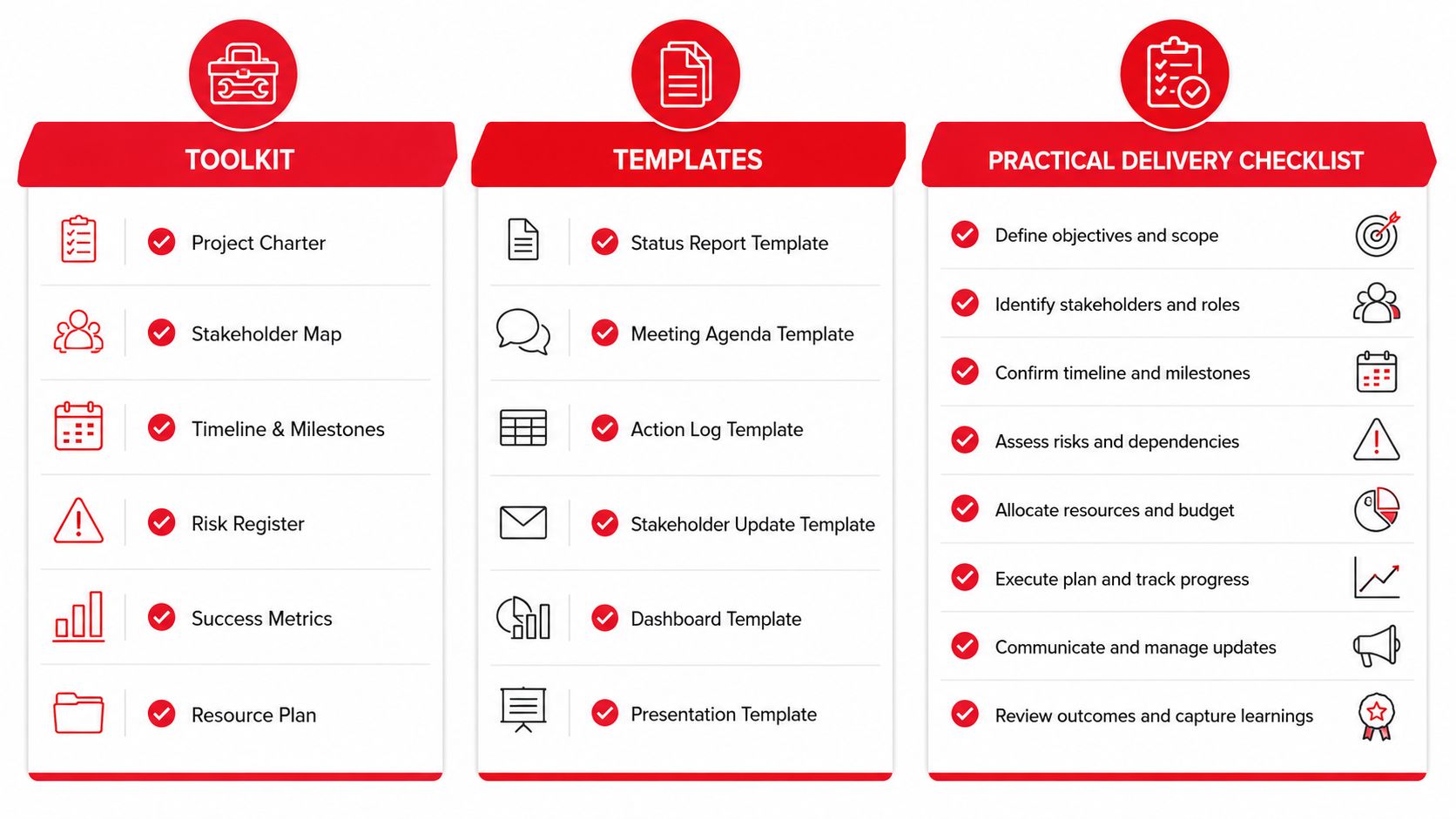
Before the first contractor meeting, establish the controls that keep external dependencies visible and actionable. The core set includes a project charter, an OSP-specific WBS, a milestone schedule with permit gates, a risk register covering make-ready and weather exposure, and a RACI for the carrier, municipality, GC, utility, and splicing vendor.
Add working registers with clear ownership:
- Change-order log: Record the trigger, technical impact, schedule and cost effects, approver, and field disposition.
- Acceptance and test plan: Set OTDR, splice, sweep, PIM, labeling, GIS, and turnover requirements before construction starts.
- Safety plan: Reference applicable OSHA, NESC, traffic-control, confined-space, fall-protection, and electrical procedures.
- Stakeholder communications plan: Define meeting cadence, escalation routes, decision rights, and distribution lists.
- Document-control register: Tie every drawing, permit, redline, test sheet, and approval to a revision and responsible owner.
A template is useful only when the field can act on it. The change-order log should tell a superintendent whether work can continue. The permitting tracker should show jurisdiction, submission, comments, aging, and approval status. The document register should prevent crews from building from superseded drawings.
Select tools by function. GIS and fiber-management software should maintain route, pole, splice, and asset information. Microsoft Project or an equivalent scheduler can hold the baseline and dependencies. A shared repository should control versions, while a field application captures daily reports, photos, production, safety observations, and blockers. No dashboard compensates for an unassigned permit, an incomplete make-ready package, or a crew without the required skills.
A workable delivery cadence
- Months 1 to 3: Approve the charter, complete HLD and LLD, validate route assumptions, submit permits, begin utility coordination, and establish change control.
- Months 4 to 6: Work the make-ready backlog, resolve comments, stage segment-based materials, complete walkouts, and assign qualified crews.
- Months 7 to 9: Release only cleared segments, manage civil and aerial production, maintain daily redlines, schedule splicing behind construction, and review test readiness.
- Months 10 to 12: Complete acceptance testing, correct punch-list items, activate service, reconcile as-builts, close permits, and hand assets to operations.
These dates are a planning example, not a promise. Fiber deployment guidance describes FTTH timelines ranging from 12 to 18 months, with smaller commercial builds sometimes taking six months and large urban districts reaching 24 months. Build the actual cadence from approval conditions, crew capacity, material availability, and activation requirements, as outlined in the Fiber rollout analysis.
Southern Tier Resources provides engineering, construction, maintenance, fiber installation, make-ready work, splicing, testing, documentation, wireless construction, and data center infrastructure fit-outs. Programs needing a field partner across design, permitting, build, activation, and closeout can contact Southern Tier Resources about route, facility, or wireless scope.