
Telecom construction is all about building the physical backbone of our digital lives. Think of the 5G towers that connect our phones and the fiber optic cables running under our streets—skilled crews are the ones putting that essential infrastructure in place. Right now, a massive wave of investment is flowing into network upgrades, creating a huge, immediate need for people to do this work.
Why Telecom Construction is Booming
Picture the internet as a sprawling highway system. For the last couple of decades, we've been cramming more and more traffic—smartphones, streaming movies, AI, you name it—onto roads that are getting old. We’re finally in the middle of a nationwide project to rip out those old roads and build brand new superhighways using fiber optics and 5G.
That's where telecom construction comes in. Companies like Southern Tier Resources are the crews on the ground, literally laying the fiber and putting up the towers that connect us all. It's a colossal effort, funded by both government programs and private companies, all aiming to bring high-speed internet to everyone and gear up for the tech of tomorrow.
A Worker's Market: More Jobs Than People
This surge in new projects has created a classic supply-and-demand problem: there’s far more work to be done than there are skilled people to do it. The fiber optic industry, in particular, is feeling the pinch.
While the push for universal broadband is expected to create 58,000 new jobs by 2032, the industry is also facing a wave of retirements. This could lead to a jaw-dropping shortfall of nearly 178,000 workers, putting critical projects at risk. You can get a deeper dive into the telecom labor shortage over at WirelessEstimator.com.
For anyone looking for a new career, this skills gap is a golden opportunity. It has completely flipped the script, putting job seekers in the driver's seat. We're seeing:
- Serious Pay Bumps: With companies competing for talent, wages are on the rise. It’s not uncommon for entry-level fiber jobs to start around $60,000 a year with overtime, and experienced pros can easily clear six figures.
- Better Benefits: To attract and keep good people, companies are rolling out much more competitive benefits packages.
- Faster Career Growth: There's a real shortage of leaders. That means new technicians who show promise have a clear and rapid path to move up into supervisory and management roles.
This isn't just a forecast; it's happening right now.
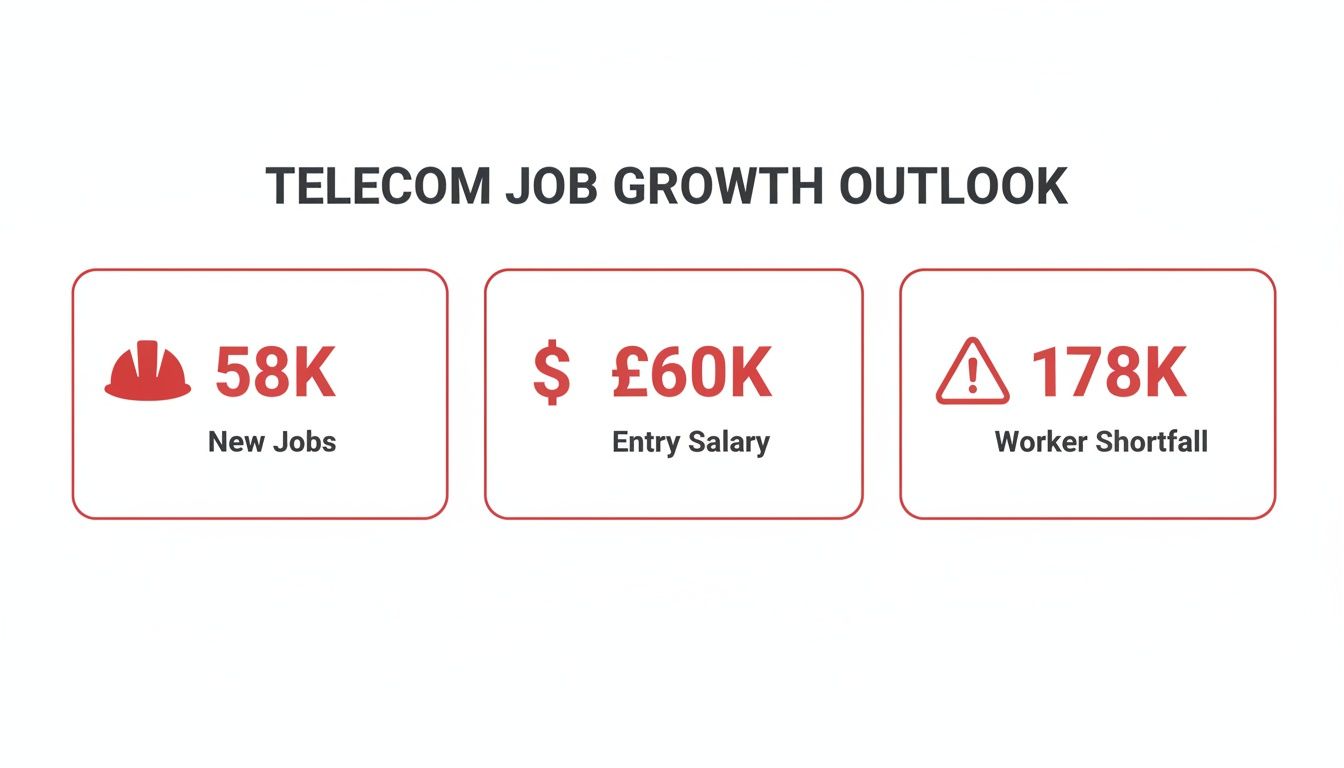
The numbers tell a clear story: strong job growth and great starting pay are colliding with a huge labor shortage. It’s the perfect time to get into this field.
At the end of the day, the people in these telecom construction jobs are doing more than just building a network. They're laying the groundwork for our entire economy. Every cable they splice and every tower they climb helps power remote work, telehealth, education, and so much more. This is a chance to be part of an upgrade that will define a generation.
A Look Inside the Most Common Telecom Construction Jobs
So, what does a career in telecom construction actually look like day-to-day? It’s a world of specialized trades, each calling for a different kind of person with a very specific set of skills. These aren't just jobs; they're technical careers building the backbone of our connected lives.
Let's get to know the crew. Understanding what each person does is the best way to figure out where you might fit in.
The Fiber Splicer: Surgeon of the Network
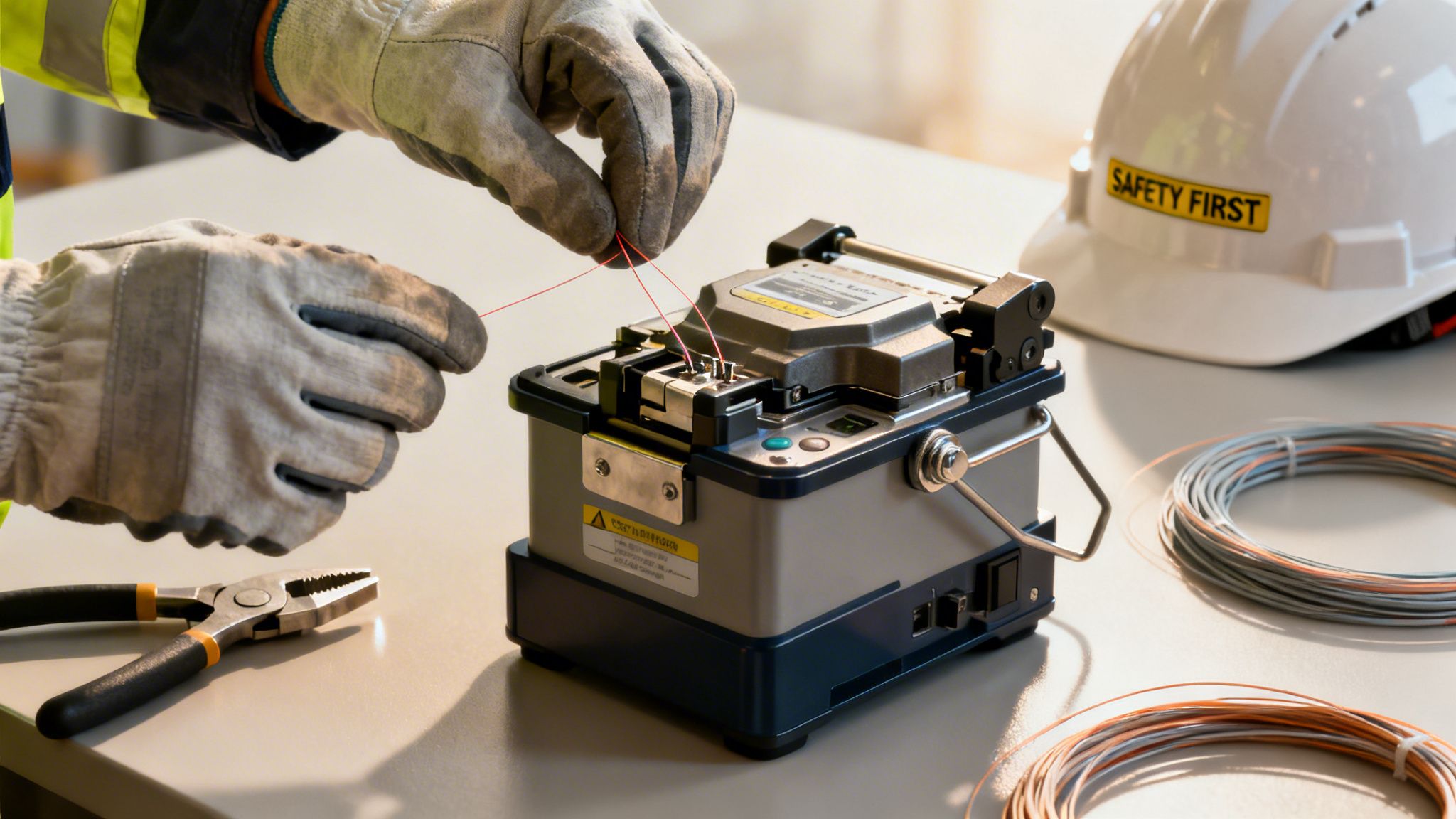
Think of a Fiber Optic Splicer as a surgeon for the internet. Their operating table could be a specialized trailer, a bucket truck, or even a manhole, and their patient is a bundle of glass fibers, each thinner than a human hair.
These technicians perform the most delicate and critical task in building a fiber network: fusing two fiber optic cables together with microscopic accuracy. One bad splice can create a digital bottleneck, slowing or even stopping the flow of data. It’s a job that demands incredible patience, steady hands, and an almost obsessive eye for detail.
A splicer’s daily grind usually involves:
- Prepping and stripping fiber cables to expose the tiny glass core.
- Using a fusion splicing machine to perfectly align and melt the two ends together.
- Testing the connection with an Optical Time Domain Reflectometer (OTDR) to make sure almost no signal is lost.
- Documenting every single splice for network maps and future troubleshooting.
The Tower Technician: Athlete in the Sky
If splicers are surgeons, then Tower Technicians are elite athletes who work at extreme heights. These are the folks you see climbing cell towers, sometimes hundreds of feet up, to install, maintain, and upgrade the gear that powers our wireless world.
It’s an intensely physical job that requires you to be comfortable with heights and changing weather conditions, all while following uncompromising safety rules. Tower Techs—often called Tower Climbers—work in small crews, blending skills in rigging, electrical systems, and advanced technology.
There's a saying in the tower world: "Pics or it didn't happen." As one closeout manager put it, "Our industry is basically 100% defined by photographs. We do not get paid without turning in photos." It's a stark reminder that documentation is king in every telecom role, whether you're on the ground or 300 feet in the air.
The OSP Technician: Master of the Field
While splicers and tower techs are highly specialized, the Outside Plant (OSP) Technician is the jack-of-all-trades who manages the network’s physical infrastructure out in the world. The "outside plant" is everything that lives between the central network hub and the customer—all the cables, poles, conduits, and cabinets.
An OSP Tech’s work is never boring. One day they might be pulling new fiber through an underground conduit; the next, they could be on a pole line, preparing it for new cable attachments. They are the ultimate problem-solvers, ensuring the physical pathways for our data are secure and correctly installed. When there's a physical network outage, they're usually the first boots on the ground.
Much of their work is governed by strict safety and engineering standards. To get a better sense of these rules, it's worth reviewing the National Electrical Safety Code (NESC), which is the bible for OSP operations.
The Project Manager: Conductor of the Orchestra
Tying it all together is the Telecom Project Manager. They are the conductor of the orchestra, making sure every section—from the field crews to the engineers—is playing in harmony.
This is a leadership role focused on logistics, scheduling, budgets, and keeping clients happy. A great PM ensures materials arrive on time, permits are approved, crews are where they need to be, and the entire project hits its deadlines and financial targets. It's a natural next step for seasoned technicians looking to move into management, since having that firsthand field experience is a massive advantage in planning and execution.
To help you see how these roles stack up, here’s a quick comparison of their responsibilities, skills, and earning potential.
Telecom Construction Job Profiles and Salary Ranges
| Job Title | Primary Responsibilities | Key Skills | Average Salary Range (2026) |
|---|---|---|---|
| Fiber Splicer | Fusing fiber optic cables, testing signal strength with an OTDR, and documenting each splice. | Patience, steady hands, attention to detail, ability to read network diagrams. | $65,000 – $95,000 |
| Tower Technician | Climbing towers to install, maintain, and repair antennas and other wireless equipment. | Physical fitness, comfort with heights, rigging, electrical knowledge, safety focus. | $60,000 – $90,000+ |
| OSP Technician | Installing and maintaining underground and aerial cables, conduits, and poles. | Problem-solving, operating construction equipment, understanding utility maps. | $55,000 – $80,000 |
| Project Manager | Planning, budgeting, scheduling, and overseeing telecom construction projects from start to finish. | Leadership, communication, organization, financial management, industry knowledge. | $90,000 – $140,000+ |
These salary ranges reflect typical compensation in 2026 but can vary based on your location, experience level, and the specific certifications you hold. As you can see, each role offers a solid career path with significant earning potential for those willing to master the trade.
Getting the Right Certifications and Safety Training
In this line of work, you can't just walk onto a job site and wing it. Telecom construction is a field built on precision and, above all, safety. The right certifications aren't just a formality to get you in the door; they're proof that you know how to work safely and competently.
For a company like Southern Tier Resources, a "safety-first" culture isn't just a nice-to-have, it's the bedrock of everything we do. Think of your certifications as your ticket to play. Without them, you're stuck on the sidelines. They show us you're serious about your craft and committed to keeping yourself and your crew safe in a high-stakes environment.
The Must-Have Safety Credentials for Every Role
Before you ever lay a hand on a fusion splicer or a tower harness, you need a solid foundation in workplace safety. This starts with the Occupational Safety and Health Administration (OSHA), which provides the baseline training that virtually every telecom job demands.
- OSHA 10-Hour: This is your entry point. It's designed for all field workers and hammers home the fundamentals of job site safety, from spotting hazards to using your personal protective equipment (PPE) correctly. It’s all about developing a safety-first mindset from day one.
- OSHA 30-Hour: If you have your sights set on a supervisory role, this is your next step. This is a much deeper dive into managing site safety protocols and programs, making it essential for anyone leading a team.
These courses aren't just about checking a box. They give you the training to spot a dangerous situation before it turns into an accident, protecting not just you, but everyone on your team.
For certain jobs, especially those that cross North American borders, you might also need specialized training for handling specific materials, such as completing WHMIS training.
Role-Specific Certifications That Make You a Pro
Once your safety basics are covered, it's time to get certified in your specific trade. These credentials are what separate the amateurs from the professionals and can have a major impact on your career path and pay. They are the undeniable proof of your technical skills.
Different telecom construction jobs require different tickets. Here are some of the most important ones you'll see.
For Fiber Optic Technicians
The Fiber Optic Association (FOA) is the name everyone recognizes.
- Certified Fiber Optic Technician (CFOT): This is the foundational cert for any fiber tech. It proves you understand the theory, installation, and testing that goes into making a perfect connection.
- Certified Fiber Optic Specialist (CFOS): Once you have your CFOT, you can specialize. You can become a specialist in splicing (CFOS/S), testing (CFOS/T), or outside plant work (CFOS/O), making you an expert in a specific part of the job.
For Tower Technicians
When it comes to working at height, the National Wireless Safety Alliance (NWSA) sets the bar.
- Telecommunications Tower Technician (TTT): The TTT-1 and TTT-2 certifications are non-negotiable for climbers. They cover everything from harness safety and complex rigging to life-saving rescue techniques. An NWSA card is your license to climb.
A lot of people think raw talent is enough. But in our industry, documented, certified proof of your skills is what really opens doors. It’s the difference between saying you can do the work and proving it.
Holding these credentials makes you a top-tier candidate. It tells an employer you're a professional who takes this work seriously and invests in your own expertise. To see how these skills come to life on the job, you can explore the fundamental mechanics of telecom work. In the end, getting certified isn't just about landing a job—it’s about building a safe, respected, and rewarding career.
Charting Your Course in Telecom Construction
A job in telecom construction isn't just a job—it's the first step on a genuine career path. Unlike many fields where your next move is a mystery, telecom offers a clear ladder for advancement. It’s a world where hands-on experience and a thirst for learning can take you from an entry-level position to a leadership role with significant earning potential.
So, what does this journey actually look like? Imagine a new hire, let's call him Alex. He joins a crew as a ground hand. This is where everyone starts. It’s tough work, focused on supporting the seasoned technicians by prepping materials, managing site safety, and soaking up every bit of knowledge possible. Think of it as a paid apprenticeship in how real-world telecom projects are built from the ground up.

From Apprentice to Specialist
After about six months of proving his work ethic and commitment to safety, Alex gets the nod for an apprentice technician role. This is where the real skill-building kicks into high gear. His company invests in him, sponsoring critical certifications like the Certified Fiber Optic Technician (CFOT).
Now, Alex isn't just watching from the sidelines. He's in the trenches, working alongside a senior fiber splicer or an OSP veteran. He’s learning to decipher complex network diagrams, handle sophisticated equipment like fusion splicers, and tackle the inevitable on-site problems. This on-the-job mentorship is priceless; it’s where classroom theory meets field reality.
A couple of years fly by. Alex has honed his craft and now holds the title of Lead Fiber Splicer. He’s trusted with the most critical network connections and is the one mentoring the next generation of apprentices, bringing his own journey full circle. This same path exists for tower crews, where a ground hand can climb the ranks to a certified Tower Tech II and eventually become a Tower Foreman in charge of their own team.
A job in this industry is a direct investment in yourself. The skills you gain—from mastering fiber splicing to leading a complex installation—are not just valuable to your current employer. They are transferable, in-demand skills that make you a respected professional across the entire industry.
Of course, a key part of climbing that ladder is showing your value on paper. If you need help translating your hard-won experience and certifications into a document that gets you noticed, it’s worth learning how to write a resume that wins interviews.
Climbing the Ladder to Leadership
After years of excelling as a Lead Splicer, Alex knows the field inside and out. He understands project logistics, safety protocols, and the nuances of team dynamics. His expertise hasn't gone unnoticed, and the next logical step presents itself: management. The company sees his potential and offers him a role as a Construction Supervisor.
The job changes completely. Instead of doing the hands-on work, Alex now orchestrates it. His day-to-day is a new kind of challenge, involving:
- Coordinating multiple crews to ensure everyone has the resources and direction to hit their targets.
- Managing project timelines alongside the Project Manager, troubleshooting delays before they become major problems.
- Championing safety and quality, conducting site audits and making sure every inch of work meets exacting standards.
- Acting as the client liaison, providing progress updates and serving as the on-site face of the company.
Making the leap from top technician to supervisor is a major milestone, often pushing your income well into six figures. And the path doesn't end there. The next steps could be Project Manager, overseeing entire multi-million dollar builds, or even Operations Manager for an entire region.
Specializing in Next-Gen Technologies
But career growth isn’t just about management. For those who love the technical side of the work, top telecom construction firms offer paths to become subject matter experts in emerging technologies. As the industry races forward, so do the opportunities for specialization.
Technicians can dive deep into fascinating, high-demand fields like:
- Small Cell and 5G Deployments: Installing the dense, powerful infrastructure that fuels our 5G networks.
- Data Center Infrastructure: Building the crucial power and fiber backbones for the hyperscale data centers that run the cloud.
- Advanced Network Testing: Mastering OTDRs and other diagnostic tools to certify and troubleshoot the most complex fiber networks.
Leading companies recognize that their people are their greatest asset. Through mentorship, company-paid training, and clear paths for advancement, they ensure that a job in telecom is just the beginning. In this field, your ambition and willingness to learn are the only real limits on how far you can go.
How Global Trends Impact Your Telecom Career
The incredible demand for telecom crews in the United States isn't just a local boom—it’s the American chapter of a massive global story. The worldwide race for 5G, universal internet, and powerful digital infrastructure is what's creating a wealth of telecom construction jobs right here at home.
Think about it this way: the skills you develop as a fiber splicer or a tower technician are a universal language. The physics of light pulsing through a glass cable or the science behind a wireless signal don't change when you cross a border. The expertise you build in the U.S. makes you a valuable professional anywhere on the planet.

A Worldwide Push for Connectivity
Two major pushes are happening at the same time across the globe. In developed countries throughout Europe and Asia, the focus is on aggressive network upgrades. They're facing the same hurdles we are—retiring old infrastructure and finding skilled technicians to deploy the next wave of technology.
Meanwhile, emerging markets in Africa, Southeast Asia, and Latin America are on a different but equally massive mission. Many are building out their core mobile broadband networks from scratch. This creates a huge demand for experienced pros who can run large-scale projects, train local workers, and establish solid, reliable building practices from the ground up.
This constant, worldwide need for connectivity gives your career an incredible level of stability. It means the skills you’re learning aren't just in-demand for a few years; they're essential for decades to come, protecting you from the typical ups and downs of any single country's economy.
The Global Job Market by the Numbers
The sheer scale of this demand is hard to wrap your head around. In 2022, the mobile industry supported roughly 28 million jobs worldwide, both directly and indirectly. By 2025, mobile technologies are projected to add an estimated $5.6 trillion to the global economy. You can find more data on the ever-growing telecommunications job market outlook on ClearlyIP.
This isn’t just about a job; it's about being part of a massive technological shift that's connecting the planet. Understanding the worldwide context reveals the long-term stability and growth baked into a telecom construction career, securing your professional future for decades.
This global explosion in connectivity is fueling some dramatic growth in specific regions. India's telecom sector, for instance, is expected to create millions of new jobs by 2025 as it rolls out its own huge 5G and IoT networks. We're seeing similar stories play out in other fast-growing markets racing to connect their populations.
Your Skills Are Your Passport
So, what does all this global activity mean for your career in telecom construction? It means you’re stepping into a field with amazing long-term security and the freedom to go almost anywhere.
- Skill Portability: The certifications and hands-on experience you earn here are recognized and respected by companies all over the world. A top-notch fiber splicer is a top-notch fiber splicer, whether you're in Texas or Tokyo.
- Career Resilience: Your skills are part of a global talent pool. Even if the market in one country cools off, surging growth in another keeps demand high for what you do.
- International Opportunities: If you've got a sense of adventure, a career in telecom can be your ticket to the world. You could find yourself leading projects in new countries and experiencing entirely different cultures.
When you choose a career in telecom construction, you’re not just taking a local job. You're joining an international community of builders who are laying the physical groundwork for our digital future. Your skills become the currency of a worldwide infrastructure revolution.
How to Start Your Career with Southern Tier Resources
You’ve learned about the different roles, the training involved, and the incredible demand for telecom professionals. Now it's time to put that knowledge into practice. Let’s talk about how you can join our team at Southern Tier Resources and start building the infrastructure of tomorrow.
We’re always looking for good people. More than just a list of qualifications on a resume, we look for a certain type of person—a problem-solver who takes pride in their work and never cuts corners on safety. If you have a rock-solid work ethic and want a career where you can see the tangible results of your efforts every day, you’ll fit right in.
Your Path to Joining the Team
We keep our hiring process straightforward and transparent. Our goal is to find the right fit, not just for us, but for you, too. We want to set you up for a long-term career, not just a short-term job.
Here’s a look at what to expect when you apply for one of our telecom construction jobs:
- See What's Open: The first step is to head over to our careers page and check out our current openings. We’re constantly hiring for all kinds of positions, from ground hands just starting out to seasoned project managers.
- Tell Us Your Story: Fill out the online application. This is your chance to highlight your experience, certifications, and what draws you to this line of work. Make sure to let your commitment to teamwork and safety shine through.
- The Conversation: If your application looks like a good match for an open role, our team will get in touch to schedule an interview. Think of this as a two-way street—it's as much about you interviewing us as it is about us interviewing you.
- Welcome to the Team: Once you’re hired, we get you started on the right foot. You’ll go through a complete onboarding process and get all the training you need to not only succeed but also advance in your career with us.
At Southern Tier Resources, we don’t just fill positions; we build careers. We give our people the best equipment, a culture of support, and the ongoing training they need to build a real future here, project after project.
Why Build Your Career with Us
When you join our crew, you're becoming part of a company that puts quality, safety, and our people first. We're big believers in promoting from within and carving out clear pathways for you to grow.
We offer competitive pay that reflects the hard work you do, solid benefits, and a culture built on respect. We empower our team to be the best in the business.
Ready to get started? To see our current opportunities and learn more about our company, you can explore careers at Southern Tier Resources and apply today.
Frequently Asked Questions About Telecom Construction Careers
Thinking about a career in telecom construction? It's a big decision, and you probably have a lot of practical questions. We get it. Let’s tackle some of the most common ones head-on so you can get a clear picture of what this industry is all about.
Do I Need Prior Experience to Get a Telecom Construction Job?
This is the number one question we hear, and the answer is a straightforward no. While having a background in a related trade is always helpful, many of the best telecom construction jobs are entry-level and designed for people starting fresh.
Honestly, for roles like a ground hand or an apprentice, we're much more interested in your work ethic and your attitude. If you show up ready to learn, listen, and put in an honest day's work, we can teach you the rest. The best companies have solid training programs that build your skills from day one.
What Are the Physical Demands of These Jobs?
The physical side of the job really depends on the path you take. It's important to be honest with yourself about what kind of work environment you'll thrive in.
- Field Roles: There's no sugarcoating it—jobs like Tower Technician or OSP Technician are physically tough. You'll be working outdoors in all sorts of weather, lifting heavy gear, and need to be comfortable working at significant heights or in tight spaces.
- Office Roles: On the other hand, a Project Manager or Closeout Coordinator spends most of their time in an office. These roles are built around strong communication, planning, and organizational skills rather than physical strength.
Figuring out where you fit on that spectrum is the key to building a career you'll enjoy for the long haul.
How Much Travel Is Involved in This Field?
Travel is a reality for many telecom construction jobs, but the amount can vary dramatically. Some of our crews are local, working on projects that get them home every night. Others tackle regional builds that might require being on the road for a week or two at a time.
It all depends on the project. This is a perfect question to bring up in an interview. A good employer will be completely transparent about travel expectations for the role and will explain how they handle things like per diems and expenses.
The long-term outlook for this industry is incredibly strong. With massive federal and private investment in 5G, fiber optics, and rural broadband expansion, the demand for skilled workers is projected to remain high for the next decade and beyond. These are not temporary projects; they are foundational infrastructure upgrades ensuring job security.
Ready to start building your future? At Southern Tier Resources, we provide the training, support, and opportunities you need to grow. Explore our open positions and apply today