At 2 a.m., the maintenance bridge is full, the field crew is at the cabinet, and the network operations center is watching alarms that cannot be allowed to become customer tickets. A fiber span is being re-terminated, a switch fabric is being moved, or a cell sector is being swapped while hospitals, emergency services, payment systems, and ordinary subscribers continue using the network.
That's the test of zero downtime deployment. It isn't whether a change window looks quiet on a dashboard. It's whether users, routing peers, sessions, and dependent systems experience the same service while crews replace the components underneath them. Conventional in-place upgrades still carry measurable risk. One comparative analysis reported an average failure rate of 9.3% and downtime of 3 to 15 minutes, while zero-downtime methods reduced downtime to below 2.1% and delivered zero user impact in 87% of releases. The analysis associated that performance with availability near 99.995%, approaching the five-nines benchmark of 99.999% for mission-critical services (comparative analysis of zero-downtime deployment methods).
What Zero Downtime Deployment Means in Real Networks
A regional carrier cutover rarely looks like a software release. During a live 10G ring migration, three hospitals, a 911 public safety answering point, and a payments processor may remain attached to trunks that technicians are re-terminating. The old path has to keep carrying traffic until the new path has passed its checks, and the change must preserve more than link status. Routing, optical levels, session state, power, and physical protection all have to line up.
Zero downtime deployment means that observable service remains continuous while infrastructure changes underneath it. From the customer's perspective, the application, subscriber session, voice call, route, or transaction should behave as though no component was replaced. From an upstream peer's perspective, the network should continue advertising and accepting traffic within the expected operational boundaries.
That definition covers four infrastructure families:
- Network software upgrades, including router and switch operating systems, firmware trains, route-policy changes, and control-plane maintenance.
- Fiber span cutovers, where splicing, patch-panel work, optical transport changes, or protection-path moves occur without interrupting service.
- Data-center fabric moves, including leaf-spine replacements, switch fabric migrations, structured cabling changes, and power or cross-connect work.
- Wireless cell swaps, where a sector, radio, baseband, antenna path, or transport connection changes while subscribers remain active.
What the term doesn't promise
Zero downtime isn't faster downtime. A rolling restart that drops sessions in small groups still creates customer impact. It also isn't a marketing label that can be applied to any change with a health check attached.
The method fails when the deployment allows uncontrolled state loss. Active sessions, ARP and MAC learning, routing adjacencies, queue contents, database writes, cache data, and integration credentials all require an explicit transition plan. A new router can be reachable and still be operationally unsafe if it has incomplete policy, stale route state, or an incompatible peer configuration.
Field rule: If the old and new paths cannot coexist safely, the change isn't ready for a live cutover.
The practical playbook therefore starts with strategy selection, moves through physical and logical readiness gates, choreographs the switch, and defines the telemetry that will force a rollback. Continuous access is designed before the first command is entered.
Blue Green Canary and Rolling Strategies Compared
The right strategy depends on how traffic can be steered and how much duplicate capacity the operator can carry during the change. On network hardware, the software pattern becomes a physical arrangement of routers, links, optics, shelves, patch panels, power feeds, and radio sectors.
Blue-green keeps two production environments available. In a carrier edge, that may mean a redundant router pair or a dual-fed fiber span. In a wireless network, it can mean a prepared, hot-standby sector or replacement radio path. Traffic moves in one controlled action, and rollback is a pointer reversal or route-policy change. With duplicate capacity, rollback can be under 10 seconds, but the deployment window can require roughly 2x infrastructure cost (blue-green deployment mechanics and trade-offs).
Canary introduces the new train to a bounded slice of traffic or sites. A route reflector, a small group of cell sites, or a selected data-center fabric segment can expose the new version while the rest stays untouched. This limits blast radius, but only if traffic steering is deterministic and the baseline is trustworthy. A canary without clean optics, route, service, and customer telemetry is only a slower full release.
Rolling deployment changes a fleet in stages. In a Clos fabric, engineers can migrate leaf and spine pairs while alternate links continue forwarding. The approach avoids duplicate infrastructure, but old and new versions overlap. That makes compatibility across routing policy, telemetry, authentication, queues, databases, and session handling mandatory.
A useful infrastructure comparison looks like this:
| Strategy | Best Fit | Blast Radius | Rollback Speed | Hardware Cost | Main Risk |
|---|---|---|---|---|---|
| Blue-green | Redundant edge, dual-fed span, hot-standby cell sector | Broad at the switch, but controlled | Very fast when the old stack remains live | Roughly double capacity during overlap | State synchronization and incompatible dependencies |
| Canary | Selected sites, route-reflector load, or limited service cohort | Small and progressive | Fast if steering is automated | Lower than blue-green, with added control complexity | Poor traffic selection or weak telemetry |
| Rolling | Leaf-spine upgrades and distributed hardware fleets | Per device or staged group | Slower because reversal follows the same sequence | Near existing fleet capacity | Mixed-version incompatibility and capacity loss |
The deployment strategies that work are useful background for teams deciding how much orchestration their environment can support. In physical networks, the simplest viable pattern usually wins. Blue-green is attractive where service criticality justifies duplicate equipment, canary suits environments with reliable steering and observability, and rolling fits staged hardware changes where compatibility has been proven.
Pre-Cutover Staging and Readiness Gates
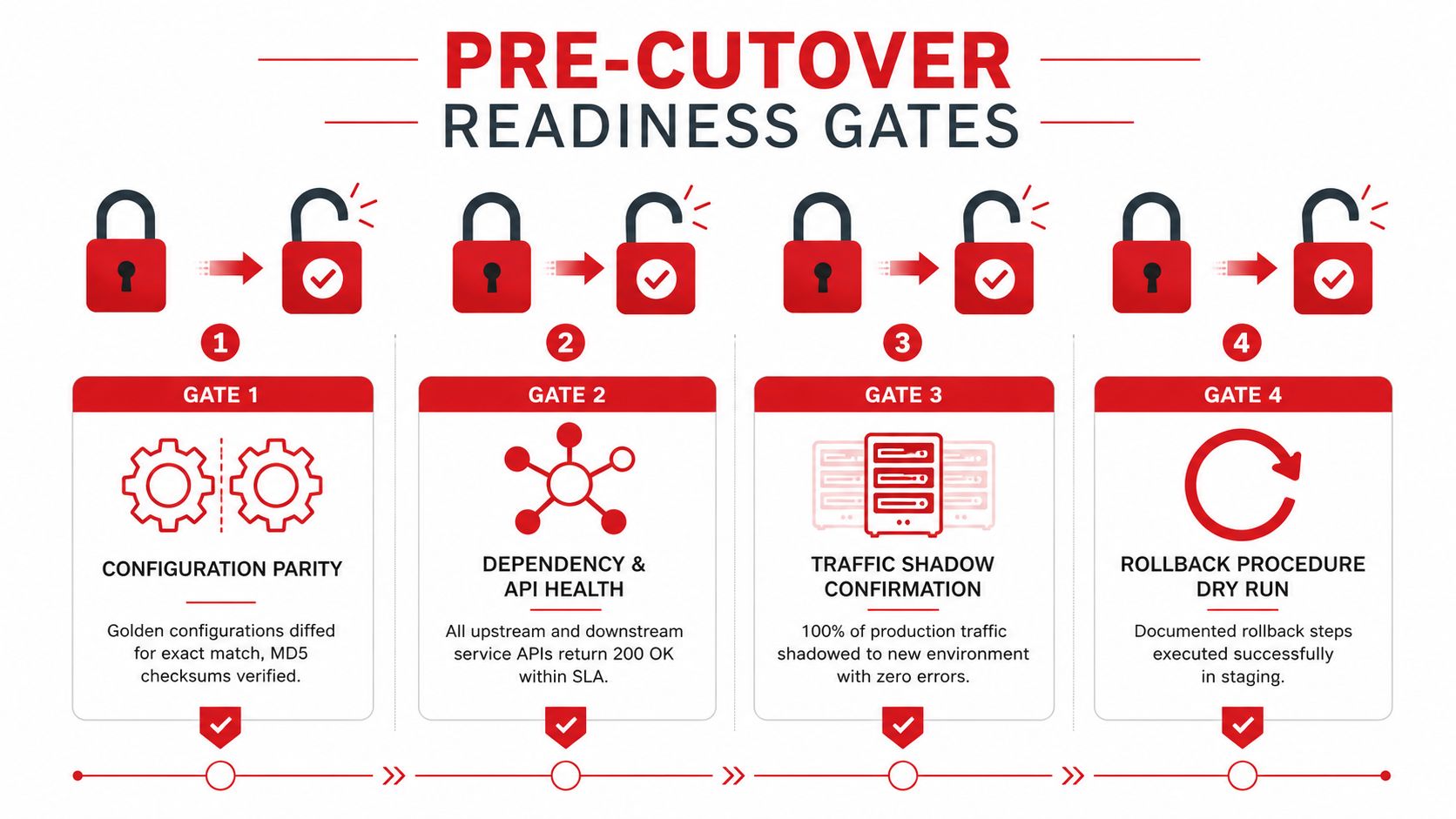
A live cutover should be a sequence of gates, not a conversation about confidence. Each gate needs a pass or fail condition, an owner, and a sign-off artifact. If a gate fails, the change stops without an escalation debate at the edge of the maintenance window.
Gate one verifies configuration parity
Export the golden configuration from the current environment and compare it with the staged environment. The diff must account for interface descriptions, route policy, VLAN or service identifiers, QoS, access controls, telemetry, timing, and management settings. Match the approved MD5 checksums, then verify out-of-band management access to every device that may need intervention.
A clean diff doesn't prove that the network is ready. It proves that the intended configuration is the one installed.
Gate two proves the sequence outside production
Run the complete method on a non-production mirror or representative testbed. Include synthetic traffic, dependency checks, failover, connection draining, and the reversal path. Inject the failure you're most afraid of, such as a failed link, unavailable peer, bad optic, incomplete route advertisement, or device that refuses to return to the previous state.
The rollback must work when the new path is unhealthy, not only when the lab is tidy.
Gate three maps dependencies and people
Enumerate every upstream peer, BGP neighbor, optical amplifier, transport shelf, power feed, patch point, and field handoff. Put an owner and contact beside each dependency. A diagram without a responsible person is reference material, not an operating plan.
Gate four confirms the window
Pull permits, approve the change ticket, confirm customer and maintenance windows, verify field access, and schedule the Go/No-Go call at T-60 minutes. The final artifact should show who can authorize the move, who can abort it, and who will speak to affected stakeholders if the plan changes.
A final rollback rehearsal should be performed in read-only mode on the live control plane. The team needs a timed, familiar reversal, not an estimate made under pressure.
Running the Cutover Window Step by Step
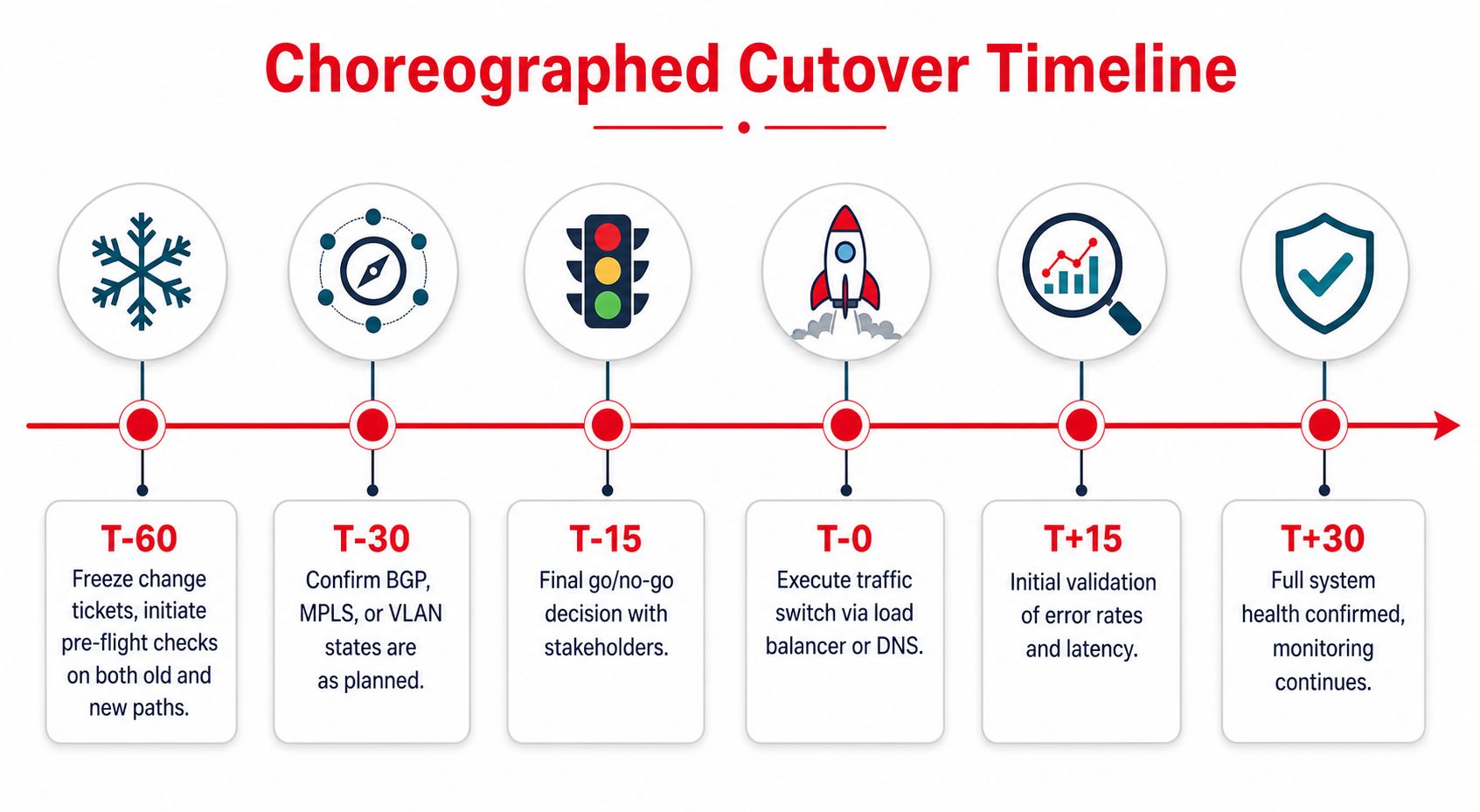
The cutover window should feel choreographed. Every action has one owner, one verification command or observation, and one decision point where the team either holds, proceeds, or aborts.
T-minus-60 to T-minus-30
At T-60, freeze unrelated change tickets. Confirm the bridge roster, open the runbook, validate management access, and run pre-flight checks against both the old and new paths. Record the baseline for optics, interface errors, route sessions, traffic, active sessions, and service probes.
At T-30, verify the planned BGP, MPLS, VLAN, optical, and power states. Confirm that backup links are physically positioned and that the staged configuration still matches the approved baseline. The NOC should read back the expected alarms and the field lead should confirm that the work area is safe to enter.
Physical safeguards are part of zero downtime, not paperwork around it:
- Lockout and tagout: Isolate equipment and power sources according to the approved safety procedure.
- Fiber safety: Shut down or isolate fiber lasers before opening connectors or working at patch points.
- Rack isolation: Confirm affected power feeds and redundant supplies before removing hardware.
- Bridge communications: Perform a communications check at regular five-minute intervals during active work.
T-minus-15 to T-zero
At T-15, the incident commander asks each owner for a direct status. “Ready” means the person has completed the check, not that they expect to complete it shortly. A single unresolved interlock, missing permit, unreachable device, or unexplained alarm is a hold.
At T-zero, execute one controlled traffic shift. That might be a route advertisement change, an SDN fabric move, a pre-tested fiber patch-panel cutover, or a cell-site swap coordinated with the operations support system. Avoid making several independent changes at once. If the service fails, the team must know which action caused it.
Record MAC tables, ARP state, sessions, optics levels, route state, and interface counters immediately before and after each micro-step. Close the window only after the new path is stable and the old path remains available as a cold, documented reversal option.
Rollback Plans That Actually Trigger
A rollback that nobody can call under pressure is not a rollback. The runbook must define the telemetry threshold, the authority to act, and the exact reversal sequence before the first production command.
The thresholds below are illustrative operational gates supplied for this playbook. Each operator should calibrate them against its own baseline, service commitments, and equipment behavior.
| Trigger Signal | Threshold | Rollback Type | Decision Owner |
|---|---|---|---|
| Packet loss | Above 0.1% for two consecutive minutes | Soft rollback first | Incident commander |
| Latency jitter | More than 50% above baseline | Soft rollback, then hard rollback if unstable | Incident commander |
| Hardware errors | Error rate rises after the switch | Hard rollback if the source is unresolved | Network or field lead, under incident commander authority |
| Safety interlock | One failed interlock | Immediate hold or hard rollback | Safety lead or incident commander |
A soft rollback moves traffic back to the old path while leaving the new equipment installed for diagnosis. It's appropriate when the new route, service policy, or software train behaves badly but the physical work remains safe. A hard rollback reverses the full change, including configuration, optics, routing policy, patching, and hardware state.
Authority must be unambiguous
Name one incident commander as the abort authority. Assign a deputy who can act if the bridge loses communication. Field technicians shouldn't wait for a committee to respond to a failed safety interlock, and the NOC shouldn't improvise a route reversal without knowing whether the physical path is ready.
The reverse procedure should be dry-run and timed in staging. Record each command, expected state, verification point, and stop condition in the same format as the forward method. The team should know whether it can restore service without rebuilding or re-terminating anything.
Automation can make these decisions more consistent. A practical change management automation guide can help teams connect approvals, runbooks, evidence, and notifications, but automation doesn't replace ownership. A system may detect the threshold. A named operator still needs authority to stop the work.
Rollback standard: If the team can't explain what will happen after the abort call, the deployment hasn't passed readiness.
Monitoring and Validation After the Switch
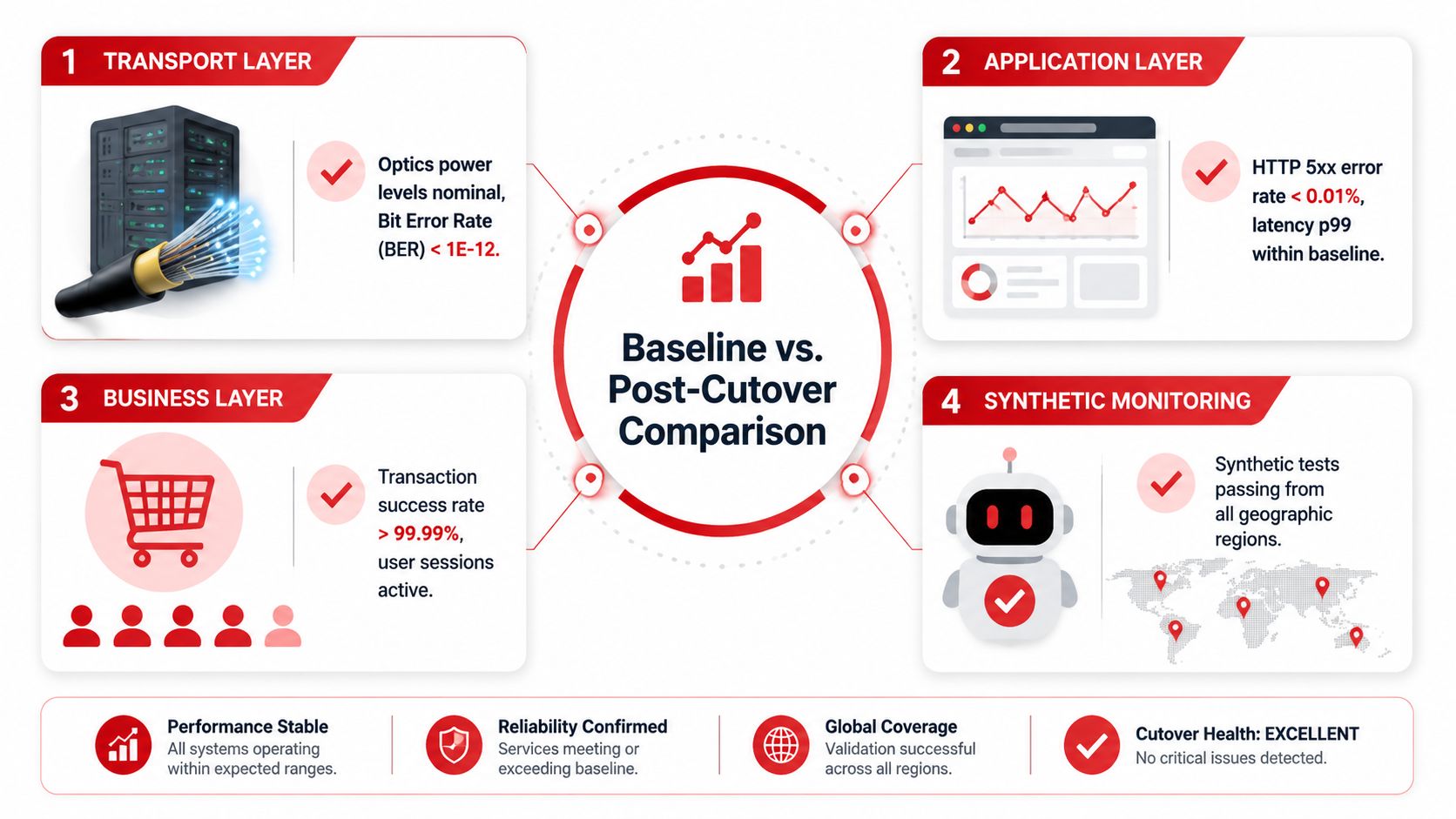
“Zero downtime” is a measured result, not an intention. The validation dashboard should compare the pre-cutover baseline with post-switch telemetry across transport, control plane, data plane, and service behavior.
Four views catch different failures
Transport telemetry reveals physical problems that application dashboards miss. Review optical power, bit error behavior, CRC errors, interface flaps, link negotiation, and transport alarms. A clean link light is not enough.
Control-plane telemetry shows whether the network is stable. Check BGP and MPLS session state, routing convergence, OSPF neighbor counts, route-table changes, and policy behavior. A session that is technically established can still be advertising the wrong reachability.
Data-plane telemetry tests what customers experience. Compare packet loss, jitter, throughput, TCP retransmits, queue drops, and path symmetry with the baseline. Small errors may appear only under load, which is why quiet traffic can produce false confidence.
Service telemetry closes the loop. Test DNS resolution, RADIUS authentication, subscriber sessions, application synthetics, transaction paths, and customer-facing APIs. Run synthetic probes from multiple geographic vantage points and from behind the new path during the full soak period.
The appropriate soak depends on traffic class and operational risk. The supplied operational guidance recommends a typical observation period of 24 to 72 hours, with automated alerts for regressions and explicit attention to 502 and 503 responses during live load testing (zero-downtime deployment guidance for infrastructure-heavy systems).
Validation needs a formal stopping rule
Keep the change provisional until the soak window is complete, the dashboard is archived, and the incident commander accepts the evidence. A cutover with clean first-minute telemetry but unresolved certificate, dependency, session, or legacy-client behavior hasn't earned closure.
Archive the before-and-after baselines, device configurations, route captures, alarm records, test results, and as-built diagrams. The evidence should allow another engineer to determine what changed and whether the service remained continuous without relying on the original crew's memory.
Coordination Safety and Post-Cutover Documentation
Infrastructure continuity depends on people and records as much as it depends on traffic engineering. A fiber splice, fabric move, or cell swap can be technically successful and still remain operationally open if permits, safety controls, customer notices, and ownership are incomplete.
Build one accountability matrix for the work. Include the method of procedure, NOC and field rosters, jurisdictional and right-of-way permits, lockout and tagout, hot-work or confined-space clearances, vendor contacts, customer communications, and the approved service window. Assign every item to a named role using a RACI model. Nothing should be implied because “the field team usually handles it.”
The closure pack
The post-cutover record should contain:
- As-built fiber records: Updated splice maps, patch-panel references, test results, and route documentation.
- Network inventories: Revised IP, VLAN, circuit, interface, optics, and equipment inventories.
- Configuration evidence: Approved diffs, final running configurations, routing policy changes, and device versions.
- MOP redlines: Every deviation from the approved method, including the reason and approving authority.
- Telemetry archive: Traffic, errors, alarms, latency, session state, and service validation at handback.
- Lessons learned: Specific failure points, delayed checks, unclear ownership, and changes required before the next window.
- Signed closure ticket: Confirmation that operational, safety, contractual, and customer obligations are complete.
| Stakeholder | Pre-Cutover Deliverable | Post-Cutover Sign-Off |
|---|---|---|
| NOC | Baselines, alarm plan, bridge roster | Service and alarm validation accepted |
| Field crew | Access plan, safety permits, materials | Physical work, labeling, and site condition confirmed |
| Network engineering | Approved configurations and rollback | Routing, policy, and as-built records accepted |
| Fiber or transport team | Splice plan and test method | Optical results and splice records archived |
| Wireless operations | Cell-swap sequence and OSS coordination | Sector health, sessions, and coverage checks accepted |
| Customer or service owner | Communications window and acceptance criteria | Customer impact review and closure approval |
| Safety lead | Lockout, tagout, and work permits | Safety controls released and documented |
Operators building a broader resilience program can also review the DataLunix operational resilience approach for a way to connect technical continuity with governance and recovery planning. The useful lesson is practical: the deployment isn't closed when traffic moves. It's closed when the network, records, safety controls, and accountable owners all agree on the final state.
For organizations that need field execution alongside engineering, Southern Tier Resources provides fiber splicing, testing, network construction, wireless upgrades, and data-center infrastructure installation with documentation intended for ongoing operations. Visit Southern Tier Resources to discuss a cutover plan that keeps physical work, telemetry, safety, and as-built records under one accountable infrastructure partner.