A rack row is energized. Network gear is staged. The commissioning window is locked. Then a protection setting, feeder path, or grounding detail proves wrong, and the entire schedule starts to slide.
That kind of failure rarely starts in the field. It usually starts much earlier, when power distribution was treated like a drafting task instead of a system design discipline. In telecom and data center work, that distinction matters. A lot.
The Unseen Architect of Network Reliability
In a mission-critical build, the electrical distribution designer is the person who turns power intent into a system that can be built, inspected, maintained, and trusted under load. They are not just drawing conduits and panel schedules. They are defining how utility service, switchgear, transformers, UPS equipment, PDUs, branch circuits, grounding, and protection all work together without creating hidden failure points.

The market demand reflects how important that role has become. The median annual wage for electrical engineers, including specialized electrical distribution designers, was $111,910 in May 2024, and employment is projected to grow 7% from 2024 to 2034, driven in part by the fact that over 70% of U.S. distribution lines are more than 25 years old according to the U.S. Bureau of Labor Statistics.
For operators expanding internationally, code fluency matters just as much as engineering judgment. A practical example is Compliance with Australian Standards (AS/NZS 3000), which shows how regional electrical rules shape documentation, safety, and installation decisions from the start.
Why this role gets missed
Plenty of project teams focus first on visible scopes. Generators, UPS modules, racks, pathways, and commissioning milestones. The distribution layer in between gets compressed into “electrical design.”
That shortcut creates problems:
- Protection gaps: Breakers may coordinate poorly or not at all.
- Constructability issues: Rooms look workable on paper, then fail in the field when cable bend radius, access, or clearance gets real.
- Expansion limits: Day-one power works, but growth becomes expensive because nobody reserved practical pathways or sectionalized the system correctly.
In telecom and data centers, uptime is protected long before equipment is switched on. It is protected when someone decides how power will flow, where faults will be isolated, and how future load will be added.
The same principle applies upstream at the utility interface. Projects involving utility service, feeder changes, or campus distribution often depend on early alignment between facility design and substation or service infrastructure. That is why teams planning larger upgrades often review related scopes such as https://southerntierresources.com/electrical-substation-construction/ at the same time they define facility power architecture.
Defining the Role Beyond a Job Title
Think of the facility electrical system as the central nervous system for the site. Utility service is the spine. Switchgear, transformers, and distribution boards are the major pathways. Branch circuits, rack feeds, and telecom power shelves are the nerves that carry energy where it is needed.
The electrical distribution designer maps that system so it performs safely under normal load, during maintenance, and when something goes wrong.
What the designer owns
At a practical level, the role sits between concept engineering and field execution. The designer converts design intent into buildable documentation. That includes wiring diagrams, layout drawings, schematics, equipment relationships, and the supporting calculations that make those drawings credible.
In many organizations, this role is classified alongside electrical and electronics drafting work. Typical U.S. salaries for electrical distribution designers are often in the $80,000-$90,000 annually range, and the work commonly includes preparing wiring diagrams, layout drawings, and schematics for power systems, according to VDCI’s electrical designer overview.
That same source also captures how the role is changing. Modern electrical distribution designers must contend with 5 key trends for 2026, including variable loads from EV adoption, projected at 40% of new car sales by 2030, automation integration, and stricter energy codes calling for 30-50% efficiency gains in new distribution hardware.
How this differs from a general electrical engineer
A general electrical engineer may work across controls, electronics, generation, instrumentation, or building systems. A focused electrical distribution designer spends their time on the path power takes through a facility.
That means they are usually deep in questions like:
- Which transformer arrangement best fits the incoming service and fault duty?
- Where should maintenance isolation occur so one activity does not jeopardize a live environment?
- How should conduits, cable tray, busway, and panel locations be arranged for both installation and long-term service?
- What documentation will the AHJ, contractor, operator, and commissioning team all need to interpret the system the same way?
This is why a strong electrical distribution designer is rarely just a CAD operator. They need enough system understanding to see where one choice ripples into protection, space, cost, schedule, and maintainability.
Codes are not a paperwork exercise
In telecom and data center work, compliance failures usually show up as delays, redesign, or restricted operations. They rarely look dramatic at first. A mislabeled one-line, an incomplete grounding detail, a feeder shown without enough installation context. Then submittals stall, field crews stop, and commissioning teams start raising valid objections.
An electrical distribution designer has to translate code and standards into construction-ready decisions. Common anchors are NEC and IEEE, but the core work is applying those standards to the actual build, not just listing them on a title block.
A useful way to judge the role is this: if you handed the drawing set to the contractor, commissioning agent, and operations team separately, would they all understand the same system? If the answer is no, the design is not finished.
A good electrical distribution designer does not just make the system code-compliant. They make it legible to everyone who has to build, test, and maintain it.
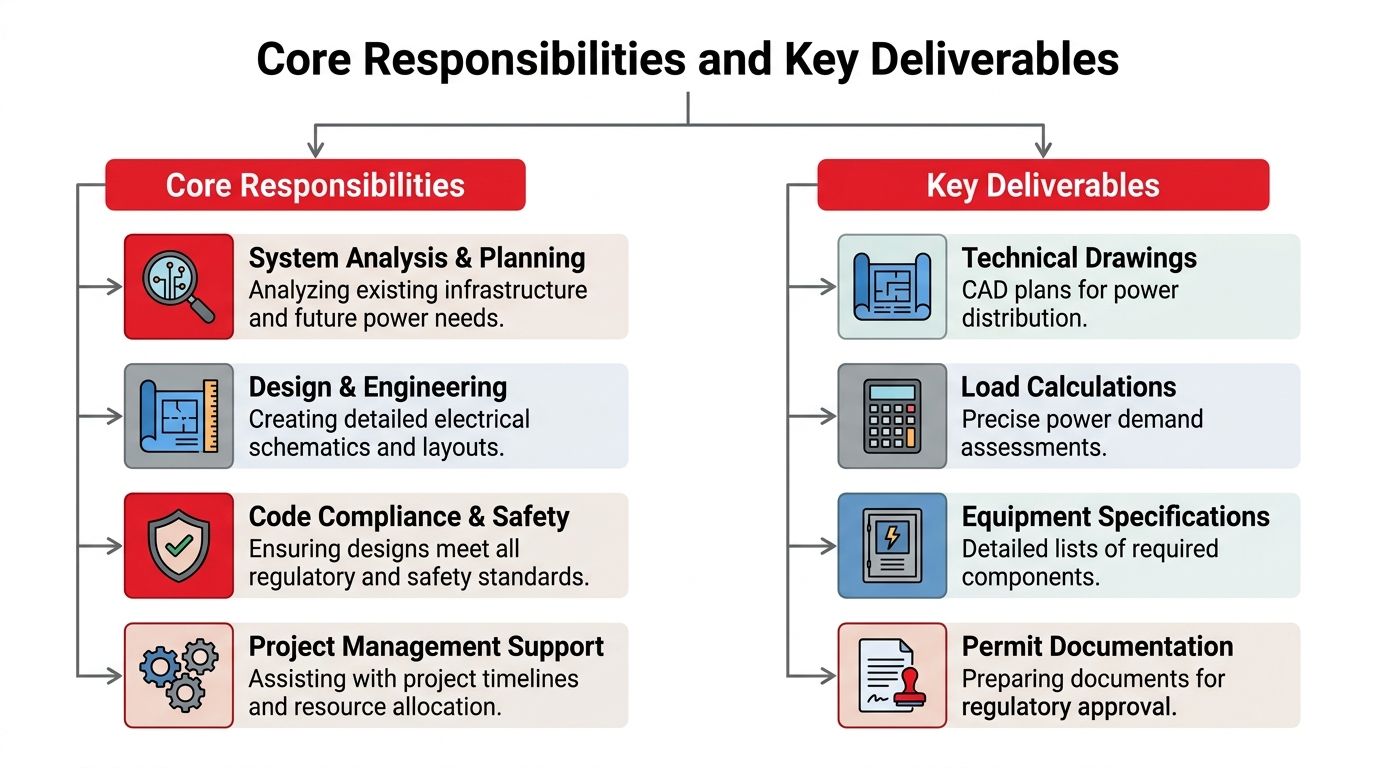
Core Responsibilities and Key Deliverables
The best way to evaluate an electrical distribution designer is by reviewing what they produce and how those deliverables reduce risk. In telecom huts, central offices, headends, colo spaces, and data halls, the same pattern holds. Good documentation prevents field improvisation.
The master document set
Some deliverables are visible to every stakeholder. Others live in calculations and equipment schedules behind the drawing package. Both matter.
Here are the core outputs that separate a serious design effort from a risky one.
| Deliverable | Why it matters in practice |
|---|---|
| Single-line diagrams | Establish the electrical architecture and fault path logic |
| Load calculations | Confirm the system can support current and planned demand |
| Short-circuit and fault studies | Validate equipment duty ratings and protection approach |
| Grounding design | Protect personnel, equipment, and signal integrity |
| Equipment specifications | Prevent mismatches between design intent and purchased gear |
Single-line diagrams
The single-line diagram, or SLD, is the master blueprint for the distribution system. If it is unclear, the rest of the project usually follows that same pattern.
A solid SLD shows source relationships, transformer details, protection devices, distribution segments, major loads, and tie points in a format that engineers, contractors, and operators can all read quickly. In data center work, it also needs to make maintenance paths and redundancy logic obvious. If a technician cannot tell what drops when a breaker opens, the one-line is not doing its job.
The value of a strong SLD is speed and alignment. Teams make better procurement decisions, reviewers catch fewer ambiguities, and commissioning scripts become easier to write.
Load calculations
Load calculations are capacity planning in engineering form. They establish what the system must carry and what reserve or growth room is built in.
For telecom and data center applications, designers earn trust by accounting for rack densities, cooling support equipment, auxiliary systems, lighting, battery systems, DC plant interfaces where applicable, and accounting for the dynamic nature of site loads.
The point is not to make every component larger. Oversizing everything is expensive and often creates different problems. The point is to place capacity where the site can use it and preserve realistic expansion paths.
Short-circuit and fault analysis
Errors in this area become dangerous. Electrical distribution designers must master critical load calculations and fault level analysis because errors can cascade into every system component. Underestimating short-circuit fault currents, which can reach tens of thousands of amperes, leads to specifying breakers that cannot safely interrupt faults, creating serious safety hazards in mission-critical facilities, as described in Vista Projects’ discussion of electrical designer skills.
For practical field teams, that means fault analysis is not an academic exercise. It directly affects:
- Breaker selection: Interrupting ratings have to match real conditions.
- Bus and gear choice: Equipment duty must align with available fault current.
- Protection philosophy: Clearing times and device coordination shape both safety and uptime.
A designer who skips depth here often pushes risk downstream to the contractor, the commissioning team, or the owner.
Grounding system design
Grounding is one of the most misunderstood parts of distribution work because it often looks simple on paper. In reality, it intersects with safety, equipment protection, surge behavior, and operational stability.
Telecom and data center environments make grounding even more sensitive. The designer has to think through the relationship between service grounding, equipment bonding, structured cabling environments, and sensitive electronics. The deliverable has to be detailed enough for the field to install consistently, not interpret loosely.
If the grounding design depends on installer guesswork, it is unfinished.
Equipment specifications
Specifications decide whether procurement supports the design or undermines it. This deliverable includes transformers, switchgear, panelboards, breakers, UPS interfaces, PDUs, cable types, terminations, and accessory requirements.
A weak spec leaves too much room for substitutions that look similar in submittals but create operational issues later. A strong spec protects critical details such as enclosure requirements, monitoring features, breaker functions, spares philosophy, and physical constraints.
Safety documentation that supports the field
Designers also need to think about how the final package will support safe installation and maintenance. That includes labeling, access, isolation logic, and the information electricians and technicians need during energized work planning. For teams refining work practices, NFPA 70E Electrical Safety Guidance is a useful reference point because it connects design decisions to field safety expectations.
What does not work is handing construction a polished drawing set with no attention to service clearances, maintenance sequence, or practical isolation strategy. That approach may pass a design review and still fail the first time a crew has to work on the system.
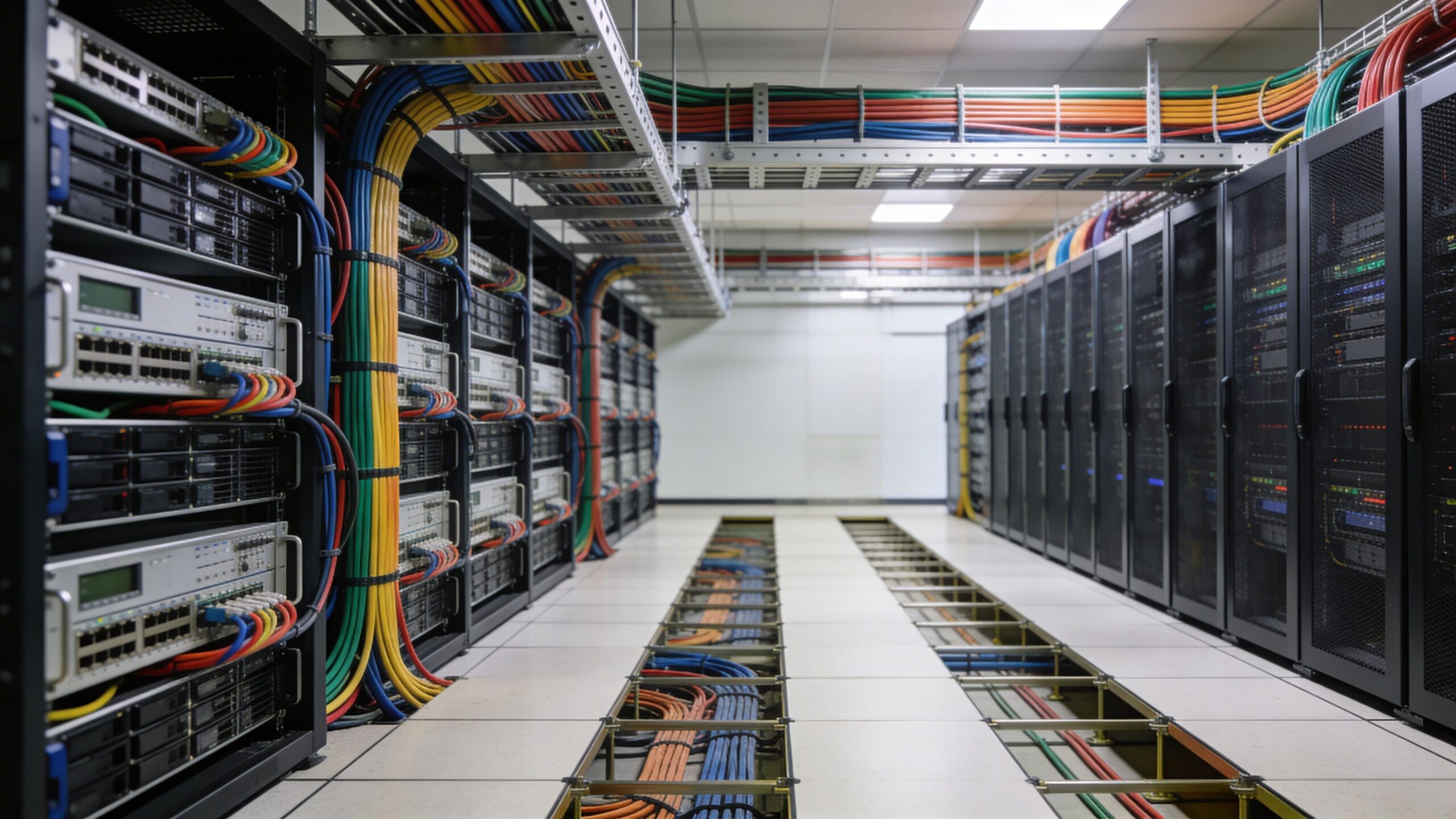
Specialized Design for Telecom and Data Centers
An electrical distribution designer working on a school, warehouse, and office tower can apply many of the same fundamentals. Telecom and data center work is different because the tolerance for interruption is far lower and the interfaces are more crowded.
A network operator does not just need power. They need power that coexists cleanly with structured cabling, pathway congestion, environmental systems, monitoring, and expansion pressure.
Telecom work starts with adaptation
A common failure in broadband and wireless projects is assigning utility-savvy electrical talent to telecom scopes without accounting for the differences in field conditions and interfaces.
The industry challenge is not basic competence. It is adaptation. Designers often have to take utility-focused skills and apply them to telecom applications such as overhead-to-underground conversions for fiber make-ready. Data suggests siloed utility and telecom designs can lead to 20-30% higher project delays, which is why converged expertise matters in this niche, as noted by GAI Consultants.
That shows up in practical ways:
- Pole-side assumptions do not translate cleanly to underground handhole and cabinet environments.
- Service entrance decisions affect not just electrical gear, but fiber routing, splice access, and restoration logistics.
- Grounding and bonding choices can complicate later network equipment additions if they are not coordinated early.
Data center redundancy is a design discipline
In data center work, redundancy language gets thrown around loosely. The designer has to make it real.
A system can be described as N, N+1, or 2N, but those labels only mean something when the distribution architecture, maintenance isolation strategy, and downstream branching all support the claimed resilience. A drawing set can look redundant and still hide single points of failure in transfer logic, common bus sections, or maintenance procedures.
For readers evaluating these systems in an operational context, detailed examples of https://southerntierresources.com/data-center-power-distribution-systems/ are useful because they show how distribution decisions connect to real infrastructure layouts instead of staying abstract.
What usually works
In practice, strong designs tend to share a few habits:
- Separate normal and backup intent clearly: One-lines and equipment schedules need to make source relationships obvious.
- Design for maintenance, not just failure: A resilient system should stay understandable when parts are isolated intentionally.
- Keep branch distribution legible: Rack power paths, PDU relationships, and panel naming need to support troubleshooting under pressure.
What often fails
The weak version usually looks polished at first review.
It has enough redundancy language to satisfy meetings, but not enough detail to support construction and operations. Cable routes overlap awkwardly. Equipment rooms are packed too tightly. Breaker naming conventions drift between drawings and submittals. None of that seems fatal until turnover and commissioning.
AC and DC realities in telecom environments
Telecom adds another layer because many sites still involve 48V DC distribution in addition to AC infrastructure, according to the earlier VDCI reference. The electrical distribution designer has to understand where AC service ends, where rectification and battery systems take over, and how those paths affect cabinets, shelters, or central office environments.
That is one reason generic commercial-building experience is not enough. Telecom sites often demand a hybrid mindset. Utility service, AC distribution, DC systems, grounding, and communications infrastructure all intersect in a smaller footprint with less room for error.
The following video is a useful visual reset before getting deeper into that overlap.
Capacity planning is where budgets and operations collide
Teams frequently feel the tension between day-one cost and future growth. Designers live in that tension constantly.
If the initial design chases the lowest first cost, the operator often pays for it later through shutdowns, difficult retrofits, or constrained growth. If the design reserves capacity everywhere without discipline, capital cost climbs fast and space gets consumed by gear the site may not need for years.
A good electrical distribution designer makes selective bets. They identify where future load is likely, preserve practical pathways, and leave expansion room in the parts of the system that are hardest to retrofit later. That may be switchgear lineup strategy, conduit stub-outs, panel locations, cable tray routing, or transformer planning.
The right answer is rarely “build everything now” or “defer everything.” The right answer is knowing which decisions will be cheap later and which ones will be painful later.
Procurement Coordination and Construction Oversight
A design package is only half the job. The electrical distribution designer still has work to do once procurement starts and boots hit the site. Telecom and data center projects are full of equipment with long lead times, physical constraints, and interdependencies that are easy to miss if nobody is actively connecting design to execution.
Procurement starts with the right level of specificity
If the designer leaves procurement with generic descriptions, buyers and contractors will fill in the blanks themselves. Sometimes that works. Often it introduces submittals that technically resemble the basis of design but create layout conflicts, monitoring gaps, or maintenance issues.
The better approach is tighter front-end coordination around:
- Critical gear definitions: Switchgear, transformers, UPS tie-ins, PDUs, and panelboards need a clear basis of design.
- Physical dimensions: Room layouts and service access depend on real equipment envelopes, not assumptions.
- Acceptable substitutions: The team should know early which features are negotiable and which are not.
This is especially important when electrical scope ties into utility-facing work and field execution packages managed by broader infrastructure teams such as https://southerntierresources.com/electrical-utility-contractors/.
Coordination with other disciplines prevents field collisions
A strong electrical distribution designer spends time outside the electrical sheet set. They coordinate with civil, structural, mechanical, fire protection, controls, and low-voltage teams because those systems all compete for the same space and often affect each other’s performance.
The common trouble spots are familiar:
| Coordination area | Typical issue if neglected |
|---|---|
| Mechanical rooms | Ductwork blocks cable routes or service access |
| Structural framing | Penetrations and support paths are not resolved early |
| Fire protection | Equipment placement interferes with clearance or protection zones |
| Telecom pathways | Power and communications routing conflict in congested spaces |
The designer is often the first person who can see those collisions while there is still time to fix them cheaply.
Construction administration closes the loop
Once construction starts, the electrical distribution designer often becomes the interpreter of original intent. That means reviewing submittals, answering RFIs, evaluating field conditions, and helping decide whether proposed changes preserve system performance or weaken it.
The best construction support is fast and precise. Crews do not need generic guidance. They need direct answers tied to the actual system.
Typical oversight tasks include:
- Submittal review for compliance with the design basis.
- RFI responses that resolve ambiguity before crews improvise.
- Field issue evaluation when as-built conditions differ from the drawings.
- As-built validation so turnover documentation reflects what was really installed.
A project does not stay on design intent by accident. Someone has to defend that intent during procurement and construction.
What does not work is disappearing after permit drawings are issued. In high-stakes infrastructure, design without follow-through usually turns into field redesign, and field redesign is almost always slower and more expensive.
How to Hire the Right Electrical Distribution Designer
The hiring decision is more strategic than most owners realize. If you choose someone who only knows generic building power, you may not discover the gap until coordination meetings, submittal reviews, or startup.
That risk is harder now because the talent pool is tight. There are over 2,255 open “electrical distribution designer” jobs on Indeed, yet few resources help telecom and data center operators figure out how to source or train people for integrated power infrastructure needs, according to Indeed job market data.

Look for operating judgment, not just software fluency
A candidate should know CAD environments and be comfortable with drawing production. That is expected.
The differentiator is whether they can explain trade-offs in plain language. Ask how they would protect uptime during maintenance. Ask how they decide where to leave expansion room. Ask what information is missing when a one-line looks clean but still feels unsafe or incomplete.
A capable electrical distribution designer will answer with system logic, not buzzwords.
Interview questions that reveal real capability
Use questions that force the candidate to think through a live environment.
- Redundancy question: Ask them to describe how they would review a distribution path for hidden single points of failure in a data hall.
- Telecom adaptation question: Ask how utility-style distribution thinking changes when the project includes fiber make-ready, shelters, or cabinet-based network equipment.
- Fault duty question: Ask what can go wrong when available fault current is underestimated and how that affects equipment selection.
- Construction question: Ask for an example of a field conflict that should have been caught during design coordination.
- Documentation question: Ask what must be present in a single-line diagram for an operations team to trust it during an outage response.
Individual hire versus specialized partner
Some owners need an in-house contributor. Others need a firm that can bring design, coordination, procurement support, and field understanding together.
The choice depends on project volume, internal review capability, and how much integration is required between electrical scope and telecom or data center infrastructure. A single person can be excellent and still struggle if the project also demands rapid field support, utility coordination, and as-built discipline across multiple workstreams.
Here is a simple way to frame it:
| Need | Better fit |
|---|---|
| Ongoing internal design capacity | Individual hire |
| Complex build with many outside interfaces | Specialized partner |
| Heavy field coordination and turnover pressure | Specialized partner |
| Narrow update to a stable facility standard | Individual hire or small support team |
The wrong hire usually looks acceptable in the interview. The warning signs appear when the conversation shifts from drawings to operations.
What not to accept
Be cautious when a candidate or vendor talks only about “meeting code” without discussing maintenance, fault behavior, equipment access, or commissioning. That answer signals a paper-compliance mindset.
Also be cautious when they cannot explain how telecom and data center environments differ from standard commercial projects. In this niche, context is part of competence.
Powering Your Future with an End-to-End Partner
An electrical distribution designer does far more than produce schematics. In telecom and data center work, that role shapes whether the finished facility can operate reliably, expand cleanly, and survive maintenance or fault conditions without avoidable disruption.
The difference shows up in the details. Clear one-lines. Credible load analysis. Thoughtful fault duty review. Grounding that works in the field. Equipment specifications that support procurement instead of confusing it. Coordination that prevents clashes before they become change orders.
For operators building or upgrading network infrastructure, the safest path is usually a partner that can carry those responsibilities across the full lifecycle. Design intent is stronger when the same organization understands engineering, procurement pressure, field installation realities, documentation, and long-term maintainability.
That illustrates the value of integrated delivery. Fewer handoff gaps. Better accountability. A power system that supports the network instead of putting it at risk.
If you are planning a telecom, broadband, wireless, or data center project, Southern Tier Resources provides the end-to-end engineering, construction, and maintenance support needed to turn electrical design into reliable, scalable infrastructure. Reach out to discuss your scope, de-risk the power side early, and build with a team that understands both distribution systems and the operational demands of critical network environments.