
Imagine a network that doesn't just shuffle data around, but actually thinks. That's the fundamental idea behind Artificial Intelligence WiFi. Instead of network teams scrambling to fix congestion and dead zones only after users start complaining, an AI-powered network anticipates these problems, heals itself, and works to deliver a consistently better experience for everyone connected.
The Future Of Connectivity Is Smart Not Just Fast
Picture a traditional network as a city grid where all the traffic lights are on fixed timers. Rush hour is guaranteed to create jams. In that world, network administrators are the traffic cops, running from one intersection to another, manually changing signals to clear up a bottleneck that has already brought things to a standstill. It works, but it’s always a step behind.
AI-driven Wi-Fi, on the other hand, is like a modern smart city’s adaptive traffic system. It uses a vast network of sensors and predictive algorithms to see traffic building up and automatically reroutes data in real time, preventing congestion before it ever happens. This is a complete shift in mindset—from reactive fire-fighting to proactive, intelligent management.
Moving Beyond Simple Speed
For carriers, ISPs, and data center operators, the game has changed. It's no longer just about offering the fastest possible speeds. The real challenge in 2026 is managing the sheer complexity driven by an explosion of IoT devices, 4K/8K streaming, and resource-hungry business applications. The battle has moved from raw speed to delivering a consistently high-quality experience, and an artificial intelligence wifi system tackles this head-on by embedding operational intelligence directly into the network.
The core value here is the move from reactive troubleshooting to proactive optimization. It’s not about making the network faster in a vacuum; it’s about making it smarter, more resilient, and far more reliable for every single user.
This intelligent approach immediately brings tangible benefits to your entire network infrastructure:
- Anticipatory Performance: The system learns daily, weekly, and even seasonal usage patterns, allowing it to prepare the network for high-demand periods and allocate resources where they'll be needed most.
- Automated Healing: If an access point suddenly fails or a neighboring business fires up a device causing massive interference, the AI instantly adjusts the power and channels of nearby APs to maintain coverage, often without a human ever touching a keyboard.
- Enhanced User Experience: By understanding not just the device but also the application it's running, the network can prioritize a critical video conference over a background software update, ensuring what matters most runs smoothly.
For any organization responsible for a large-scale network, embracing this shift from manual oversight to automated intelligence isn’t just a nice-to-have upgrade—it’s becoming essential for survival and growth. This guide is designed to walk you through the core concepts, show you real-world applications, and provide practical steps for deployment. It’s about building a network that works for you, not one that you’re constantly working on.
Understanding The Technologies Driving AI WiFi
To really get what makes artificial intelligence wifi different, you have to look under the hood. The engine running the whole show is Machine Learning (ML), a branch of AI that acts as the network’s brain. It's constantly sifting through performance data, learning the unique patterns of your environment, and making smart predictions to fix problems before they ever affect a user.
But this intelligence isn't coming from one giant, all-knowing computer. It’s a distributed system where two key pieces, edge inference and cloud inference, work together. For any technical leader aiming to build a more resilient and responsive network, understanding this architecture is the first critical step.
This diagram shows just how much things have changed, moving from the old reactive model to the new, intelligent one.
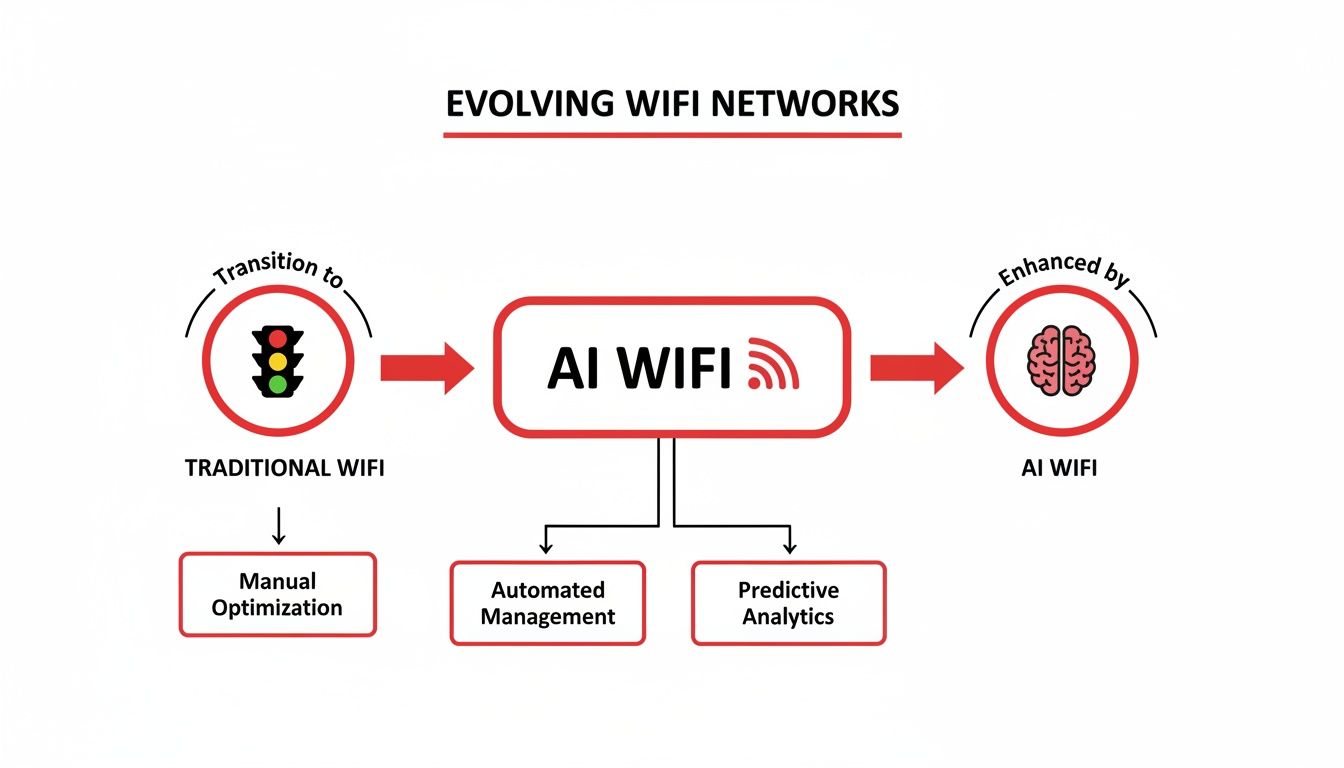
As you can see, we've gone from manually reacting to network fires to having a proactive, automated system where intelligence is built right into the infrastructure.
Before we dive deeper, it helps to see a direct comparison. This table breaks down the fundamental shift from old-school network management to the AI-powered approach.
Traditional WiFi vs Artificial Intelligence WiFi
| Feature | Traditional WiFi | Artificial Intelligence WiFi |
|---|---|---|
| Management | Manual configuration, reactive troubleshooting | Automated, self-optimizing, and proactive |
| Optimization | Static, based on initial setup and periodic checks | Dynamic and continuous, based on real-time data |
| Problem Solving | Responds to failures after they occur | Predicts and prevents issues before they impact users |
| Data Analysis | Limited to historical logs and basic metrics | Deep analysis of vast datasets to find hidden trends |
| Decision Making | Human-driven, relies on admin expertise | AI-driven, happens instantly at the edge or strategically in the cloud |
| User Experience | Inconsistent, prone to slowdowns and dead zones | Personalized, reliable, and consistently high-performing |
This comparison really highlights the core difference: Traditional WiFi depends on human intervention, while Artificial Intelligence WiFi can think for itself.
The Power Of Edge Inference
Edge Inference is all about making AI-driven decisions right on the local network hardware, like an intelligent access point (AP). Think of it like a security guard at a building entrance making an instant call without having to radio headquarters. This local processing delivers the split-second responses needed for real-time applications.
For instance, if an AP detects a sudden flood of RF interference from a microwave in the breakroom, its onboard AI doesn't wait for instructions. It immediately switches to a clearer channel to keep everyone’s connection stable. That decision happens in milliseconds—a speed you could never achieve if the data had to make a round trip to a central server. This is a core component of what makes up Intelligent WiFi.
This shift to on-device processing is rapidly becoming an industry-wide standard. In fact, the IEEE 802.11 Working Group is set to formally approve an AI Offload Study Group in March 2026, which will effectively turn APs into dedicated edge AI compute nodes. It’s a move driven by changing traffic patterns; the old 9:1 downlink-to-uplink ratio is history. Today, some devices need a staggering 25 Mbps uplink for tasks like live video analysis.
Cloud Inference And Centralized Control
While edge AI handles the immediate, tactical decisions, Cloud Inference takes care of the heavy strategic thinking. Running in a data center, cloud-based AI engines chew through massive, long-term datasets collected from every corner of the network. This is your central command, responsible for big-picture analysis and system-wide optimizations.
By analyzing historical data from thousands of access points and millions of client sessions, cloud AI can identify subtle, network-wide trends that would be invisible at the local level.
Tying this whole ecosystem together are the AI-Powered Network Controllers. These controllers are the conductors of the orchestra, making sure the deep insights from the cloud are translated into effective policies at the edge. They synchronize the actions of thousands of individual network devices, creating a single, intelligently managed system. You can get more details on how to integrate AI capabilities into your network in our comprehensive guide.
This dual architecture—fast, local reflexes at the edge combined with deep, strategic analysis in the cloud—is what gives an artificial intelligence wifi network its incredible power and scalability. It’s a framework designed to handle both the immediate needs of a single user and the long-term health of your entire infrastructure.
Practical Use Cases For Network Operators

The theory behind AI-driven Wi-Fi is interesting, but for network operators, the only thing that matters is how it performs in the real world. An artificial intelligence wifi system isn't just a shiny new object; it’s a practical tool that directly addresses some of the most stubborn challenges in network management.
Let's look at four key applications where this technology is already making a significant, measurable difference for carriers, ISPs, and data centers.
Create Self-Optimizing Networks
What if your network could tune itself without anyone lifting a finger? That’s the core promise of a Self-Optimizing Network (SON), and it's one of the most powerful applications of AI in this space. Forget the old way of dispatching technicians to manually tweak settings—a process that’s both slow and often based on guesswork.
With a SON, the AI is constantly listening to the radio frequency (RF) environment. If a new source of interference pops up—say, a neighboring office fires up a new wireless system—the network doesn't wait for users to complain or for a trouble ticket to be filed. It instantly and automatically reconfigures channel assignments and power levels on nearby access points (APs) to keep performance stable for everyone. This is a game-changer, ensuring the network is always adapting and running at its best.
Enable Intelligent Load Balancing
Anyone who has managed Wi-Fi for a stadium, conference hall, or a crowded office knows the pain of bottlenecks. Traditional systems often let dozens of users pile onto a single AP, crippling performance while another access point just a few feet away sits nearly empty. AI-powered load balancing puts an end to that chaos.
Think of the AI as a smart traffic controller for your data. It goes beyond just looking at signal strength and considers the real-time device load, the types of applications being used, and the actual capacity of each AP.
Instead of letting devices connect to the closest AP by default, the system actively guides them to less congested ones, spreading the traffic evenly across the infrastructure. This prevents any single AP from becoming a chokepoint and dramatically improves the experience for everyone, especially during peak hours.
It’s the difference between a free-for-all and a well-managed system, effectively increasing your network's total capacity and keeping users happy.
Deploy Predictive Maintenance
Hardware failures are a fact of life, but the resulting outages don't have to be. AI brings the power of predictive maintenance to your network, giving you a heads-up before things go wrong. By constantly analyzing thousands of small performance metrics and historical data points, the AI learns what "healthy" looks like for every single device in your infrastructure.
It can spot the subtle signs of a component nearing the end of its life, like a slow decline in an AP's throughput or a pattern of intermittent packet loss that a human would likely miss.
- Early Warnings: Operators get specific alerts about at-risk hardware well before it fails.
- Proactive Replacement: Technicians can schedule a replacement during a planned maintenance window, avoiding disruptive, middle-of-the-day outages.
- Reduced Downtime: You shift from a reactive, "break-fix" model to a proactive one, which means fewer emergencies and a major drop in costly "truck rolls."
This is also where network intelligence can start to influence physical operations. For example, the same location and device data can feed into smart building applications like Wifi Desk Booking solutions, where network insights help manage facility resources more effectively.
Enhance Security And Anomaly Detection
Finally, AI completely changes the game for network security. Traditional security tools depend on recognizing known threats, which means they’re always one step behind the latest zero-day attack. An AI-driven system works differently. Its first job is to build a deeply detailed, constantly evolving picture of what "normal" looks like on your network.
It establishes a baseline of typical traffic patterns, device behaviors, and user activity. When something deviates from that baseline—like an IoT camera suddenly trying to communicate with an unknown server or a user's laptop attempting to scan the network—the AI flags it immediately.
This allows the system to automatically detect and quarantine a compromised device before it can infect other systems or exfiltrate data. It’s a fundamentally more resilient security posture, moving from a reactive defense to a proactive one that’s essential for modern network operators.
How To Deploy Your AI Wi-Fi Infrastructure
Transitioning from the concept of AI-powered Wi-Fi to a live, working network isn't a matter of just flipping a switch. It's a strategic process that involves careful planning around data, privacy, infrastructure, and integration. Let's walk through what a successful rollout actually looks like on the ground.
At its core, the "intelligence" of your new network is a direct result of the quality and depth of the data you feed it. That's where the journey begins.
Begin With Strategic Data Collection
Before you even think about new hardware, you need a data strategy. High-quality, relevant data is the fuel for any effective AI system. The goal is to define what information your network needs to collect to get a complete, real-time picture of its health and the user experience.
This isn’t just about measuring traffic volume anymore. You need rich telemetry, including:
- RF Environment Data: Capturing details on signal strength, channel utilization, and sources of interference.
- Client Device Telemetry: Understanding device types, roaming behavior, and connection quality from the user's perspective.
- Application Performance: Gaining insight into how specific applications, like video conferencing or cloud services, are actually performing for users.
Collecting this level of detail allows the AI to graduate from simple uptime monitoring to truly understanding the quality of experience being delivered to every single user.
The objective is to build a comprehensive dataset that lets the AI learn the unique patterns and behaviors of your specific environment. This is what enables proactive optimization instead of just reactive troubleshooting.
Design For Privacy And Compliance
Gathering this much data naturally brings up questions of privacy and security. As you collect more detailed network information, privacy and compliance must be woven into your deployment strategy from day one, not bolted on as an afterthought.
It is absolutely essential to build a system that delivers powerful insights while respecting user data rights and adhering to regulations like GDPR or CCPA. This means partnering with vendors who offer robust tools for data anonymization and strict access controls. The AI's real power comes from analyzing aggregated patterns, not from spying on individuals. Making this distinction clear—both technically and in your policies—is non-negotiable for any modern network operator.
Build Robust Edge Compute Infrastructure
The latest intelligent access points are much more than simple radios; they are powerful compute devices. They don't just pass data along—they actively process it. This shift to performing AI inference at the network edge has direct consequences for your physical infrastructure.
These new APs often demand more power and have different physical or mounting requirements than older models. This is a critical consideration for any data center or structured cabling project and needs to be factored into your budget and timeline. It's an important part of any professional wireless network installation services plan.
This is all part of a much larger trend. The explosion in AI is putting immense pressure on network infrastructure. Global spending on data center systems is projected to surge 32% to $653 billion in 2026, largely because hyperscale providers are pouring money into AI-optimized servers—a segment growing at 37% annually. This boom is directly tied to the rise of AI in Wi-Fi, as intelligent APs and on-device processors create massive workloads that feed back to data centers, pushing the entire market forward. For more on this, you can review the full report on how AI is driving trillions in tech spending and reshaping infrastructure.
Ensure Seamless Integration And Define New KPIs
Finally, your new AI Wi-Fi platform can't operate in a vacuum. To get the full return on your investment, it must integrate smoothly with the tools you already use, like your Network Operations Center (NOC) dashboards, ticketing systems, and management platforms. Prioritize solutions that offer robust Application Programming Interfaces (APIs) to make these connections possible.
Just as important, you need to rethink how you measure success. Old-school KPIs like uptime and bandwidth are no longer enough. A successful AI deployment is measured by the user experience. You need new metrics that reflect this reality, such as:
- Time to Connect: How quickly and reliably a user can join the network.
- Roaming Success Rate: The percentage of seamless handoffs as users move between access points.
- Application Performance Score: A score that rates the quality of experience for critical business applications.
By focusing on these experience-centric KPIs, you can clearly demonstrate the tangible business value of your investment and prove the ROI of a truly intelligent network.
Building The Foundation For AI-Driven IoT

When we talk about artificial intelligence wifi, it's easy to focus on the immediate benefits, like better connections for our devices. But the real story is much bigger. This technology isn't just an upgrade—it's the launchpad for the next massive shift in our digital world: the Internet of Things (IoT).
Pairing the predictive power of AI with new connectivity standards creates the essential backbone for a world filled with smart, connected devices. This isn't science fiction. We're talking about sprawling smart cities that manage traffic in real-time, fully automated factories, and huge agricultural operations using thousands of sensors to perfect crop yields. For network operators, this isn't some distant trend; it's the next major market opening up right now.
That’s precisely why AI-driven network management has become so critical. The challenge is no longer just about connecting more devices. It's about connecting them with intelligence and absolute reliability.
A New Era Of IoT Connectivity
A huge piece of this puzzle is the arrival of wireless standards built from the ground up for IoT. One of the most important on the scene is Wi-Fi HaLow (IEEE 802.11ah). It's engineered specifically for low-power devices that need to send data over long distances. Think of it as the marathon runner of Wi-Fi—it can connect sensors across a massive farm or an entire warehouse complex where traditional Wi-Fi would simply give up.
When you let AI manage a HaLow network, it can orchestrate thousands of these low-power devices, ensuring they operate at peak efficiency without draining their batteries or creating a mess of signal interference. This is how you build a stable, scalable foundation for truly massive IoT deployments.
The growth projections here are staggering. Shipments of Wi-Fi HaLow devices are expected to jump from 19 million units in 2025 to an incredible 124 million by 2030, which is a 45% compound annual growth rate. This year, in 2026 alone, we're expecting 17.1 million new smart home HaLow devices to come online. That kind of explosive growth puts immense pressure on networks to perform flawlessly, because AI-dependent IoT simply cannot tolerate downtime.
Infrastructure Demands For Carriers And Data Centers
This tidal wave of connected devices creates unique challenges—and huge opportunities—for the companies that build and run our digital infrastructure.
For telecom carriers and ISPs, the job is to provide the powerful, high-capacity backhaul that all these new networks will depend on. Every smart streetlight, logistics robot, and soil sensor generates data, and all of it needs a fast, reliable path back to a central processing hub.
For data center operators, the focus shifts to handling the resulting flood of information. Billions of new devices will generate an unprecedented volume of data that must be stored, analyzed, and acted on by AI systems. This demands massive investment in compute power and storage, fundamentally shaping how modern facilities are designed and scaled. You can learn more about this connection in our guide on how fiber optics power modern data centers.
An AI-managed Wi-Fi network acts as the intelligent 'front door' for this data deluge, while robust fiber and data center infrastructure provide the 'central nervous system' required to make sense of it all.
At the end of the day, artificial intelligence wifi is what makes large-scale IoT a practical reality. It delivers the automated, self-healing, and resilient connectivity needed to manage millions of devices. For infrastructure providers, building and supporting this next-generation network isn't just an opportunity; it's your role in laying the foundation for the entire connected future.
Your AI-Powered Wi-Fi Implementation Roadmap
So, you're ready to bring artificial intelligence Wi-Fi into your network. It’s a smart move, but a successful rollout is about much more than just swapping out old hardware for new. It's a strategic shift.
To get it right, you need a clear plan. Here’s a breakdown of the journey into four manageable phases, designed to guide network and data center teams from initial concept to a fully optimized, intelligent network.
Phase 1: Assessment and Goal Setting
Before you even look at a single vendor’s website, you have to look inward. The first step is a frank and thorough audit of your current network infrastructure. Where are the real pain points? Pinpoint the areas with chronic interference, document the user complaints about sluggish performance, and calculate the operational drag from manual troubleshooting.
Once you have a clear picture of the "before," you can define the "after." Set concrete, measurable goals. Don't just aim for "better Wi-Fi." Aim to reduce trouble tickets by 30%, or to guarantee five-nines reliability in your high-density conference rooms. These goals become your North Star, guiding every decision you make down the line.
Phase 2: Vendor Evaluation and a Pilot Project
With your goals in hand, you can start talking to vendors. It's time to cut through the marketing jargon. Ask them the tough questions about their AI models, how they handle data, and how their platforms integrate with existing systems. A non-negotiable question is how they guarantee data privacy and compliance—you'll be collecting a massive amount of network telemetry, and that data must be protected.
Don't attempt a full-scale rollout right out of the gate. Select your most promising vendor and plan a tightly controlled pilot project. Choose a specific, measurable environment—like a single floor of your office or a small campus building. This lets you establish a performance baseline and see if the vendor's promises hold up in your real-world environment.
Phase 3: Integration and Scaling Up
After a successful pilot, it's time to think bigger. Planning the integration and a wider rollout is critical. Your new artificial intelligence Wi-Fi platform can't live on an island; it needs to talk to your existing operational toolkit, like your Network Operations Center (NOC) dashboards and ticketing systems. This is where you'll truly appreciate vendors who provide robust, well-documented APIs.
Map out a phased scaling plan to avoid disrupting your entire operation. A good strategy is to upgrade one building or region at a time. This approach allows your team to manage the transition effectively, learning from each phase and applying those lessons to the next for an even smoother deployment.
Phase 4: Ongoing Optimization and Measuring ROI
Getting the system live isn't the finish line—it’s the starting line. An AI-driven network is designed to learn and improve continuously, but it still needs a human touch. You'll want to establish a regular process for reviewing the AI's recommendations and performance dashboards to keep the network finely tuned.
Finally, it’s time to prove the value. Circle back to the goals you established in Phase 1 and track your key performance indicators (KPIs) relentlessly. Measure the hard savings, like fewer truck rolls and a sharp drop in hours spent on troubleshooting. But don't forget the soft benefits, like happier customers and lower user churn. This data is your proof, demonstrating the tangible business value your intelligent new network is delivering.
Your AI Wi-Fi Questions, Answered
When you're considering a move to an AI-driven network, you’re bound to have questions. It's a big decision, and for any technical leader or network operator, the practical side of things is what really matters. Let's cut through the hype and get straight to the common-sense answers you need.
Think of this less as a complete overhaul and more as giving your network a brain transplant. You're shifting your team's focus from constantly fighting fires to preventing them in the first place.
How Is AI Wi-Fi Different From My Monitoring Tools?
This is probably the most important question to ask. Your current network monitoring tools are excellent at what they do—they’re reporters. They tell you when an access point goes down or when a link is saturated. The problem is, by the time you get the alert, the damage is already done and your users are feeling the pain.
An artificial intelligence wifi system operates on a completely different principle. It’s a forecaster. By constantly analyzing thousands of data points and learning the unique rhythm of your network, it can spot trouble long before it starts. It might see a tiny, gradual decline in performance on a specific AP and flag it for maintenance, preventing an outage that was weeks away. It’s the difference between reading last month's newspaper and getting a reliable weather forecast for tomorrow.
Does This Mean A Complete Rip-And-Replace?
Thankfully, no. That's a huge relief for budgets and a big win for operational stability. Most of the top-tier AI Wi-Fi solutions are built to work as an intelligent overlay on top of the infrastructure you already have. The "AI" part is often a software layer that can be deployed to start collecting data and delivering insights almost immediately.
This opens the door to a much smarter, phased rollout. You can start with the software intelligence and then make strategic hardware upgrades over time, focusing on high-density areas or known trouble spots first. It's a practical way to maximize your current investments while building a clear path to a fully optimized, next-gen network.
The goal is evolution, not a disruptive revolution. Start with the software and intelligent overlays to see immediate benefits. Then you can plan hardware upgrades as part of a strategic roadmap, not as an emergency fix.
What Are The Main Security Benefits?
The security enhancements are a game-changer. Traditional security, based on signatures, is always a step behind. It’s designed to catch known threats, leaving you vulnerable to anything new. AI flips the script.
Instead of looking for bad guys, it starts by building an incredibly detailed baseline of what "normal" behavior looks for every single device and user on your network. The moment anything deviates from that established pattern—say, an IoT thermostat suddenly tries to access a financial database—the AI flags it as an anomaly. It can then automatically quarantine the device, stopping a potential breach cold before it can cause any real damage. This is your best defense against zero-day attacks and even insider threats.
How Do I Measure The ROI?
The return on investment for an AI-powered network isn't just theoretical; it shows up clearly on the balance sheet. You’ll see it in a few key areas:
- Reduced Operational Costs: Predictive maintenance and automated root cause analysis mean fewer trouble tickets. That translates directly to fewer "truck rolls" and a sharp drop in the hours your team spends on tedious manual troubleshooting.
- Improved Customer Retention: For any carrier or ISP, network stability is everything. A consistently high-performing network is a massive competitive advantage that keeps customers happy and dramatically reduces churn.
- New Service Opportunities: Once you have a smarter, more reliable network, you can confidently roll out new, high-margin services. Think about offering guaranteed QoS tiers for business clients or creating premium connectivity packages for demanding users.
The ROI isn't just about saving money. It's about building a more resilient business, keeping your customers loyal, and creating new streams of revenue.
Southern Tier Resources provides the end-to-end engineering, construction, and maintenance to build and support these next-generation networks. Learn how our turnkey infrastructure services can help you deploy a high-performance AI-ready network.