Broadband telecom services are the invisible highways of our modern world. They’re the high-speed data arteries—built from fiber optics, advanced wireless systems, and other technologies—that deliver everything from internet and video to crystal-clear voice calls. Think of them as the foundational infrastructure for communication, just as essential as roads and bridges are to a city.
These networks are the backbone supporting nearly every facet of our daily lives and business operations, from streaming movies at home to powering complex cloud computations for major enterprises.
Defining the Digital Foundation

In simple terms, “broadband” refers to any high-capacity, always-on internet connection that can handle massive amounts of data at once. It’s the difference between a single-lane country road—like old dial-up—and a sprawling, multi-lane superhighway. This digital highway is constructed from a combination of physical and wireless components that all have to work together perfectly to deliver a seamless experience.
But these services are much more than just the internet plug in your wall. They represent a complex ecosystem of physical infrastructure and sophisticated managed solutions. For any organization that builds, buys, or depends on network connectivity, understanding this ecosystem isn’t just helpful—it’s absolutely critical.
Core Components of Broadband Networks
When we talk about broadband telecom services, we’re really talking about a few distinct layers of technology and service delivery. Each one plays a unique role in getting data from point A to point B, whether that destination is a massive data center, a mobile phone, or a corporate headquarters.
- Physical Infrastructure: This is the stuff you can actually see and touch (or at least, that exists in the physical world). It includes everything from buried fiber optic cables and copper lines to the cell towers that transmit wireless signals. This is the bedrock on which all other services are built.
- Connectivity Services: This is the active data transport that happens over the physical infrastructure. It includes familiar services like high-speed internet access, but also more specialized offerings like dedicated private lines connecting different business sites or the data backhaul that wireless carriers rely on.
- Managed Services: Going beyond raw connectivity, many providers offer managed services that add a layer of intelligence and reliability. This can include things like proactive network monitoring, robust security solutions, and VoIP (Voice over Internet Protocol) phone systems.
At the end of the day, the goal of this entire intricate system is to deliver fast, reliable, and scalable connectivity. Every single piece—from the colossal data pipes linking continents to the final “last-mile” connection reaching a single rural home—has to work in perfect harmony.
This guide is designed to demystify each part of the process, from the initial engineering and construction of these networks to the performance metrics that ultimately define their quality. To see how these components come together in the real world, take a look at our full range of telecom services and solutions.
Whether you’re an ISP, a municipality, or a data center operator, getting a firm grip on these fundamentals is the first and most important step toward making smart infrastructure decisions.
The Building Blocks of Broadband: A Look at the Core Technologies
To get a real handle on broadband telecom services, you have to start with the foundational technologies that actually deliver the connection. It helps to think of them like different road systems. Some are massive, multi-lane superhighways built for speed and volume, while others are more like nimble city streets designed to get you precisely where you need to go.
At the very top of this food chain is fiber-optic technology. It’s the undisputed champion of both speed and reliability, forming the backbone of the modern internet and quickly becoming the go-to for connecting homes and businesses.
The Power of Light: Fiber Optics
There’s a good reason fiber-optic cable is considered the gold standard. Instead of pushing electrical signals down an old copper wire, it transmits data as literal pulses of light through hair-thin strands of glass. This is as close as we get to sending information at the speed of light, and the performance speaks for itself.
You’ll typically see fiber deployed in two main ways:
- Fiber-to-the-Home (FTTH): This is the premium residential connection, where a fiber line runs directly into a house. It delivers symmetrical speeds—meaning your upload is just as fast as your download—which is a game-changer for video calls, competitive gaming, and sending large files.
- Dedicated Business Fiber: For enterprises, data centers, and other carriers, shared connections just don’t cut it. Dedicated fiber provides a private, uncontested line that guarantees a specific amount of bandwidth 24/7. This is the top-tier solution for security and performance when operations are on the line.
The real magic of fiber is its sheer capacity and incredibly low latency. It’s not just about being fast today; it’s about being ready for tomorrow. Fiber is fundamentally future-proof, built to handle the explosive growth in data demand for decades to come.
This global push toward fiber, coupled with other innovations, is making a real impact. The quality and speed of internet connections have jumped significantly between 2020 and 2025, thanks largely to fiber rollouts, the expansion of 5G, and new satellite players entering the market. In fact, global average fixed broadband download speeds hit about 97.3 Mbps in the first quarter of 2025, a jump of roughly 12.1% from the previous year. You can dig into more of these global internet statistics and trends on sqmagazine.co.uk.
To put these different technologies into perspective, here’s a quick comparison of what you can expect from each.
Broadband Technology At a Glance
| Technology Type | Typical Download Speed | Latency Profile | Best For |
|---|---|---|---|
| Fiber Optic | 1 Gbps – 10 Gbps+ | Ultra-Low (1-5 ms) | Enterprises, data centers, FTTH, backhaul, and mission-critical applications. |
| Fixed Wireless | 50 Mbps – 1 Gbps | Low (10-30 ms) | Last-mile connectivity in suburban/rural areas where fiber is unavailable. |
| Satellite (LEO) | 50 Mbps – 250 Mbps | Medium (25-50 ms) | Remote and rural locations, maritime, and aviation connectivity. |
| Macro Cell (5G) | 100 Mbps – 1 Gbps+ | Low (10-20 ms) | Wide-area mobile coverage for cities, suburbs, and highways. |
| Small Cell (5G) | 300 Mbps – 3 Gbps+ | Very Low (5-10 ms) | Dense urban areas, stadiums, airports, and high-traffic public venues. |
As you can see, it’s not about one technology being “better” than another in a vacuum; it’s about using the right tool for the right job to build a complete, high-performing network.
Going Beyond the Wire: Wireless Solutions
While fiber is the king of wired connections, wireless is absolutely essential for mobility and for reaching places where trenching fiber is just too difficult or expensive. These technologies don’t compete with fiber—they work with it, extending the reach of the core network to nearly everywhere.
Fixed Wireless Access (FWA) has become a popular and effective alternative for that “last mile” to the customer. It uses radio waves to deliver a broadband signal to a stationary point, like a home or office, completely bypassing the need to run a physical cable to the building. For underserved suburban and rural communities, this often means a much faster and more flexible path to getting quality internet.
At the same time, satellite broadband has taken a huge leap forward. Not long ago, it was the option of last resort, plagued by frustratingly high latency. But the new low-Earth orbit (LEO) satellite constellations have changed the game, offering solid speeds and much lower latency. This has made satellite a truly viable choice for people in the most remote and isolated locations.
Weaving the Mobile Network Fabric
For anyone using a smartphone, the quality of your connection depends on a constant dance between different types of cellular infrastructure. That seamless 5G coverage you experience in a city isn’t coming from a single type of tower but from a dense, layered network working in harmony.
- Macro Towers: These are the big, traditional cell towers you see on hillsides or rooftops. They are the workhorses of the network, providing broad, wide-area coverage that forms the foundational layer.
- Small Cells: These are the smaller, low-powered antennas you might see on streetlights or the sides of buildings in urban areas. Their job is to handle the massive amounts of data traffic in very concentrated spots—think downtown cores, stadiums, or busy transit hubs—preventing the network from bogging down.
These two pieces work in tandem to create a smooth mobile experience. A macro tower might handle your connection as you drive into the city, but the moment you step into a crowded downtown area, your phone will seamlessly hop onto a series of small cells to keep your speeds high and your connection stable.
It’s this intricate combination of fiber backbones, fixed wireless extensions, and a layered mobile grid that creates the comprehensive web of broadband telecom services we all depend on.
How a Broadband Network Is Built and Managed
Bringing a network of broadband telecom services to life is an immense undertaking, a lot like building a city’s entire power grid from the ground up. It’s a methodical journey that starts as a concept on a blueprint and evolves into a living, breathing network that demands constant attention. Each phase has its own unique challenges and requires a very specific set of skills.
The whole process kicks off long before the first shovel hits the dirt. It starts with strategic planning and a deep dive into the market. In this foundational stage, we’re identifying underserved communities, forecasting subscriber demand, and modeling the financial viability of the entire project. You have to go in with a clear vision for the network’s purpose and a realistic grasp of the resources you’ll need to pull it off.
From Blueprint to Physical Network
With a solid strategy in place, the project moves into the highly technical engineering and design phase. This is where the network is meticulously mapped out, detailing everything from the core routing equipment right down to the specific path a fiber cable will take down a particular street. Experts chart the most efficient routes to keep construction costs in check and maximize coverage.
This is the critical stage where you spot potential roadblocks and solve them on paper before they become expensive real-world headaches. Many organizations bring in specialized telecom network design services to get this part right. After the design is locked in, the painstaking process of securing permits and rights-of-way begins—a step that can easily take months.
The physical construction is where the plan finally becomes reality. It breaks down into several key steps:
- Make-Ready Construction: This means preparing existing infrastructure, like utility poles, to handle the new fiber or wireless equipment. It’s a vital and often complex step that requires a ton of coordination with other utility owners.
- Trenching and Boring: For underground fiber, crews either dig trenches or use directional boring machines to lay the conduit that protects the fiber optic cables. This is often the most disruptive and capital-intensive part of the build.
- Installation and Splicing: Technicians pull the delicate fiber cables through the newly laid conduit. Then comes the highly precise work of fiber splicing, connecting different segments of the network to create one continuous path for light to travel.
- Equipment Installation: This involves everything from setting up gear in central offices and mounting antennas on towers to installing the necessary hardware right at the customer’s home or business.
This visual shows that journey in a simplified way—from the core network infrastructure, through the local connection, and finally to your device.
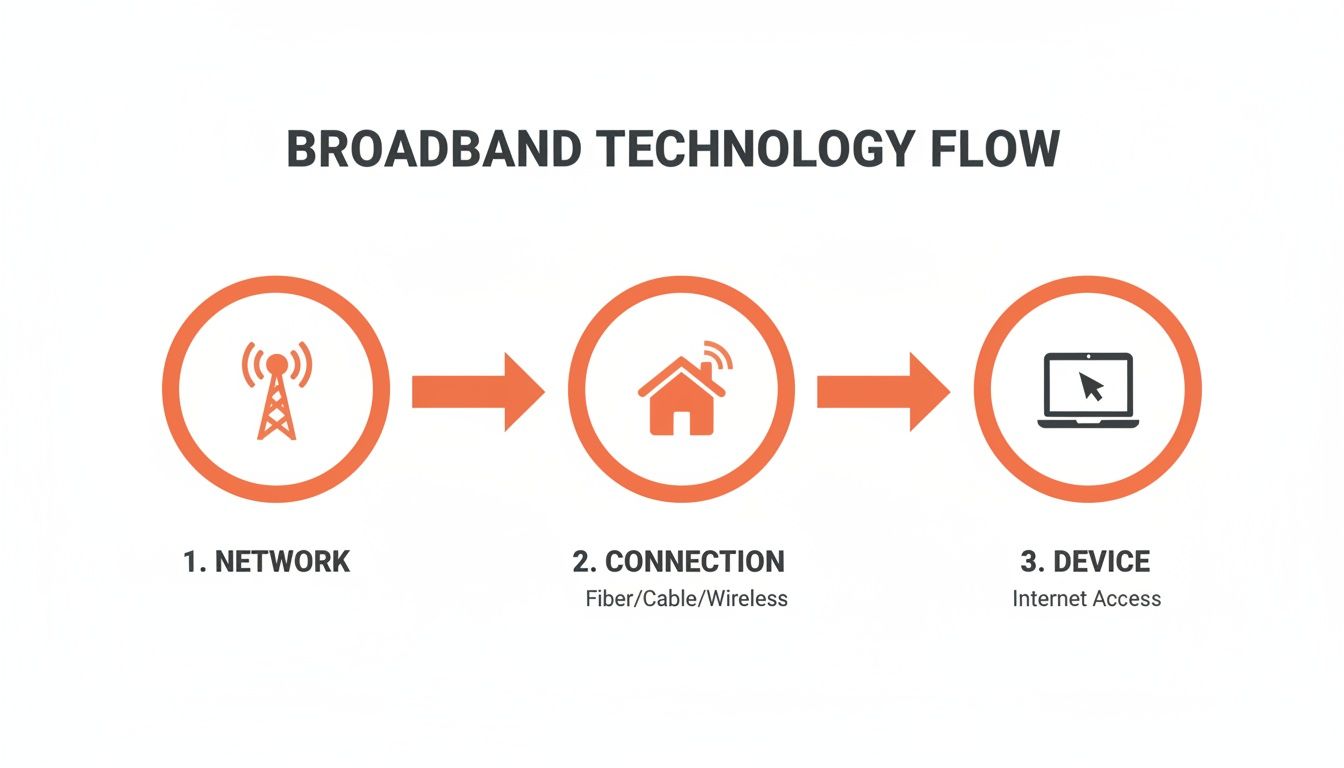
Every single step in this flow is a critical link in the chain. Each one must be expertly engineered and maintained to ensure you get a reliable connection.
Activating and Maintaining the Network
Once the physical infrastructure is in place, it’s time to “light up” the network. Service activation involves configuring all the network electronics, testing signal strength and data speeds at every connection point, and then, finally, turning on services for the first wave of customers. It’s a huge milestone that marks the shift from a construction project to a live, operational service.
But the work is far from over. After the first customers are connected, the lifecycle moves into its final and longest phase: ongoing operations and maintenance.
A broadband network is not a “set it and forget it” utility. It is a dynamic system that requires continuous, proactive monitoring to maintain peak performance and reliability. Small issues must be caught and fixed before they can escalate into widespread outages.
This means 24/7 network monitoring from a Network Operations Center (NOC) to watch for any performance dips or equipment failures. It also involves routine field maintenance—things like inspecting cables for damage after a storm, managing tree growth around towers, and upgrading equipment as technology advances. This constant vigilance is what separates a truly reliable provider from an inconsistent one, ensuring the network continues to deliver for years to come.
Matching Broadband Services to Business Needs
Not all consumers of broadband telecom services are the same. A local Internet Service Provider (ISP) pushing into a new suburb has a completely different set of priorities than a massive data center that needs flawless, high-capacity connections to the internet backbone.
To really get a handle on the market, you have to walk a mile in the shoes of the key buyers and see the network from their point of view. For these organizations, picking a connectivity partner is a high-stakes decision. It’s driven by a unique mix of technical demands, business goals, and financial realities. A one-size-fits-all sales pitch just won’t cut it when the needs for bandwidth, latency, and uptime are so incredibly different.
Wireless Carriers: The Quest for Seamless Backhaul
Wireless carriers are dealing with an insatiable, ever-growing demand for mobile data. Their number one concern is getting robust backhaul—that critical link connecting their cell towers (both the big macro sites and the small cells) back to the core network.
Think of backhaul as the highway system for mobile data. It has to carry all the combined traffic from the local streets (the cell sites) back to the city center (the internet).
Their top priorities are straightforward:
- Massive Bandwidth: A single 5G tower can pump out a staggering amount of traffic. Carriers need backhaul, usually dedicated fiber, that can handle terabits of data without breaking a sweat.
- Low Latency: For things like 5G-powered gaming or augmented reality, every millisecond is critical. The backhaul connection must be incredibly fast to deliver a smooth, responsive user experience.
- Scalability: As people use more data, carriers need to easily crank up their backhaul capacity. They can’t afford a major network overhaul every time demand spikes.
For a wireless operator, a backhaul failure isn’t a small problem. It can knock an entire sector of their mobile network offline, cutting off service for thousands of customers. Reliability is absolutely non-negotiable.
ISPs and Municipalities: Bridging the Digital Divide
Internet Service Providers and municipalities that are building public networks are on a similar mission: deliver great internet directly to homes and businesses. Their focus is almost entirely on the last-mile connection, which is notoriously the most difficult and expensive part of any network build.
Their decision-making boils down to a few key factors:
- Widespread Coverage: The main goal is to reach as many potential subscribers as possible within a specific area, whether it’s a new housing development or a whole rural county.
- Cost-Effective Deployment: The total cost of ownership is a massive consideration. They have to find the right balance between the superior performance of technologies like Fiber-to-the-Home and the real-world costs of construction and signing up customers.
- Symmetric Speeds: To stay competitive today, ISPs have to offer upload speeds that are as fast (or nearly as fast) as their download speeds. This is one of the biggest advantages of a fiber-based network.
The sheer size of the consumer market puts these decisions into perspective. As of mid-2025, the biggest online populations were in China, India, and the United States, which together made up more than a quarter of the world’s 5.5 to 6 billion internet users. Nailing down a smart deployment strategy is essential to capture even a small piece of that demand. You can dig deeper into global internet usage statistics on sganalytics.com.
Data Centers: The Need for Flawless Connectivity
Data centers are the nerve centers of the digital world, and their standards for connectivity are the highest of all. For them, broadband services aren’t just a utility; they are the absolute lifeline that connects their clients’ critical applications to the rest of the planet.
For a data center, network uptime is everything. Even a few seconds of downtime can result in millions of dollars in losses for their customers. As a result, they demand multiple, redundant, high-capacity fiber routes from diverse carriers.
The name of the game is ultra-low latency and extreme reliability. Data centers need the absolute fastest, most direct paths to major internet exchange points and cloud providers. Because their requirements are so specific, they almost always need custom-engineered solutions.
You can learn more about how these complex telecom infrastructure services are designed and rolled out for different business needs. In the end, every buyer’s choice comes down to one question: which provider can best match their unique operational profile?
Making Sense of Performance Metrics and SLAs

When you buy broadband telecom services, you’re not just buying a connection. You’re buying a promise of performance. To make sure that promise is kept, you have to speak the language of network quality—understanding the metrics that matter and the Service Level Agreements (SLAs) that put those promises in writing.
Think of these metrics as your network’s vital signs. Just like a doctor checks your heart rate and blood pressure, network engineers monitor specific indicators to gauge the health of a connection. Moving beyond a simple speed test is the first real step toward evaluating a service like a pro.
Decoding the Four Core Metrics
While bandwidth grabs all the headlines, it’s only one part of a much bigger story. Four key metrics really define the quality of a broadband connection. A weakness in any one of them can kill the user experience, even if you have all the bandwidth in the world.
- Bandwidth: This is raw capacity, measured in megabits or gigabits per second (Mbps/Gbps). It’s like the number of lanes on a highway—the more lanes you have, the more traffic can flow at once.
- Latency: This is the round-trip travel time for a single packet of data. Low latency is absolutely essential for real-time applications like video conferencing or online gaming, where even a tiny delay feels like an eternity.
- Jitter: This measures the variation in latency. If latency is the travel time, jitter is the unpredictable traffic that makes the trip take 20 minutes one time and 45 the next. High jitter is what causes robotic-sounding audio and frozen video streams.
- Packet Loss: This happens when data packets simply never arrive at their destination. A little bit is normal and easily corrected, but anything more than a tiny fraction leads to sluggish performance and corrupted data.
Getting a handle on these terms helps you cut through the marketing noise and figure out how a provider’s network will actually hold up under the unique demands of your operation.
Understanding Service Level Agreements
A Service Level Agreement (SLA) is the single most important part of any commercial broadband contract. It’s the provider’s legally-binding promise to deliver a specific, measurable level of performance and reliability. It turns vague assurances into concrete commitments.
Your SLA is basically an insurance policy against bad service. It sets crystal-clear expectations and defines the remedies—usually service credits—if the provider fails to live up to their end of the bargain.
A strong SLA doesn’t just promise performance; it defines it with precision. It should specify uptime guarantees, repair timelines, and performance thresholds, leaving no room for ambiguity when service quality is on the line.
A solid SLA will always have several key components. Digging into these details during contract negotiations is non-negotiable if you want to protect your business.
Key SLA Components to Review:
- Uptime Guarantee: This is usually a percentage, like 99.99% (known as “four nines”), guaranteeing how much time the service will be available. Always check the fine print for what officially counts as “downtime” and whether scheduled maintenance is excluded.
- Mean Time to Repair (MTTR): This is the provider’s commitment to how fast they will fix an outage once you report it. A four-hour MTTR is a common, and very reasonable, standard for business-critical fiber circuits.
- Performance Thresholds: The SLA must define the minimum acceptable levels for latency, jitter, and packet loss. This ensures the connection isn’t just “on” but is actually usable for your specific applications.
- Service Credits: These are the penalties the provider pays for breaking the SLA. Typically, they come as a credit on your next bill, giving you some financial recourse when things go wrong.
Navigating Broadband Funding and Regulations
Building out a network is about more than just technology and engineering. You have to get a firm grip on the financial and policy side of things, too. The whole landscape is a mix of government funding programs designed to close the digital divide and a web of regulations that can either make or break your project timeline.
If you’re a network planner, you can’t treat these as afterthoughts. Public funding and regulatory hoops aren’t just boxes to check; they’re baked into the core strategy. How well you handle them will directly impact your project’s scope, budget, and whether it’s even financially viable in the long run.
Securing Public Funding for Network Expansion
Governments have finally recognized that connectivity is essential, and they’re putting serious money behind it, especially for areas that have been left behind. These programs can be a massive financial boost, but you have to know how to navigate the system.
One of the biggest game-changers is the $42.5 billion Broadband Equity, Access, and Deployment (BEAD) program. The goal is simple: get every American connected to reliable, high-speed internet. But getting a piece of that pie involves a lot more than just filling out a form.
Here’s something that catches a lot of people off guard: public grants are often taxable. Imagine getting a multi-million dollar grant for construction, only to be hit with a massive tax bill that’s due long before your new network is bringing in a single dollar of revenue. That can put a serious strain on your cash flow.
This is exactly why you need a solid financial plan from day one. You have to account for these hidden costs to make sure a grant-funded project doesn’t go off the rails. It’s also why a proposal like the Broadband Grant Tax Treatment Act is getting so much attention—it aims to get rid of that very problem.
The Complex World of Telecom Regulations
Funding is one half of the equation; regulations are the other. This is where projects can get seriously bogged down in red tape if you’re not proactive.
You’ll run into a few major hurdles time and time again:
- Right-of-Way (ROW) Access: Before you can even think about digging a trench, you need legal permission to build on public and private land. This means endless negotiations with cities, counties, and individual landowners, and it can take forever.
- Pole Attachment Agreements: If you’re running aerial fiber, you need to get on utility poles. That requires striking detailed agreements with the pole owners—usually power and phone companies—that cover everything from rental fees to safety protocols.
- Spectrum Licensing: For any wireless service, you have to get a license from bodies like the FCC to use specific radio frequencies. It’s a competitive and tightly controlled process that determines who can operate where.
The pressure to expand access is immense. We’ve seen a huge jump in global internet use, with estimates suggesting around 6.0 billion people (74% of the world’s population) were online by 2025. But that still leaves about 2.2 billion people completely offline, mostly in lower-income nations. You can dig into these global connectivity trends from the ITU. This global gap is what’s driving the urgency behind both the funding and the push to make regulations a little less painful.
Frequently Asked Questions About Broadband Services
When you’re dealing with network infrastructure, a few key questions pop up again and again. Whether you’re planning a build, buying services, or managing an existing network, getting the fundamentals right is crucial. Let’s clear up some of the most common points of confusion.
Getting these core concepts straight from the start helps you make smarter decisions, evaluate your technology options more accurately, and understand the real-world challenges of network deployment.
What Is the Difference Between Broadband and Wi-Fi?
It’s a common mix-up, but broadband and Wi-Fi are two completely different things. The easiest way to think about it is like your home’s water supply.
Broadband is the main water pipe coming into your house from the street. It’s the high-capacity connection that delivers the internet service from your provider to your property line.
Wi-Fi, then, is the plumbing inside your house. It’s the local wireless network that takes that main internet connection and distributes it to your devices—your laptop, phone, or smart TV. So, broadband gets the internet to your location, and Wi-Fi spreads it around that location.
What Does Last-Mile Connectivity Mean?
In telecom, the “last mile” refers to the final, critical leg of the network’s journey. It’s the physical connection that bridges the gap between the provider’s core network and the end-user’s building, whether that’s a suburban home, a downtown office, or a remote cell tower.
This final stretch is almost always the biggest headache in delivering high-speed internet.
The last mile is notoriously the most complex and expensive part of any network build. Overcoming its logistical and financial hurdles is the primary challenge in bridging the digital divide and bringing reliable broadband to unserved and underserved communities.
Whether you’re trenching fiber down a residential street or mounting a fixed wireless antenna on a roof, the last mile is where network expansion projects live or die. It demands massive capital investment and meticulous planning to get right.
Why Is Fiber Optic Considered the Best Technology?
Fiber optic technology is widely seen as the gold standard for a few simple reasons, all tied to how it moves data. Instead of pushing electrical signals down a copper wire, fiber sends pulses of light through ultra-thin strands of glass.
This approach delivers some serious advantages that other technologies just can’t match:
- Immense Speed and Capacity: Light moves incredibly fast. This allows fiber to offer symmetrical speeds—the same for uploads and downloads—that can easily hit 10 Gbps today and scale far beyond that in the future.
- Low Latency: Data travels at nearly the speed of light with almost no delay. This gives fiber the lowest possible latency, which is essential for real-time applications like video calls, cloud computing, and online gaming.
- Superior Reliability: Fiber optic cables are made of glass, so they’re completely immune to the electromagnetic interference that plagues copper-based services. They’re also far more durable and resistant to weather, leading to a rock-solid, consistent connection.
At Southern Tier Resources, we specialize in engineering and deploying the high-performance network infrastructure that powers modern connectivity. From last-mile fiber builds to data center fit-outs, our expert teams deliver reliable solutions built for the future. Learn more about how we can support your next project at southerntierresources.com.