
For any telecom carrier, ISP, or data center operator in the Meriden area, professional cable management isn't just about making things look neat. It's the hidden framework that keeps your entire network from grinding to a halt, preventing the digital equivalent of a massive traffic jam on I-91 during rush hour.
This isn’t about aesthetics; it’s the absolute bedrock of a high-performance network.
Why Professional Cable Management Is Your Network’s Foundation
Think of your network infrastructure as a city's highway system. Your fiber optic and copper cables are the roads, and the data packets are the cars. When those roads become a tangled, disorganized mess, traffic doesn't just slow down—it stops completely. That's exactly what happens inside a telecom hub or data center when cable management is an afterthought.
A "spaghetti" of disorganized cabling is far more than an eyesore. It’s a serious operational risk that creates a cascade of problems that will absolutely hit your bottom line.
- Degraded Network Performance: Cables that are bent too sharply, cinched together too tightly, or run alongside power lines will suffer from signal loss and interference. This isn't a theoretical problem; it directly translates to slower speeds and frustratingly intermittent connectivity for your customers.
- Massive Downtime: When a connection inevitably fails, tracing a single bad cable through a chaotic mess of wires can turn a ten-minute fix into a four-hour ordeal. For an ISP or a data center, that extended downtime can be catastrophic.
- Serious Safety Hazards: A web of unsecured cables on the floor is a blatant tripping hazard for your technicians. Just as critically, masses of tangled wires can choke off airflow in your server racks, causing equipment to overheat, fail, and even create a fire risk.
- Zero Scalability: A messy rack makes it functionally impossible to add new equipment or perform routine upgrades efficiently. A simple server addition becomes a complex, high-risk rewiring project that could bring down adjacent systems.
The Business Case for a Strategic Approach
Putting a well-designed cabling plan in place from day one is one of the smartest financial decisions a network operator can make. The explosive growth of the global market tells the story. Valued at USD 27.6 billion in 2023, the cable management market is projected to reach an incredible USD 64.7 billion by 2032.
Why the boom? The data is clear: businesses that prioritize this see a 15% reduction in initial installation costs and can extend the life of their infrastructure by up to 50%.
The table below highlights some of the immediate operational wins you can expect.
Immediate Returns of Strategic Cable Management
A quick look at the direct operational advantages gained from implementing a professional cable management strategy in any telecom or data center project.
| Benefit | Impact on Business Operations | Real-World Scenario |
|---|---|---|
| Faster Troubleshooting | Drastically reduces mean-time-to-repair (MTTR) and minimizes service outages. | A technician can trace and replace a faulty fiber jumper in minutes, not hours, restoring service to a critical client almost instantly. |
| Improved Safety | Creates a secure work environment, reducing workplace accidents and equipment damage. | Clear pathways around racks prevent trips and falls, while proper airflow prevents servers from overheating and failing prematurely. |
| Enhanced Scalability | Allows for simple, fast, and low-risk addition of new hardware and services. | Adding a new switch or server becomes a predictable, plug-and-play process, enabling rapid growth without service interruptions. |
| Increased Performance | Maintains signal integrity by preventing physical stress and electromagnetic interference. | End-users experience consistent, high-speed connectivity because cables are protected from kinks, crushing, and electrical noise. |
Ultimately, a professionally managed cabling system gives you a network that is more resilient, safer, and ready to grow with your business.
A strategically organized cabling system is not an expense; it is an investment in your network's long-term health, reliability, and ability to adapt to future demands. It is the blueprint for operational excellence.
To build this kind of robust foundation, you have to start with the basics. On a small scale, this means tackling the tangled cords and overloaded power strips that kill productivity in an office setting. For instance, using a dedicated office cubicle power pole is a simple way to bring order to individual workspaces.
When you scale that principle up for a major cable management Meriden project, you're setting the stage for a network that empowers your business growth, rather than fighting against it.
The Blueprint for a Scalable Network: Structured Cabling
If you’ve ever had to trace a single faulty wire through a tangled mess behind a server rack, you know the frustration. The fix isn't just about tidying up—it’s about implementing a formal discipline known as structured cabling. This is more than just organization; it’s an engineering strategy for building a robust and future-proof network infrastructure.
Think of it as designing the central nervous system for your facility. A properly structured system is built from the ground up to handle data, voice, and video with predictable, rock-solid performance. It’s a standardized architecture that ensures your network isn’t just orderly today, but ready to adapt to whatever technology comes next.
For a major Meriden-area ISP, for example, this approach completely changes the game for maintenance. Instead of a chaotic, time-consuming search for a problem, a technician can pinpoint a faulty connection in minutes. This drastically cuts down on maintenance time and allows for upgrades to next-gen speeds without having to rip and replace everything.
The Core Components of a Structured System
A truly scalable network is built from a few key subsystems that all work together. When you understand how these pieces fit, you start to see the real power of a structured design.
- Backbone Cabling: This is the superhighway of your network. It’s the high-capacity fiber optic or copper cabling that connects your main equipment rooms, telecom closets, and entrance facilities. Think of it as the interstate system carrying huge amounts of data between buildings or across floors.
- Horizontal Cabling: If the backbone is the highway, horizontal cabling is the network of local roads. These cables, typically Cat6 or Cat6a, run from a telecommunications closet out to the individual outlets in a work area, bringing connectivity directly to your team’s devices.
- Work Area Outlets: These are the final destinations—the wall plates and jacks where users plug in their computers, phones, and other equipment. In a structured system, every outlet is clearly labeled and mapped back to its corresponding port on a central patch panel, eliminating guesswork.
This is why we view professional cable management as the essential foundation for any network aiming for reliability and growth.
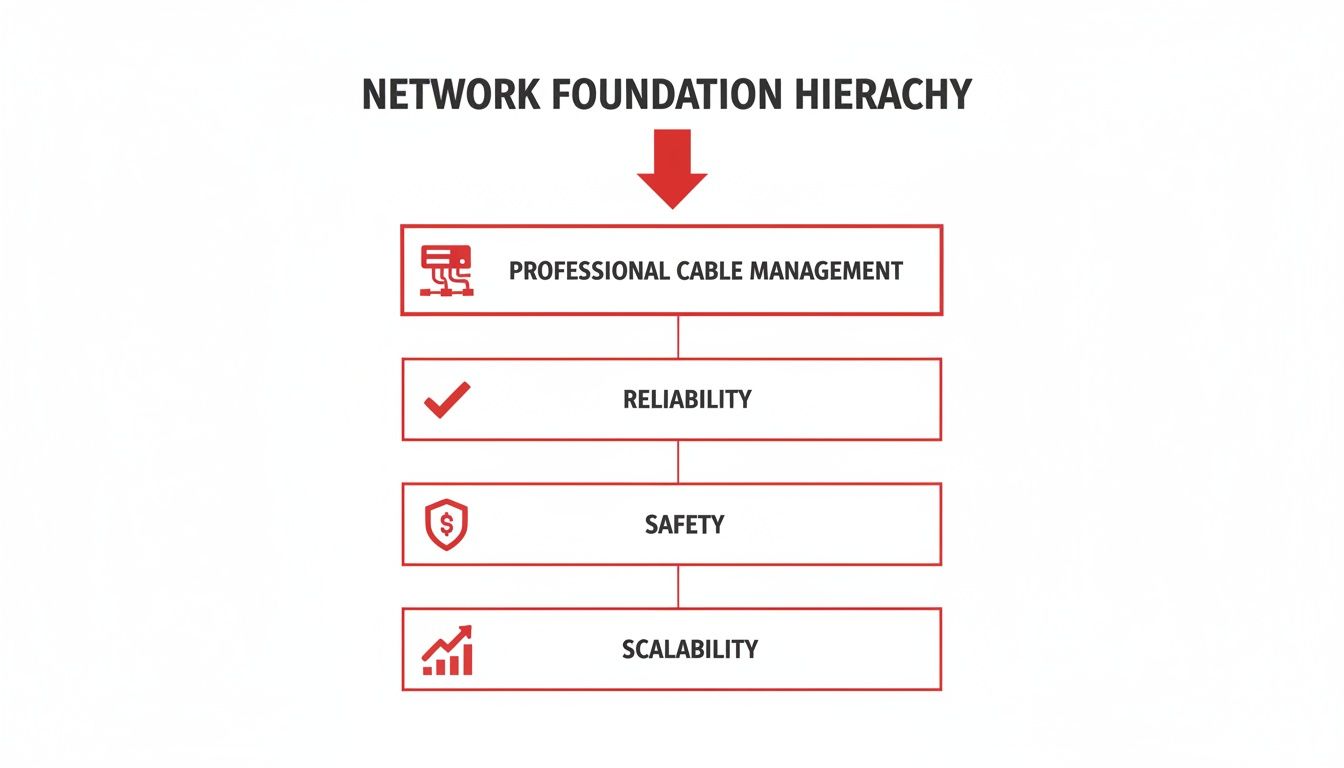
As you can see, without a professional cabling strategy at its core, achieving true network reliability, safety, and scalability is next to impossible. It's the layer that everything else depends on.
Why Standardization Is a Game-Changer
The real magic of structured cabling comes from following industry standards, like those from the Telecommunications Industry Association (TIA). These standards define everything from cable performance and connection types to proper installation and testing methods.
By sticking to a standardized methodology, you turn your cabling from a potential liability into a predictable, long-lasting asset. It guarantees that equipment from different vendors will play nice together and ensures your infrastructure can handle the demands of tomorrow's applications.
This commitment to standards has a direct impact on your bottom line. A non-standard, "wild west" cabling setup leads to constant reactive fixes and frustrating downtime. In contrast, a well-designed, structured network dramatically lowers the total cost of ownership by making moves, adds, and changes (MACs) simple and fast. For a deeper look at what goes into these systems, feel free to check out our complete guide on network cabling infrastructures.
Ultimately, this blueprint is about turning a common point of failure into a source of strength. By implementing a thoughtful cable management Meriden strategy built on structured design principles, you get a network that is not just organized, but inherently more reliable and manageable. It’s what allows your infrastructure to expand gracefully instead of requiring disruptive, costly overhauls.
Designing Pathways for Peak Performance and Safety
The best networks are built on a solid foundation, and that foundation is laid long before the first cable is ever pulled. Strategic design of the physical pathways—the highways your data will travel on—is the practical side of professional cable management Meriden leaders simply can't afford to ignore. This isn't just about making things look tidy; it's about engineering a protected, accessible, and compliant environment for your most critical infrastructure.
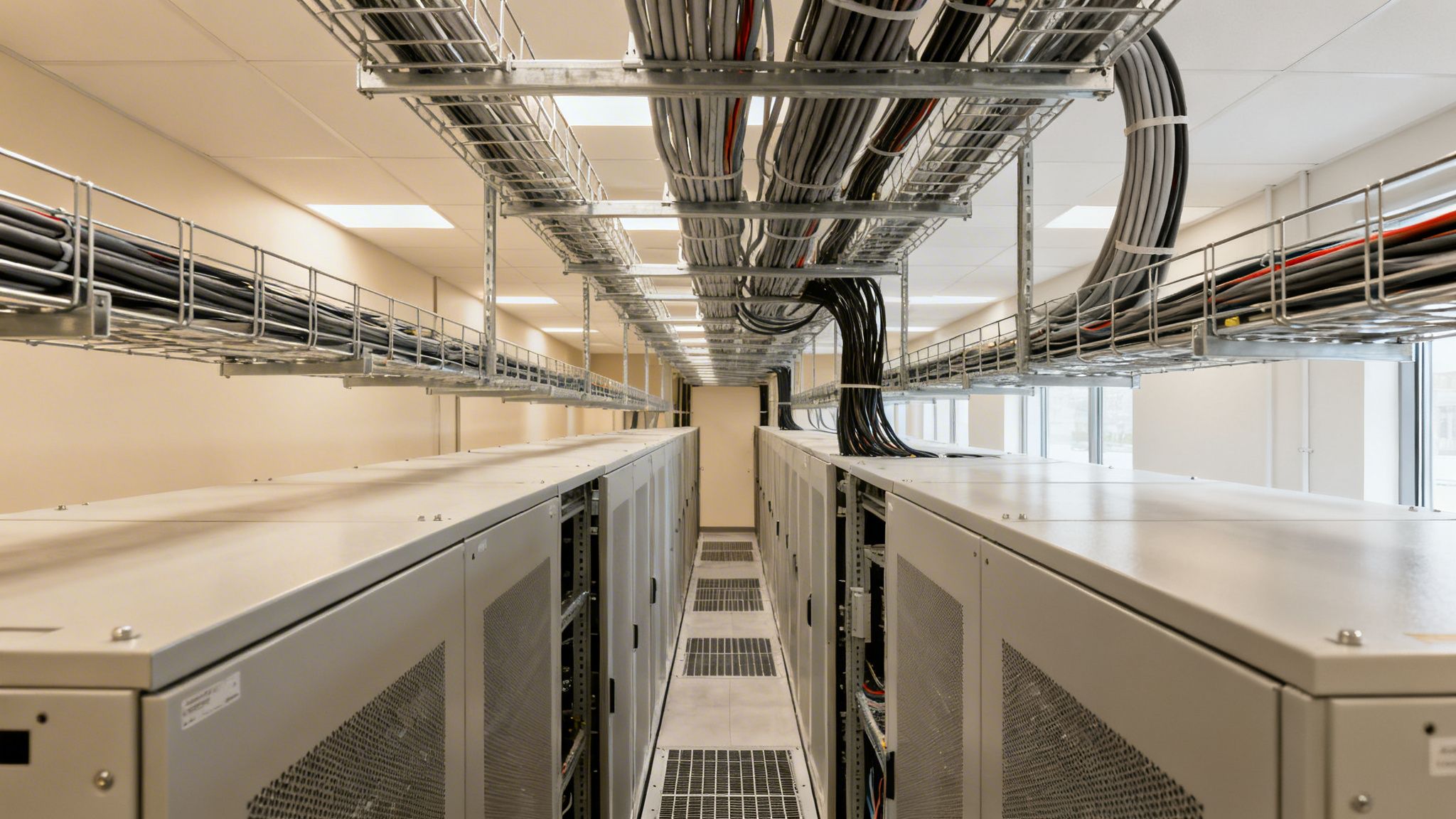
Think of it as architectural planning for your data. A building needs hallways and corridors for people to move safely and efficiently. In the same way, your network needs conduits, cable trays, and raceways to shield cabling from physical damage, electromagnetic interference (EMI), and other hazards. Getting this right from the start turns what could be a series of reactive, costly fixes into a proactive, intelligent strategy.
Planning Your Physical Infrastructure
Effective pathway planning means thinking in three dimensions. You have to consider everything from ceiling heights and floor voids to the specific routes your backbone and horizontal cabling will take. The objective is always to create clean, direct, and accessible pathways.
Three primary tools help us build these data highways:
- Conduits: These enclosed tubes offer the highest degree of protection. We use them to shield cables from moisture, dust, and physical impact, especially for runs through walls, under floors, or in tough industrial settings.
- Cable Trays: You see these everywhere in modern data centers and telecom rooms. They are open, ladder-like structures that support large bundles of cable overhead or under raised floors, providing great support and crucial airflow.
- Raceways: These are surface-mounted channels that offer a clean and secure path for cables along walls or ceilings. For situations where you need both protection and a professional look, understanding different solutions like raceway cable management is key.
The financial incentive for getting this right is massive. The global cable management market is projected to grow from USD 19.65 billion in 2026 to an estimated USD 31.57 billion by 2031. That growth is fueled by real-world results: proper management can cut maintenance costs by 25% and, for large-scale data centers, even reduce deployment times by 30%. You can dig deeper into how expert partners are shaping the industry by reviewing insights on the cable management market.
Server Rack and Cabinet Layout Best Practices
Nowhere is smart pathway design more critical than inside a data center or network closet. The physical layout of your server racks and cabinets has a direct and immediate impact on performance, cooling efficiency, and how easy (or difficult) it is to perform maintenance. The goal is to promote optimal airflow and prevent equipment from overheating—one of the leading causes of premature hardware failure.
One of the most effective strategies we implement is the hot aisle/cold aisle configuration. It’s a simple concept with a powerful impact.
- Arrange Racks in Rows: We position racks in parallel rows, with their fronts facing each other and their backs facing each other.
- Create Cold Aisles: The aisles where the fronts of the racks face off become the "cold aisles." This is where your cooling systems deliver cold air for the equipment to breathe in.
- Establish Hot Aisles: The aisles behind the racks become the "hot aisles." This is where the servers exhaust all their hot air, which can then be efficiently captured and returned to the cooling units.
This simple but brilliant design stops hot exhaust air from one row of servers from being sucked right into the intake of the next row. This separation dramatically improves cooling efficiency, which in turn lowers energy bills and extends the lifespan of your expensive hardware.
By focusing on intelligent pathway design and strategic rack layouts from the outset, you build a physical network that’s not just powerful, but also safe, compliant with local Meriden codes, and far easier to manage for years to come.
Mastering Your Network with Labeling and Documentation
Imagine an electrician wiring a new skyscraper but leaving every circuit breaker unlabeled. The building might have power, but the first time a fuse blows, it’s a maintenance nightmare. That exact scenario plays out every day in telecom closets and data centers. A perfectly installed cabling system is almost useless if no one can identify what goes where.
This is where the real professional work begins. The final, critical steps of labeling, testing, and documentation are what turn a cabling project from a short-term fix into a long-term, manageable asset. The goal is to transform a chaotic troubleshooting search into a quick, targeted repair.

The Power of Standardized Labeling
Putting a sticker on a wire isn’t a labeling strategy. A real strategy involves a logical, standardized system that anyone on your team can understand at a glance, now and in the future. Informal methods like "Bob's office" or "Server 2" seem fine at first, but they fall apart the moment your network grows or staff changes.
This is precisely why we rely on industry standards like TIA-606. This isn't just a suggestion; it's a proven, scalable framework for identifying every component in your infrastructure, from the patch panel port right down to the work area outlet. Each cable gets a unique identifier that acts like a GPS coordinate, pinpointing its origin and destination on your network map.
A TIA-606 compliant labeling scheme means a technician can walk into a telecom closet, look at a cable, and immediately know which port it connects to, what floor it serves, and which specific user outlet it terminates at. This level of clarity reduces mean-time-to-repair (MTTR) by up to 80%.
Choosing the right labeling method from the start is critical. While a quick, informal system might seem faster initially, a standardized approach provides far greater value and prevents massive headaches down the road.
Comparing Cable Labeling Approaches
| Labeling Method | Pros | Cons | Best For |
|---|---|---|---|
| Informal (e.g., markers, handwritten tags) | Cheap and fast for very small jobs. | Inconsistent, not scalable, hard to read, fades over time. No shared logic. | A handful of cables in a home office. Not for professional environments. |
| Simple Sequential Numbering | Easy to implement initially. Better than nothing. | Lacks context. Number "142" means nothing without a separate, often lost, spreadsheet. | Small, static environments where no changes are ever expected. |
| TIA-606 Standard | Scalable, logical, and universally understood. Provides clear location and connection data on the label itself. | Requires upfront planning and a disciplined process to implement correctly. | Any professional network, from small businesses to large data centers and ISP infrastructure. |
Ultimately, the TIA-606 standard is the only method that treats your network infrastructure as the critical asset it is, ensuring it remains manageable and serviceable for its entire lifecycle.
Why Testing and Certification Are Non-Negotiable
You don’t install high-performance Cat6a or fiber optic cabling just to hope it delivers the gigabit speeds you paid for. You have to prove it. Performance testing and certification are the only ways to guarantee your physical infrastructure meets the required specifications from day one.
We use specialized tools like Fluke network certifiers to send signals through each cable, measuring a host of critical performance metrics:
- Bandwidth: Can the cable actually handle the required data throughput?
- Crosstalk: Is signal bleed from adjacent cables corrupting data?
- Signal Loss: Is the signal degrading too much over the length of the run?
- Return Loss: Are poor connections causing signals to reflect back to the source?
Passing these tests generates a certification report—an ironclad guarantee that the installed link performs exactly as designed. Without this proof, you’re flying blind and leaving your network open to subtle, intermittent problems that are a nightmare to diagnose later.
The Master Blueprint: As-Built Documentation
Finally, every piece of the puzzle—the pathways, the installations, the labels, and the test results—must be captured in comprehensive as-built documentation. This is the master blueprint of your network, a detailed record that shows exactly what was installed and where.
This is far more than a simple diagram. A proper as-built package includes detailed floor plans showing cable pathways, rack elevations illustrating equipment layouts, a complete cross-connect list of all labeled connections, and the certification reports for every single cable. This living document empowers your team to perform maintenance, moves, and upgrades efficiently and safely for years to come. To get a better sense of what this entails, you can learn more about what as-built documentation is and why it's so valuable. It’s the definitive guide that ensures consistency and prevents costly mistakes long after the initial project is complete.
Budgeting for Long-Term Value in Cable Management
It's tempting to look at the bottom line of a cabling proposal and just go with the lowest number. But when it comes to your network's foundation, the initial price tag tells only a fraction of the story. The real financial picture is about the total cost of ownership—what you’ll spend over the entire life of your infrastructure.
Thinking about cable management meriden projects this way helps you spot the difference between a cheap bid and a high-value one. A lowball offer might save a little now, but it often leads to a future filled with expensive downtime, frustrating troubleshooting, and painful upgrades. A strategic investment, on the other hand, pays for itself many times over in smooth operations and solid performance.
Breaking Down the Costs
So, what actually goes into a professional cabling budget? Understanding these core components is the key to evaluating proposals fairly and making a decision that protects your network for the long run.
Essentially, every project budget boils down to three main areas:
- Materials and Quality: This covers everything from the cables themselves (like Cat6a versus fiber optics, or plenum-rated cables for fire safety) to the pathways and termination hardware. Higher-quality components do cost more upfront, but they deliver the performance and durability you need.
- Labor and Expertise: This is the cost of having skilled technicians design, install, test, and document the system correctly. You're not just paying for hands; you're paying for experience that prevents costly mistakes and ensures everything is up to code.
- Project Scale and Complexity: The size of your facility, the number of cable drops, and the working environment all play a huge role. A sprawling, active data center is a completely different ballgame than a simple office build-out.
Focusing only on the initial quote is a critical mistake. The real value is found in a project that minimizes future maintenance costs, prevents downtime, and makes it easy to scale—saving you far more money over the system's lifecycle.
This shift toward long-term thinking is happening everywhere. The global market for wire and cable management is expected to jump from USD 26.44 billion in 2025 to USD 39.55 billion by 2030. It’s no wonder, when you consider that poor cable management is directly responsible for up to 30% of network failures, while meticulous planning can cut installation times by a staggering 40%. You can dig into more industry data by reviewing market research on wire and cable management.
The Local Know-How That Saves You Money in Meriden
Beyond the standard costs of materials and labor, running a project in the Meriden area comes with its own set of challenges. If not handled by someone who knows the local landscape, these hurdles can throw your budget and timeline completely off course.
Two of the biggest local factors are permitting and utility coordination.
- Local Permitting: Any significant infrastructure work has to meet Meriden's specific building and electrical codes. A partner who already knows these regulations inside and out will design a compliant system from day one. That proactive approach helps you avoid failed inspections and costly rework orders that can put your project on hold for weeks.
- Utility Coordination: If you’re running fiber between buildings or doing any other outside plant (OSP) work, you have to coordinate with local utilities like Eversource Energy. A contractor with established relationships can navigate this process efficiently, securing the right approvals and preventing delays that could jeopardize your entire schedule.
By partnering with a team that has this local expertise, your cable management Meriden project stays on track and on budget. That foresight turns a potential headache into a predictable, well-managed investment in your network's future.
Choosing the Right Partner for Your Meriden Project
All the standards, best practices, and meticulous planning we've discussed come down to one thing: execution. The success of your network infrastructure hinges on the team you trust to bring it to life. For your cable management Meriden project, picking the right expert is the most critical decision you'll make.
Think of it this way: you wouldn't hire a deck builder to construct a hospital. You need a partner with proven experience in projects of similar scale and complexity. For your network, this means finding a team that lives and breathes this work, from the first blueprint to the final network test.
Evaluating Potential Vendors
When you start looking at potential partners, it’s easy to get fixated on the price tag. But a low bid can hide a world of future problems. A truly qualified vendor offers something far more valuable: complete accountability for the entire project.
So, what should you really be looking for? Here's a checklist to help you gauge a vendor's true expertise:
- Initial Design and Engineering: Do they create detailed, standards-compliant plans that account for airflow, physical pathways, and future expansion from day one?
- Local Permitting and Coordination: Have they successfully navigated Meriden's specific building codes before? Do they have relationships with local utilities to keep your project on schedule?
- Advanced Technical Skills: Are their technicians certified in critical skills like fiber optic splicing, termination, and performance testing? Ask for proof.
- Meticulous Documentation: Will they deliver a complete set of as-built documents, including rack elevations, pathway maps, and detailed test reports for every single cable?
A partner who checks all these boxes isn't just installing equipment; they're delivering certainty. For a more detailed breakdown of what separates the pros from the rest, our guide on selecting cable contractor companies is a great resource.
The Value of a Single Source of Accountability
At the end of the day, you want a turnkey partner—one team that takes full ownership of the project's success. This approach eliminates the frustrating blame game that can happen when you're juggling multiple subcontractors. When a single team handles everything from design and permitting to installation and final testing, the result is a project delivered on time and built to last.
A partner with end-to-end capabilities doesn’t just install cables; they build a reliable, high-performance asset for your business. They guarantee your network’s physical foundation is strong enough to support your goals for years to come.
By choosing a partner who understands every phase of the project, you ensure your investment in professional cable management pays off. It’s how you guarantee your Meriden facility is equipped with an infrastructure that not only works today but is ready for whatever comes next.
Your Cable Management Questions, Answered
If you're responsible for telecom, ISP, or data center infrastructure in the Meriden area, you've likely got questions about professional cable management. We hear these a lot from local stakeholders, so let's get you some clear, practical answers.
Does Professional Cable Management Actually Affect Network Speed?
Absolutely. It’s all about protecting the integrity of the signal traveling through your network. Think about it: when data cables are kinked, bent too sharply, or run parallel to high-voltage lines, it’s like trying to have a clear conversation next to a jackhammer.
This creates signal "noise" and interference—a problem technicians call crosstalk. Crosstalk leads directly to data errors and packet loss. Your network hardware then has to work overtime to retransmit all that lost data, which your users experience as lag, slow file transfers, and dropped connections.
A professionally managed system respects the physical limits of the cable, like minimum bend radii, and ensures proper separation from power sources. This is how you guarantee your Cat6a or fiber optic cabling delivers the full, peak performance it was designed for, protecting your investment from day one.
Proper cable management in Meriden isn't just about looks; it's fundamental to preserving the quality of every data packet that zips through your infrastructure.
What's the Difference Between Structured Cabling and Just Tidying Up?
This is a fantastic question because the difference is massive. Cable tidying is a purely aesthetic, temporary fix. It’s like using velcro straps to bundle the "spaghetti" behind a server rack. It might look a little neater for a while, but it solves zero underlying issues with performance or scalability.
Structured cabling, on the other hand, is a disciplined, engineered approach. It’s a standardized methodology for designing and installing your entire physical network infrastructure from the ground up. This system includes:
- Designated Pathways: Using purpose-built conduits and cable trays to protect and route cables safely.
- Specific Hardware: Implementing patch panels, racks, and termination blocks in a logical, organized way.
- Detailed Documentation: Creating a complete map of your network with plans, labels, and certified test results.
Tidying up makes a rack look clean today. A structured system guarantees that your network is reliable, easy to troubleshoot, and ready to grow for years to come.
Can't Our Internal IT Team Handle Cable Management?
While your internal IT team is fantastic at managing the active side of your network—the servers, switches, and software—a large-scale physical infrastructure project is a completely different animal. It demands a highly specialized skill set.
Professional cabling partners are experts in infrastructure design and live and breathe local Meriden building and electrical codes. They also bring specialized certification tools to the job to test and guarantee that every single cable meets strict performance standards.
By bringing in a specialist, you ensure the very foundation of your network is built correctly and to code. This frees up your invaluable IT team to focus on their core mission instead of getting tangled up in a complex construction project.
What's the Real ROI on Professional Cable Management?
The return on investment for professional cable management is found in a dramatic reduction in long-term operational costs. The financial upside is clear and measurable.
First and foremost, it minimizes network downtime. For most businesses, an outage can cost thousands of dollars per hour in lost productivity and revenue. A stable physical layer is your best insurance against that. Second, it makes troubleshooting and maintenance incredibly fast, cutting down "mean time to repair" from hours to minutes. This frees up your IT staff for strategic work instead of hunting for a single faulty cable.
Beyond that, a well-documented and scalable system makes future upgrades or expansions faster and far less expensive. The initial investment in professional management pays for itself over and over through rock-solid reliability, operational efficiency, and an infrastructure that’s truly ready for whatever comes next.
Ready to build a network foundation that’s reliable, scalable, and easy to manage? The experts at Southern Tier Resources provide end-to-end engineering, installation, and maintenance for telecom and data center projects. Discover how our turnkey solutions can benefit your Meriden facility.