A rollout can look healthy on paper and still miss the date that matters. The permits are moving. Materials are ordered. The RF plan is approved. Then one subcontracted crew fails a safety audit, another can’t produce current certifications, and a third disappears after saying they can mobilize “next week.” The tower is standing still, your market launch is not.
That’s the reality many carriers, tower owners, and broadband teams are dealing with right now. The constraint often isn’t steel, fiber, or radios. It’s whether you have cell tower installers who can carry a project from site walk to closeout without creating rework, compliance exposure, or schedule chaos.
Your Network Rollout Depends on More Than Just Towers
The problem usually shows up late. A market team thinks it has a construction issue, but the root cause is often partner quality. One crew can climb but can’t document. Another can pull cable but struggles with grounding. A low-bid installer says yes to every scope item, then starts asking basic questions once the permit is approved and the clock is already running.

That isn’t a one-off procurement headache. It reflects a broader labor and quality problem. The industry is dealing with a shortage of qualified technicians, along with falsified certifications and unreliable “have crew, will travel” outfits, as noted in this review of communication tower workforce challenges. For owners and operators, that shows up as delayed milestones, safety exposure, and uneven workmanship.
What goes wrong in the field
A site can slip for reasons that never appear in the original bid package:
- Crew quality mismatch: The team assigned to your site may not have the certifications or experience the estimator implied.
- Weak supervision: Without a disciplined foreman and project manager, handoffs between civil, electrical, and RF work break down fast.
- Incomplete closeout: The physical install may be done, but missing documentation can still block turnover and payment.
- Safety shortcuts: In tower work, small shortcuts become major liabilities.
Practical rule: If an installer can’t prove who will be on your site, what they’re certified to do, and how they report progress, you’re not hiring capacity. You’re buying uncertainty.
Why installer selection is a strategic decision
A tower project isn’t won at award. It’s won when the right team shows up prepared, executes to spec, and closes cleanly. That’s why selecting cell tower installers shouldn’t sit in a commodity procurement bucket.
The right partner protects schedule, quality, safety, and operating performance at the same time. The wrong one creates a chain reaction. Construction slips into commissioning. Commissioning slips into launch. Launch slips into revenue, customer experience, and credibility with internal stakeholders.
Beyond Climbing The True Scope of a Cell Tower Installer
Many buyers still picture a tower installer as a climber with a harness and a bag of tools. That’s one piece of the work, but it’s a narrow view of what modern projects require. In practice, today’s cell tower installers function more like specialized general contractors for wireless infrastructure.
They don’t just go vertical. They coordinate civil prep, structural assembly, grounding, power integration, fiber and coax routing, equipment mounting, testing support, punch lists, and documentation. On a good project, those moving parts feel synchronized. On a poorly managed one, every discipline waits on the other.
The workforce grew because the work got broader
The profession expanded sharply during the 4G build cycle. WirelessEstimator.com reported that the number of tower climbers in the U.S. grew from about 9,800 in 2006 to over 29,000 by 2015 as LTE deployment drove tower erection, antenna installs, and retrofit work across the country, according to this industry workforce study.
That growth matters because it changed the job itself. The market didn’t just need more climbers. It needed more teams who could handle integrated scopes, carrier standards, and complex upgrades on live networks.
What a complete installer team actually covers
A capable installer organization usually spans several functions at once:
- Site and construction management: Someone has to sequence trades, confirm readiness, control change, and keep the owner informed.
- Structural and rigging execution: Tower sections, mounts, and appurtenances have to be assembled and lifted safely and in the right order.
- Electrical and grounding work: Power, bonding, and protection details are not side tasks. They are core reliability items.
- RF and transport integration: Antennas, radios, hybrid lines, coax, and fiber all need disciplined installation practices.
- Testing and turnover support: If the closeout package is weak, the project is not finished, no matter what the field crew says.
A strong wireless crew doesn’t just install hardware. It reduces the number of surprises between design intent and on-air acceptance.
The work varies by asset type
Not every wireless job looks like a macro tower build. Cell tower installers may work across:
| Infrastructure type | Typical installer focus |
|---|---|
| Macro towers | Structural assembly, antenna swaps, sector adds, shelter or cabinet integration |
| Small cells | Pole work, compact equipment placement, power and fiber coordination, urban permitting support |
| DAS and in-building systems | Structured cable paths, head-end equipment, indoor antenna placement, testing support |
| Upgrades and overlays | Live-site sequencing, cutover planning, minimizing service disruption |
That’s why a one-dimensional crew often struggles. A tower owner may think they’re hiring for climbing, but the actual need is coordinated execution across multiple disciplines.
What works and what doesn’t
What works is a team that understands dependencies before mobilization. They review drawings, validate materials, confirm access, and know where the hold points are.
What doesn’t work is sending a field crew to “figure it out on site.” That approach burns days, creates rework, and puts your most expensive people in reactive mode.
The Seven Stages of the Cell Tower Installation Lifecycle
Most delays start long before steel is in the air. They begin when one stage is treated as separate from the next. In wireless construction, every handoff matters. A missed detail in site planning becomes a permit revision. A permit revision affects foundation timing. A foundation slip pushes the lift plan. Then the equipment crew loses its window.
The lifecycle is easiest to manage when one team owns the sequence end to end.
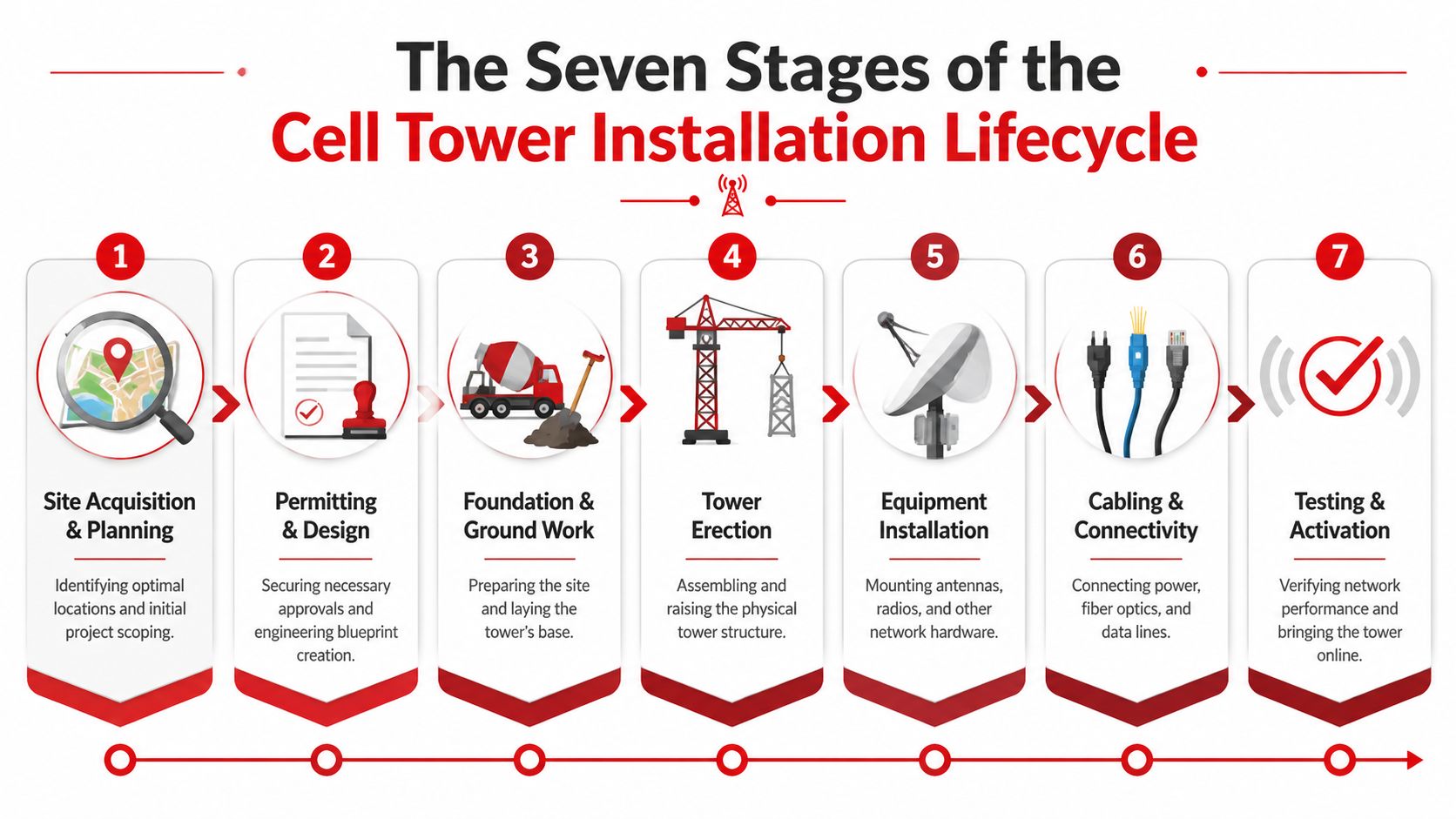
Stage 1 Site acquisition and feasibility analysis
The first question isn’t “Can we build here?” It’s “Should we build here?” That means validating land access, utility availability, route logistics, zoning context, and whether the location supports the coverage objective without creating downstream problems.
Tower type changes that analysis immediately. A monopole can require as little as 600 square feet, while a guyed tower can require up to 20 acres because of guy wire anchors, according to this tower planning checklist. That difference affects land strategy, neighbor exposure, and entitlement risk from the first site walk.
For teams working in mixed portfolios, external location intelligence also helps. Resources on finding mobile mast locations can be useful for understanding how existing infrastructure visibility supports planning and collocation thinking in real projects.
Stage 2 Zoning permitting and community engagement
Many schedules become fictional. A site may be technically feasible and still become politically difficult.
Public input under Section 106 of the National Historic Preservation Act is often underestimated, especially near homes, schools, or historically sensitive areas. This overview of cell tower placement and consultation requirements is a good reminder that community engagement and historic review are not paperwork formalities. Mishandle them, and the schedule moves backward.
What works here is early transparency. Owners who answer basic questions about location, design, access, and visual impact before opposition hardens usually avoid a lot of churn.
Stage 3 Site engineering and foundation construction
Once the site is viable and approvals are advancing, engineering needs to translate field reality into something buildable. Survey data, geotechnical conditions, setbacks, structural loads, drainage, and utility routing all meet here.
This stage often exposes whether the estimating team accurately understood the site. Tight urban lots, rooftop constraints, remote access roads, and poor soil conditions all change means and methods. If the installer didn’t catch those variables early, field productivity suffers and change orders start arriving.
A disciplined partner also uses this stage to align procurement with the construction sequence. That sounds basic, but projects still stall every week because the wrong mount, connector, or grounding component shows up late.
Stage 4 Tower erection and assembly
This is the visible part of the project, but it’s not where successful jobs are won. It’s where earlier planning gets tested.
Lift plans, crane access, rigging methods, weather windows, and crew competency all matter. So does discipline around laydown areas and component verification. If sections arrive damaged or mislabeled, the tower crew becomes an expensive waiting party.
Field reality: The safest erection day usually looks uneventful. The crew knows the lift sequence, the ground team controls materials, and no one improvises under pressure.
This is also the point where an integrated construction partner earns its keep. When engineering, logistics, and field supervision sit under one roof, problems get resolved faster. A practical example is a provider that manages build sequencing and documentation through a single workflow, such as this wireless construction capability page.
Later in the process, this visual summary is useful for owners who need a quick reference before field mobilization.
Stage 5 Antenna and coax or fiber integration
After the structure is ready, the equipment phase begins. Antennas, radios, mounts, feeders, hybrid cables, fiber, and weatherproofing details all have to be installed to spec.
Mediocre crews often look busy while creating future trouble. Poor cable support, weak labeling, inconsistent torque practices, and sloppy weather sealing don’t always fail on day one. They fail later, during troubleshooting, optimization, or the first severe weather event.
A good installer works clean. Cable paths are planned, bend radii are respected, drip loops are intentional, and every component is installed so another technician can maintain it later.
Stage 6 System testing optimization and commissioning
Construction teams sometimes treat testing as the owner’s problem. That’s a mistake. A quality installer builds for commissioning from the start.
That means grounding continuity checks, fiber verification, power validation, mechanical inspection, punch correction, and support for RF acceptance. If a crew disappears after installation, internal teams end up spending time on basic field cleanup instead of activation work.
Stage 7 Project closeout and as-built documentation
The last phase decides whether the project is complete. As-builts, photo records, material reconciliation, inspection signoffs, and closeout packages are what allow operations teams to own the asset with confidence.
Weak closeout creates a long tail of confusion. Future crews don’t know what was installed. Maintenance teams inherit undocumented deviations. Audits take longer than they should. The project may be built, but it still isn’t operationally clean.
Your Vetting Checklist How to Select the Right Installer
Most procurement teams can compare pricing. Fewer can separate a capable wireless construction partner from a crew broker with a polished proposal. That distinction matters more now because labor shortages have made weak operators better at marketing than at delivery.
The selection process should be treated like risk control. You are not just buying labor. You’re choosing who will represent your standards in the field, who will interact with permitting bodies and property stakeholders, and who will hand over an asset your operations team has to live with.
Start with proof not promises
Any installer can say they value safety and quality. Ask for records, training evidence, and examples of comparable scope. If the answers stay vague, that’s useful information.
Regulatory complexity is one of the fastest ways to expose weak partners. Public input under Section 106 can become a real schedule issue when an installer doesn’t understand how to support community engagement and historic consultation requirements. Experienced teams account for that early instead of acting surprised later.
For procurement leaders who want a broader framework for structuring oversight, these vendor management best practices are a helpful companion to tower-specific due diligence.
The questions serious buyers ask
Use interviews and bid reviews to pressure-test how the installer operates:
- Who will supervise the job? Ask for names, roles, and reporting lines, not just company bios.
- How do you verify certifications? A real partner should have a process, not a shrug.
- What similar work have you completed? Similar means similar asset type, jurisdiction, and technical scope.
- How do you manage documentation? If closeout is an afterthought, expect pain at turnover.
- How do you handle scope change? Good teams escalate quickly and document impact before rework spreads.
“Low price only helps if the crew can finish the site without creating a second project for someone else.”
Installer partner vetting checklist
| Criteria | What to Look For | Red Flags |
|---|---|---|
| Safety discipline | Current safety program, site-specific planning, clear escalation path, documented compliance practices | Generic safety language, missing records, reluctance to discuss incident handling |
| Certification control | Verifiable technician credentials, current training records, named personnel for your scope | “We’ll send whoever is available,” inconsistent paperwork, unclear expiration tracking |
| Relevant experience | Work history on comparable macro, small cell, or upgrade programs in similar environments | Broad claims with no project detail, examples that don’t match your scope |
| Project management | Regular updates, issue logs, schedule visibility, disciplined submittal and closeout process | Reactive communication, no defined reporting rhythm, poor document control |
| Permitting support | Practical understanding of zoning, landlord coordination, and consultation workflows | Treating approvals as someone else’s problem |
| Mobilization capacity | Crews, equipment access, and realistic scheduling commitments | Overpromising start dates, vague resourcing answers |
| Quality control | Inspection routines, punch management, photo documentation, as-built accuracy | “We fix it if someone finds it,” no formal QA process |
| Accountability model | Clear single point of contact and defined ownership across phases | Multiple handoffs, unclear responsibility, broker-style staffing |
Choose a partner who can be audited
The best installers are easy to inspect. They can show you how they track qualifications, how they document field conditions, and how they keep project information current. That matters as much as technical skill.
If you want a practical benchmark for what verifiable field readiness can look like, this qualification and verification resource is the kind of material buyers should ask any prospective partner to provide in some form.
Decoding Costs Timelines and Critical Project Risks
Buyers always ask two fair questions. What’s this really going to cost, and how long is it going to take? The honest answer is that budget and duration are driven less by the drawing set than by field conditions, permitting friction, and installer quality.
That’s why early pricing and schedules should be treated as working assumptions until the site has been properly validated. On stable projects, that discipline prevents surprises. On difficult projects, it prevents self-inflicted surprises.

What usually moves cost
Even without assigning generic market numbers, the major cost drivers are consistent:
- Site access and logistics: Remote or constrained sites require more planning, staging, and equipment coordination.
- Foundation and civil complexity: Soil conditions, grading requirements, and drainage solutions can materially change the build.
- Tower type and equipment load: Structural scope affects steel, rigging, labor, and inspection demands.
- Permitting conditions: Jurisdictional requirements can add redesign, hearing support, or additional studies.
- Rework exposure: The cheapest proposal becomes expensive quickly if the crew installs to the wrong standard.
A useful way to discuss scope assumptions internally is to anchor them to documented service categories rather than optimistic line items. This construction cost and scope overview is the kind of reference that helps teams align budget discussions with actual deliverables.
Schedule risk usually hides in technical details
A project can lose days to weather and weeks to avoidable mistakes. One of the clearest examples is grounding. Professional installers working to AT&T standards use an 8-foot by 5/8-inch metallic ground rod, a minimum #2 AWG bare copper ground ring buried at least 30 inches below final grade, and #6 AWG or larger insulated copper ground wire with bonding by exothermic welds or irreversible connectors, according to AT&T’s cell site customer requirements.
That isn’t a paperwork detail. Improper grounding leads to equipment damage, signal degradation, and safety risk. When a crew gets grounding wrong, the owner doesn’t just pay for correction. The owner pays in troubleshooting time, delayed turnover, and reduced confidence in everything else that crew touched.
Risk view: The most expensive defect is often the one that passes a casual visual inspection and fails later under load, weather, or commissioning.
The three risks that hurt the most
| Risk area | How it shows up | What reduces it |
|---|---|---|
| Safety failure | Site shutdowns, crew replacement, owner exposure | Verified training, disciplined supervision, real pre-task planning |
| Quality failure | Punch growth, failed acceptance, repeat visits | Standardized installation methods, inspection routines, documentation |
| Compliance failure | Permit issues, turnover delays, stakeholder conflict | Early review of requirements, experienced PM oversight, complete closeout |
For teams that want to sharpen how they think about control measures beyond construction alone, broader frameworks around risk security management can help structure owner-side governance and escalation.
What works in the field is simple to describe and hard to fake. Experienced installers don’t rush technical details that affect long-term performance. In telecom, that patience is often what protects both timeline and budget.
The Southern Tier Resources Advantage An End-to-End Partner
The safest way to control a difficult wireless project is to reduce the number of disconnected parties who can create handoff failure. That’s the practical case for an end-to-end model.
Southern Tier Resources operates as a telecom infrastructure partner across engineering, construction, maintenance, fiber work, wireless deployment, and documentation. For carriers, ISPs, tower companies, and data center operators, that matters because the build doesn’t stop at a single discipline. It moves across design interpretation, field execution, testing support, and closeout.
Why the model fits the current market
The labor shortage has made fragmented delivery riskier. If one subcontractor drops out or underperforms, the owner spends time rebuilding the project structure instead of moving the site forward. An integrated partner reduces that exposure by keeping accountability in one place.
Southern Tier Resources also brings 20+ years of experience in network infrastructure delivery, along with a stated safety-first culture, skilled crews, 24/7 mobilization, and support for as-built documentation across the project lifecycle. In practical terms, those traits address the exact failure points that derail wireless programs: weak field readiness, unclear ownership, and incomplete turnover.
What end-to-end accountability changes
A single accountable partner improves performance in a few specific ways:
- Fewer handoff gaps: Engineering intent, field execution, and closeout stay connected.
- Cleaner communication: Owners know who owns the answer when scope, access, or schedule changes.
- Better schedule protection: Mobilization and sequencing can be managed against the full program, not just one crew’s availability.
- Stronger operational turnover: Documentation is treated as part of delivery, not cleanup after the fact.
The best partner relationship is the one where the owner doesn’t have to arbitrate between vendors to find out what happened on site.
Where this matters most
This model is particularly useful when a program includes multiple asset types, compressed rollout windows, or coordination between wireless and fiber scopes. It also matters when the owner needs a partner who can support both deployment and the less glamorous but essential parts of the work, such as records, testing support, and ongoing maintenance planning.
That’s not marketing language. It’s a delivery preference shaped by hard lessons in the field. When one partner can carry responsibility across the life of the job, fewer things get lost.
Build Your Network with Confidence
Cell tower projects don’t succeed because a bid was low or a crew said it could mobilize quickly. They succeed because the installer understands the full lifecycle, respects the technical standards that protect the asset, and can prove readiness before arriving on site.
Three ideas should drive your next selection decision.
First, cell tower installers do much more than climb. They coordinate civil work, structural execution, electrical details, equipment integration, testing support, and closeout. Second, vetting matters as much as pricing. Certifications, supervision, documentation discipline, and permitting awareness are the difference between a clean build and a long punch list. Third, an end-to-end delivery model reduces risk because fewer handoffs mean fewer opportunities for schedule slips, rework, and confusion.
In a market where qualified labor is tight and project expectations keep rising, the safest path is to choose a partner that can own the work from planning through turnover. If your team is preparing a macro build, a small cell program, or a wireless upgrade tied to fiber expansion, bring in a partner early and pressure-test how they execute.
If you’re planning your next wireless infrastructure project, Southern Tier Resources can help you evaluate scope, field risk, and delivery strategy before small issues become major delays. Start the conversation early, align the right crews and documentation path, and build with confidence.