Data center cabling solutions are the physical web of fiber optic and copper cables connecting all the servers, storage arrays, and networking gear inside a facility. Think of it as the central nervous system for any digital operation; it dictates the speed, reliability, and ultimate potential of everything from cloud services to AI model training.
Why Strategic Cabling Is the Bedrock of Modern Data Centers
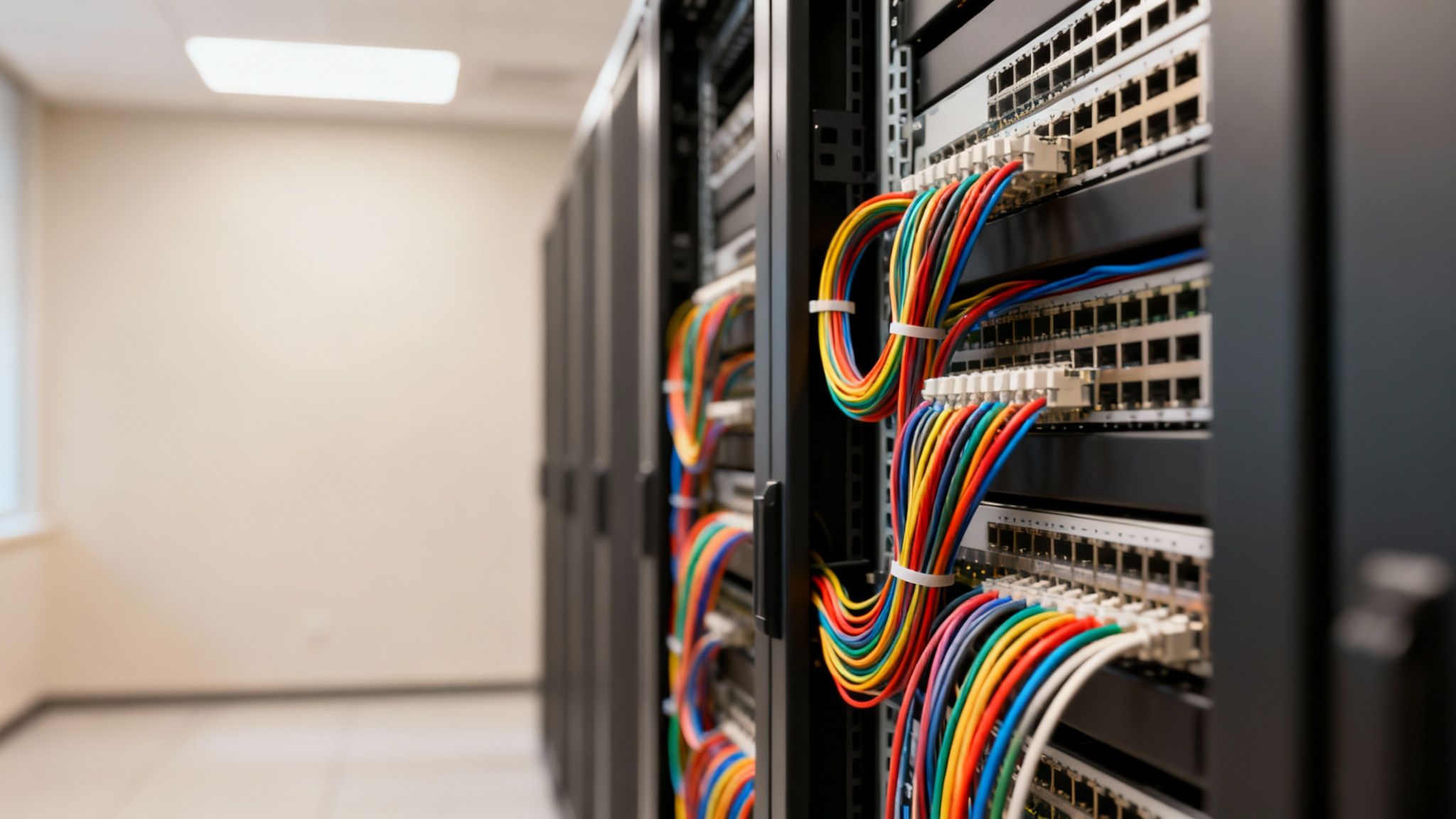
Imagine a data center is a busy city. The servers are the skyscrapers and the switches are the financial exchanges, but the cabling is the hidden network of highways, subways, and power grids that make it all work. If that infrastructure is chaotic and unplanned, the entire city grinds to a halt. The same is true for a data center.
This physical layer is the absolute foundation for every digital service you offer. A haphazard, reactive cabling approach—what we in the industry call "spaghetti cabling"—creates performance bottlenecks, makes troubleshooting a nightmare, and chokes airflow, leading to overheating and costly outages. In stark contrast, a professional structured cabling system provides a clean, organized, and scalable roadmap for all data traffic.
The Impact on Performance and Scalability
Modern workloads, especially in AI and machine learning, are incredibly demanding. An AI cluster might need tens of thousands of GPUs all working together, chattering over ultra-fast 400G or 800G connections. The physical cables are what make this massive, low-latency communication possible.
A thoughtful approach to data center cabling solutions has a direct and measurable impact on your operations:
- Better Performance: The right cables and pathways minimize signal loss and latency, letting your applications run as fast as the hardware allows.
- Easier Maintenance: When everything is labeled and organized, technicians can find, fix, or replace components in minutes, not hours. That means less downtime.
- Future-Proof Growth: Structured cabling is designed for expansion. Adding new racks or upgrading hardware becomes a simple, predictable process instead of a massive rewiring project.
- Smarter Cooling: Neat cable runs improve airflow, which is non-negotiable for cooling high-density racks and preventing heat-related equipment failures.
A well-designed cabling infrastructure isn't just an expense; it's a long-term investment in operational stability and business agility. It ensures that the physical foundation can support the logical demands of today and the unforeseen requirements of tomorrow.
Moving Beyond Point-to-Point Connections
The old method of just running a single cable from one server to one switch port doesn't scale. Structured cabling introduces a much smarter, hierarchical system with dedicated pathways and connection points like patch panels. This creates a modular network that's far easier to manage.
For example, modern systems rely heavily on MPO/MTP (Multi-fiber Push-On) connectors. These allow a technician to plug in a single connector that terminates dozens of fiber strands at once. This kind of innovation is what makes it possible to rapidly deploy the high-density networks inside today's hyperscale data centers.
Ultimately, getting these fundamentals right is the first step toward building a data center that is not only powerful but also resilient and ready for whatever comes next.
Choosing Between Fiber Optic and Copper Cabling
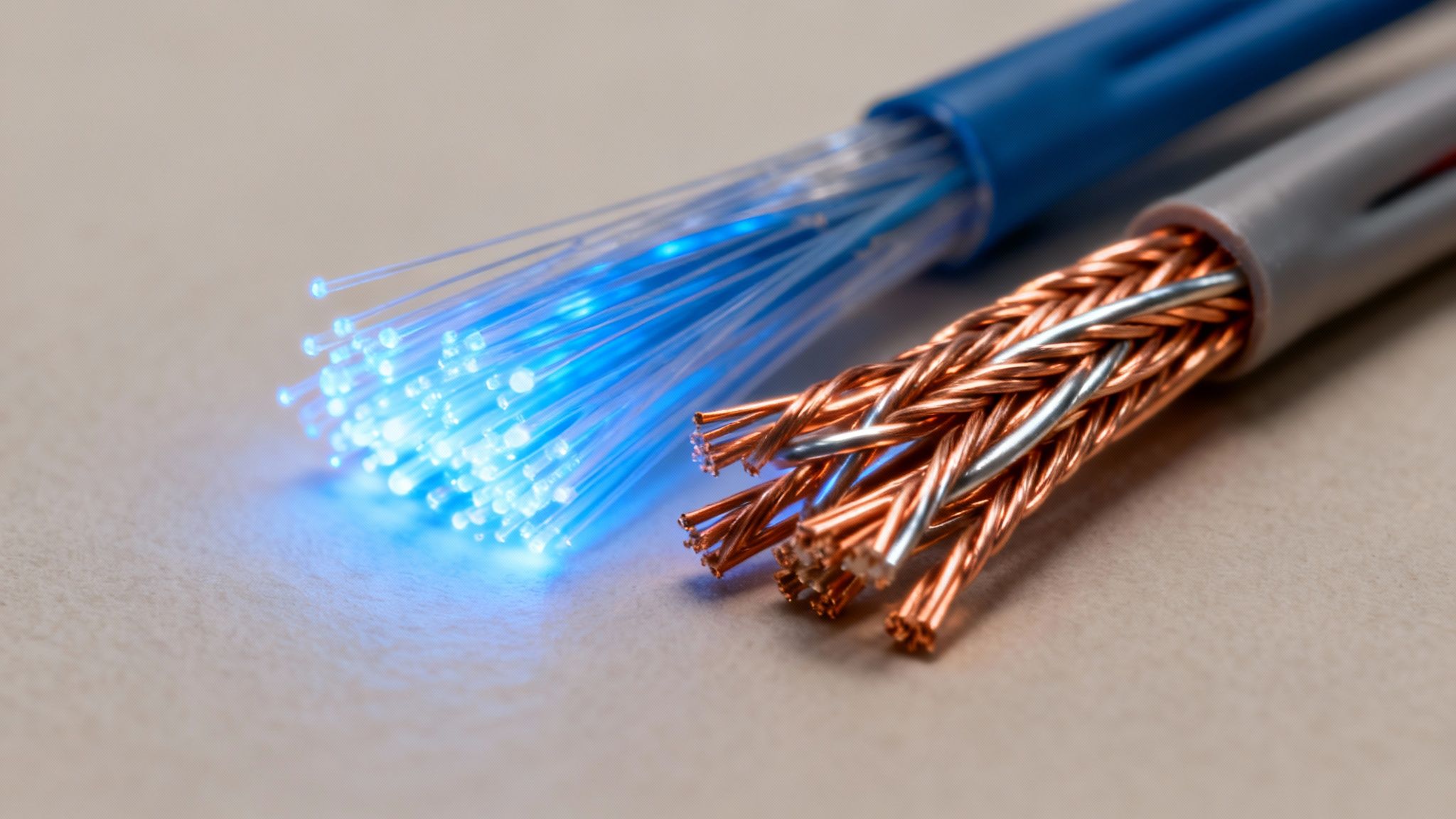
When designing a data center’s physical layer, one of the most fundamental decisions is what kind of cabling to use. The two main players, fiber optics and copper, aren't really rivals. Instead, think of them as specialized tools, each engineered for different tasks within the data center.
Getting this choice wrong can create performance bottlenecks, inflate your budget, and box you in when it's time to scale.
Think of fiber optics as the superhighway of your data center network. It's built for incredible speed over long distances, capable of moving enormous amounts of data with almost no signal loss. This makes it the clear winner for backbone links, like connecting switches or linking entire rows of racks.
On the other hand, traditional copper cabling—like twisted-pair Ethernet—is more like the local city streets. It’s perfect for shorter, high-density connections where cost-effectiveness and easy termination are priorities. A classic example is connecting servers to a Top-of-Rack (ToR) switch just a few feet away.
Understanding Key Performance Drivers
The choice between fiber and copper isn’t random; it comes down to physics and engineering. To build an efficient network, you have to weigh a few critical factors to match the cable to the job.
- Bandwidth Capacity: Fiber optics use light pulses traveling through glass, which allows for vastly higher bandwidth. This is non-negotiable for supporting the 400G and 800G speeds demanded by AI workloads and high-performance computing.
- Distance and Signal Integrity: Copper signals weaken significantly over distance, which strictly limits their reach. Fiber can carry a clean signal for kilometers, making it the only option for connecting different data halls or buildings on a campus.
- Electromagnetic Interference (EMI): Because they carry electrical signals, copper cables can be disrupted by EMI from power lines or heavy machinery, potentially corrupting data. Fiber, made of glass, is completely immune, guaranteeing a stable connection even in electrically noisy environments.
It's no surprise that optical fiber has become the go-to cabling solution in most data centers. In fact, the fiber optic market is projected to grow at an 8.3% CAGR through 2030, far outpacing copper. This trend is a direct result of fiber’s superior performance, as highlighted in this data center cabling market analysis.
Fiber Optic vs Copper Cabling at a Glance
To make the decision clearer, here's a side-by-side comparison of how these two cabling types stack up in a data center environment.
| Attribute | Fiber Optic Cabling | Copper Cabling |
|---|---|---|
| Bandwidth | Extremely high (Terabits per second) | High, but limited (Up to 40 Gbps with Cat8) |
| Max Distance | Kilometers | ~100 meters (30 meters for highest speeds) |
| EMI Immunity | Completely immune | Susceptible to interference |
| Size & Weight | Thin, lightweight, and flexible | Thicker, heavier, and less flexible |
| Security | Very difficult to tap | Can be tapped non-invasively |
| Initial Cost | Higher material and equipment cost | Lower material and equipment cost |
| Installation | Requires specialized tools and skills | Relatively simple and fast to terminate |
| Best For | Backbone, switch-to-switch, long-haul | Server-to-switch (in-rack), patch panels |
This table shows there’s a clear role for each. The key is knowing when and where to deploy them for a balanced, high-performance infrastructure.
The Real-World Application Divide
In any modern data center, you’ll find a hybrid approach. The network backbone—the core and aggregation layers—will be almost exclusively fiber. The speed and data volume flowing through these arteries simply demand it.
But inside a single server rack, using high-category copper like Cat6a or Cat8 for server-to-switch links is often smarter. It’s more cost-effective and much simpler to manage for those short runs.
The goal is to build a cohesive system where each component is optimized for its role. Using fiber for high-speed, long-haul routes and copper for short-reach, high-density connections creates a balanced infrastructure that is both high-performing and economically sound.
This strategic deployment is a core principle of all well-designed network cabling infrastructures, ensuring you get maximum reliability without overspending. It’s not about picking one type over the other; it’s about using them together to build a robust and scalable network.
Understanding Structured Cabling Topologies
Think of a data center's cabling like a city's road system. You wouldn't just build roads randomly; you'd plan a grid to manage the flow of traffic efficiently. In a data center, these planned layouts are called topologies, and they are the strategic blueprints that dictate how every server connects to the network.
Getting this blueprint right is critical. The right topology makes operations smoother, simplifies maintenance, and sets you up for future growth without headaches. A poor choice, on the other hand, can quickly lead to a tangled mess of cables, create airflow and cooling nightmares, and force expensive re-cabling projects down the road. Let's walk through the three most common designs you'll see in the field: Top-of-Rack (ToR), End-of-Row (EoR), and Middle-of-Row (MoR).
The Top-of-Rack (ToR) Approach
Picture each server cabinet as its own self-sufficient unit. In a Top-of-Rack (ToR) design, a network switch is placed right inside each rack, usually at the very top. From there, every server in that rack connects directly to this local switch with short, easy-to-handle patch cords.
This localized approach has some clear benefits:
- Tidy In-Rack Cabling: With servers connecting only to the switch in their own rack, the cables are incredibly short and contained. This drastically cuts down on clutter and makes life much easier for technicians managing connections.
- Faster Intra-Rack Communication: When servers in the same rack need to talk to each other, the data travels a very short distance. This can be a real advantage for specific high-performance computing clusters.
- Scales with Your Budget: You only add a new switch when you add a new rack. This keeps the initial investment lower and lets your network hardware costs grow in lockstep with your server deployment.
The trade-off, however, is that you end up with a lot of switches to manage. This "switch sprawl" can add a layer of operational complexity and increase the overall power draw on the data center floor.
End-of-Row (EoR) and Middle-of-Row (MoR) Designs
Now, imagine a central hub for an entire row of racks. That's the basic idea behind the End-of-Row (EoR) and Middle-of-Row (MoR) topologies. Instead of a switch in every cabinet, all the network hardware is consolidated into a dedicated rack at either the end or the middle of the row.
With an EoR or MoR setup, each server in the row needs a longer cable run back to this central aggregation point. This design choice presents a completely different set of pros and cons compared to ToR.
The core principle of EoR and MoR is to centralize network management by having fewer switches to look after. This simplifies administration but demands a much more disciplined strategy for handling the long cable runs from every server back to that single aggregation rack.
The biggest win here is the reduced switch count. This simplifies network management and can bring down overall hardware and maintenance expenses. It's much easier to push out software updates, enforce security policies, and monitor network health from a handful of locations rather than dozens.
The challenge, of course, is the cabling itself. This approach requires a well-planned system of overhead trays or underfloor pathways to route hundreds of cables from individual servers to the aggregation rack. If not managed perfectly, these bundles can obstruct airflow, and the longer distances might mean you need to invest in more expensive cabling, like fiber optics, to ensure signal quality.
Choosing the Right Topology
There’s no single "best" answer here. The right topology for your facility depends entirely on your operational priorities, budget constraints, and long-term growth plans.
- ToR is often the go-to choice for high-density environments where keeping in-rack cabling simple is the main goal. It's also great for facilities that expect to grow one rack at a time.
- EoR/MoR really shines in large, more static deployments. If centralized network management and a smaller number of switches are more important to you than having short cable runs, this is a very strong option.
At the end of the day, each approach is just a different way to organize the physical pathways for your data. Making the right choice from the start is a foundational step in building a data center that’s both reliable and efficient for years to come.
Navigating Critical Cabling Standards
Think about trying to build a skyscraper without architectural blueprints or engineering codes. The project would be a chaotic, unreliable mess doomed to fail. Data center cabling follows the same logic. Without a common set of rules, creating a stable, high-performance environment is next to impossible. This is precisely why industry standards from organizations like the Telecommunications Industry Association (TIA) and the International Organization for Standardization (ISO) are so crucial.
These standards aren't just polite suggestions; they are the universal language of data center design. A framework like TIA-942, for example, gives you a comprehensive blueprint for everything from physical pathways and redundancy levels to the specific performance criteria for different cable types. When you stick to these guidelines, you ensure every component in your infrastructure can talk to each other effectively, no matter who made it.
The following diagram shows a few common physical layouts used to organize racks and manage data flow, all of which are governed by these foundational standards.
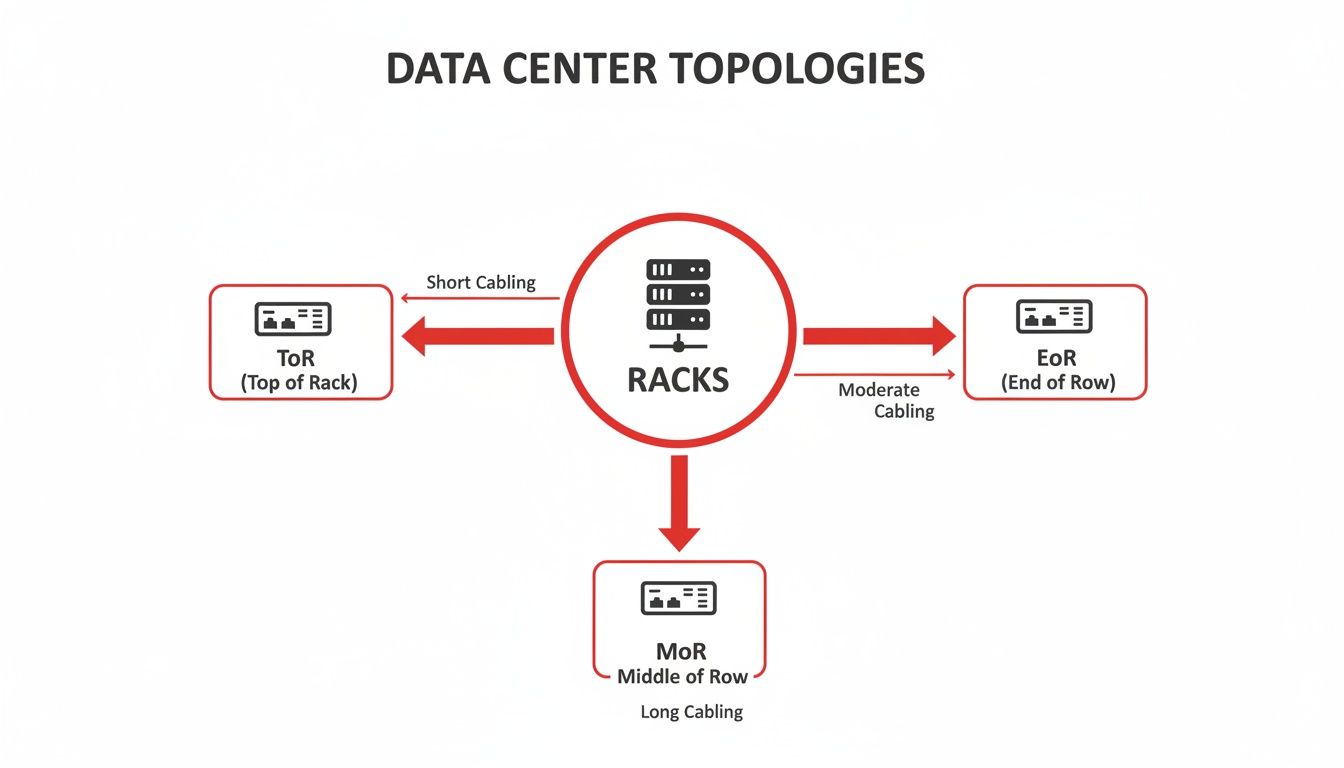
This visual helps illustrate how standards provide a solid framework for deploying organized and scalable designs, moving you away from messy point-to-point connections and toward a structured, manageable system.
The Business Impact of Compliance
Following established standards for data center cabling solutions isn't just a technical box to check—it's a smart business decision that protects your investment. When your infrastructure is built to spec, you gain several powerful advantages that directly affect your bottom line.
- Interoperability and Vendor Neutrality: Standards guarantee that cables, connectors, and hardware from different manufacturers will play nicely together. This frees you from vendor lock-in, giving you the flexibility to choose the best-of-breed solutions for your specific needs.
- Future-Proofing Your Infrastructure: Standards are always developed with an eye toward the future. A TIA-compliant system installed today is built to handle the higher-speed networking equipment of tomorrow, dramatically reducing the need for expensive "rip and replace" upgrades down the road.
- Simplified Troubleshooting and Maintenance: A standardized, well-documented system is infinitely easier to manage. When issues arise, technicians can find and fix them faster because the layout and labeling follow a predictable, logical pattern.
The market itself reflects this growing demand for professionalism. The global data center cabling market is projected to hit roughly USD 18.1 billion by 2035, growing at a CAGR of 8.9%. This trend underscores just how much businesses are relying on expert installation and strict adherence to recognized standards.
Connecting Standards to Performance
At the end of the day, standards exist for one primary reason: to guarantee performance. They define the specific, measurable metrics a cabling link must meet to reliably support everything from cloud services to intensive AI workloads. This is where abstract rules deliver tangible, real-world results.
Compliance isn't about checking boxes on a list. It's about ensuring that your physical layer has the proven signal integrity and bandwidth capacity to run your most critical applications without failure.
For instance, standards dictate maximum cable lengths, acceptable levels of signal loss (attenuation), and minimum resistance to outside electrical noise. By designing and testing against these benchmarks, you can be confident that every connection—whether it's a short copper patch cord inside a rack or a long-haul fiber run between data halls—delivers the speed and stability you expect.
You can learn more about how these frameworks are put into practice by reading our detailed guide to data center cabling standards. This commitment to proven engineering principles is what transforms a simple collection of cables and hardware into a truly resilient, high-performance data center.
Best Practices for Cabling Design and Deployment
A successful data center build-out is about bridging the gap between a high-level blueprint and a flawless on-the-ground reality. It’s where meticulous planning and professional deployment turn a theoretical design into a reliable, high-performance physical infrastructure. In this game, even the smallest details can have massive consequences, and skipping a single step can lead to costly rework and frustrating network headaches down the road.
The key is to treat your cabling infrastructure not as an afterthought but as a critical system with its own lifecycle. This process starts with a thoughtful design that looks ahead to future needs and ends with rigorous testing that guarantees performance from day one. Following best practices is the only sure way to build a foundation that’s scalable, manageable, and ready for whatever comes next.
Critical Design and Planning Considerations
Before you even think about pulling a single cable, you need a rock-solid design that accounts for the physical realities of your data center. This initial planning phase is arguably the most important because it sets the stage for everything that follows. Great design isn't just about connecting Point A to Point B; it’s about creating an efficient, safe, and manageable ecosystem for your data to thrive in.
Here’s what needs to be on your radar:
- Planning Cable Pathways: You need to strategically map out exactly where your cables will run. This means designing overhead trays and underfloor conduits that steer clear of power lines, which can cause electromagnetic interference (EMI) with copper cabling. Well-planned pathways also keep cables safe from physical damage.
- Calculating Cooling and Airflow: Cable density has a direct impact on your thermal management. If you pack bundles of cables too tightly, you can create "air dams" that block the carefully engineered flow of your hot-aisle/cold-aisle containment system. The design must ensure pathways don't get in the way of cool air reaching server intakes.
- Respecting Bend Radius: Every cable, especially fiber optic, has a minimum bend radius. If you bend a cable too sharply, you create microfractures that kill the signal, leading to packet loss and terrible performance. Your design must map out pathways with gentle, sweeping turns that protect the cable's integrity.
A proactive design doesn't just solve today's connectivity needs; it anticipates tomorrow's challenges. By planning for airflow, signal integrity, and physical protection from the start, you prevent the most common causes of network failure before they ever happen.
Professional Deployment and Management Techniques
With a solid design in hand, the focus shifts to professional installation. This is where skilled technicians bring the blueprints to life, using precise techniques to ensure the final product meets every performance spec. The way cables are handled, terminated, and managed during deployment has a lasting impact on your network’s reliability and serviceability.
A successful deployment really boils down to a few core principles:
- Systematic Installation and Termination: Technicians must follow standardized procedures for pulling, terminating, and securing every cable. This consistency prevents physical stress on the cables and guarantees that each connection is solid and dependable.
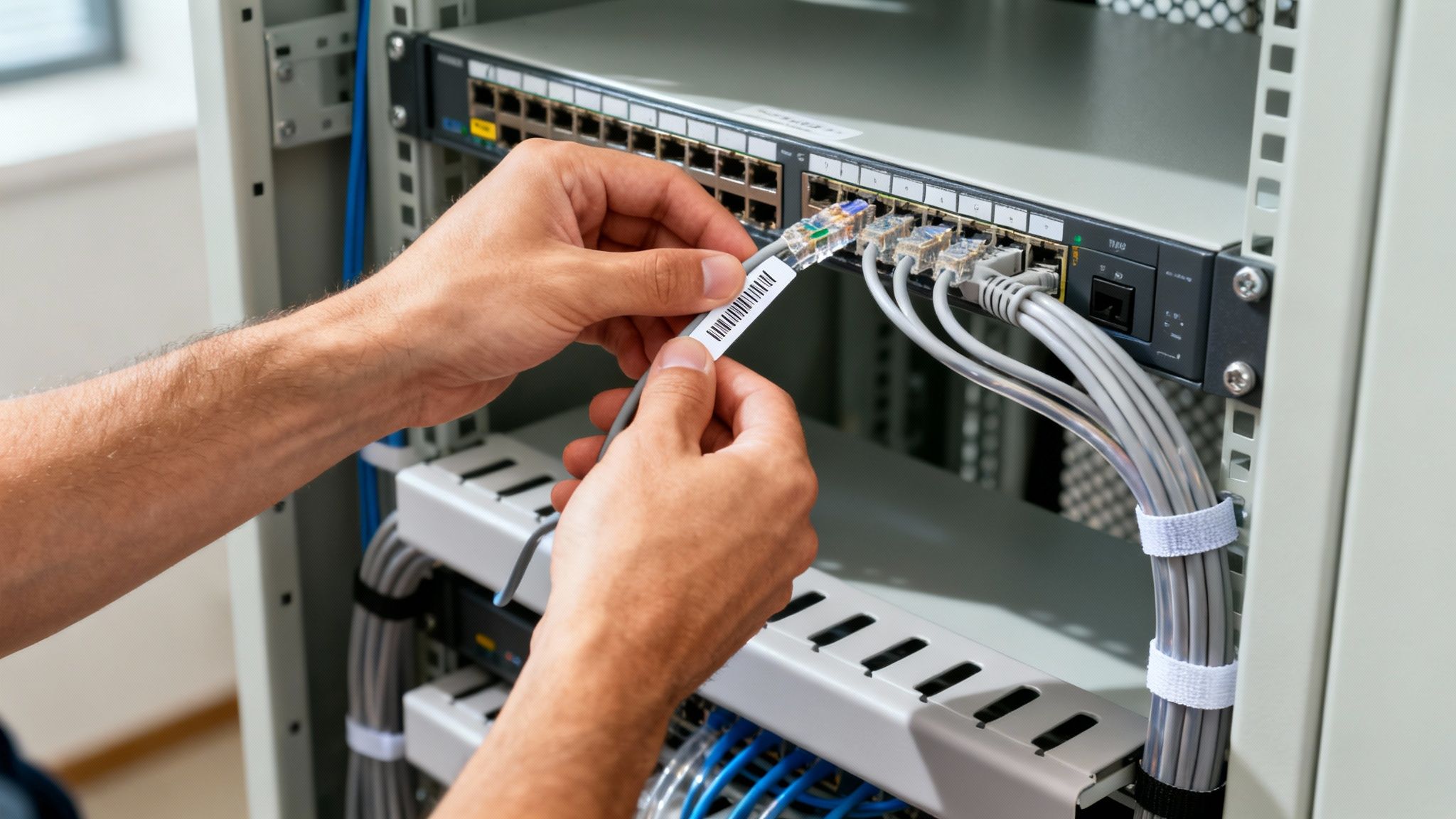
- Clear and Consistent Labeling: Every single cable and port needs to be labeled at both ends according to a logical, documented system. This might seem like a small detail, but it’s an absolute lifesaver during troubleshooting. It allows technicians to trace connections in minutes instead of hours, which is invaluable for minimizing downtime.
- Meticulous Cable Management: Using tools like vertical managers and structured raceways keeps cable bundles neat and organized. This isn't just about looking good; it protects cables from being crushed, makes moves, adds, and changes (MACs) a breeze, and—most importantly—maintains clear pathways for critical airflow.
Finally, no deployment is complete until it’s been thoroughly tested and certified. Using specialized tools, every link has to be tested to verify it meets industry performance standards for metrics like insertion loss and return loss. This final step gives you documented proof that your data center cabling solutions were installed correctly and are ready to support your most critical applications. This meticulous execution is the ultimate quality assurance for your infrastructure investment.
How to Choose Your Data Center Infrastructure Partner
Picking the right partner for your data center cabling solutions is every bit as important as the servers and switches you choose. The physical infrastructure they install is the absolute foundation of your digital operations. Get it right, and you have a high-performance, reliable backbone. Get it wrong, and you're in for years of headaches.
This isn't just about hiring a contractor; it's about bringing on a strategic partner. You're looking for a team that understands the gravity of their work, where every connection has long-term consequences for your success. Don't just look at the bottom line on a quote.
Evaluating Core Competencies and Experience
First things first: you need to vet their experience. A team that's great at wiring up a small office is likely out of its depth in a hyperscale data center. The skills simply don't translate. You need a partner who lives and breathes high-density, mission-critical environments.
Drill down into their specific qualifications. Look for verifiable proof:
- Proven Hyperscale Expertise: Ask them point-blank about projects of a similar size and scope to yours. Request case studies and references. You need to know they can handle the immense scale and complexity of deploying thousands of fiber strands flawlessly.
- End-to-End Capabilities: Your ideal partner handles everything—from the initial design and engineering to the physical installation, obsessive testing, and detailed as-built documentation. Having one team manage the entire process eliminates the finger-pointing and miscommunication that can derail a project.
- Impeccable Safety Record: Data centers are unforgiving environments. A partner with a rock-solid safety program isn't just a "nice to have," it's essential for protecting your people, their team, and your expensive infrastructure.
A partner’s value is measured not just by the final product but by their process. Look for a team that emphasizes transparent communication, detailed project management, and a culture of accountability from start to finish.
Identifying a Strategic Asset Over a Simple Vendor
At the end of the day, you’re looking for a partner who sees the bigger picture. They need to understand that they aren't just pulling cables; they're building the physical layer that your entire business runs on. For a wider perspective, this guide on choosing an information technology company offers a solid framework that can help.
A true strategic partner adds value long after the install is complete by ensuring your infrastructure is dependable, easy to manage, and ready for whatever comes next. When you start evaluating potential cable contractor companies, focus on the ones that ask the right questions and show a genuine commitment to your operational goals.
Frequently Asked Questions About Data Center Cabling
When you're dealing with the nervous system of a data center, questions are bound to come up. Getting the right answers is crucial for making smart decisions that affect everything from day-to-day performance to your ability to grow in the future. Let's tackle some of the most common questions we hear from IT managers and facility operators.
What's the Difference Between Structured and Unstructured Cabling?
Think of structured cabling as a meticulously planned city grid. It’s a standardized, organized system with designated pathways and connection points, all designed for logic, scalability, and easy management. Every cable has a purpose and a place.
Unstructured cabling is the exact opposite—it's more like a tangled maze of jungle vines. Often called "point-to-point" or "spaghetti cabling," this is where cables are run directly between devices as new needs arise, without any overarching plan. This ad-hoc approach quickly becomes a nightmare, choking off airflow, making troubleshooting nearly impossible, and turning simple upgrades into major projects.
How Often Should a Data Center Upgrade Its Cabling?
There's no magic number here. A cabling upgrade isn't tied to a calendar but to your specific technology and business needs. A good rule of thumb is to strategically review your infrastructure every 5-7 years, especially when you're planning a major hardware refresh.
The real catalysts for an upgrade usually fall into a few key categories:
- New, faster hardware: When you're moving from 100G to 400G or even 800G switches to handle demanding workloads like AI, your old cabling simply won't keep up.
- Application demands: You might be rolling out new applications that require lower latency and more bandwidth than your current setup can deliver.
- Performance degradation: If your existing cables are no longer meeting performance standards and causing network errors or instability, it's time for a change.
Why Are Professional Testing and Documentation So Important?
Simply put, professional testing and documentation are not optional; they are the bedrock of a reliable data center. This is your quality control and your operational playbook, all rolled into one.
Professional testing confirms that every single link performs exactly as it should, meeting strict industry standards. It's the only way to be certain that your physical layer won't be the source of baffling network problems down the road. Think of it as an insurance policy for your network's integrity.
Detailed documentation, from as-built diagrams to complete test results, provides a complete map of your infrastructure. This map becomes invaluable for rapid troubleshooting, efficient maintenance, and smart planning for future growth. It eliminates guesswork, which saves an immense amount of time and dramatically cuts the risk of expensive, avoidable outages.
When your infrastructure needs to be flawless and built to last, you need an expert partner. Southern Tier Resources provides comprehensive data center cabling solutions, handling everything from initial design and engineering to precise installation, testing, and documentation. Learn more about our turnkey data center services and build a foundation that’s truly ready for what's next.