Data center cabling standards are the official guidelines that dictate how a physical network infrastructure should be designed, installed, and managed. Think of them as the official building code for digital construction. They're the rulebook that ensures every server, switch, and connection delivers on reliability, safety, and performance.
Following these standards isn't just a suggestion; it's fundamental to achieving operational excellence.
The Blueprint for Digital Infrastructure
Imagine trying to build a modern skyscraper without architectural blueprints. The foundation would be weak, electrical systems would be a fire hazard, and the whole structure would be unsafe and impossible to expand. A data center operates on the same principle, and its cabling is the complex web of electrical and data pathways that keeps everything running.
Without clear guidelines, a data center's cabling quickly devolves into what technicians grimly call "spaghetti"—a tangled, undocumented mess that kills performance and turns every troubleshooting task into a nightmare. Standards bring order to this potential chaos.
They establish a common language and a proven methodology for everything at the physical layer, from the type of fiber optic cable you select to the precise bend radius you're allowed to use. This structured approach is what makes every component work together seamlessly.
Why Standards Form the Bedrock of Reliability
Sticking to these established frameworks is the most critical factor in guaranteeing uptime and making sure your facility can grow with demand. These aren't just arbitrary rules; they're the culmination of decades of collective engineering knowledge, rigorous testing, and hard-won experience.
Governing bodies like the Telecommunications Industry Association (TIA) and the International Organization for Standardization (ISO) develop these standards to solve real-world operational challenges.
Here’s why following this blueprint is so crucial:
- Guaranteed Performance: Standards set minimum performance benchmarks for all components. This ensures your network can actually handle the data speeds it's rated for without signal degradation or interference.
- Simplified Maintenance: When your cabling is logically organized and properly documented, technicians can trace lines and solve problems in minutes, not hours. That's a massive reduction in costly downtime.
- Future-Proof Scalability: A standardized system plans for growth from day one. When it's time to add new servers or upgrade to the next generation of network speeds, the process is far simpler and more cost-effective.
A properly designed data center begins with a solid plan, which often includes professional structured networking solutions. Ultimately, standards are what transform a room full of expensive hardware into a resilient, high-performance digital ecosystem. For a deeper look into the foundational planning process, see our complete guide on how to build a data center.
Key Cabling Standards You Need to Know
Stepping into the world of data center cabling can feel like you’re trying to decipher an alphabet soup of acronyms. TIA, ISO, IEEE… what does it all mean? The key is to stop thinking of them as one giant, confusing rulebook.
Instead, think of them like the different building codes for a skyscraper. You have a code for the electrical system, another for the plumbing, and yet another for the structural steel. Each standard governs a specific, critical piece of the whole. They’re designed to work together to create a safe, reliable, and high-performance environment. Getting a handle on who does what is the first step to building a rock-solid network.
This blueprint shows how it all fits together—solid infrastructure, guided by clear standards, is the only real path to achieving the uptime your business demands.
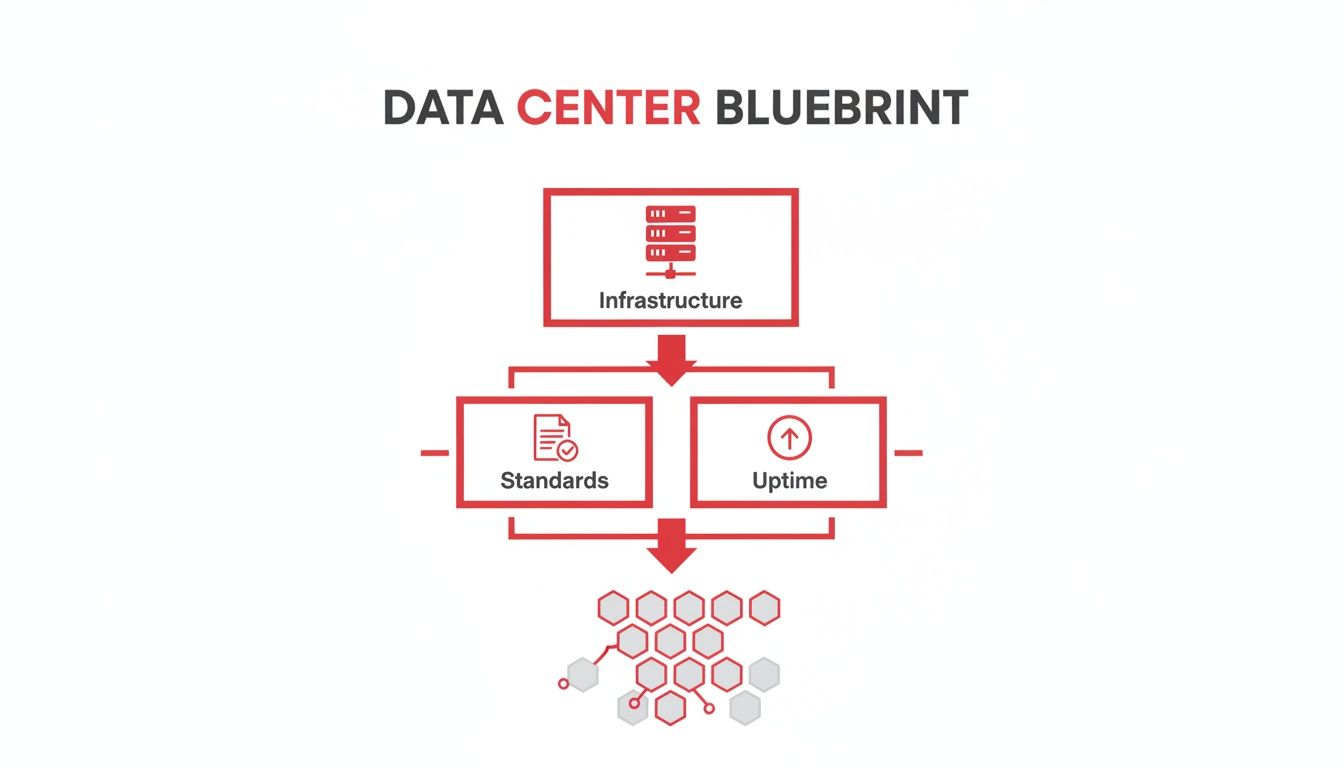
The message is simple: without standardized infrastructure, consistent uptime is just a hopeful goal, not a predictable outcome.
To help you make sense of it all, here's a quick look at the major players and what they cover.
Major Data Center Cabling Standards at a Glance
This table breaks down the primary focus of each major standards body. Think of it as your quick-reference guide for figuring out which standard applies to which part of your data center project.
| Standard | Governing Body | Primary Focus Area |
|---|---|---|
| TIA/EIA-568 | Telecommunications Industry Association | Performance of individual components (cables, connectors, patch panels). |
| TIA-942 | Telecommunications Industry Association | Holistic data center facility design (power, cooling, layout, redundancy). |
| ISO/IEC 11801 | International Organization for Standardization | International equivalent to TIA-568 for generic cabling systems. |
| IEEE 802.3 | Institute of Electrical and Electronics Engineers | Network protocols that run over the cable (e.g., Ethernet speeds). |
| BICSI | Building Industry Consulting Service International | Best practices for the physical installation and maintenance of cabling. |
Each of these standards answers a different question, from "How fast can this cable run?" to "How should we physically lay out the server rooms?" Let's dig into the details.
TIA-568: The Rulebook for Cabling Components
The ANSI/TIA-568 series is the bedrock of structured cabling in North America. Its job is to define the performance of the individual building blocks: the cables, the connectors, the patch panels. It's the reason a Cat 6A cable from one company works perfectly with a Cat 6A jack from another.
This standard gets deep into the technical weeds to guarantee signal integrity. It covers things like:
- Cable Categories: Defines performance specs for twisted-pair copper, including Cat 6, Cat 6A, and Cat 8.
- Fiber Classifications: Outlines the requirements for multimode (OM3, OM4, OM5) and single-mode (OS1a, OS2) fiber optic cables.
- Connector and Pinout Standards: Specifies everything from the physical size of connectors to the T568A and T568B wiring patterns that ensure everyone is on the same page.
Back in 1991, before this standard existed, cabling was a bit of a Wild West. The first release from ANSI, TIA, and EIA brought order to the chaos, establishing the foundational rules we still build upon today. You can learn more about the history of structured cabling on hexatronicdatacenter.com.
TIA-942: The Architectural Plan for the Facility
If TIA-568 is about the bricks, ANSI/TIA-942 is the blueprint for the entire building. This standard zooms out from individual cables to address the whole data center facility. It covers site selection, power and cooling infrastructure, physical security, and room layouts.
Its main purpose is to create a framework for availability and reliability. It does this through a well-known tiered rating system.
Key Insight: TIA-942 defines four rating levels, from Tier 1 to Tier 4, that tell you the fault tolerance and expected uptime of a facility. A Tier 4 data center, the gold standard, has redundancy for every single component and aims for 99.995% availability.
This standard is what tells you how to design your Main Distribution Area (MDA), Horizontal Distribution Areas (HDAs), and Equipment Distribution Areas (EDAs) for maximum efficiency and resilience.
ISO/IEC 11801: The Global Translator
While TIA standards are king in North America, ISO/IEC 11801 is the go-to standard for generic cabling on the global stage. It essentially harmonizes cabling requirements across different countries, ensuring that a project in London follows the same fundamental principles as one in Tokyo.
In practice, it’s very similar to TIA-568 but uses slightly different language. For instance, where TIA talks about "Categories" for copper cable, ISO/IEC uses "Classes" (e.g., Class EA for 10 Gigabit Ethernet). For any company operating internationally, complying with ISO/IEC 11801 is non-negotiable.
Other Critical Standards and Guidelines
The "big three" cover a lot of ground, but a few other organizations provide essential pieces of the puzzle.
- IEEE (Institute of Electrical and Electronics Engineers): The IEEE doesn’t care about the cable itself, but it defines the protocols that run over it. The IEEE 802.3 standard, better known as Ethernet, sets the speed limits. When the IEEE releases a new standard for 400GBASE-SR8, it’s the TIA and ISO that define the cabling required to actually achieve that speed.
- BICSI (Building Industry Consulting Service International): If TIA and ISO provide the "what," BICSI provides the "how." Their manuals are the industry’s masterclass in installation best practices. They cover the hands-on details that separate a professional job from a messy one—things like proper pull tension, bend radius, grounding, and labeling.
When you put it all together, the picture becomes clear. TIA-568 specifies the parts, TIA-942 designs the building, ISO/IEC ensures it works globally, IEEE sets the traffic speed, and BICSI teaches you how to build it all correctly.
Understanding Core Technical Requirements
Once you understand the "what" of data center standards, it's time to dive into the "how." This is where the core technical requirements come into play—the specific, hands-on decisions that define the physical layer of your network. Getting these details right is what separates a reliable, scalable data center from a constant source of headaches.
Think of it like building a house. The architectural standards are the blueprints, but the technical requirements are the quality of the concrete, the gauge of the wiring, and the strength of the support beams. Each choice directly impacts the performance and longevity of the final structure. This same logic applies to your cable types, physical layouts, and performance testing.
Choosing the Right Cable: Copper and Fiber
The first, and arguably most fundamental, decision you'll make is what kind of cable to use. This isn't just about cost; it's a strategic choice that will dictate your network's speed, reach, and future-readiness. The two main players are twisted-pair copper and fiber optic cables, and each has a distinct role.
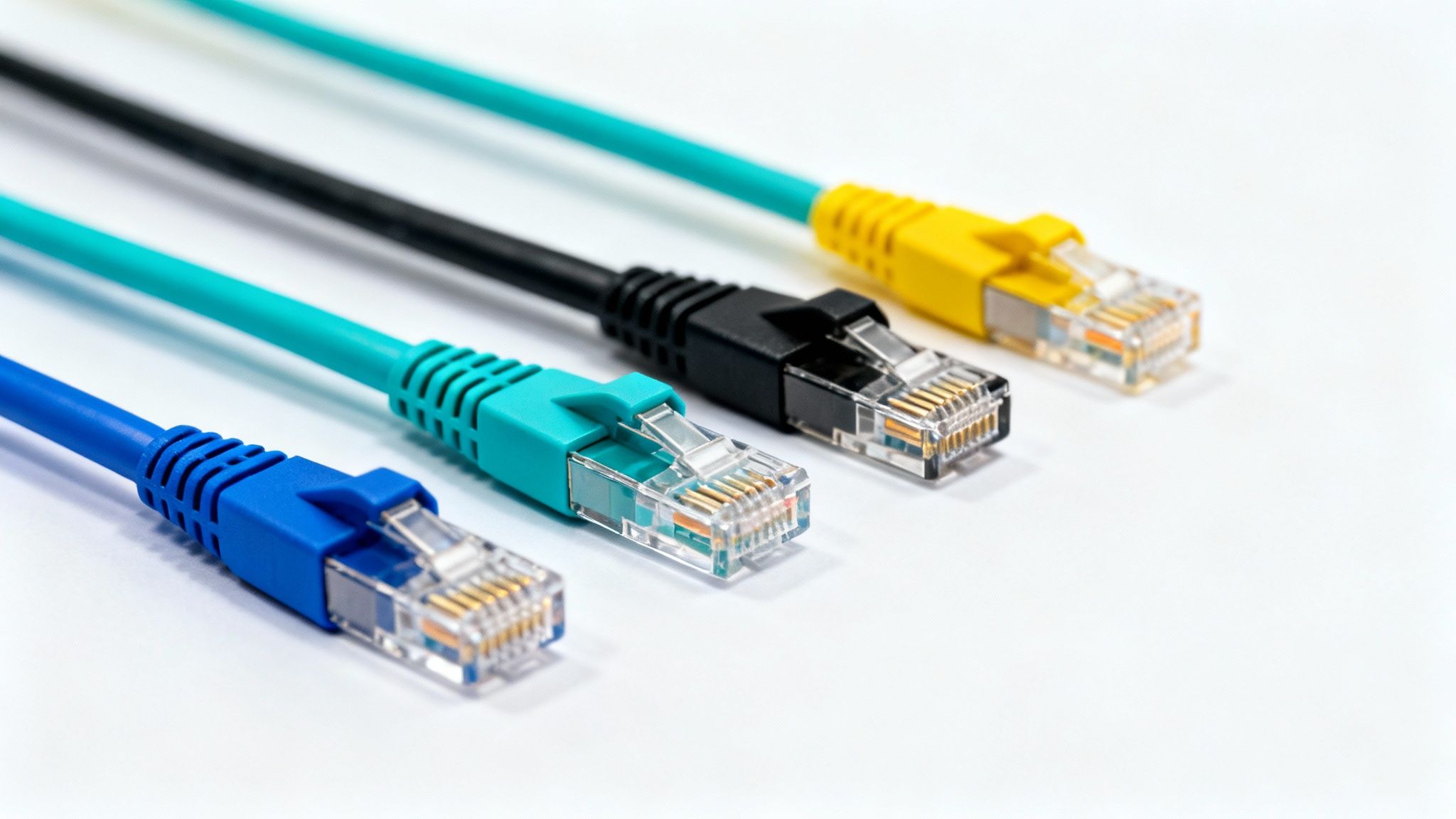
Copper cabling is the workhorse of the data center, perfect for shorter runs like connecting servers to switches within the same rack. The evolution of copper Ethernet standards tells a compelling story of our relentless demand for speed. Back in the 90s, Category 3 cable topped out at 10 Megabits per second (Mbps). Today, we have Category 8, introduced around 2016, which supports frequencies up to 2,000 MHz and delivers blazing speeds of 25 to 40 Gigabits per second—designed specifically for the high-density demands of modern data centers.
Fiber optic cable, on the other hand, is the undisputed champion for high-speed, long-distance links. It transmits data as pulses of light, making it completely immune to the electromagnetic interference (EMI) that can plague copper.
- Multimode Fiber (MMF): This is your go-to for connections within the data center, like linking rows of racks. OM4 and OM5 are the current standards, easily handling 40G and 100G Ethernet over hundreds of meters.
- Single-mode Fiber (SMF): When you need to go the distance—connecting buildings on a campus or linking separate data centers—single-mode is the answer. OS2 fiber can transmit data for kilometers with virtually no signal degradation.
A deep understanding of the various common cable types and connectors is non-negotiable for building resilient https://southerntierresources.com/network-cabling-infrastructures/.
Comparing Cabling Topologies: ToR vs. EoR
After selecting your cable, the next question is how to arrange it all. This physical layout, or topology, determines the data flow between servers and the core network. In modern data centers, the choice usually boils down to two designs: Top-of-Rack (ToR) and End-of-Row (EoR).
Key Takeaway: The choice between ToR and EoR is a classic trade-off. You're balancing the simplicity of in-rack cabling against the complexity of managing a large number of switches. There's no single right answer; it all depends on your operational model.
In a Top-of-Rack (ToR) design, a network switch is placed in every server rack. The servers connect to this local switch with short, easy-to-manage patch cords. This keeps horizontal cable runs to an absolute minimum but means you have a lot more switches to purchase, power, cool, and maintain.
Conversely, the End-of-Row (EoR) approach consolidates all the network switches for a row of racks into one or two dedicated network cabinets. Servers then connect to these central switches via structured cabling that runs through overhead trays or under a raised floor. This dramatically simplifies switch management but demands a much more disciplined and extensive cable management plan.
Pathways and Spaces: The Unseen Heroes
How your cables get from point A to point B is just as important as the cables themselves. Pathways and spaces—the cable trays, conduits, and enclosures—are the unsung heroes of a well-run data center. A thoughtful pathway design prevents countless future problems with performance and maintenance.
Properly planned pathways accomplish several critical goals:
- Bend Radius Protection: Every cable has a limit to how sharply it can be bent before the internal wiring is damaged and performance plummets. Good pathways prevent this.
- Cable Separation: High-voltage power lines can create electromagnetic "noise" that interferes with copper data cables. Standards mandate specific separation distances to keep signals clean.
- Airflow Management: A messy "rat's nest" of cables can block airflow, causing servers to overheat. Neat, organized pathways are essential for efficient cooling and preventing thermal shutdowns.
Performance Limits and Signal Integrity
Finally, standards set strict performance benchmarks to guarantee that your installed cabling can actually deliver the speeds you paid for. Think of it as certifying that your data highway has no potholes and can handle traffic at its posted speed limit.
Certified technicians use specialized testers to measure critical parameters like insertion loss (how much the signal weakens over distance) and crosstalk (signal bleed from one cable to another). Passing these certification tests is the final seal of approval, confirming that the installation meets the rigorous performance demands of standards like TIA-568. This verification is what ensures your network’s signal integrity, providing a rock-solid foundation for every application running on it.
How to Verify and Certify Your Installation

You can have the most meticulously installed cabling system in the world, but if it doesn't perform, it's essentially worthless. This is where testing and certification come into play. It's the final, and most critical, step that proves your infrastructure can actually handle the high-performance demands set by today's data center cabling standards.
Think of it as the final inspection on a newly constructed building. Before anyone moves in, an inspector validates every beam, wire, and pipe to ensure the structure is sound. Certification does the same for your network's physical layer before it goes live.
Without this validation, you’re flying blind. A tiny installation error—a slightly kinked cable or a poorly seated connector—can create massive performance bottlenecks that are a nightmare to track down later. Certification gives you a definitive "pass" or "fail" against precise industry benchmarks, replacing guesswork with hard data.
From a Basic Check to Full-Blown Certification
It's important to know that not all "testing" is the same. The industry really has three different tiers of assurance, and each one gives you a very different level of confidence in your physical network.
Choosing the right level comes down to how critical the infrastructure is. While a simple continuity check might be fine for a temporary office setup, a data center demands irrefutable proof of performance.
- Verification: This is the most basic checkup. It simply confirms that a cable is connected from point A to point B and that the individual wires are in the right order (like T568A or T568B). It answers one question: "Is it plugged in correctly?" That's it. It tells you nothing about performance.
- Qualification: This is a step up. A qualification test determines if an existing cable run can support a specific network speed, like 10GBASE-T. It’s handy for evaluating older infrastructure before an upgrade, but it doesn't certify that the link meets a specific standard category.
- Certification: This is the gold standard. For any new data center build, this is non-negotiable. Using sophisticated field testers, certification measures a link's performance against the full suite of parameters defined by bodies like the TIA. It's the only way to guarantee a Cat 6A or OM4 installation truly delivers its advertised speed.
The Key Metrics That Matter in Certification
Certification testers are complex instruments for a reason. They measure a whole range of performance metrics, each one testing a different aspect of signal integrity to ensure data can fly through without errors.
A Pro's Take: Your official certification reports are more than just a piece of paper; they are your proof of a quality installation. They provide a vital baseline for any future troubleshooting and are almost always required to validate manufacturer warranties on your expensive cabling components.
During the certification process, technicians are laser-focused on a few key parameters:
- Insertion Loss: Measures how much the signal weakens as it travels down the cable. Too much loss, and the receiver won't be able to make out the signal.
- Return Loss: This looks at the amount of signal that gets reflected back toward the sender because of imperfections in the link. High return loss is like an echo on the line, corrupting the original signal.
- Near-End Crosstalk (NEXT): This is a huge one. It measures how much signal "bleeds" from one pair of wires to an adjacent pair at the near (transmitting) end of the cable. High NEXT is a very common culprit behind transmission errors.
- Attenuation-to-Crosstalk Ratio (ACR): This isn't a direct measurement but a calculated ratio. It compares the strength of the intended signal to the "noise" caused by crosstalk, giving you a clear picture of the overall signal quality.
Nailing this rigorous testing process gives you tangible proof that your physical plant meets all the necessary data center cabling standards. It confirms that every single link—from the shortest copper patch cord to the longest fiber optic backbone—is ready for action. For a deeper look into the practical side of this work, our guide on how to install fiber optic cable provides some great hands-on details.
From Blueprint to Reality: Mastering Design and Installation

Knowing the standards is just the first step. The real test comes when you have to translate those documents into a clean, high-performance physical installation. This is where meticulous planning and hands-on skill turn a paper design into a resilient, manageable, and truly professional data center infrastructure. A flawless installation isn't just about aesthetics; it's a critical discipline that directly impacts performance, airflow, and your ability to scale.
We’ve all seen the difference. One data center is a model of efficiency, with perfectly dressed cables flowing through dedicated pathways. The other is a tangled mess of "spaghetti" that makes troubleshooting a nightmare and turns every minor upgrade into a high-risk operation. Adhering to best practices is what keeps you firmly in that first category.
Plan for Tomorrow, Not Just Today
The single most expensive mistake you can make in a data center build is being shortsighted. Designing an infrastructure that only meets today's needs guarantees it will become tomorrow's bottleneck. A truly standards-compliant design always anticipates future demands, building in capacity and flexibility from day one.
This isn’t about guesswork; it's about strategic planning:
- Leave Room to Grow: Never max out your pathways. A well-established rule of thumb is to leave at least 40% of your cable tray and conduit capacity open for future runs. This simple step prevents incredibly costly and disruptive retrofits down the road.
- Install Future-Ready Media: Your network gear might only need 10G speeds today, but what about in three years? Installing higher-grade cabling like OM4 fiber or Cat 6A copper now prepares your physical layer for the inevitable 40G or 100G hardware upgrades.
- Build with Modularity in Mind: Think in terms of building blocks. Using components like high-density patch panels and pre-terminated cassettes allows you to add new connections quickly and cleanly, without disturbing live services.
This forward-thinking approach means your infrastructure can absorb growth gracefully, rather than forcing you into expensive, rip-and-replace projects every few years.
Protecting Signal Integrity: Handle with Care
How you physically handle a cable during installation has a massive impact on its performance. A cable that’s been carelessly pulled, kinked, or bent too sharply can suffer permanent internal damage. This leads to signal degradation and the kind of intermittent, hard-to-diagnose network errors that keep engineers up at night. Following data center cabling standards means treating every single cable with precision.
The Installer's Golden Rule: A cable's performance is only as good as its installation. Exceeding the minimum bend radius or applying too much pulling tension can cripple a high-performance cable, turning it into a chronic source of network failure.
Respecting the minimum bend radius is arguably the most critical rule. For twisted-pair copper, it's typically four times the cable's outer diameter. For fiber optic cables, the rules are even tighter to prevent micro-fractures in the delicate glass core. Similarly, installers must stay below the maximum pulling tension to avoid stretching copper pairs or stressing the fiber strands.
The Power of a Logical Labeling Scheme
In a facility with thousands upon thousands of connections, an unlabeled cable is a lost cable. A logical, consistent, and durable labeling system, as outlined in standards like ANSI/TIA-606-B, is the absolute backbone of efficient data center operations. It’s the universal language that makes your entire infrastructure legible.
A truly professional labeling scheme is:
- Systematic: Every label follows a predictable pattern, clearly identifying a cable's source and destination—down to the specific rack, panel, and port.
- Durable: Forget handwritten tags. Use high-quality, machine-printed labels designed to survive for years in a data center environment.
- Visible: Labels must be placed on both ends of every cable, positioned so they can be read easily without having to unplug anything.
This discipline transforms what could be a chaotic web of wires into a fully traceable map. When an outage occurs, a technician can pinpoint the exact physical link in seconds, slashing troubleshooting time and minimizing expensive downtime. This is the hallmark of a world-class installation.
A Practical Checklist for Your Next Cabling Project
Knowing the standards is one thing, but putting them into practice is where projects succeed or fail. To bridge that gap, I've put together a checklist that walks you through a cabling project from start to finish. Think of it as a quality control roadmap, broken down into four clear phases.
Following these steps will help you sidestep common pitfalls and ensure you're building a reliable, scalable network that stands the test of time.
Phase 1: Design and Planning
Getting the blueprint right from the outset saves a world of headaches and expense down the road. This is where you translate your operational needs into a technical design that’s grounded in industry standards.
- Plan for Growth: Have you designed your pathways—your trays, conduits, and racks—with at least 40% spare capacity? You'll thank yourself later.
- Choose the Right Media: Are you selecting cable types (like Cat 6A, OM4, or OS2) that can handle not just today's traffic, but your projected bandwidth needs for the next 5-10 years?
- Settle on a Topology: Does your chosen layout (ToR, EoR, MoR) actually fit how your team manages switches and how you plan to scale?
- Lock in Your Labeling Scheme: Before a single cable is pulled, is your labeling system—compliant with ANSI/TIA-606-B—fully documented and ready to go?
Phase 2: Procurement and Vendor Management
The hardware you buy is the literal foundation of your network. Smart procurement isn't just about price; it's about asking the right questions to get components that actually meet the standards.
A Hard-Earned Lesson: Never take compliance for granted. Always demand the spec sheets and certification documents from your vendors for everything—cables, patch panels, connectors, the works. This isn't just paperwork; it's your proof of quality.
When you're talking to vendors, here are a few pointed questions to ask:
- Can you provide complete compliance documents showing these parts meet TIA and ISO/IEC standards?
- What does your warranty process look like, and what paperwork is required on my end?
- Are these components from a single manufacturer's certified, end-to-end channel solution?
Phase 3: Installation and Quality Assurance
This is where the rubber meets the road—where your meticulous design becomes a physical reality. There’s no room for shortcuts here. The performance you get is a direct result of the quality of the installation.
Make sure your installation team is held to these non-negotiable QA checks:
- Respect the Bend Radius: This is a simple one, but it's critical. All copper and fiber cables must be installed without violating their minimum bend radius. No exceptions.
- Watch Your Pull Tension: Use a tension meter or breakaway pulling eyes. Exceeding the maximum pull tension on a cable is an easy way to ruin it before it's even terminated.
- Label Everything First: Apply durable, machine-printed labels to both ends of every single cable before you terminate it. Doing it after is a recipe for mistakes.
- Keep "As-Built" Drawings: The final installation never perfectly matches the original plan. Maintain detailed "as-built" drawings that show exactly where everything ended up.
Phase 4: Testing and Ongoing Maintenance
Your project isn't done when the last cable is plugged in. It’s done when you’ve proven it works and have a plan to keep it that way. Rigorous testing validates the work, and a solid maintenance plan protects your investment for years to come.
- Test Every Single Link: 100% of your permanent links need to be tested with a certified field tester. "Spot checking" isn't good enough.
- Archive Your Test Results: All pass/fail reports must be reviewed, handed over to the client, and archived. This is your baseline for future troubleshooting and your ticket for any warranty claims.
- Schedule Physical Audits: At least once a year, walk the floor. Look for damaged cables, check that labels are still intact and legible, and make sure your documentation still reflects reality.
- Update Documentation Religiously: Any time a move, add, or change (MAC) happens, your documentation must be updated immediately. A mismatch between your records and the physical layer is a ticking time bomb.
Common Questions About Cabling Standards
When you're in the trenches of data center design and management, the web of cabling standards can raise some very real, practical questions. Getting these answers right is crucial—it's the difference between a high-performance, future-proofed facility and one that’s plagued by problems.
Let's clear up one of the most common points of confusion: the relationship between TIA-568 and TIA-942. I like to think of it like this: TIA-568 is the standard that governs the quality of the individual building blocks—the cables, connectors, and patch cords. It ensures each piece meets specific performance criteria.
On the other hand, TIA-942 is the master architectural plan for the entire data center. It looks at the big picture, defining how everything from the physical layout and structural integrity to power and cooling systems should come together. They’re not competing; they're complementary. One defines the "what" (the components), and the other defines the "where" and "how" (the facility design).
Keeping Up with Evolving Standards
Data center technology never stands still, and neither do the standards that support it. You'll typically see major standards reviewed and updated every three to five years to keep up with faster network speeds and new innovations. But does a new revision mean you have to rip and replace your entire infrastructure? Absolutely not.
Key Takeaway: A new standard sets the benchmark for new installations. Your current infrastructure is still considered compliant with the version it was certified under. However, any new build-outs or major expansions should follow the latest revision to guarantee performance and compatibility down the road.
This is a sensible approach that provides stability while still pushing the industry forward.
Finally, we get the big question: can you mix and match components from different manufacturers? Sure, a Cat 6A jack from one brand will physically plug into a cable from another, but you're playing with fire. Standards are written to guarantee performance across a complete, end-to-end channel—that means every single component, from the patch panel to the wall outlet, has been tested to work together as a system.
Sticking with a certified, single-manufacturer solution is the only surefire way to guarantee that performance. More importantly, it keeps your warranty intact and prevents the dreaded blame game between vendors when a problem inevitably pops up.
A robust, standards-compliant cabling infrastructure is the bedrock of any reliable data center. At Southern Tier Resources, we specialize in designing and deploying end-to-end structured cabling solutions that meet the highest industry benchmarks. Learn more about our data center services.