A 250 MW campus can break ground with an approved site plan, a committed general contractor, and a schedule that still isn't executable. The constraint may sit outside the building envelope, in a utility queue, a transformer allocation, a relay study, or a commissioning sequence that nobody has rehearsed. On these projects, the slab is often visible progress, but power delivery determines whether the facility can operate.
That changes the job of the construction manager. Data center construction management now requires a power-first operating model that connects site selection, design, procurement, field execution, testing, and handover. The teams that protect the date aren't just moving trades faster. They're deciding earlier, documenting every readiness gate, and treating electrical equipment and integrated testing as schedule infrastructure.
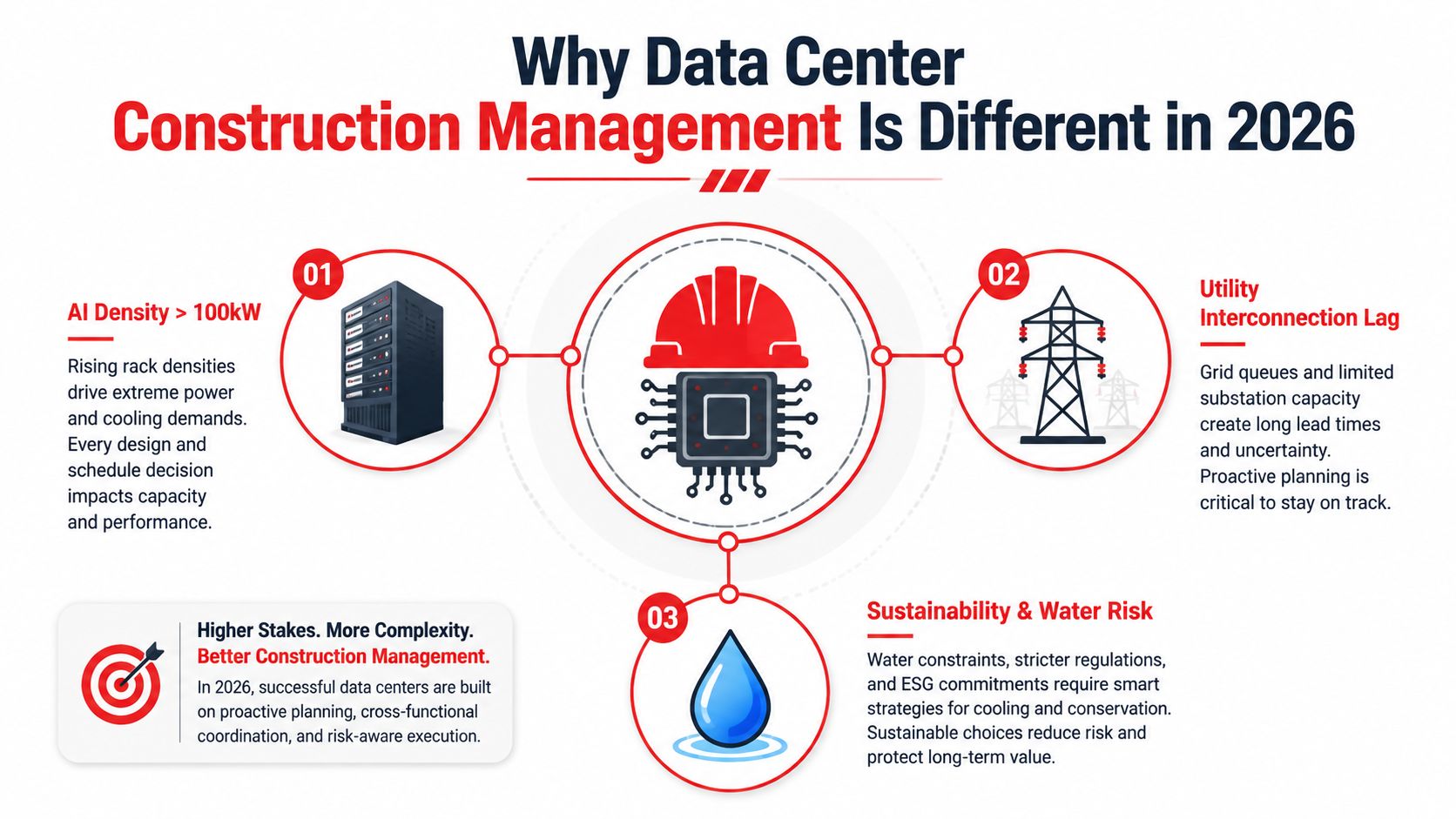
Why Data Center Construction Management Is Different in 2026
North American data center development has reached a scale that resembles utility infrastructure more than conventional commercial building. JLL reported more than 66 GW of capacity under construction in its midyear 2026 market report, while ConstructConnect reported $77.7 billion in U.S. data center construction starts in 2025, a 190% year-over-year increase, with $44.4 billion in Q4 2025 alone. JLL also reported $17 billion in SASB/CMBS and ABS data center volume during the first half of 2026, up 29% from the prior year. These figures point to sustained capital deployment and an execution environment where procurement, labor, energization, and turnover must be managed at exceptional volume (Cumming Group market analysis).
At the same time, the facility itself is becoming more engineered. ConstructConnect reported that average data center costs rose 70% in 2025, reaching $633 million per project and $1,033 per square foot. JLL reported average global shell-and-core construction cost at $11.3 million per MW in 2026, compared with $7.7 million per MW in 2020, and projected global supply to rise from about 103 GW in 2025 to roughly 200 GW by 2030, a 14% CAGR. JLL's projection also placed total data center expenditures through 2030 at potentially nearly $3 trillion, including tenant IT (Yahoo Finance coverage of the market report).
The operating model has to change
A conventional commercial playbook usually treats the building enclosure, interior fit-out, and MEP installation as the dominant sequence. That approach breaks down when the project depends on substations, switchgear, generators, UPS systems, cooling plants, controls integration, and full-load testing.
Schedule realism is another weak point. Industry analysis found measured weekly trade output running 20% to 50% below plan, while 78% of webinar participants said their schedules probably weren't based on realistic production rates. 43% identified inaccurate initial schedule logic as the main cause of schedule drift (Stoel Rives schedule-risk analysis).
The practical response is to manage every phase around five controls:
- Power-first sequencing: Confirm utility and electrical readiness before treating architectural milestones as meaningful.
- Long-lead ownership: Assign one accountable party to each critical purchase order, factory test, delivery, and storage decision.
- Gate-based handoffs: Don't release the next phase until the preceding phase has produced a signed deliverable.
- Independent validation: Keep commissioning and quality verification separate from the team responsible for installation.
- Evidence-based turnover: Deliver tested systems, complete records, training, spares, and maintainable asset data.
The same logic applies to hyperscale and enterprise facilities. Scale, tenancy, redundancy, and AI density change the detail, but not the discipline. Environmental concerns also belong in the planning conversation, including e-waste risks for Atlanta construction firms, which can affect removal, segregation, documentation, and responsible recycling decisions during technology-heavy fit-outs (e-waste risks for Atlanta construction firms).
The End-to-End Phase Model for Data Center Construction
A successful project phase doesn't merely complete its own work. It produces a verified handoff that makes the next phase executable. The owner should establish those gates before the schedule is baselined.
Site selection and feasibility
The owner and program manager should create a site feasibility package covering available power, utility interconnection status, fiber routes, water exposure, environmental constraints, access, and expansion options. The gate is a documented site decision with a credible power-delivery path, not merely land control. If the utility cannot define a workable interconnection sequence, the project shouldn't advance on the assumption that the issue will resolve later.
Concept design
The design authority converts the business case into an initial technical basis. That includes IT capacity, redundancy strategy, Tier objective, rack-density assumptions, cooling concept, electrical topology, security zones, and future phases. The deliverable is a signed basis-of-design package. Detailed design shouldn't begin until the owner accepts the capacity and resiliency assumptions that drive every downstream system.
Detailed design
The architect and engineers produce coordinated construction documents, equipment-room layouts, one-line diagrams, control sequences, equipment schedules, BIM coordination requirements, and inspection criteria. The critical gate is a design-release package that identifies unresolved interfaces and authorizes procurement. A drawing set that looks complete but leaves switchgear lineups, busway routes, controls points, or liquid-cooling interfaces unresolved isn't ready for construction.
Permitting and procurement
Permitting belongs beside procurement, not after it. The owner, design team, GC, utility, and vendors should align AHJ reviews, environmental approvals, utility studies, factory slots, submittals, and delivery dates. Procurement must issue a live equipment register with responsible parties, required-by dates, factory acceptance tests, shipping conditions, storage requirements, and installation dependencies.
Construction oversight
The GC owns field execution, but the owner needs visibility into sequence, quality, safety, material status, and design changes. Area turnover should be based on documented readiness, including installed equipment, completed inspections, approved test procedures, safe access, labeling, controls availability, and clean power or mechanical conditions where required. “Substantially installed” isn't the same as ready for testing.
Commissioning and integrated testing
The commissioning authority breaks validation into progressive levels, from component and installation checks through functional performance and integrated systems testing. Electrical, mechanical, BMS, EPMS, fire protection, security, and IT interfaces must be tested under normal and failure conditions appropriate to the design. The gate is formal acceptance of tested operating scenarios, not a punchlist with optimism attached.
Handover and maintenance
The owner receives the as-built model, approved drawings, test records, warranties, spare parts, asset data, operating procedures, training records, and open-item register. Maintenance planning starts during design because access, isolation points, replacement paths, and service clearances can't be fixed cheaply after equipment is installed. The final gate is operational acceptance, with named owners for every residual item.
Roles and Responsibilities Across Owner, GC, and Specialty Trades
Data center disputes often start where responsibility is assumed rather than written. The owner PM should be accountable for scope, budget, schedule, risk acceptance, and program decisions. The GC is responsible for site execution, trade coordination, logistics, safety, and delivering the work in accordance with the contract. Electrical, mechanical, fire protection, low-voltage, controls, and testing specialists own technical delivery within their packages.
The owner should also appoint an owner's commissioning authority early and retain an independent quality firm. The Cx agent validates the intended operation. The QA firm verifies installation and records. Neither should report solely through the GC if the owner expects objective acceptance.
Formal handoffs prevent informal assumptions
Five handoffs deserve signed records:
- Design package release: Drawings, specifications, model status, open interfaces, and approved deviations.
- Long-lead purchase order: Vendor, configuration, approved submittal, factory date, delivery condition, and accountable buyer.
- Energized milestone: Approved switching plan, safety controls, test readiness, and authorization to energize.
- Beneficial occupancy: Defined usable area, life-safety status, operational restrictions, and residual work.
- Substantial completion: Contract requirements, commissioning evidence, training, documents, spares, and exceptions.
A decision log should capture the decision, owner, due date, affected systems, cost and schedule consequence, and required follow-up. Weekly trade coordination should focus on the critical path rather than becoming a general progress meeting. BIM clashes matter, but a resolved clash doesn't prove that the equipment can be delivered, installed, energized, controlled, and tested.
| Decision | Owner PM | GC | Specialty Trade | Cx Agent |
|---|---|---|---|---|
| Approve basis of design | A | C | C | C |
| Release coordinated construction package | A | R | C | C |
| Place long-lead equipment order | A | R or C, by contract | R for technical package | C |
| Coordinate installation sequence | C | A/R | R | C |
| Approve energized milestone | A | R | R | C |
| Accept functional performance testing | A | C | R | R |
| Approve operational handover | A | R | C | R |
Use a shared document-control environment, a live equipment register, and a clear escalation path. For teams coordinating telecom, power-integrated infrastructure, and structured cabling interfaces, Southern Tier Resources is one example of a specialist partner that supports engineering, construction coordination, testing, and documentation.
Making Power and Long-Lead Equipment the Real Critical Path
The schedule should be built backward from usable, tested power, not forward from site mobilization. Utility studies, interconnection approvals, substations, protective relay coordination, switchgear, transformers, generators, UPS systems, cooling plants, and busways can determine the date long before steel or interior finishes do.
The exact lead time varies by manufacturer, configuration, allocation, and region. A project team should maintain a vendor-confirmed procurement schedule rather than rely on generic allowances. The equipment register needs to connect every item to design approval, purchase order, factory test, shipment, installation, energization, and commissioning.
Put the electrical topology in control early
Lock the power topology before the design has progressed far enough to make changes expensive. That means resolving utility service assumptions, medium-voltage distribution, redundancy, generator paralleling, UPS architecture, busway strategy, grounding, protection, and controls interfaces. If the team treats MEP as a late package, structural openings, equipment-room dimensions, cable routes, maintenance clearances, and cooling interfaces will force rework.
Practical rule: If a piece of equipment controls energization, it belongs in the schedule before the architectural milestone that depends on it.
BIM coordination should focus on equipment rooms and infrastructure corridors before structural topping out. Confirm housekeeping pads, embeds, access paths, rigging routes, door sizes, floor loading, ventilation, heat rejection, cable-bus clearances, and replacement paths. A delivered transformer that can't be moved into its room is a procurement success and a schedule failure.
| Equipment Package | Typical Lead Time (weeks) | Critical Path Impact |
|---|---|---|
| MV/LV switchgear | 40 to 60 | Controls energization and feeder installation |
| MV/LV transformers | 30 to 50 | Controls service capacity and startup sequence |
| Generator sets | 50 to 80 | Affects standby power and integrated testing |
| UPS systems | 30 to 45 | Affects critical-load commissioning |
| Chillers | 35 to 55 | Affects mechanical startup and thermal testing |
| Busways or busduct | 20 to 35 | Affects white-space distribution and fit-out |
The broader market signal is more severe than any planning table. One industry risk source identifies compressed windows with little or no float, while 66% of tracked large-scale projects were in pre-planning or planning and 34% were in pre-execution or execution, reinforcing the value of early procurement and sequence lock (Crowell data center risks guidance). Power availability was identified as the most prominent obstacle by 48% of respondents in a 2025 survey, and reporting found that more than half of data center projects in 2025 were delayed by three months or more because of power, labor, and procurement issues (Turner & Townsend industry challenges).
For procurement teams that need a broader framework for communicating manufacturing constraints and material availability, lead times for construction specifiers provides useful context. The construction manager still needs project-specific vendor commitments, escalation triggers, and alternate-source decisions.
Scheduling, Cost Control, and Risk Practices That Deliver
A data center schedule earns credibility by showing how the team will reach each energization, startup, and testing milestone. Substantial completion alone says little about whether power and long-lead equipment will be ready. Pull planning works when the owner, GC, designers, vendors, and specialty trades define every prerequisite, assign an owner, and clear constraints before crews arrive.
A credible schedule follows measurable production logic. It includes owner and utility activities, submittal reviews, factory testing, shipping, storage, installation, inspections, controls integration, and commissioning. Industry analysis found that planned production rates often exceed measured output by 20% to 50%, and 78% of poll participants questioned whether their schedules used realistic rates (Stoel Rives schedule-risk analysis). Validate quantities and rates with trade supervisors, record actual production weekly, and reforecast before variance becomes a claim.
The schedule should also expose procurement-driven sequence changes. A delayed transformer, switchgear lineup, or controls package can change installation priorities, temporary power plans, and commissioning windows. Link each long-lead commitment to design release, factory testing, delivery, installation, and energization activities so the forecast reflects field dependencies rather than assumed dates.
Tie cost decisions to procurement reality
Use early work packages to release enabling work and critical design effort while maintaining scope control. For major equipment, open-book cost-plus arrangements can reveal vendor pricing and escalation sooner. A GMP can establish a defensible ceiling once design, allowances, exclusions, and procurement commitments are sufficiently clear.
Contingency should match the project phase and its remaining unknowns. The planning ranges in this model are 8% to 12% before GMP and 4% to 6% after GMP. Apply them as stated planning guidance, not as a universal rule. Separate design development, market escalation, utility uncertainty, owner changes, and execution risk. A single undifferentiated reserve makes it difficult to see which exposure is consuming the budget.
Run the risk register as a management tool
A useful register identifies the risk owner, trigger, affected milestone, mitigation, residual exposure, and decision date. A quantified scoring matrix can rank probability and consequence. Monthly Monte Carlo refreshes can test whether the forecast still supports the required date. The register should drive procurement escalation, design release, resequencing, or executive decisions rather than decorate a report.
| Trade Package | Share of Total Installed Cost | Notes |
|---|---|---|
| Electrical | 35% to 45% | Includes major distribution and standby infrastructure |
| Mechanical | 20% to 25% | Includes cooling generation and distribution |
| Structural | 10% to 15% | Includes structure and supporting building work |
| Commissioning and startup | 2% to 4% | Includes testing, validation, and startup activities |
These ranges come from the project planning guidance in the brief and require recalibration against the actual design and procurement strategy. Cost reporting should track committed cost, forecast cost, approved change, pending change, contingency draw, and remaining exposure by package. Review those fields against equipment release dates and delivery commitments. Low current spend can conceal an unhealthy project when critical orders remain unplaced.
Quality, Commissioning, and As-Built Delivery as One Workflow
Quality records, commissioning evidence, and as-built information should function as one acceptance system. Start the inspection test plan during design, then carry the same asset record through procurement, fabrication, delivery, installation, startup, testing, and handover. Power equipment and other long-lead assets deserve early attention because late evidence or incomplete interfaces can delay energization and every downstream commissioning activity.
Build the evidence chain before installation
The ITP should define hold points, witness points, acceptance criteria, responsible parties, instruments, calibration records, and closeout documents. Extend that structure across each test stage:
- Factory acceptance testing: Confirm equipment configuration, controls, alarms, protection, and documentation before shipment.
- Site acceptance testing: Verify installation condition, connections, labeling, settings, and site-specific interfaces.
- Pre-functional checks: Confirm systems are complete, safe, accessible, and ready for operation.
- Functional performance testing: Test equipment and sequences under intended operating conditions.
- Integrated systems testing: Test electrical, mechanical, BMS, EPMS, fire, security, and IT interactions, including defined failure scenarios.
The commissioning authority should join at 30% design, rather than first appearing near substantial completion. Early review covers sequences of operation, maintainability, test access, sensor placement, control points, alarm priorities, and the evidence required for acceptance. Poorly managed projects can carry a 3 to 6 month punchlist overhang, so commissioning must be managed as a planned workstream, not a final inspection.
Make the model the handover record
A unified BIM handover model should contain asset identifiers, manufacturer data, serial numbers, locations, maintenance requirements, warranty information, and links to FAT, SAT, inspection, and functional test results. The owner can use that model as the as-built record, CMMS input, and commissioning evidence trail.
Acceptance isn't a meeting. It's a traceable chain from design intent to tested operation.
Before turnover, the closeout team should test the handover package with operators. They need to find an asset, understand its normal state, locate its isolation point, retrieve its test history, and identify the spare or procedure needed for maintenance. If operators cannot use the information, the project is not finished, regardless of how polished the document index appears.
How AI Density and Modular Delivery Change the Management Playbook
AI-ready facilities challenge the assumption that a data hall is a traditional rack room with more servers. Recent industry reporting describes rack densities reaching up to 120 kW in AI-ready facilities, with liquid cooling changing reliability and sustainability requirements (iRecruit owner trends). That load changes structural design, electrical distribution, heat rejection, controls, water strategy, maintenance access, and commissioning evidence.
Replace the one-size-fits-all contract model
A design-bid-build structure based on stable, conventional rack assumptions struggles when the owner is still refining AI workload requirements. Integrated delivery, EPC structures, or IPD-style collaboration can bring the electrical engineer, mechanical designer, equipment vendors, controls team, and commissioning authority into decisions earlier. The trade-off is less isolated package certainty at the start, but better control of interface risk as the design evolves.
Modular delivery shifts risk from the field into design, fabrication, inspection, and factory testing. Skid-mounted mechanical systems, prefabricated busways, liquid-cooling distribution, and white-space assemblies can reduce site congestion and parallelize work. They also create new obligations, including dimensional control, lifting plans, transport protection, factory witness testing, interface tolerances, and a clear boundary between factory completion and site acceptance.
BIM coordination must become more frequent and more operational. Vendor engagement should occur early for liquid-cooling skids and direct-to-chip loops, with acceptance tests covering flow rates, pressure, leak detection, coolant chemistry, controls response, and alarm behavior, not just electrical capacity. Teams evaluating modular systems should also review modular building site preparation tips because foundations, access, drainage, tolerances, and delivery logistics can determine whether prefabrication produces savings or creates field rework.
Lock probable Phase 2 decisions early
If an AI workload is a credible future phase, the team should resolve the following before the design hardens:
- Structural loading, pour depths, equipment support, and vibration criteria.
- Electrical topology, busway ampacity, breaker coordination, and spare capacity.
- Cooling distribution, liquid-cooling interfaces, heat rejection, and water treatment.
- Floor plate zoning, service clearances, overhead distribution, and maintenance routes.
- BIM attributes, factory test requirements, installation tolerances, and commissioning procedures.
- Modular transport, rigging, storage, weather protection, and site acceptance boundaries.
A short briefing on the management shift is available below.
The construction manager's role is to turn those decisions into controlled interfaces. AI capacity isn't only a demand forecast. It makes delivery a precision logistics and commissioning exercise, where an unverified cooling loop or unresolved busway interface can matter more than visible building progress.
Southern Tier Resources supports data center fit-outs with power-integrated infrastructure, fiber, structured cabling, construction coordination, testing, and documentation. If your project needs a partner that can connect those field packages to the power-first schedule and final handover record, visit Southern Tier Resources to discuss the scope.