At its core, a data center's infrastructure is the collection of physical systems—power, cooling, connectivity, and security—that keeps all the IT equipment humming. You can think of it less as a pile of hardware and more as the essential life support system for our digital world. It's what guarantees the reliability and performance behind everything from cloud computing to artificial intelligence.
Understanding Modern Data Center Infrastructure Solutions
Think about what makes a modern city work. Beneath the surface, there's a complex, mostly invisible network of critical services: a stable power grid, clean water, high-speed transit networks, and vigilant security. A data center's infrastructure is built on the exact same principles, but for the digital world. It’s the meticulously engineered ecosystem that lets servers, storage arrays, and networking gear do their jobs without a single interruption.
This foundation has never been more important. The incredible processing demands of AI, the relentless expansion of cloud services, and the explosion of IoT devices are putting immense strain on these facilities. A simple server rack in a closet just doesn't cut it anymore. Today's problems demand integrated, turnkey data center infrastructure solutions designed to handle huge power loads and get rid of massive amounts of heat, all while leaving room to grow.
The Shift Toward Integrated Ecosystems
The industry has moved on from the old days of assembling components piece by piece. The new standard is holistic, pre-engineered systems where every part is designed to work together from the start.
This approach ensures all the core pillars are in perfect sync:
- Power and Cooling: The lifeblood and climate control that prevent costly hardware meltdowns.
- Connectivity and Cabling: The central nervous system that moves data at the speed of light.
- Security and Monitoring: The immune system that guards against both physical and environmental threats.
This integrated model is non-negotiable for telecom carriers, ISPs, and hyperscale providers who measure downtime in millions of dollars. To meet this demand, the global data center market is growing at a breakneck pace, projected to hit US$527.46 billion in revenue by 2025 and an eye-watering US$739.05 billion by 2030. It's no surprise that network infrastructure is the largest piece of that pie, which really underscores the need for expert fiber-optic and structured cabling work.
A data center is only as strong as its physical foundation. Without resilient power, precision cooling, and flawless connectivity, even the most powerful servers are rendered useless. True operational continuity is built from the ground up.
For businesses that want direct control over their hardware but prefer to use a third-party facility, looking into options like colocation hosting can be a smart move.
Ultimately, whether you're breaking ground on a new facility or upgrading an old one, the principles of resilient design are everything. For a much deeper look into the strategic planning involved, check out our guide on how to build a data center. We’ll walk through each of these critical components to give you the clarity needed to build your own digital city on solid ground.
The Four Pillars of Data Center Infrastructure
When you think about a high-performance data center, it’s easy to picture a single, monolithic building. But it's more accurate to see it as a finely tuned ecosystem built on four distinct, codependent systems. Each pillar holds up the others, and if one falters, the whole operation can grind to a halt.
Together, these pillars create the stable, secure, and always-on environment our digital world demands. Getting to know them is the first step toward building or upgrading a facility that can handle today’s workloads and whatever comes next.
Power: The Uninterruptible Lifeblood
Let's start with the most basic truth: without power, nothing else matters. A constant, clean, and reliable flow of electricity is the absolute foundation. If it fails, every server, switch, and storage array instantly becomes an expensive paperweight. This isn't just about plugging into the local utility; it's about a multi-layered defense to guarantee uptime, even if the entire grid goes down.
A truly resilient power system has a few key players:
- Uninterruptible Power Supplies (UPS): Think of these as giant battery backups. The moment they detect a utility failure, they kick in instantly, providing a seamless bridge of temporary power. This buys precious time for the heavy hitters to get started.
- Backup Generators: These are the industrial-grade workhorses, usually diesel-powered, that can power the entire facility for days or even weeks during a prolonged outage.
- Power Distribution Units (PDUs): These are the smart, heavy-duty power strips of the data center. They take the conditioned power from the UPS and distribute it to individual server racks, giving operators granular control and monitoring over every circuit.
The infographic below shows exactly why this level of power planning has become so critical.
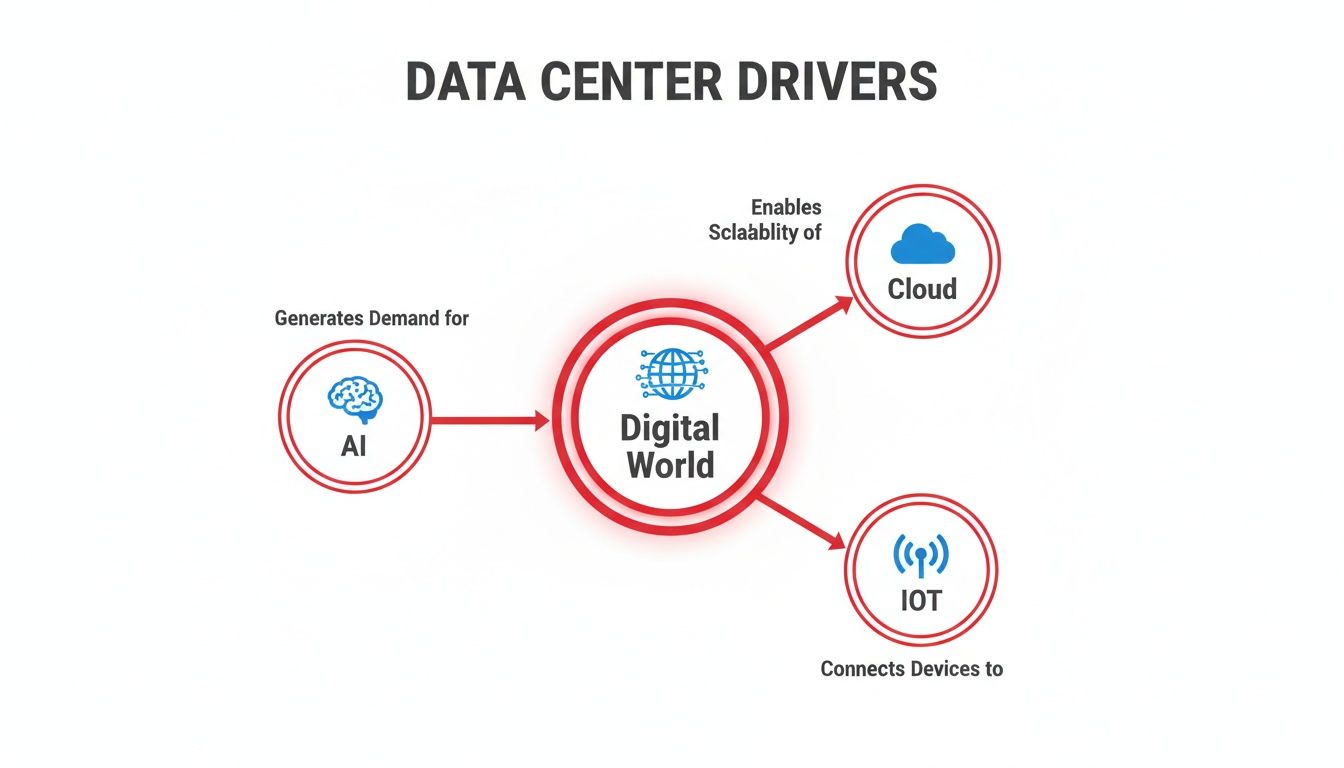
It’s a clear picture of how technologies like AI, cloud computing, and IoT are driving an unprecedented need for bigger, denser, and more powerful data centers.
Cooling: Precision Climate Control
Every single watt of power a server consumes generates heat. Without a way to get that heat out of the building, temperatures would skyrocket, leading to equipment failure and catastrophic downtime. Modern data center cooling is a science, far more sophisticated than just cranking up the AC.
Effective cooling is all about maintaining the perfect operating environment for sensitive electronics, which directly impacts performance and hardware longevity. As racks get packed with more powerful chips for AI, old-school air cooling often can't keep up. This is pushing the industry toward more efficient methods like liquid cooling, where coolant is piped directly to the hottest components to whisk heat away.
Connectivity: The Central Nervous System
If power is the lifeblood, then connectivity is the central nervous system. It's the complex web of high-speed cabling that lets data flow between servers, storage, and out to the wider world. And at the heart of it all is a well-designed structured cabling system.
A data center's performance is ultimately capped by its network infrastructure. Investing in high-quality, organized cabling isn't just an operational best practice; it's a strategic decision that enables future growth and simplifies maintenance for years to come.
This means meticulously planning pathways for thousands of fiber optic and copper cables. They have to be protected, organized, and easy to access for future upgrades. A messy, unplanned cabling job—what we call "spaghetti"—is a surefire recipe for performance bottlenecks and troubleshooting nightmares.
This pillar's financial impact is staggering. Power infrastructure, the backbone of data center reliability, was a global market valued at $18,928.3 million in 2024 and is projected to explode to $101,901.4 million by 2035. This growth is supercharged by AI's insatiable energy appetite, which will demand an estimated 156 GW of capacity by 2030 and require a jaw-dropping $5.2 trillion in CapEx for AI-ready facilities. This directly fuels the need for the advanced systems that keep the lights on. To see how these systems work, you can learn more about data center power distribution systems.
Physical Security And Monitoring: The Immune System
The final pillar is the facility's immune system. It works around the clock to protect the priceless digital assets inside from physical threats and environmental hazards. This is all about preventing unauthorized access and flagging potential problems long before they can cause damage.
Key elements of a strong security posture include:
- Access Control: Multi-layered systems that go way beyond a simple lock and key. Think key cards, biometric scanners, and mantraps that ensure only authorized people can get into sensitive areas.
- Surveillance: A comprehensive network of cameras watching over every entry point, critical hallway, and the data hall itself.
- Environmental Monitoring: A web of sensors constantly tracking temperature, humidity, airflow, and other vital signs, ready to send an alert if anything deviates from the ideal.
To put it all together, let's summarize how these physical components form the foundation of a data center.
Key Components of Data Center Infrastructure
| Component | Primary Function | Criticality for Operations |
|---|---|---|
| Power Systems | Provide continuous, conditioned electricity via UPS, generators, and PDUs. | Absolute. Without it, the entire facility is offline. Essential for uptime. |
| Cooling Systems | Remove waste heat generated by IT equipment to maintain optimal temperatures. | Critical. Prevents overheating, equipment failure, and service outages. |
| Connectivity | Enable data transfer via structured cabling (fiber and copper). | Essential. The network is the pathway for all data; poor cabling limits performance. |
| Physical Security | Protect assets from unauthorized access, theft, and environmental hazards. | Vital. Safeguards both physical hardware and the invaluable data it holds. |
These four pillars are the bedrock of any successful data center. Get them right, and you have the resilient, high-performance foundation needed to power the digital economy.
Strategic Design and Deployment Principles
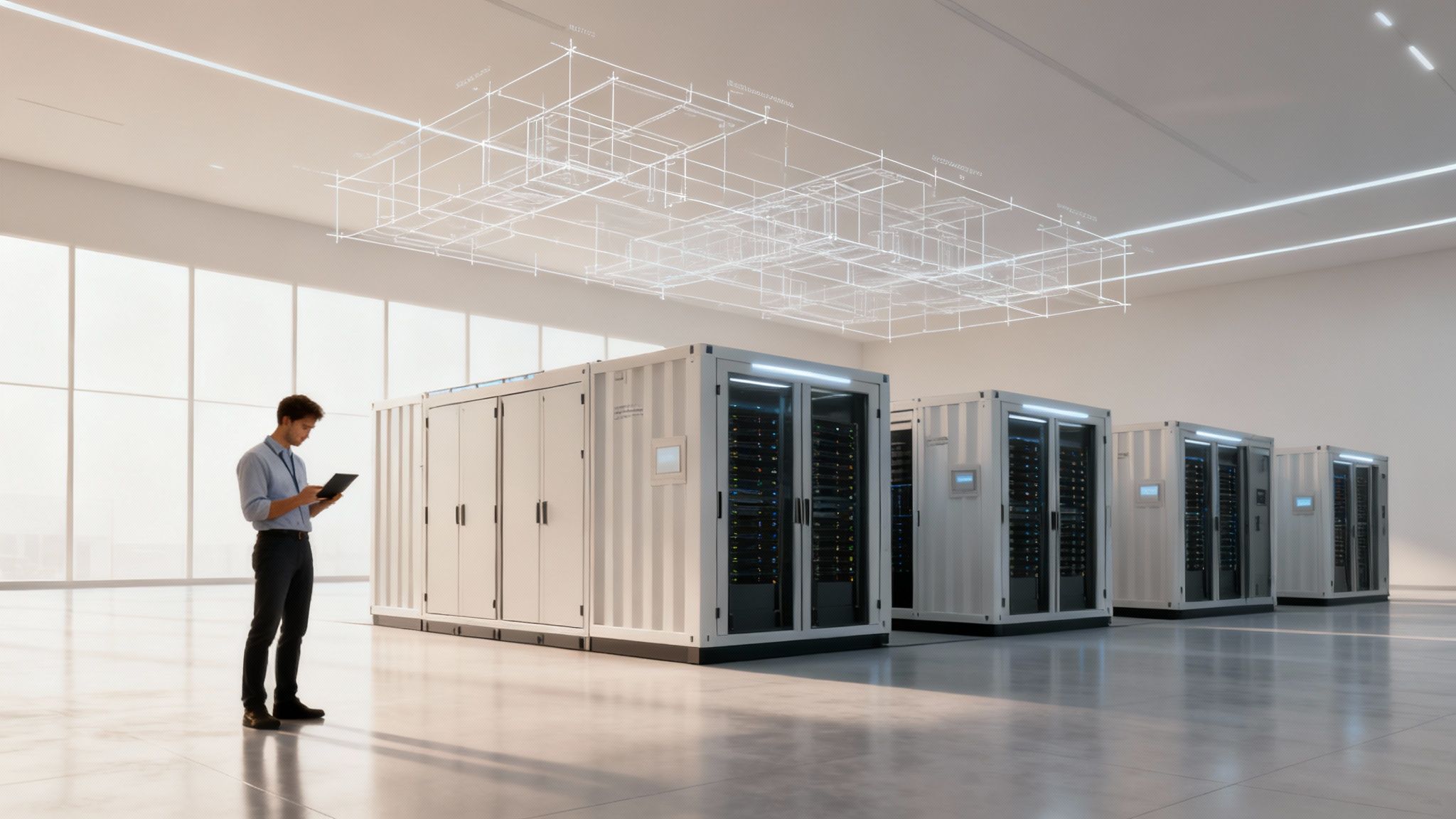
Once you've identified the core components, the real work begins: translating those needs into a functional, physical environment. This is where strategic design separates a high-performance asset from just a room full of expensive equipment. It's the difference between simply assembling parts and engineering a cohesive system that’s built to last.
Think of it like building a new highway. You wouldn't just lay down pavement for today's traffic; you’d build with future growth in mind, adding extra lanes and smart on-ramps to handle increased volume down the road. A well-designed data center works the same way, anticipating tomorrow's power, cooling, and connectivity demands from day one. That foresight is what saves you from costly, disruptive overhauls later.
Redundancy: The Bedrock of Uptime
Redundancy is your insurance policy against downtime. It’s all about having duplicate critical components on standby so a single point of failure doesn't bring your operations to a halt. Two common models drive this strategy, each offering a different balance of protection and cost.
-
N+1 Redundancy: This is the most common approach. It means you have at least one extra component ("+1") for every group of primary components ("N") you need to run. So, if your facility requires four power supply units, an N+1 design would have a fifth one ready to kick in instantly if one of the others fails.
-
2N Redundancy: This is the gold standard for uptime—a completely mirrored system. For every primary component, there’s an identical, independent backup. It’s like having two separate power and cooling plants; if the entire primary system goes down, the secondary system keeps everything online without skipping a beat.
The choice between N+1 and 2N really comes down to your uptime requirements and budget, but some form of redundancy is non-negotiable for reliable data center infrastructure solutions.
Modularity: Designing for Scalable Growth
Modularity is about building in standardized, self-contained blocks that you can add over time. Instead of sinking huge capital into a massive facility built for its maximum theoretical capacity from the start, a modular approach lets you deploy what you need now and expand easily as demand grows.
It’s a far more capital-efficient, "pay-as-you-go" model. This applies to everything from power distribution units to prefabricated rows of server racks. Not only does it protect your budget, but it also dramatically shortens deployment times, letting you bring new capacity online much faster.
The Project Lifecycle: A Holistic Approach
Executing a data center build-out is a complex, multi-stage project that demands painstaking coordination. The entire process moves through distinct phases, and a mistake in one can create a domino effect of expensive problems down the line.
A data center project’s success is often determined before a single cable is pulled. Meticulous engineering, diligent procurement, and a clear deployment strategy are non-negotiable for delivering a facility on time, within budget, and to spec.
Here are the key phases you’ll navigate:
-
Engineering and Design: This is the blueprint stage. Everything is defined here, from power load calculations to the layout of structured cabling. Following industry best practices, like the ones in these data center cabling standards, is critical for guaranteeing future performance and manageability.
-
Procurement: This involves sourcing and purchasing all the necessary gear—generators, UPS systems, CRAC units, racks, and cabling—from vendors you can trust.
-
Construction and Fit-Out: Boots on the ground. This is the physical installation and integration of all the infrastructure components inside the data hall.
-
Commissioning and Testing: This is the final, exhaustive shakedown. Every system is tested under real-world load conditions to make sure it performs exactly as designed before you flip the switch.
For any major infrastructure change or build, using a detailed data center migration checklist is an absolute must to minimize downtime and ensure a smooth, headache-free transition. Managing each of these steps with precision is how you create a truly scalable and efficient environment.
Planning for Costs and Building for the Future
Let's be direct: building out a data center is a major investment. But thinking of it purely as an expense is the first mistake. A well-designed data center is a strategic asset, built not just for today's needs but to deliver value for years to come without becoming a money pit. The key is looking beyond the initial price tag to understand the full financial story.
It’s easy to get fixated on the upfront Capital Expenditures (CapEx)—the checks you write for servers, racks, and construction. But that's just the beginning. The real costs often lie in the long-term Operational Expenditures (OpEx), the recurring bills for power, cooling, maintenance, and staff. Over the life of the facility, OpEx can easily dwarf the initial build-out cost. A smart financial strategy finds the sweet spot between the two.
Thinking in Terms of Total Cost of Ownership
This is where the concept of Total Cost of Ownership (TCO) becomes so important. TCO is more than just a buzzword; it's a framework that forces you to connect today's design choices with tomorrow's operational reality.
For example, you could save money upfront on a standard cooling system. But what if a more advanced, high-efficiency system—though carrying a higher CapEx—slashed your monthly power bill for the next ten years? That's the TCO mindset. It shifts the question from, "What's the cheapest way to build this?" to "What's the most cost-effective way to run this for its entire lifespan?"
How to Future-Proof Your Infrastructure
Future-proofing isn't about gazing into a crystal ball. It’s about building in flexibility from day one so you can adapt to new technologies without having to rip everything out and start over. It’s about creating a foundation that can grow as your business does.
Here are a few practical ways to build for tomorrow:
- Plan for Power-Hungry Hardware: AI and other high-performance computing tasks are driving rack power densities through the roof. Design your power distribution to handle these future high-density loads now, and you'll avoid a hugely expensive electrical overhaul later.
- Don't Skimp on Cabling: The biggest cost in running cable isn't the cable itself—it's the labor. Pulling high-count fiber optic cabling rated for 400G and 800G speeds today means you won't have to pay someone to do it all over again in three years when your bandwidth needs explode.
- Build in Modular Blocks: A modular design lets you add power, cooling, and space in standardized increments. This approach is incredibly efficient, allowing you to scale your infrastructure—and your spending—in lockstep with actual demand.
The most expensive data center is the one you have to rebuild in five years. Think of future-proofing as a form of risk management; it protects your investment against the relentless pace of technology.
This kind of forward-thinking planning has never been more critical. The market for data center IT infrastructure is projected to surge by USD 106.6 billion between 2024 and 2029, and North America is expected to capture 35% of that growth. With global CapEx predicted to hit nearly $598 billion in 2025, finding a partner who can deliver on schedule and within budget is non-negotiable. You can dive deeper into these figures by reading the full analysis of data center market trends on Technavio.com. Aligning your build with these trends is how you set your facility up for success.
Keeping the Lights On: Compliance and Maintenance for Uninterrupted Service
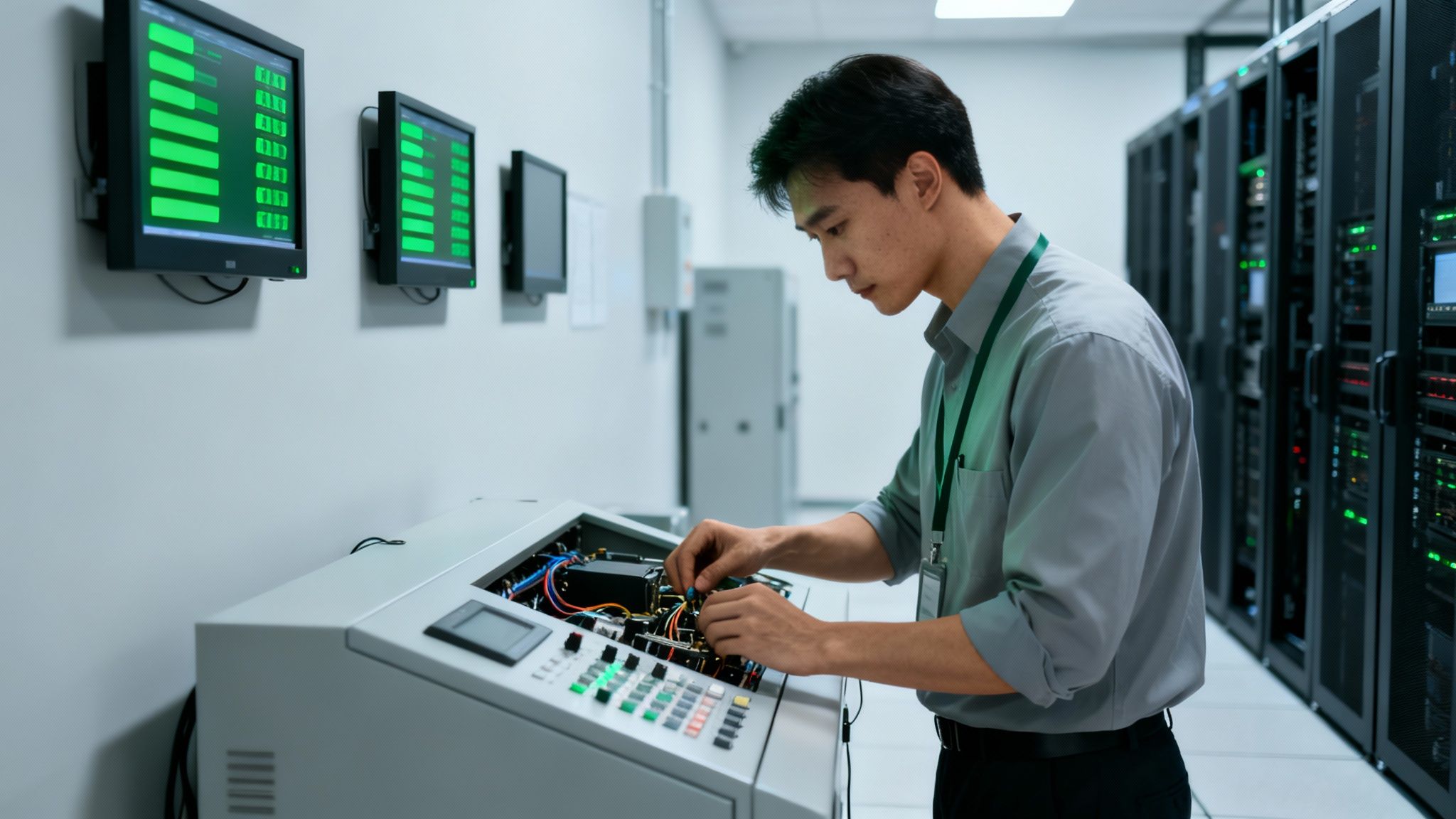
A data center's real work begins long after the last server is racked and the final cable is plugged in. Excellence isn’t a one-and-done deal; it’s a constant, disciplined commitment. The focus immediately shifts to the meticulous, day-in-day-out processes that ensure the facility remains reliable and secure for years. This is where a well-designed data center becomes a genuinely resilient business asset.
Think of industry standards not as red tape, but as a shared playbook for managing risk and guaranteeing performance. They give everyone a clear, objective framework to evaluate how well a facility can handle equipment failures and protect critical data—essential for building real trust with your clients.
What Industry Standards Actually Mean for Your Business
Certifications are more than just badges; they provide a transparent scorecard of a data center's capabilities. Knowing what they mean is crucial for matching data center infrastructure solutions to your own operational needs and security requirements. Two of the most important benchmarks you'll encounter are Uptime Institute Tiers and SOC 2 compliance.
-
Uptime Institute Tiers: This is a grading system (from I to IV) for a data center's design and operational robustness. A Tier II facility, for example, has some redundant capacity, but a Tier IV facility is fully fault-tolerant. That means it can withstand a major equipment failure without a single blip in service.
-
SOC 2 (Service Organization Control 2): This isn't about physical hardware, but about process and security. A SOC 2 audit verifies that a provider has implemented strict controls to manage the security, availability, confidentiality, and privacy of customer data.
These certifications directly impact your business continuity. A Tier IV rating gives you confidence that your most critical applications won't go down, while SOC 2 compliance assures you that your data is protected by proven, audited security practices.
From Reactive Fixes to Proactive Uptime
The best-run data centers are never just waiting for something to break. The secret to operational continuity is proactive maintenance—a strategy designed to find and fix small issues before they can ever cause an outage. It’s always better to prevent a problem than to react to one in the middle of the night.
The ultimate measure of a data center's infrastructure is not how it performs on a good day, but how it responds during a crisis. True resilience is proven when redundant systems kick in seamlessly, turning a potential disaster into a non-event.
A solid maintenance plan involves regular health checks on everything from power and cooling systems to detailed inspections of the structured cabling. This is backed by a comprehensive disaster recovery (DR) plan that spells out exactly what to do when the unexpected happens. Redundant infrastructure is the heart of any good DR strategy, making sure that if one component fails, another is already running to pick up the slack. This blend of diligent upkeep and strategic foresight is what keeps a facility performing at the highest level of reliability.
Choosing the Right Infrastructure Partner
Picking the right partner for your infrastructure build is probably the single most important decision you'll make. It’s the difference between a project that lands on time and on budget, and one that spirals into a mess of costly rework and missed deadlines. The wrong choice doesn't just sting financially; it can leave you with a facility that's a constant operational headache.
This is about so much more than just comparing quotes. A real partner in data center infrastructure solutions brings a powerful mix of deep experience, hands-on technical skill, and a proven history of getting it right. Their true value shows up in how they manage the entire process, not just in the final product.
Evaluating Technical Expertise and Experience
When you start vetting potential partners, the first thing to do is dig into their past work. Don't settle for vague promises; you need to see hard evidence that they can handle the unique scale and complexity of your build. A company that’s great at setting up small server closets for local businesses might be completely out of its depth when faced with a multi-megawatt data hall.
Ask for specific and relevant case studies. Get into the details of past projects that look a lot like yours:
- Project Scale: Have they built facilities with a similar power footprint, square footage, and rack density?
- Technical Complexity: Can they show you where they’ve implemented advanced cooling, managed high-density cabling, or engineered fully redundant 2N power systems?
- Industry Focus: Do they get the specific compliance and uptime demands of your world, whether you're a major telecom carrier or a hyperscale cloud provider?
A solid partner will have this information ready to go, eager to show you a portfolio that lines up perfectly with what you need.
Verifying In-House Capabilities and Safety
Next, look at how they actually operate. One of the biggest differentiators is what they can do themselves. A partner that handles critical jobs like fiber splicing, power system integration, and final testing with their own team has a massive advantage. They maintain direct control over quality and timelines, unlike a company that just farms everything out to a long list of subcontractors.
The best infrastructure partners are built on a foundation of safety. A stellar safety record isn't just about ticking a box for compliance; it's a clear sign of a disciplined, professional, and well-run organization.
Ask to see their safety metrics, like their Experience Modification Rate (EMR). A low EMR is proof of their commitment to rigorous training and safe job site practices, which dramatically lowers the risk of accidents that could derail your project. That kind of discipline is exactly what you need when dealing with complex, high-stakes installations.
Assessing Project Management and Communication
Finally, take a hard look at their process. How a partner gets the work done is just as important as what they do. You're looking for clear communication, obsessive planning, and detailed documentation. A top-tier provider can walk you through their project management methodology and will have a system for giving you structured, regular updates.
There’s one deliverable you absolutely cannot compromise on: as-built documentation. These are the final, detailed blueprints showing exactly how everything was installed—every cable run, every connection, every single detail. This documentation is gold for future maintenance, troubleshooting, and upgrades. A partner who provides meticulous as-builts isn't just finishing a job; they're investing in the long-term success of your facility, proving they're in it for the long haul.
Common Questions We Hear About Data Center Infrastructure
Even with a solid grasp of the core components, real-world questions always pop up when you're in the trenches of planning a new data center or overhauling an existing one. Getting clear, practical answers is the only way to make smart decisions that align your project with your actual business objectives.
Let's walk through three of the most common questions we get from clients navigating the world of data center infrastructure solutions.
What’s the Difference Between a Fit-Out and a Greenfield Build?
Think of a greenfield build like building a house from scratch on an empty plot of land. You're responsible for everything—the foundation, the walls, and every system inside. In the data center world, this means constructing the building's core and shell plus all the mission-critical infrastructure.
A fit-out, on the other hand, is like renovating an existing structure. You take a building or an empty data hall and install all the necessary power, cooling, cabling, and security systems to bring it to life as a high-performance facility.
While fit-outs are often quicker and more budget-friendly if you have a suitable space, a greenfield project gives you total control. That level of customization can be a game-changer for very specific or massive-scale operations.
How Do You Actually Design for Scalability?
True scalability isn't just about leaving empty space; it's a deliberate strategy woven into the very fabric of the design. It comes down to a combination of modular thinking and smart, forward-looking engineering that lets your facility grow without forcing you into costly, disruptive rip-and-replace projects later.
- Power and Cooling: The key is to build systems that let you add capacity in predictable chunks. You might install the foundational "backbone" to handle your ultimate goal, but only deploy the power and cooling modules you need right now.
- Connectivity: This means laying down a high-density structured cabling plant and high-count fiber from day one. You’re building a superhighway that can handle tomorrow's traffic speeds, even if you're only driving a sedan on it today.
This proactive approach is a powerful form of investment protection. It ensures your infrastructure can evolve alongside your business needs, preventing you from being locked into a facility that can’t keep up with new technology.
Why Is Everyone So Focused on Structured Cabling Now?
Structured cabling has always been important, but with the rise of AI and high-performance computing, it’s become the absolute central nervous system of the data center. A well-designed, professionally installed cabling plant is non-negotiable for ensuring reliability, hitting peak performance, and making your facility manageable for the long haul.
A clean, organized system makes troubleshooting a breeze and dramatically reduces the risk of human error causing an outage. On the flip side, messy "spaghetti" cabling doesn't just look bad—it creates performance bottlenecks, chokes off critical airflow needed for cooling, and becomes a massive operational headache. Investing in professional structured cabling makes your foundation solid, orderly, and ready for whatever comes next.
Planning, building, and maintaining this kind of high-performance infrastructure isn’t a DIY project. It demands a partner with proven, hands-on expertise and an unwavering commitment to quality. Southern Tier Resources delivers turnkey data center fit-outs and connectivity solutions engineered for rock-solid reliability and intelligent scale.
Explore our data center infrastructure services to learn how we can support your next project.