
A data center migration is one of the most complex and high-stakes projects an organization can undertake. With zero room for error, success hinges on meticulous planning, expert execution, and a deep understanding of every interconnected system, from power and cooling to fiber optics and security. A single misstep can lead to catastrophic downtime, data loss, and significant financial repercussions, impacting everything from customer-facing services to internal operations. This is where a comprehensive data center migration checklist becomes your most valuable asset. It transforms an overwhelming endeavor into a structured, manageable process, ensuring every critical detail is addressed before, during, and after the move.
This guide provides a definitive, 10-point checklist designed for the precise needs of data center operators, enterprise IT teams, and their telecom partners. We move beyond generic advice to deliver actionable insights and practical implementation details for each phase of the project. You will learn how to properly inventory physical assets and map complex dependencies, plan for power and cooling requirements in the new facility, and design a network cutover sequence that minimizes service disruption.
By following these proven stages, you will be equipped to de-risk your migration and ensure a seamless transition to your new environment. We will cover infrastructure assessment, structured cabling, server migration, security implementation, and post-migration validation. The goal is not just to move equipment, but to safeguard operational continuity, validate performance, and lay a solid foundation for future growth and scalability. This checklist is your roadmap to a flawless data center migration.
1. Infrastructure Assessment and Inventory
A successful data center migration begins not with a single unplugged cable, but with a meticulous and comprehensive infrastructure assessment. This foundational step involves creating a complete, detailed inventory of every physical and virtual asset within the existing environment. It goes beyond a simple equipment list; it’s about documenting how everything connects, consumes power, and depends on other systems. This process establishes the critical baseline against which the entire migration's success will be measured, forming the cornerstone of your data center migration checklist.

This detailed audit uncovers hidden complexities and potential risks early, preventing costly surprises during the cutover phase. For example, a hyperscale provider acquiring a new facility must audit every PDU, circuit, and fiber run to validate its capacity against their high-density compute requirements. Similarly, an enterprise moving to a colocation space needs an exact inventory to plan for rack elevations, power allocation, and network port mapping in the new environment.
Actionable Implementation Strategy
To execute a thorough assessment, focus on granular details and systematic documentation. This ensures nothing is overlooked and provides a reliable source of truth for all subsequent planning stages.
- Asset Tagging: Implement barcode or RFID tagging for all physical assets, including servers, switches, PDUs, and patch panels. Link these tags to a central asset management database.
- Power and Environmental Baselining: Document power distribution from the utility feed down to the individual circuit level. Record baseline metrics for power draw (kW), temperature, and humidity at the rack and row level.
- Cabling Documentation: Photograph and label every cable run, from copper to fiber. Create detailed port maps and a digital inventory of all structured cabling. During this phase, consider the full lifecycle of your hardware. As you identify equipment that will be decommissioned rather than moved, it's essential to have a clear strategy for its disposal. Developing a plan for IT Asset Disposition (ITAD) ensures that retired assets are handled securely and in compliance with environmental regulations.
- Digital Twinning: Create precise, to-scale digital floor plans using DCIM software, mapping the exact U-space location of every piece of equipment. This visual model is invaluable for planning the layout in the new facility.
2. Power and Electrical System Migration
Ensuring seamless power continuity is non-negotiable in a data center migration checklist, as even a momentary interruption can trigger catastrophic data loss and service outages. This phase involves the meticulous planning and execution of migrating the entire electrical backbone, from utility feeds and uninterruptible power supplies (UPS) to rack-level power distribution units (PDUs). It's a high-stakes process of de-energizing, relocating, and re-energizing critical power infrastructure while maintaining operational integrity.
A successful power migration guarantees that the new environment can support the intended IT load reliably from day one. For instance, when a hyperscale provider like Microsoft Azure expands, it often involves implementing pre-configured, modular power skids that are tested off-site and then integrated, ensuring consistent dual-feed redundancy. Similarly, a colocation provider like Equinix must precisely manage the transfer of A-side and B-side power systems during a client's equipment relocation to prevent any single point of failure from disrupting service.
Actionable Implementation Strategy
Executing a power system migration requires rigorous testing, precise labeling, and a phased approach to de-risk every step of the transition. Success hinges on validating power capacity and redundancy before any IT equipment is connected.
- Load Calculations and Capacity Planning: Before moving any equipment, perform detailed load calculations for every planned rack. Validate that the new facility’s circuits, PDUs, and upstream infrastructure can handle the projected power draw with sufficient headroom for future growth.
- Backup System Validation: Conduct full load tests on all backup power systems, including UPS units and generators, at the new site. Simulate a utility failure to verify automatic transfer switch (ATS) functionality and ensure battery runtimes meet design specifications.
- Circuit Labeling and Verification: Implement a strict labeling protocol for every power component. Each cable, PDU, and circuit breaker must be clearly labeled with its source, destination, and phase information to prevent misconnections.
- Phased Energization: Develop a phased power-up sequence. Bring up infrastructure in a controlled order, starting with core networking, then storage, and finally compute, verifying stability at each stage before proceeding to the next.
3. Network Connectivity and Fiber Infrastructure Routing
A data center migration lives and dies by its network connectivity. This critical phase involves designing, installing, and validating every network pathway, from internal structured cabling to external carrier circuits. It’s about more than just plugging in cables; it’s the strategic routing of fiber optics, preparing conduits, and flawlessly executing splicing and testing to ensure resilient, high-performance network operation post-migration. This step is a non-negotiable part of any data center migration checklist, as it guarantees the new facility can communicate reliably with the outside world.
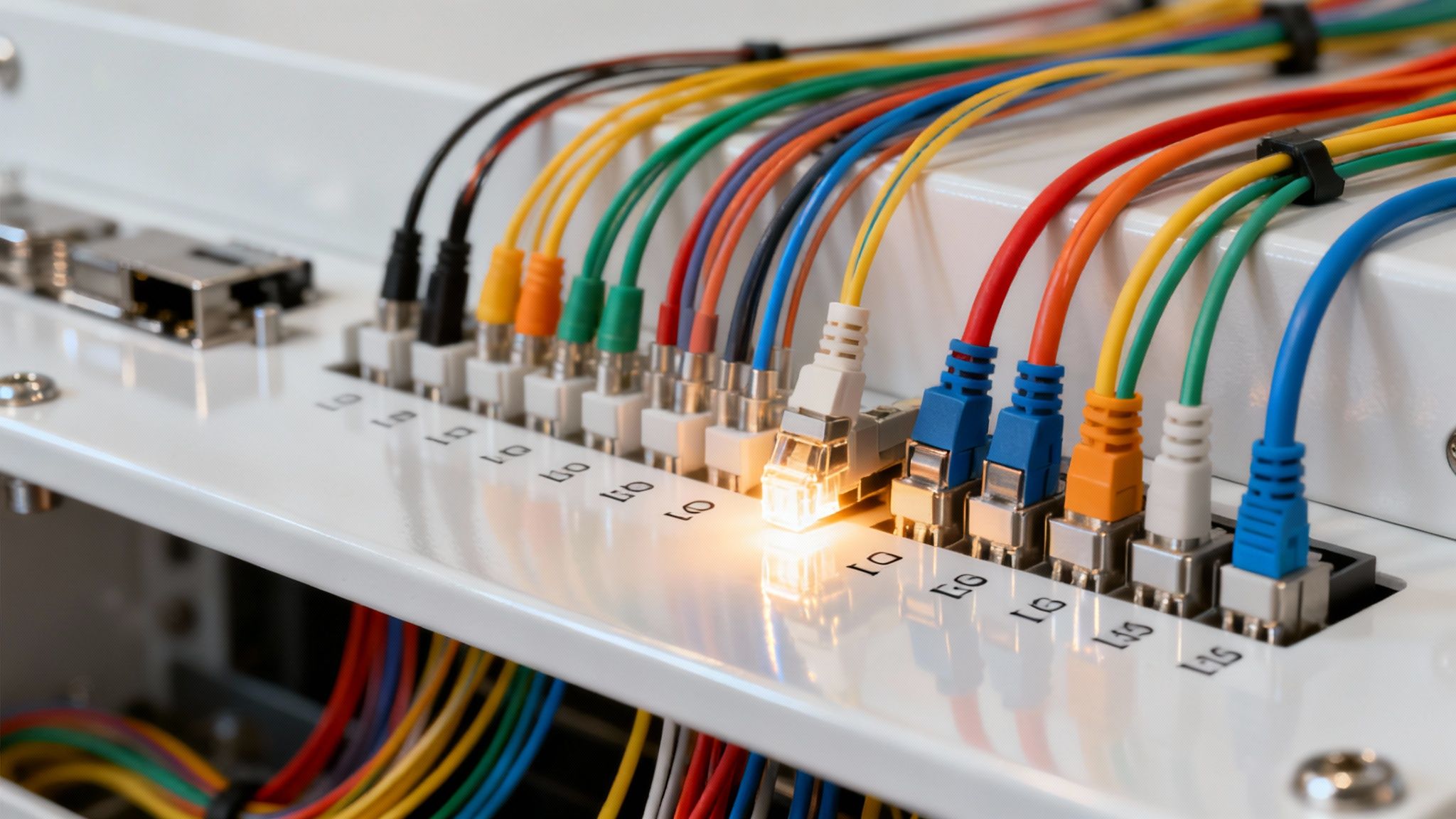
The goal is to eliminate any single point of failure by engineering multiple, diverse network paths. For instance, hyperscalers like Google and Meta establish physically separate fiber entry points and routes to regional networks, ensuring a carrier outage or physical disruption on one path doesn't impact service. Similarly, a Tier 1 ISP consolidating facilities must meticulously manage fiber routing and splices to prevent widespread customer outages, a process requiring deep coordination with multiple upstream providers.
Actionable Implementation Strategy
To build a resilient network foundation, focus on meticulous planning, precise execution, and exhaustive validation. This systematic approach prevents bottlenecks and ensures seamless service continuity from day one in the new environment.
- Diverse Path Planning: Design at least two physically separate entry conduits and pathways for carrier fiber. Map these routes to avoid high-heat equipment zones, high-traffic corridors, and potential sources of physical damage.
- Carrier Coordination: Establish clear communication channels and coordination procedures with all involved network carriers. Schedule all external circuit work, such as splicing and testing, during pre-approved maintenance windows.
- Meticulous Cabling and Testing: Use color-coded cabling to differentiate circuit types (e.g., internet, point-to-point, dark fiber). Before any equipment cutover, test every fiber strand with an OTDR (Optical Time-Domain Reflectometer) to verify light levels and integrity.
- Documentation and Management: Maintain detailed documentation of all splice locations, fiber types, and port assignments. For robust internal network management, understanding the capabilities of a managed Ethernet switch can be crucial for optimizing performance and security. Proper documentation is key to rapid troubleshooting and future capacity planning.
4. Structured Cabling System Installation and Reconfiguration
A data center’s performance and reliability are directly tied to its nervous system: the structured cabling. This step in the data center migration checklist addresses the critical task of planning and deploying the physical connectivity infrastructure in the new environment. It involves more than just running cables; it is about designing a clean, scalable, and manageable system of copper and fiber pathways, cable trays, grounding, and cable management that will support current needs and future growth. A well-executed cabling strategy prevents troubleshooting nightmares, simplifies maintenance, and ensures signal integrity for high-performance applications.
This methodical approach is essential for preventing the "spaghetti" that plagues poorly planned data centers, which can obstruct airflow, increase the risk of accidental disconnects, and complicate future upgrades. For instance, a provider like CoreWeave, deploying high-density cabling for AI workloads, must meticulously plan every fiber run to support massive bandwidth requirements and ensure low latency. Similarly, an enterprise consolidating multiple data centers into a single new facility must standardize its cabling methodology to create a consistent, maintainable, and efficient environment from day one.
Actionable Implementation Strategy
To ensure your cabling infrastructure is a long-term asset rather than a liability, focus on precise planning, adherence to standards, and comprehensive documentation from the very beginning.
- Design with Scalability in Mind: Design your cable trays, conduits, and pathways to accommodate at least 50% future growth. This prevents costly and disruptive retrofitting as density increases.
- Adhere to Standards: Strictly follow TIA-942 standards for data center cabling, paying close attention to specifications for bend radius, cable separation (power vs. data), and proper grounding to ensure performance and safety.
- Implement a Labeling System: Develop a clear and consistent labeling scheme for every cable, patch panel port, and termination point. This label should correspond directly to an entry in your Configuration Management Database (CMDB) for rapid identification and troubleshooting.
- Plan Cable Routing: Create detailed cable pulling diagrams and rack elevations before a single cable is installed. Implement separate horizontal and vertical cable management to maintain organization and proper airflow within each rack.
- Test and Certify: Use certified cable testing equipment to validate every copper and fiber link post-installation. This certification process confirms that each connection meets performance standards and eliminates physical layer issues before equipment goes live.
5. Server and Computing Equipment Migration
The physical relocation of servers, storage arrays, and high-performance computing equipment is the most tangible phase of any data center migration. This step involves the carefully orchestrated de-racking, packaging, transporting, and re-racking of your core IT assets. It is a high-stakes process where every minute of downtime counts and the risk of physical damage is at its peak. This element of the data center migration checklist is where meticulous planning directly translates into operational continuity and risk mitigation.

This process demands precision, from ensuring anti-static precautions are met to verifying that transport vehicles are climate-controlled and equipped with air-ride suspension. For example, when a financial services firm consolidates data centers, the secure, uninterrupted movement of servers processing real-time transactions is paramount. Similarly, a hyperscale provider moving thousands of servers must execute the move with factory-like efficiency to bring capacity online within a tight schedule, minimizing revenue loss and service disruption.
Actionable Implementation Strategy
Executing a successful physical server migration requires a combination of specialized logistics, technical precision, and clear communication. The goal is to move assets safely and re-establish functionality as quickly as possible.
- Create a Runbook: Develop a minute-by-minute runbook for the migration event. This document should detail every task, assign ownership, and define communication protocols and escalation paths for every team member involved.
- Logical vs. Physical Migration: Where possible, use Physical-to-Virtual (P2V) or Virtual-to-Virtual (V2V) tools to migrate workloads logically before moving the underlying hardware. This significantly de-risks the physical move by reducing dependencies.
- Establish Parallel Systems: For mission-critical applications, run parallel environments at the source and destination sites. This allows for a seamless cutover and provides an immediate rollback path if issues arise post-migration.
- Specialized Logistics: Partner with a logistics provider experienced in high-value electronics transport. A critical consideration is ensuring the transport is handled by professionals; understanding the specifics of heavy haul trucking and specialized freight is essential for safeguarding your assets.
- Post-Move Validation: Once equipment is re-racked and connected, execute a pre-defined validation plan. This includes verifying network connectivity, checking application functionality, and confirming performance metrics against the baseline established during the assessment phase.
6. Cooling and HVAC System Migration
A successful data center migration is not just about moving servers; it's about recreating the precise environmental conditions that guarantee their optimal performance and longevity. The migration of cooling and HVAC systems is a critical component of any data center migration checklist, ensuring the new environment can effectively dissipate heat generated by high-density equipment. This involves designing and implementing a thermal management strategy that prevents overheating, reduces hardware failure rates, and maintains operational efficiency from day one.
The stakes are incredibly high, as inadequate cooling can lead to catastrophic system shutdowns and permanent equipment damage. For instance, hyperscale providers deploying liquid cooling for AI and HPC clusters must meticulously plan fluid distribution, leak detection, and heat exchange integration. Similarly, an enterprise consolidating into a new facility must validate that the existing HVAC can support its planned rack density, or budget for upgrades like in-row cooling units to handle localized hotspots.
Actionable Implementation Strategy
To ensure thermal stability post-migration, a proactive and data-driven approach to cooling system design and validation is essential. This strategy focuses on modeling, testing, and continuous optimization to match the cooling infrastructure with the specific heat load of the migrated IT assets.
- Thermal Modeling and CFD Analysis: Before moving any equipment, use Computational Fluid Dynamics (CFD) to model airflow and temperature distribution in the new space. This analysis helps optimize rack placement and validates the effectiveness of containment strategies like hot/cold aisles.
- Establish Environmental Baselines: Deploy temperature and humidity sensors throughout the target data center to establish a pre-migration baseline. Monitor these metrics at the rack inlet level to ensure they align with ASHRAE guidelines and equipment manufacturer specifications.
- Implement Airflow Management: From the outset, install blanking panels in all unused rack U-space to prevent hot air recirculation. Use brush grommets and proper cable management techniques to seal air gaps in the raised floor and within racks, maximizing the efficiency of your cooling system.
- Commissioning and Load Testing: Before the final cutover, perform a commissioning (Cx) process using heat-load banks to simulate the full thermal load of the migrated equipment. This stress test validates that the HVAC systems can perform under worst-case scenarios and identifies any weak points in the design.
7. Compliance, Security, and Access Control Implementation
A data center migration's success is not only measured by uptime but also by its ability to maintain and enhance security and compliance posture. This step involves the rigorous implementation and validation of all physical and logical security measures in the new facility. It’s about ensuring that every access point, surveillance camera, and security protocol meets stringent regulatory requirements before any production systems are activated, making it an indispensable part of your data center migration checklist.
Neglecting this phase can lead to catastrophic compliance failures and security breaches. For instance, a financial services firm migrating to a new facility must ensure its environment meets SOC 2 Type II and PCI-DSS requirements from day one to avoid regulatory penalties and loss of customer trust. Similarly, healthcare providers must validate HIPAA compliance, including physical access logs and data encryption protocols, to protect sensitive patient information in the new location. This proactive validation ensures the new environment is a fortress, not just a facility.
Actionable Implementation Strategy
To build a secure and compliant environment, your approach must be systematic, layered, and auditable. This ensures that security is integrated into the facility's design and operational procedures, rather than being an afterthought.
- Layered Physical Security: Implement multi-factor authentication at all entry points, from the facility perimeter to the individual cage or rack. This includes biometric scanners, key cards, and PIN codes, all logged in a central, immutable audit trail.
- Access Control Policies: Enforce the principle of least privilege, granting physical and logical access only to personnel who explicitly require it for their job function. Document and regularly review all access lists.
- Comprehensive Surveillance: Deploy high-definition surveillance cameras with full coverage of all critical areas, including entrances, exits, and server aisles. Ensure motion detection is active and that footage is securely stored for a defined retention period.
- Compliance Validation and Audits: Conduct a pre-migration security risk assessment and a post-implementation audit. Engage third-party auditors to validate compliance with specific frameworks like ISO 27001, HIPAA, or FERC, and ensure all documentation is prepared for regulatory review.
8. Testing, Validation, and Performance Verification
A data center migration's success is ultimately determined not by the move itself, but by how systems perform post-cutover. This is where a rigorous testing, validation, and performance verification phase becomes indispensable. This stage involves executing a series of predefined tests to confirm that every migrated component, from individual servers to complex application stacks, functions as expected or better in the new environment. It is the final quality gate before handing the keys over to production traffic, ensuring all operational requirements and service level agreements (SLAs) are met.
This comprehensive validation is a non-negotiable part of any professional data center migration checklist. For instance, a hyperscale provider must simulate regional failover scenarios and massive traffic spikes to validate the new site’s resilience before it goes live. Likewise, an enterprise migrating its core financial applications must conduct strenuous load testing and transaction-level verification to guarantee performance and data integrity, preventing post-launch outages that could impact revenue and customer trust.
Actionable Implementation Strategy
To ensure a smooth transition to production, your testing strategy must be multi-layered, systematic, and meticulously documented. This approach moves from foundational infrastructure checks to full-scale application performance benchmarking.
- Develop Granular Test Plans: Create detailed test scripts for every system. Define clear pass/fail criteria, expected outcomes, and the specific personnel responsible for execution. The plan should cover infrastructure (power, cooling), network connectivity (latency, packet loss), and application functionality.
- Phased Testing Execution: Begin with Layer 1 and 2 tests, verifying physical connectivity and network links. Progress to system-level tests, ensuring servers boot and services start. Finally, conduct integrated application and user acceptance testing (UAT) to validate end-to-end workflows.
- Performance and Load Testing: Use automated tools to benchmark system performance against pre-migration baselines. Simulate peak production loads to identify potential bottlenecks in CPU, memory, storage I/O, or network throughput before they affect real users.
- Stability and Failover Testing: Once initial tests pass, run a 24 to 48-hour stability test under a simulated production load. Critically, test all failover mechanisms, including redundant power feeds, network paths, and server clusters, to confirm that high-availability designs work as intended. This process often benefits from robust monitoring tools that can track performance in real-time. For a deeper look into the equipment used for such monitoring, you can find more information about professional-grade test monitors.
9. Change Management, Cutover Planning, and Execution
The culmination of all planning and preparation, the cutover phase is where the migration becomes a live operational event. This step is far more than just flicking a switch; it is a meticulously choreographed sequence of events governed by a robust change management process. A well-defined cutover plan orchestrates the actions of every team member, from engineers to stakeholders, ensuring the physical and logical transition from the source to the destination environment happens with minimal disruption. This disciplined approach is a non-negotiable part of any data center migration checklist, transforming a high-risk event into a controlled, predictable procedure.
Effective execution minimizes operational impact and enables rapid recovery if issues arise. For instance, a financial services company like Stripe executing a coordinated cutover across multiple data centers must do so with zero downtime to avoid impacting global transactions. Similarly, enterprise IT teams consolidating infrastructure into a new colocation facility use detailed runbooks to manage dependencies and ensure services are brought online in the correct order. This stage is the ultimate test of the project's planning and readiness.
Actionable Implementation Strategy
Success during the cutover hinges on clear communication, defined roles, and a granular, time-based plan that accounts for every dependency. The goal is to eliminate ambiguity and empower the team to act decisively.
- Develop a Granular Runbook: Create a detailed, minute-by-minute cutover script. This runbook should document every action, the responsible party, expected duration, and specific success criteria for each step.
- Establish a Command Center: Designate a physical or virtual command center to serve as the single source of truth during the migration window. All communications, decisions, and status updates should flow through this central point.
- Define Clear Escalation Paths: Document a clear decision-making hierarchy and pre-approved escalation paths for handling unexpected issues. This ensures that problems are addressed swiftly by the appropriate personnel without causing delays.
- Conduct Pre-Migration Briefings: Hold mandatory briefings for all participants to review the cutover plan, their specific roles, communication protocols, and rollback triggers. Ensure every team member understands their responsibilities and the critical path.
- Implement a Communication Plan: Create a proactive communication strategy to keep business stakeholders and customers informed before, during, and after the migration window. Transparency builds confidence and manages expectations effectively.
10. Documentation, Knowledge Transfer, and Operational Handoff
The physical move is just one phase of a successful data center migration; the project is not truly complete until the new environment is fully operational and supportable. This final, critical step involves compiling comprehensive documentation, conducting thorough knowledge transfer sessions, and executing a formal handoff to the operations team. It is the bridge between the migration project team and the long-term operational staff, ensuring the new data center can be managed, maintained, and scaled effectively. This process is essential for long-term stability and is a non-negotiable part of any professional data center migration checklist.
Without this structured transition, valuable institutional knowledge gained during the migration is lost, leading to longer incident response times and inefficient troubleshooting. For instance, a hyperscale provider like AWS provides extensive documentation and runbook templates to customers to ensure they can operate their new cloud environment. Similarly, a colocation provider like Equinix maintains meticulous facility documentation, enabling their support teams to assist clients efficiently. This final handoff solidifies the project's success by empowering the teams who will manage the infrastructure for years to come.
Actionable Implementation Strategy
To ensure a seamless transition from project to operations, focus on creating clear, accessible, and comprehensive resources that capture every aspect of the new environment. The goal is to eliminate single points of failure related to knowledge and empower the entire operations team.
- Create Operational Runbooks: Develop detailed, step-by-step runbooks for common operational tasks, such as server reboots, network failover procedures, and power-down sequences. Include contact information for vendors and escalation paths.
- Finalize As-Built Documentation: Update all initial planning documents, including network diagrams, rack elevations, and power circuit maps, to reflect the final "as-built" state of the data center. Photographs and clear labels are invaluable here.
- Conduct Knowledge Transfer Workshops: Schedule dedicated training sessions with the operations team. Walk them through the new infrastructure, key architectural decisions ("the why"), and the location of all documentation.
- Establish a Centralized Knowledge Base: Use a Configuration Management Database (CMDB) or a dedicated wiki (like Confluence) to store all documentation. This creates a single source of truth that is easily searchable and can be updated over time.
- Define Post-Handoff Support: Clearly outline a "hypercare" period where the migration project team remains available to the operations team for questions and support before fully disengaging.
10-Point Comparison: Data Center Migration Checklist
| Item | 🔄 Implementation Complexity | ⚡ Resource Requirements | ⭐ Expected Outcomes | 📊 Ideal Use Cases | 💡 Key Advantages |
|---|---|---|---|---|---|
| Infrastructure Assessment and Inventory | Medium–High — detailed surveys, testing, cross-team coordination | Moderate — technicians, inventory tools (RFID/barcode), test equipment | ⭐ High — accurate baseline, dependency mapping | Pre-migration audits, facility acquisitions, cloud migration planning | 💡 Enables capacity planning, prevents surprises, supports compliance |
| Power and Electrical System Migration | High — code compliance, limited execution windows | High — licensed electricians, UPS/generator/PDU equipment, metering tools | ⭐ High — validated redundancy, minimal downtime risk | Facility expansions, fed relocations, critical-load migrations | 💡 Ensures continuity, validates failover, documents power handoff |
| Network Connectivity and Fiber Infrastructure Routing | High — precision splicing, path design, carrier coordination | High — fiber technicians, OTDR, conduit/patch hardware, carrier access | ⭐ High — improved bandwidth, redundant low-latency paths | Carrier interconnects, high-bandwidth/low-latency migrations | 💡 Reduces latency, enables carrier independence, provides tested SLAs |
| Structured Cabling System Installation and Reconfiguration | Medium — detailed design and labor‑intensive installation | Moderate — cabling crews, trays, labeling, testing tools | ⭐ Medium–High — organized, scalable cabling infrastructure | Consolidation projects, standardization across sites, growth planning | 💡 Reduces errors, improves maintenance and airflow, supports future growth |
| Server and Computing Equipment Migration | High — coordination with applications, rollback planning | High — transport, racking crews, sync tools, 24/7 monitoring | ⭐ High — consolidation, better utilization if coordinated | Data center consolidation, hardware refreshes, P2V/V2V migrations | 💡 Minimize downtime with parallel systems, test failover, document configs |
| Cooling and HVAC System Migration | High — thermal engineering, containment design, complex installs | High — HVAC systems, thermal modeling, installers, sensors | ⭐ High — improved efficiency, supports higher density | High-density deployments, PUE improvement projects, equipment refresh | 💡 Implement hot/cold containment, monitor temps, plan 30–40% overhead |
| Compliance, Security, and Access Control Implementation | Medium–High — policy alignment and system integration | Moderate–High — access hardware, cameras, monitoring, training | ⭐ High — regulatory adherence and protection of assets | Regulated industries, multi-tenant facilities, audit-driven environments | 💡 Enforce least-privilege, maintain immutable logs, train staff |
| Testing, Validation, and Performance Verification | Medium — phased, thorough test plans and retesting | Moderate — test tools (iperf, OTDR), personnel, maintenance windows | ⭐ Very High — confirmed readiness, SLA and failover validation | Pre-cutover validation, new facility commissioning, SLA acceptance | 💡 Use automated tests, document results, include 24‑hr stability runs |
| Change Management, Cutover Planning, and Execution | High — detailed timelines, stakeholder coordination, rollback plans | High — cross-team staff, communications, monitoring, parallel ops | ⭐ High — minimized customer impact when executed correctly | Live cutovers, multi-system migrations, zero‑downtime goals | 💡 Define decision authority, rehearse roles, maintain continuous comms |
| Documentation, Knowledge Transfer, and Operational Handoff | Medium — comprehensive documentation and training sessions | Moderate — documentation tools, trainers, CMDB updates | ⭐ High — reduced operational risk, faster troubleshooting | Post-migration handoff, ops team transitions, vendor support changes | 💡 Provide as‑built diagrams, runbooks, and scheduled documentation reviews |
Partnering for a Successful Migration Journey
Executing a data center migration is one of the most complex and high-stakes initiatives an organization can undertake. It's far more than a simple physical relocation of assets; it's a strategic overhaul of the digital heart of your business. As we've detailed throughout this comprehensive data center migration checklist, success hinges on a meticulous, multi-faceted approach that leaves no stone unturned. From the foundational stages of infrastructure assessment and inventory to the final operational handoff, each phase is a critical link in a chain that determines the project's ultimate outcome.
A flawed migration can lead to catastrophic downtime, data loss, and significant financial repercussions. Conversely, a well-executed migration serves as a powerful catalyst for modernization, enhanced performance, and future scalability. The difference between these two outcomes lies not just in the quality of the plan but in the proficiency of its execution.
From Checklist to Strategic Execution
The ten pillars we've explored provide the essential framework for navigating this complexity. Let's recap the core principles that bind them together:
- Proactive Planning is Paramount: The initial phases, including infrastructure assessment, power and cooling analysis, and network connectivity routing, are not mere preliminaries. They are the bedrock of the entire project. In-depth dependency mapping and precise inventory management prevent the "gotcha" moments that derail migration timelines.
- Precision in Physical and Logical Layers: The success of migrating sophisticated server and computing equipment is directly tied to the underlying infrastructure. Meticulous structured cabling, robust power systems, and optimized network design are not just support functions; they are enablers of performance and reliability in the new environment.
- Validation is Non-Negotiable: A migration is not complete when the last server is racked. It is complete when every application, system, and connection has been rigorously tested, validated, and proven to meet or exceed performance benchmarks. This includes comprehensive testing, clear cutover planning, and robust rollback strategies.
- Human Factors Determine Success: Technology migration is ultimately a human endeavor. Effective change management, clear communication, comprehensive documentation, and a seamless knowledge transfer are what transform a technical project into a sustainable operational success.
Your Next Steps: Activating the Plan
Mastering these concepts is about shifting your perspective from a tactical "to-do" list to a strategic, holistic view of your infrastructure's future. The true value of this data center migration checklist is realized when it is used as a dynamic tool for communication, risk management, and quality assurance.
Your immediate next step should be to use this framework to conduct a gap analysis of your own internal capabilities. Where are your team's strengths? More importantly, where do you lack the specialized expertise or resources required for flawless execution? An honest assessment will reveal areas where partnering with seasoned experts is not a luxury, but a necessity. A strategic partner brings battle-tested methodologies, specialized tools, and the experience needed to navigate unforeseen challenges, ensuring your migration doesn't just avoid disaster but actively drives business value. Ultimately, a successful data center migration is a testament to meticulous planning and expert partnership, positioning your organization for a more resilient and scalable future.
Transform your comprehensive data center migration checklist from a plan into a reality with a partner dedicated to precision and excellence. The expert teams at Southern Tier Resources specialize in end-to-end data center and telecom infrastructure deployment, ensuring every phase of your project is executed to the highest standard. To mitigate risks and guarantee a seamless transition, explore how our tailored solutions can support your next critical migration by visiting Southern Tier Resources.