Think of data center structured cabling standards as the official playbook for your network's physical layer. These are the established guidelines and best practices that govern the design, installation, and management of every cable, connector, and pathway. They are the universal building codes for a data center’s digital foundation, making sure every component speaks the same language and works together flawlessly.
Why Cabling Standards Are the Bedrock of Modern Data Centers
Imagine building a city without an electrical grid plan. Lights would flicker, power would fail without warning, and connecting new buildings would be a chaotic, dangerous mess. That’s a data center without structured cabling standards—a tangled web of "spaghetti wiring" that invites outages, makes maintenance a nightmare, and brings growth to a screeching halt.
Every single click, stream, and transaction your business processes relies on data flowing perfectly through this physical layer. That level of performance is only possible with a meticulously organized and standards-based approach.
These standards take potential chaos and turn it into predictable order, providing a logical, hierarchical framework for the entire network. This isn't just about making cables look neat; it’s a strategic blueprint for operational excellence.
From Unstructured Chaos to Predictable Order
Without a plan, technicians are forced to run cables ad-hoc, directly from point A to point B. The result is a brittle system that's nearly impossible to manage. Upgrades become massive headaches, and tracing a single point of failure can take hours of manual work, racking up costly downtime.
Standards replace that guesswork with a methodical system designed to anticipate future needs.
Adhering to structured cabling standards isn't an expense; it's an investment in reliability, manageability, and future scalability. It’s the difference between a custom-built race car and one assembled from mismatched parts—only one is built for sustained high performance.
The organizations that develop these rules, like the Telecommunications Industry Association (TIA) and the International Organization for Standardization (ISO), are the master architects of this digital foundation. They establish clear, non-negotiable requirements for everything from system layout to component performance.
This includes:
- System Architecture: Defining critical areas like the Main Distribution Area (MDA) and Horizontal Distribution Areas (HDAs) to create a logical and efficient data flow.
- Component Performance: Specifying minimum capabilities for cables, connectors, and patch panels to guarantee bandwidth and maintain signal integrity under load.
- Installation Practices: Outlining precise methods for routing, terminating, and labeling to ensure long-term reliability and simplify day-to-day maintenance.
- Redundancy and Uptime: Providing frameworks (like the TIA-942 Tiers) that directly align infrastructure resilience with specific business continuity goals.
Ultimately, a deep understanding of these standards is non-negotiable. Building a data center on a non-compliant foundation is like constructing a skyscraper on sand. It might stand for a little while, but it lacks the structural integrity to support today's demands, let alone the explosive growth of tomorrow. This is why a standards-based approach is the bedrock of any modern, high-performance data center.
Decoding the Most Important Cabling Standards
Trying to get a handle on data center structured cabling standards can feel like wading through alphabet soup. You've got TIA, ANSI, ISO, BICSI—it's a lot. But these aren't just arbitrary rules; they're the blueprints that ensure every cable, connector, and pathway works together flawlessly. Think of them as the shared language that prevents a high-performance data center from descending into a chaotic mess of wires.
This need for a common language isn't new. The whole concept of structured cabling standards goes back to the early 1990s, when the telecom industry was desperate to tame the "spaghetti" taking over network closets. In 1991, the industry got its first real playbook: ANSI/TIA-568. This was a game-changer for commercial buildings, setting clear rules for cabling types, distances, and connectors. It finally moved us away from the messy, point-to-point wiring of the past and set the stage for the more specialized ANSI/TIA-942 data center standard, which arrived in 2005.
The shift was dramatic, moving from pure chaos to predictable order. This image says it all.
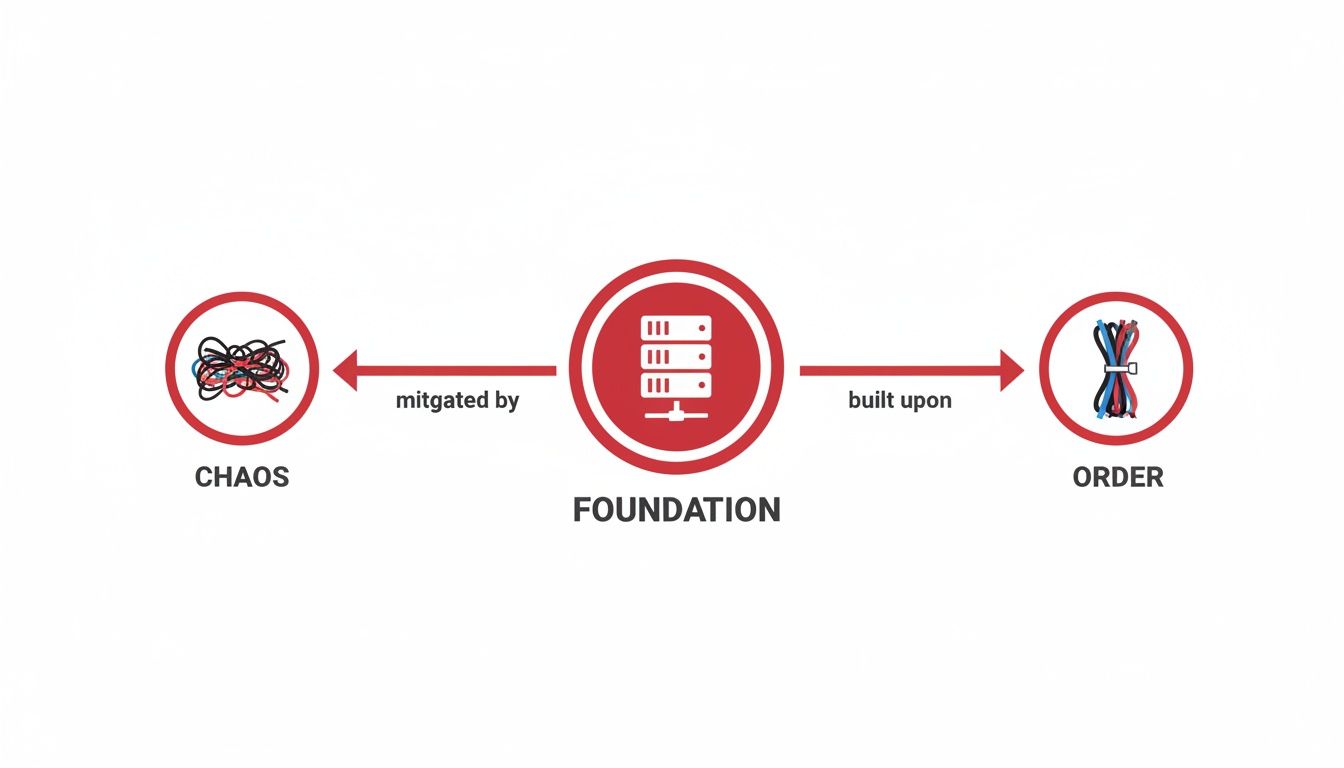
Without a standards-based approach, creating a data center that's both manageable and reliable is next to impossible. Let's break down the key players you need to know.
To help you keep these standards straight, here’s a quick overview of what each one brings to the table.
Key Data Center Cabling Standards at a Glance
| Standard | Primary Focus | Geographic Scope | Key Feature |
|---|---|---|---|
| ANSI/TIA-942 | Holistic data center design (cabling, power, cooling, security) | Primarily North America | Defines the Tier rating system (1-4) for availability and fault tolerance. |
| ANSI/TIA-568 | Performance of cabling components (cables, connectors) | Primarily North America | Sets specific performance criteria for categories like Cat6A. |
| ISO/IEC 11801 | Generic cabling systems for commercial premises | International | The global equivalent of TIA-568, using "Class" for links and "Category" for components. |
| BICSI | Installation best practices and craftsmanship | Global | Provides the "how-to" guides for professional, high-quality installation work. |
This table gives you the high-level view, but the real value comes from understanding how they work together to create a robust, high-performing environment.
ANSI/TIA-942: The Master Blueprint for Data Centers
If there’s one standard that governs the entire data center ecosystem, it’s ANSI/TIA-942. This isn't just about cabling; it's the master blueprint for the whole facility.
Think of it like the architectural plans for a hospital. The plans don't just show where the electrical outlets go—they dictate the layout of operating rooms, the requirements for life-support systems, and the redundant power needed to keep everything running. TIA-942 does the same for data centers.
It covers critical areas like:
- Topology: It lays out a clear, hierarchical structure with functional zones like the Main Distribution Area (MDA), Horizontal Distribution Area (HDA), and Equipment Distribution Area (EDA).
- Redundancy: This is where the famous Tier rating system (Tier 1-4) comes from, which classifies a facility's ability to withstand failures and maintain uptime.
- Environmental Controls: The standard gives detailed guidance on everything from HVAC and fire suppression to physical security, making sure the entire environment is stable and secure.
ANSI/TIA-568: The Rulebook for Cabling Components
While TIA-942 designs the building, the ANSI/TIA-568 series is the rulebook for the materials you build it with. This group of standards gets down to the nitty-gritty, focusing entirely on the performance specs of telecommunications cabling and components.
Basically, if TIA-942 tells you where to put your network rooms, TIA-568 tells you what kind of cable, connectors, and patch panels to use inside them. It’s the reason a Category 6A cable from one vendor performs just like one from another, which is essential for creating a reliable, vendor-neutral infrastructure.
The TIA-568 series is what guarantees your network’s physical layer can actually deliver the speeds you’re paying for. It prevents the cabling itself from becoming the bottleneck.
For installers and designers, this standard is gospel. It defines the minimum performance benchmarks for testing and certification, setting the acceptable limits for things like signal loss and crosstalk. As technology pushes bandwidth demands higher, keeping up with innovations like advanced future fiber technologies is critical.
ISO/IEC 11801: The International Counterpart
Think of ISO/IEC 11801 as the international version of the TIA-568 series. Developed by global bodies, it serves the same fundamental purpose but is the dominant standard outside of North America.
While TIA and ISO/IEC have worked to align their standards over the years, some differences in terminology remain. For example, ISO/IEC uses "Classes" (like Class EA) to define the performance of a full channel and "Categories" (like Category 6A) for the individual cables and connectors. For any company with a global footprint, being fluent in both is a must.
BICSI: The Professional Installer's Handbook
Finally, we have BICSI (Building Industry Consulting Service International). If the other standards tell you what to build, BICSI’s standards and manuals show you how to build it right. This is all about professional craftsmanship.
BICSI provides the definitive best practices for everything from pulling and terminating cable without compromising its performance to proper grounding, bonding, and firestopping. An installation that follows BICSI guidelines doesn't just pass certification tests—it's also clean, safe, and far easier to manage for years to come. This attention to detail is especially important for certain components; our own guide on the principles of https://southerntierresources.com/goodscode/shielding/4051862030 dives deeper into one such area.
When you start talking about data center standards, the conversation almost always lands on the TIA-942 Tier system. It's the industry's go-to framework for defining a facility's resilience and uptime potential. This isn't just about technical specs; it’s a business strategy that directly links what you spend on infrastructure to how well your operations can weather a storm.
Think of it like an insurance policy for your data. A Tier 1 facility is basic liability coverage—it handles the bare minimum. A Tier 4 facility, on the other hand, is the premium, all-risk policy that protects against almost any conceivable event. Each level up introduces more redundancy and fault tolerance, with specific demands on cabling, power, and cooling.
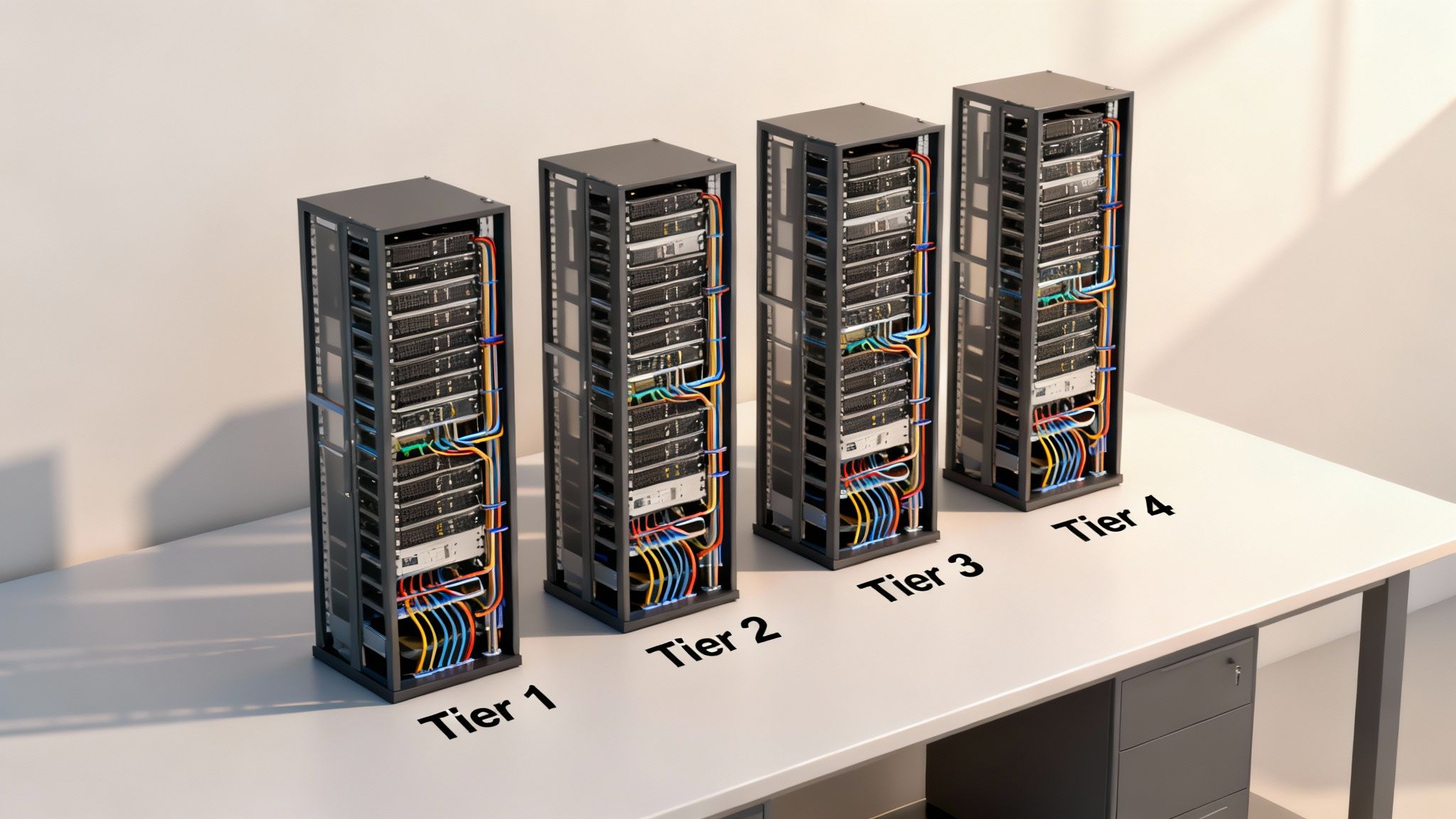
This system gives everyone a common language, helping organizations decide just how much "insurance" they really need—from a small office server closet to a mission-critical cloud provider.
Tier 1: Basic Capacity
A Tier 1 data center is the most straightforward setup you can have. It provides a single, non-redundant path for both power and cooling distribution. There are no backups for any of the critical systems.
What does that mean in practice? Any planned maintenance or unexpected equipment failure will bring the entire operation to a halt. The structured cabling is equally simple, with just one route for all network traffic. This tier is a workable choice for small businesses or development labs where occasional downtime isn't a deal-breaker.
- Uptime Guarantee: Around 99.671%, which translates to a potential 28.8 hours of downtime per year.
- Redundancy: None. A single point of failure anywhere in the chain takes everything down.
- Best For: Small businesses, test environments, and applications where uptime isn't critical.
Tier 2: Redundant Site Infrastructure
Tier 2 introduces the first real layer of protection. While it still operates on a single path for distribution, it adds redundant components to the mix. Think extra UPS modules, backup generators, or additional chillers. This is often called N+1 redundancy, meaning there’s at least one extra component on standby.
The catch is that maintenance on that primary distribution path—the main power line, for example—will still require a full shutdown. The cabling design is still fairly simple but needs to account for the presence of the backup gear. It’s a solid improvement over Tier 1, offering a real safety net for component failures.
A Tier 2 facility is like having a spare tire. It’s a lifesaver if you get a flat, but you still have to pull over and stop everything to make the fix.
Tier 3: Concurrently Maintainable
This is where things get serious. A Tier 3 facility is built to be concurrently maintainable. In plain English, you can take any single piece of critical equipment offline for maintenance, repair, or even replacement without disrupting the IT load. This is possible because it has multiple, independent distribution paths for power and cooling.
This demands a much more sophisticated structured cabling plan to manage the multiple active pathways. Every server and switch needs dual power inputs, each connected to a completely separate power source. If one path goes down or needs to be serviced, the other takes the full load without a hitch. For most businesses, Tier 3 hits the sweet spot between cost and high availability.
- Uptime Guarantee: A much stronger 99.982%, allowing for no more than 1.6 hours of downtime per year.
- Redundancy: N+1 fault tolerance with multiple, active distribution paths.
- Key Feature: Planned maintenance can happen anytime without impacting service.
Tier 4: Fault Tolerant
Tier 4 is the pinnacle of data center design, engineered to be completely fault-tolerant. It can survive any single, unplanned failure—whether it's an equipment malfunction or a total path interruption—without impacting operations. This is achieved with a fully redundant "2N" or "2N+1" architecture, where every component and pathway is mirrored.
The infrastructure is physically compartmentalized, so an event like a fire in one area can't cascade and take out the redundant systems. The cabling here is incredibly complex, with completely separate and often physically isolated pathways running to every piece of dual-powered equipment.
Building to Tier 4 standards is the most expensive and demanding route. It's reserved for organizations where even seconds of downtime are catastrophic, such as major stock exchanges, global banks, and critical government agencies.
Putting Standards into Practice with Smart Design
Knowing the standards is one thing, but putting them into practice is where the real work begins. This is the "how" that follows the "what"—translating those dense documents into a physical layout that’s high-performing, manageable, and built for the future. It’s less about just ticking boxes on a checklist and more about building an intelligent, layered system that can actually handle the demands you’ll throw at it.
Think of it like designing a city’s road network. You wouldn't have every cul-de-sac connect directly to the interstate; you'd have chaos. Instead, local roads flow into bigger collector streets, which then merge onto the main highway. A data center’s cabling topology works on the exact same principle, creating a clean, predictable path for data traffic to follow.
This structured approach is what separates a truly functional design from a messy, reactive one. It ensures every single connection has a purpose and a logical route.
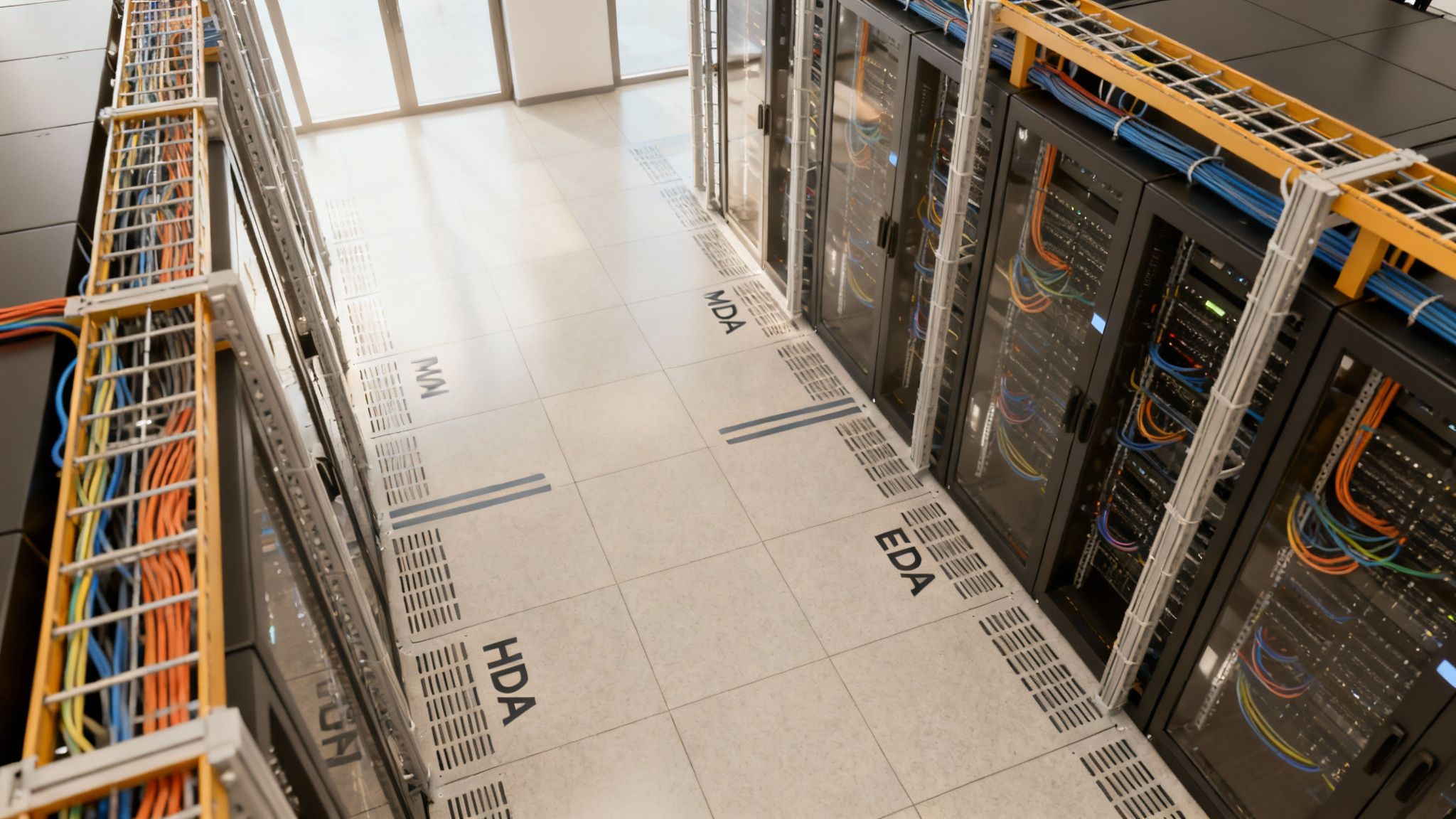
Building the Data Center Hierarchy
Standards like TIA-942 give us a clear architectural map for this. They define specific areas within the data center, each with its own job, all working together to prevent the dreaded "spaghetti wiring" that can cripple a facility.
- Main Distribution Area (MDA): This is Grand Central Station for your network. It’s the central hub where all external connections from service providers and campus backbones come together. Everything flows from here.
- Horizontal Distribution Area (HDA): Think of the HDA as a regional distribution hub. It takes the main connections from the MDA and parcels them out to specific zones or rows of cabinets, acting as an intermediary switchboard.
- Equipment Distribution Area (EDA): This is the final destination. The EDA is essentially the cabinet or rack where your servers, switches, and storage arrays live. They connect to the network through patch panels that are fed directly from an HDA.
This tiered model is what makes a data center scalable. When you need to light up a new row of servers, you're just running connections to the nearest HDA. You aren’t pulling hundreds of new cables all the way back across the facility to the MDA. This approach saves an incredible amount of time, reduces cable mess, and makes management far simpler. Our guide on strategic data center planning dives deeper into how this kind of foresight pays huge dividends down the road.
Cable Pathways and Containment
How a cable gets from point A to point B matters just as much as the connection itself. A well-thought-out design incorporates dedicated pathways and containment systems, like overhead cable trays or raised-floor conduits.
These aren't just for looks. Properly engineered pathways protect cables from getting crushed or snagged and, just as importantly, they’re crucial for managing airflow. A tangled mess of cables can block cold air from reaching your equipment and trap hot exhaust, leading to overheating and premature hardware failure.
A well-designed cable pathway is the unsung hero of data center efficiency. It ensures that your cooling systems can work as intended, directly impacting both equipment longevity and energy consumption.
Another key benefit is separating power and data cables into different pathways. This simple step helps minimize the risk of electromagnetic interference (EMI), a notorious culprit for corrupting data signals and hurting network performance.
The Critical Role of Labeling and Administration
Finally, none of this matters if you can't find anything. This is where meticulous administration comes in. The TIA-606 standard provides a comprehensive framework for labeling every single piece of the cabling puzzle—from individual cables to patch panels, outlets, and ports.
This isn’t just about being tidy; it's a lifeline for your operations team. When something goes down at 3 AM, a clear, logical labeling system is the difference between tracing a bad connection in minutes versus hours. This systematic approach is the foundation for rapid troubleshooting and simplified maintenance for the entire life of the facility.
A truly intelligent design also plans for the entire lifecycle of the hardware, which includes professional and secure data center equipment recycling at the end of its service. By putting all these principles into practice, you build a data center that’s not only compliant today but is also organized, efficient, and ready for whatever comes next.
How to Verify and Document a Compliant Installation
A perfectly designed and installed structured cabling system means very little until you can prove it performs. Sticking to data center structured cabling standards doesn't stop when the last cable is pulled and terminated. The job is only done when every single link is rigorously tested, certified, and thoroughly documented.
This final step is non-negotiable. It's the quality-control gate that guarantees your network will perform as expected from the moment you flip the switch.
Think of it like building a race car engine. You wouldn't just assemble the parts and assume it's ready for the track. You’d put it on a dynamometer to measure its precise horsepower and torque. Cabling certification is the same idea—it provides hard, empirical data proving your infrastructure meets the strict performance metrics laid out in standards like TIA-568. This creates a performance baseline that is absolutely critical for future troubleshooting.
Performance Testing for Copper and Fiber
Testing is far more than a simple pass/fail check. It requires specialized field testers that measure a whole range of precise electrical and optical characteristics. These tests confirm that the physical installation—the pulling, terminating, and dressing of cables—didn't accidentally compromise the integrity of the components themselves.
For copper cabling, installers are looking for several key performance metrics:
- Near-End Crosstalk (NEXT): This measures how much signal "bleeds" from one twisted pair to another. Think of it as crosstalk on a phone call where you can faintly hear another conversation. High NEXT is a primary source of data errors.
- Insertion Loss (Attenuation): This is the natural weakening of a signal as it travels down the cable. Too much insertion loss is like someone's voice fading to a whisper over a long distance—the signal arrives too weak to be understood.
- Return Loss: This test measures signal reflections bounced back toward the transmitter, usually caused by poor connections or kinks in the cable. It’s like an echo that can distort the original message.
For fiber optic links, the game changes to measuring light transmission:
- Optical Loss (Insertion Loss): Just like with copper, this measures the total amount of light lost from the transmitter to the receiver. It's the most fundamental measure of a fiber link's health.
- Optical Return Loss (ORL): This measures how much light is reflected back from connection points. Excessive reflected light can actually destabilize the sensitive laser light sources in your equipment, causing serious transmission problems.
The Importance of Comprehensive Documentation
Once all the tests are passed, the results must be meticulously documented. This package of information is essentially the birth certificate for your network, creating a permanent record of its architecture and as-built performance. It becomes an invaluable asset for day-to-day management and future troubleshooting.
Meticulous documentation transforms your physical infrastructure from a liability into a manageable asset. When an issue arises, you're not searching for a needle in a haystack—you're consulting a detailed map.
A complete documentation package isn't just a folder of test results. It should always include:
- As-Built Drawings: Detailed floor plans and rack elevations that show the exact physical routes of all pathways and the locations of every outlet, patch panel, and piece of hardware.
- Cable Schedules: A spreadsheet that acts as a master directory, linking every cable's unique ID to its origin and destination points, right down to the specific port numbers.
- Test Results: The full, detailed certification reports for every copper and fiber link. This isn't just a summary; it's the raw data showing it passed all required performance parameters.
This level of record-keeping is fundamental to running an efficient data center and protecting your investment. For organizations aiming to maintain peak performance, a complete data center infrastructure audit offers a deep dive into compliance, ensuring every component is accounted for and performing exactly as it should be.
Turning Cabling Standards into a Competitive Advantage
Following data center structured cabling standards isn't just about checking a box or following the rules. It’s about consciously building your physical infrastructure into a real business asset—one that directly impacts your bottom line. Think of a standards-based approach not as an expense, but as a direct investment in reliability, efficiency, and your company's future.
This kind of disciplined framework gives you a clear roadmap for getting the most out of your data center investment. When every cable, pathway, and connection follows a globally recognized blueprint, the entire system becomes predictable and resilient. That predictability is the bedrock of operational excellence.
From Cost Center to Strategic Asset
First and foremost, a compliant infrastructure means better reliability and uptime. By sticking to established guidelines for design and redundancy, like those outlined in the TIA-942 Tiers, you’re actively designing out single points of failure. This systematic approach dramatically cuts the risk of unplanned outages, which can easily cost a business thousands of dollars per minute.
Day-to-day operational costs also drop significantly. When cabling is meticulously labeled and organized—as required by standards like TIA-606—troubleshooting stops being a painful forensic investigation. Instead, it becomes a quick, straightforward fix. Moves, adds, and changes become routine tasks, not complex and risky projects.
A data center built on structured cabling standards simply has a lower total cost of ownership. It's cheaper to manage, easier to upgrade, and far more resilient, all of which directly contributes to a healthier bottom line.
This structured approach also lays a foundation that’s ready for whatever comes next. The intense demands of AI, machine learning, and edge computing require an infrastructure that can push massive bandwidth with almost no latency. A standards-based design ensures your data center can handle these advancements without needing a complete and costly overhaul.
Capitalizing on a Growing Market
The industry’s sharp focus on these standards is driving some serious investment and growth. We're seeing an explosive expansion in the data center cabling market, all fueled by the relentless need for more performance and scalability to handle today's data volumes. The global market, currently valued at $14.22 billion, is on track to nearly double, hitting $28.34 billion by 2032. This surge is largely pushed by hyperscalers who are all-in on fiber optics for AI and low-latency needs.
This incredible market growth highlights just how critical these standards are for building tomorrow's digital world. If you're interested in the numbers, you can discover more insights about the data center cabling market.
At the end of the day, data center standards are the bridge connecting technical execution to business success. When you embrace them, you aren't just building a network; you're engineering a competitive advantage. You're ensuring your infrastructure is a powerful engine for innovation, not an anchor holding you back.
Your Data Center Cabling Questions, Answered
Even with a firm handle on the theory, a lot of practical questions come up when you're in the trenches, actually applying these structured cabling standards. Let's tackle some of the most common ones we hear from IT leaders and data center managers.
What’s the Best Cable to Install for Future Growth?
When you’re planning a new installation and want to avoid a costly rip-and-replace down the road, Category 6A (Cat6A) copper is your go-to baseline for horizontal runs to server cabinets. It’s the workhorse that reliably delivers 10 Gbps speeds, a must-have for today's demanding applications.
But when you're talking about the backbone—the critical links between your main and horizontal distribution areas (MDAs and HDAs)—the conversation shifts to fiber. For any speeds pushing past 10 Gbps, single-mode fiber optic cable is the clear winner. It gives you practically limitless bandwidth, making it essential for handling the massive data loads from AI and machine learning.
A bit of expert advice: It is always, always cheaper to invest in higher-performance cabling during the initial build than to upgrade a live data center later. The labor costs to pull new cable in a functioning facility dwarf the initial price difference in materials.
Do I Really Need to Follow Every Single Standard?
While following standards is non-negotiable for a reliable build, you don’t have to treat them all equally. It’s more about knowing which standard to lean on for which part of your project.
Think of it like building a house. ANSI/TIA-942 is the overall architectural blueprint—it covers everything from the foundation to the roof, including your uptime Tiers. On the other hand, ANSI/TIA-568 is like the electrical code, focusing specifically on the performance of the wires and outlets.
Here’s a simpler way to look at it:
- Concerned about Uptime & Resilience? TIA-942 and its Tier requirements for redundancy are your primary guide.
- Need Blazing Network Speed? The TIA-568 performance specs for Cat6A or fiber are what you'll live by.
- Focused on Installation Quality? BICSI provides the detailed, hands-on best practices for true craftsmanship.
Why is Cable Testing Such a Big Deal?
Think of cable testing and certification as your performance guarantee. It’s the final inspection that proves your installation wasn't just done, but done right. We use specialized field testers to send signals down every single link, measuring everything from crosstalk to signal loss against the strict benchmarks set by TIA standards.
Without certified test results, you're just guessing that your network can handle the load. Testing gives you a concrete performance baseline, confirms the physical layer is solid before you start pointing fingers at switches or servers, and makes future troubleshooting infinitely easier. It’s the quality control step that validates your entire infrastructure investment.
At Southern Tier Resources, we translate complex standards into high-performing, reliable data center infrastructure. Our complete turnkey services mean your facility isn't just compliant—it's strategically engineered for future growth and operational peace of mind. Contact us to build your future-ready data center.