A network planner signs off on East Carolina because the map looks straightforward. There’s room to extend fiber, demand is moving outward from denser corridors, and several sites look ideal for cabinets, huts, tower upgrades, or edge compute. Then field reality shows up.
A county road that looked simple on a screen has drainage issues and limited shoulder. A municipal review takes a different path than the neighboring town. Pole attachment assumptions break once the existing plant is surveyed. A data room renovation that seemed minor now needs tighter sequencing around power, cooling, and uptime protection. In East Carolina, projects rarely fail because the concept was bad. They fail because early assumptions weren’t tested against local conditions.
East Carolina construction management then stops being an academic phrase and becomes an operating discipline. Buyers who do well in this region treat construction management as the control point for permitting, utility coordination, labor planning, weather exposure, documentation, and turnover quality.
In practice, I’ve seen the same pattern repeat. The owners who get projects built cleanly ask better questions early. They don’t just ask who can trench, hang strand, or fit out a room. They ask who can manage jurisdictional variation, make-ready friction, schedule risk, and handoff quality from day one. For some sites, even temporary energy planning matters before permanent service is ready. On projects with interim fuel or utility constraints, a resource like a temporary natural gas virtual pipeline can help frame how teams think about continuity planning during construction and startup.
If you’re evaluating routes, facilities, or municipal broadband work, it helps to look at East Carolina through an execution lens, not just a market lens. A practical baseline for that starts with understanding what full-scope telecom infrastructure work entails in the field: https://southerntierresources.com/s/build70144462.shtml.
Your East Carolina Expansion Starts Here
The first real decision isn’t where to build. It’s how you’ll control the build once field conditions start challenging the plan.
East Carolina attracts serious infrastructure interest for good reasons. You’ve got expanding broadband needs, a mix of urban and rural service areas, coastal and inland corridors, and plenty of public and private sites where telecom and data center work can create long-term value. But that same mix creates operating complexity.
What owners are usually balancing
Most buyers come into the region with three pressures at once:
- Speed to service: Carriers and ISPs want route segments energized and tested fast enough to support customer commitments.
- Capital discipline: Data center and network budgets have to survive internal review, not just contractor optimism.
- Low rework: Municipal and enterprise teams can’t afford to revisit permitting, utility conflicts, or acceptance documentation after crews demobilize.
Those pressures collide quickly in East Carolina because projects move across different right-of-way rules, utility coordination styles, and site conditions. Rural work can look easy on a drawing and become expensive once mobilization, traffic control, and access limitations show up. Coastal work adds exposure to weather windows, water table issues, and environmental review sensitivities. Urban-adjacent work often carries tighter public visibility and less tolerance for field improvisation.
Practical rule: The earlier you test your assumptions against jurisdiction, utility ownership, and constructability, the less your schedule depends on luck.
What strong construction management changes
Strong management doesn’t eliminate risk. It makes risk visible early enough to act on it.
That means one team is tracking permit status, field verification, utility coordination, material release timing, splicing readiness, punch closure, and as-built accuracy as one connected system. Without that, owners usually get partial progress everywhere and clean completion nowhere.
For East Carolina projects, that discipline is what turns a promising expansion into an operating asset.
Understanding the Regional Infrastructure Environment
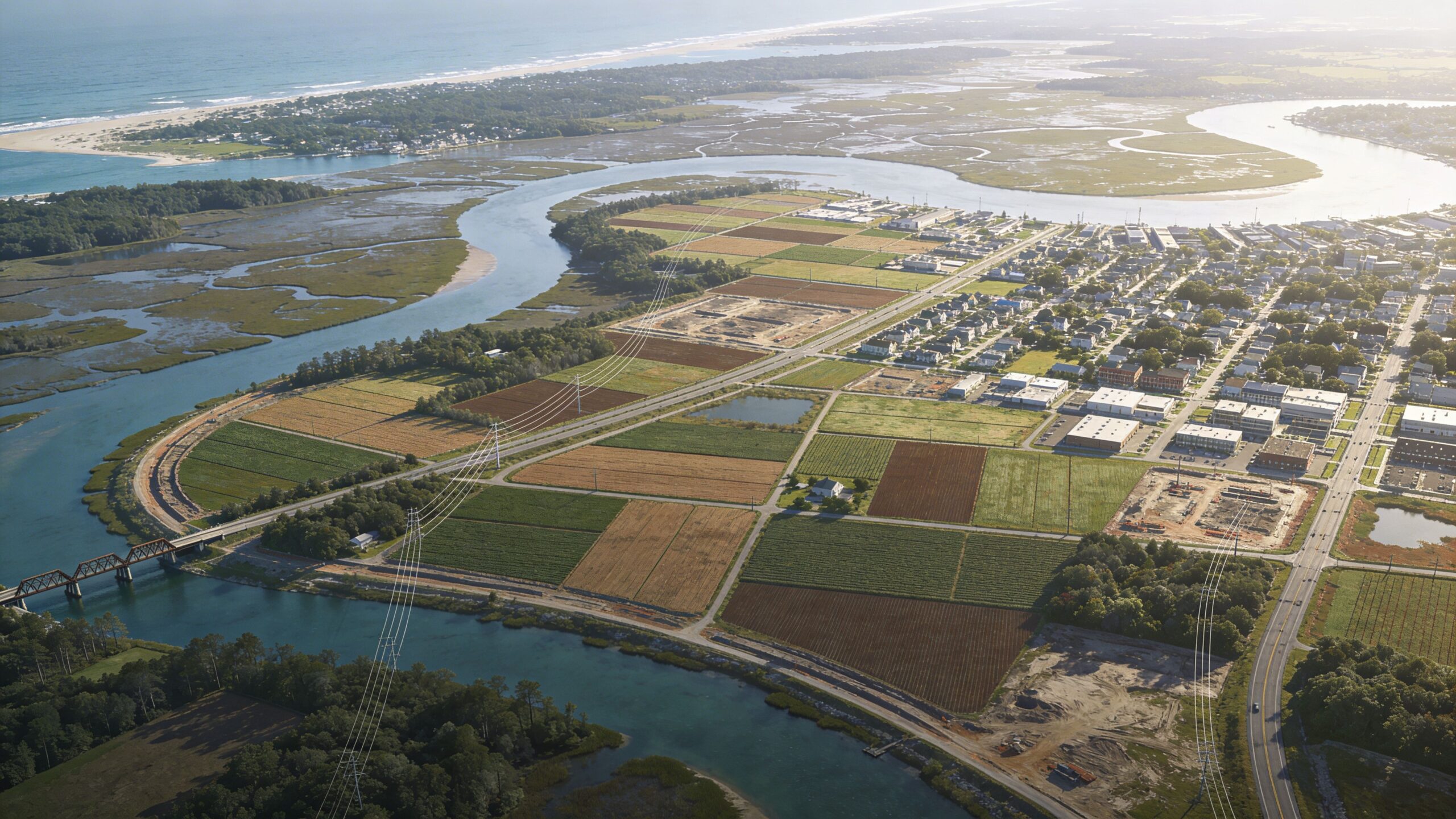
East Carolina isn’t one construction environment. It’s a chain of very different operating conditions stretched from inland corridors toward coastal communities, agricultural land, river crossings, older town centers, and utility territories that don’t behave the same way from one jurisdiction to the next.
Why geography changes the build plan
On paper, many East Carolina routes look open and buildable. In the field, three factors reshape that view.
First, distance and dispersion affect mobilization. Crews, equipment, traffic control setups, and material staging all become more sensitive when work is spread across long segments or lightly developed areas.
Second, terrain and drainage matter. Flat ground doesn’t always mean easy construction. Soft shoulders, ditch lines, high water, and narrow work envelopes can force design revisions or different installation methods.
Third, jurisdictional patchwork slows assumptions. County processes, municipal expectations, and utility owner requirements often differ enough that a single standard playbook won’t hold.
That’s why east carolina construction management has to be region-specific. Generic PM practices don’t go far enough when the route crosses multiple review environments and field realities.
ECU’s role in the local talent ecosystem
East Carolina University is one of the strongest institutional anchors for the regional construction workforce. Its Bachelor of Science in Construction Management is the first program accredited by the American Council for Construction Education in North Carolina, with continuous accreditation since 1994, and it’s described as one of the largest construction management programs in the southeastern United States on the ECU construction management program page.
That matters because East Carolina buyers need people who understand project controls, materials, safety, scheduling, quality, and field execution. ECU helps supply that broader construction foundation into the market.
At the same time, owners should be clear-eyed about what that means in practice. A strong regional construction pipeline is valuable, but infrastructure buyers still need to verify whether teams understand telecom-specific sequencing, active network constraints, utility pole workflows, structured cabling turnover, and uptime-sensitive fit-outs.
A practical view of civil scope helps here, especially for greenfield and outside plant planning where grading, access, trenching, and restoration have to line up with utility and route realities: https://southerntierresources.com/s/civil70745926.shtml
Demand isn’t the only story
The region has real need for broadband expansion, facility upgrades, and infrastructure investment. But demand alone doesn’t make projects executable.
What makes projects executable is alignment between:
| Regional condition | Why it matters |
|---|---|
| Mixed rural and municipal settings | Changes permit workflows, traffic control, and restoration expectations |
| Existing utility constraints | Drives redesign, make-ready, and attachment timing |
| Coastal and inland weather exposure | Affects schedule logic and contingency planning |
| Local labor availability | Influences sequencing, supervision, and specialty crew planning |
The buyers who do best in East Carolina don’t ask whether the market supports the project. They ask whether the route, jurisdiction, and utility environment support the schedule they’ve been promised.
Mastering Regional Permitting and Make-Ready Engineering
Permitting and make-ready work are where many East Carolina schedules start slipping. Not during major construction. Before it.
Most delays come from one bad habit: treating pre-construction as paperwork instead of fieldwork. In this region, that approach doesn’t hold. You need route validation, utility verification, municipal alignment, and environmental awareness before crews are committed.
Start with field truth, not desktop confidence
Aerial and buried projects both fail when design assumptions outrun field verification. Pole lines that seem attachable may need more make-ready than expected. Buried corridors that look open may have drainage structures, encroachments, private conflicts, or restoration requirements that weren’t visible in early planning.
A disciplined pre-con workflow usually includes:
Field walks with documented exceptions
Capture clear photos, spans, obstructions, driveway density, road classifications, and likely access restrictions.Utility ownership confirmation
Don’t assume one owner controls the full route. Ownership splits change reviews, standards, and timing.Jurisdiction-by-jurisdiction permit mapping
Neighboring authorities can ask for different submittal packages, traffic control detail, restoration language, or notice periods.Constructability review before permit issue
If field supervision sees a problem after permits are approved, redesign starts consuming schedule.
The strongest young construction professionals coming out of the region usually understand this better than people expect. ECU requires students to complete a minimum of 500 documented hours of construction work experience before the final semester, which is one reason graduates often arrive with practical exposure to field coordination and real site conditions, as outlined in the ECU catalog requirement for construction management work experience.
Make-ready is a coordination exercise first
Owners often think make-ready is mostly engineering. It isn’t. It’s engineering, utility process management, field validation, scheduling, and communication.
For aerial work, the trouble spots are predictable:
- Pole loading conflicts: Existing attachments, clearance issues, and pole condition can trigger changes.
- Sequence mismatches: One party’s approved design doesn’t mean all affected work can start.
- Notification gaps: If stakeholders aren’t informed in the right order, approved work can still stall.
For buried work, the equivalent trouble spots show up as locates, road crossing methods, restoration expectations, and private frontage coordination.
If the permitting lead, field engineer, and construction superintendent aren’t working from the same route-level issue log, make-ready problems multiply until they hit the schedule.
A focused permitting strategy should also spell out escalation paths. Who calls the municipality when a submittal sits? Who resolves utility review comments? Who decides whether a conflict triggers redesign or field adjustment? If that ownership is fuzzy, the owner becomes the default traffic cop.
Teams preparing permits for outside plant and network construction usually benefit from a tighter operational framework for approvals, submittals, and agency coordination, especially when work crosses multiple authorities: https://southerntierresources.com/s/permi70449462.shtml
Environmental and public-facing risks
East Carolina projects can trigger extra scrutiny around waterways, drainage, tree impacts, shoulder disturbance, and public safety. Even when formal review is manageable, public complaints can force attention onto staging, lane impacts, erosion control, and restoration quality.
That’s why permit packages should match the field plan. If the package promises one traffic control setup and the crew needs another, trust erodes fast. In municipal areas, that affects current permits and future ones.
A practical permitting culture is simple. Verify early. Document everything. Don’t let assumptions survive first contact with the field.
The Project Lifecycle for Digital Infrastructure
Telecom and data center projects only look linear from the owner’s dashboard. In the field, they’re a chain of dependencies. Design affects procurement. Procurement affects crew sequencing. Construction quality affects splicing, testing, commissioning, and turnover. If one handoff is weak, everything downstream gets more expensive.
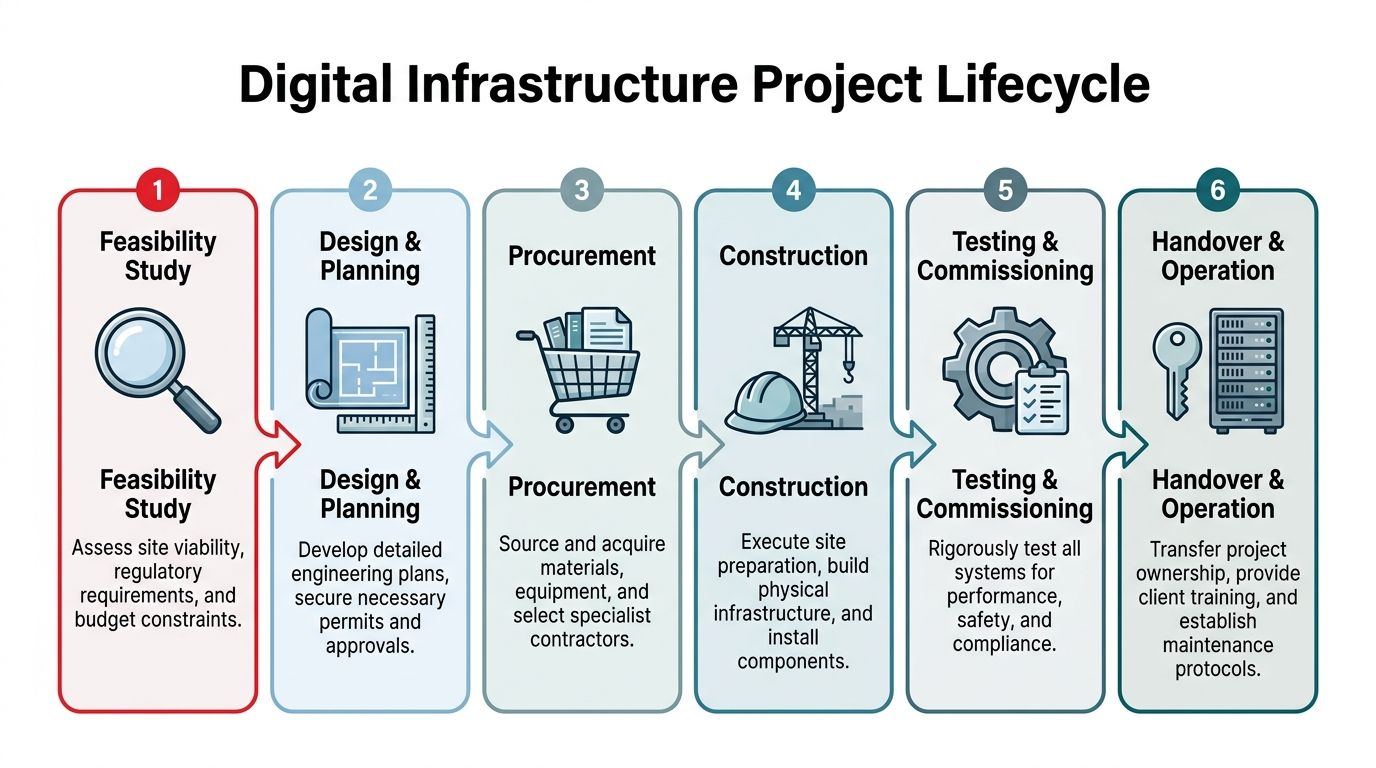
Feasibility and planning
The lifecycle starts long before a crew arrives. For a fiber build, feasibility means validating route logic, service objectives, utility environment, access constraints, and expected permit path. For a data center or enterprise facility, it means confirming the room, building, or campus can support power, cooling, cable pathways, security controls, and installation sequencing without compromising operations.
A lot of bad projects begin with a partial feasibility review. Someone validates demand and budget but doesn’t stress-test constructability.
The minimum questions are straightforward:
- Can this route or facility be built the way the concept assumes?
- What approvals govern the work?
- Which dependencies can stop progress even after notice to proceed?
- What needs to be ordered early enough to protect the critical path?
Design, procurement, and field execution
Once feasibility is real, design needs to carry field intelligence into the build. At this stage, telecom and data center projects separate themselves from generic construction.
Aerial outside plant work has to align attachment assumptions with utility reality. Buried work has to account for congestion, restoration, and access. Facility work has to sequence racks, pathways, cable management, grounding, and turnover criteria in a way that fits the operating environment.
Procurement then becomes a schedule control function, not a purchasing function. If conduit, cabinets, fiber assemblies, structured cabling components, grounding materials, or specialty hardware arrive out of sequence, crews either wait or start skipping ahead. Both options increase risk.
For data center teams looking at prefabricated deployment models, a modern modular data center can be a useful reference point because it highlights how much project success depends on integrating facility systems, delivery logistics, and commissioning planning early rather than treating them as separate scopes.
Construction, testing, and turnover
Construction, testing, and turnover. At this point, owners often assume the hard part is over. It isn’t. Physical installation creates the asset, but testing and turnover determine whether the asset is usable, supportable, and billable.
A disciplined execution sequence usually looks like this:
| Phase | What has to go right |
|---|---|
| Site and route prep | Access, safety setup, staging, locates, and protected work areas |
| Physical installation | Conduit, strand, fiber placement, cabinets, pathways, racks, and support systems |
| Technical completion | Fiber splicing, labeling, testing, structured cabling verification, and issue logging |
| Client acceptance | Punch resolution, as-builts, turnover packages, and operating handoff |
Field advice: Don’t measure progress only by footage installed or equipment set. Measure it by what can be tested, documented, and accepted without argument.
This is also where unified management matters most. The trenching crew, aerial crew, splicers, low-voltage team, electricians, and turnover staff don’t just need their own tasks. They need the same release logic, issue log, and quality standard.
When that happens, the project feels coordinated. When it doesn’t, each group claims its own work is complete while the owner still can’t put the asset into service.
Analyzing Key Cost Drivers and Budgeting Strategies
Budgets go sideways in East Carolina for familiar reasons, but the pattern is usually hidden in the estimate. The headline scope looks reasonable. The unpriced friction does the damage.
The cost drivers that matter most
Labor remains one of the clearest pressure points. Construction management roles are in demand, and the market for experienced supervision and project leadership isn’t getting looser. ECU’s online Master of Science in Construction Management launched in 2005, and the program notes that the field is projected to see nearly 39,000 new job openings annually through 2030, with construction managers earning a median wage around $101,000, according to the ECU master’s program overview. That doesn’t tell you what any one project will cost, but it does tell you the labor market for qualified management talent is competitive.
For East Carolina projects, budget pressure usually clusters in five areas:
- Pre-construction drag: Permit revisions, make-ready redesign, and utility coordination consume time before production starts.
- Material logistics: Conduit, cabinets, handholes, structured cabling components, and specialty hardware can arrive in the wrong sequence even when they technically arrive on time.
- Mobilization inefficiency: Rural spread and dispersed sites raise costs when crews and equipment spend too much time moving instead of producing.
- Restoration exposure: Pavement, shoulder, ground cover, and site-finish expectations often cost more than early estimates assume.
- Schedule disruption: Weather, access restrictions, owner changes, and utility delays create idle time or out-of-sequence work.
What disciplined budgeting looks like
The best budgets aren’t just detailed. They’re decision-ready.
That means separating direct production cost from risk cost. If an estimate folds permitting uncertainty, restoration ambiguity, and schedule contingency into one opaque line, owners can’t manage trade-offs. They can only approve or reject the total.
A stronger approach is to break the budget into controllable categories:
Base scope
The work that should happen if design, access, and approvals hold.Known variable conditions
Items like restoration bands, traffic control complexity, utility conflicts, and active-site work restrictions.Owner-driven options
Alternate routes, accelerated sequencing, additional redundancy, or phased turnover packages.Contingency tied to named risks
Not a generic allowance. A risk list with clear triggers.
What works and what doesn’t
What works:
- Early joint review between design, field operations, and permitting staff.
- Procurement tied to actual sequence, not broad schedule bars.
- Clear distinctions between assumptions, exclusions, and risk ownership.
- Site packages that let work proceed in phases instead of waiting for every segment to clear at once.
What doesn’t work:
- Using average unit rates to price routes with mixed conditions.
- Treating make-ready as a minor pre-con item.
- Assuming restoration and closeout are cleanup activities.
- Waiting until construction starts to resolve facility access or outage constraints.
Cheap budgets often fail twice. First in execution, then again in rework, owner time, and delayed revenue.
If you need internal budget approval, the most credible estimate is the one that explains uncertainty plainly. Decision-makers trust budgets more when they can see what’s fixed, what’s variable, and what event would move the number.
How to Select the Right Construction Management Partner
The wrong partner usually looks acceptable in procurement. The proposal reads well, the org chart looks complete, and the rates seem competitive. Problems show up later, when the project demands telecom-specific judgment that general construction experience doesn’t automatically provide.
East Carolina buyers need to screen for that difference directly.
Why specialization matters here
The regional workforce has a solid general construction base, but there’s a gap between broad construction education and dedicated telecom infrastructure preparation. ECU’s broader program pipeline is valuable, yet the available program information also indicates there’s no dedicated pathway focused specifically on telecom and broadband infrastructure, which creates a workforce mismatch for buyers who need fiber, wireless, and related delivery expertise, as noted in the ECU program catalog context.
That gap is exactly why partner selection matters. A firm can be capable in commercial construction and still struggle with attachment workflow, route-level permitting complexity, active network protection, splicing dependencies, or tower upgrade sequencing.
Vendor Selection Checklist for East Carolina Infrastructure Projects
| Evaluation Criteria | Why It Matters in East Carolina | Look For (Documentation/Proof) |
|---|---|---|
| Telecom and broadband project history | General construction experience doesn’t guarantee fiber, wireless, or data center execution quality | Project lists, scope descriptions, turnover examples |
| Local permitting familiarity | Municipal and county processes vary enough to affect schedule reliability | Permit logs, sample submittal packages, named local contacts |
| Make-ready and utility coordination capability | Utility bottlenecks can stop an otherwise ready build | Engineering workflows, escalation process, pole or utility coordination examples |
| Integrated field and technical execution | Construction without clean splicing, testing, or acceptance sequencing creates stranded work | QA checklists, test documentation samples, as-built standards |
| Safety and operational discipline | Public ROW work and active facilities require consistent controls | Safety program, training records, incident procedures |
| Communication structure | Owners need visibility into issue aging, not just status summaries | Sample reporting, issue logs, meeting cadence, escalation matrix |
Questions worth asking in interviews
Don’t ask only how many projects they’ve completed. Ask how they handle failure points.
Useful questions include:
- What typically causes permits to stall in this region, and who owns escalation?
- How do you validate route assumptions before construction pricing is locked?
- What happens when make-ready approval and material delivery get out of sequence?
- How do you manage turnover so the owner receives an asset that’s testable and supportable, not just installed?
- Who controls as-built accuracy, and when is documentation updated?
A qualified partner should answer with process, examples, and ownership. If the answer is mostly reassurance, keep looking.
The red flags
Watch for firms that:
- Claim they can “do everything” but can’t explain telecom-specific dependencies.
- Depend on the owner to coordinate utilities, municipalities, and technical closeout.
- Speak confidently about construction but vaguely about testing, commissioning, and acceptance.
- Treat East Carolina as a generic extension of another market.
The right construction management partner doesn’t just build. They reduce uncertainty before uncertainty becomes cost.
Actionable Next Steps for Your Project Type
Different buyers need different starting packages. A carrier planning outside plant expansion shouldn’t approach the first meeting the same way a municipality or data center operator would.

If you’re a telecom carrier or ISP
Bring the route logic, not just the service goal.
At minimum, prepare:
- Preliminary network maps: Show intended path, priority segments, customer demand clusters, and interconnection points.
- Known utility assumptions: Identify where you expect aerial attachment, underground placement, or mixed methods.
- Service activation priorities: Clarify which segments must turn up first and which can phase later.
The key early question is whether the proposed route can survive field validation without major redesign. If your first planning package is too abstract, the contractor spends the early weeks rediscovering basics you could have clarified up front.
If you’re a data center operator or enterprise facility team
Your risk is usually less about route miles and more about integration.
Prepare these items before engaging a construction management partner:
| Document or input | Why it matters |
|---|---|
| One-line diagrams or facility infrastructure summary | Helps align cabling, power interfaces, and room-level work sequencing |
| Rack layout or white-space plan | Prevents pathway and installation conflicts |
| Uptime constraints | Defines work windows, MOP expectations, and protection requirements |
| Fiber path and diversity intent | Supports resilient routing and handoff planning |
For East Carolina facility projects, the best outcomes come when power, cooling, structured cabling, and access control implications are discussed together. If each discipline is reviewed separately, the project usually discovers its conflicts too late.
If you’re a municipality, utility, or public entity
Your first move should be alignment between policy goals and buildable scope.
That means gathering:
- Public right-of-way priorities: Which roads, business districts, or underserved areas matter most.
- Existing asset information: Utility corridors, public facilities, towers, conduit, or easement records.
- Funding strategy notes: Grant targets, local match assumptions, and service outcomes you need to defend publicly.
Regional development funding can create openings for broadband work, but construction management education and broadband goals aren’t always directly integrated. The Southeast Crescent Regional Commission 2025 award information shows substantial regional investment activity, and a knowledgeable partner can help municipalities translate those opportunities into realistic project scopes and grant-aligned execution plans.
Municipal projects work best when technical scope, funding language, and public communication all match. If those three drift apart, even a worthy broadband plan can stall.
What to send before the first serious call
Regardless of project type, the most useful kickoff package is concise and operational:
- A map or site plan.
- A short narrative of the business objective.
- Known constraints.
- Desired in-service date.
- Existing design material, if any.
- Internal decision-makers.
That package is enough to start a real conversation about feasibility, risk, and sequencing without wasting weeks in generalities.
Frequently Asked Questions
Is East Carolina a good fit for telecom and data center construction?
Yes, if you approach it as a field-driven market instead of a map-driven one. The region supports meaningful infrastructure work, but success depends on route validation, jurisdiction awareness, utility coordination, and realistic sequencing. Projects struggle when teams assume a single playbook works across every county, town, and site type.
What’s the most common mistake buyers make early?
They underestimate pre-construction. Buyers often focus on budget and high-level schedule while leaving route verification, permitting strategy, utility ownership, and make-ready complexity too vague. That usually leads to redesign, permit churn, and production starts that slip before crews can build efficiently.
Should I use one partner for the full lifecycle or split scopes?
It depends on your internal capacity. If your organization can actively manage handoffs between design, permitting, construction, technical completion, and turnover, split scopes can work. If not, fragmented delivery often creates accountability gaps. The owner ends up resolving conflicts between parties instead of getting one coherent execution plan.
How important is local knowledge compared with technical specialization?
You need both. Local familiarity helps with jurisdiction behavior, access realities, and utility relationships. Technical specialization matters because telecom, wireless, and data center projects have dependencies that standard commercial construction experience doesn’t always cover well. A firm that has one without the other can still create risk.
Can local talent support these projects?
Yes, especially for core construction management and field execution roles. East Carolina has a construction talent base, and ECU contributes to that pipeline. But buyers shouldn’t assume every available team has deep telecom-specific expertise. Verify the actual experience of the people who will manage your route, facility, or tower work.
How should I prepare for supply chain and long-lead risk?
Start by identifying materials and components that directly control your critical path. Then tie release dates to field sequence, not broad schedule milestones. It also helps to define acceptable alternates early, especially for non-core components, so procurement doesn’t become a late-stage design debate.
What documents matter most at closeout?
As-builts, test results, labeling records, punch resolution logs, and any client-required turnover package for operations and maintenance. If closeout documentation is treated as an afterthought, the owner may receive a physically completed project that’s still difficult to support, troubleshoot, or formally accept.
If you’re planning a fiber build, wireless upgrade, or data center infrastructure project in East Carolina, Southern Tier Resources can help you evaluate constructability, permitting risk, sequencing, and turnover requirements before small issues become major delays. For owners who need a single accountable partner across engineering, construction, testing, and maintenance, that kind of early coordination makes the difference between a project that merely starts and one that finishes cleanly.