Behind every video call, cloud server, and 5G signal is a massive, unseen foundation of electrical power. And the people who build it are electrical utility contractors. They're the critical link, the specialists who engineer and construct the high-voltage infrastructure that brings our digital world to life.
Think of them as the ones who bridge the gap between the raw power of the grid and the sophisticated technology that depends on it.
The Hidden Backbone of Our Digital World
It’s easy to focus on data centers, cell towers, and fiber optic lines when we talk about the digital economy. But without a constant, reliable, and enormous supply of electricity, none of that technology would even turn on. Electrical utility contractors are the experts who ensure the lights stay on for our most critical infrastructure.
Their job is far more than just pulling wires. It involves engineering complex power systems designed to handle the ever-increasing demands of modern tech. They make sure everything from a remote 5G tower to a sprawling data campus has the stable, scalable power it needs to run 24/7 without a hitch.
Powering a Connected Future
The work these contractors do is fundamental, even if it often goes unnoticed. They are building and maintaining the circulatory system of our digital age.
Their highly specialized skills are essential for:
- Enabling Connectivity: They construct the electrical systems that power the cell towers and fiber networks forming the very backbone of our communications.
- Supporting the Cloud: They build the high-capacity power feeds for data centers, home to the servers that run cloud computing, AI, and countless online services.
- Modernizing the Grid: They’re on the front lines of upgrading and expanding our existing electrical distribution and transmission networks to handle bigger loads and improve reliability.
This is intricate work that demands more than just technical ability. It requires an unshakeable commitment to safety protocols, a deep understanding of regulatory compliance, and real insight into the unique operational needs of telecom and data center clients. One mistake can lead to millions in downtime or, worse, a serious safety incident.
A Market Driven by Demand
As global electricity consumption keeps climbing, the need for skilled electrical utility contractors has exploded. The global market for these services is seeing incredible growth, a direct reflection of our world's surging appetite for power and connectivity.
Valued at an astounding $1.29 trillion in 2024, the market is projected to hit $1.84 trillion by 2030, a clear signal of the relentless expansion of digital infrastructure. You can learn more about the industry's impressive growth projections and market analysis. This powerful trajectory shows just how central these contractors are to keeping our world connected.
Understanding Core Electrical Contractor Services
So, what does an electrical utility contractor actually do? They're the ones in the field, turning the immense, raw power of the grid into the reliable energy that fuels our digital world. Their work goes far beyond simply connecting wires; it's a collection of highly specialized services that form the very backbone of both our electrical and communications infrastructure.
To really grasp their role, it helps to think of the electrical grid like the body's circulatory system. You have massive arteries carrying huge volumes of power under high pressure, and then you have smaller capillaries delivering that energy precisely where it's needed. Electrical utility contractors are the surgeons of this system, ensuring power flows seamlessly from the generation plant all the way to your data center or cell tower.
This diagram shows how these contractors serve as the crucial, hands-on link between the high-level grid and the digital services we rely on every day.
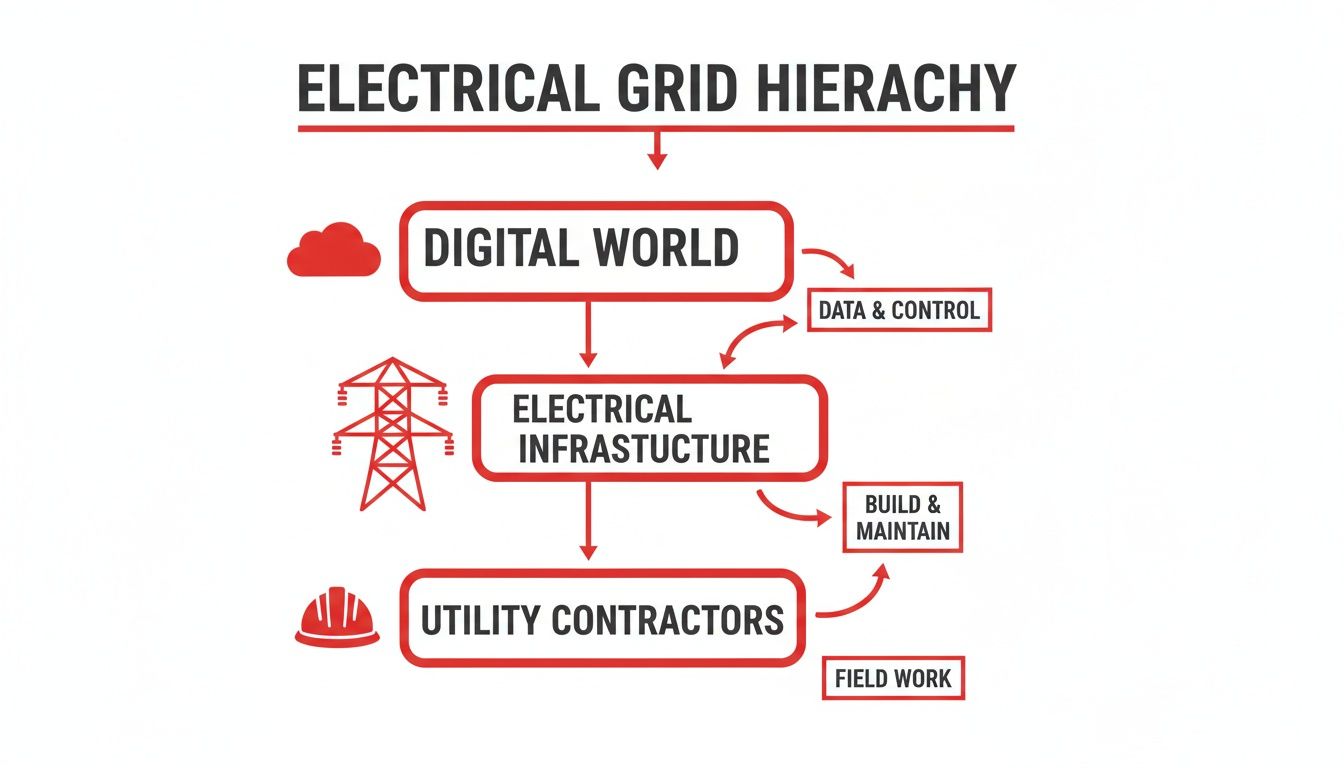
Without the physical construction and maintenance these crews perform, the entire infrastructure propping up our connected world would simply grind to a halt.
Key Services of Electrical Utility Contractors
To better understand their capabilities, let's break down the main services these specialized contractors provide. The following table offers a clear overview of their primary work, its application, and why it's so vital for telecom and data center clients.
| Service Area | Primary Function | Key Applications | Required Expertise |
|---|---|---|---|
| Electrical Transmission | Building and maintaining the high-voltage "interstate highway" of the grid that moves power over long distances. | Connecting power plants to regional substations, large-scale renewable energy projects. | High-voltage engineering, heavy equipment operation, stringent safety protocols (OSHA). |
| Electrical Distribution | Stepping down voltage and delivering power on the "local roads" of the grid to end-users. | Powering neighborhoods, businesses, cell towers, and data centers. | Medium/low-voltage systems, overhead and underground line work, system troubleshooting. |
| Make-Ready Engineering | Preparing existing utility poles to safely accommodate new attachments like fiber optic cables. | 5G network expansion, fiber-to-the-home (FTTH) deployments, small cell installations. | NESC/GO 95 compliance, structural analysis (PoleForeman/O-Calc), asset management. |
| Specialized Infrastructure | Designing and building custom, high-reliability power systems for critical facilities. | Hyperscale data centers, colocation facilities, network headends, mission-critical sites. | Power system design, UPS and generator integration, redundancy planning (N+1, 2N). |
Ultimately, these services are not isolated tasks. They are interconnected pieces of a much larger puzzle, ensuring that from the power plant to the server rack, the electricity is always on.
The Highways and Local Roads of Electricity
The work of electrical utility contractors generally falls into two main categories: transmission and distribution. Each plays a distinct but equally vital role in getting power where it needs to go.
Electrical Transmission: Think of this as the grid’s superhighway system. Massive transmission lines carry extremely high-voltage power over hundreds of miles, connecting generation sources to major substations. Crews working on these projects handle enormous towers and conductors, requiring heavy-duty equipment and an absolute, unwavering commitment to safety.
Electrical Distribution: If transmission lines are the highways, then distribution lines are the local streets and roads. This is where high-voltage power from a substation is "stepped down" to lower, safer levels and delivered to homes, businesses, and—critically for our industry—cell towers and data centers. It’s the final, crucial mile in the power delivery chain.
Enabling Connectivity With Make-Ready Engineering
For any telecom project, one of the most important services is make-ready engineering. Picture a typical utility pole; it's already crowded with power lines, old copper cables, and other attachments. You can't just string up a new fiber optic cable wherever you want.
Make-ready work is the detailed process of preparing that pole for the new attachment. It involves a structural analysis to confirm the pole can handle the added weight and wind load. Contractors then work to identify and relocate existing equipment to create a clear, safe path for the new line—sometimes, they even have to replace the pole entirely. This meticulous prep work is fundamental to the rapid rollout of 5G and fiber networks.
Without careful make-ready engineering, new fiber deployments can overload utility poles, creating serious safety hazards and violating NESC or GO 95 regulatory codes. It's the essential first step that makes network expansion both safe and efficient.
This process requires a team that speaks both languages fluently: electrical utility standards and telecommunications requirements. It’s a specialized niche where many projects can get bogged down if not handled by experienced electrical contractors who understand the intricacies involved.
Powering Unique Digital Infrastructure
The power requirements of a single cell tower and a hyperscale data center are worlds apart. A top-tier contractor not only understands these differences but knows how to engineer the perfect power solution for each.
Cell Towers: These sites need a reliable, but relatively small, power feed. The contractor’s job is to establish that service efficiently, often in remote or hard-to-reach locations, and integrate backup systems like generators or batteries to ensure continuous operation.
Data Centers: These facilities are true power behemoths, with some consuming as much electricity as a small city. Contractors here must design and construct incredibly robust and redundant power systems. This includes multiple utility feeds, massive backup generators, and uninterruptible power supply (UPS) systems designed to guarantee 100% uptime.
For a data center, a single second of downtime can trigger millions in losses, so the electrical engineering and construction have to be perfect. The contractor's expertise is critical every step of the way, from the initial high-voltage tie-in to the final checks. To learn more about this vital last phase, you can read our guide on the commissioning process for high-voltage systems at https://southerntierresources.com/goodscode/commissioning/593035867.
Powering the AI and Hyperscale Revolution
The world’s demand for data is ballooning, and at the center of it all is a new type of power consumer: the AI-driven hyperscale data center. These facilities aren't just a bit bigger than what came before; they represent a seismic shift in energy consumption. We're witnessing a complete overhaul of the power paradigm, turning what was once a predictable construction process into a high-stakes engineering feat.
The engine behind this change is the raw computational power required by artificial intelligence. Just training a single large language model can burn through gigawatt-hours of electricity. Because of this, the very definition of a "large" data center has been redrawn, seemingly overnight.
From Megawatts to Gigawatts: A New Scale of Power
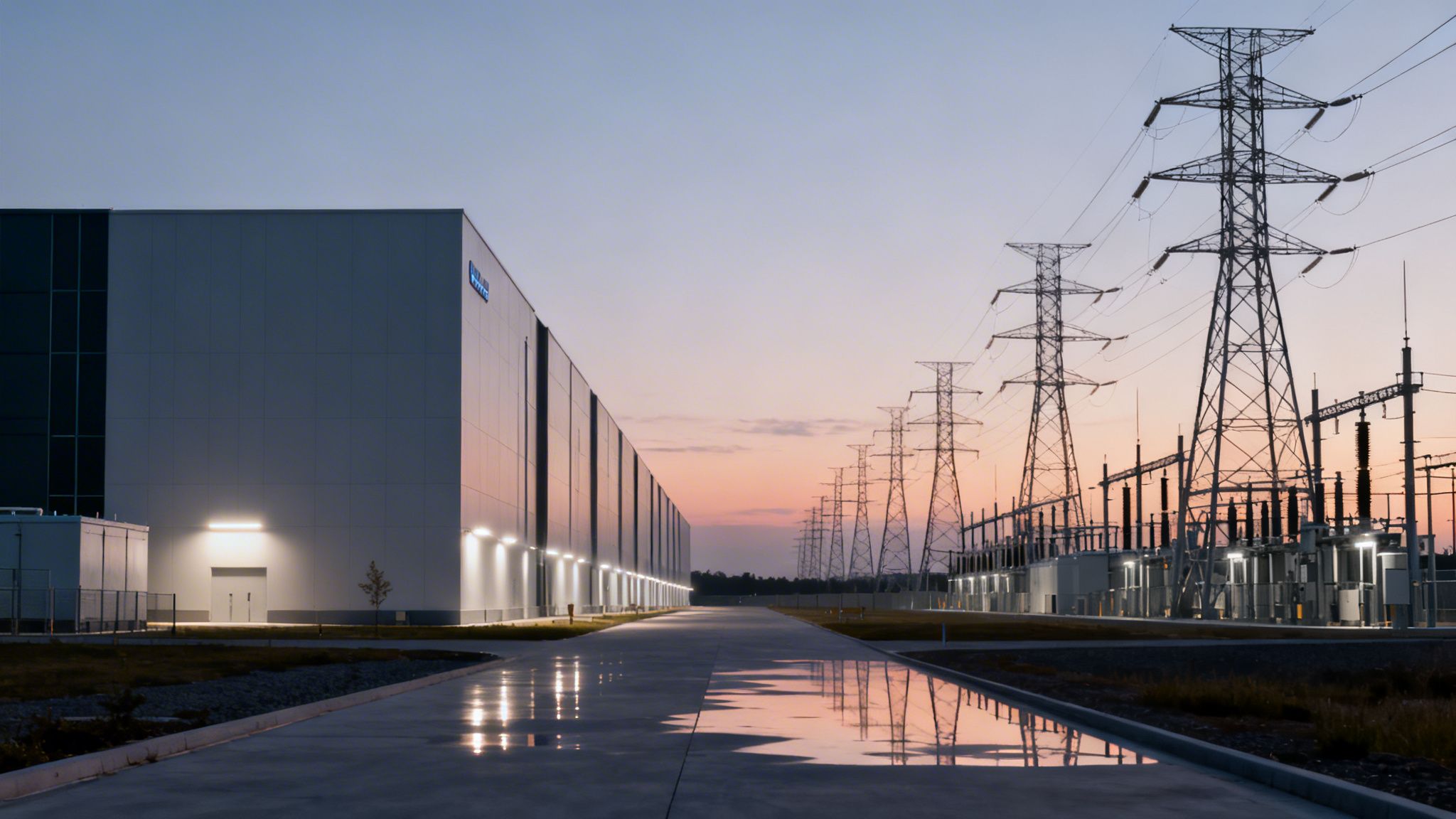
The staggering electricity demand from AI and data processing is creating an urgent need for more, and bigger, high-voltage infrastructure. Not long ago, a large data center might have topped out at 20-50 megawatts (MW). Today's sprawling giga-campuses are demanding north of 1 gigawatt (GW)—that's enough juice to power a million homes.
This isn't just a steady increase; it's explosive. The job of an electrical utility contractor has morphed from running a hefty power feed to engineering and building private electrical substations and high-voltage tie-ins that look more like the grid infrastructure of a small city. For a deeper dive into how this demand reshapes the industry, you can explore trends in the electrical contracting market [https://southerntierresources.com/goodscode/electrization/1445225919].
The Challenge of Extreme Power Density
At the core of this power surge is a concept we call rack density—basically, how much power is crammed into a single server rack. Driven by the powerful GPUs essential for AI, this number has gone through the roof.
- Traditional Cloud Racks: A standard rack for typical cloud services usually draws about 5-10 kilowatts (kW).
- AI Training Racks: By comparison, a rack loaded with high-performance AI processors can pull well over 100 kW.
This tenfold leap in density creates enormous electrical and thermal headaches. You can't just deliver that much power to each rack without completely re-thinking the system; it requires much beefier conductors, busways, and distribution units. It also throws off an incredible amount of heat, making advanced liquid cooling systems—which have their own significant power needs—a necessity, not a luxury.
"The jump to gigawatt-scale facilities and 100-kW racks isn't just an engineering update; it's a complete reimagining of mission-critical power. The margin for error is zero, and success hinges on the flawless integration of high-voltage systems, advanced cooling, and absolute redundancy."
The electrical utility contractor is on the front lines, tasked with building the rock-solid foundation that makes this incredible density possible, ensuring every single component can safely and reliably handle the extreme load.
Redundancy is the Cornerstone of AI Infrastructure
For a hyperscale data center, even a flicker of downtime can trigger catastrophic data loss and financial fallout. This makes electrical redundancy completely non-negotiable. Contractors are expected to design and build systems with multiple failsafes to guarantee the lights stay on, no matter what.
These bulletproof systems typically include:
- Multiple Utility Feeds: Drawing power from entirely separate substations to guard against a single point of failure on the grid.
- Massive Generator Farms: Huge arrays of generators capable of powering the entire campus for days during a utility outage.
- N+1 (or greater) Redundancy: A design principle that ensures there is always at least one extra component (like a UPS unit or transformer) on standby, ready to take over instantly if another fails.
To build these resilient, modern power systems, contractors need to stay on top of new technologies like digital switchgear. Their ultimate responsibility is to deliver a power ecosystem where failure simply isn't an option.
Why Safety and Compliance Are Non-Negotiable
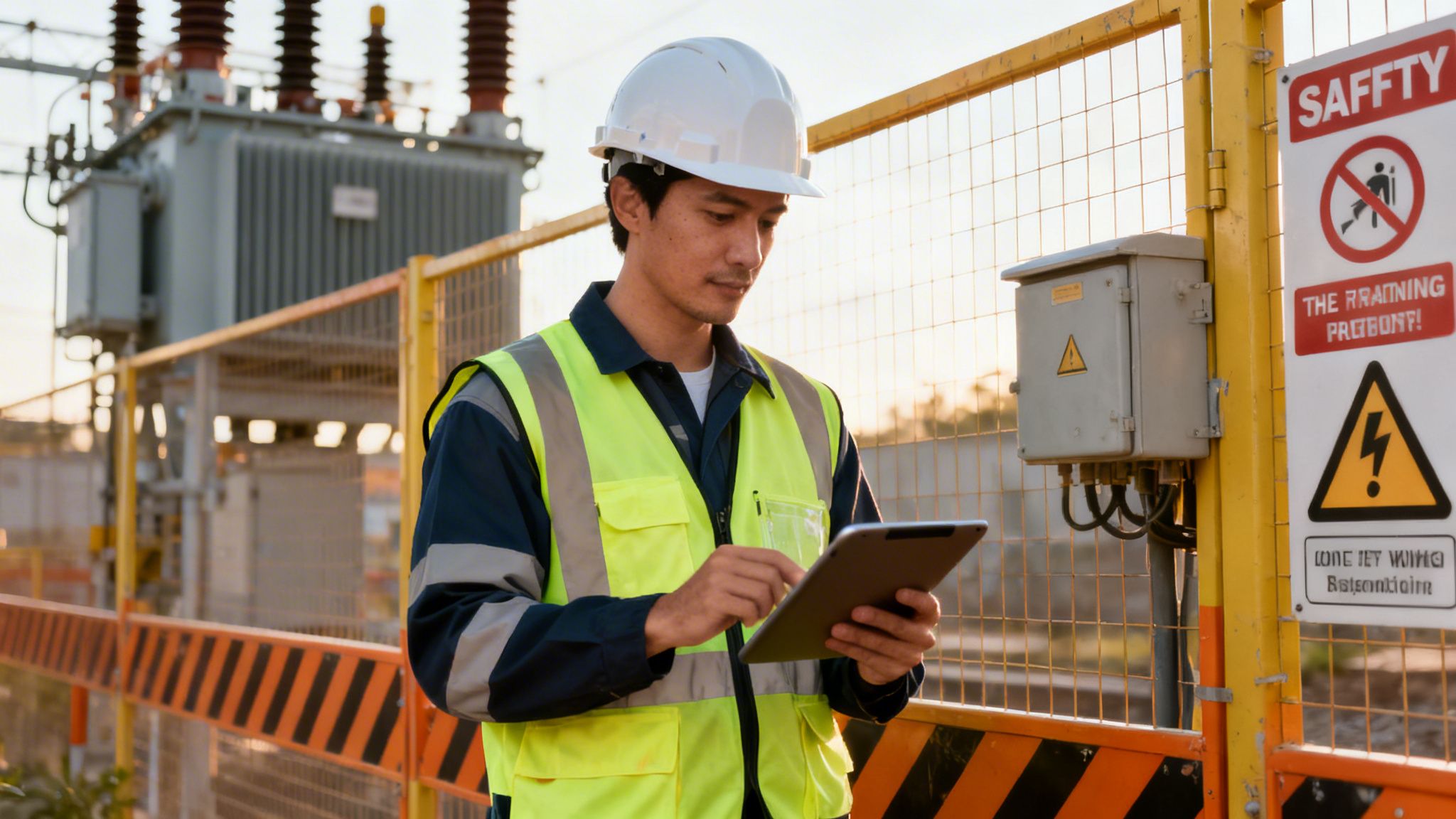
When you're dealing with high-voltage infrastructure, there's simply no room for error. Safety isn't just a policy to follow; it’s the absolute bedrock of the entire operation, preventing catastrophic failures, protecting lives, and ultimately, ensuring a project succeeds.
You can tell a lot about an electrical utility contractor by their safety culture. It's not about the rulebook sitting on a shelf; it’s a direct reflection of their discipline and professionalism in the field. A single mistake doesn’t just mean a delay—it can lead to life-altering injuries or trigger massive, costly outages.
Think about what these crews do every day. They work inches from energized lines carrying thousands of volts, operate heavy machinery on challenging terrain, and perform complex tasks at great heights. Without a deeply ingrained, safety-first mindset, disaster is always just one misstep away.
Decoding Critical Safety Standards
To keep everyone on the same page and manage these immense risks, the industry is governed by a set of strict, legally enforceable standards. Two of the most important are OSHA and the National Electrical Safety Code (NESC). These aren’t guidelines; they are the law for how this work gets done.
OSHA (Occupational Safety and Health Administration): This is the federal agency that sets the rules for a safe workplace. For an electrical contractor, OSHA’s standards are everything—dictating requirements for personal protective equipment (PPE), fall protection, safe trenching practices, and crucial arc flash protocols.
NESC (National Electrical Safety Code): Published by the IEEE, the NESC is the essential guide for the safe installation, operation, and maintenance of electric and communication lines. It defines everything from minimum clearances between lines and the ground to the structural strength poles need to withstand the elements.
A contractor's deep, working knowledge of these codes is non-negotiable. It’s what ensures a new fiber line is hung at a safe distance from a power line and that every single person on site has the right training and gear to go home safely.
Measuring a Contractor's Safety Performance
So, how do you measure a contractor's commitment to safety beyond what they tell you? The single most reliable metric is their Experience Modification Rate (EMR). This number, used by insurance companies to set workers' compensation premiums, offers a clear, data-driven snapshot of their safety history.
An EMR is essentially a credit score for safety. The industry average is 1.0. A rate below 1.0 points to a better-than-average safety record, while a rate above 1.0 signals a history of more frequent or severe worker injuries.
A low EMR is a massive green flag. It’s hard proof that the contractor knows how to manage risk, which for you means less liability, fewer unexpected delays, and a more professional crew on your project. Always ask a potential contractor for their EMR—a top-tier partner will be proud to share it.
Choosing a contractor with a stellar safety program isn't an added expense; it's a fundamental investment in your project's integrity.
How to Select the Right High-Voltage Partner
Picking an electrical utility contractor is one of the most critical decisions you’ll make on any major infrastructure project. This isn't just about hiring a vendor; it's about finding a partner. The right one will see around corners and anticipate challenges, acting as a genuine extension of your own team. The wrong one? They can blow up your budget, derail your schedule, and introduce risks you simply can’t afford.
You have to look past the price tag. The best selection process is really an exercise in managing risk. It starts with a Request for Proposal (RFP) that does more than just ask for a number—it demands proof of experience, safety, and financial stability.
Crafting an RFP That Gets Results
Think of your RFP as the first line of defense against unqualified bidders. A vague, slapdash document will get you vague, useless responses, making it impossible to compare your options fairly. A sharp, detailed RFP, on the other hand, forces contractors to prove they’re the right fit for your specific job.
To get meaningful bids, your RFP has to be crystal clear on a few key things:
- The Full Scope of Work: Don’t leave anything to the imagination. Detail every technical requirement, from the first engineering sketches and permit applications to final commissioning and as-built drawings.
- Safety and Performance Metrics: Get specific. Mandate your non-negotiable safety standards, like an Experience Modification Rate (EMR) below 1.0, and spell out the key performance indicators (KPIs) you'll be tracking against the project timeline.
- Insurance and Bonding Minimums: Clearly state the minimum liability coverage and bonding capacity required. This is what protects your project and stakeholders if something goes wrong.
A well-built RFP signals to serious contractors that you know what you’re doing and you value quality and accountability, not just the lowest price.
Understanding the Key Cost Drivers
Of course, the bottom line matters. But to truly understand a contractor's bid, you need to know what’s driving the numbers behind the scenes. The final quote is a complex mix of variables that goes far beyond simple labor and materials.
Several major factors will shape the project's cost:
- Labor Rates and Availability: Local prevailing wages, union agreements, and the simple supply-and-demand for specialized crews like lineworkers or fiber splicers have a huge impact on the budget.
- Material and Equipment Costs: The market price for commodities like copper and aluminum can fluctuate wildly. The same goes for the cost to rent or buy the heavy machinery needed to get the job done.
- Project Complexity and Location: It’s just a fact: a job in a crowded city or out in rugged, remote terrain is going to cost more than one on a flat, easily accessible patch of land. Logistics are everything.
- Regulatory and Permitting Hurdles: The time, paperwork, and expertise needed to navigate the maze of local, state, and federal rules can add significant administrative costs before a single shovel hits the ground.
When you understand these drivers, you can have much more productive conversations with potential partners. It helps you see where costs are fixed and where there might be an opportunity for smarter engineering or scheduling. To see how these factors come together on major jobs, take a look at our guide on managing complex transmission line construction at https://southerntierresources.com/goodscode/transmissionist/2457847895.
Mitigating Risk Through Diligent Vetting
The paperwork can only tell you so much. Choosing the right partner means digging deep to evaluate how they actually manage risk in the real world. This is where the true professionals separate themselves from the pack.
High-voltage work comes with immense liability. You need to investigate a contractor’s safety record (and verify their EMR), check their financial health (confirmed by their bonding capacity), and look at their project history. Do they have a proven track record of handling jobs of this scale and complexity?
Ultimately, this decision is an investment in your project's success. By writing a detailed RFP, getting a handle on the cost structure, and thoroughly vetting every potential partner for risk, you’re setting yourself up to find a contractor who will deliver—safely, on time, and on budget.
Your Contractor Vetting Checklist
Choosing the right electrical utility contractor isn't just about hiring a vendor; it's about finding a strategic partner you can trust when millions of dollars and critical infrastructure are on the line. A solid vetting process is your best defense against the delays, budget blowouts, and safety nightmares that can derail a project.
Think of it as moving beyond the sales pitch. You need to uncover hard evidence of how a contractor truly operates when the pressure is on. The following checklist is designed to help you ask the right questions and, more importantly, recognize what a great answer actually sounds like.
Contractor Vetting Checklist
Use this table to guide your interviews and evaluate potential partners against the same critical standards. A contractor's answers—and their ability to back them up with proof—will tell you everything you need to know.
| Category | Essential Question | What to Look For (Green Flag) | What to Avoid (Red Flag) |
|---|---|---|---|
| Technical Expertise | "Can you walk me through 3-5 projects of similar scope you've completed in the last two years?" | Provides detailed case studies with client references you can actually call. The projects closely mirror your own in scale and complexity. | Offers vague project lists, is hesitant to provide references, or the examples are significantly smaller or less complex than your project. |
| Relevant Skills | "Describe your team's specific experience with [e.g., NESC compliance for make-ready, high-density power distribution]." | Details specific training, certifications, and years of hands-on experience. They speak fluently about the common pitfalls and nuances of the work. | Answers are high-level and lack detail. They pivot to their "general experience" instead of addressing the specific skill set you asked about. |
| Safety & Compliance | "What is your company's EMR for the last three years, and can we review your OSHA 300 logs?" | Immediately provides an EMR consistently below the industry average of 1.0. They are transparent with their safety logs and can explain what they learned from any incidents. | Evasive about their EMR, claims they don't track it, or the rate is consistently above 1.0. Any reluctance to share safety data is a major warning. |
| Financial Stability | "What is your current bonding capacity, and can you share your project backlog?" | Provides a letter from their surety confirming a bonding capacity that comfortably covers your project’s value. They have a healthy backlog but can clearly explain how they'll staff your project. | Their bonding capacity barely covers your project. They are overextended with a massive backlog and no clear plan for managing more work. |
A great partner will welcome these tough questions. They'll be proud of their safety record, eager to share their project successes, and transparent about their financial health. Any hesitation or deflection is a clear signal to dig deeper or walk away.
Technical Expertise and Experience
First things first: does this contractor have the chops to handle the specific technical challenges of your project? Vague assurances won't cut it. You're looking for concrete proof that they’ve done this exact kind of work before, and done it well.
When you ask for case studies, you want to see projects that mirror your own. A contractor who has only ever handled small-scale distribution lines isn't suddenly ready to tackle a high-voltage transmission project, no matter what they tell you. Look for experience that directly maps to your needs.
Safety Culture and Compliance
Let's be clear: a contractor's safety record is the single best predictor of their professionalism and discipline. A strong safety culture is absolutely non-negotiable.
A contractor’s safety program isn't just about checking a box; it's a direct reflection of their operational excellence. A low Experience Modification Rate (EMR) is one of the clearest indicators of a partner who manages risk effectively, protecting both their people and your project.
An EMR below the industry average of 1.0 shows they are better than their peers at preventing injuries. When a company is serious about safety, it shows in everything they do—from how they maintain their equipment to how they manage their people. Don't be afraid to ask for their OSHA logs; a transparent partner will have nothing to hide.
Project Management and Financial Stability
Finally, you need a partner with the operational and financial backbone to see a complex project all the way to the finish line. A firm that is financially overextended or poorly managed can become a massive liability.
Their bonding capacity is a direct measure of how much risk their surety is willing to underwrite. If their capacity is just enough to cover your job, it's a sign they might be stretched too thin. A healthy project backlog is a good sign—it means they're in demand—but they must be able to prove they have the crews and resources to take on your work without sacrificing quality.
Answering the Tough Questions
When you're dealing with a project that involves high-voltage power, a lot of questions come up. And they should. Getting the right answers upfront is the difference between a project that runs smoothly and one that’s plagued by delays and cost overruns. Here are some of the most common questions we hear from project managers.
What Happens When You Hit Something Unexpected on Site?
Let's be honest—unforeseen site conditions are a given, not a possibility. Whether it’s hitting a seam of solid rock nobody knew was there or discovering old, unmarked utility lines, surprises happen. The real measure of a contractor isn't if they encounter a problem, but how they handle it.
A seasoned crew has a clear-cut process for this. It starts with immediately stopping work in the affected area, documenting the issue with photos and reports, and quickly assessing the impact on the timeline and budget. From there, we communicate a set of practical solutions. The best partners even build contingency time and budget into the initial plan, turning a potential crisis into a manageable hurdle.
How Long Does a High-Voltage Project Actually Take?
This is the million-dollar question, and the honest answer is: it depends entirely on a few key variables. Anyone who gives you a hard-and-fast number without knowing the details is guessing.
Here’s what really drives the schedule:
- Permits and Paperwork: Frankly, securing permits and right-of-way access from all the different agencies can often take longer than the actual construction. A contractor with deep local relationships can navigate this bureaucratic maze far more efficiently.
- Getting the Gear: You can’t just pick up a high-voltage transformer at the local hardware store. Specialized equipment can have lead times stretching for months, so getting those orders in early is absolutely critical.
- The Scope of Work: There's a world of difference between a simple distribution line extension and building out a dedicated substation for a new data center. The complexity of the job is the biggest factor of all.
A trustworthy contractor will break all this down for you in a detailed schedule with clear, accountable milestones.
The real value of an experienced electrical utility contractor isn’t just their ability to do the work. It’s their ability to see around corners, manage immense complexity, and protect the project from risk every step of the way. That’s what a true partnership delivers.
Is It Safe to Just Go with the Lowest Bid?
While keeping an eye on the budget is essential, choosing your contractor based on the lowest price alone is one of the riskiest moves you can make. A bid that looks too good to be true usually is. It often signals that corners are being cut on safety, the crew isn't properly qualified, or the contractor has completely misunderstood the scope of your project.
Instead of the lowest price, you should be looking for the best value. Consider their safety record (look for a low EMR), their track record on similar projects, and their ability to bring a skilled, reliable team to your site. Spending a little more upfront for a quality partner almost always saves you a fortune in change orders, delays, and safety incidents later. It’s an investment in getting the job done right the first time.
At Southern Tier Resources, we provide the specialized expertise and unwavering commitment to safety needed to power your most critical infrastructure projects. From make-ready engineering for 5G deployments to building high-voltage systems for hyperscale data centers, we deliver reliable solutions.