At 02:17, a wallboard can turn from ordinary noise into an incident before anyone has agreed on what happened. Optical alarms appear across two transport paths, a data center reports utility feeder loss, the generator controller shows a failed synchronization attempt, and an enterprise customer asks whether its protected circuit is protected. The NOC may have vendor alarms, the field crew may have only a radio update, and the account team may already be reading an SLA clause.
That first hour rarely fails because a technician doesn't know how to splice fiber or an operator can't acknowledge an alarm. It fails because handoffs become ambiguous. The field team, NOC, incident commander, customers, carriers, facilities staff, and compliance owners each hold part of the truth, while the network keeps changing underneath them. Effective emergency procedures must therefore define not only the technical action, but also who confirms it, who records it, who communicates it, and who has authority to move to the next action.
Why Telecom and Data Center Incidents Break the Standard Checklist
Consider a composite regional-carrier incident. A contractor's backhoe severs two physically diverse fiber routes feeding a Tier III facility. Almost at the same moment, utility feeder A drops. The on-site generator starts, but its automatic transfer sequence fails to synchronize with the remaining electrical configuration.
The NOC wallboard doesn't display one clean outage. It shows optical loss on multiple spans, protection alarms from different vendors, BGP neighbor instability, power telemetry from the facility, and a growing list of customer circuits that may be affected. One monitoring platform labels the transport event as a path failure. Another reports degraded service. The data center facilities console shows generator trouble, while the customer portal still shows some circuits as available.
The field technician reaches the road crossing and radios back that both routes appear to enter the same damaged duct bank. The technician can provide a location, photos, and a safety status, but not yet a repair estimate. Meanwhile, the NOC must decide whether to suppress repeated alarms, protect surviving traffic, and open a bridge. The customer team is asking whether the outage qualifies for an SLA event, a tower tenant wants confirmation that its backhaul has a viable alternate path, and the compliance lead is checking a state public-utility reporting window.
Where the runbook stalls
A conventional ITIL runbook may begin with incident classification, ownership, escalation, workaround, and closure. Those steps are useful, but they become insufficient when several service models overlap. A protected wavelength, a managed Ethernet circuit, a tower backhaul agreement, and a data center power commitment may all define impact differently.
The NOC may classify the event as transport degradation while the facilities team classifies it as a power emergency. The field crew may be waiting for a safe excavation hold, while the customer liaison is preparing a notification that implies restoration is already underway. Every team is following a reasonable local procedure, yet the combined response loses time.
Operational rule: The incident bridge must establish one shared timeline and one authoritative impact statement, even when the underlying tools disagree.
Emergency procedures work when they close the seams between actors. The operator needs a confirmed field location, the field crew needs a clear dispatch objective, the incident commander needs decision-ready options, the customer liaison needs approved language, and compliance needs preserved evidence. The first 60 minutes should therefore be designed around handoff quality, not checklist volume.
The Four Incident Classes Every Network Operator Must Plan For
A useful classification system makes the first action obvious. It doesn't need to predict every detail. It needs to stop the on-call engineer from treating a physical hazard like an ordinary alarm or a power event like a routine service ticket.
| Incident Class | Trigger Examples | Severity Levels | First Action within 5 min |
|---|---|---|---|
| Fiber and Transport Events | Diverse-path loss, sharp optical power change, multiple circuit alarms | Local degradation, protected-path failure, broad transport outage | Correlate paths, map affected services, and open the transport bridge |
| Power and Environmental Events | Utility loss, UPS autonomy risk, generator load-shed failure, HVAC excursion, uncertain fuel runway | Alert, equipment-risk condition, facility continuity threat | Confirm facility safety and power state, then engage facilities leadership |
| Tower and Outside-Plant Damage | Structural damage, weather impact, RF failure, access restriction, climb hold, tenant isolation | Component issue, site degradation, unsafe site | Place personnel safety first, isolate unsafe work, and verify tenant impact |
| Site Evacuation and Safety Events | Fire, hazardous materials, civil-authority order, active threat | Precautionary evacuation, confirmed hazard, restricted re-entry | Follow authority direction, account for personnel, and stop remote instructions that could put people at risk |
Class one, fiber and transport
Use this class when the evidence points to path integrity, optical performance, or service convergence. A single customer circuit with a healthy alternate path is different from loss of diverse paths feeding a facility. The severity decision should consider path diversity, optical change, and the number and type of impacted services, not just the alarm count.
The common misclassification is calling a shared-duct event a single-circuit fault. Within five minutes, the NOC should correlate transport alarms across vendors and build a customer-impact map.
Class two, power and environmental
A utility failure isn't automatically a facilities incident, but it becomes one when UPS autonomy, generator synchronization, load shedding, HVAC conditions, or fuel projections threaten equipment continuity. The first action is to confirm the electrical state with facilities staff and establish whether the site is stable, running on temporary power, or approaching a controlled shutdown decision.
Teams often misclassify generator alarms as isolated equipment faults. That delays facilities escalation while network engineers attempt traffic changes that can't solve a site-power problem.
Class three, tower and outside plant
Structural alarms, weather damage, RF degradation, access restrictions, and climb holds require a safety-led response. A tower can remain technically reachable while being unsafe to climb, and a site can remain powered while tenant isolation prevents normal access.
The recurring error is treating a tower event as an RF optimization ticket. Stop unsafe work, verify the site condition, identify affected tenants, and obtain a field assessment before dispatching anyone into a hazardous area.
Class four, evacuation and safety
Fire, hazardous materials, civil-authority instructions, and active threats override ordinary restoration priorities. The incident commander should confirm the authority directing the response, account for personnel, preserve remote access where safe, and prevent staff from being sent toward the site.
The dangerous misclassification is labeling an evacuation as a facilities outage. The objective is first life safety and controlled access, then continuity planning.
Defining Roles and Responsibilities Before the Bridge Call
In the composite fiber and power incident, five roles must operate as a coordinated system. Titles can vary by organization, but the decision rights can't remain vague.
Field technician
The field technician owns the safety hold and physical facts. That includes confirming whether the location is safe to approach, documenting visible damage, capturing photo evidence according to company policy, and sending a realistic dispatch or access update back to the NOC.
The field technician shouldn't promise a restoration time from the roadside. A useful update states what was observed, what remains unknown, what access or permit constraint exists, and when the next update will arrive.
NOC operator
The NOC operator turns raw alarms into an operational record. The ticket should contain correlated vendor alarms, affected route identifiers, customer and site impact, the last known healthy state, and the current owner for each open question.
The NOC also opens the bridge when the defined threshold is crossed. It doesn't wait for perfect certainty. A bridge exists to create certainty faster.
Incident commander
The incident commander makes decisions that cross organizational boundaries. In this scenario, that includes approving traffic reroutes, deciding whether a customer notification is required, prioritizing a splicing crew or power specialist, and authorizing carrier, regulator, legal, or public-affairs escalation.
The commander shouldn't become the person typing every update. The role is to resolve conflicts, set priorities, and make the call when technical and contractual interests diverge.
Customer liaison
The customer liaison owns outbound communication to enterprise customers, tower tenants, partners, and affected carriers. Messages should reflect confirmed impact, current protection status, active mitigation, and the next update commitment.
A hospital, bank, or public-safety customer needs operationally useful language. “Service is degraded on a protected route, traffic is being assessed, and the next confirmed update will come from the incident team” is better than a vague assurance that engineers are investigating.
Compliance lead
The compliance lead tracks regulatory clocks, contractual notification duties, breach-disclosure questions, and evidence preservation. This role should be engaged early when a service event might cross a reporting threshold, not after restoration when logs and decisions are harder to reconstruct.
Assign people before the bridge starts. A name on a roster is more valuable than a role invented under pressure.
Pre-rostered deputies matter because the primary person may be unavailable, traveling, or already handling another event. Rehearsals should test the actual paging chain, vendor contacts, authority limits, and documentation fields. The first five minutes reward teams that have practiced these handoffs and expose teams that assumed everyone would know who was in charge.
Escalation Paths and Communication Workflows That Actually Trigger
An escalation matrix should behave like a decision tree, not a directory of names. The NOC starts with evidence, crosses a defined threshold, pages the right internal owner, and records whether each handoff was accepted. If nobody acknowledges the page, the next escalation occurs automatically rather than waiting for someone to notice.
The decision tree
At the initial alarm, the NOC validates whether the event is real, identifies the incident class, and checks for shared infrastructure. If a diverse-path loss, facility power threat, unsafe tower condition, or evacuation trigger exists, the NOC opens the incident bridge and pages the incident commander immediately.
At 15 minutes, the commander should have a confirmed scope, a field or facilities owner, and a first mitigation decision. At 30 minutes, unresolved ownership, missing vendor access, or expanding customer impact should force a skip-level escalation. At 60 minutes, legal, compliance, and communications should be involved where contractual or regulatory duties may apply. At four hours, the team should have a formal restoration plan, customer-specific updates, and an executive decision on sustained service risk.
These time windows are operating gates, not promises that every repair will finish within them. Their purpose is to prevent silent waiting.
| Incident Class | 0–15 min | 15–60 min | 1–4 hr | 4+ hr |
|---|---|---|---|---|
| Fiber and Transport | Correlate paths, identify shared infrastructure, open bridge | Approve protection or reroute, notify affected service owners | Coordinate repair, carrier handoff, and customer updates | Maintain restoration cadence and executive visibility |
| Power and Environmental | Confirm utility, UPS, generator, HVAC, and site safety state | Engage facilities leadership and prioritize load protection | Coordinate fuel, equipment, and traffic-continuity decisions | Manage sustained-site operations and recovery acceptance |
| Tower and Outside Plant | Establish safety hold and tenant scope | Obtain field assessment and access decision | Coordinate structural, RF, and vendor work | Track tenant restoration and residual safety restrictions |
| Site Evacuation and Safety | Follow authority direction and account for personnel | Establish controlled communications and continuity options | Coordinate re-entry authority and service alternatives | Preserve evidence, document decisions, and transition to recovery |
The communication workflow should separate confirmed facts, working assumptions, and requests for action. A status page can state that service is degraded and mitigation is in progress without publishing an unverified cause. A customer-wide message before containment is confirmed can create contractual confusion and unnecessary alarm.
For teams refining this logic, SRE escalation workflows with Fluxtail offers useful context on acknowledgement, ownership, and escalation design. Apply those principles to carrier dependencies, facilities teams, and field dispatch rather than copying a software-only model.
On the bridge, one person speaks for the incident commander, one person maintains the timeline, and each technical owner reports changes with timestamps. Nobody uses the bridge to debate blame. When a hospital or bank is degraded, explain what is affected, what protection or workaround is active, what action the provider is taking, and when the next verified update will arrive.
Recovery and Restoration Sequencing From First Hour to Full Service
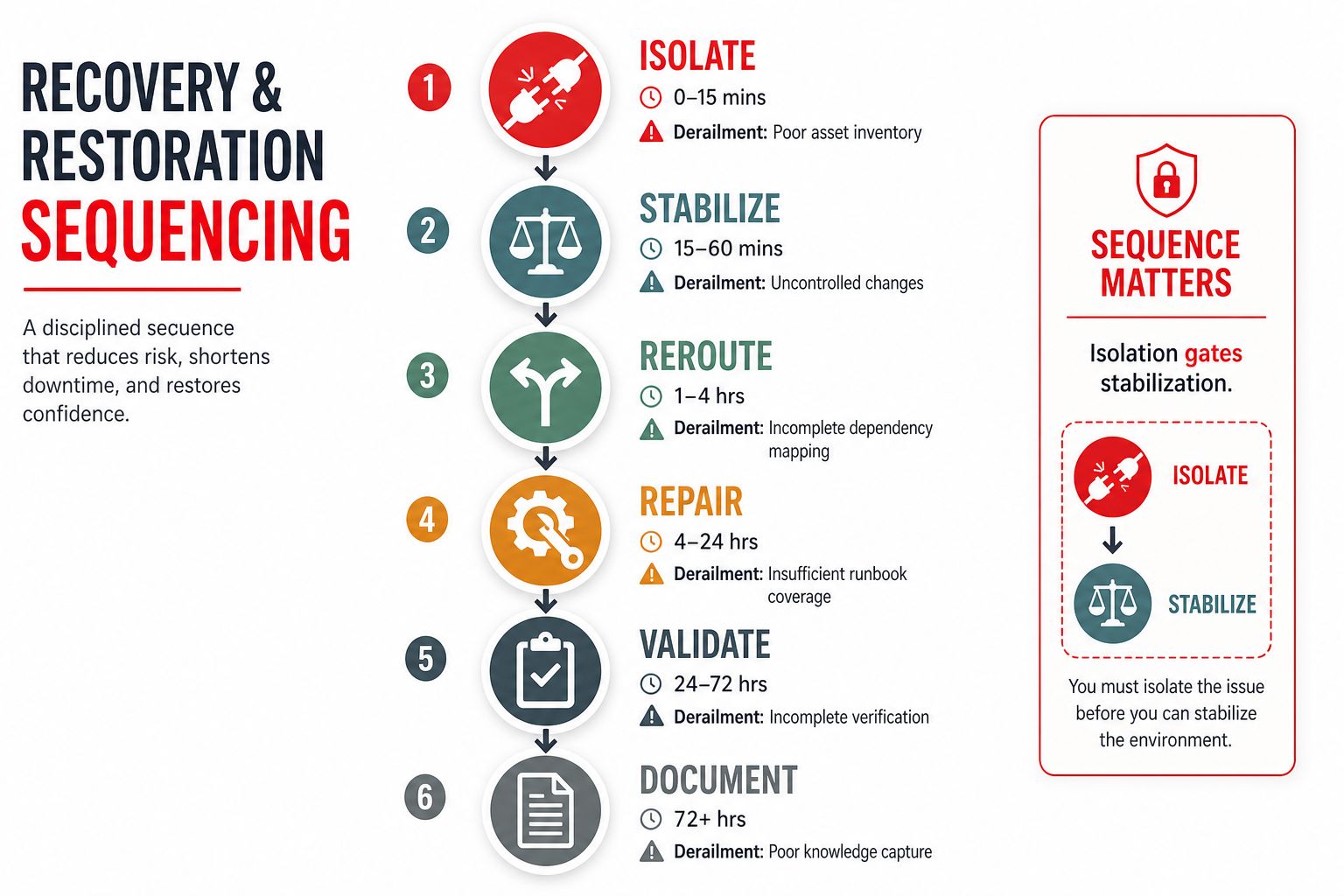
Restoration becomes safer when the team follows a strict order. Isolate, stabilize, reroute, repair, validate, document. The sequence prevents a common mistake, restoring a component while traffic, power, or monitoring conditions remain unstable.
The six phases
Isolate, 0 to 15 minutes. Remove failed paths from service, confirm the damaged optical span, and stop automatic reconvergence onto equipment that is still unstable. In the composite event, the NOC may need to hold or disable a protection path while facilities confirms the generator state. Poor asset inventory is the derailment. If the team doesn't know which circuits share a duct, cabinet, or power feed, isolation is incomplete.
Stabilize, 15 to 30 minutes. Keep surviving equipment within safe operating conditions. Facilities may prioritize generator synchronization, controlled load shedding, HVAC protection, or fuel coordination. Network staff should avoid repeated manual changes that create oscillation. The failure mode is treating a temporary electrical state as permanent and making routing decisions before the site is stable.
Reroute, within the first hour. Use automatic optical protection or controlled routing changes where the alternate path has been verified. Manual reroute is appropriate when the automated system cannot distinguish a damaged shared segment from a healthy alternate. The usual derailment is unvalidated capacity or an overlooked customer dependency.
Repair, during the active field window. Dispatch the splicing crew when the work zone is safe and the damage is documented. Engage the fuel or generator vendor separately when power is the limiting condition. Repair is not a substitute for traffic protection, and a repaired fiber won't help if the receiving equipment remains power constrained.
Validate, after physical recovery. Confirm optical levels, transport stability, routing convergence, application reachability, customer acceptance, and monitoring clearance. Restoration frequently appears complete in the NOC while a customer still has a failed handoff or asymmetric path.
Document, before bridge closure. Capture the timeline, commands and approvals, vendor updates, photos, test results, customer notices, and unresolved risks. Teams that want stronger network resilience failover testing should use these records to build the next controlled test.
Evidence before closure
Before the bridge disbands, confirm:
- Timeline: Alarm, detection, engagement, decisions, dispatch, repair, and validation times.
- Decision record: Why the team chose automatic protection, manual reroute, load shedding, or customer isolation.
- Technical proof: Optical tests, power readings, routing state, monitoring screenshots, and acceptance results.
- Customer record: Impacted services, notification times, commitments, and exceptions.
- Open actions: Owners and due dates for inventory, vendor, topology, safety, and contract corrections.
Drills, Testing, and Continuous Validation of Your Procedures
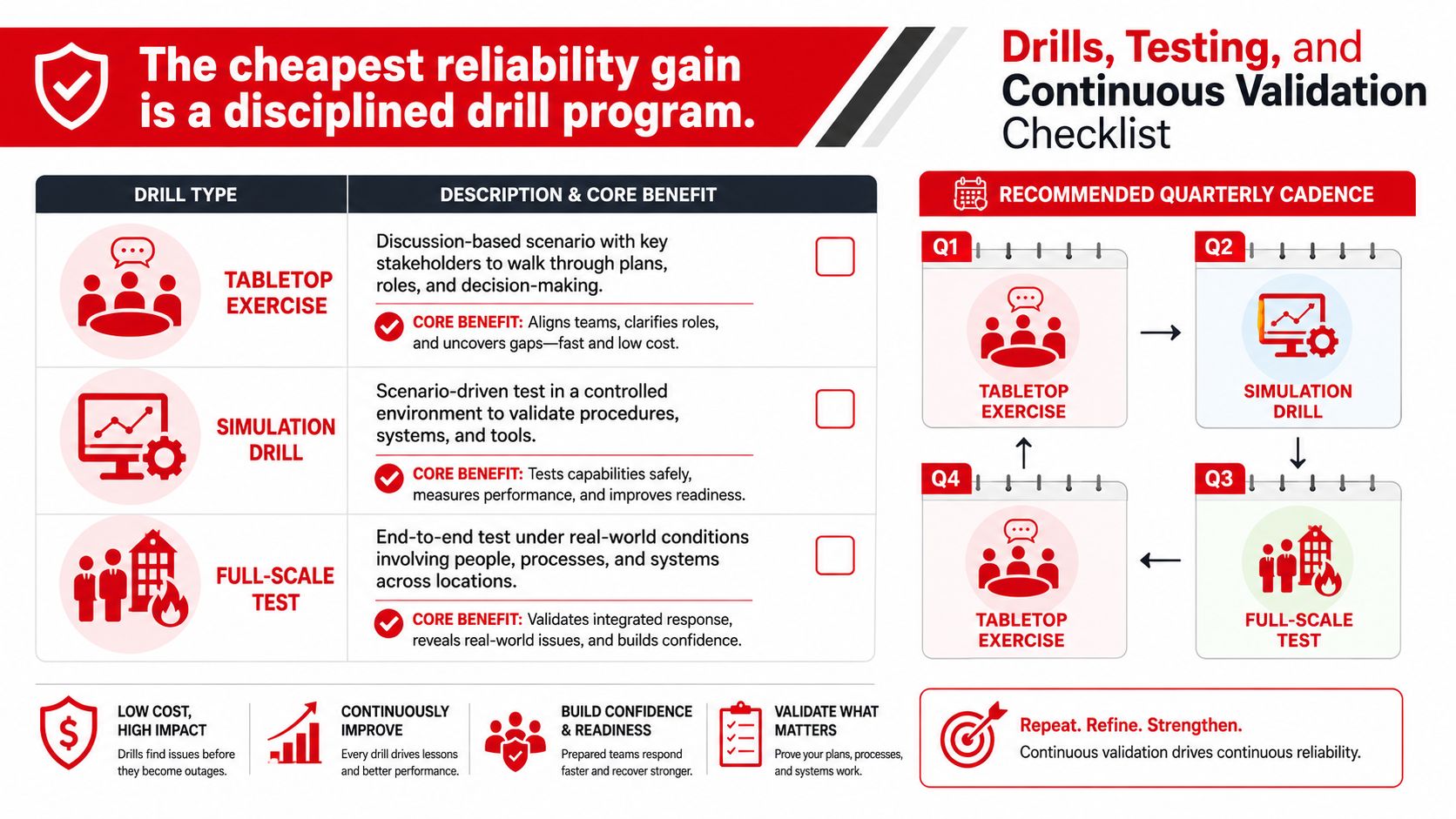
The cheapest reliability gain in an operations organization is a disciplined drill program. Many carriers invest heavily in redundant paths and resilient facilities, then test the people and handoffs only when a real outage creates the pressure.
Build a cadence that exposes seams
Run one tabletop exercise each quarter, rotating through fiber, power, tower, and evacuation scenarios. Add an annual live cutover or generator failover test with the appropriate safety controls, facilities approval, customer coordination, and rollback plan.
A tabletop should force participants to make decisions with incomplete information. Inject a missing field technician, a new subcontractor with no bridge access, a vendor who gives conflicting restoration information, or a customer who demands a contractual answer before containment. Without surprises, the exercise tests reading comprehension rather than operational readiness.
Measure the behaviors that determine whether emergency procedures work:
- Detection quality: How quickly did the team distinguish correlated alarms from noise?
- Engagement speed: How long did it take to reach the incident commander and required specialists?
- Paging accuracy: Did the correct people receive, acknowledge, and act on the notification?
- Reroute success: Did the chosen protection or manual change work without creating a second failure?
- Procedure delta: Where did actual behavior diverge from the written runbook?
- Evidence quality: Could an independent reviewer reconstruct the decisions from the ticket and bridge record?
A drill that produces no corrective action is a meeting with better branding.
Use a short debrief
Reserve 30 minutes immediately after the exercise. Ask what the team believed at each decision point, which handoff failed, which contact or tool was missing, and what single change would make the next response easier. Assign an owner and a due date to every corrective action, then schedule a follow-up review.
Place the video later in the exercise section, after participants have considered the operating model:
Any procedure untouched for six months should be presumed wrong until a current topology review, contact check, or exercise proves otherwise. Networks change, vendors change, and people change roles. A runbook can remain grammatically perfect while becoming operationally false.
Documentation, Compliance, and the Quarterly Refresh Checklist
Documentation belongs inside the emergency procedure. After a fiber cut, generator failure, or facility evacuation, the record must let operators, customers, auditors, regulators, and legal reviewers reconstruct events without depending on one person's memory. It also exposes where the handoff between field crews, the NOC, customers, and compliance staff failed.
The minimum incident record
Capture the event timeline, decision rationale, customer-impact summary, root cause, remediation actions, and evidence chain. Put those fields in the NOC ticket and bridge platform, where operators already work. A separate repository can store the final report, but it should not be the only operational record.
Map obligations to specific fields. Telecom teams may need to assess FCC Part 4 outage reporting. Data center teams may need evidence for SOC 2 and ISO 27001 controls. Healthcare-adjacent workloads require attention to HIPAA, EU data may create GDPR breach-timeline questions, and payment traffic may involve PCI DSS requirements. The compliance lead should determine which obligation applies to the service, customer, geography, and event. Applying every framework to every outage creates noise and slows decisions.
Contracts change the response
Review the service agreement before the bridge opens. The contract checklist should cover:
- SLA credits: Define the event clock, exclusions, measurement source, and approval authority.
- Force majeure: Confirm what qualifies, what evidence is required, and whether notice still applies.
- Mutual aid: Record when alternate crews, carriers, or facility partners can be engaged.
- Vendor coordination: State who owns dispatch, site access, repair authorization, and status updates.
- Notification windows: Align customer, partner, and regulatory notices with the actual incident timeline.
These terms determine who can authorize work, who must be informed, and which records support the decision.
Refresh the system quarterly
A practical quarterly review checks:
- Contact rosters, deputies, paging groups, and vendor escalation paths.
- Current topology, diverse-path assumptions, facility power dependencies, and asset records.
- Regulatory thresholds, contract clauses, customer notification language, and evidence requirements.
- After-action items, unresolved remediation, and changes to monitoring or ticket templates.
- The next tabletop scenario, rotating fiber, power, tower, and evacuation events deliberately.
Formal emergency management procedures developed for a reason. The history of U.S. emergency management records FEMA's establishment and later move into the Department of Homeland Security. The American Heart Association's 2025 CPR and ECC update reports that bystander CPR rates remain low. The same lesson applies to network operations: procedures help only when recognition, authority, action, and handoff occur in the right order.
Southern Tier Resources provides end-to-end fiber, wireless, data center, and maintenance support for organizations that need emergency procedures backed by dependable field execution. Visit Southern Tier Resources to discuss network construction, fiber splicing, infrastructure documentation, and 24/7 mobilization for more resilient operations.