
You are in one of three situations right now.
A build needs to start fast, internal stakeholders want three bids by next week, and someone on the team typed fiber optic contractors near me into a search bar hoping the local results would narrow the field. Or the project already has budget approval, but no one agrees on whether this is a straightforward outside plant job, a data center fit-out, or a multi-phase deployment that needs engineering discipline from day one. Or you had one bad experience with a low bidder and do not want to repeat it.
The search itself is easy. The hard part is knowing whether the companies that appear can manage route planning, permitting, make-ready work, splicing, testing, as-builts, and closeout without turning your schedule into a weekly escalation call.
That is where project discipline matters. A fiber project rarely fails because cable is hard to buy. It fails because scope was vague, access assumptions were wrong, documentation was weak, or acceptance criteria were left until the end. Good crews can recover from field surprises. Weak crews hide them until turnover.
Beyond the Search Bar The Stakes of Your Next Fiber Project
A carrier project lead once described the early procurement phase to me this way: every contractor looked qualified until the first buried obstacle, first permit delay, or first OTDR review. That is accurate. Websites are polished. Capability decks are polished. The field is where the difference shows up.
The riskiest jobs are often the ones that seem modest on paper. A short rural FTTH extension, a secondary market build, a small enterprise loop, a few lateral connections to support a larger backbone. Those are exactly the jobs that can get underestimated, under-supervised, and under-tested.
A documented industry gap makes that risk hard to ignore. A 2025 FCC report notes 40% of rural FTTH deployments fail post-install due to undetected splices and microbends, and Lightwave magazine data cited in the same analysis says projects under 10 km make up 60% of ISP capex in secondary markets (FiberNexxt on splicing and FTTH contractors). That is not a search problem. It is a contractor management problem.
What goes wrong when procurement treats fiber like a commodity
The common failure pattern is familiar.
A buyer compares bids on unit cost alone. The lowest contractor wins. Field work starts before final standards for testing, labeling, redlines, and turnover are locked down. Midway through the job, the owner realizes the contractor's "testing included" line item meant basic checks, not a complete acceptance package. Then a splice issue appears, a handoff drawing is missing, and no one can tell whether the route problem came from design, installation, or undocumented field changes.
That is why I tell clients to think like a project manager before they think like a purchaser.
Tip: If a contractor answers technical questions with broad assurances instead of naming tools, test methods, and document deliverables, treat that as an early warning sign.
Local visibility still matters. Firms that show up well in local search usually understand service areas, response time expectations, and market positioning. If your team is evaluating how local contractors present themselves online before the first call, the Local SEO Playbook for Contractors is a useful reference for reading those signals without confusing marketing polish with delivery capability.
For a large deployment, the better starting point is a partner that handles engineering, construction, maintenance, and documentation under one accountable structure, such as Southern Tier Resources. The important part is not the brand name. It is the ability to connect planning, field execution, testing, and turnover without gaps between subcontractors.
The critical decision is not local versus national
The critical decision is whether the contractor can control risk on your type of build.
A local crew may know municipality contacts, utility constraints, and access issues better than an out-of-market firm. A larger regional or national contractor may bring stronger PM controls, deeper bench strength, and broader mobilization capacity. The right answer depends on route complexity, documentation requirements, and how much failure your operation can tolerate.
A low bid can still be the right bid. It just should not be the least-examined bid.
Define Your Project Scope Before You Vet Contractors
Most contractor selection problems start upstream. If your scope is loose, every bidder fills in the blanks differently. Then you are not comparing proposals. You are comparing assumptions.
A strong statement of work does not need to be bloated. It needs to be explicit.
Start with the physical network you need
Write down the route, endpoints, handoff points, and intended application in plain operational terms.
Are you connecting buildings across a campus, extending middle-mile plant, feeding a data center, supporting small cells, or building greenfield FTTH? Those are different jobs. They use different labor mixes, different planning assumptions, and often different acceptance standards.
Fiber type belongs in the SOW early. Single-mode fiber supports transmission distances up to 100 kilometers with minimal signal degradation, while multi-mode is better suited for shorter runs under 550 meters (The Network Installers on fiber optic installation companies). If the route and application are not clear, bidders may price different materials and test expectations.
Define the boundaries before anyone prices the work
Your SOW should answer these questions clearly:
- Geographic footprint: List the exact start and end points, intermediate cabinets, huts, buildings, poles, vaults, and customer locations if known.
- Build type: State whether the work is underground, aerial, inside plant, or mixed.
- Interfaces with others: Identify who handles utility coordination, customer access, electrical work, rack integration, or restoration.
- Owner-furnished versus contractor-furnished items: Be explicit about cable, closures, splitters, cabinets, patch panels, and electronics.
- Turnover package: Define what must be submitted for acceptance, not just what must be installed.
If you skip these, bidders will price around uncertainty. Some will pad the proposal. Others will underbid and recover margin through change orders.
Add route and constructability homework
Preconstruction work is where realistic schedules are made.
Permits, right-of-way constraints, pole attachment approvals, and make-ready all belong in early planning. Dense corridors, railroad crossings, utility conflicts, and restoration requirements should be identified before issue of bid when possible. If those items are unknown, state them as assumptions and ask each bidder to describe how they will validate them.
A short table can keep internal planning disciplined:
| Scope item | What to define before bid |
|---|---|
| Route | Preliminary path, access constraints, property boundaries |
| Fiber architecture | Strand count, spare strategy, split points, handoff locations |
| Construction method | Underground, aerial, directional boring, trenching, duct use |
| Testing | OTDR, insertion loss, end-to-end acceptance expectations |
| Documentation | Redlines, as-builts, labeling, strand mapping, turnover format |
Build schedule logic into the scope
Do not ask for a single completion date without asking how the bidder will get there.
Modern deployment methodologies can deliver 10 to 20% faster rollouts through AI-assisted route optimization, and smart duct blowing can reach installation speeds up to 5 km per day while maintaining minimum bend radius requirements (McKinsey on deploying fiber networks faster and cheaper). That does not mean your project will hit that pace. It means advanced planning methods exist, and qualified contractors should be able to explain whether they apply to your route.
Ask for schedule assumptions tied to field conditions, not generic duration estimates.
Tip: The best SOWs separate "known conditions," "owner assumptions," and "contractor validation required." That single distinction prevents many kickoff disputes.
Clarify acceptance before construction starts
Owners often wait too long to define what “done” means.
For fiber work, acceptance should cover physical completion, restoration, labeling, test results, and documentation. If your operation relies on GIS, NOC review, or strict closeout records, specify that before proposals are due. If your team wants every strand tested and documented by segment, say so.
Scope quality changes the bids you receive
Strong contractors usually respect a demanding SOW. Weak contractors prefer ambiguity because it gives them room to reinterpret the work later.
If you want meaningful responses from companies showing up for fiber optic contractors near me, give them a scope that rewards precision.
Your Prequalification Checklist for Finding Quality Partners
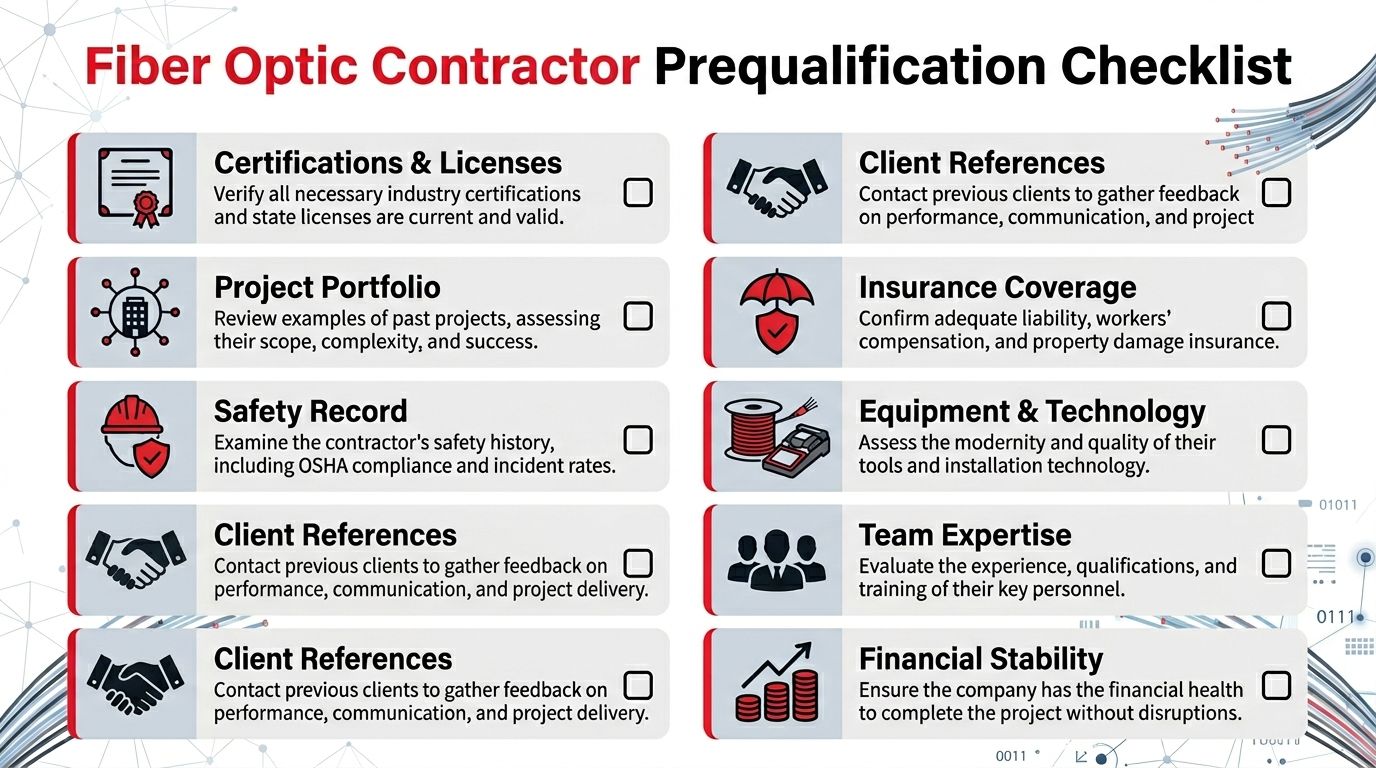
Once the scope is stable, the field narrows quickly. At this stage, I stop listening to broad capability claims and start looking for evidence that the contractor can execute the type of project in front of them.
The first screen is not price. It is whether the contractor belongs in the process at all.
The shortlist should be built on proof
A qualified fiber contractor should be able to produce current licensing, insurance, safety documentation, project references, and examples of turnover packages without delay. If basic records come in slowly or inconsistently during procurement, communication usually gets worse after award.
I look at prequalification in layers.
Layer one checks whether they are legally and operationally ready
- Licenses and registrations: Confirm the contractor is properly licensed for the jurisdictions and trades involved.
- Insurance package: Review general liability, workers’ compensation, auto, and any project-specific coverage requirements.
- Safety documentation: Ask for written safety programs, training records, and how field incidents are escalated.
- Crew availability: Confirm whether the firm can dedicate crews during your required window, not just “support as needed.”
These are minimums. They do not tell you whether the contractor is good. They tell you whether the contractor is even viable.
Layer two checks whether they have done your kind of work before
Experience has to be matched to project type.
A contractor that excels at inside plant terminations may not be the right choice for aerial make-ready and long outside plant routes. A crew that can trench and place conduit may not be strong in closeout, OTDR interpretation, or data center turnover.
In Beaumont, California, where population is projected to reach 125,000 by 2040, experienced local installers are described as critical for complex terrain and elevation challenges, while top-tier contractors with 20+ years of experience have served 20,000+ locations nationwide (Data Installers on fiber optics networks in Beaumont). The takeaway is practical. Relevant experience matters more than generic years in business.
What I ask for before inviting a proposal
I want to see work product, not only logos and testimonials.
- Project portfolio: Show builds similar in scale, terrain, customer type, and delivery method.
- Testing samples: Provide anonymized OTDR traces, insertion loss reports, and strand documentation from prior jobs.
- As-built examples: Redlines are not enough. I want to know how the contractor documents final routing, slack, splice points, and asset IDs.
- Change management examples: Show how field changes are captured, priced, approved, and folded back into documentation.
One practical resource for structuring this review is this contractor selection page: selection guidance for telecom projects.
Credentials matter, but only if they map to execution
Buyers often overvalue logos on a capability sheet.
BICSI-trained crews, manufacturer certifications, and formal splicing training are useful because they indicate exposure to standards and methods. They are not enough on their own. I have seen certified firms produce thin documentation and weak field coordination. I have also seen disciplined crews with less polished marketing outperform larger competitors because their PM controls were better.
Use credentials as a screen, not a substitute for due diligence.
A practical prequalification matrix
| Review area | What a strong contractor shows | Warning sign |
|—|—|
| Safety | Clear program, documented training, job hazard planning | Generic assurances, no field process detail |
| Field capability | Named crews, equipment list, realistic mobilization plan | Vague staffing promises |
| Testing | Sample OTDR and loss documentation, named tools | “We test everything” with no examples |
| PM process | Schedule logic, RFI process, change control method | No clear escalation path |
| Documentation | Redlines, labeling standards, turnover package examples | Closeout handled “at the end” |
Tip: References are most useful when you ask about the hard parts. Ask previous clients how the contractor handled delays, utility conflicts, and disputed punch items, not whether the crew was “good to work with.”
Local knowledge versus scalable delivery
A local firm may understand municipal expectations better. A larger builder may handle simultaneous crews, broader geographies, or overnight recovery better. For major programs, I often favor contractors that can combine local field understanding with standardized PM controls.
That balance matters most when a project includes multiple jurisdictions, varied construction methods, or phased turnover. A contractor should be able to show who is accountable for each layer of the work. Design. Field execution. Testing. Closeout.
When people search fiber optic contractors near me, they often mean “who can respond fast.” For an owner, the better question is “who can respond fast and still hand over a network that operations can trust.”
Crafting an RFP That Uncovers True Expertise
A weak RFP invites polished guesswork. A strong RFP forces contractors to show how they think.
That distinction matters because fiber projects are won or lost in methodology. Two contractors can promise the same completion date. Only one may have a realistic plan for route validation, crew sequencing, testing, defect isolation, and turnover.
This short video gives a useful visual primer before you start drafting your bid package.
Ask process questions, not checkbox questions
Do not ask, “Do you perform OTDR testing?”
Ask for the procedure. Ask when the test is performed, who reviews the trace, what pass/fail logic is used, how exceptions are handled, and how the results are submitted. The answer will tell you far more than a yes or no box.
Improper cleaving contributes to 40% of splice failures. Fusion splicing should average 0.02 dB loss, verified with OTDR measurements for attenuation below 0.05 dB/km and reflectance below -60 dB, and automated OTDR testing can reduce rework by 50 to 70% (Jonard on mistakes by fiber optic technicians). A contractor who understands these numbers should be able to explain how crews prepare fiber, validate splice quality, and catch defects before turnover.
Questions worth putting in your RFP
Use open-ended prompts that require the bidder to expose their operating system.
Technical execution
- Describe your splice workflow: Include stripping, cleaning, cleaving, fusion process, post-splice protection, and immediate verification.
- Explain your OTDR procedure: Identify test direction, event review process, exception handling, and report format.
- Define your insertion loss approach: State when end-to-end loss is measured and how test failures are corrected and retested.
- Show sample deliverables: Attach anonymized OTDR traces, loss reports, and fiber assignment records from a comparable job.
Project management
- Provide a project controls narrative: Explain schedule development, daily reporting, field issue escalation, and owner communication cadence.
- Describe change order handling: Explain how unknown utilities, inaccessible routes, or permit-driven reroutes are documented and priced.
- Identify key personnel: Name the PM, superintendent, lead splicer, and quality reviewer assigned to the job.
Construction means and methods
- Walk through your route execution plan: Tell us how you validate pathing before mobilization and how you sequence work by segment.
- Explain traffic, restoration, and access coordination: This is especially important for urban corridors, campuses, and active facilities.
- List major equipment: Include fusion splicers, OTDR platforms, pullers, blowers, vacs, locators, and restoration support assets.
Ask for examples, not promises
An RFP gets better when every major claim must be backed by a sample.
If a contractor says they provide detailed closeout, require a redacted turnover package. If they say they manage changes cleanly, request a sample change log. If they say they maintain quality in the field, request a pre-task plan and quality checklist used by crews.
A practical drafting aid can help your procurement team format these requirements cleanly. This construction bid proposal template is useful as a framework, as long as you adapt it to telecom-specific testing and closeout requirements.
Make them explain failure handling
The best RFP questions are about what happens when conditions are not ideal.
Ask how the contractor handles a bad trace, an unplanned obstruction, a permit stall, a mis-marked utility, or a splice closure that fails review. Experienced teams answer these calmly and specifically. Inexperienced teams answer with vague confidence.
Tip: Any contractor can describe the happy path. The value of the RFP is learning how they perform off the happy path.
Score the responses with weighted criteria
Do not score only on cost and schedule.
Use weighted categories such as methodology, testing approach, documentation quality, PM controls, staffing, and commercial terms. Owners who do this usually identify the serious bidders quickly because the weak proposals collapse under detailed review.
For this stage, specificity is your friend. A contractor that can teach your team how they build is usually safer than one that only tries to reassure you.
Decoding Fiber Optic Project Costs and Timelines
A client approves a fiber budget based on a clean per-foot estimate. Two weeks later, the route hits utility conflicts, permit conditions tighten, and the crew loses days waiting on access. The original number was not wrong. It was incomplete.
That is the cost problem owners need to solve.
For large deployments, I break pricing into three buckets. Direct installation cost, route-specific complexity, and project friction. If a contractor only talks about labor and material, you still do not know what the job will really cost.
Start with unit pricing, then pressure-test it
Material and labor rates are still useful. They help establish a baseline and they help you compare bids that are formatted differently. Earlier benchmark data in this article showed typical per-foot and per-mile ranges for cable, labor, and common deployment types. Use those figures as a screening tool, not as an approval-ready budget.
A real budget has to answer harder questions. Is the route mostly open trench, directional bore, aerial attachment, or a mix? Are restoration standards basic, or do they require full-width paving, concrete replacement, or specialty surface repair? Does the scope include building entry, rack work, splicing, testing, and closeout, or only outside plant placement?
Those details move the number fast.
Cost swings usually come from scope transitions and field constraints
Two routes with the same footage can land far apart on cost because the expensive parts are rarely distributed evenly.
Lower-risk routes usually have long continuous segments, predictable access, a stable utility picture, and limited handoffs between outside plant and inside plant teams. Higher-risk routes tend to include traffic control, railroad or highway crossings, mixed construction methods, customer coordination, and multiple approval points for restoration or closeout.
I tell clients to watch the transitions. A bore crew waiting on locates, a splice team blocked by incomplete cabinet prep, or an inside plant crew delayed by building access can burn budget without placing a foot of cable.
For owners comparing bore-heavy segments, protected crossings, or constrained subsurface access, this overview of tunneled and subsurface construction considerations helps frame the added production and risk factors.
Separate production cost from friction cost
This is the distinction many budgets miss.
Production cost covers the field work itself. Place conduit or cable, install handholes, splice, test, label, restore. Friction cost comes from permit cycles, utility coordination, redesigns, missed assumptions, owner review lag, traffic control revisions, and rework after failed inspection.
A disciplined contractor prices both, even if they do not label them that way. A risky contractor keeps the base number low and hopes to recover margin through change orders once the job is underway.
That is why I want every estimate tied to assumptions. If the contractor assumes clean locates, continuous access, owner-furnished power, or a five-day permit turnaround, those assumptions need to be written down before award.
The schedule lives or dies on dependencies
Construction duration is only one part of the calendar.
On many fiber projects, the longest path runs through permits, utility responses, make-ready work, access approvals, material lead times, and owner decision speed. A contractor who gives you one finish date without a dependency map is asking you to trust a promise instead of a plan.
Good schedules show where time is being spent and who controls each step. They also show float. If every activity is shown as critical, the schedule is not being managed. It is being decorated.
What a usable timeline should include
Ask for a timeline that identifies these items clearly:
| Schedule item | What the contractor should state |
|---|---|
| Preconstruction | Site verification, route walkout, permit strategy, utility coordination plan |
| Procurement | Long-lead materials, approved alternates, release dates, storage responsibility |
| Construction | Crew count, segment sequence, access constraints, restoration windows |
| Testing | Interim testing points, final test sequence, failure response, retest timing |
| Closeout | Redlines, as-builts, test package review, punch list aging, final acceptance target |
The key is accountability. If permit submission belongs to the contractor, say so. If access letters or site escorts belong to the owner, say that too. Schedules slip when tasks exist between companies but belong to neither.
Build contingency around known unknowns
Contingency is a management tool, not a sign of weak planning.
I expect a fiber budget and schedule to carry room for concealed utilities, route obstructions, weather disruption, access delays, and failed tests that require corrective work. The amount will vary by route and construction method, but the logic should always be visible. If a proposal has no contingency, the risk did not disappear. It just moved to your side of the table.
The same standard applies to schedule contingency. A mature contractor will explain what can absorb delay, what cannot, and which owner decisions will immediately affect the critical path.
If you want a contractor who can handle a large rollout, ask one simple question during review. Show me where your estimate can break, and show me how you built around that risk. The serious teams answer with marked assumptions, production logic, and acceptance-based milestones. The risky ones answer with confidence alone.
Finalizing the Contract and Ensuring Project Success
Award is not the finish line. It is the point where vague expectations become expensive if they remain vague.
The contract should define how the relationship works under pressure. Not only when everything goes right.
Put operating rules in writing
A strong contract spells out who decides what, who responds when, and what documentation is required before a milestone is considered complete. If those rules are left to goodwill, disputes arrive fast once field conditions change.
I want three things nailed down before kickoff.
Communication and escalation
Name the owner PM, contractor PM, field superintendent, and quality lead. Set a reporting rhythm. Decide how RFIs, design clarifications, and urgent field issues move. Clarify who can authorize scope changes and what requires written approval.
Milestones and acceptance
Do not accept broad milestone labels like “construction complete.”
Define milestones around observable deliverables. Segment installed. Splicing complete. Testing package submitted. Punch items closed. Final as-builts accepted. If a milestone supports billing, tie it to documents, not verbal updates.
Documentation package
The turnover package should be listed in the contract exhibits.
That usually includes redlines, final as-builts, strand mapping, splice matrices, labeling schedules, OTDR traces, insertion loss records, and any required GIS-compatible files. Owners who wait until closeout to clarify format requirements often end up paying twice for documentation.
Safety review is not a formality
A kickoff meeting should include the operative field safety plan, not just a generic corporate document.
Underground work, aerial work, active facilities, traffic interfaces, and access-controlled environments all require task-specific controls. If the contractor cannot explain how hazards are identified and communicated to crews each day, the owner is taking operational risk whether they realize it or not.
Change orders should be boring
That is the goal.
A healthy contract makes change management routine. Unknown utilities, route obstructions, owner-requested adds, and permit-driven reroutes should have a defined workflow for notice, pricing, approval, and incorporation into the latest documents. The more boring that process is, the less likely it is to derail the project.
Tip: If the contract is detailed on payment terms but thin on testing deliverables and as-built standards, it is incomplete.
Partnership beats transaction
The best projects feel less like vendor management and more like controlled collaboration. The contractor raises issues early. The owner answers decisively. Field changes are documented in near real time. Everyone knows what counts as acceptance.
That is how you protect uptime, budget, and future maintenance. Not with optimism. With clarity.
Conclusion Your Blueprint for a Reliable Network
Searching for fiber optic contractors near me is easy. Selecting the right one for a carrier, ISP, municipal, enterprise, or data center deployment takes a different level of discipline.
The reliable path is consistent. Define scope clearly. Prequalify hard. Write an RFP that exposes methodology, not just marketing. Build budgets and schedules around risk. Lock acceptance criteria and documentation standards into the contract before mobilization.
Good fiber infrastructure is rarely the product of a fast bid comparison alone. It comes from matching the project to a contractor that can plan the route, manage the field, prove the testing, and hand over records your operations team can use long after construction crews leave.
A dependable network is built twice. First on paper, then in the field. Owners who manage both stages well get fewer surprises and a better asset at turnover.
If you need a partner to support engineering, construction, splicing, testing, documentation, or project planning for an upcoming build, Southern Tier Resources supports wireline and wireless infrastructure programs with end-to-end delivery across the project lifecycle.