A fiber optic handhole is a grade-level, reach-in enclosure where a technician pulls, splices, stores slack, and tests buried fiber without excavating the route or climbing into a vault. The boxes that satisfy most public standards run no larger than 30 by 48 inches inside, sit at least 30 inches back from the pavement edge in a municipal right-of-way, and carry a structural tier chosen from the wheel loads above the lid rather than from the name of the land use.
The situation usually looks like this. A subdivision build closed out last spring, the lawns have healed, and now a splitter needs one more customer while one span throws intermittent errors. The crew pulls up to a lid in the shoulder, hooks it open, and reaches in. No backhoe, no trench, no lane closure. That afternoon only works because someone picked the right box, set it at the right station, drained it, and recorded where it landed. Get any one of those wrong and the same job becomes an excavation with a permit, or worse, a splice that fails every wet season.
Most of the confusion around these enclosures comes from shopping them like a product instead of specifying them like a system. Volume is the easy part. Load, water, and records decide whether the box is still usable in year fifteen.
What a Fiber Optic Handhole Is For
A technician kneels at a flush lid in a road shoulder, hooks the cover off, and sets it on the grass. Two conduits come up through the bottom of the box. She reaches in to her elbows, finds the slack coil, lifts a splice closure to the surface, and works on it on the tailgate of the truck. Nothing about that scene involves a ladder.
A fiber optic handhole is a buried enclosure with a removable cover set at grade, sized so arms and hand tools reach the cable, the closures, and the slack loops inside it. Think of the hatch in a sidewalk, the one a utility worker lifts to reach a valve. It's an access hatch, not a room. The distinction sounds academic until you price out what happens when a design calls for a room where a hatch would have done.
Five jobs happen at that lid on a live route:
- Pulling cable through a duct run, with a sheave or a helper feeding from the box.
- Storing slack, coiled at a radius the cable and closure can tolerate.
- Housing a splice, either a straight splice or a splitter, in a closure that rides inside the box.
- Testing a span, clipping a launch cable to a fiber and shooting an OTDR trace from the surface.
- Returning later for a repair or an additional fiber without opening the whole trench.
Reach in, don't climb in
The dividing line between a handhole and a manhole isn't material or price. It's whether a body goes inside. A manhole is person-entry: a worker climbs down a ladder to rack and splice. A handhole is reach-in, and that single choice determines the maintenance regime for the life of the route, because entry access brings confined-space procedure, atmospheric testing, an attendant at the surface, and a second crew member on every visit.
Carriers, ISPs, cooperatives, municipalities, and data-center interconnect builders all end up owning this decision, usually in a design review where the box is one line item among hundreds.
The cost of getting it wrong rarely shows up at acceptance. It shows up as a lid that has settled two inches below grade, a closure sitting in standing water, or a pull that stalls because the next opening is a quarter mile too far away.
Size and load are the first decision, not the last. Everything else follows from them.
Handhole Sizes and Load Classes to Specify
Treat this table as the spec sheet to mark up before a purchase order exists. Each row answers one question: what job does this box have to do, and what has to be true about the ground above it.
| Enclosure | Typical size | Load class | Use it when |
|---|---|---|---|
| USDA BHF(17x30x30)T | About 17 x 30 x 30 in internal | Vehicular traffic rated | Rural fiber slack and a splice closure |
| Type III | 36 x 24 x 30 in | Project outside-plant class | Mid-route access; five of eight units on a 2026 Iowa plan |
| Type IV | 48 x 30 x 36 in | Larger volume, same project class | More slack or closures; three of eight units on that plan |
| Municipal maximum box | No larger than 30 x 48 in (10 sq ft) | Minimum ANSI/SCTE 77 Tier 5 | At-grade polymer concrete in a limited right-of-way |
| Heavy structural box | Deflection max 0.024 in per foot of length | ASTM C-857 Tier 22, PE stamp | Wheel loads beyond a sidewalk tier |
| Manhole instead | Person-entry vault | Site and traffic design | A technician must climb in, not reach in |
Read the table by job, not by catalog size
Start at the bottom-left of the problem: what is the smallest volume that still lets a person's arms reach the closure and coil the slack? A rural unit sits at the small end, and a route crossing ground vehicles can reach wants a cover rated for that traffic.
Municipal work often caps the footprint hard. A fiber standard published by the City of Port Orange pairs a 30 by 48 inch maximum, about 10 square feet of plan area, with UL-listed boxes, a minimum ANSI/SCTE 77 Tier 5 rating, precast polymer-concrete construction, placement at grade, and an 8-inch aggregate drainage bed underneath, as detailed in the fiber optic cable and handhole standard. That row is the right-of-way compromise: enough access to work, little enough footprint to fit between curb and sidewalk.
Heavier ground steps up. The same municipal specification points to ASTM C-857 Tier 22 for structural capacity, with wall deflection held to 0.024 inches per foot of box length, a figure that matters because a wall that bows inward eats the clearance the closure needs. On a Tier 22 box, ask for third-party verification and a registered professional engineer's stamp before you accept the submittal, not after the box is in the hole.
One route, more than one volume
Don't assume a single SKU. A 2026 Iowa outside-plant fiber plan mixed five Type III boxes at 36 by 24 by 30 inches with three Type IV units at 48 by 30 by 36 inches, which is exactly how a real design behaves: the smaller boxes cover ordinary pull and splice points, and the larger ones hold the heavier slack and closure load at junctions.
Selection rule: pick the row from verified wheel loads and from the closure plus slack that has to fit inside, never from the zoning label on the parcel.
If the answer comes back that a technician must climb in, stop and specify a manhole. The rest of the table is about keeping the work at the surface.
How a Handhole Serves the Cable Route
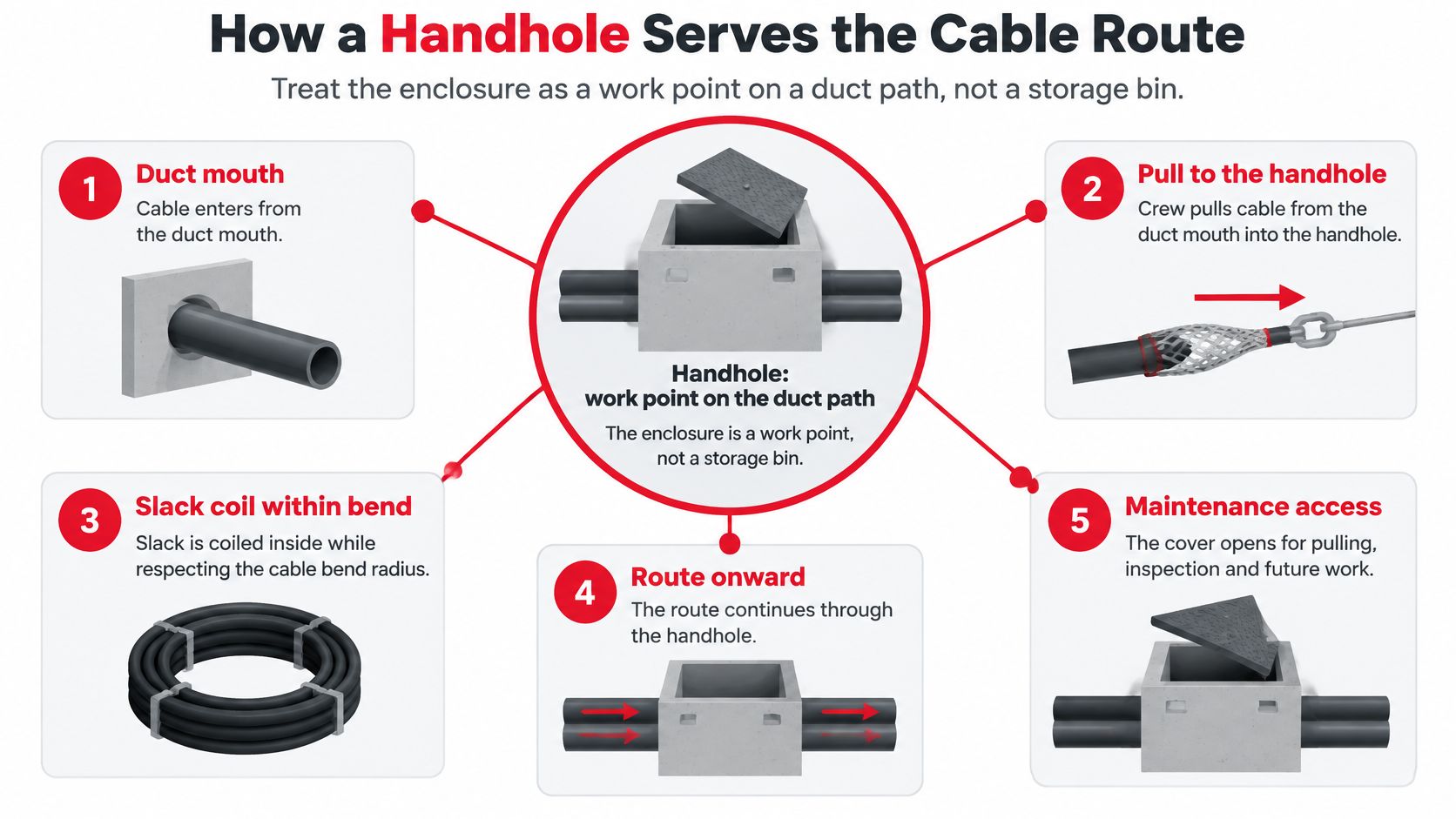
Follow one cable from the duct mouth to a parked splice and the enclosure stops looking like a bin. The box is a work point on a path, and every dimension inside it exists to let a crew stop, work, and continue.
Cable arrives from the duct mouth at the bottom of the box, pulled from the reel position several spans back. The crew brings it in, coils the slack, and sets the coil against the sidewall so the closure can sit on top without crushing it. The splice gets made and parked so the lid still seats flush. The span gets tested before the cover goes back on, because testing after restoration means digging again.
The duct package behind the lid
A typical municipal duct package puts four inner ducts inside a 4-inch Schedule 40 multi-cell conduit, with traceable metallic jet or mule string left in each cell for the next cable, according to the Port Orange fiber optic cable and handholes notes. Spares get capped, and that cap matters more than it looks. An open spare duct becomes a water path into the box and a pathway nobody can find later.
Clearance is where plans go wrong. A box can meet a plan-view maximum and still be too shallow for the coil the closure requires, so check internal depth against the actual closure plus the slack loop rather than against the catalog drawing.
The handhole is the place the route can be opened again without opening the street.
The payoff shows up on the worst day. A fault between two access points gets isolated by testing from both lids instead of excavating between them, and a later fiber addition gets pulled through spare cells rather than bored alongside the existing duct.
Who sets type, position, and depth
The U.S. Department of Agriculture's rural telecommunications construction specification makes the division of labor explicit. Its representative fiber handhole, designation BHF(17x30x30)T, carries approximate internal dimensions of 17 x 30 x 30 inches and a vehicular-traffic rating, and the same document assigns the engineer, not the installer in the hole, the job of determining location, type, position, and installation depth, with excavation sized for proper placement and backfill tamped, per the USDA rural utilities specification.
That authority structure protects the record. If the crew in the field relocates a box to dodge a root, the as-built has to change with it, because the exact position and depth drive every future locate and every future splice visit.
Open lids and temporary cable runs across shoulders and driveways create their own hazard while the work is live. A covered crossing such as these Material Handling USA cable protectors keeps vehicles off the cable and pedestrians out of the works while the box sits open.
Spacing and Setbacks That Set the Location
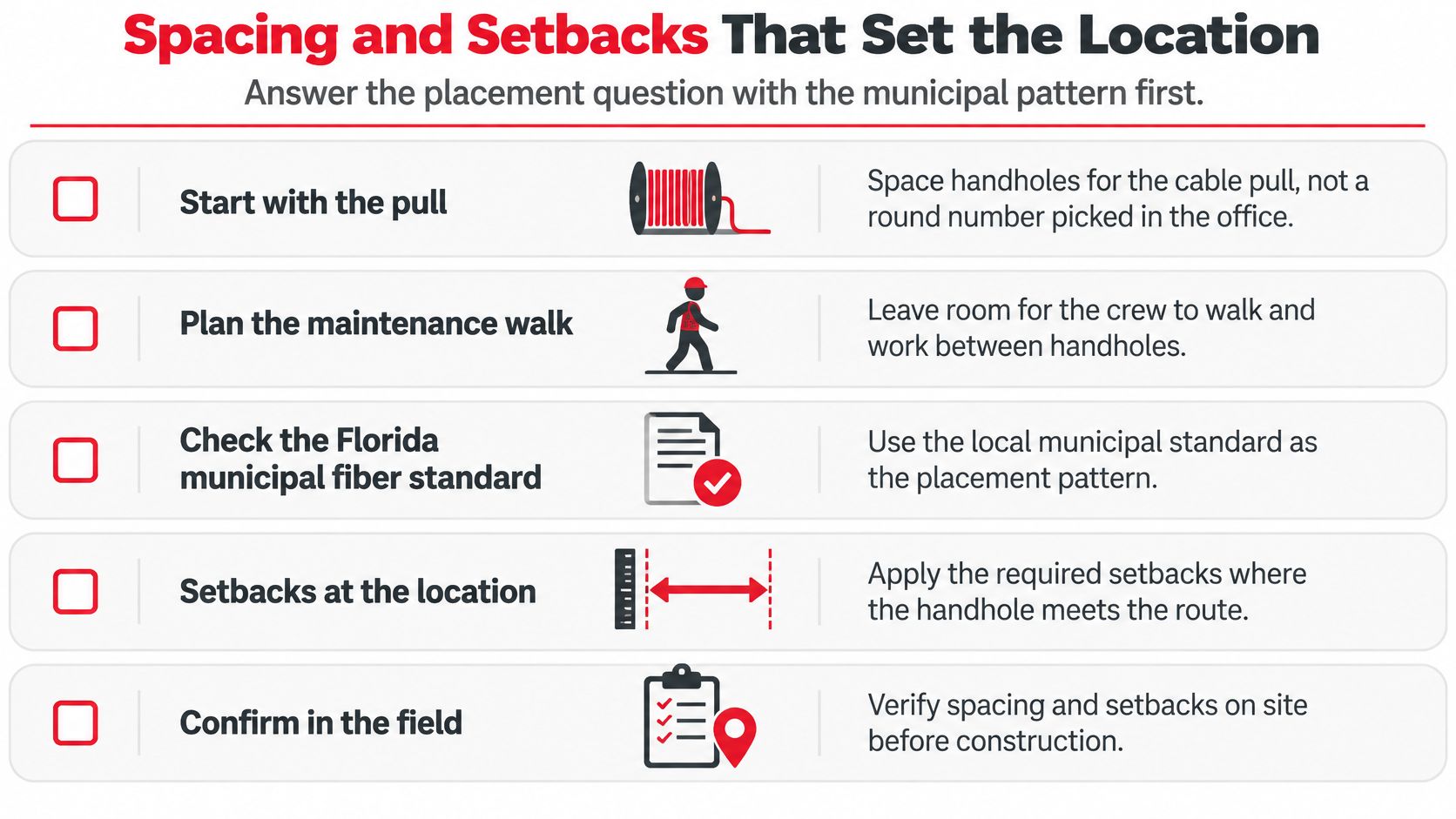
A crew standing at an open lid wants two things: cable they can still pull, and a fault they can still reach on foot. Spacing serves the first. Setback serves the second. Together they decide whether the route stays maintainable for the next twenty years.
The City of Port Orange fiber standard caps spacing at 1,000 feet, or approximately 305 meters, and requires each handhole to sit at least 30 inches from the edge of pavement or the back of a curb. Those two numbers do different work. The interval controls pull tension and fault isolation. The setback keeps the lid, and the technician kneeling on it, clear of the travel lane and out of the path of a snowplow blade or a mower deck.
The one tradeoff that sets the interval
Longer gaps cost less to build and more to run. Push past the pull limit and tension climbs, slack storage gets cramped, and the technician chasing a fault starts the trace from farther away. Shorter gaps flip the ledger: more excavation, more surface restoration, more lids to inspect, and more chances for a single settled cover to generate a complaint.
For a residential build heavy with drop activity, the practical answer leans toward more access. The boxes a design skips today become the bores a crew pays for later.
Practical rule: if a station lands more than 1,000 feet from the last one, write down why on the plan before the trench opens.
Depth follows the duct profile
The conduit profile the engineer set determines where the enclosure sits. Confirm the box fits at that depth with the closure and the coil of slack inside, then check the plan area against the right-of-way. A box picked for depth alone, with no check on footprint, is how lids end up sitting in the gutter pan.
Places to refuse
Three locations get rejected on sight. Ditch bottoms, where water collects by design. Ponding areas, where the ground still holds water days after a storm. And the normal wheel path, unless the cover carries a rating for that traffic. A lid that looks traffic-ready in a submittal and flexes under a delivery truck was never rated for the load it sees.
In flood-prone ground, a station on soil that sheds water beats a deeper box in a swale. Moving a station twenty feet uphill costs a little conduit. Replacing a submerged splice costs a day and a half.
What to mark on the plan
Three fields, every time: the station where the box sits, the offset from the curb or pavement edge, and the reason the interval is what it is. A shorter interval needs its justification on paper, whether that is a road crossing, a change in duct size, or a splice point that needs surface access. An interval at the limit deserves a note too, because the next designer will want to know whether the number was chosen or inherited.
Bedding Drainage and Wall Rules
Where the lid lands is a plan question. How the hole gets built is a construction question, and it decides whether the box survives twenty winters.
Iowa Department of Transportation specifications require qualifying handholes to meet ANSI/SCTE 77 and, for specified applications, an ASTM C-857 Tier 22 load rating, with third-party verification and a registered professional engineer's stamp, and they require the assembly to operate without failure across -50°F to +170°F, a 220°F span that covers a northern installation day and a July afternoon on asphalt, per the Iowa DOT special provision. The first two rows in the table below come from that provision. The rest are the field numbers a crew lead holds the hole to when the drawings go quiet.
| Control | Spec or typical value | What fails if skipped |
|---|---|---|
| Operating temperature | -50°F to +170°F without failure | Cracked walls or a seized lid |
| Water absorption | Maximum 2% of original weight, ASTM D-570 | A shell that soaks and weakens |
| Municipal drainage bed | 8 inches of aggregate at grade | A lid that ponds and settles |
| Heavy-spec bedding | About 1 foot of aggregate below the box | Rocking walls and misaligned conduit |
| Conduit stub | 4 to 6 inches above the bedding | A joint buried in mud |
| Wall penetrations | Prohibited; conduit enters from below | A cut wall that loses its rating |
| Interior fill | Pea gravel inside the enclosure | Condensation on closures and slack |
| Bend drainage | Hole at the low point of the conduit bend | Trapped water and freeze-thaw at the entry |
Why each row exists in the field
The 2 percent water absorption limit under ASTM D-570 tells you the shell is meant to stay a shell, because a shell that soaks up water weakens and cracks after a few freeze cycles. The typical bedding course, about a foot of aggregate below the box, gives water somewhere to go and gives the walls uniform support, so the box doesn't rock when a load passes over. Conduit ends rising 4 to 6 inches above that bedding keep the joint out of the mud and let the crew see the stub when they set the box.
The prohibition on side penetrations is the one that catches retrofit crews. Knock a hole in a sidewall and you've cut a structural shell that was tested as a unit. Conduit enters from below, on the bottom, where the design expects it.
Inside the enclosure, pea gravel reduces condensation on closures and slack. And any assembly sitting where vehicles travel has to be rated for vehicular traffic, because a box drained perfectly at the base still fails if the lid was never built for the load above it.
Two moisture problems, not one
Water-blocking cable construction and sealed cable ends handle water inside the cable. The ground around the box needs its own defense. The drainage hole belongs at the low point of the conduit bend between cabinets, so water can't sit at the transition where freeze-thaw, hydrostatic pressure, and cable-entry leakage do their damage. Cable design and site drainage are separate specifications, and a job needs both.
Field note: a drained box with a cheap closure still fails. Assume the enclosure will take on water at some point and specify the closure for the wet condition inside it.
The acceptance check before the lid goes on
Look at four things before you accept the installation: the aggregate base, the compaction, the grade, and the wall condition. Settlement and deflection pinch the cable bend radius and block closure access, and both are visible at that stage if anyone looks. Write the bedding depth and stub heights on the as-built while the hole is still open, because nobody can measure them after the pour.
Where the box sits in a paved shoulder, restoring the surface around the lid so it stays flush takes a proper pour matched to the roadway section. That patch is pavement work, so crews find commercial poured concrete contractors who can match the repair to the surrounding section. A lid sitting proud of the asphalt gets hit by everything.
Flood Routes and a Real Handhole Count
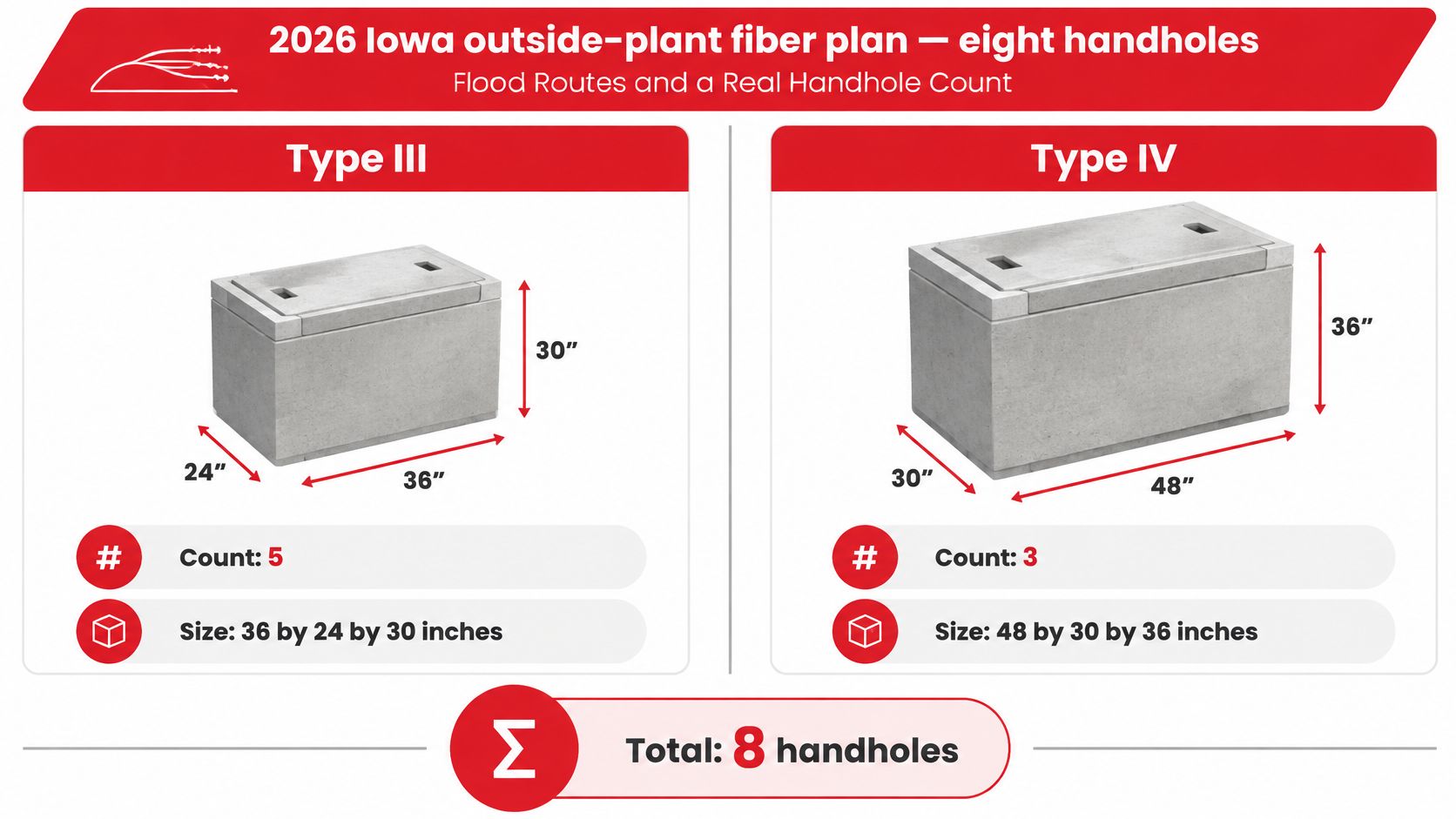
A 2026 Iowa outside-plant fiber project plan specified eight handholes: five Type III units at 36 x 24 x 30 inches and three Type IV units at 48 x 30 by 36 inches, according to the project listing published by HigherGov. Read that mix as a volume decision. The Type III boxes cover ordinary pull and splice points, and the three larger units hold the heavier slack or the extra closures at junctions. The catalog sizes answer a capacity question, and nothing more.
Move the same route onto ground that floods and the count stops being the interesting part.
When the site changes, the row changes
A 2025 telecommunications standard written for extreme weather asks access points to withstand flooding, recommends burying fiber deeper than 120 cm in flood-prone areas, and requires drainage so dampness doesn't linger, per the Gambian technical standards and protocols. Iowa DOT specifications take a related posture from the dry side: keep construction out of ditch bottoms, ponding areas, and locations exposed to normal vehicle traffic, with conduit depth set by the engineer for each alignment.
Reaching that depth is trenching work before it is enclosure work. The trench sets the grade, and the box inherits whatever the ground does afterward. Pick the enclosure second.
A short decision set, each step used once:
- Pedestrian grade only? Keep a Tier 5 polymer lid. It matches a sidewalk away from the curb.
- Can wheels reach it? Step up to a vehicular-rated cover and enclosure. Actual traffic sets the class, whatever the land use says on paper.
- Can the hole fill? Saturated soil pushes upward on a hollow box. Raise or seal the enclosure, add a drainage layer or a sump, and restrain buoyancy so it doesn't lift.
- Still can't keep the splice reachable? Move the station off the flood path entirely. A relocation costs conduit. A flooded closure costs an outage.
One more check separates a compliant box from a working route: a handhole that meets every clause but can't be opened after a storm has failed the job. Maintainability is the specification, and each box on the sheet has to earn its station.
The clip below shows how these enclosures sit in the ground and what the surface looks like when the job is done right.
Lock the Spec and Records Before Construction
Four items belong on the drawing before anyone orders a box: enclosure type and internal clearance for the closure plus slack, load class taken from actual traffic, station and offset with no interval beyond the pull limit, and a drainage path that names the aggregate bed, bottom entry, and the low-point drain at the conduit bend. Any one of them left as "per manufacturer" is the one that gets value-engineered out.
Then there's the record. An independent network audit found a cable buried only 12 inches deep rather than the recommended 30 inches, with inaccurate or missing documentation contributing to a later break during water-line work, according to the Iowa Communications Network mapping account. The same source describes how field GPS, GIS, project plans, and as-builts are used to locate buried fiber and surface structures, avoid design conflicts, and route emergency crews to a suspected damage location.
What the records must prove
Survey the lid with GPS or a total station and tie it to GIS or the project plans. Record the depth, the duct occupancy, the slack available, the splice status, and whether the box is accessible at all. Field-verify any legacy handhole whose position was never written down, because an undocumented enclosure is the most likely place for a dig strike and the slowest place to restore.
Before a crew breaks ground near a lid, the utility locate marks have to be read correctly, and this guide to decoding spray paint colors in yards helps a crew lead interpret what 811 painted and what it deliberately left unpainted.
Revise the as-built after every emergency repair and every third-party dig. The record is a living document, not a closeout deliverable.
Do not order the box until load, volume, and water have each been named on the drawing.
Southern Tier Resources builds the underground plant these enclosures live in, from fiber construction for broadband networks through splicing and testing, and our crews work to the same load, drainage, and documentation standards this guide describes. If your route needs handholes that hold up to traffic and records that make the next locate fast, visit Southern Tier Resources and talk to a team that has spent more than two decades on outside plant.