Let’s think about your internet connection like a highway system. Older technologies, like DSL and cable, are a bit like shared local roads—they get you where you need to go, but they're prone to traffic jams, especially during rush hour.
FTTH (Fiber to the Home), on the other hand, is your own private, multi-lane superhighway built right to your front door. It’s all about pure, unadulterated speed and reliability.
What Is FTTH (Fiber To The Home)?

At its core, FTTH is a network architecture where a single, continuous strand of fiber optic cable runs directly from an internet service provider’s (ISP) central office right into an individual home or business. This setup completely bypasses the old copper wiring that has been the backbone of internet infrastructure for decades.
Unlike cable or DSL, which often split bandwidth among multiple homes in a neighborhood, FTTH provides a dedicated, direct line. This design is the key to eliminating the frustrating slowdowns you experience during peak hours, delivering a consistently fast connection no matter what your neighbors are doing online.
The magic behind it all is transmitting data as pulses of light through impossibly thin strands of glass. This method allows information to travel at nearly the speed of light, which means dramatically lower latency (lag) and a massive increase in bandwidth capacity compared to sending electrical signals down a copper wire.
The Technical Edge Of A Pure Fiber Connection
The real beauty of FTTH is that it's fundamentally future-proof. While copper-based technologies are hitting their physical limits, the potential bandwidth of a single fiber strand is practically limitless. To boost speeds, all a provider needs to do is upgrade the electronics on either end of the line—the Optical Line Terminal (OLT) at their hub and the Optical Network Unit (ONU) at your location.
This incredible scalability makes FTTH a smart, long-term investment. It can handle whatever the future throws at it—from 8K streaming to holographic meetings—without anyone having to dig up streets to replace the underlying cables. The quality of this infrastructure hinges on critical components, a reality reflected in the growing fiber optic connector market.
An FTTH network is one of the few telecom investments that delivers sustainable, long-term value. That direct connection ensures data-heavy applications like cloud-based work, competitive gaming, and telemedicine perform exactly as they should—flawlessly.
FTTH Compared to Legacy Internet Technologies
To really grasp the difference, it helps to see a side-by-side comparison. The table below breaks down how FTTH stacks up against the technologies most of us have used for years.
| Technology | Infrastructure Medium | Typical Speeds | Symmetrical Speeds (Upload = Download) | Future Scalability |
|---|---|---|---|---|
| FTTH | Glass Fiber Optic Cable | 1 Gbps – 10 Gbps+ | Yes (Standard) | Extremely High |
| Cable | Coaxial Cable / HFC | 25 Mbps – 1 Gbps | No (Uploads are much slower) | Limited |
| DSL | Copper Telephone Wires | 5 Mbps – 100 Mbps | No (Uploads are significantly slower) | Very Low |
As you can see, the advantages aren't just about raw download speed. The symmetrical performance and scalability of fiber put it in a completely different league.
Why FTTH Is Now A Strategic Necessity
In a world where remote work, 4K streaming, and dozens of smart home devices are the norm, the demand for symmetrical speeds (equally fast uploads and downloads) has skyrocketed. This is where FTTH truly shines, offering balanced performance that legacy systems just can't deliver. If you're curious about the specific hardware that makes this possible, check out our comprehensive guide to fiber networking products.
For the providers building these networks, deploying FTTH brings huge operational advantages:
- Less Maintenance: Fiber optic cables are incredibly durable. They are immune to electrical interference and far more resistant to corrosion and environmental damage than copper.
- Lower Running Costs: With fewer service calls and less troubleshooting, the total cost of owning and operating the network is significantly lower over its lifespan.
- A Clear Competitive Edge: In a crowded market, offering true gigabit speeds is the ultimate differentiator for attracting and keeping high-value customers.
Choosing Your FTTH Network Architecture
At the heart of every ftth fiber to the home network lies a fundamental design choice. This decision isn't just technical; it shapes the entire project's cost, future scalability, and the level of service you can deliver. Getting it right from the start is one of the most critical steps in any deployment.
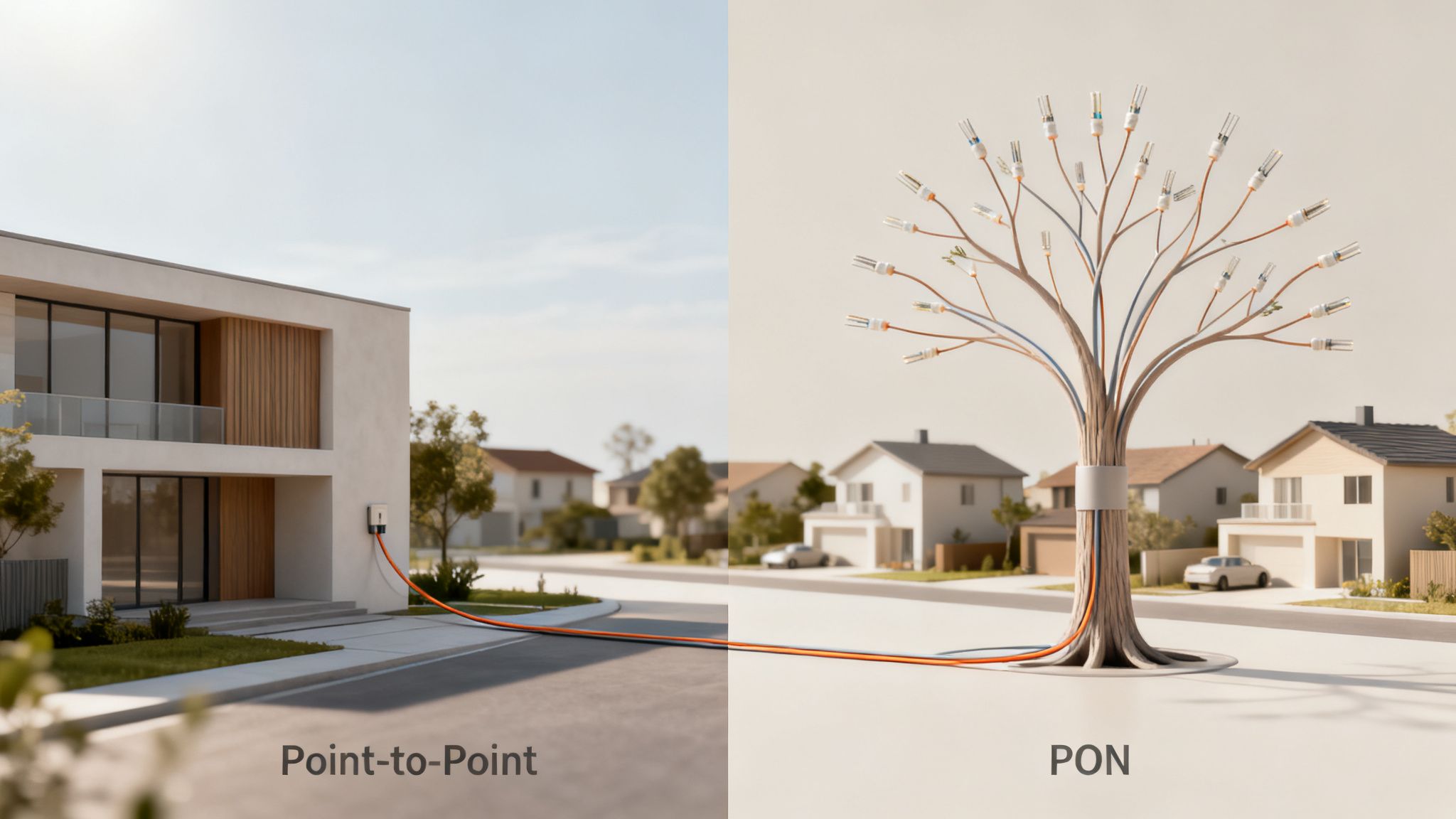
You essentially have two paths to choose from: a Point-to-Point (P2P) architecture or a Passive Optical Network (PON).
To make it simple, think of it like planning a new road system. One option is to build a private, dedicated driveway for every single house, running all the way back to the main highway. The other is to build a larger neighborhood road that cleverly branches off into smaller side streets to reach each home. Each approach works, but they serve very different needs and budgets.
With the global FTTH market projected to jump from $16.48 billion in 2026 to a staggering $27.43 billion by 2032, making the right architectural choice has never been more important.
Point-to-Point (P2P): The Dedicated Superhighway
A Point-to-Point, or P2P, architecture is exactly what it sounds like. It’s the most straightforward design where every single customer gets their own dedicated, unbroken fiber optic strand running directly from your central office or hub right to their doorstep.
Think of it as a private, armored car route connecting a bank vault directly to a single high-value client. There are no stops, no shared routes, and no other traffic—just a secure, direct link. This setup provides unmatched security and absolutely guaranteed bandwidth, making it the gold standard for clients who can't afford any compromise on performance.
Because this model requires more fiber cable and a separate port at the central office for each customer, P2P is the more expensive route. However, for certain users, the benefits are non-negotiable:
- Enterprise Clients: Businesses that depend on guaranteed, symmetrical gigabit speeds for cloud applications, large file transfers, and daily operations.
- Data Centers: Facilities needing ultra-reliable, high-capacity connections for network backhaul and linking infrastructure.
- Government & Institutional Facilities: Organizations where security, reliability, and dedicated bandwidth are absolute mission-critical requirements.
Passive Optical Network (PON): The Efficient Tree
For most residential ftth fiber to the home projects, the Passive Optical Network (PON) is the go-to architecture. This model uses a smart point-to-multipoint design that dramatically reduces the amount of fiber needed, making it far more cost-effective for connecting entire neighborhoods.
A PON works like a tree. A single, high-capacity fiber "trunk" leaves your central hub. At a key point in the neighborhood, a simple, unpowered (passive) optical splitter acts like a major fork in the tree, splitting the light signal down multiple smaller fiber "branches" that run to individual homes.
This shared approach is incredibly efficient. It allows a single fiber port at your hub to serve up to 32, 64, or even 128 homes, drastically cutting down on infrastructure costs. It all hinges on two key pieces of hardware:
- Optical Line Terminal (OLT): This is the brains of the operation, located in your central office. It sends and receives the data for the entire network branch.
- Optical Network Unit (ONU): Also known as an Optical Network Terminal (ONT), this is the small box installed at the customer's home. Its job is to convert the light signals from the fiber back into electrical signals that their router can use. To get a better feel for the end-user equipment, you can see examples of FTTH hardware solutions like ONUs and other components.
As you weigh your options, it's helpful to consider different strategic infrastructure models, like the brownfield vs. greenfield modernization approaches. While P2P offers unbeatable performance for a premium, PON provides the cost-efficiency and scalability that make it possible to bring world-class internet to entire communities, cementing its place as the engine of the current fiber boom.
The Seven Stages of an FTTH Deployment
Bringing a Fiber to the Home (FTTH) network to life is a massive undertaking, not unlike building a new highway system from the ground up. It’s a complex, multi-stage marathon, not a sprint. Every phase, from the initial sketch on a napkin to the final flick of a switch, has to be executed with precision.
Cutting corners or mismanaging a single step can create a domino effect of costly delays, budget blowouts, and a network that just doesn't perform as promised. This is precisely why having an experienced turnkey partner in your corner is so critical—they navigate the entire journey, ensuring each phase builds successfully on the last.
Let's break down the seven essential stages of a typical FTTH deployment lifecycle.
Stage 1: Strategic Planning and Permitting
This is the bedrock of the entire project. Before any dirt is moved, we have to define the mission: What's the scope? Who are we serving? Is there a solid business case? This means diving deep into market analysis, demographic studies, and forecasting subscriber "take rates" to prove the project is viable.
Then comes the real test of patience: securing permits and rights-of-way. This is a tangled web of local, state, and sometimes federal regulations. A team that knows the ins and outs of each jurisdiction is absolutely essential here. Without that expertise, it’s all too easy for administrative red tape to strangle a project before it even begins.
Stage 2: Network Design and Engineering
With a solid plan and the green light from regulators, the engineers take over. They become the architects, creating incredibly detailed blueprints for the entire fiber network. Think of it as mapping a new circulatory system, from the central "heart" of the network all the way to the individual homes.
This isn't just drawing lines on a map. Engineers use sophisticated software to optimize every inch of the fiber path, calculate potential signal degradation (loss budgets), and pinpoint the exact location for critical hardware like splitters and cabinets.
Key activities in this stage include:
- High-Level Design (HLD): Sketching out the big picture—the core, distribution, and access layers of the network.
- Low-Level Design (LLD): Zooming in to the street level, specifying exact cable routes, splice points, and equipment placement.
- Bill of Materials (BOM) Creation: Compiling an exhaustive shopping list of every single component needed, from miles of fiber optic cable down to the last connector.
Stage 3: Make-Ready Construction
You can't build something new without prepping the existing environment first. This "make-ready" work is often one of the most unpredictable and challenging parts of any FTTH build.
If you’re running fiber on utility poles (aerial), this means making space. It could involve shifting existing cables from the phone or cable company, replacing old or overloaded poles, and ensuring every change meets strict safety and engineering codes. For underground builds, it might mean clearing out old, clogged conduits or doing preliminary excavation work. To see what this involves, check out our guide to underground construction techniques.
Make-ready is notorious for causing delays. Unforeseen pole conditions, complex negotiations with other utility owners, and intricate permitting can quickly stall a project. Proactive project management is key to mitigating these risks.
The nationwide push for fiber highlights just how critical these projects are. The United States has made huge progress, with fiber now available to over 60% of households. That translates to 84.6 million unique locations with fiber access, and with a record 11.8 million homes passed in 2025 alone, the pace is only accelerating.
Stage 4: Physical Installation
With all the prep work done, it's time for the most visible part of the job: the physical buildout. This is where crews hit the streets and bring the engineering plans into the real world.
- Aerial Installation: Crews string fiber optic cable from pole to pole. In areas with plenty of existing utility poles, this is usually the faster and more budget-friendly option.
- Underground Installation: This involves more intensive methods like trenching, less-invasive micro-trenching, or directional boring to place the fiber and its protective conduit safely underground. It costs more, but it offers better protection from the elements and is much more sightly.
Stage 5: Fiber Splicing and Termination
This is where true craftsmanship comes into play. Inside specialized splicing vans, highly skilled technicians perform microscopic surgery, perfectly aligning and connecting individual glass fibers that are each thinner than a human hair.
The go-to method is fusion splicing, which uses a high-precision electric arc to literally melt and fuse two fiber ends together. The goal is a seamless, permanent connection with virtually zero signal loss. Once spliced, these delicate fibers are carefully organized in splice trays and sealed in weatherproof enclosures. At the customer's home, the process ends by attaching a connector to the fiber, ready to plug into their modem.
Stage 6: Network Testing and Commissioning
You don't just flip the switch and hope for the best. Before a single customer is connected, the entire network undergoes a battery of rigorous tests to ensure it's performing perfectly.
Technicians use specialized gear like Optical Time Domain Reflectometers (OTDRs) and power meters to check every line for quality. They’re looking at a few key things:
- Signal Loss (Attenuation): Is the light signal making it from point A to point B with enough strength?
- Reflectance: Are there any dirty connections or bad splices bouncing the signal back and causing interference?
- End-to-End Connectivity: Does the path work exactly as designed?
Only after every single segment passes with flying colors is the network officially "commissioned" and declared ready for service.
Stage 7: Final As-Built Documentation
The last step is one of the most important for the long-term health of the network: creating the "as-built" documentation. These are the final, definitive records of the network exactly as it was constructed, noting any minor changes or deviations from the original design that happened in the field.
Think of them as the permanent medical records for the network. When a problem pops up years down the line, accurate as-builts allow technicians to pinpoint the issue quickly without having to guess. This documentation is absolutely vital for efficient maintenance, troubleshooting, and future upgrades, protecting the massive FTTH fiber to the home investment for decades to come.
Breaking Down FTTH Costs and Business Models
Building a Fiber-to-the-Home (FTTH) network is a serious capital investment. While the futuristic fiber optic cables and advanced electronics grab the headlines, the real story of the budget isn't in the tech—it's in the trenches.
The single largest expense, by a long shot, is the civil work. We're talking about the hard-hat-and-a-shovel part of the job: digging trenches, directional boring under roads, or prepping utility poles for new aerial lines. It's often a surprise to newcomers, but this construction can swallow up a staggering 70-80% of the total project budget. This one statistic highlights just how critical expert project management and skilled field execution really are.
The rest of the funds get split between materials (the fiber cable itself, connectors, hardware) and the highly skilled labor needed for splicing and network testing.
Identifying Key FTTH Cost Drivers
A handful of variables can make or break an FTTH budget. Nailing these down in the planning phase is the difference between a profitable network and a financial headache.
- Deployment Method: Putting fiber underground is more expensive upfront because of all the excavation involved, but it pays off in the long run by protecting the cable from the elements. Aerial builds are typically faster and cheaper to start, but you’re more exposed to storms and have to deal with recurring pole attachment fees.
- Geographic Density: This is simple math. Connecting homes in a dense urban neighborhood is far cheaper per door than in a sprawling rural area. More distance between customers means more cable, more labor, and a higher cost to connect each one.
- Make-Ready Work: Getting existing infrastructure ready for fiber can be a minefield of hidden costs. Negotiating with utility pole owners and making the necessary structural upgrades often lead to frustrating delays and budget overruns.
- Labor and Permitting: The local cost and availability of skilled crews can swing a budget significantly. On top of that, navigating the maze of municipal permitting can add both time and money to any project.
The journey from a blueprint to a live network has several distinct stages, each requiring a different set of skills.
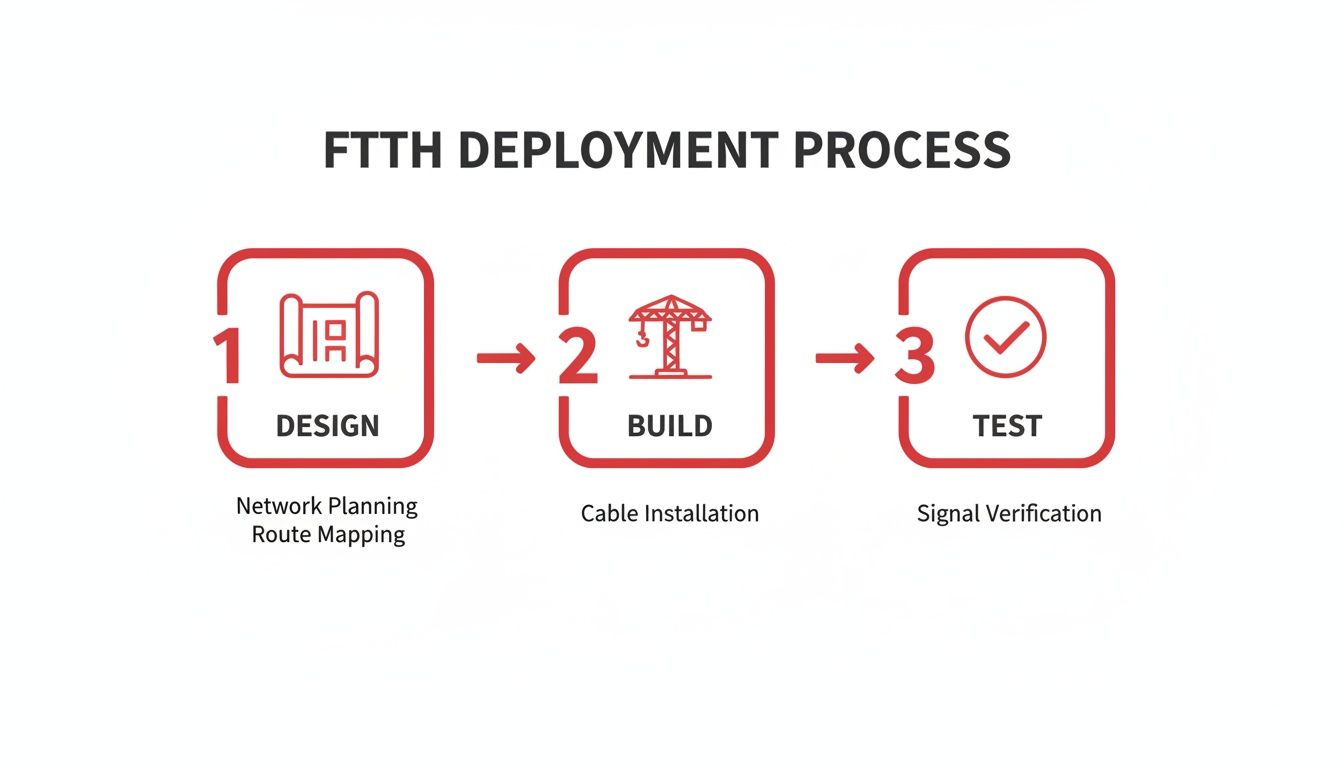
From the initial design to the final build and testing, every phase needs to be tightly coordinated to keep the project on track and within budget.
To give you a clearer picture of where the money goes, here's a typical cost breakdown for an FTTH project.
Estimated FTTH Project Cost Breakdown by Phase
| Deployment Phase | Estimated Percentage of Total Cost |
|---|---|
| Civil Works & Construction | 60% – 80% |
| Materials (Cable, Hardware) | 10% – 20% |
| Splicing, Testing & Labor | 5% – 15% |
| Design, Planning & Permitting | 3% – 7% |
As you can see, the physical construction overwhelmingly dominates the budget, reinforcing the need for meticulous planning and execution in the field.
Exploring Sustainable Business Models
With a firm grasp of the costs, the next step is choosing a business model that can deliver a return on that massive investment. The right strategy really depends on the operator’s goals, the local market, and who the competition is.
The ultimate goal is to build a network that not only meets today's demand but also generates revenue for decades. The right business model aligns the high initial investment with a long-term strategy for profitability and growth.
Here are the most common ways to make an FTTH network pay for itself:
- Direct Retail Model: This is the classic approach. The network owner, like an ISP or a utility, sells internet service directly to customers. It offers the highest potential revenue per user but also means you’re on the hook for marketing, sales, and 24/7 customer support.
- Wholesale or Open Access Model: Here, the network owner builds and maintains the fiber infrastructure but doesn’t sell service to the public. Instead, they lease access to other retail ISPs, who then compete for customers on the same network. This model creates a stable revenue stream for the owner and more choices for consumers.
- Public-Private Partnerships (P3): These have become incredibly popular for community broadband projects. A city or county might team up with a private company, with the public side providing funding or access to public rights-of-way, and the private partner handling the construction and operations. It's a great way to close funding gaps and ensure the project serves the public interest.
The global hunger for better internet is what’s fueling all this investment. The Asia-Pacific region, for instance, now commands 28.8% of global industry earnings, making it the revenue leader in the fiber-to-the-home market. At the same time, demand for speeds of more than 1 Gbps now drives 43.4% of global market revenue, proving that customers are willing to pay for top-tier performance. You can read the full research about these market trends to get a deeper look at the global landscape.
Navigating Common FTTH Deployment Hurdles
Large-scale infrastructure projects are never as clean as they look on paper, and building an FTTH fiber to the home network is certainly no exception. Even the most carefully crafted plan will eventually meet real-world friction. The secret to success isn't about dodging every single problem—that’s impossible. It's about knowing what's coming and having a solid game plan to handle it.
When you can anticipate these roadblocks, they stop being project-killing crises and become just another set of tasks to manage. Understanding where things usually get stuck allows operators to build in contingencies that keep the project moving forward and, just as importantly, on budget.
The Right-of-Way and Permitting Maze
Long before the first shovel hits the ground, every project has to fight its way through a mountain of paperwork. The first major hurdle is usually securing the legal right to build on public and private land, a process known as Right-of-Way (ROW) acquisition. This means getting into detailed negotiations with city and county officials, private property owners, and other utility companies. It’s a delicate dance.
Once you have the right-of-way, you step into the equally complex world of permitting. Every town, county, and state has its own unique playbook of rules, timelines, and fees. Trying to navigate this regulatory patchwork can slow progress to a crawl if you’re not prepared.
An experienced deployment partner who knows the local landscape is worth their weight in gold here. Their familiarity with municipal codes and, crucially, their existing relationships with local authorities can shave months off the timeline and prevent a lot of headaches.
Make-Ready and Pole Attachment Delays
When you're running fiber along existing utility poles, it's not as simple as just throwing a new line up there. The poles themselves have to be prepped in a process called make-ready engineering. In the world of FTTH fiber to the home deployments, this is where unexpected costs and delays often rear their ugly heads.
Here’s a taste of what can go wrong:
- Pole Overloading: Many older poles just aren't strong enough to handle the weight of another cable. If a survey finds a pole is at capacity, it has to be replaced, which is a major expense.
- Space Negotiation: There's only so much room on a pole. Often, existing cable and phone lines need to be shifted to make space for the new fiber, which means coordinating with other utility providers—a process that is famously slow.
- Attachment Agreements: Simply getting permission to attach your fiber to a pole involves a legal agreement that dictates rights and annual fees. These negotiations can be drawn-out and complicated.
The best way to defend against these setbacks is with meticulous upfront surveys and by opening lines of communication with pole owners as early as possible.
Supply Chain and Labor Shortage Pressures
Global demand for fiber optic components has never been higher. This has created significant supply chain headaches and long lead times for everything from the fiber cable itself to cabinets and specialized electronics. If just one critical component is delayed, it can bring construction to a dead halt across an entire section of your project.
On top of that, there's a real shortage of skilled hands. The industry is hungry for more qualified fiber splicers, linemen, and project managers than are currently available. This fierce competition for talent can inflate labor costs and make it tough to staff up your field crews when you need to.
To get ahead of these challenges, savvy operators are focused on:
- Strategic Procurement: Ordering materials with long lead times far in advance of when they're actually needed on site.
- Vendor Diversification: Not putting all their eggs in one basket. Building relationships with multiple suppliers provides a safety net if one runs into trouble.
- Workforce Development: Investing in their own training programs or partnering with firms that have already built a stable, highly skilled team.
Common Questions We Hear About FTTH
Even after laying out the entire deployment process, there are always a few key questions that pop up during the planning stages of an ftth fiber to the home project. Getting these answers straight from the start helps everyone—from network planners to investors and community leaders—get on the same page and make smarter decisions. Here are the things we get asked most often about timelines, tech choices, surprise costs, and the real long-term value.
How Long Does A Typical FTTH Deployment Take?
There's no single answer here—timelines can swing wildly depending on the size and complexity of the build. Connecting a small, well-defined neighborhood might only take a few months. But wiring up an entire city? That can easily stretch into a multi-year effort.
The biggest factors that move the needle on your schedule are how quickly you can get local permits, whether you’re stringing fiber on poles (aerial) or burying it underground, and the availability of skilled crews in your area. A partner who's been around the block can give you a realistic schedule because they know how to predict and manage these moving parts right from the get-go.
Is PON Or P2P Architecture Better For My Network?
The "better" choice really comes down to your business model and who you're trying to serve.
- Passive Optical Network (PON): This is the go-to for residential deployments because it's more cost-effective. It uses a shared, point-to-multipoint model that cuts down on infrastructure costs, making it perfect for blanketing entire communities with high-speed internet.
- Point-to-Point (P2P): This setup gives each connection its own dedicated, secure line. It’s the premium choice for businesses, government agencies, or data centers that can't afford to share bandwidth and need ironclad security.
Honestly, a lot of the most successful networks we see use a hybrid approach. They'll run PON to homes and then build out dedicated P2P connections for their high-value commercial customers.
What Is The Biggest Hidden Cost In An FTTH Build?
Without a doubt, it's make-ready work. This is all the prep needed to get existing utility poles ready for new fiber optic cables, and it is consistently the biggest source of unexpected costs and delays.
You might discover older poles aren't structurally sound, get bogged down in tricky negotiations with other utility companies over attachment rights, or find your budget completely blown out of the water. This is where meticulous upfront surveys and seasoned project management are non-negotiable—they're the only way to get a handle on these costs before they derail the project.
How Does FTTH Future-Proof A Network?
The secret is in the glass itself. A strand of fiber optic cable has nearly limitless bandwidth potential. The electronics we use today might deliver speeds of 1 or 10 Gbps, but the physical fiber line can handle so much more.
What this really means is that as our demand for speed grows (and it always does), network providers can boost performance just by upgrading the equipment at either end of the fiber. You don't have to go through the massive expense and disruption of ripping out and replacing the core cable infrastructure. That incredible scalability is what makes ftth fiber to the home a true long-term investment, one that can support whatever technology comes our way for decades to come.
Navigating the complexities of an FTTH deployment takes a partner with real-world expertise in every single phase, from initial planning and permitting to the final splice and ongoing maintenance. Southern Tier Resources provides the end-to-end engineering and construction services you need to build a reliable, future-proof fiber network—on time and on budget. Learn how our turnkey solutions can ensure the success of your next fiber project.