A telecom general foreman job description lays out the blueprint for a critical field leadership position. This isn't just a supervisor role; it's about taking complex engineering plans off the page and transforming them into the communication networks we rely on every day. They are the on-site commanders, the ones responsible for getting the job done safely, on time, and on budget.
The On-Site CEO of Telecom Construction
Think of a Telecom General Foreman as the project's on-site CEO. While a project manager maps out the high-level strategy from an office, the general foreman is in the field, making the moment-to-moment decisions that can make or break a project. They close the gap between the engineer's blueprint and the physical reality of a newly installed fiber optic line or a fully operational cell tower.
But their job is far more than just giving orders. It’s about expertly coordinating a massive effort involving multiple crews, heavy equipment, and a constant stream of materials, all while enforcing strict safety protocols. A great general foreman ensures that the underground boring crew, the aerial line workers, and the fiber splicing team all work in sync. For a company like Southern Tier Resources, their leadership is the key to successfully deploying everything from rural broadband to dense urban 5G networks.
Growing Demand for Field Leadership
The need for this kind of hands-on leadership is skyrocketing. With massive national investment pouring into digital infrastructure, the demand for experienced managers to lead these complex builds has never been higher.
Employment for construction managers is set to grow by 9 percent between 2024 and 2034, much faster than the average for other jobs. That translates to roughly 46,800 openings each year, fueled by nationwide broadband expansion and 5G upgrades. You can dive into the full report from the U.S. Bureau of Labor Statistics on construction manager career outlooks.
This isn't just a fleeting trend. This data highlights just how vital the general foreman's role is in today's market. They are the ones who turn ambitious network expansion goals into a functional reality. Their skill in managing risk, maintaining quality, and leading diverse teams has a direct line to a project's bottom line and the company's reputation.
At the end of the day, the general foreman is where the buck stops. They are the leader accountable for making sure every cable is laid correctly and every tower is built to the highest standard of safety and performance. They are, quite literally, building the backbone of our connected world.
Core Responsibilities in Modern Telecom Projects
A Telecom General Foreman does far more than just supervise a crew. They’re the field general, the person on the ground who turns complex engineering prints into the high-performance networks we rely on every day. Think of them as the orchestrator of a complex symphony of construction. Their specific duties shift and adapt depending on the job, from a massive greenfield fiber build to a precise small cell installation in a crowded city.
At its heart, the General Foreman role is a blend of high-level strategy and in-the-trenches execution. They are the CEO of the job site, the leader who mentors their teams, and the executor who guarantees the work gets done right.
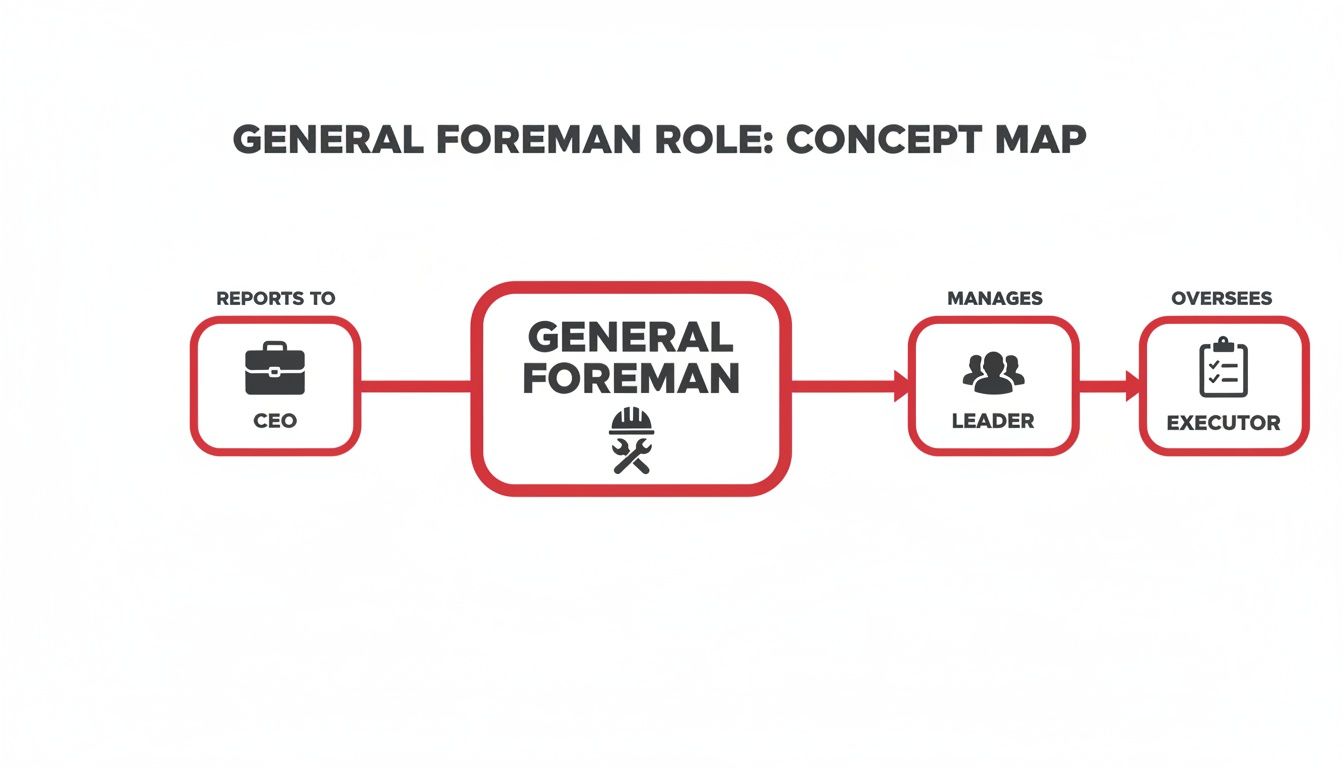
This image really nails it, showing how the foreman sits at the center of everything, balancing big-picture oversight with hands-on leadership. Let's dig into what that looks like across different types of telecom projects.
Greenfield Fiber and FTTH Builds
On a greenfield Fiber-to-the-Home (FTTH) project, the General Foreman is building a brand-new network from scratch. This is a massive logistical challenge that involves managing multiple specialized crews working at the same time. The foreman is the central hub, making sure every phase of the project connects flawlessly.
Their key responsibilities include:
- Coordinating Underground and Aerial Crews: The foreman is the one making sure the underground boring teams are working in lockstep with the aerial crews hanging fiber on the poles. Without this coordination, you get expensive delays and a lot of rework.
- Managing Material Logistics: They're in charge of getting all the critical materials—from huge spools of fiber optic cable and conduit to handholes and pedestals—to the right place at the right time. A single missing part can bring an entire crew to a standstill.
- Ensuring Quality Splicing and Testing: Ultimately, the foreman owns the quality of the final network. This means they have to verify that every fiber splice is perfect and that all connections pass strict testing protocols to deliver the promised speed and reliability.
Make-Ready Engineering and Construction
Before you can hang a single new strand of fiber on a utility pole, you have to get the poles ready. This critical prep work is called make-ready engineering (MRE) and construction. Here, the General Foreman’s job is to take the MRE plans and turn them into reality, bringing existing poles up to code so they can handle the new attachments.
Think of it like this: make-ready is the process of widening a highway before adding new lanes. The foreman directs crews to remove old, dead cables, replace poles that are failing, and shift existing lines to make room. Their work is absolutely essential for the safety and long-term integrity of the entire grid.
This phase demands tight coordination with utility companies, an almost obsessive focus on local regulations, and careful management of crews who are often working near live power lines. It's all about precision and safety to prevent any disruption to existing services.
Wireless Site Deployment
When the project involves wireless sites, like small cell installations or upgrades to macro towers, the General Foreman's role shifts again. These jobs have their own unique technical and logistical hurdles, often taking place in busy public spaces or on existing rooftops.
On a wireless build, a foreman’s duties often include:
- Site Civil Work: They oversee everything on the ground, from pouring concrete pads for equipment cabinets to trenching for the power and fiber feeds that keep the site online.
- Tower Crew Coordination: The foreman manages the tower climbers and the ground support crew. This team is responsible for carefully mounting antennas, radios, and other hardware onto the tower or structure.
- System Integration and Testing: Once the hardware is up, they ensure every component is connected and powered up correctly. They then work side-by-side with network engineers to test the site and confirm it’s broadcasting a clean, strong signal.
Across all these projects, a General Foreman must create a collaborative and productive job site; a deep understanding of how to build high-performing teams is non-negotiable. This leadership has a direct line to project timelines and quality. For companies looking to staff these critical roles, Southern Tier Resources provides a range of professional telecom construction services.
The Skills That Define a Top-Tier Foreman
Making the leap from a skilled crew member to a successful Telecom General Foreman isn't just about putting in the years. It's about developing a unique mix of hard-won technical knowledge, genuine leadership, and an unwavering commitment to safety.
These aren't just buzzwords for a resume; they're the everyday toolkit a foreman relies on to translate complex project plans into a finished, functioning network. Think of them as the three legs of a stool—technical skill, leadership, and safety. If any one of them is weak, the entire project becomes unstable. Let's dig into what this skill set really looks like on the ground.
Technical and Operational Expertise
A great foreman speaks the language of telecom construction fluently. This is about more than just telling people what to do; it’s about a deep, practical understanding of the technical nuts and bolts of the project. Without this foundation, you can't effectively guide crews, troubleshoot problems, or earn their respect.
This expertise breaks down into a few critical areas:
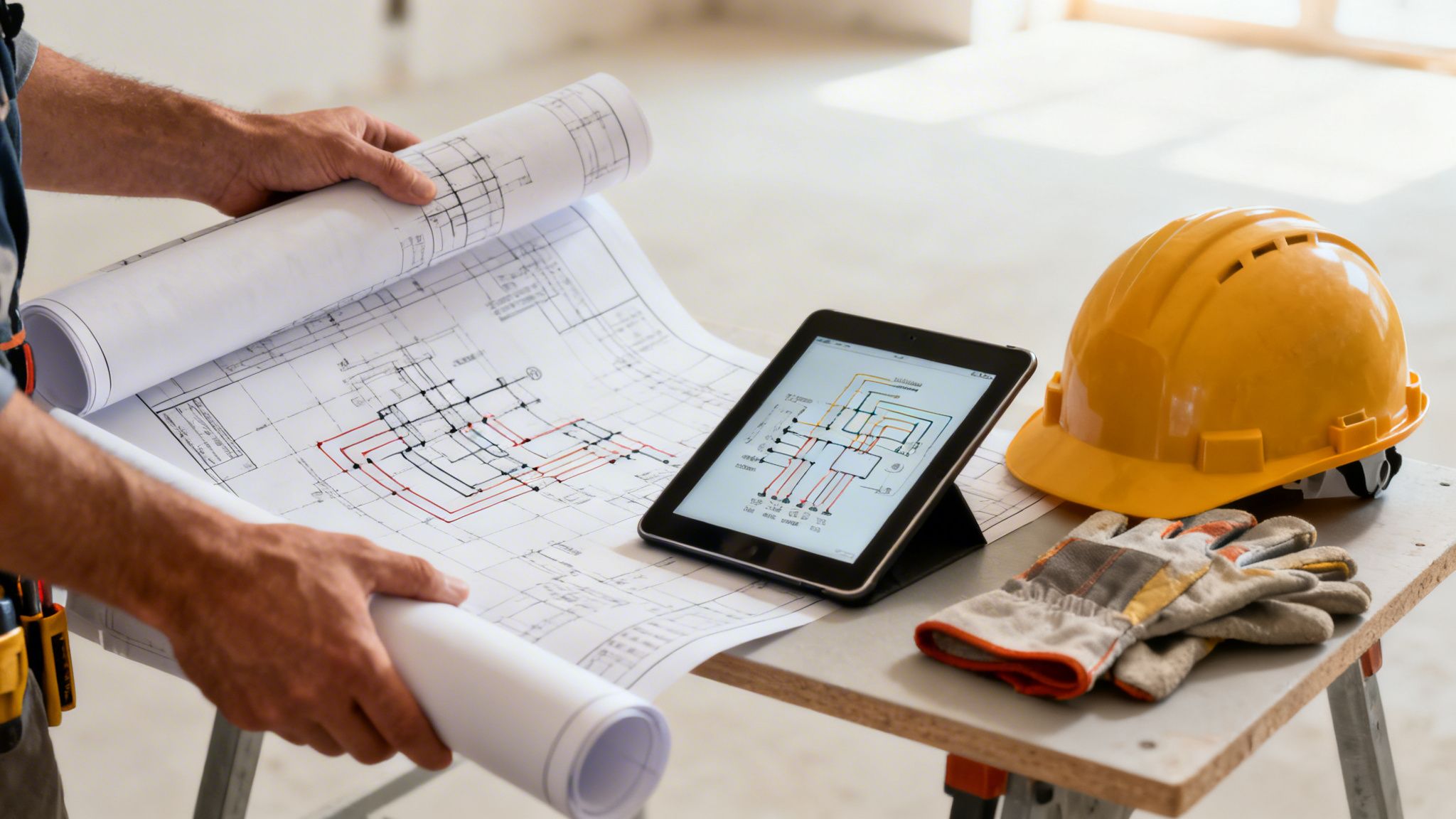
- Blueprint and Design Interpretation: You have to be able to look at a set of complex engineering drawings, schematics, or as-builts and see the job in your mind. The real skill is turning those lines on a page into clear, actionable tasks for your team.
- Knowledge of Fiber Optic Standards: A foreman must be the authority on industry standards for everything from installation and splicing to testing. This ensures the network we build not only works but meets every performance and quality benchmark.
- Hands-On Equipment Acumen: While you might not be in the driver’s seat every day, you need to know the capabilities and, more importantly, the limitations of the equipment. From directional drills and bucket trucks to fusion splicers and OTDR testers, this knowledge is vital for smart planning and keeping everyone safe.
Leadership and Management Skills
Technical ability gets the network built. Leadership gets it built on time, on budget, and to the client's satisfaction. As a foreman, you're the direct leader of multiple crews, the go-to contact for project managers, and often the face of the company on-site.
Beyond just directing work, modern leadership involves new tools. Proficiency with field service management software is quickly becoming a must-have for tracking progress and managing resources effectively. But technology is no substitute for strong communication. Great leaders motivate their teams, resolve conflicts before they escalate, and are ultimately responsible for building a civil construction environment where teamwork and high standards are the norm. You can learn more about what leading civil construction contractors deliver in this environment.
Most companies today look for 5 to 10+ years of direct experience in construction leadership. For specialized telecom roles like this, that often includes at least two or three years specifically as a foreman in underground utilities and fiber. With increasingly diverse crews, bilingual proficiency in English and Spanish is also becoming a standard requirement.
Unwavering Commitment to Safety and Certifications
In our world, safety isn't just a priority that can be shuffled around—it's a non-negotiable value. A General Foreman is the absolute owner of safety on their job site. This means more than just knowing the rulebook; it means building a culture where every single person feels responsible for their own safety and for looking out for their teammates.
A safety certification is more than a piece of paper; it’s proof that a leader has the knowledge to identify hazards, prevent accidents, and respond effectively in an emergency. For a company like Southern Tier Resources, it's a non-negotiable requirement.
This commitment to safety is backed by specific, verifiable certifications. These aren't just "nice-to-haves"; they are foundational to the role.
- OSHA 30: This is the baseline. It proves you have a comprehensive grasp of hazard identification, avoidance, and control on a construction site.
- First Aid/CPR: When an accident happens, the foreman is the first line of defense. You have to be prepared to act as a first responder and provide immediate care until medical professionals arrive.
- Specialized Certifications: Depending on the project, this might include credentials for confined space entry, traffic control, or certification as a Qualified Gas Thermal Fusion Operator for specific infrastructure jobs.
How Performance Is Measured on the Job Site
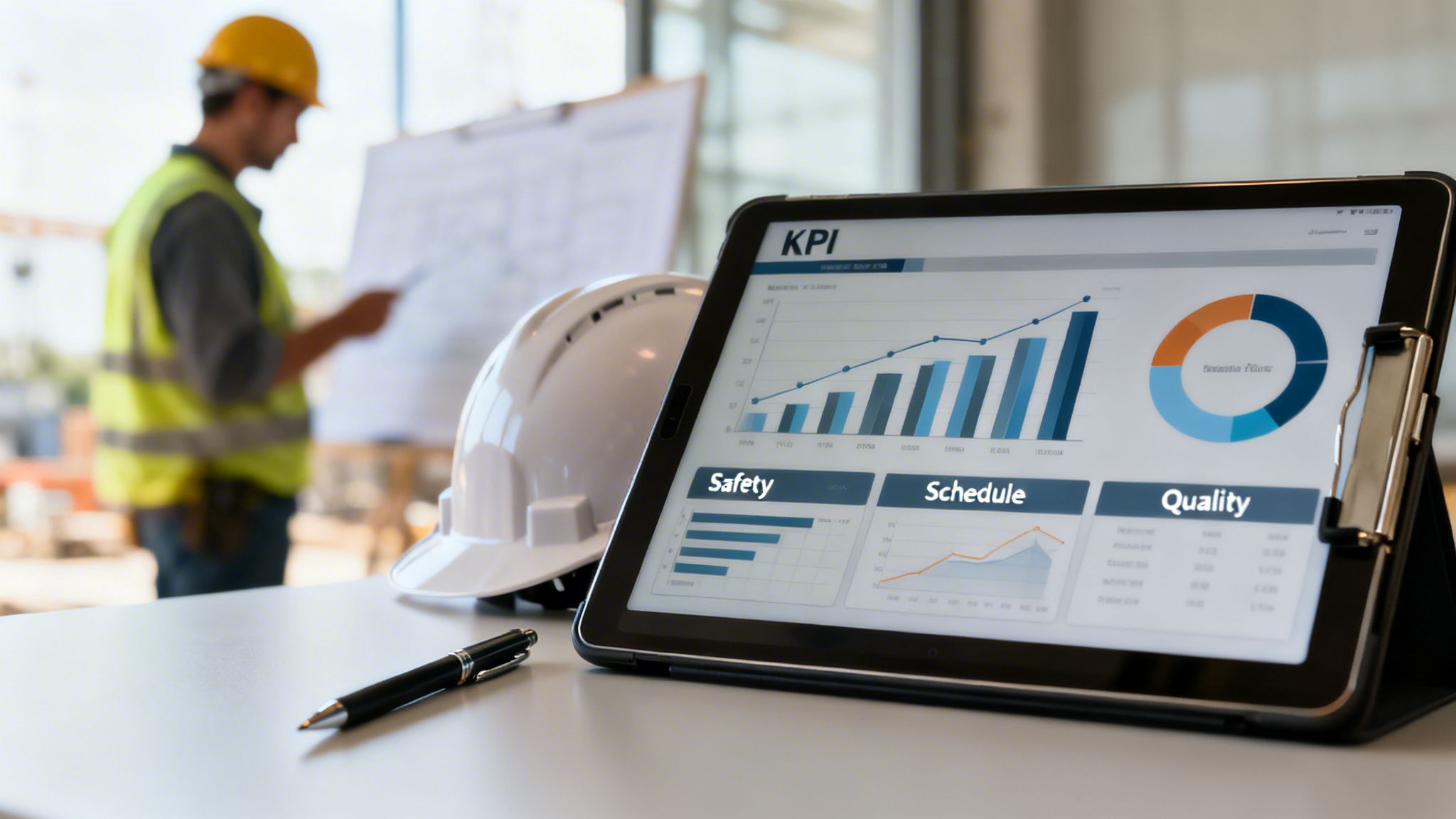
It all comes down to the numbers. While experience and leadership are crucial, a general foreman's true value is ultimately tracked on a scorecard of key performance indicators (KPIs). These metrics take the guesswork out of performance evaluation, turning subjective feelings into hard data.
For clients and project managers, this data provides a clear, real-time picture of a project's health. The best foremen don't just oversee the work; they obsess over their numbers and consistently deliver results across four make-or-break categories: safety, quality, schedule, and budget.
Safety Metrics
In telecom construction, there is no metric more important than safety. It’s the bedrock of a successful project and the first thing anyone looks at. A foreman's ability to run a tight, safe ship is their primary measure of success.
Here's what gets tracked:
- Total Recordable Incident Rate (TRIR): This is the big one. It measures work-related injuries across the team, and the only acceptable target is TRIR of 0.0. Anything else is a problem.
- Safety Audit Scores: Foremen should expect regular, unannounced site visits. These audits aren't about "gotcha" moments; they're about verifying that a true safety culture exists. Consistently high scores show that safety is a daily habit, not just a response to being watched.
- Toolbox Talk Completion: Are daily safety briefings happening? Are they relevant and engaging? Tracking this simple activity confirms a foreman's commitment to keeping safety top-of-mind for every crew member, every single day.
Quality and Adherence Metrics
A fiber network is a long-term asset, and shoddy work today creates massive headaches tomorrow. That’s why a foreman’s performance is heavily scrutinized for the quality of the final build and the accuracy of the paperwork that comes with it.
A great foreman understands that their job isn't finished until the "as-built" drawings are complete and accurate. These documents are the final record of what was actually installed, and they are critical for future maintenance and network upgrades. Any deviation from the plan must be documented.
Key quality metrics include:
- Rework Percentage: How much work had to be redone because of mistakes? This number speaks volumes about a foreman's oversight and the crew's skill. A low rework percentage means the job was done right the first time, saving both time and money.
- As-Built Drawing Accuracy: At the end of the project, the final drawings must be a perfect mirror of what’s in the ground or on the poles. Performance is measured by how precisely the documentation reflects reality, giving clients a trustworthy map of their new infrastructure.
Schedule and Budget Performance
At the end of the day, projects have deadlines and budgets. A foreman's ability to manage time, money, and resources is a fundamental part of the general foreman job description.
The essential financial and scheduling metrics are:
- Milestone Completion Rate: Big projects are broken down into smaller, manageable phases. A foreman is judged on their crew's ability to hit these critical deadlines consistently.
- Cost Variance: This KPI simply asks: Are you over or under budget? It compares the planned cost of labor, materials, and equipment to the actual spending. An effective foreman keeps a close eye on this and knows how to stay in the black.
- Resource Utilization: This metric shows how efficiently a foreman is using their crews and equipment. Idle trucks and crews sitting around are a project manager's nightmare. High utilization means everyone is productive, which flows directly to the project's bottom line.
General Foreman Salary and Compensation in 2026
When it comes to pay, let's get straight to the point. A Telecom General Foreman is a high-stakes, high-responsibility role, and the compensation reflects that. This isn't just about a paycheck; it's a measure of the trust a company puts in you to manage multi-million dollar projects, lead crews safely, and keep critical infrastructure builds on track.
Your earning potential is directly tied to the scale of your work. The foreman leading a crew on a massive greenfield fiber build for a major carrier will naturally command a higher salary than someone managing smaller, localized repair projects. Your experience, specific certifications, and even the region you work in all play a significant part in your take-home pay.
Analyzing the Pay Scale
It's important to look at the right numbers. If you search for a "general foreman" salary, you might see figures around $60,657 per year as of March 2026. But that number is misleading because it lumps in foremen from all types of general construction. A much closer comparison is the average construction foreman, who earns closer to $95,000 annually. You can dig deeper into these figures and see how they shift based on location and years on the job in this detailed salary breakdown.
The real story, however, is in the specialization. While some entry-level foreman roles in other industries might start around $22-$23 per hour, a skilled telecom foreman is in a different league. In our industry, experienced leaders often earn well over $31.57 per hour. The technical complexity and mission-critical nature of telecom infrastructure mean companies are willing to pay a premium for proven field leadership.
What Makes Up the Full Compensation Package
That base salary is just the starting point, though. The total compensation for a top-tier Telecom General Foreman is much more than an hourly wage or annual salary.
A foreman’s total compensation is a direct reflection of their impact. Beyond the base salary, perks like a company vehicle, robust benefits, and overtime potential acknowledge the 24/7 nature of their responsibility and their direct role in a project's financial success.
Here’s a look at what a truly competitive package should include:
- Company Vehicle and Fuel Card: You’ll be living on the road, moving between job sites. A company truck and a gas card aren't just a perk; they're a necessity for the job.
- Health and Retirement Benefits: Look for quality medical, dental, and vision insurance for you and your family, plus a solid 401(k) plan with a company match.
- Overtime Pay: Telecom projects don't always stick to a 9-to-5 schedule. Hitting tight deadlines often means long days and weekend work, and that overtime can significantly increase your annual earnings.
- Performance Bonuses: The best companies reward results. Bonuses tied to hitting safety, budget, and schedule targets mean your hard work directly translates into extra cash in your pocket.
If you're curious how this stacks up against other technical roles in the field, check out our guide on the average cell tower technician salary. Looking at the complete package—not just the base pay—is the only way to accurately evaluate a career opportunity as a general foreman.
Telecom General Foreman Job Description Template
Here’s a practical, ready-to-use template for a Telecom General Foreman job description. We've designed it to be clear and direct, with sections for the role summary, key responsibilities, and required qualifications. This isn't just a generic template; it’s optimized with the right keywords and written in a professional tone that champions a culture of safety, quality, and teamwork.
This is a valuable tool for hiring managers aiming to attract top-tier field leaders. It’s also perfect for candidates who want to know exactly what the best companies are looking for. To round it out, we’ve included a set of interview questions designed to help you gauge a candidate's real-world skills and see if they’re a true fit for your culture.
Role Summary
We are looking for an experienced Telecom General Foreman to coordinate operations and lead crews at our telecom construction sites. You’ll be the main point of contact for both the field teams and project managers, playing a vital part in the successful completion of our fiber optic, wireless, and infrastructure projects.
The right person for this role has a solid background in telecom construction. More importantly, they are a proven leader who can direct multiple teams and make smart, decisive judgments on the fly. You are the on-site leader responsible for translating complex engineering plans into functional, high-performance networks. This job demands a solid mix of technical know-how, leadership, and organization to manage crews and the moving parts of the construction process, all while enforcing a strict, safety-first culture.
Key Responsibilities
At its core, the Telecom General Foreman's job is to get the project done safely, on time, and to the highest standard of quality.
- Oversee Daily Site Operations: You'll lead all on-site activities for telecom construction, which includes everything from underground and aerial fiber builds to make-ready engineering and wireless site deployment.
- Coordinate and Delegate Tasks: Your day will involve assigning work to crew members and contractors based on project plans and daily priorities. You’ll need to be ready to adjust for weather, material deliveries, or staffing changes.
- Enforce Safety and Compliance: You are the champion of safety on site. This means enforcing the safe use of all tools and machinery and ensuring every bit of work follows OSHA guidelines and our own company safety protocols.
- Manage Resources and Logistics: It's your job to make sure crews have the people, materials, and equipment they need to hit their deadlines. This includes overseeing material deliveries and keeping an eye on equipment maintenance.
- Report on Project Progress: You'll provide daily reports to project management detailing work completed, hours logged, safety observations, and any challenges that came up.
Required Qualifications
A great candidate will have a proven track record of leadership in the telecom construction field. While many skills can be learned on the job, a deep-seated commitment to safety and quality is absolutely non-negotiable.
Experience and Skills
- A minimum of 5 years of hands-on experience in telecom construction, with at least 2-3 years spent in a foreman or supervisory role.
- Deep knowledge of telecom construction methods, equipment, and OSHA guidelines.
- The proven ability to read and accurately interpret project plans, blueprints, and technical specs.
- Strong leadership, time-management, and decision-making skills are essential.
- Excellent communication skills, whether you're giving clear orders to your crew or reporting progress to management.
Certifications and Physical Requirements
- A valid U.S. driver's license with a clean driving record is mandatory.
- OSHA 30 certification is required; Basic First Aid/CPR is a definite plus.
- Must be physically able to handle the demands of a construction environment, including lifting up to 70 lbs and working outdoors in all kinds of weather.
- A willingness to travel to different project locations as needed.
Think of this job description template as a blueprint. It’s built to attract candidates who don’t just have the technical chops, but also the leadership qualities needed to guide a project from start to finish, making sure every detail aligns with the highest safety and quality standards.
A great interview goes beyond the resume. The goal is to understand how a candidate thinks, solves problems, and leads. Below is a framework of questions designed to probe their practical skills and determine if they truly fit within a safety-focused culture.
Interview Question Framework for a Telecom General Foreman
| Competency Area | Sample Question | What to Look For |
|---|---|---|
| Safety Leadership | Describe a time you had to stop a job due to a safety concern. What was the situation and how did you handle it? | A clear, non-hesitant commitment to safety over schedule. Look for evidence of proactive hazard identification and a focus on coaching, not just punishment. |
| Problem Solving | You discover a major discrepancy between the engineering prints and the actual site conditions. What are your next three steps? | A logical process: 1) stop affected work, 2) document the issue, 3) communicate up the chain of command. This shows an understanding of process and accountability. |
| Team Management | How do you handle a conflict between two experienced crew members who disagree on the best way to tackle a task? | The ability to listen, mediate, and make a final decision that aligns with project specs and safety. They should promote teamwork, not take sides. |
These questions help you see past canned answers and get a real feel for how a candidate would perform when faced with the real-world, high-stakes challenges of running a telecom construction site.
Frequently Asked Questions About the Role
If you're mapping out a career in telecom or looking to hire the right field leader, you probably have some questions. We get it. Let’s clear up a few of the most common ones about what it really means to be a Telecom General Foreman.
Think of this as advice from the field—straightforward answers that build on everything we’ve covered, giving you a practical look at what this critical role is all about.
What Is the Career Path for a General Foreman?
Nobody walks onto a job site and becomes a General Foreman on day one. It's a role you earn through years of in-the-trenches experience, typically starting as a skilled crew member or equipment operator.
Once you’ve mastered the hands-on work, the next logical step is leading a single team as a Crew Lead or Foreman. After you've proven you can manage a crew effectively, the door opens to the General Foreman position, where you'll start overseeing multiple crews and much larger project scopes.
But the ladder doesn't stop there. Great General Foremen often advance to high-level roles like Construction Superintendent, Project Manager, or even Operations Manager. At that level, their firsthand field knowledge becomes indispensable for making smart, strategic decisions.
How Is This Role Different From a Standard Construction Foreman?
While both are leadership roles, the difference really comes down to scope and specialization. A standard construction foreman is often a master of a specific trade, like concrete or electrical, managing that single piece of the puzzle on a job site.
A Telecom General Foreman, on the other hand, is a systems specialist. They have to understand the entire, interconnected lifecycle of a network build. They’re juggling a dozen highly technical tasks at once—coordinating everything from underground boring and make-ready crews to delicate fiber splicing and wireless equipment testing. This demands a deep, working knowledge of telecom standards and safety protocols that are completely unique to our industry.
Think of it this way: a standard foreman manages a task, but a telecom general foreman manages an integrated system. Their job isn't just about building something; it's about ensuring a complex network comes online and performs perfectly.
What Are the Biggest Challenges on a Major Fiber Build?
When you’re running a large-scale fiber deployment, every day brings a new set of challenges that will test your grit and your ability to think on your feet.
Logistical Juggling Act: You're constantly managing the flow of specialized materials like fiber optic cable and splice enclosures, heavy equipment, and multiple crews with different skills. If one piece of that puzzle is delayed, it can create a costly domino effect across the entire project.
Quality Control at Scale: It’s one thing to get one splice right. It's another thing entirely to ensure every single connection across hundreds of miles of fiber meets precise technical standards. This requires an obsessive focus on process and absolutely meticulous documentation.
The Great Unknown: The field is full of surprises. You might hit solid rock during a directional bore, find undocumented utilities, or run into unexpected permitting issues. A great foreman has to be a master of on-the-spot problem-solving to keep the project moving without ever cutting corners on safety or quality.
At Southern Tier Resources, we give our field leaders the support and autonomy they need to tackle these challenges and build the networks of the future. If you're ready to take the next step in your career with an industry leader, learn more about our professional services at https://southerntierresources.com.