Houston network projects usually look straightforward on a coverage map and messy everywhere else.
A team gets the budget. The service area looks promising. Demand is real. Then the Houston realities hit all at once. Harris County sprawl changes route miles fast. Hurricane season affects cabinet placement, backup paths, and restoration planning. Utility coordination can drag longer than the physical build if make-ready work starts late. And if your customer base includes energy, logistics, industrial, or public sector users, downtime tolerance is low and excuses don't travel.
That’s why infrastructure networks houston projects reward operators who think like builders, not just planners. The winning teams don't treat fiber, towers, permits, civil work, and maintenance as separate workstreams. They treat them as one operating system with local constraints baked in from day one.
This guide is written from that on-the-ground perspective. It focuses on what slows deployments, what protects schedule and performance, and where Houston-specific conditions force different decisions than you’d make in a tighter, simpler market.
Tackling Your Houston Network Deployment
If you're responsible for a Houston deployment right now, you're probably balancing three maps at the same time. The first is your target footprint. The second is the permit and utility ownership map. The third is the one nobody talks about enough, the risk map covering flooding exposure, restoration access, traffic control constraints, and customer sites that can't tolerate missed cutovers.
That mix is what separates infrastructure networks houston work from a standard metro build. Houston is broad, operationally uneven, and full of critical users who care less about your construction sequence than whether service comes up on time and stays up in bad weather.
The first mistake teams make is assuming speed comes from pushing construction harder. In Houston, speed usually comes from front-loading the messy work. Pole ownership, conduit availability, existing easements, railroad constraints, and municipal review comments can all reshape the route before a crew ever pulls cable. When those issues surface in the field, production stalls and costs start moving in the wrong direction.
The better approach is simple:
- Define the service objective first. Is this an enterprise route, small cell backhaul, FTTH expansion, private wireless support, or data center connectivity?
- Build the route around field reality. A route that works in CAD but fails utility review is not a route.
- Set resilience rules early. In Houston, that means planning for water, wind, access disruption, and restoration priorities before final design.
- Assign one owner to schedule integration. Permitting, make-ready, civil, fiber, testing, and closeout have to move as one chain.
Teams that need a practical view of network delivery often benefit from looking at how turnkey network infrastructure work is typically scoped in the field. The key is accountability across design, build, and turnover, not just labor on a spreadsheet.
Practical rule: In Houston, the cleanest route on paper is rarely the fastest route to revenue.
The Houston Telecom Market Landscape
A Houston build can look profitable in the estimate and fall apart once the route crosses three jurisdictions, two utility owners, and a flood-prone corridor. That is normal here. The market is large, but it is not uniform, and teams that treat it like one coverage map usually miss schedule, cost, or both.
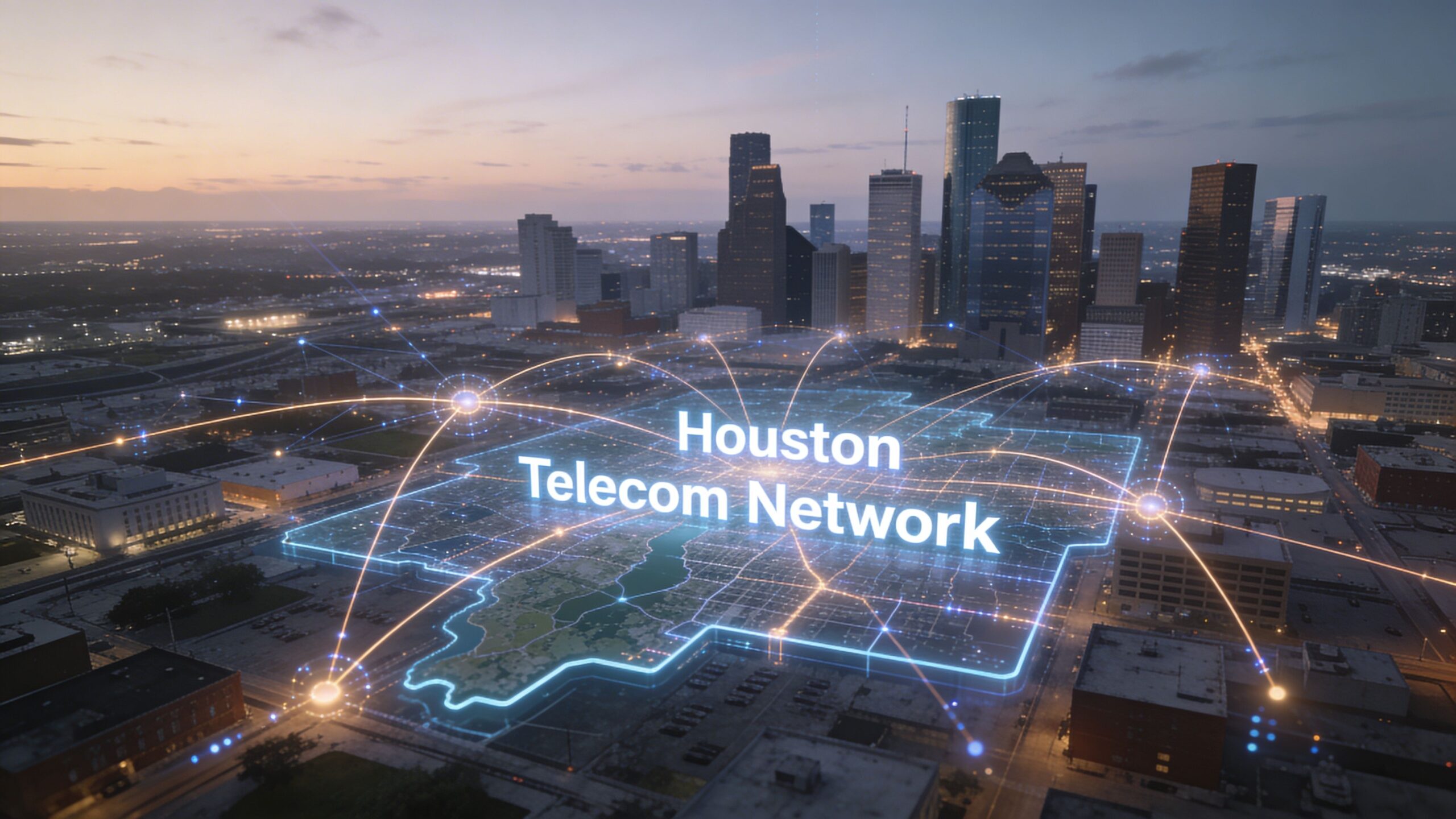
Houston market conditions are shaped by distance, density, and industry
Houston spreads demand across master-planned suburbs, older urban corridors, port and petrochemical zones, and energy operations that extend well beyond the city. Each area buys capacity for different reasons and tolerates different construction methods. A route that pencils out for residential growth in Cypress or Katy may fail in the Ship Channel where uptime, access control, and restoration planning carry more weight than lowest first cost.
Distance drives more than material quantities. It increases splicing exposure, utility conflict points, traffic control needs, and the number of stakeholders who can delay a turn-up. Dense districts create a separate problem set. Crews lose time to lane restrictions, limited work windows, and harder restoration requirements.
That is why serious planning starts with demand type, not just passings.
- Outer-ring growth areas reward disciplined expansion planning. Teams need clean subdivision sequencing, room for laterals, and a path to future splits without rebuilding the backbone.
- Industrial and energy corridors reward resilience and access planning. Redundant paths, protected electronics, and practical maintenance entry matter more than a neat drawing set.
- Legacy neighborhoods reward construction restraint. Existing utilities are crowded, residents watch every cut, and aerial-versus-underground decisions can change block by block.
Houston also has a strong residential broadband case, but take rate assumptions need to stay realistic. In greenfield and redevelopment pockets, Fiber to the Home (FTTH) can support long-term growth. In tougher affordability zones, passing homes is only part of the job. Adoption, service tiers, and local partnership strategy affect whether the build performs financially.
The energy economy changes the standard
Houston is not just a population story. It is an operations story.
Energy, logistics, port activity, health care, data centers, and industrial automation all push the network harder than a basic coverage plan suggests. Buyers in these sectors care about latency, restoration sequence, physical path diversity, and how quickly a provider can support expansions, temporary facilities, or hardened sites. In practice, that means more private fiber, more specialized backhaul, and more scrutiny around who owns each handoff.
It also means outside plant choices carry business consequences. A provider that serves enterprise parks and industrial users may need a different mix of aerial plant, underground routes, and hardened facilities than a provider focused mainly on suburban broadband. Teams comparing build options often benefit from reviewing how field cable and outside plant work is structured for telecom deployment, because the labor plan and material choices have to match the service obligation, not just the route map.
Affordability still affects deployment priorities
Strong demand does not guarantee easy monetization. Houston has high-growth pockets and real price pressure at the same time.
According to the Kinder Institute’s analysis of ACP use in Houston, Harris County had over 224,300 Affordable Connectivity Program subscribers as of December 2023. That matters because any shift in subsidy support changes adoption risk in lower-income service areas and can reshape where providers focus expansion, partnership, and marketing dollars.
For operators, the takeaway is straightforward:
- Coverage plans need a revenue test, not just an engineering test.
- Public-private coordination becomes more useful where affordability and access overlap.
- Build priorities should reflect actual adoption risk, especially in areas where service availability does not automatically convert into subscriptions.
Houston rewards operators who match network strategy to local operating conditions. Sprawl, storms, utility coordination, and energy-sector expectations all show up in the same build, and each one affects margin.
Mapping Houston's Core Infrastructure Types
People often talk about “the network” as if it’s one asset. It isn’t. In Houston, it’s a stack of different asset classes that depend on each other. If one layer is weak, the rest underperform.
A useful way to think about it is transportation. The fiber backbone is your freeway system. Wireless access is your local road network. Data center connectivity is the freight interchange where traffic gets processed and redirected. Utility poles and conduit are the physical right-of-way that let any of it exist in the first place.
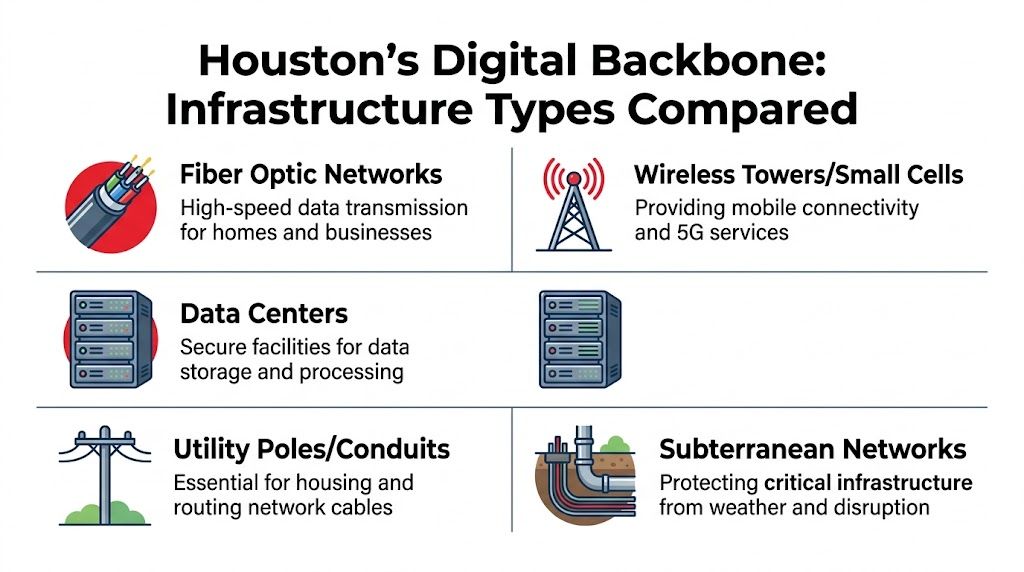
What each infrastructure type actually does
The confusion usually starts when teams expect one asset class to solve a problem it wasn’t built to solve.
| Infrastructure Type | Primary Use Case | Typical Bandwidth | Key Houston Challenge |
|---|---|---|---|
| Fiber optic networks | Backbone, middle mile, business service, residential broadband | Multi-gigabit and higher capacity paths | Permitting, utility conflict, flood-prone construction environments |
| Wireless towers and small cells | Mobile coverage, private wireless, 5G access, industrial mobility | Varies by spectrum and backhaul quality | Power, backhaul availability, zoning, pole access |
| Data center connectivity | Cloud on-ramps, enterprise interconnect, low-latency transport | High-capacity transport links | Diverse path design, meet-me coordination, schedule-sensitive cutovers |
| Utility poles and conduits | Physical support and routing | Not a service layer, but enables all others | Ownership, make-ready, congestion, shared-use constraints |
| Subterranean networks | Protected routing for critical paths | Depends on installed cable plant | Drainage, unknown undergrounds, restoration complexity |
Fiber is still the base layer
If the job is serious, fiber is usually underneath it somewhere. Residential growth, enterprise service, tower backhaul, industrial control traffic, and data center interconnect all depend on wireline capacity.
That’s why the region keeps seeing major investment. Comcast’s recent $265 million fiber expansion to reach over 100,000 homes and businesses in high-growth Houston suburbs such as Conroe and Porter shows the scale of current greenfield and hybrid upgrade work, as reported by the Texas Tribune’s coverage of Comcast’s Texas expansion.
For teams evaluating residential architecture, this primer on Fiber to the Home (FTTH) is a useful refresher on why direct fiber delivery changes long-term service quality and upgrade flexibility.
In field terms, fiber gives you three things wireless can’t replace:
- Deterministic capacity
- Stable backhaul for mobile and private wireless
- Upgrade headroom without rebuilding the route from scratch
If your Houston plan depends heavily on wireless but skimps on fiber backhaul, the bottleneck will show up later in customer experience, not in the design review.
Wireless works best when it rides on disciplined wireline
Wireless is often pitched as the fast answer. Sometimes it is. It can reach hard-to-serve sites quickly, support mobility, and solve coverage gaps where new fiber laterals aren’t practical yet.
But small cells, macro upgrades, and private LTE or 5G systems don’t perform in isolation. They rely on power, transport, pole or structure access, and good RF design tied to real backhaul engineering. In industrial Houston environments, that dependency gets more obvious.
A practical way to evaluate wireless in this market is to ask two questions first:
- What is the backhaul path?
- Who restores it when weather or a third-party cut takes it down?
If those answers are weak, the radio plan won’t save the deployment.
Utility structures are part of the network, whether teams like it or not
A lot of schedule pain comes from treating poles, conduit, vaults, and access points as outside issues. They’re not. They are core infrastructure.
That’s especially true in Houston, where aerial and underground choices both come with trade-offs. Aerial can be faster in the right corridor, but it inherits pole loading, make-ready, and storm exposure. Underground can improve protection and aesthetics, but it increases civil coordination and creates risk around unknown utilities and drainage conditions.
Good execution depends on treating outside plant as a full system. Teams handling cable and plant installation work usually see this early. Route engineering, placement method, splice access, and maintenance planning all affect future operating costs.
A Houston network isn’t just fiber and radios. It’s the physical path, the access rights, the restoration logic, and the documentation that lets someone else maintain it two years later.
Navigating Houston's Permitting and Utility Maze
A Houston route can look clean in design review and still stall before the first crew rolls. The usual failure point is early coordination. Jurisdiction changes block by block, utility ownership is not always obvious from desktop records, and a route that works on paper can break down once permit language meets field conditions.

That is especially true in Houston. The city’s size spreads projects across multiple review desks and inspection habits. Add flood control concerns, utility congestion, railroad crossings, private access constraints, and energy corridor requirements, and permitting becomes an operating discipline, not an admin task.
Right-of-way review needs to shape the route
Permits should influence design from the first serious route pass. If that sounds obvious, it still gets missed.
Houston-area builds often cross city, county, utility, and private control points with different standards for traffic control, restoration, bore depth, lane closure timing, and closeout documentation. One corridor can trigger several approval paths. If the team finds that out after design is finished, the redraws start, then the schedule slips.
Teams that control this phase usually do four things early:
- Verify ownership before final alignment. Public right-of-way, private easement, utility corridor, and railroad frontage each create a different approval path.
- Build permit sets around field reality. Reviewers reject vague traffic control, incomplete restoration notes, and drawings that ignore access limits.
- Sequence submittals around dependencies. Utility conflict review has to clear before later approvals matter.
- Walk the hard segments. Houston hides access and constructability problems that desktop design misses.
Large regional networks make this more obvious. As noted earlier, operators with wide-area footprints across Texas deal with repeated jurisdiction changes, maintenance obligations, and permit variation from county to county. The lesson for Houston is straightforward. Even a shorter metro route can carry the same coordination risk if it crosses enough agencies and asset owners.
Utility coordination is often the critical path
In Houston, utility review can drive the schedule more than engineering production. Pole attachments, make-ready, clearance conflicts, and access restrictions all have the power to stop a clean design.
CenterPoint is part of that reality on many projects. Even when the telecom scope does not modify energized plant, the route still has to fit utility standards, safety rules, and available attachment space. On underground jobs, the same pattern shows up in a different form. Existing electric, gas, drainage, and unknown legacy facilities narrow the construction window fast.
The recurring causes are familiar:
- Late pole loading review
- Incomplete field inventory
- Designs that assume usable space without verification
- Optimistic make-ready durations
- Poor handoff between engineering and construction
Field note: If make-ready starts after the civil or fiber contractor is already on the calendar, that schedule is fiction.
The fix is plain, but it takes discipline. Inventory poles thoroughly. Flag congestion early. Assume some spans will require redesign. Build float into the sequence before procurement and crew commitments lock the team in.
Underground work changes the problem, not the need for coordination
Underground placement can be the right answer in Houston, but it does not remove permit risk. It shifts it into drainage, restoration, locates, traffic control, and municipality-specific boring rules.
That matters in this city because soil conditions, flood-prone areas, pavement requirements, and crowded utility corridors vary a lot from one side of town to another. A bore plan that works in one district can trigger redesign in another. Crews handling civil telecom construction activities usually account for that early through potholing, access planning, and segment-by-segment method changes instead of forcing one construction approach across the whole route.
A short visual on permit process and field coordination helps explain why timing matters as much as engineering quality:
What works in practice
The Houston projects that stay on schedule usually run a tight operating model.
- Freeze service intent early. Sales, engineering, and construction need the same target before route decisions harden.
- Run permit and utility review in parallel when possible. Sequential handling burns time without reducing risk.
- Escalate conflict segments fast. Three blocked spans can control the whole schedule.
- Keep field feedback active. First boots on the ground often expose the assumptions that matter.
- Close records as construction progresses. Cleanup at the end is slower, more expensive, and less accurate.
Permitting does not get much credit when a Houston build goes well. It gets all the blame when utility coordination, right-of-way review, and field execution fall out of sync.
Best Practices for Construction and Deployment
Once the route is cleared for build, the temptation is to chase production numbers. That’s understandable, but in Houston, raw speed can produce fragile plant if the construction method doesn’t match the corridor.
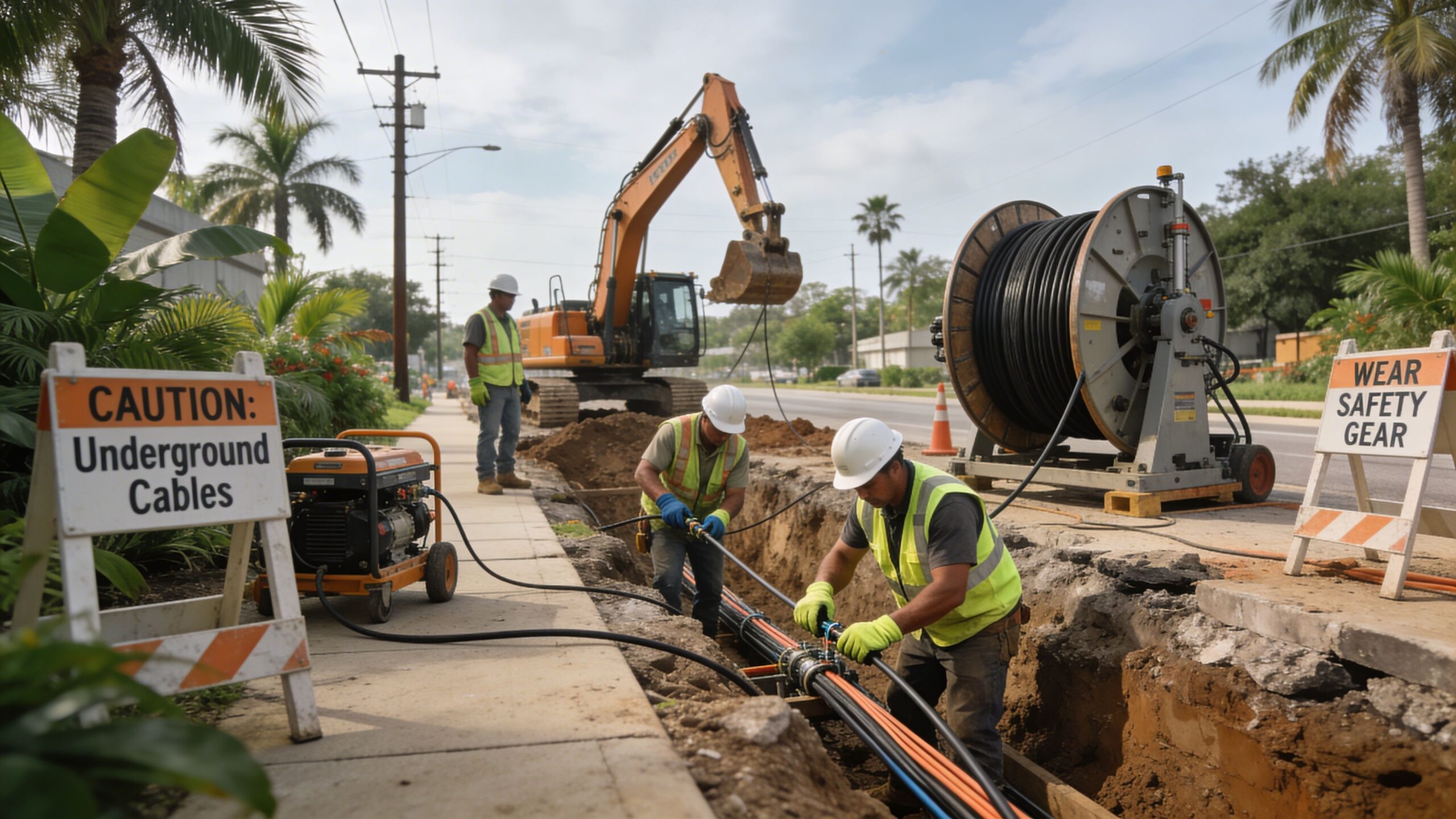
The better standard is simple. Build for the environment you have, not the install rate you wish you had. That usually means making harder decisions upfront about placement method, route redundancy, access, and restoration.
Choose the method for the corridor, not for habit
Every market has crews that prefer one construction style. Houston punishes that kind of bias. Some corridors are good trench candidates. Others need directional boring because surface restoration, traffic, or utility density leave no margin for open-cut work. Some aerial routes make sense if pole conditions are favorable and restoration speed matters more than storm exposure.
A practical selection framework looks like this:
- Use directional boring where roadway disruption, business access, or dense utility conflict makes trenching too disruptive.
- Use trenching where right-of-way is more forgiving and restoration can be controlled cleanly.
- Use aerial placement where utility infrastructure supports it and the operating model accepts storm-related exposure.
- Mix methods by segment instead of forcing one method through the entire route.
That last point matters. Good Houston builds are often hybrids. The route may move from bore to trench to aerial over a relatively short distance because each segment has different constraints.
Hardening is not optional in this market
If a network serves critical users in Houston, storm recovery and flood exposure belong in the construction conversation from day one.
Hardening is rarely one dramatic decision. It’s a stack of smaller choices:
- Route diversity so one cut or flooded segment doesn’t isolate a service area
- Undergrounding in vulnerable sections where aerial exposure creates unacceptable restoration risk
- Cabinet and access point placement that accounts for water pathways and restoration access
- Slack and splice planning that supports repair without creating a maintenance mess
- Aerial hardware selection and attachment discipline where above-ground plant remains the best option
Crews that treat resilience as a later upgrade usually leave operators with a network that works fine in fair weather and becomes expensive in every outage.
Build as if your maintenance team will inherit every shortcut, because they will.
Safety and quality travel together
Some managers still separate safety culture from production quality. In outside plant work, that’s a mistake. The same crew discipline that prevents incidents also improves cable handling, restoration, labeling, and closeout.
A safe build usually looks better because the crew is planning the site, controlling the work area, and following procedure instead of improvising. That matters in Houston, where traffic, heat, utilities, and changing site conditions create plenty of chances for rushed work to go sideways.
Signs of a healthy deployment operation include:
- Pre-task planning that reflects the actual site
- Clear utility locate respect
- Consistent restoration standards
- Cable handling that avoids avoidable damage
- Field documentation done while work is still visible
The cheap build is usually the expensive one
Operators don’t feel poor construction immediately. They feel it later through truck rolls, repeat trouble tickets, splice faults, restoration claims, and awkward maintenance windows.
That’s why the ROI case for quality-first deployment is strong even when budget pressure is real. Houston’s environment exposes weak workmanship faster than easier markets do. Mud, water, congestion, and heavy use all find the weak point.
The practical question isn’t whether quality costs more. It’s whether you want to pay during construction or keep paying after turn-up.
Ensuring Quality Through Design Testing and Partnership
A network is not complete when the cable is in the ground or on the strand. It’s complete when design intent, field conditions, and test results all agree.
That sounds obvious, but plenty of infrastructure networks houston projects still break down at turnover. The plant is installed. The drawings are partial. Test files are scattered. Splice records don’t line up with route IDs. Operations inherits an asset that technically exists but isn’t ready for disciplined support.
Design quality shows up later in operations
Good design isn’t just route selection. It includes naming convention discipline, slack strategy, access planning, future capacity allowance, and as-built accuracy. If those items are weak, every future upgrade and outage response gets slower.
GIS-backed as-builts matter here because Houston builds change in the field. Handholes move. bore paths shift. Access points get adjusted. Those changes aren’t failures if they are captured accurately. They become failures when nobody updates the record set.
A useful turnover package usually includes:
- As-built route documentation
- Splice matrices and fiber assignment clarity
- Test records tied to actual installed segments
- Asset labeling that matches documentation
- Open issue tracking for punch-list items
Test to the standard the service requires
Testing should match the service objective, not just satisfy a checkbox. If the route supports low-latency private wireless, business-critical enterprise transport, or data center interconnect, then the acceptance standard has to reflect that.
That’s one reason tested backhaul quality matters so much in advanced wireless environments. Private 5G networks like those deployed by iNet achieve less than 10 ms latency and more than 1 Gbps throughput, performance that depends on tested fiber backhaul with connector losses under 0.1 dB and precise OTDR verification, according to iNet’s 5G case study PDF.
That’s the practical lesson, even if your project isn’t a well-pad 5G deployment. High-performance services expose weak fiber work quickly.
What to verify before accepting the plant
Some acceptance meetings stay too high level. They discuss “completion” before confirming whether the asset is supportable.
Use a tighter checklist:
- Do test results align with route records? A clean result with vague segment mapping is not enough.
- Are splice enclosures and access points documented clearly? Operations should not have to guess.
- Does labeling match the drawings? Mismatches waste time during outages.
- Were exceptions closed or just noted? A deferred fix is still a risk item.
- Can another team maintain this without tribal knowledge? That is the standard.
The network you can’t document is the network you can’t operate well.
Partnership matters more than unit pricing
A low unit price can hide expensive gaps. If a contractor can place cable but can’t manage permits, coordinate utility issues, produce clean closeout, or mobilize for restoration, the operator ends up filling those gaps internally.
That’s why vendor evaluation should go beyond bid totals. For Houston work, the stronger partner is usually the one that can hold the whole chain together under field pressure.
Look for evidence of:
- Turnkey project management capability
- Strong local field judgment
- Consistent closeout quality
- 24/7 emergency response readiness
- A safety record that reflects actual operating discipline
- Experience across wireline and wireless environments
The best partners reduce decision friction. They surface route conflicts early, document changes cleanly, and keep handoffs from breaking. In a market as operationally demanding as Houston, that’s not a soft benefit. It’s a direct protection against schedule slip and support costs.
Houston's Future Networks in Action
The most useful way to judge a Houston network strategy is to look at where it has to work under pressure.
In the energy sector, that means connectivity that survives remote conditions, supports field automation, and delivers predictable performance for monitoring and operations. Houston’s role in oil and gas makes that a daily requirement, not a niche edge case. Private LTE and private 5G have become practical tools in that environment because they give operators more control over coverage, reliability, and traffic handling than public networks often can in remote or industrial settings.
Houston-based iNet is one visible example. Its private network work in energy-heavy environments shows what happens when hardened wireless, disciplined backhaul, and field operations are designed together instead of bolted on later. That model matters because the same thinking translates beyond the oilfield.
The next opportunity sits along freight and energy corridors
The H2LA Hydrogen Corridor project points to a broader shift. Its focus on the I-10 corridor in Texas highlights the need for integrated fiber and private 5G to support next-generation freight mobility, grid monitoring, and industrial automation outside traditional enterprise settings.
That’s a Houston story as much as a corridor story.
The region already combines logistics, energy, port activity, industrial sites, and suburban expansion. As those systems become more instrumented, network operators will have to support mixed environments where a single project may touch roadside infrastructure, utility assets, industrial control points, and remote operations.
That changes how teams should think about deployment:
- Fiber can’t be planned only around office demand
- Wireless can’t be sold as standalone coverage
- Power, access, and maintenance become part of the design conversation early
- Operational continuity matters as much as raw bandwidth
Community buildouts will need the same discipline
Houston’s future network buildout isn’t only about industrial modernization. It also includes underserved neighborhoods where connectivity quality and affordability still shape outcomes.
The practical challenge is that community broadband projects need the same rigor as enterprise work. They still require permit discipline, route logic, restoration quality, and clean documentation. Public funding may support the build, but public funding doesn’t fix weak execution.
That’s where the Houston playbook becomes useful across very different use cases. The same habits that support industrial reliability also improve neighborhood deployment outcomes:
- clear route ownership
- realistic make-ready assumptions
- resilient construction choices
- clean testing and closeout
- fast maintenance response
Houston rewards operators who can build one network strategy that serves enterprise, industrial, and community needs without lowering standards for any of them.
The market is too large, too weather-exposed, and too operationally complex for siloed thinking. Fiber, wireless, civil, utility coordination, and lifecycle maintenance all have to work as one system. When they do, infrastructure networks houston projects become durable assets instead of recurring problems.
If you need a partner that can handle telecom infrastructure from engineering through construction, testing, and ongoing support, Southern Tier Resources is built for that role. Their team supports wireline, wireless, data center, and maintenance programs with the field discipline Houston-area projects demand.