Executing a large-scale telecom, fiber, or data center infrastructure project demands a partner with nationwide reach and deep technical expertise. The success of your rollout, from initial site acquisition to final commissioning, hinges on selecting the right single-source contractor. Finding a firm that can manage complex logistics, maintain quality control across diverse geographic regions, and scale resources efficiently is a critical business decision. A mistake in this selection process can lead to costly delays, budget overruns, and a compromised network.
This guide is designed to simplify that decision. We provide a direct comparison of top-tier national technology integrators, equipping you with the information needed to vet and select a partner for your next major deployment. We move beyond generic capabilities and dive into the specific strengths and operational focus of each company. You will find detailed profiles, service coverage maps, and candid assessments to help you match an integrator to your project's unique requirements.
Inside this comprehensive roundup, you'll discover:
- Detailed profiles of leading integrators, including Southern Tier Resources, MasTec Network Solutions, and Dycom Industries.
- Actionable criteria for evaluating potential partners on a national scale.
- A comparison matrix for a clear, side-by-side view of services and capabilities.
- Key questions to ask during the RFP and vetting process to ensure alignment.
Our goal is to provide a practical resource that helps you move from a long list of potential vendors to a short list of qualified, accountable partners. Each profile includes direct links to the company's website so you can continue your research with ease. Let's get started.
1. Southern Tier Resources
Southern Tier Resources (STR) distinguishes itself among national technology integrators by offering a truly turnkey project lifecycle, managed by a single, accountable partner. With over two decades of field-proven experience, STR has developed a reputation for delivering end-to-end engineering, construction, and maintenance services for both wireline and wireless networks. This integrated approach is a significant advantage for clients like carriers, data center operators, and municipalities who need to avoid the complexities and potential communication breakdowns of managing multiple specialized vendors.
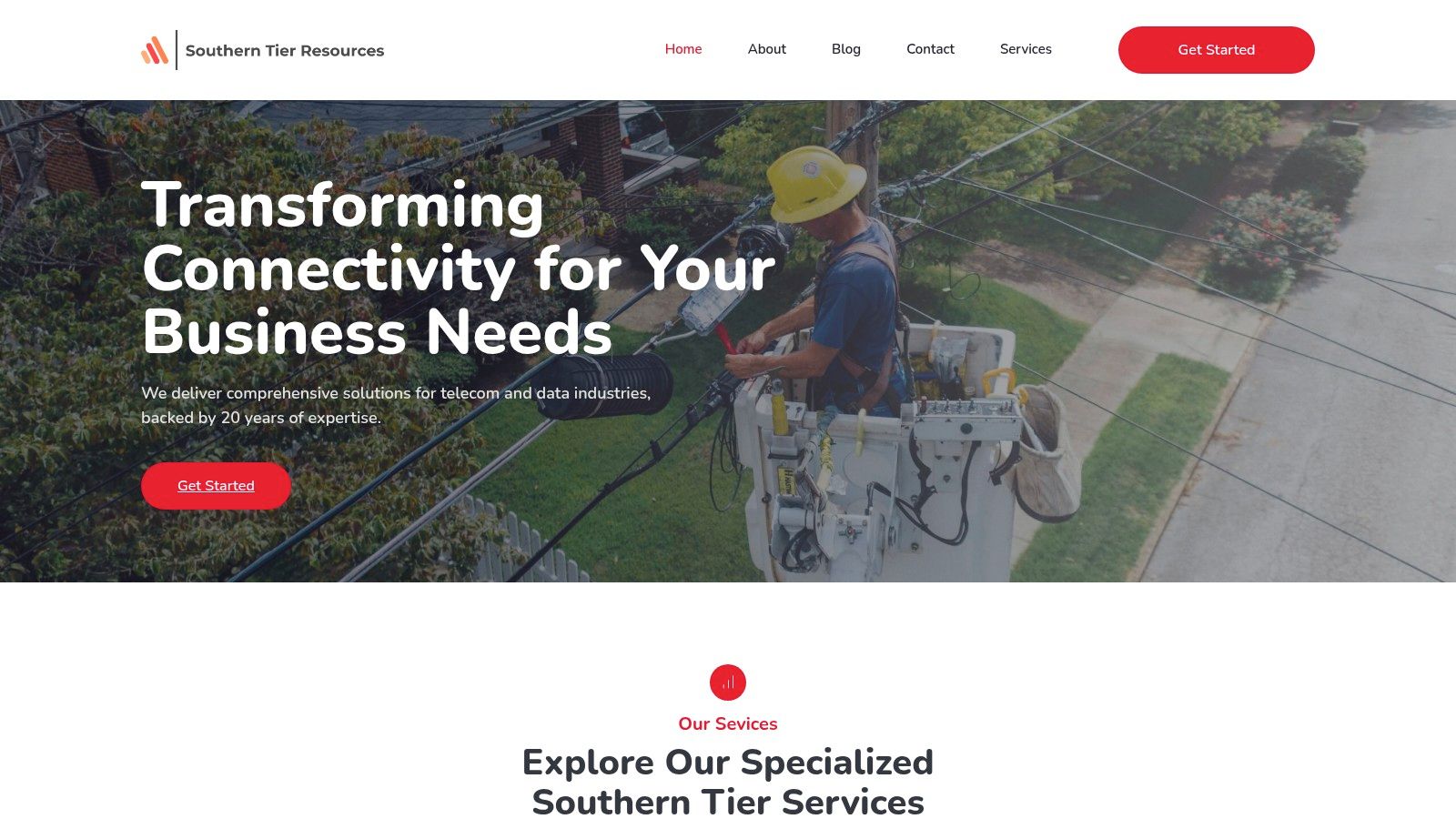
Their service portfolio is notably extensive, covering the entire spectrum from initial design and permitting to final splicing, testing, and detailed as-built documentation. This single-source responsibility ensures continuity and quality control at every project stage, a key factor in keeping complex builds on schedule and within budget. Testimonials from repeat clients such as SnapDial and Premier Broadband frequently cite STR's on-time delivery and high-quality, consistent work as primary reasons for their continued partnership.
Key Service Areas and Capabilities
STR's expertise is structured around three core pillars, allowing them to function as a one-stop shop for diverse infrastructure needs.
- Wireline & Fiber Optic Networks: STR excels in greenfield fiber builds and make-ready engineering. Their teams are skilled in precision fiber splicing, OTDR and power meter testing, and delivering comprehensive documentation that simplifies network management post-deployment. This is particularly valuable for ISPs and municipalities building out new fiber-to-the-home (FTTH) networks.
- Data Center Infrastructure: For hyperscale and enterprise data centers, STR provides complete fit-out services. This includes the critical integration of power systems, structured cabling, and network connectivity. Their focus on reliability and scalability ensures that data center facilities are built to support current demands and future growth.
- Wireless Network Services: The company's wireless capabilities range from small cell deployments in dense urban areas to macro tower construction and technology upgrades (e.g., 5G). A documented safety-first culture and 24/7 crew mobilization give wireless carriers confidence in STR's ability to execute projects safely and efficiently.
Standout Strengths & Practical Benefits
What makes Southern Tier Resources a strong contender is its synthesis of broad service capability with deep field expertise. Clients benefit from a partner that not only understands the high-level project goals but also masters the granular, in-the-field execution needed to achieve them. The commitment to delivering thorough as-built plans is a practical advantage, reducing future maintenance costs and operational headaches.
For organizations evaluating potential partners, it's recommended to engage STR directly through their website or contact information. While the site does not list pricing or formal certifications, their team is prepared to provide custom quotes, project scoping, and any requested safety or compliance documentation. This direct-contact model allows for a more consultative approach tailored to specific project requirements.
To discover more about their integrated project delivery model and specific service offerings, you can get in touch with the Southern Tier Resources team.
Why It Makes the List
| Feature | Analysis & User Impact |
|---|---|
| End-to-End Project Ownership | A single accountable partner handles everything from design to maintenance. This reduces administrative burden for clients and minimizes the risk of miscommunication between different contractors. |
| Proven Fiber & Data Center Expertise | Deep experience in precision fiber work and complete data center fit-outs. This ensures that mission-critical infrastructure is built for high reliability and performance from day one. |
| Safety and Mobilization | A strong safety record combined with 24/7 crew availability. This gives clients confidence that projects will be completed safely, on time, and without costly delays. |
| Comprehensive Service Portfolio | Covering wireline, wireless, and data center needs. This makes STR a versatile partner for carriers, tower companies, and enterprises seeking a single integrator for diverse infrastructure projects. |
Website: https://southerntierresources.com
2. MasTec Network Solutions (MasTec, Inc.)
MasTec Network Solutions operates as a powerhouse among national technology integrators, distinguished by its sheer scale and capacity for self-performing complex, multi-state deployments. As a division of MasTec, Inc., a Fortune 500 infrastructure construction company, it brings significant resources, a vast labor pool, and deep financial stability to telecom, fiber, and data center projects. Their website serves as a corporate gateway, outlining their extensive service portfolio and showcasing project experience with major carriers and enterprises.
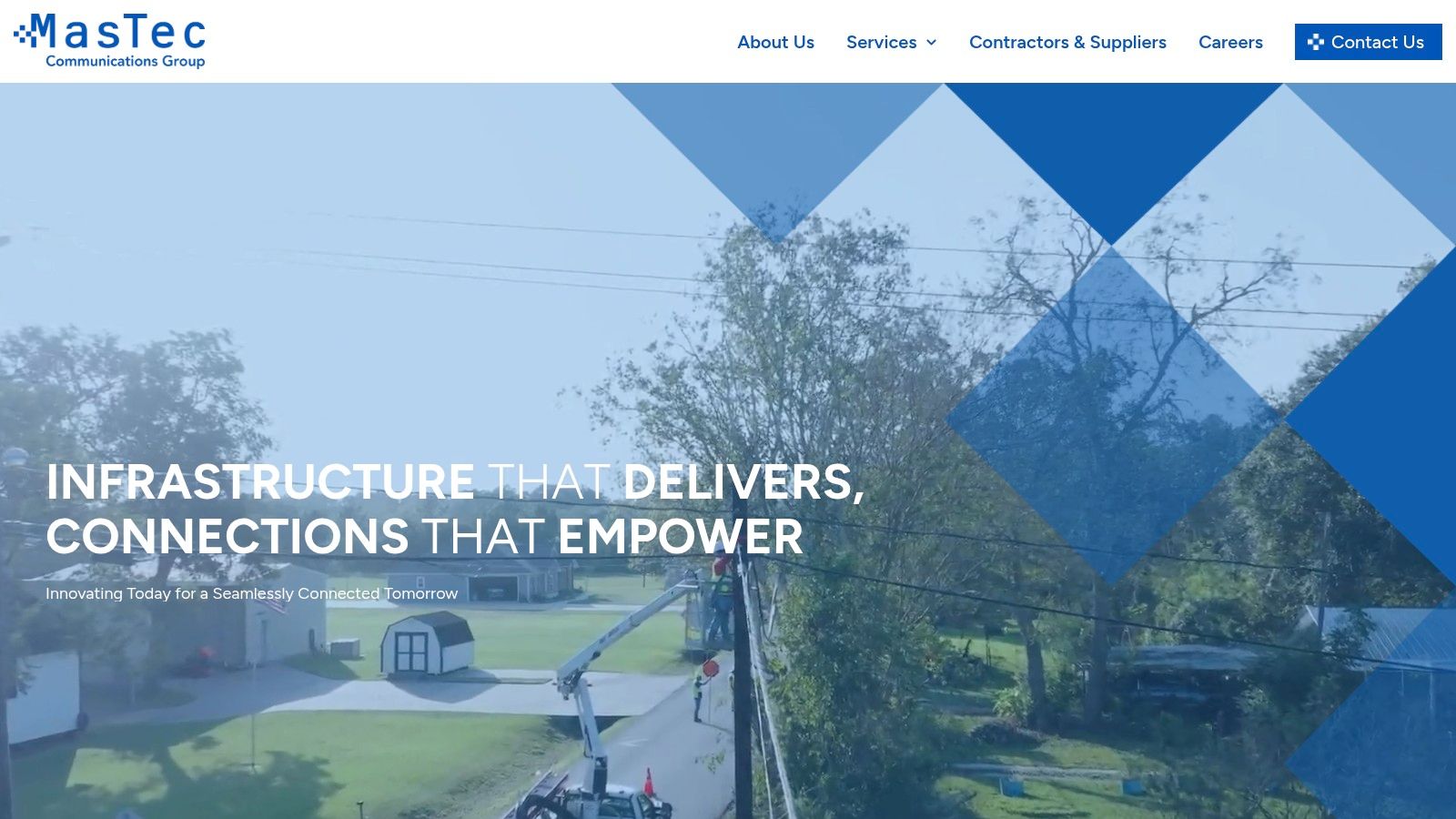
Unlike smaller, regional firms, MasTec provides a single point of accountability for end-to-end network rollouts, from initial site acquisition and engineering to final system integration and ongoing maintenance. This capability is especially valuable for Tier 1 carriers executing 5G densification or large-scale Fiber-to-the-Home (FTTH) builds.
Core Service Offerings & Strengths
MasTec's key strength lies in its ability to manage and staff large-scale initiatives directly, reducing reliance on a fragmented web of subcontractors. This model provides greater control over project timelines, quality, and safety standards.
- Wireless Deployment: Full turnkey services for macro sites, small cells, and Distributed Antenna Systems (DAS), including civil construction, tower erection, and RF integration.
- Wireline & Fiber: Extensive outside plant (OSP) and inside plant (ISP) engineering and construction for long-haul, metro, and last-mile fiber networks.
- Data Center & Edge: EF&I (Engineer, Furnish & Install) services for data center and edge computing facilities. Their in-house teams are certified by major Original Equipment Manufacturers (OEMs), ensuring installation meets precise manufacturer specifications.
- Maintenance & Operations: Provides 24/7 network monitoring, emergency restoration, and scheduled maintenance services to ensure network uptime and performance. A crucial part of choosing a single accountable partner is understanding their post-deployment support structure.
Key Insight: MasTec's self-perform model at a national level is a significant differentiator. For organizations planning network expansions across multiple states or regions, this can simplify procurement and project management by consolidating responsibility with a single, well-capitalized partner.
Considerations for Engagement
While MasTec’s scale is a primary advantage, it also means they are best suited for large, program-level work rather than smaller, one-off projects. Their pricing reflects their position as a major national contractor, and lead times can be affected by high demand from their anchor carrier clients during peak deployment cycles. Potential clients should engage their business development teams early in the planning process to align on scope, resource availability, and timelines. Regional field-level experience can also vary, so it's wise to request case studies and team credentials specific to your project's geographic footprint.
Website: https://www.mastecnetworksolutions.com
3. Dycom Industries
Dycom Industries stands as a titan in the telecommunications contracting sector, operating as a collection of specialized subsidiary companies under a single corporate banner. This unique structure allows it to offer the geographic reach and financial backing of a major national technology integrator while maintaining localized expertise through its various brands. The corporate website acts as a high-level portal, directing potential clients to the appropriate subsidiary based on service needs and location, while providing investors with a consolidated view of its market performance and strategy.
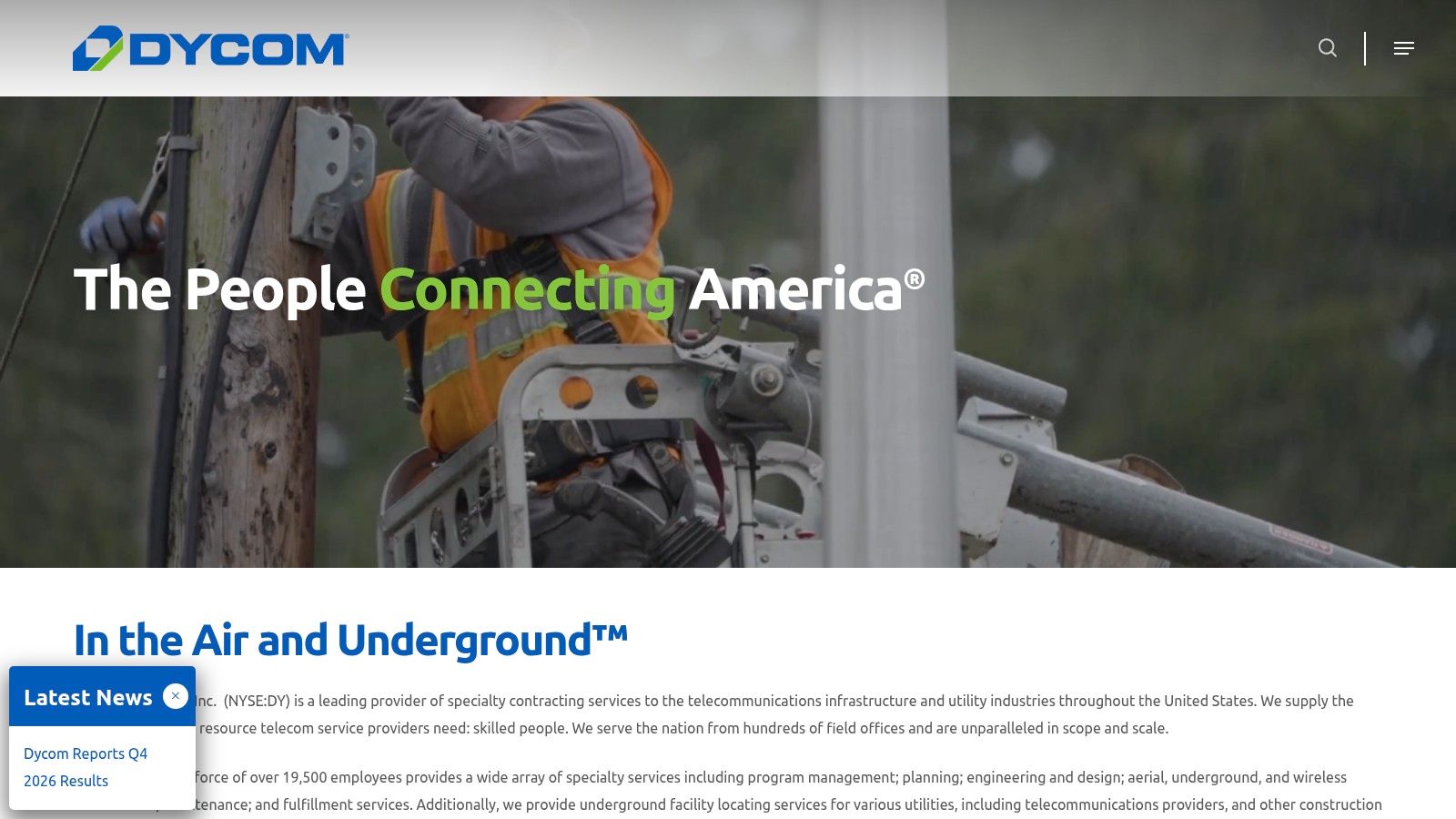
This model makes Dycom a formidable partner for carriers and ISPs executing widespread Fiber-to-the-Home (FTTH) programs, rural broadband expansions, and multi-market wireless builds. Its primary strength is providing turnkey engineering, construction, and fulfillment services at an immense scale, making it a go-to contractor for the nation's largest service providers.
Core Service Offerings & Strengths
Dycom's competitive advantage is its extensive network of operating companies, which provides deep relationships with local utilities and permitting authorities. This "boots-on-the-ground" knowledge, combined with national-level resource coordination, helps accelerate deployment timelines for complex, multi-jurisdictional projects.
- Nationwide Fiber Construction: A core business focus, covering all aspects of outside plant (OSP) work. This includes aerial and underground construction, directional boring, and splicing for long-haul, metro, and last-mile fiber networks.
- Turnkey Wireless Services: Provides complete cell site construction services from small cells and DAS to traditional macro towers. Services include site acquisition, civil work, tower erection, and final commissioning.
- Integrated Engineering & Construction: Dycom often integrates its engineering and design services directly with its construction arms. This one-stop approach can reduce handoffs and improve schedule control, particularly for large-scale builds where design modifications are common.
- Fulfillment & Restoration: Offers last-mile installation and fulfillment services for residential and business customers. Its national footprint also supports large-scale emergency restoration efforts for network operators after natural disasters.
Key Insight: Dycom’s multi-subsidiary model offers a blend of national scale and local expertise. For a carrier planning a multi-state FTTH rollout, this can be a key benefit, as the assigned Dycom company will likely have pre-existing relationships and knowledge of the specific local challenges, from permitting to terrain.
Considerations for Engagement
The federated nature of Dycom's operations means that project experience and team performance can vary between its different subsidiary companies and geographic markets. While this structure provides local advantages, it can also create inconsistencies in process and quality control compared to a single, monolithic self-perform organization. Market commentary has occasionally raised questions about its wireless business positioning during certain industry cycles, so it's important to validate their current capacity and focus. Clients should conduct due diligence not just on Dycom corporate but on the specific operating company that will handle their project. Engaging with their teams to understand the required protocols for safe and efficient wire work is a critical step in the evaluation process.
Website: https://www.dycomind.com
4. Black & Veatch
Black & Veatch is an employee-owned engineering, procurement, and construction (EPC) firm that has carved out a specialized niche among national technology integrators. Their focus is on complex, mission-critical digital infrastructure for utilities, municipalities, and hyperscale data center operators. While they have divested from public carrier wireless construction, their deep expertise in private LTE/5G networks, utility communications, and fiber systems makes their website a valuable resource for organizations requiring deep engineering and program management.
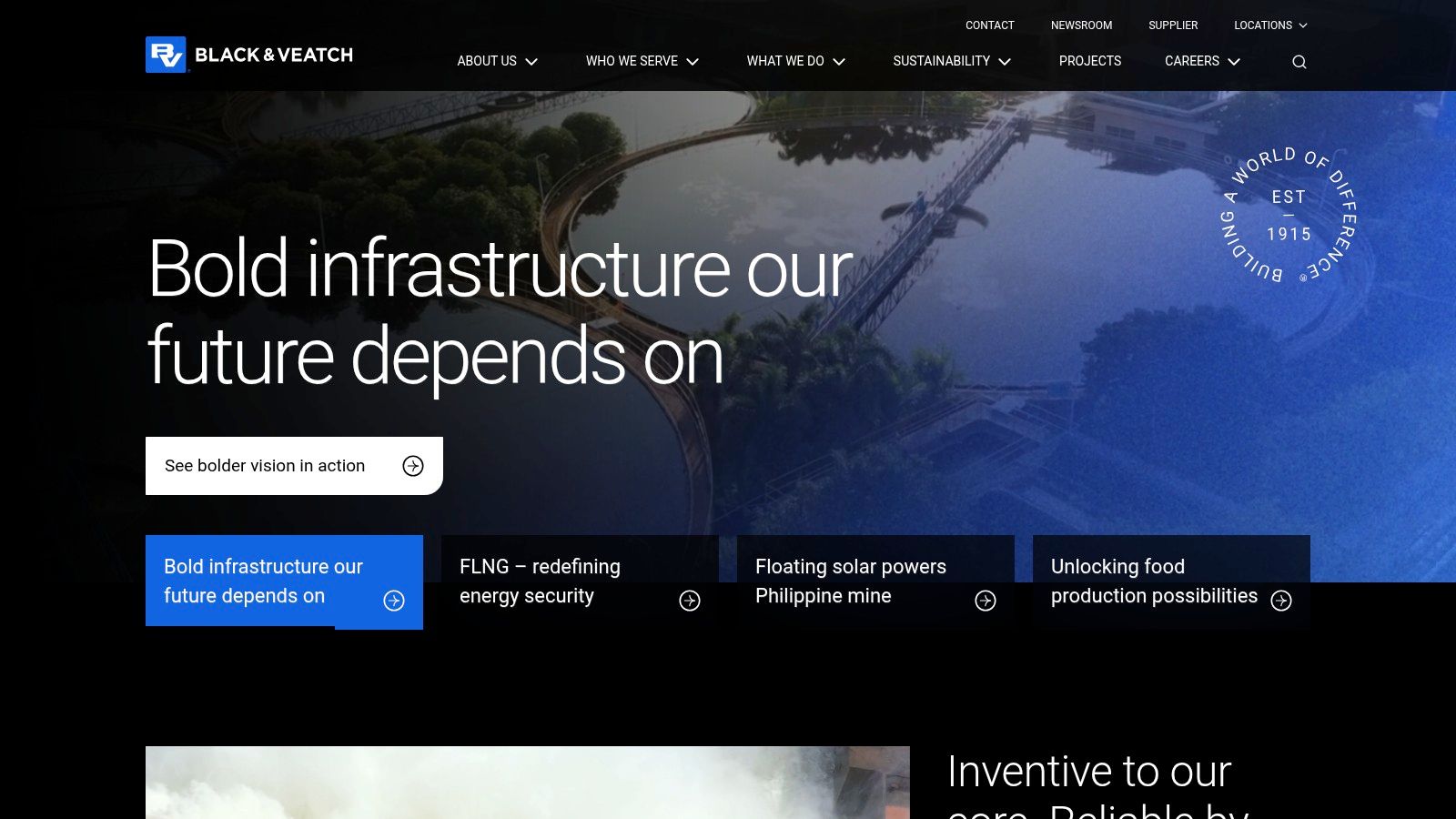
Unlike integrators focused primarily on field construction, Black & Veatch excels in the advisory, design, and management phases of multifaceted projects. Their strength lies in coordinating numerous stakeholders, navigating complex permitting, and delivering full design-build programs where reliability and performance are non-negotiable. This engineering-first approach is particularly suited to entities building private networks or next-generation data centers.
Core Service Offerings & Strengths
Black & Veatch’s primary advantage is its ability to serve as a single point of responsibility for the entire project lifecycle, from initial strategy and feasibility studies to final commissioning and long-term asset management. This EPC model helps de-risk projects for owners, especially on accelerated schedules.
- Private LTE/5G Networks: Offers end-to-end services, including spectrum advisory, network design, and full deployment for utilities modernizing their grid or enterprises seeking secure, dedicated connectivity.
- Data Center Design & Build: Provides complete design-build and EPC services for both hyperscale and enterprise data centers, with a proven track record in mission-critical facility engineering.
- Fiber & Wireline Networks: Specializes in the planning and engineering of fiber optic networks for utilities and public sector clients, integrating communications infrastructure with other critical systems.
- Permitting & Advisory: A core strength is managing complex regulatory, environmental, and right-of-way permitting processes, which is often a major bottleneck in large infrastructure deployments.
Key Insight: Black & Veatch’s expertise in multi-stakeholder coordination and permitting is a key differentiator. For utilities or public-private partnerships, where project success depends on aligning diverse interests and navigating regulatory hurdles, their EPC approach provides significant value beyond simple construction.
Considerations for Engagement
The firm's premium, engineering-led EPC model means they are best suited for large, program-level initiatives where upfront design and planning are critical. Their cost structure may be higher than that of pure-play construction contractors, reflecting the added value of their advisory and management services. Given their strategic shift away from public carrier wireless construction, they are not the ideal partner for mobile network operators focused on macro site or small cell rollouts. Prospective clients, especially in the utility and hyperscale sectors, should engage them early to define project requirements and leverage their full strategic planning capabilities.
Website: https://www.bv.com
5. Michels Corporation
Michels Corporation stands out as a construction-first national technology integrator, bringing a heavy-civil, infrastructure-focused approach to telecommunications projects. While many integrators focus on the final-mile technology, Michels excels at building the foundational pathways that make modern networks possible. Their website highlights a deep portfolio in energy and infrastructure, with communications representing a critical segment built on their core expertise in large-scale, challenging construction scenarios.
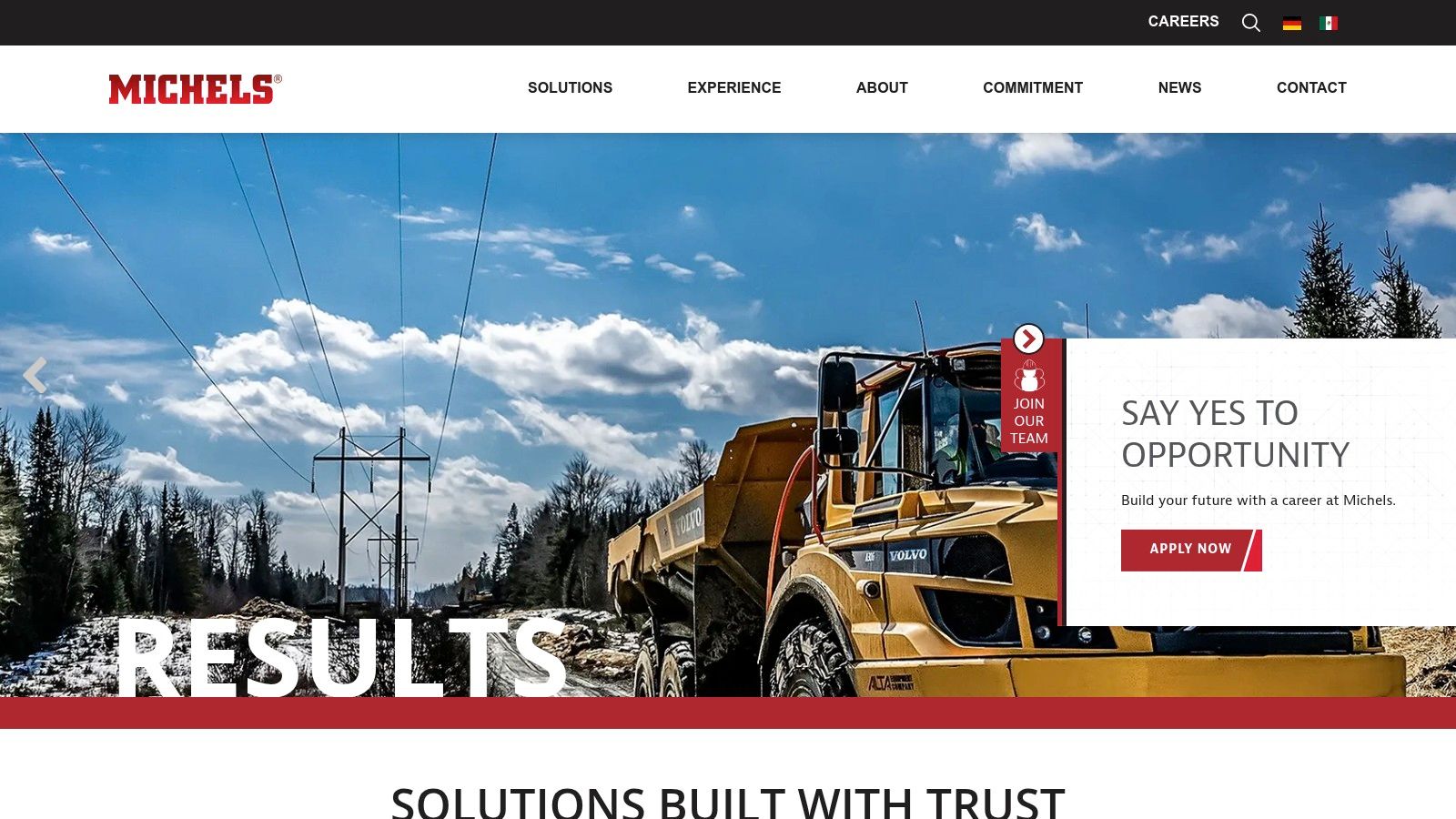
This construction-centric model makes them a prime partner for statewide or county-wide rural broadband initiatives and large-scale Fiber-to-the-Home (FTTH) programs, especially those traversing difficult terrain or requiring specialty installation methods. Unlike firms that subcontract heavy construction, Michels directly owns and operates an enormous fleet of equipment, giving them superior control over project schedules and execution, particularly in high-volume builds.
Core Service Offerings & Strengths
Michels’ primary strength is its self-perform capability in demanding outside plant (OSP) construction. They are renowned for rapid mileage production and have a proven track record delivering multi-hundred-mile FTTH projects for major service providers and rural cooperatives.
- Trenchless & Open-Cut Construction: Broad capabilities in horizontal directional drilling (HDD), plowing, and trenching, allowing them to select the most efficient method for varied ground conditions and accelerate deployment schedules.
- FTTH Deployment: End-to-end outside plant construction for fiber networks, from backbone and middle-mile routes to final drops. Their experience is particularly valuable for rural and cold-weather builds where logistics and ground conditions are major factors.
- Heavy Civil & Specialty Methods: The ability to self-perform complex civil work, such as river crossings or rock drilling, reduces dependency on third-party contractors and simplifies the project management chain for network owners.
- Splicing & Testing: In-house teams provide fiber splicing, testing, and activation services, ensuring the physical network meets performance specifications upon completion of construction.
Key Insight: Michels Corporation is a construction powerhouse first and foremost. For projects where the primary challenge is the physical build-out of the network pathway, especially in rural or geographically diverse areas, their self-perform model and heavy equipment fleet offer a distinct advantage in speed and reliability.
Considerations for Engagement
Because their core competency is construction, clients may need a separate partner for network engineering, design, and program management unless these services are bundled into a larger turnkey contract. Michels’ scale and focus on heavy infrastructure mean they are best suited for large-scale, linear construction projects rather than smaller, technology-specific integration tasks like in-building DAS or data center fit-outs. Their project minimums and pricing structure reflect their position as a major national infrastructure contractor. It is best to engage them for projects where the construction component is the most significant risk or cost driver.
Website: https://www.michels.us
6. AFL (AFL Network Services – a Fujikura company)
AFL occupies a unique position among national technology integrators by bridging the gap between world-class product manufacturing and full-lifecycle network services. As a subsidiary of Fujikura Ltd., a global leader in fiber optic technology, AFL brings an engineer’s precision to field deployments. Their website acts as a detailed portal into this dual identity, showcasing both their extensive catalog of fiber optic products and their comprehensive service capabilities for planning, building, and activating complex networks.
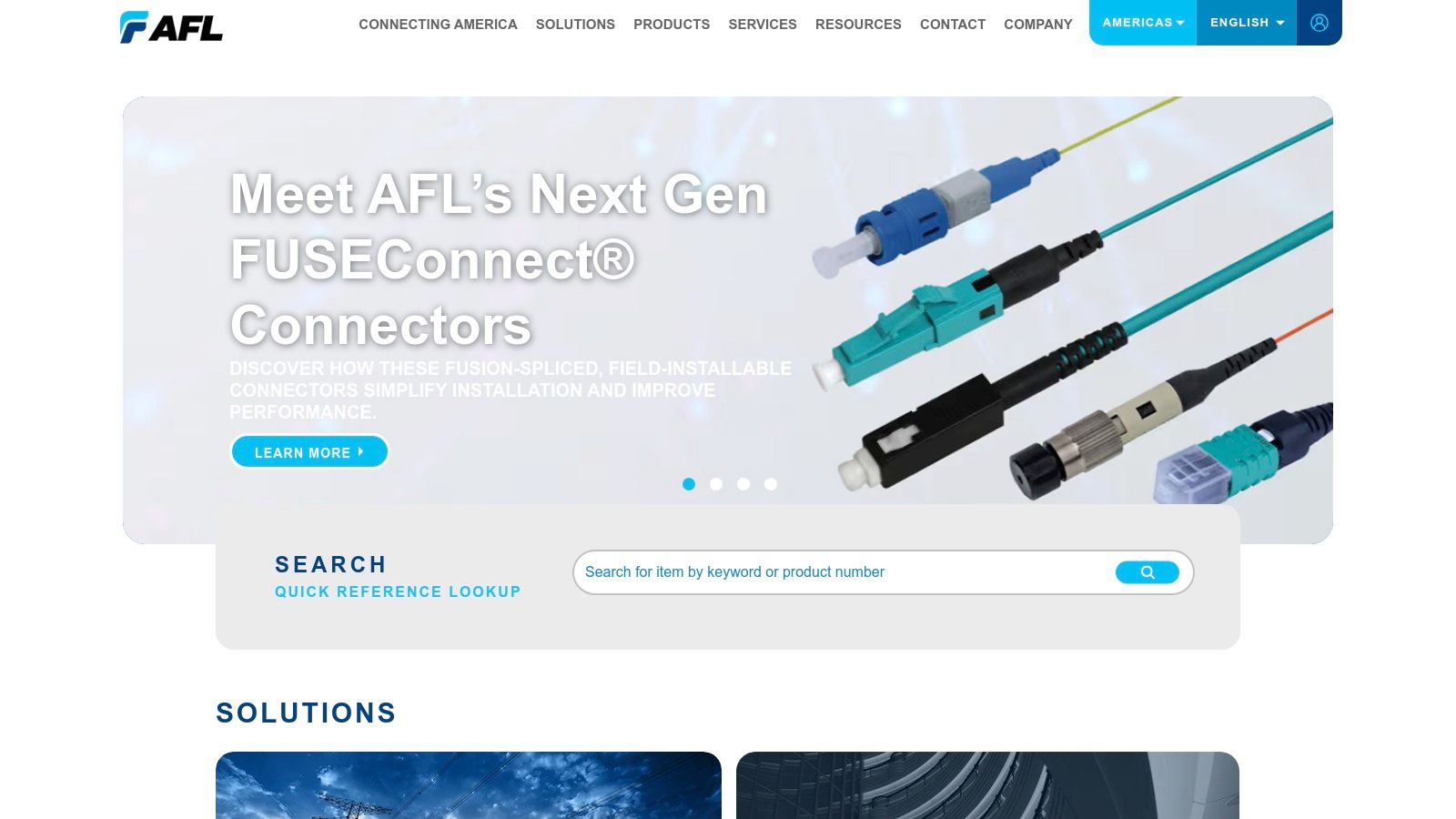
This integration of manufacturing and service delivery makes them a specialized partner for clients prioritizing fiber optic performance and long-term reliability. Unlike construction-first integrators, AFL's deep domain expertise in fiber's physical properties informs every stage of their service delivery, from initial network design to the final splice and test. This is particularly valuable for data center interconnect, long-haul fiber builds, and FTTH projects where signal integrity is paramount.
Core Service Offerings & Strengths
AFL’s primary strength is its profound expertise in fiber optics, supported by its parent company’s R&D and manufacturing legacy. They offer a highly consultative approach, capable of delivering either product-agnostic services or bundled material-and-labor packages, providing procurement flexibility.
- Lifecycle Fiber Services: Offers end-to-end support for fiber projects, including feasibility studies, route planning, OSP/ISP engineering, permitting, and make-ready engineering.
- Specialty Splicing & Testing: A core competency is high-precision fusion splicing, testing, and activation. Their teams are sought after for projects with stringent quality control requirements, like submarine cable landings or data center turn-ups.
- Integrated Solutions: Combines their manufactured products (e.g., fiber cable, connectivity hardware, fusion splicers) with installation services, creating a single point of contact for both materials and labor.
- Broad Market Experience: Delivers projects for a wide range of clients, including wireline and wireless carriers, hyperscale data center operators, utilities, and enterprise customers.
Key Insight: AFL is an ideal integrator for projects where fiber performance is non-negotiable. Their ability to troubleshoot and resolve issues at the physical layer, backed by deep product knowledge, minimizes risk in complex optical network deployments.
Considerations for Engagement
AFL's national services organization is substantial, though its pure construction scale may not match that of the largest civil-focused contractors. Their public-facing materials emphasize fiber-centric services more than large-scale wireless macro site construction. Therefore, they are an excellent fit for fiber-deep projects or the fiber components of a wireless build (e.g., fronthaul/backhaul), but may be less suited for turnkey tower erection programs. Organizations should engage AFL when the technical complexity of the fiber network itself is a primary project driver, as their pricing will reflect this specialized expertise. Requesting case studies specific to your network type (e.g., metro dark fiber, rural FTTH) is a smart step to ensure alignment.
Website: https://www.aflglobal.com
7. Black Box
Black Box has carved out a distinct and critical niche among national technology integrators by focusing on the complex IT infrastructure inside the four walls of enterprise offices, campuses, and data centers. As a global solutions provider, their strength is delivering standardized, multi-site rollouts with a deep expertise in structured cabling, network equipment installation, and data center services. Their website acts as a detailed catalog of these capabilities, targeting IT leaders who need consistent, high-quality deployments across a distributed geographic footprint.
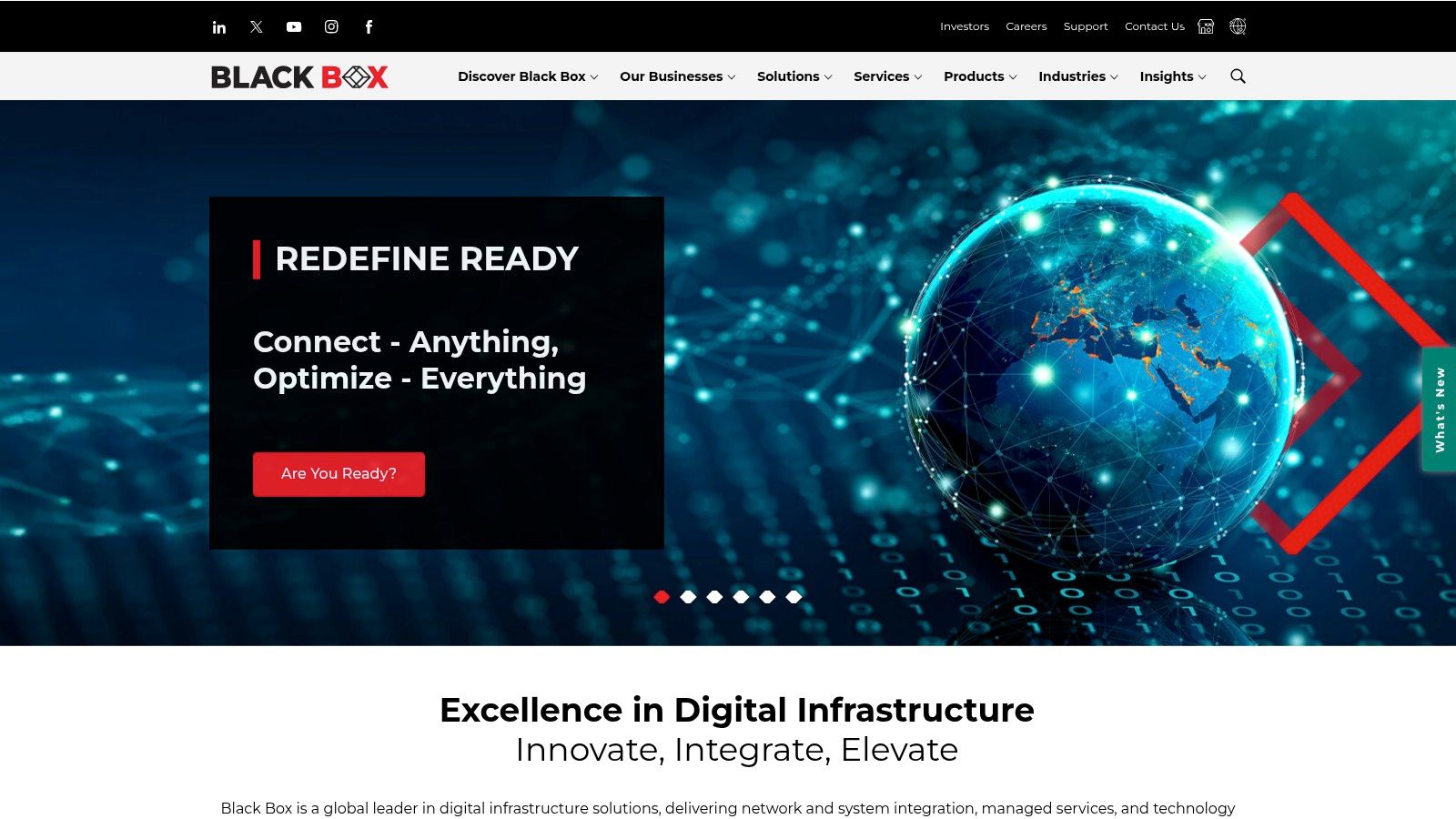
While many integrators on this list focus on outside plant (OSP) construction, Black Box excels at the "last 100 meters" of the network. They provide the physical layer that underpins an organization's digital operations, from the data center rack to the user's desktop. This specialization makes them a go-to partner for large enterprises, retailers, and financial institutions managing hundreds or thousands of locations that demand uniform installation standards and service level agreements (SLAs).
Core Service Offerings & Strengths
Black Box's primary value lies in its structured process, extensive technician network, and ability to manage logistics for complex, multi-location projects. They act as a single point of contact for sourcing, staging, deploying, and maintaining on-premises IT infrastructure, which simplifies management for corporate IT departments.
- Data Center Services: Offers a full suite of services including design assistance, structured cabling (copper and fiber), cabinet and rack installation, equipment rack-and-stack, and commissioning support. They are adept at working in live data center environments.
- National Structured Cabling: Their core practice involves designing and installing structured cabling systems for new builds and retrofits. This includes ongoing Moves, Adds, and Changes (MAC) support, providing a lifecycle service model.
- Multi-Site Rollout & Logistics: Manages the deployment of technology (like Wi-Fi access points, POS systems, or digital signage) across numerous sites, handling everything from material sourcing and kitting to on-site installation and verification.
- Vendor-Neutral Integration: As a vendor-agnostic partner, they maintain certifications and expertise across a wide array of major OEM ecosystems, allowing them to install and support equipment from Cisco, CommScope, Corning, and others without bias.
Key Insight: Black Box is an ideal partner for organizations that prioritize operational consistency and standardized IT environments across many locations. Their ability to deliver repeatable, high-quality installations with defined SLAs is a powerful tool for managing geographically dispersed infrastructure.
Considerations for Engagement
The company's focus is clearly on premises and data center integration. Organizations seeking a partner for heavy outside-plant fiber construction or the civil work associated with macro wireless towers will find other integrators better aligned with those needs. Their model is built for scale and process, making them best suited for program-level work or large, multi-faceted projects rather than small, one-off cabling jobs. Pricing is structured around service contracts and project scopes that reflect their national coordination and management capabilities. Early engagement is key to define standards and build a deployment plan that aligns with their logistics and field service operations.
Website: https://www.blackbox.com
Top 7 National Technology Integrators Comparison
| Provider | 🔄 Implementation Complexity | ⚡ Resource Requirements | 📊 Expected Outcomes / Quality ⭐ | Ideal Use Cases | 💡 Key Advantages |
|---|---|---|---|---|---|
| Southern Tier Resources | Turnkey end‑to‑end (design → maintenance); moderate‑high process coordination | Skilled field crews, 24/7 mobilization, splicing/testing teams | Reliable, scalable fiber & data‑center fit‑outs; strong as‑built documentation ⭐⭐⭐⭐ | Carriers, ISPs, data centers, municipalities, tower companies | Single accountable partner; precision splicing/testing; safety‑first |
| MasTec Network Solutions | Large, multi‑program EF&I and integration; high program complexity 🔄 | Extensive national workforce, heavy equipment, 24/7 mobilization | Scalable multi‑state deployments with carrier experience ⭐⭐⭐⭐ | Multi‑state fiber/wireless programs, EF&I data center builds | Self‑perform at national scale; OEM EF&I capability |
| Dycom Industries | Turnkey engineering + construction across many markets; high coordination 🔄 | Nationwide crews for aerial/underground + emergency restoration | Strong for large FTTH and multi‑market small‑cell programs ⭐⭐⭐⭐ | Large‑scale FTTH, rural expansions, multi‑market small‑cell | One‑stop model (engineering→fulfillment); carrier relationships |
| Black & Veatch | Complex EPC and multi‑stakeholder projects; very high complexity 🔄 | Heavy advisory, permitting, engineering resources; premium teams | Mission‑critical, low owner risk for hyperscale/private networks ⭐⭐⭐⭐ | Utilities, municipalities, hyperscale operators, private LTE/5G | Deep permitting/EPC coordination; strong design credentials |
| Michels Corporation | Construction‑focused with high civil complexity; medium 🔄 | Heavy civil and trenchless equipment, multi‑region mobilization | High‑volume mileage production for challenging terrain ⭐⭐⭐ | Statewide/county rural broadband, tough terrain FTTH builds | Directional drilling expertise; self‑perform heavy civil capability |
| AFL (AFL Network Services) | Fiber lifecycle specialist; moderate complexity 🔄 | Specialty splicing/testing teams + manufacturing parent support | High quality splicing/testing and controlled turn‑ups ⭐⭐⭐⭐ | Complex splicing/testing, OSP design, data‑center activations | Product‑agnostic integrator; deep fiber domain expertise |
| Black Box | Premises/data‑center centric; lower implementation complexity 🔄 | Structured cabling crews, logistics, vendor‑neutral engineers | Consistent multi‑site deployments and strong SLAs ⭐⭐⭐ | Enterprise multi‑site rollouts, data centers, campus networks | Vendor‑neutral integration; end‑to‑end data‑center cabling services |
Finding Your Single Source of Truth for Project Success
Navigating the field of national technology integrators can feel like an immense task, especially when the success of a multi-million dollar fiber, wireless, or data center deployment hangs in the balance. This guide was created to provide a clear roadmap, moving beyond surface-level directories to offer a functional comparison of top-tier partners. We have examined the distinct capabilities of firms like MasTec, Dycom, and Black & Veatch, each a powerhouse in its own right, alongside specialists like AFL and established enterprise experts such as Black Box.
The central theme woven throughout these profiles is the critical importance of finding a partner who can act as a single source of truth for your entire project lifecycle. Disjointed communication, conflicting data, and a lack of unified accountability are the primary points of failure in large-scale technology deployments. A dependable integrator eliminates these risks by centralizing project management, from initial feasibility studies and engineering design to final system turn-up and ongoing maintenance.
Key Takeaways for Selecting Your Partner
As you move forward in your selection process, keep these core principles at the forefront of your evaluation. These factors are often more predictive of long-term success than a simple price comparison.
Beyond Scale, Seek Specialization: While national reach is a prerequisite, it doesn't guarantee expertise in your specific domain. A company like Michels Corporation might have deep roots in complex utility construction, making them a fit for challenging right-of-way projects, whereas a firm like Southern Tier Resources offers a dedicated focus on the precise needs of telecom and data center infrastructure. Assess a potential partner's portfolio for projects that mirror your own in scope, complexity, and technology.
The Power of Self-Performance: An integrator's reliance on subcontractors versus in-house crews is a significant differentiator. Partners with strong self-perform capabilities can offer greater control over quality, scheduling, and safety. Inquire about the percentage of work they typically self-perform for core tasks like fiber splicing, tower climbing, or data center fit-outs. This directly impacts their ability to be a true single point of accountability.
Cultural and Methodological Alignment: Your chosen integrator becomes an extension of your own team. A partner that prioritizes transparent, real-time reporting and collaborative problem-solving will foster a much healthier and more productive project environment. During the RFP process, ask detailed questions about their project management software, communication protocols, and how they handle unforeseen challenges. The answers will reveal their operational character.
Your Actionable Next Steps
With this information, you are equipped to make a more informed and strategic decision. The next phase is about translating this knowledge into direct action.
Refine Your RFP: Use the comparison matrix and sample QA questions from this article to strengthen your Request for Proposal. Be explicit about your need for a single point of contact and detailed reporting requirements.
Schedule Deeper Dives: Move beyond initial sales calls. Request meetings with the actual project management and operations teams from your shortlisted national technology integrators. This is your opportunity to gauge their practical expertise and team chemistry.
Establish Your Internal "Source of Truth": Before you can expect an external partner to be your single source of truth, you must have your own house in order. To ensure all project stakeholders have access to consistent and up-to-date information, it's essential to understand how to build a knowledge base as a single source of truth. This internal repository becomes the foundation upon which your partnership is built.
Ultimately, choosing the right national technology integrator is one of the most consequential decisions you will make. It’s a choice that impacts not just budgets and timelines, but the quality, reliability, and future-readiness of the critical infrastructure you are building. The goal is not just to complete a project, but to build a lasting asset with a partner you can trust for years to come.
Ready to partner with an integrator that prioritizes accountability and proven execution for your next network deployment? Southern Tier Resources combines the self-perform capabilities and national reach you require with the focused expertise of a dedicated telecom and data center infrastructure specialist. Contact our team today to discuss how we can become your single source of truth for project success.