A small cell can be ready in the radio design package and still be nowhere near construction-ready. The pole owner may be waiting for a stamped loading analysis, the city may be asking for a revised application, and the utility may not have scheduled make-ready work. Meanwhile, the carrier sees an approved target on a map and wonders why a crew can't install it.
That gap defines small cell construction. The radio equipment is usually a known assembly. The difficult work sits in the right of way, where pole ownership, structural capacity, power, fiber, traffic control, public access, and local approvals have to line up. The European Commission recorded 44,180 installed small cells in the EU in 2023, an increase of 1,962 units, or 4.6% year over year, while 5G-enabled small cells reached 6,205, up 850.2% from 2022. Those figures show deployment momentum, but they also show why execution discipline matters. Growth depends on buildable sites, not only on radio demand. European Commission data on small-cell deployment provides the relevant context.
Why Small Cell Construction Is Mostly a Civil Works Problem
A node can spend months stalled after the RF team has finished its work. In one common field pattern, the proposed 5G node is technically sound, but the pole owner hasn't accepted the nonlinear loading analysis, the municipality wants a revised shot-clock package, and the electric utility hasn't cleared the existing attachments. Nothing is wrong with the radio. The project is blocked by governance and physical access.
The dependency chain is unforgiving. The radio engineer needs a viable candidate location. The surveyor needs reliable pole records and safe access. The structural engineer needs accurate field measurements. The pole owner needs stamped calculations before approving an attachment, while the municipality may require evidence of authorization before it accepts the permit package. A missed handoff pushes every downstream activity.
Practical rule: Treat the pole, right of way, power route, and backhaul path as part of the radio design, not as post-design construction details.
The work that actually controls the schedule
Experienced construction leads spend substantial time on activities that never appear in a propagation plot:
- Ownership verification: Identify whether the structure belongs to a utility, municipality, transportation agency, private landlord, or another infrastructure owner.
- Make-ready coordination: Confirm who will move, rearrange, or protect existing attachments, and establish how estimates and final costs will be handled.
- Permit sequencing: Align zoning, small wireless facility, electrical, excavation, conduit, traffic-control, and access approvals.
- Field coordination: Keep surveyors, structural engineers, utility representatives, civil contractors, fiber crews, and integration teams working from the same revision.
- Closeout control: Preserve the records needed for future attachments, maintenance, audits, and warranty decisions.
Site preparation principles from expert land clearing guidance are also relevant to telecom work. Clearing, access, drainage, and protection of surrounding assets affect whether a crew can safely reach and complete a site, even when the visible installation is limited to a pole and compact equipment.
The radio equipment may be standardized, but the host environment isn't. A pole with limited loading headroom, a narrow sidewalk, an inaccessible transformer, or a long fiber route can make an attractive RF candidate commercially unusable. The rest of this guide follows the practical workstreams that decide whether a node advances: site selection, surveying, permitting, make-ready, structural attachments, power, backhaul, integration, acceptance, scheduling, and as-built documentation.
Picking the Right Site and Running the Survey
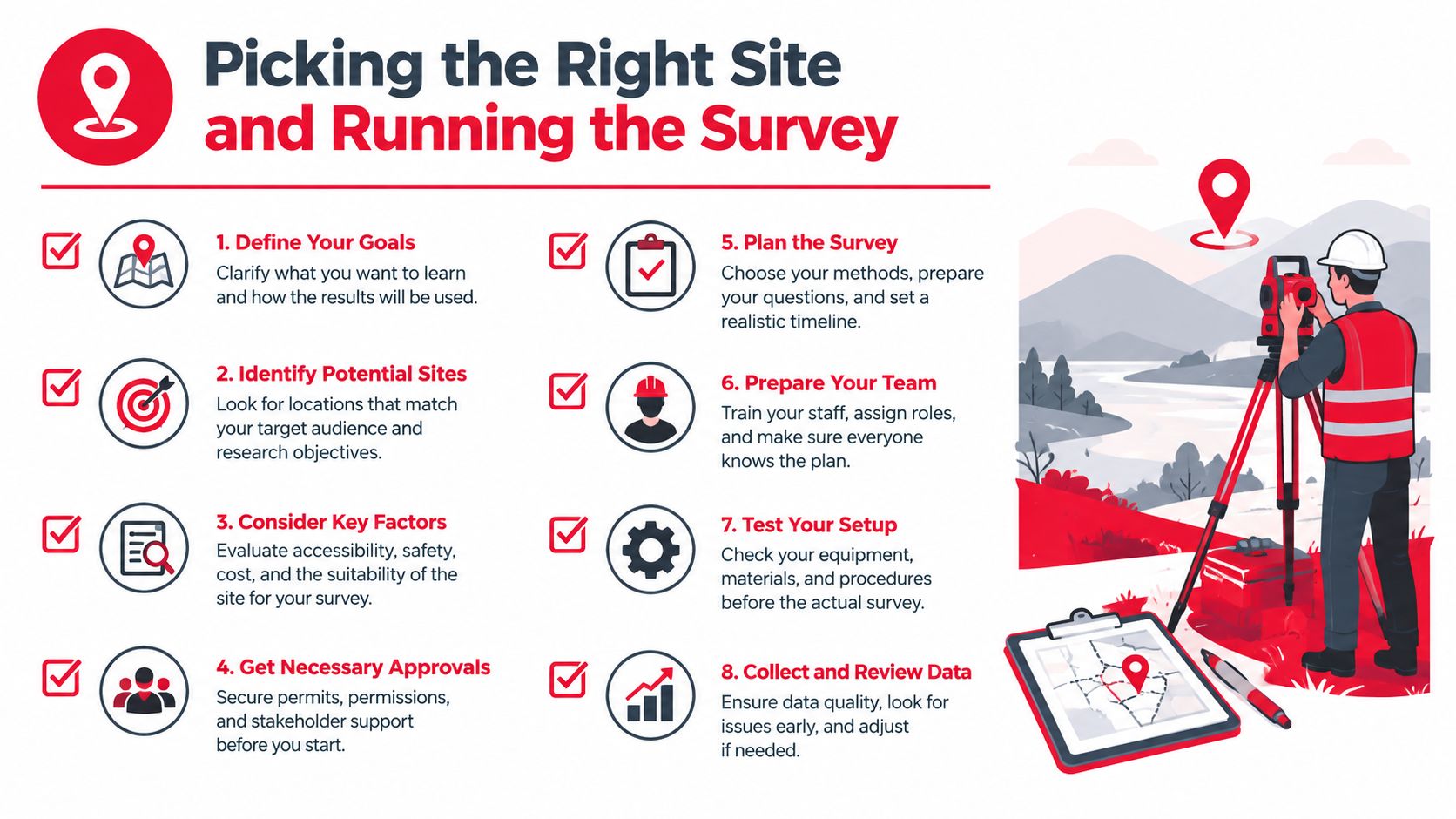
Site selection is a constrained construction decision, not a map exercise. RF planning may produce a cluster of candidate points, but the build team has to filter those points through coverage need, structure availability, power distance, backhaul proximity, access rights, clearance, and jurisdictional friction.
Start with a desktop review. Compare the RF candidate against GIS layers, parcel boundaries, street furniture, utility corridors, existing fiber, traffic patterns, and sensitive districts. A candidate near a historic facade or school may meet the coverage objective but trigger a difficult visual or public-safety review. A less perfect RF position on an available utility pole may reach switch-on sooner and cost less civil work.
A survey sequence that prevents rework
- Review the desktop package. Confirm the target area, proposed mounting asset, access road, sidewalk conditions, and likely utility service point.
- Request pole-owner records. Obtain available pole data, existing attachment information, ownership rules, and application requirements before formal design.
- Walk the pole. Verify attachment height, span conditions, guying, clearance from conductors, sidewalk width, tree conflicts, and safe crew access.
- Document the surroundings. Capture photos from each approach, equipment cabinet locations, transformers, meters, handholes, service drops, and nearby structures.
- Measure the site. Use tape-up measurements, lidar, or another suitable method to record pole geometry, attachment positions, offsets, and equipment footprints.
- Check the mounting concept. Decide whether the design favors strand-mount, pole-top, side-mount, or another configuration based on clearance and owner rules.
- Run a structural sanity check. Screen the likely loading before paying for a formal make-ready package.
- Issue a candidate site package. Include photos, measurements, GPS coordinates, a one-line sketch, ownership questions, and unresolved engineering or permitting issues.
The field lead should also note strand span, cabinet space, meter location, transformer position, and the likely length of the power run. These details often decide whether a candidate survives design review. If aerial fiber is proposed, record attachment space and span geometry. If underground work is likely, identify the nearest handhole, trench route, restoration surface, and traffic-control constraints.
Drone imagery can help where access is difficult, but it doesn't replace a qualified ground survey or pole-owner records. Teams using aerial data should confirm that the operator has appropriate training, operational competence, and aviation knowledge. The drone pilot qualifications at Ace Aviation Aerospace offer useful context when a project considers aerial inspection as part of site intelligence.
A good survey package answers the next team's questions before they ask them. It doesn't merely show where the pole stands. It shows who controls it, what is attached to it, how the node will be reached, where power and fiber can run, and which approval risks need resolution.
Permitting and the Approval Stack
Permit packages fail when teams treat them as a flat checklist. Small cell approvals form a dependency graph. The order matters because one authority may require proof that another authority has already approved the installation.
The municipal small wireless facility application usually establishes the jurisdiction's review path. In the United States, FCC rules adopted a presumptively reasonable 90-day shot clock for new small wireless facilities and 60 days for collocation on existing structures, as described in the FCC order on wireless facility deployment. Those time limits don't remove the need for a complete application. An incomplete package can trigger requests for information, corrections, or a restart of practical review.
Build the package around dependencies
The submission normally needs a site plan, construction drawings, photo simulations, equipment details, ownership information, and applicable electrical or right-of-way documentation. The exact requirements vary by jurisdiction, so the construction manager should maintain a local requirements matrix rather than reuse a generic application.
The pole-owner package follows its own review. Hydro Ottawa's checklist, for example, requires a Professional Engineer-stamped nonlinear analysis and PE-stamped construction drawings for small-cell wireline attachments. Asheville's specification requires a licensed RF PE-endorsed NIER report defining minimum approach distances for workers and the public. These requirements are reflected in the Hydro Ottawa pole-attachment permit checklist.
A practical sequence looks like this:
| Permit Type | Approving Authority | Common Blocker | Recommended Order |
|---|---|---|---|
| Municipal small wireless facility permit | City or local jurisdiction | Incomplete drawings, weak photo simulations, missing signatures | Start first |
| Pole attachment license | Utility or pole owner | Loading analysis, clearance conflict, ownership uncertainty | Run after the mounting concept is validated |
| Structural review | Pole owner or designated engineer | Stale seal, mismatched equipment schedule, incorrect pole data | Parallel with municipal review where allowed |
| RF exposure documentation | Jurisdiction or pole owner | Missing mounting height or incorrect equipment configuration | Complete with the engineering package |
| Electrical or service approval | Utility and electrical authority | Unclear meter location, service route, or disconnect design | Begin once power assumptions are fixed |
| Traffic-control or right-of-way permit | Public works or transportation authority | Frozen design missing, work-zone details incomplete | Pull after design freeze |
Common traps include photo simulations that don't match the drawing set, notarized signatures that were omitted, and structural seals that expired before submission. A revision to antenna height or cabinet position can invalidate several documents at once.
Run the longest approval path in parallel with shorter reviews, but don't submit contradictory packages. Freeze the equipment schedule, mounting height, pole identity, and power concept before final assembly. When a jurisdiction requires proof of pole-owner authorization, obtain that evidence early. When the pole owner needs municipal approval first, submit the city package before the attachment application. The objective isn't to bypass review. It's to prevent one missing approval from idling every other workstream.
Make-Ready, Structural Attachments, Power, and Backhaul
Three civil streams determine whether the node is buildable: make-ready, utility service, and backhaul. Structural attachment design connects all three because the pole must carry the proposed equipment while preserving required clearances and safe access.
Make-ready starts with the pole-owner application and a verified inventory of existing attachments. The owner or its engineering representative reviews pole loading, conductor clearances, communications space, attachment hardware, and any rearrangement work. The cost process can be just as important as the engineering. Some owners issue an estimate before construction and reconcile the actual cost afterward, creating a true-up invoice that can surprise a project budget or delay authorization.
Field lesson: A make-ready estimate isn't a construction release. Get written confirmation that the required rearrangements are complete, accepted, and available to the crew.
Structural attachment decisions
Wood, metal, and concrete poles behave differently under added equipment and wind loading. The design must use the actual pole record and field condition, not an assumed standard. The engineer should confirm the attachment class, hardware, climb steps, fall-protection provisions, grounding, and working clearances. A compact equipment assembly can still create a difficult installation if the crew can't climb, stage, or maintain it safely.
Power needs its own owner and schedule. Confirm the utility's meter agreement, service-drop route, disconnect requirements, cabinet location, and landlord coordination where the equipment sits on private property. If a shut-off is required, schedule it with the property owner and utility rather than treating it as a same-day field request. The power design should also identify who installs the service, who provides the meter base, and who verifies energization.
Backhaul can be the hidden civil project. Measure the fiber route from the node to the splice point, identify aerial versus underground construction, confirm conduit capacity, and account for restoration and traffic control. Where fiber isn't practical, a microwave or millimeter-wave link may work, but it introduces line-of-sight, mounting, alignment, and spectrum considerations. A radio design that lacks a practical backhaul route isn't ready for construction.
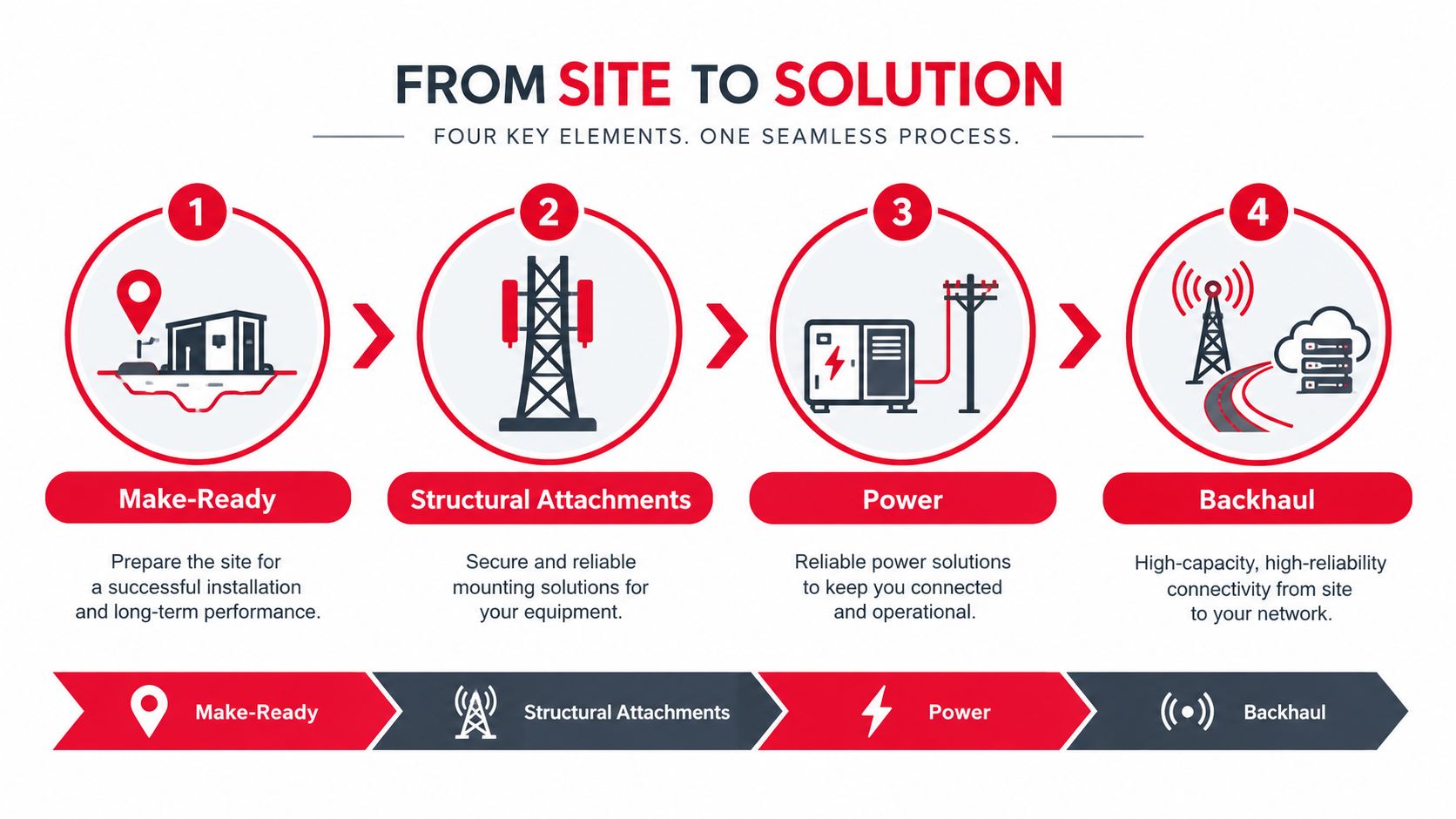
Use a responsibility matrix with one accountable owner, a lead time, and a completion record for each stream:
- Make-ready: Pole-owner approval, rearrangement scope, cost authorization, and final completion notice.
- Structure: Stamped calculations, approved hardware, clearances, grounding, and safe-access confirmation.
- Power: Utility acceptance, service installation, disconnect verification, and energization record.
- Backhaul: Fiber route, splice plan, conduit or aerial approval, test plan, and handoff to integration.
For inside facilities and equipment rooms, a structured cabling Dublin guide can provide useful reference for pathway planning, labeling, separation, and testing discipline. The same principles apply to a small-cell cabinet or venue deployment, even when the outdoor pole work is handled separately. Teams that need a single partner across fiber construction, wireless site work, splicing, and documentation can also review Southern Tier Resources as one available delivery model.
Do not mobilize the installation crew until each stream has a documented release. A verbal promise that fiber is coming or that make-ready is scheduled isn't enough. The release package should identify the approved revision, responsible party, field date, and evidence that the condition is complete.
RF Integration, Commissioning, and Acceptance Testing
Civil completion only proves that the node exists. Commissioning proves that it operates as designed and can join the live network without creating avoidable alarms or coverage defects.
Start by verifying the physical installation against the approved design. Check radio unit placement, antenna orientation, sector labels, cable routing, grounding, weatherproofing, and equipment serials. Then power the system in the approved sequence, establish the backhaul path, and connect the radio to the core or management environment.
Commission before testing coverage
The integration engineer uploads the approved parameters and verifies PCI and PSS planning, neighbor lists, transport settings, and management visibility. The cell should appear in the OSS before a drive or walk test begins. If it isn't visible, field testing only proves that the team can measure a partially integrated node.
Commissioning checks should include:
- Alarm state: Confirm that active alarms, environmental alerts, and transport faults are cleared or dispositioned.
- RF path: Perform VSWR checks and inspect feeder, connector, and weatherproofing conditions.
- Geometry: Verify azimuth, mechanical or electrical tilt, mounting height, and sector identity against the design.
- Baseline KPIs: Capture RSRP, SINR, throughput, and relevant counters before commercial traffic is enabled.
- Transport: Confirm latency, packet integrity, synchronization, and stable management connectivity according to the operator's acceptance standard.
The test route should reflect the service objective. A street-level node needs pedestrian paths, building entrances, intersections, and the intended coverage edge. A venue node needs representative indoor zones and likely handover areas. Testers should record the route, time, configuration, serving cell, neighboring cells, and any obstruction or construction condition that could explain an outlier.
The acceptance thresholds must come from the operator's approved design and contract. The following example format uses the thresholds specified for this project brief:
| KPI | Target Threshold | Measurement Method |
|---|---|---|
| RSRP at target coverage edge | ≥ -95 dBm | Logged walk or drive test at the defined edge |
| Handover success | ≥ 98% | Controlled mobility sequence across planned neighbor boundaries |
| SINR | Design-approved value | Route log compared with the RF acceptance plan |
| Throughput | Design-approved value | Repeated uplink and downlink test under documented load |
| Cell visibility | Present in OSS before field test | OSS and element-management verification |
The RSRP and handover targets above are acceptance criteria for this guide, not universal industry limits. The operator may set different values based on band, service objective, device class, and surrounding macro-layer behavior.
A node should not flip to commercial traffic while the punch list contains unresolved safety, grounding, transport, configuration, or coverage defects. Close each issue with an owner, corrective action, retest evidence, and approval. Final sign-off needs the integration record, test logs, photographs, alarm status, and confirmation that the as-built configuration matches the commissioned configuration.
Closing the Node With Schedules and As-Built Documentation
A small cell schedule works when every dependency has an owner and a release condition. A realistic end-to-end planning window is 90 to 180 days from candidate identification to switch-on, as specified in the project brief. The shorter path requires clean ownership records, an available structure, nearby power and fiber, responsive authorities, and no major make-ready work. The longer path usually reflects permit revisions, utility coordination, structural redesign, or backhaul construction.
Schedule by release, not by optimism
Use a schedule that exposes the handoffs:
- Candidate and survey: Release the site only after ownership, measurements, photos, and the mounting concept are documented.
- Engineering and permitting: Advance the node when the drawings, structural package, RF documentation, and municipal submission are consistent.
- Make-ready and utilities: Hold the construction date until the pole owner and utility issue written completion or access confirmation.
- Civil and installation: Mobilize crews with approved traffic control, materials, outage coordination, and a confirmed fiber route.
- Integration and acceptance: Reserve time for configuration, alarms, RF testing, punch-list work, and retest.
- Closeout: Submit the as-built package before the node is considered complete.
The recurring schedule failures are familiar. A crew arrives during a missed make-ready window. A permit expires while fiber construction is delayed. The utility connection remains incomplete after the cabinet is installed. A fiber route sits idle because the splice point or restoration permit wasn't ready. These failures aren't solved by asking the installation crew to work faster. They require earlier release checks and clearer ownership.
The closeout package should include:
- Red-lined construction drawings and final as-builts
- Photos with date, location, orientation, and metadata
- Equipment serial numbers, model details, and firmware versions
- Commissioning records, test results, and punch-list closure
- Marked utility locates and power documentation
- Final structural loading calculations and pole-owner approval
- Fiber splice records, test results, labels, and route details
- Permit approvals, inspection records, and traffic-control documentation
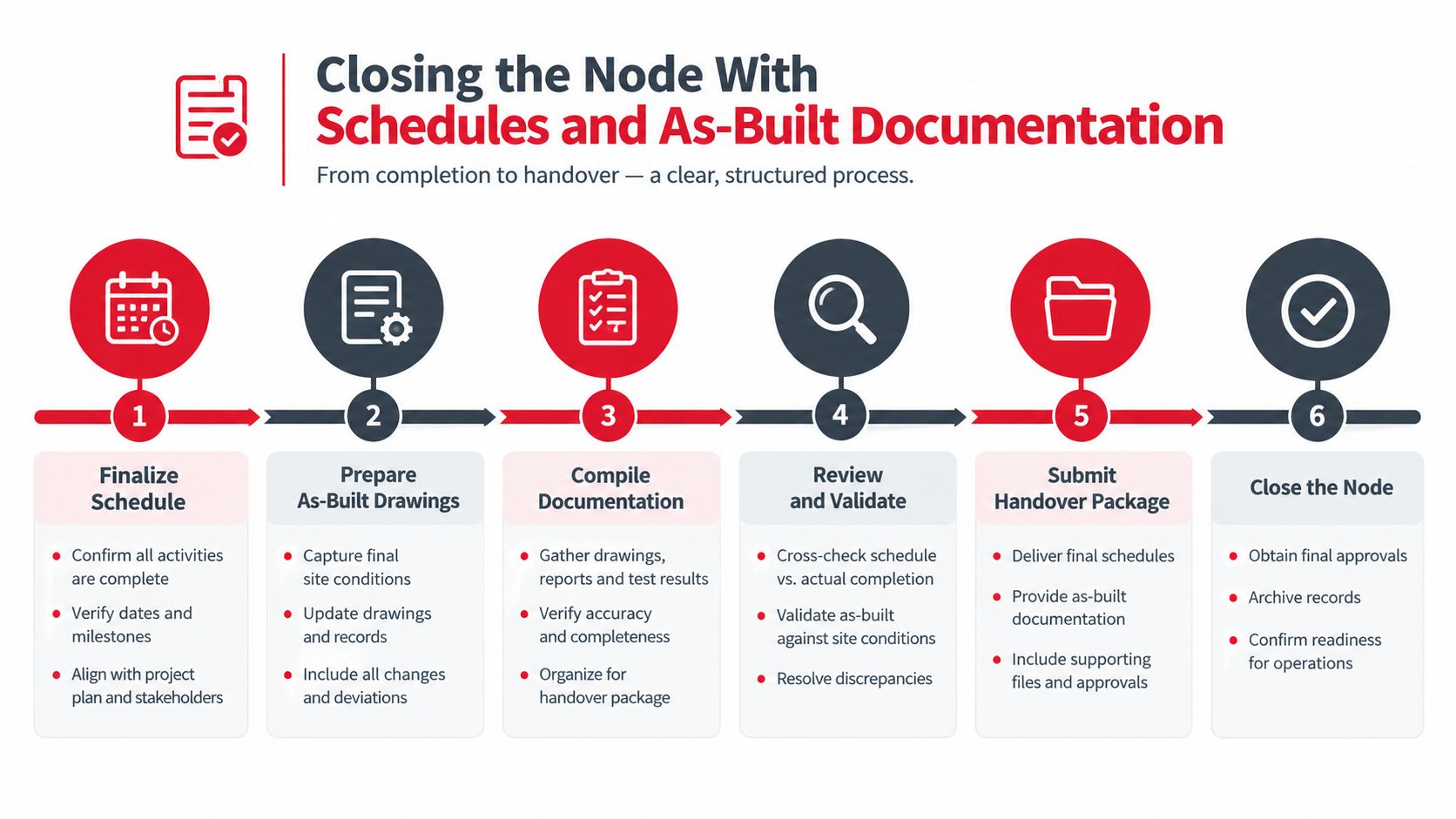
Clean as-builts shorten the next site because the cluster team can reuse verified pole, utility, pathway, and approval information without rebuilding the record from scratch. They also settle warranty and audit disputes with evidence rather than competing recollections. A construction lead should treat documentation as a deliverable with the same status as an energized node.
Southern Tier Resources provides engineering, construction, fiber, wireless site work, testing, maintenance, and detailed as-built documentation for telecom infrastructure programs. If your small cell rollout is being slowed by make-ready, power, backhaul, or fragmented field coordination, visit Southern Tier Resources to discuss an end-to-end delivery approach.