
Choosing the right partner to build tomorrow's networks is one of the most critical decisions for any organization deploying network infrastructure. The success of a fiber-to-the-home (FTTH) project, a 5G wireless network rollout, or a hyperscale data center build depends heavily on the capabilities of the selected construction firm. Identifying the best telecommunications construction companies can be a demanding process, requiring extensive research into their service offerings, safety records, and project history.
This guide simplifies that process by providing a detailed roundup of leading firms in the industry. We present an objective look at top-tier companies like MasTec, Dycom, Quanta Telecom Solutions, and others who are shaping the physical layer of our connected future. For each company, you will find a concise profile, direct links to their websites, and a clear breakdown of their core competencies. We analyze their specific services, from aerial and underground fiber installation to small cell deployment and data center infrastructure builds.
The goal is to equip telecom carriers, ISPs, enterprise IT teams, and municipalities with the information needed to create a shortlist of potential partners. Rather than sifting through countless websites, you can use this resource to directly compare the key players. This article offers a clear, actionable overview to help you identify the construction partner whose expertise aligns with your specific project requirements, geographic scope, and long-term network goals. We will examine their certifications, notable projects, and what makes each a strong contender for your next critical infrastructure deployment.
1. Southern Tier Resources
Southern Tier Resources (STR) stands out as a premier partner for organizations seeking a complete, single-accountability solution for their network infrastructure projects. With over two decades of dedicated experience, STR has established itself as one of the most dependable telecommunications construction companies, managing everything from initial design and engineering to final as-built documentation and ongoing maintenance. This end-to-end approach eliminates the common pain points of coordinating multiple vendors, ensuring projects remain on schedule and within budget.
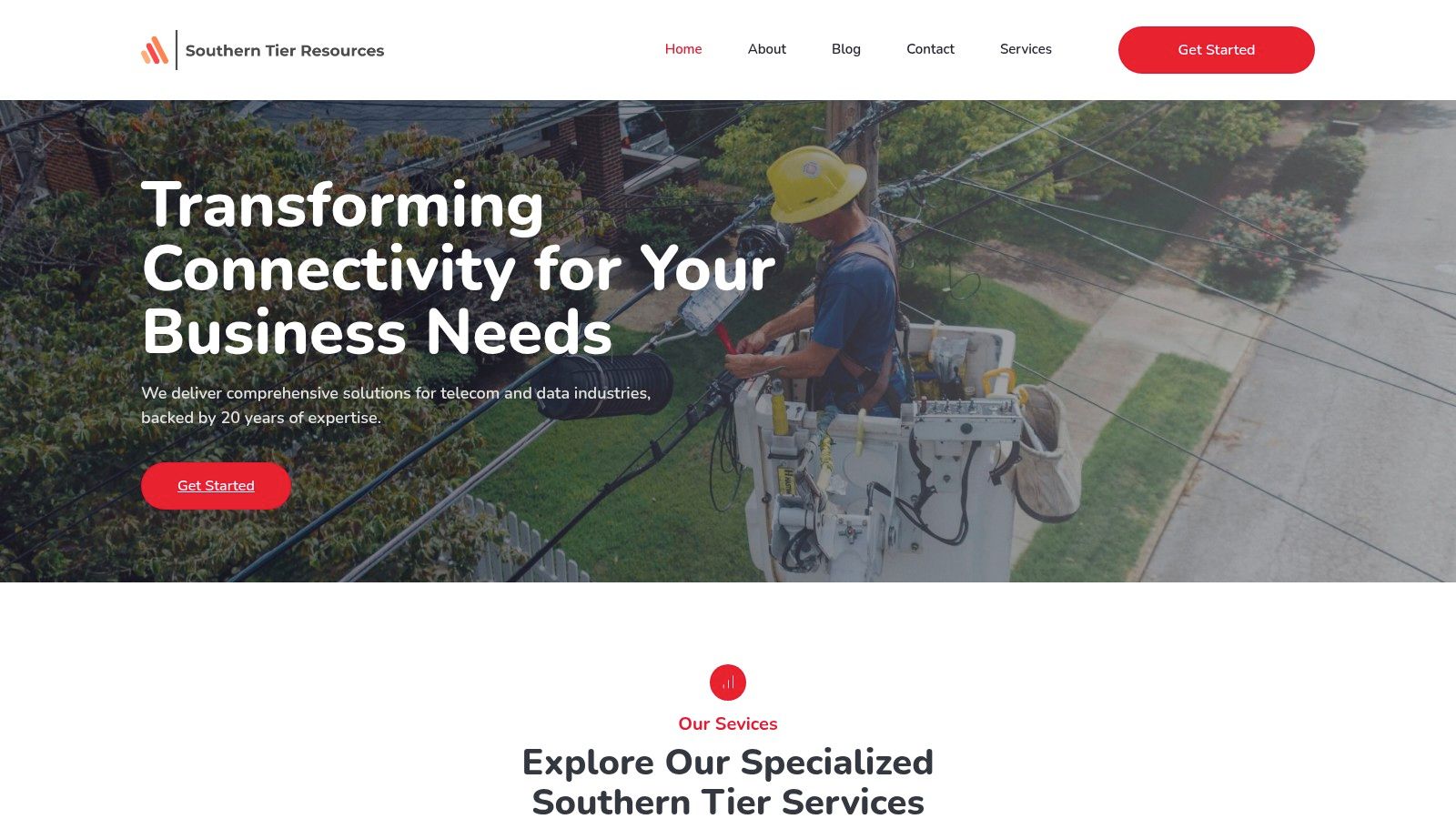
Based in Carrollton, Texas, STR serves a diverse client base that includes carriers, ISPs, data centers, and municipalities. Their reputation is built on reliability, with skilled crews and equipment available 24/7 to address project demands and maintain operational continuity. Testimonials from clients like SnapDial and Premier Broadband consistently highlight the company's professionalism, on-time delivery, and the exceptional quality of their documentation, which is vital for future network scaling and maintenance.
Core Service Offerings & Specializations
STR's service portfolio is both broad and deep, covering the critical domains of modern telecommunications. This allows them to function as a true turnkey provider.
- Fiber Optic Networks: STR handles every aspect of fiber deployment. This includes greenfield builds, make-ready engineering, aerial and underground construction, and precision fiber splicing and testing. Their expertise ensures optimal network performance from day one.
- Wireless Infrastructure: From small cell deployments in dense urban areas to macro tower construction, STR provides complete wireless solutions. Their capabilities support the rapid expansion of 5G and other next-generation wireless technologies.
- Hyperscale Data Center Fit-Outs: STR specializes in preparing data centers for operation by integrating power, connectivity, and structured cabling. This focus on the foundational infrastructure is critical for the reliability demanded by hyperscale operators.
Key Differentiators and Advantages
What sets Southern Tier Resources apart is its unwavering commitment to a partnership model. They go beyond simple execution to provide transparent communication and meticulous planning. This approach is particularly valuable for complex, multi-stage projects where clear documentation and a single point of contact are essential for success.
For companies evaluating regional expansion, understanding local market dynamics is critical. For instance, firms looking to enter or expand in the Northeast could benefit from analyzing New York State market data to forecast demand and infrastructure needs. While STR is based in Texas, this type of regional analysis is a best practice they would apply to any service area.
Key Insight: The true value of STR lies in their single-source accountability. By managing the entire project lifecycle, they significantly reduce coordination overhead and mitigate the risks associated with handoffs between different contractors.
Practical Considerations
While STR’s website provides a strong overview of their capabilities, some details require direct engagement.
- Pricing: Custom quotes are necessary, as pricing is based on the specific scope, scale, and complexity of each project.
- Geographic Coverage: Their primary service areas are not explicitly defined online. Prospective clients should contact STR directly to confirm coverage for their project locations.
- Certifications: While they promote a safety-first culture, specific safety certifications and awards are not listed. It is advisable to request verification of any required credentials during the procurement process.
To explore their full range of capabilities and see how they apply to different project types, you can review their telecom construction services page for more detail. This resource provides a solid foundation for understanding how STR can support your specific infrastructure goals.
2. MasTec Communications Group
MasTec Communications Group operates as a specialized division within the larger MasTec, Inc. entity, focusing entirely on telecommunications infrastructure. They stand out as one of the premier telecommunications construction companies capable of managing massive, multi-market network deployments from initial concept to final commissioning. For organizations needing a single point of accountability for complex projects spanning both wireline and wireless domains, MasTec offers a mature and integrated solution.
Their website functions as a corporate portal, detailing their extensive service portfolio and showcasing their national scale. It serves as an initial point of contact for carriers, ISPs, and municipalities looking to vet a prime contractor with a proven track record for large-scale builds.
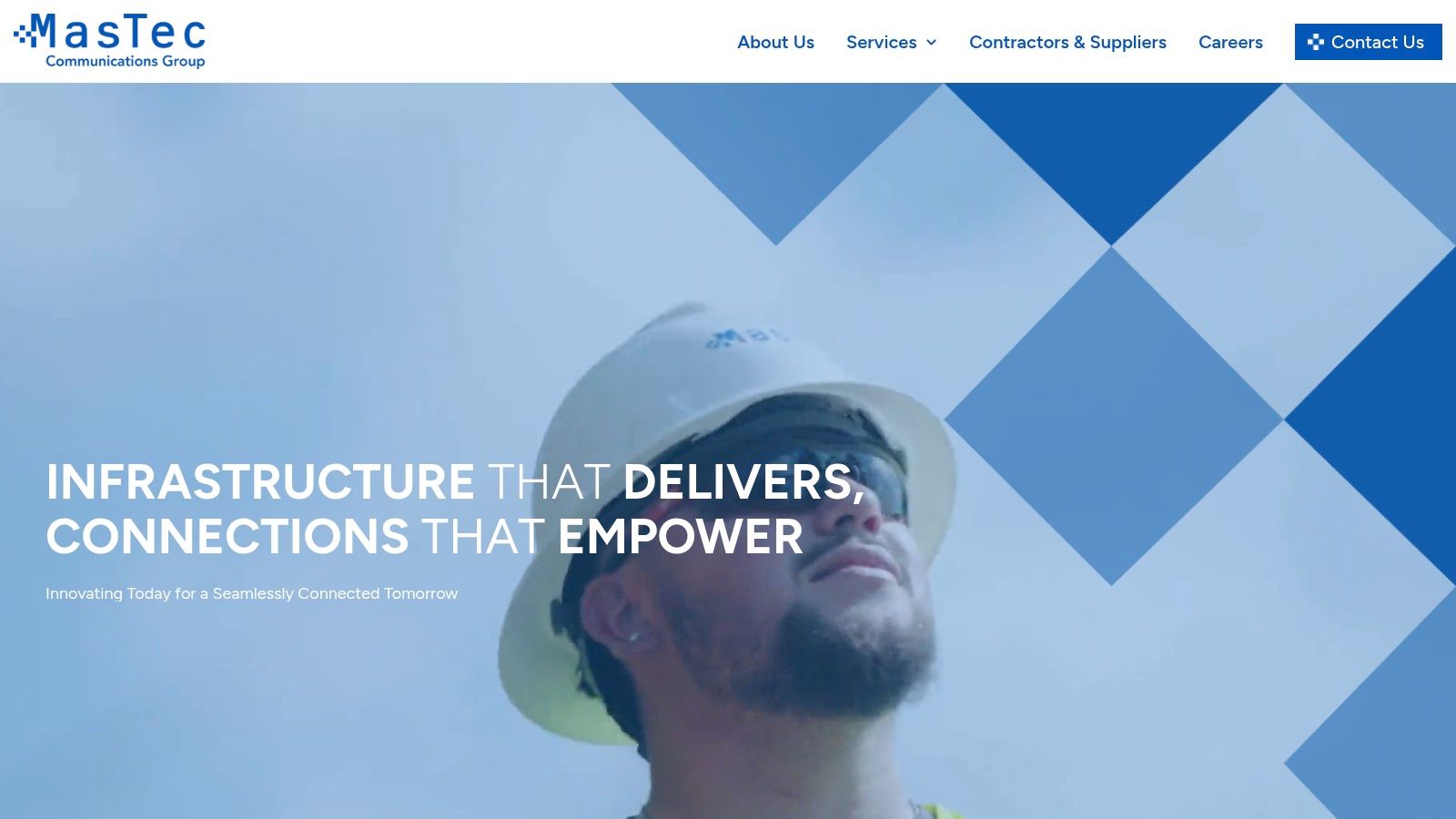
MasTec’s primary strength lies in its ability to self-perform a wide array of services, reducing the reliance on multiple subcontractors and minimizing interface risk for the client. This turnkey approach is a significant differentiator.
Core Service Offerings
MasTec organizes its services to cover the entire lifecycle of network development, providing a "one-stop shop" experience.
- Wireline Engineering & Construction: This includes everything from outside plant (OSP) engineering and permitting to the physical installation of fiber optic networks through aerial and underground methods. They also handle splicing, testing, and final activation.
- Wireless Site Development: Their teams manage new site builds for macro towers, small cell deployments in dense urban areas, and critical 5G network upgrades for major carriers.
- Program & Vendor Management: For clients with ambitious, multi-state buildouts, MasTec provides the overarching program management needed to coordinate logistics, materials, and multiple workstreams, ensuring projects stay on schedule and within budget.
Key Insight: The ability to execute both fiber backhaul and 5G small cell installation under a single contract is a major advantage for carriers. It simplifies coordination and ensures both parts of the network are built in concert, accelerating time-to-market.
Pricing, Access, and Engagement
Engaging with MasTec typically involves a formal Request for Proposal (RFP) or a direct inquiry through their website for a consultation. Pricing is project-specific and reflects their position as a national prime contractor with a deep bench of experts and a strong safety record. While this may come at a premium compared to smaller, regional firms, the cost often includes risk mitigation and the assurance of meeting aggressive deployment timelines. Lead times can be a factor during peak build seasons, so early engagement is recommended.
Website: https://www.masteccommunicationsgroup.com
3. Dycom Industries
Dycom Industries stands as one of the largest specialty contractors in the United States, providing a massive, national workforce dedicated to telecommunications infrastructure projects. As a powerhouse among telecommunications construction companies, Dycom excels at executing high-volume, multi-year programs for major carriers and internet service providers. They are a go-to partner for organizations requiring rapid, large-scale deployment capabilities across a broad geographic footprint.
Their corporate website provides a high-level overview of their subsidiaries and service capabilities. It is designed for potential clients like national carriers, MSOs, and government entities to understand the scale of their operations and initiate contact for major program bids.
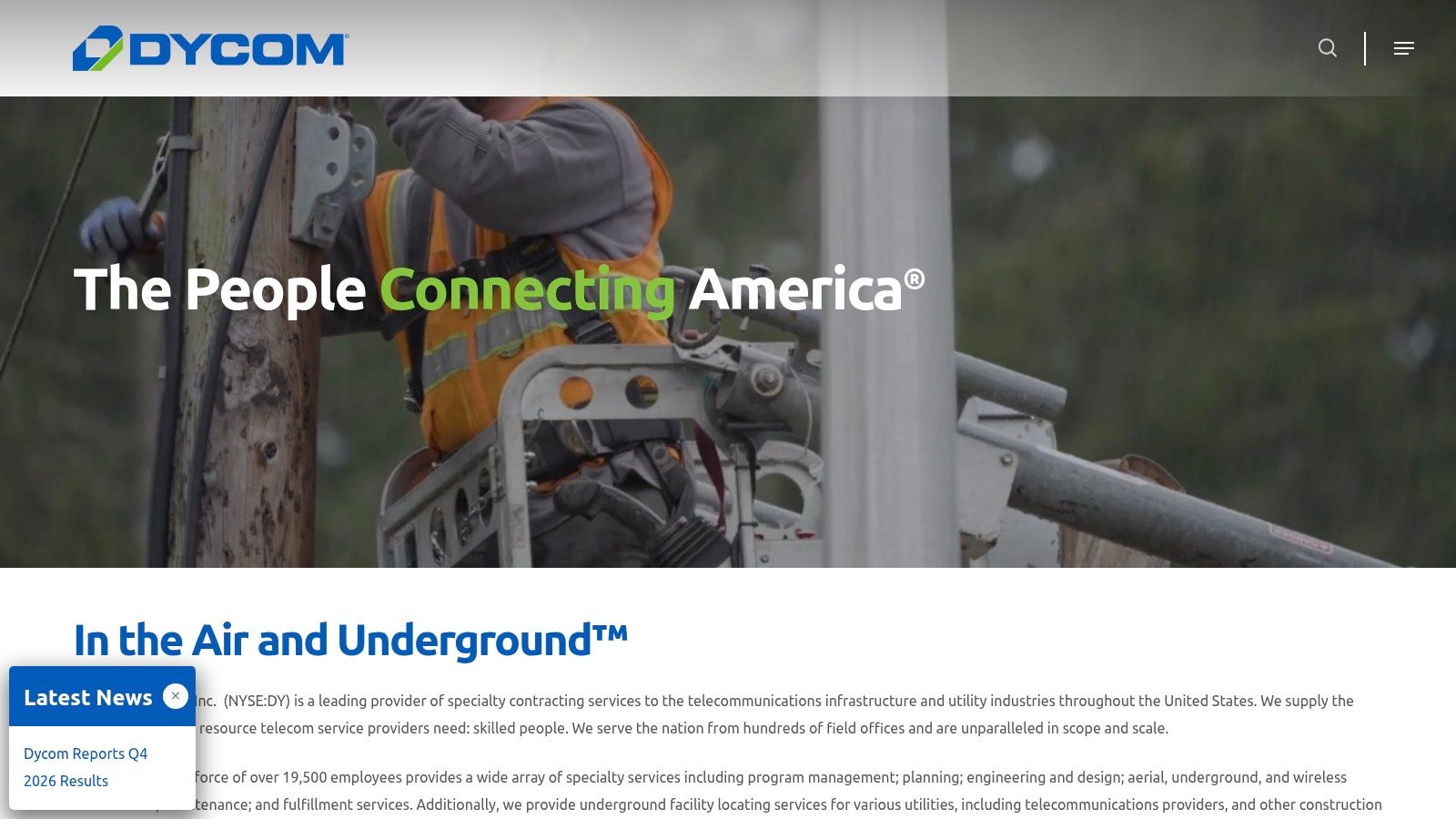
A key advantage for Dycom is its vast network of hundreds of field offices and a significant labor force, which allows for quick mobilization and scaling of resources to meet aggressive project timelines. This structure is particularly effective for nationwide fiber-to-the-home (FTTH) rollouts and rural broadband initiatives.
Core Service Offerings
Dycom’s services are structured to provide end-to-end support for network construction and maintenance, with a notable strength in self-performing critical preliminary work.
- Engineering & Construction (Wireline/Wireless): Dycom handles the full scope of network builds, from initial planning and design to aerial and underground construction for both fiber and wireless infrastructure. Their crews are experienced in everything from macro tower builds to small cell and 5G densification projects.
- Utility Locating Services: Uniquely, Dycom has a strong internal capability for locating underground utilities. This integrated service helps to minimize costly and dangerous utility strikes, a common source of delays in large-scale construction projects.
- Program Management & Maintenance: With deep experience managing long-term contracts for top-tier carriers, Dycom provides the programmatic oversight needed for complex, multi-state deployments. They also offer ongoing maintenance and storm restoration services. Selecting the right telecom infrastructure partners is crucial for these long-term engagements.
Key Insight: The integration of utility locating services directly into their construction workflow is a significant operational advantage. It streamlines the pre-construction phase and reduces the risk of third-party delays, ensuring a smoother and safer build process.
Pricing, Access, and Engagement
Engaging Dycom typically begins with participation in a formal Request for Proposal (RFP) process for a large-scale program or a direct inquiry for a specific project scope. Pricing is determined by the project's size, complexity, and geographic location. Given their scale, they are best suited for substantial, multi-market buildouts rather than smaller, one-off projects. While their deep resources offer schedule security, field quality can sometimes vary between regions and subcontracted crews. During peak construction seasons, lead times and scheduling windows can be tight, making early engagement crucial for program planning.
Website: https://dycomind.com
4. Quanta Telecom Solutions (Quanta Services)
Quanta Telecom Solutions operates as the specialized telecommunications arm within the much larger Quanta Services, a leading provider of infrastructure solutions for the electric power, pipeline, industrial, and communications industries. This connection provides Quanta Telecom with immense financial stability and resource depth, positioning it as one of the most formidable telecommunications construction companies for large-scale broadband deployments. For service providers and municipalities seeking an end-to-end partner for building a fiber optic network, Quanta offers a complete, turnkey model backed by an industry-leading safety program.
The company's website acts as a direct gateway for potential clients to explore their capabilities in fiber and wireless network construction. It clearly communicates their value proposition: a single, accountable partner that can manage every phase from initial engineering and materials procurement to final customer drops and network maintenance, all while leveraging the parent company's extensive utility expertise.
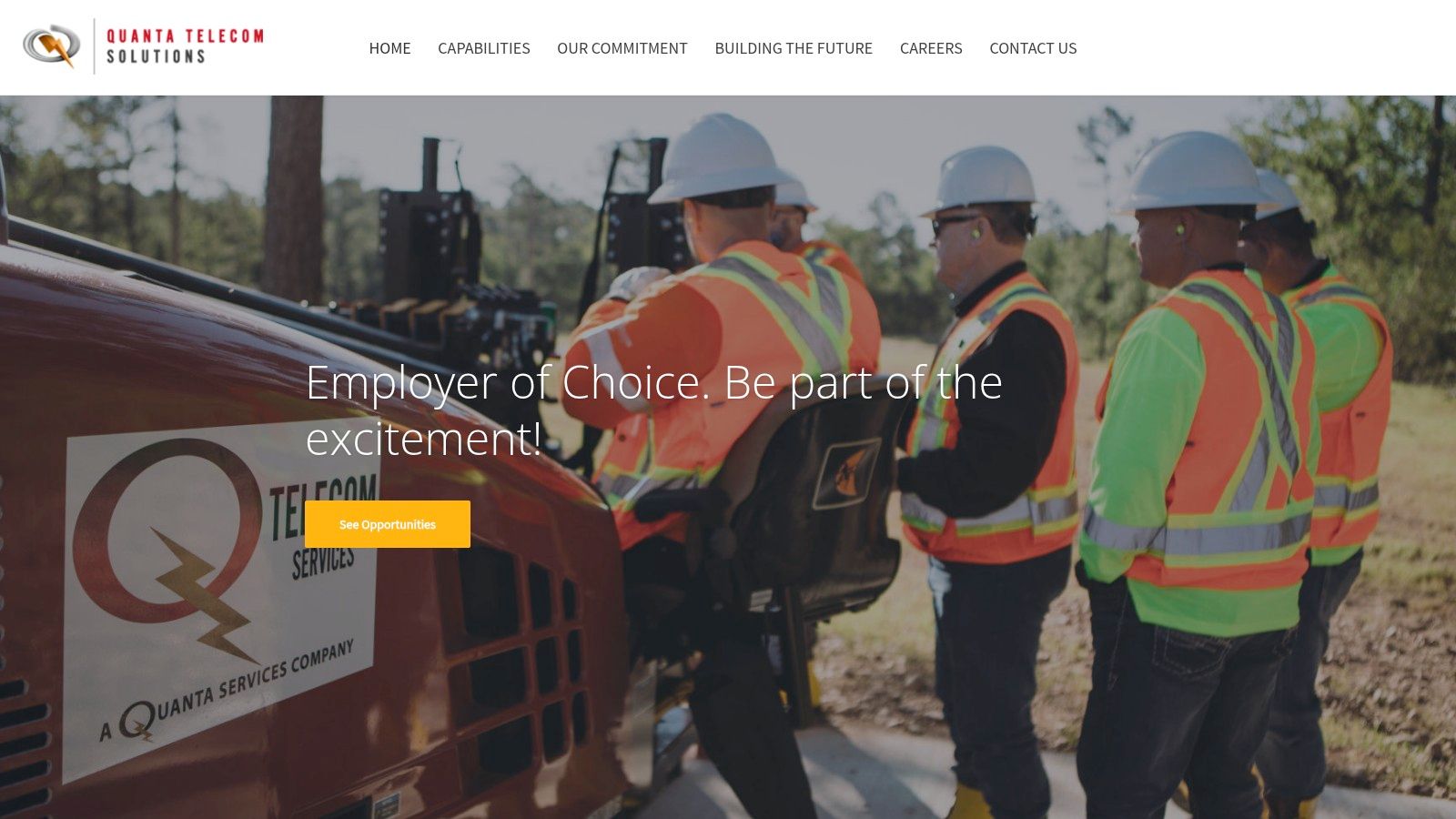
Quanta Telecom’s major advantage is its direct access to Quanta Services' vast resources, including make-ready electrical engineering and pole work. This integration is crucial for fiber-to-the-home (FTTH) projects, as it removes a common bottleneck and streamlines coordination between telecom construction and utility pole preparation.
Core Service Offerings
Quanta Telecom structures its services to provide a seamless program lifecycle, particularly for greenfield and overbuild fiber projects.
- Turnkey Fiber Program Management: This all-inclusive service covers initial network design and engineering, route feasibility, permitting, and material supply chain management. The goal is to provide a single point of responsibility from concept to completion.
- Aerial & Underground Construction: Their core strength lies in the physical construction of fiber networks. This includes a deep bench of skilled crews for both aerial placement on utility poles and complex underground builds using methods like directional drilling and trenching.
- Make-Ready Engineering & Services: Backed by the broader Quanta Services organization, they handle the critical pre-construction work on utility poles, such as pole loading analysis, relocations, and transfers, ensuring the infrastructure is ready for new fiber attachments.
Key Insight: Quanta's ability to self-perform make-ready utility work is a significant competitive advantage. It eliminates the delays and coordination challenges that often arise when a separate utility contractor is needed, directly accelerating project timelines.
Pricing, Access, and Engagement
Engaging with Quanta Telecom typically starts with a direct inquiry or response to a formal Request for Proposal (RFP). Given their scale and focus on comprehensive, multi-year programs, pricing is customized based on the project's scope, geography, and specific engineering requirements. As a top-tier EPC (Engineering, Procurement, and Construction) firm, their rates reflect a strong emphasis on safety, quality, and program management rigor. The onboarding process can be more formal than with smaller firms due to their corporate structure, but this ensures all project controls and safety protocols are established upfront.
Website: https://www.quantatelcom.com
5. Henkels & McCoy (H&M)
Henkels & McCoy (H&M) is a century-old infrastructure powerhouse with deep roots in the utility and communications sectors. As one of the most established telecommunications construction companies, H&M offers an extensive suite of services covering the full project lifecycle, from initial engineering to long-term maintenance. Their ability to deliver across multiple infrastructure markets, including power and gas, provides unique advantages for clients with complex, multi-utility projects.
The company's website acts as a high-level corporate gateway, outlining its core markets and service capabilities. It is designed for large-scale clients like carriers, utilities, and municipalities to evaluate H&M's experience, safety credentials, and North American operational footprint. The site directs potential partners to the appropriate business units for detailed discussions.
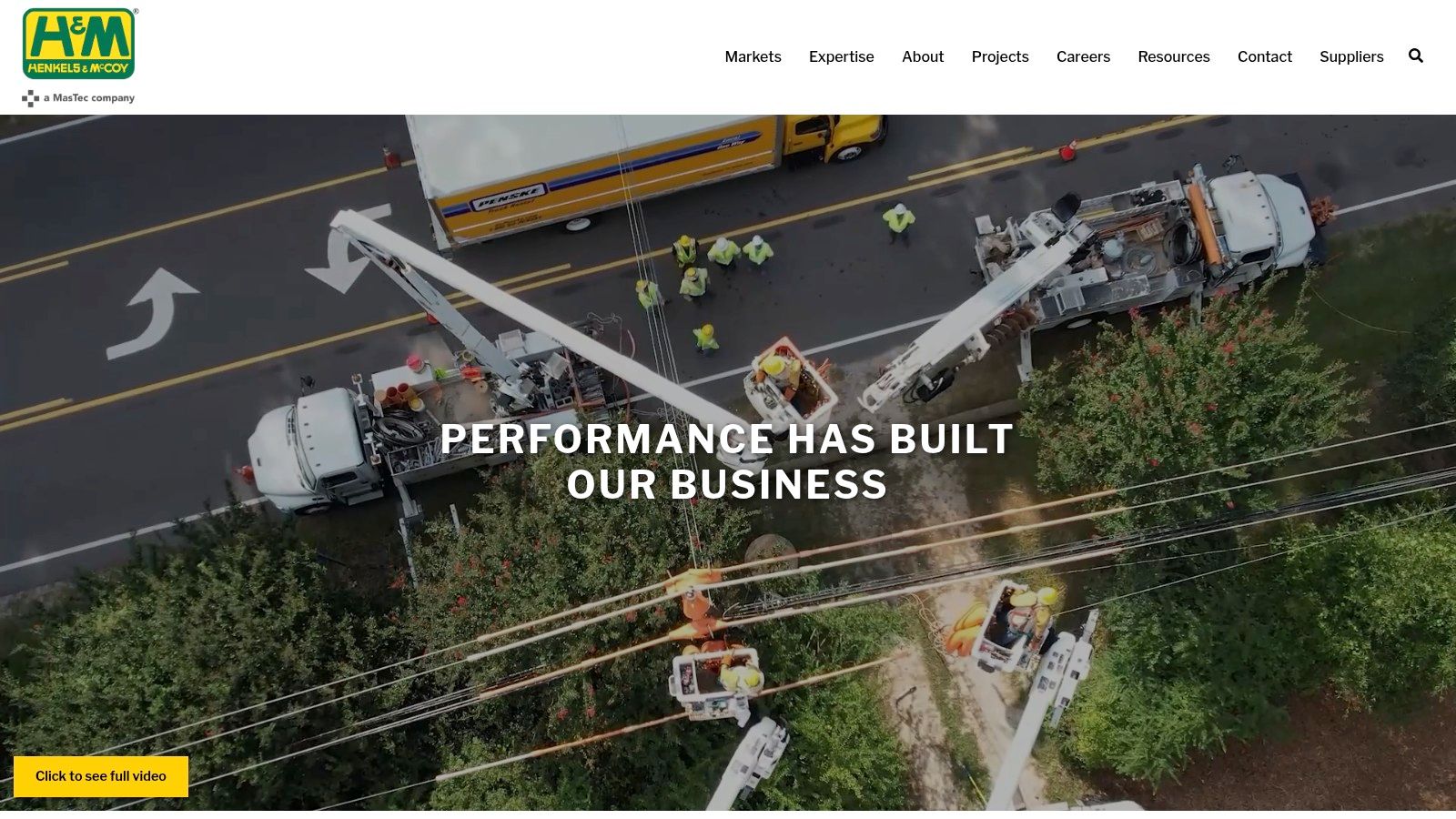
H&M's primary strength is its long-standing track record and its integrated approach to utility construction. Having expertise in both communications and power distribution allows them to manage joint trench and pole attachment projects with greater efficiency, reducing coordination friction between separate contractors.
Core Service Offerings
H&M provides a comprehensive range of solutions for communications network development, backed by robust engineering and project management.
- Communications Engineering & Construction: This service includes the design, build, and maintenance of both outside plant (OSP) and inside plant (ISP) networks. They handle everything from aerial and underground fiber and coax installation to system testing, splicing, and final turn-up.
- EPC (Engineering, Procurement, and Construction): For large, complex network builds, H&M offers a full turnkey EPC solution. This single-source responsibility model covers all phases, from design and material procurement to construction and commissioning, minimizing handoffs and streamlining project delivery.
- Emergency Restoration: A key differentiator is their dedicated emergency response capability. H&M crews are available to rapidly mobilize for network restoration after storm damage or other outages, helping carriers restore service to customers quickly.
Key Insight: H&M's dual expertise in power and telecom is a significant benefit for projects requiring new utility poles or joint-use trenching. Their ability to manage both scopes of work under one contract can accelerate timelines and reduce the administrative burden on the client.
Pricing, Access, and Engagement
Engaging with H&M is typically done through formal RFP processes or by contacting their regional offices directly via their website. Pricing is project-dependent and aligns with their status as a major utility contractor with mature safety and quality assurance programs. While their deep expertise commands a market-appropriate rate, the value comes from their reliability and proven ability to deliver on large-scale infrastructure projects. Their regional field depth can vary, so early communication is key to confirming resource availability in your specific project area.
Website: https://www.henkels.com
6. Michels Corporation
Michels Corporation is a massive U.S. infrastructure contractor with a deeply specialized communications division. This group excels in executing fiber-to-the-home (FTTH), long-haul, and last-mile fiber projects, particularly in environments that present significant construction challenges. For internet service providers and municipalities expanding into rural or topographically complex areas, Michels stands out as one of the few telecommunications construction companies with the heavy equipment and specialized techniques to ensure project success.
Their website acts as a broad portal to their diverse infrastructure services, with dedicated sections for communications. It's designed for prospective clients to explore their extensive capabilities, particularly in underground construction methods, and to initiate contact for large-scale build-outs where construction risk is a primary concern.
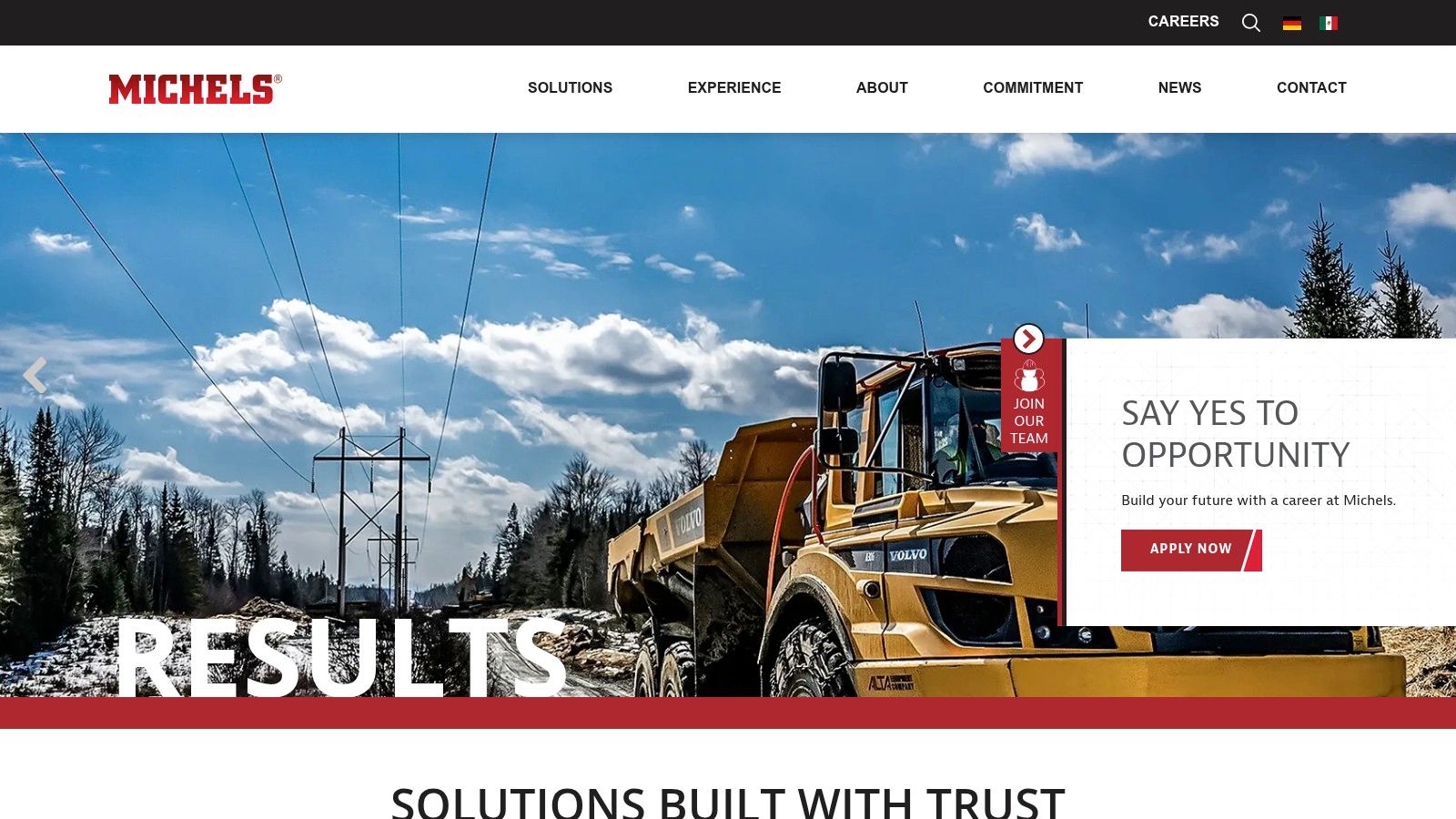
Michels' core advantage is its mastery of difficult terrain. Their ability to confidently handle river crossings, rock excavation, and even permafrost conditions with a large, owned fleet of equipment significantly de-risks projects that might otherwise face crippling delays and cost overruns.
Core Service Offerings
Michels provides end-to-end services focused on the physical installation and activation of fiber optic networks, from initial design support to final documentation.
- Complex Terrain Construction: This is their signature offering. They employ horizontal directional drilling (HDD), rock trenching, plowing, and traditional excavation to install conduit and cable in challenging geographies, including major road and river crossings.
- FTTH & Rural Broadband Delivery: The company has a proven track record of delivering entire FTTH builds, from design-assist and route planning to the final construction and connection of subscriber drops. Their experience is particularly valuable for county-wide and exchange-wide rural projects.
- Fiber Splicing & Testing: Their teams are equipped to handle mass fusion splicing, testing, cutovers, and the detailed documentation required for network activation. This in-house skill speeds up the process of turning up new network segments for service.
Key Insight: The ownership of a massive, specialized equipment fleet allows Michels to control project timelines and tackle geological obstacles that would force smaller contractors to rely on expensive, and often unavailable, third-party rentals.
Pricing, Access, and Engagement
Engaging Michels typically begins with a direct inquiry or formal RFP process initiated through their website. Because their work is organized by divisions, initial conversations are important to clarify project scope and the ideal delivery model. Pricing is bespoke to each project, reflecting the complexity, geography, and scale of the work. As a major contractor, their availability for smaller, single-town projects may be limited during peak construction seasons, making early engagement crucial for planning large-scale deployments.
Website: https://www.michels.us
7. Tilson
Tilson operates as a full-service, design-build firm specializing in network infrastructure and has earned a strong reputation for navigating complex right-of-way (ROW) and permitting challenges. They are recognized as one of the key telecommunications construction companies adept at serving not only major carriers but also municipalities, cooperatives, and mid-market ISPs. For organizations seeking a partner with deep expertise in utility pole attachments and rapid mobilization capabilities, Tilson provides a flexible and experienced solution.
The company's website is a straightforward B2B resource, outlining its end-to-end services and highlighting its nationwide reach. It serves as a direct engagement channel for network owners who need a turnkey contractor capable of managing projects from initial design and grant support through to final construction and maintenance.
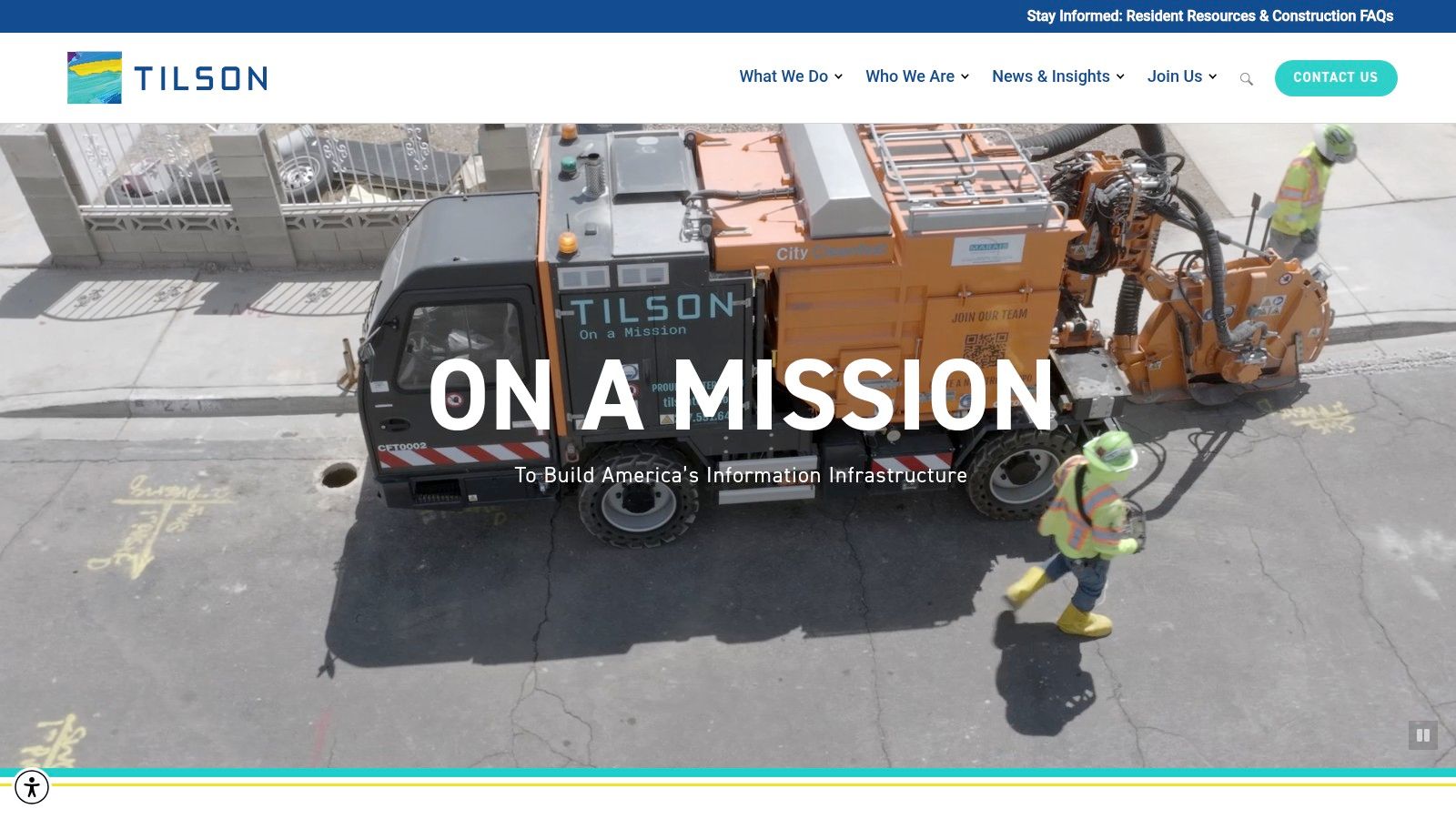
Tilson's primary strength is its integrated design-build model, combined with an exceptional ability to manage the intricate processes of permitting and utility relations. This proficiency often accelerates project timelines, a critical factor for broadband grant programs and competitive network expansions.
Core Service Offerings
Tilson’s services are structured to provide a comprehensive, single-source solution for network deployment, with a particular focus on turnkey execution.
- Turnkey Fiber Design-Build: This covers the entire project lifecycle, including network design, engineering, permitting, make-ready engineering and coordination, and construction of both aerial and underground fiber plants. They serve a diverse client base, from large carriers to local electric co-ops.
- Wireless & Tower Services: Their teams handle small cell deployments, in-building wireless systems (oDAS/iDAS), and new tower site development and construction. They also offer portfolio maintenance for existing tower assets.
- Consulting & Program Management: Tilson provides strategic consulting, including grant application support for federal and state broadband programs, and overarching program management to ensure complex, multi-faceted projects are delivered successfully.
Key Insight: Tilson’s documented success in securing permits and negotiating pole attachment agreements is a major asset. This specialized skill set can significantly de-risk a project schedule, particularly in regions with congested utility poles or strict municipal codes.
Pricing, Access, and Engagement
Engaging with Tilson usually starts with a direct inquiry or consultation request via their website, leading to a tailored proposal. Their pricing for turnkey design-build services reflects the value of an integrated project delivery model, which can be a premium compared to a traditional design-bid-build approach. However, this cost structure often provides greater budget certainty and faster completion. While they have a national presence, their capacity is more finite than that of a mega-prime contractor, so project staging and regional resource allocation may be part of the engagement strategy.
Website: https://tilsontech.com
Top 7 Telecommunications Construction Companies Comparison
| Provider | 🔄 Implementation complexity | ⚡ Resource requirements | 📊⭐ Expected outcomes | 💡 Ideal use cases | ⭐ Key advantages |
|---|---|---|---|---|---|
| Southern Tier Resources | Moderate — turnkey single‑vendor lifecycle | Skilled crews, fiber splicing/testing gear, 24/7 mobilization | Reliable on‑time delivery with thorough as‑built docs; scalable builds | Greenfield broadband, data center fit‑outs, turnkey wireless | Single accountability; deep splicing/testing; transparent communication |
| MasTec Communications Group | High — multi‑market program coordination | Large national workforce, mature QA/safety, premium capacity | Strong multi‑state program execution and consistent QA 📊 | Carrier nationwide rollouts, 5G macro/small‑cell, multi‑region programs | Nationwide reach; broad wireline & wireless catalog; program management |
| Dycom Industries | High — large program scale and regional variation | Very large labor pool, hundreds of field offices, locating services | Reduced schedule risk for nationwide programs; field quality can vary | High‑volume FTTH, rural broadband, rapid scaling needs | Scale and geographic coverage; integrated utility locating |
| Quanta Telecom Solutions | Moderate–High — turnkey EPC processes | Strong construction bench, corporate training, make‑ready/pole capability | Single accountable partner with strong safety/training; fast surge support ⭐ | Turnkey broadband builds, pole/make‑ready heavy projects | Corporate training/upskilling; safety culture; rapid staffing support |
| Henkels & McCoy (H&M) | Moderate–High — EPC and multi‑market scopes | Established QA, emergency restoration teams, power/comm experience | Reliable delivery; effective for integrated power/communications projects 📊 | Joint trench/pole projects, EPC work, outage restoration | Long track record; integrates power + comm scopes; EPC capability |
| Michels Corporation | High — complex terrain and heavy civil integration | Large equipment fleet, HDD/plowing, rock/permafrost capability | Strong execution in difficult environments; faster activation in hard terrain | Rural FTTH, long‑haul builds, challenging‑geography projects | Complex terrain expertise; experienced splicing/testing teams |
| Tilson | Moderate — design‑build with regional staging | ROW/permits expertise, agile regional teams, small‑cell capabilities | Accelerated permitting/ROW and repeatable mid‑market delivery 📊 | Municipal/co‑op broadband, mid‑market carriers, small cell/iDAS | Strong ROW/permitting relationships; flexible design‑build approach |
Your Action Plan for Selecting the Right Telecom Partner
Choosing the right partner from the many qualified telecommunications construction companies is a critical decision that will directly influence the success, timeline, and budget of your network deployment. This guide has profiled leading firms like Southern Tier Resources, MasTec, Dycom, Quanta, H&M, Michels, and Tilson, each with distinct strengths, geographic footprints, and service specializations. The next step is to translate this information into a concrete decision-making process for your organization.
Moving from a shortlist to a signed contract requires a methodical approach. Your selection process should be as robust and well-planned as the network infrastructure you intend to build. This involves a deep dive into not just what a company claims to do, but how they actually do it, verifying their track record and ensuring their operational model aligns with your project's specific demands.
From Comparison to Actionable Vetting
The comparison matrix and company profiles provided a high-level overview. Now, it's time to put that information to the test. Use the vendor-selection checklist from earlier in this article as your roadmap for the next phase of engagement.
Here’s a practical sequence for your team to follow:
- Internal Needs Analysis: Before you even send a Request for Proposal (RFP), clarify your project's non-negotiables. What are the absolute must-have certifications? What is the maximum acceptable EMR safety rating? Define your specific geographic and technical scope with precision.
- RFP Distribution: Send a detailed RFP to the top 3-4 candidates that appear to be the best fit based on their profiles. A well-crafted RFP sets clear expectations and allows for an apples-to-apples comparison of the responses.
- Scrutinize the Details: When you receive proposals, look beyond the price. A bid that seems low may omit crucial elements like traffic control, restoration, or specific permitting fees. A premier partner will provide a transparent and comprehensive bid that accounts for the project's full lifecycle.
- Verify Past Performance: Don't just take their case studies at face value. Request contact information for recent clients with projects similar in scope to yours. Ask direct questions about communication, problem-solving, and adherence to schedules and budgets.
Evaluating Operational Excellence
A key differentiator among top-tier telecommunications construction companies is their internal efficiency and adoption of modern operational tools. A partner's back-office competence is a strong indicator of their front-line performance and professionalism. A disorganized contractor will bring that disorganization to your project.
For instance, when evaluating potential partners, inquire about their internal processes for managing project finances and documentation. Efficiently handling thousands of documents, from permits to material orders and invoices, is critical for project velocity. Companies that invest in technology to automate these workflows, such as using construction invoice extraction solutions to process financial documents quickly and accurately, demonstrate a commitment to operational excellence. This focus on internal process improvement often translates to better project management, fewer administrative delays, and more transparent financial reporting for you, the client.
Key Insight: A contractor's investment in their own operational technology is a direct reflection of their commitment to efficiency and professionalism on your project.
Finalizing Your Partnership
The final selection comes down to a synthesis of technical capability, financial stability, safety culture, and cultural fit. The right partner isn't just a vendor; they are an extension of your team, dedicated to achieving your connectivity goals. They communicate proactively, anticipate challenges, and work collaboratively to find solutions.
Whether your priority is rapid fiber-to-the-home deployment, dense urban 5G small cell installation, or a cross-country long-haul fiber build, one of the companies detailed in this article likely has the expertise you need. By following a structured evaluation process, you can move forward with confidence, knowing you've selected a partner equipped to build the future of your network.
Ready to partner with a team that combines decades of field expertise with a forward-thinking approach to project management? Southern Tier Resources provides comprehensive telecommunications construction services, from outside plant (OSP) fiber builds to inside plant (ISP) and data center fit-outs. Visit Southern Tier Resources to see how our commitment to safety, quality, and client collaboration can bring your next network project to life.