
Tempting as it is, searching for "telecommunications contractors near me" shouldn't be your first move. That's actually the last step. To get sharp, accurate proposals and sidestep budget-busting surprises, you have to start with a rock-solid, crystal-clear project scope. A well-defined plan is your single best tool for attracting the right kind of qualified contractors—the ones who can deliver on time and on budget.
Defining Your Project Before You Search

Before you even think about opening a search browser, the most important work has to happen in-house. A vague request like "we need new fiber runs" is a recipe for disaster. It leads to equally vague, often inflated proposals and an endless stream of follow-up questions from confused contractors. Your job is to translate what your business needs into a detailed brief that leaves absolutely no room for misinterpretation.
Think of this as moving from a general idea to a specific, actionable blueprint. Getting this right ensures that every contractor bidding on your project is quoting for the exact same work, which makes your job of comparing apples to apples that much easier.
From Vague Ideas to Actionable Briefs
The first thing to do is write down your core objectives. Are you trying to expand network capacity for a growing team? Are you finally getting around to upgrading ancient, legacy infrastructure? Or are you building a brand-new system from the ground up? Your answer to this fundamental question will shape every single detail that follows.
Next, get granular with the technical specifications. This isn’t just about the type of work but the nitty-gritty details that dictate quality and performance.
You’ll want to document things like:
- Specific Technology: Be precise. Is this a fiber-to-the-home (FTTH) build, a data center fit-out requiring meticulous structured cabling, or a small cell deployment for a 5G network?
- Material and Equipment Standards: Don't leave this to chance. Specify the exact cable types (e.g., single-mode vs. multi-mode fiber), connector standards, and if you have any preferred hardware manufacturers.
- Performance Metrics: What does success look like? Define your expectations for network speed, latency, and overall reliability. This gives contractors clear targets to engineer their solution toward.
Here’s a quick checklist to make sure you've covered the essentials.
Project Scope Essentials Checklist
Use this checklist to ensure you cover every critical detail when defining your telecommunications project for potential contractors.
| Component Category | Essential Details to Document | Example |
|---|---|---|
| Project Objective | What is the primary business goal? | "Upgrade existing Cat5e to Cat6a cabling across a 3-floor, 50,000 sq ft office to support 10Gbps speeds for all workstations." |
| Physical Scope | Where is the work taking place? | "Installation across three buildings (A, B, C) on our main campus, including all conduit runs between buildings." |
| Technical Specs | What specific materials and standards are required? | "Must use plenum-rated, single-mode OS2 fiber optic cable and LC connectors. All patch panels must be from Manufacturer X." |
| Deliverables | What must the contractor provide upon completion? | "Full cable certification test results for every drop, as-built drawings in CAD format, and labeled patch panels and wall plates." |
| Timeline | What are the key deadlines? | "Project must be completed by October 31. Work can only be performed after-hours (6 PM – 11 PM) on weekdays." |
Nailing down these details ensures everyone is on the same page from day one.
Expert Insight: A detailed scope does more than just clarify the work—it acts as a powerful filter. It instantly weeds out contractors who don't have the specific expertise for your project, saving everyone time and making sure you only talk to truly qualified partners.
Establishing Timelines and Budgets
Once your technical needs are outlined, you can start mapping out a realistic timeline and budget. I've seen too many projects go sideways because of a rushed schedule or an insufficient budget—it’s a surefire way to compromise quality and, even worse, safety.
Be upfront about your ideal completion date, but it's also smart to ask bidding contractors for their expert take on a feasible schedule. They're in the trenches every day and know where potential bottlenecks can pop up.
Understanding the market helps, too. The global telecommunications industry is a massive, multi-trillion-dollar engine, and that high demand for skilled infrastructure services definitely influences costs and availability. Knowing a little about the local SEO strategies contractors use to attract clients can also give you a peek into how the most reputable local companies market themselves.
This detailed, upfront planning, combined with a clear understanding of the full range of available telecom construction services, is what truly positions you to find the perfect partner for the job.
How to Read a Contractor's Qualifications and Certifications
Once you’ve got your project scope nailed down, the real search for a local telecommunications contractor begins. But here's the thing: a team with a truck and some tools doesn't automatically have the specialized skills your project demands. You have to look past the business license and dig into their actual expertise, certifications, and, just as importantly, their commitment to safety.
Your project's success is all about matching the contractor's skills to your specific needs. The crew that’s great at a sprawling Outside Plant (OSP) fiber build might not be the right fit for the meticulous, high-density work inside a data center. An expert in aerial fiber might not have the light touch needed to terminate thousands of connections in a mission-critical facility.
What Technical Expertise Really Matters
When you start talking to potential partners, look for proof they've done work like yours before. Don't just take their word for it—ask to see case studies or talk to references from similar jobs.
You'll want to see demonstrated experience in a few key areas:
- Outside Plant (OSP) Construction: This is the heavy lifting of infrastructure. The contractor needs real-world experience with trenching, directional boring, setting poles for aerial runs, and working in manhole systems. This work involves heavy machinery and, crucially, a deep understanding of local permitting and right-of-way rules.
- Structured Cabling: Inside an office or data center, it's all about precision. Your contractor must be an expert at installing, terminating, and testing copper (Cat6/6a) and fiber optic cables. This has to be done according to strict industry standards, or you'll be chasing network performance issues for years.
- Fiber Optic Splicing and Testing: This is where the real technical artistry comes in. One bad splice can cripple your network. A qualified crew will be using sophisticated tools like an Optical Time Domain Reflectometer (OTDR) to certify every single connection and will hand you detailed test reports to prove it.
A contractor’s ability to provide comprehensive as-built documentation and test results is a huge green flag. This isn't just paperwork; it’s the definitive map of your network, and it's absolutely essential for any future maintenance or troubleshooting.
Don't Skip the Certifications
Certifications are more than just fancy acronyms; they're proof that a contractor has been independently vetted against industry best practices. They show a real commitment to quality and staying current.
Keep an eye out for credentials from well-respected organizations:
- BICSI (Building Industry Consulting Service International): When you see a BICSI credential, like RCDD (Registered Communications Distribution Designer), you know you're talking to someone with a deep, proven knowledge of telecom and data cabling design.
- Fiber Optic Association (FOA): The FOA's certifications, especially the Certified Fiber Optic Technician (CFOT), confirm a tech’s hands-on skills in fiber installation, splicing, and testing. To dig deeper into what sets the best crews apart, our guide on what to look for in professional fiber optic construction companies offers more insights.
A Strong Safety Record is Non-Negotiable
Finally, and this is a big one, never overlook safety. A contractor's safety record tells you a lot about their professionalism and how they run their business.
The key number to ask for is their Experience Modification Rate (EMR). This is an insurance industry benchmark, and what you want to see is a number below 1.0. A lower EMR means their safety record is better than average, which directly protects you from liability and project delays caused by accidents. A team with a solid safety program is a team that values its people and your project—and that's the kind of partner you want.
Vetting Partners: A Look Beyond the Proposal
You’ve got a shortlist of telecommunications contractors, and their proposals look promising. Now, the real work begins. A proposal is just the highlight reel; your job is to get a sense of the on-the-ground reality of working with them. It’s time to move past the sales pitch and dig into their actual processes, team skills, and how they handle quality control when things don't go perfectly.
Your Request for Proposal (RFP) is the first and best tool for this deeper dive. This document isn't just about getting a price—it's your chance to ask tough, specific questions that reveal how a contractor truly operates under pressure.
Crafting a Smarter Request for Proposal
A good RFP forces potential partners to show their work. You want to structure your questions to make generic, copy-paste answers impossible. Ask them to outline their approach to your specific project, not just give you a boilerplate description of their general services.
Here are a few questions I always include to separate the pros from the rest:
- Project Management: Who is my dedicated point of contact? What’s the communication plan—are we talking daily check-ins or weekly status reports?
- Team Experience: I want to know about the crew lead and key technicians you plan to assign to my project. What’s their direct, hands-on experience with this exact type of installation?
- Quality Control: Walk me through your process for testing and certifying the work. What happens if deficiencies are found during a QA check?
- Contingency Planning: Tell me about a time a similar project went sideways. How did your team handle the unexpected obstacle, and what was the final impact on the timeline and budget?
These kinds of questions push contractors to demonstrate their problem-solving abilities and operational maturity. It’s a similar vetting process you’d use when finding trusted local service providers for any critical service.
Pro Tip: The goal of an RFP isn't just to compare costs, but to compare competency. A detailed, thoughtful response is a strong indicator you’re dealing with a professional and capable partner.
The Power of the On-Site Visit
Never, ever skip the site visit or pre-bid meeting. This is your chance to see the team in person and get a feel for their professionalism. Are they on time? Did they come prepared? Most importantly, are they asking smart, clarifying questions? You can tell a lot about a contractor by the quality of their questions—it shows they’ve actually read your scope of work and are thinking critically about its unique challenges.
This simple flowchart breaks down the core pillars you should focus on during the vetting process.
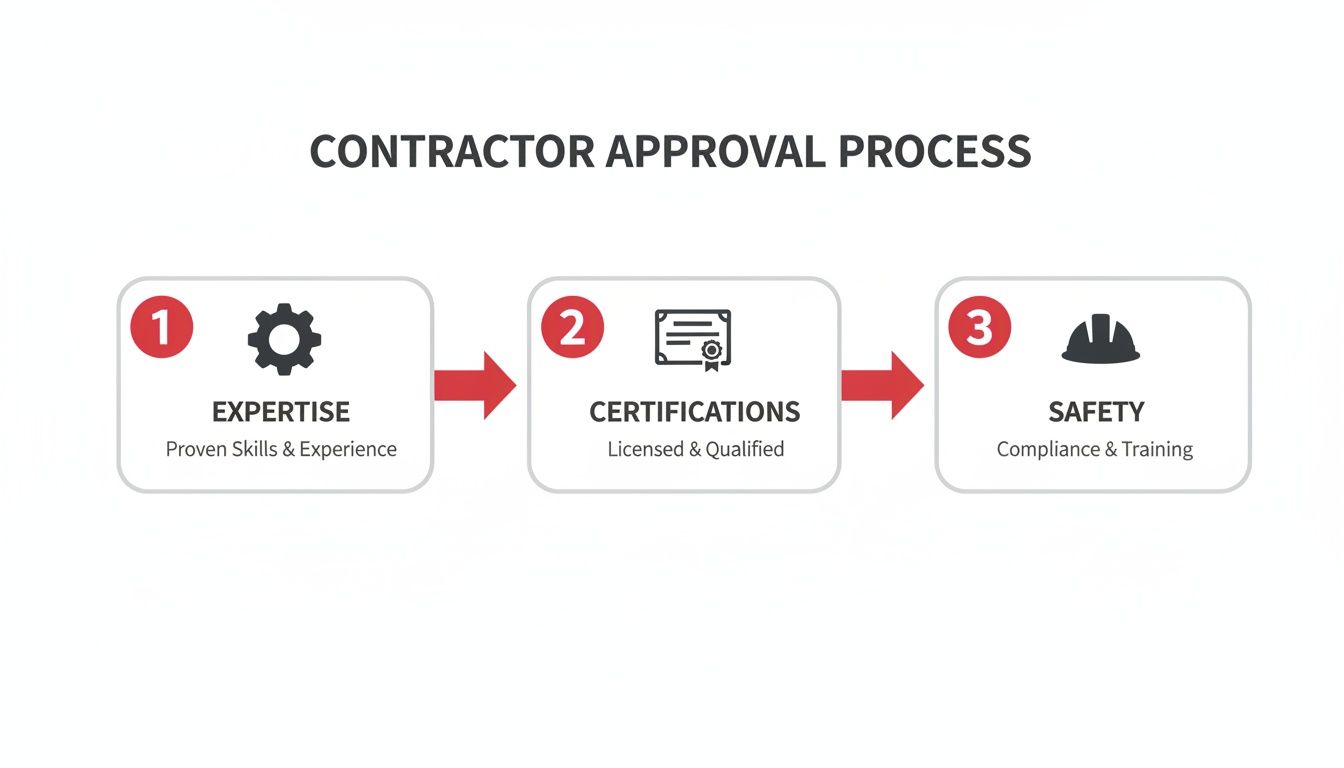
As you can see, true vetting requires a balanced look at their technical expertise, official certifications, and a proven commitment to safety. I’ve seen contractors who are incredibly skilled but have a spotty safety record, and others who are fully certified but lack the specific hands-on experience your project demands. You need all three.
The demand for these specialized teams is intense right now. With mobile internet users now making up nearly 60% of the global population, the need for both wireless and fiber infrastructure experts has exploded. This highly competitive market is exactly why doing your homework upfront is so critical.
Choosing the Right Partner, Not Just the Lowest Bid
You’ve got a stack of proposals on your desk, and the temptation to just jump to the bottom line and pick the lowest number is real. We’ve all been there. But honestly, this is one of the most common—and most costly—mistakes you can make.
The cheapest bid often hides compromises that will come back to haunt you. Think shoddy workmanship, missed deadlines, endless change orders, and a network that just doesn't perform. In the long run, those "savings" evaporate pretty quickly.
A true project partner delivers the best value, not just the lowest price. Finding them requires a more structured, objective way to look at each proposal. This isn't about ignoring cost; it's about putting it in context with everything else that matters for a successful project.
Building a Proposal Scoring Matrix
One of the best ways to keep the evaluation process fair and focused is by using a scoring matrix. It’s a straightforward tool that lets you weigh different criteria based on what’s most important for your specific project. This helps take personal bias out of the equation and prevents one single factor—like price—from clouding your judgment.
You simply assign a weight to each category based on its importance. For a complex data center build, for instance, you might give the team’s direct experience the highest weight. For a more routine aerial fiber run, maybe the proposed timeline is your number one priority.
This simple structure creates a level playing field and forces you to compare contractors based on what truly matters.
Here’s a look at what a basic scoring matrix might look like.
Contractor Proposal Scoring Matrix
A sample scoring matrix to help you objectively compare proposals from different telecommunications contractors.
| Evaluation Criterion | Weight (%) | Contractor A Score (1-5) | Contractor B Score (1-5) | Notes |
|---|---|---|---|---|
| Technical Approach | 30% | 4 | 5 | Contractor B provided a more detailed plan for minimizing downtime. |
| Relevant Experience & Team | 25% | 5 | 3 | Contractor A's team has completed three similar projects in the last year. |
| Project Timeline | 20% | 4 | 4 | Both timelines are realistic and meet our deadline. |
| Safety Record (EMR) | 15% | 5 | 5 | Both have excellent EMRs below 1.0. |
| Total Cost | 10% | 3 | 5 | Contractor B is 12% cheaper, but Contractor A's experience justifies the cost. |
Using this tool, you can see how a slightly more expensive bid might actually represent the better overall value once all factors are considered.
Spotting Red Flags in the Fine Print
As you dig into the proposals, you need to read between the lines. Vague language is a huge red flag. If a contractor’s timeline just says “Fall Completion” without breaking it down into specific, dated milestones, you need to push them for more detail.
Another classic warning sign is an unusually low bid. If one proposal is dramatically cheaper than all the others, it’s often because they misunderstood the scope or left something critical out. That’s a mistake you’ll end up paying for later.
A professional contractor's proposal will be clear, detailed, and transparent. If you feel like they are hiding details in complex language or glossing over key deliverables, trust your gut and ask more questions.
Finally, don’t skip the reference checks. This is your chance to get a real, unfiltered look at how they operate. Don't just ask if the client was happy. Ask probing questions that reveal how the contractor really performs under pressure.
Try asking something like, "Tell me about a time something went wrong and how their team handled it," or "How was their communication with your internal stakeholders?" Getting honest feedback on a contractor’s problem-solving skills and on-site professionalism is invaluable when you're making your final choice.
Finalizing the Contract and Planning for Kickoff

You’ve done the hard work of vetting and have selected a contractor who feels like a true partner, not just the lowest bidder. Now it’s time to make it official and set the stage for a smooth project.
This final step is less about last-minute negotiations and more about cementing total clarity for everyone involved. A detailed contract is the blueprint for your entire engagement, protecting both you and your contractor by spelling out exactly what happens, when it happens, and what to do if things go off-script. When you’re looking for "telecommunications contractors near me," this legal framework is what turns a promising handshake into a secure, well-managed project.
Building a Bulletproof Contract
A solid contract goes way beyond just the price and the scope of work. It needs to anticipate the realities of a complex telecom project. Before anyone signs on the dotted line, make sure the agreement includes specific language on a few critical points.
These are the non-negotiables that form the backbone of any good construction contract:
- Payment Schedules and Milestones: Don’t just agree on a total price. Tie payments to specific, verifiable project milestones. This keeps the contractor motivated and protects your budget.
- Change Order Procedures: Projects evolve. It’s inevitable. Your contract needs a crystal-clear process for how changes are requested, priced, approved, and documented. This is your best defense against scope creep and unexpected costs.
- Insurance and Bonding Requirements: Be explicit. State the exact types and minimum coverage levels for general liability, worker's compensation, and auto insurance. For larger-scale projects, requiring a performance bond is a smart move for extra financial security.
- Quality Standards and Deliverables: Define what "done" looks like. Specify the quality benchmarks the work must hit and mandate final "as-built" documentation—the official map of your newly installed infrastructure.
A well-defined contract isn't about mistrust; it's about mutual respect. It ensures both you and your contractor have a clear, agreed-upon playbook for navigating the project from start to finish.
Launching a Successful Project Kickoff
Once the ink is dry, the last hurdle before the real work starts is the kickoff meeting. This is far more than a formality. It’s your first chance to get everyone aligned and establish a collaborative rhythm that will carry through the entire project. The goal here is simple: get your internal team and the contractor's crew to function as one cohesive unit.
Your kickoff meeting needs a tight, action-oriented agenda. Use this time to introduce the key players from both sides, designate the primary points of contact for day-to-day issues, and lock down communication protocols. For projects requiring deep integration with your existing systems, looking into comprehensive turnkey network solutions can offer a great model for this level of coordination.
Finally, dedicate a serious chunk of the meeting to safety. Walk through site-specific safety plans, emergency contacts, and daily check-in procedures. Driving home the point that safety is a shared, non-negotiable priority from day one sets the right tone and ensures everyone on site understands the high standards you expect. A proper kickoff turns a legal document into a real partnership, ready to get to work.
Got Questions? We've Got Answers on Hiring Telecom Contractors
Even with the best-laid plans, finding the right local telecommunications contractor can bring up a lot of questions. I’ve seen these same concerns come up again and again, whether I’m talking to a veteran PM or a business owner who’s never managed an infrastructure project before. Getting these things sorted out upfront builds confidence and, frankly, prevents some major headaches later on.
The first question is almost always about the money. While no two projects are identical, a contractor's price usually boils down to three things: labor, materials, and equipment. Labor is typically the biggest piece of the pie, based on the size of the crew and the hours they’ll need to put in. If someone throws a flat number at you without a detailed breakdown, that’s a red flag. You want transparency.
What Happens When the Project Scope Changes?
Let's be realistic—things change. You might hit bedrock while trenching, or maybe your company's needs evolve halfway through the build. It happens. A truly professional contractor knows this and will have a Change Order Process clearly spelled out in their contract from day one.
Think of this process as your project's safety valve. It's a formal system for documenting any change from the original plan, pricing it out, and getting your written approval before the work happens. This is what stops "scope creep" from blowing up your budget and keeps everyone on the same page.
Another big one I hear a lot is about oversight. How do you know the job is getting done right if you can't be there watching over their shoulder every single day?
A good contractor won't just tolerate client oversight—they’ll encourage it. They should give you a dedicated project manager and set up a regular schedule for updates, complete with photos and progress reports on major milestones. Communication is everything.
Dealing with Delays and Disagreements
Even the most meticulously planned projects can hit a snag. Bad weather, permitting hold-ups, or supply chain glitches are all real-world factors. A reliable partner will be proactive, letting you know about potential delays immediately and working with you to adjust the schedule. The contract should also outline how these kinds of events are handled.
So, what if you're not happy with the quality of the work?
This is precisely why your contract needs to be crystal clear about quality standards and deliverables. The agreement must lock down:
- Industry Standards: All work has to meet established benchmarks from groups like BICSI or the TIA.
- Proof of Performance: The contractor is responsible for providing detailed test results—like OTDR reports for a fiber installation—to prove the system works as specified.
- The Final Walk-Through: There should be a formal process for a final inspection and sign-off. This is your chance to either accept the project or create a "punch list" of items that need to be fixed.
Having these terms defined from the start protects everyone involved. It creates a clear, objective framework for resolving issues and ensures the contractor you hire is fully accountable for the quality of their work.
For a partner with over two decades of experience navigating these exact challenges, Southern Tier Resources delivers the expertise and transparent processes needed for a successful project. Learn more about our end-to-end telecommunications infrastructure services.