
Imagine walking into a brand-new home where the builder hands you the keys and everything is perfect—from the foundation to the light fixtures. That's the idea behind turnkey network solutions. It’s a complete, end-to-end service where one partner handles your entire network deployment, delivering a fully operational system that’s ready to go.
What Are Turnkey Network Solutions?
Building a network the traditional way is a bit like building a car from scratch. You'd buy the engine from one place, the chassis from another, and hire different specialists for the wiring, paint, and interior. You’re the project manager, trying to make sure all those different pieces and people work together. It’s a complex process, often plagued by delays and unexpected costs.
Turnkey solutions completely change that dynamic. Instead of juggling dozens of vendors and contracts, you work with a single, expert partner. This partner takes ownership of the entire project from start to finish, acting as your one point of contact and accountability.
This approach simplifies communication, aligns everyone's goals, and takes the massive weight of coordinating a complex project off your shoulders. The real value is getting a complete, tested, and documented network that’s ready to "turn the key" and start generating revenue from day one.
From Blueprint to Live Operations
A true turnkey partnership covers every single step of the deployment. It's a holistic service built for predictability and efficiency, leaving nothing to chance.
A typical project includes:
- Strategic Design and Engineering: Crafting a detailed network blueprint that meets your specific technical needs and business goals.
- Permitting and Right-of-Way: Handling all the complex red tape to secure the necessary approvals for construction.
- Hardware Procurement: Sourcing and managing all the equipment, from routers and switches to fiber optic cables.
- Physical Construction and Installation: Building the network, whether that means trenching for fiber or outfitting a data center.
- System Integration and Testing: Making sure all the components work together perfectly and running rigorous tests to ensure performance and reliability.
This 'start button' philosophy is fueling massive growth. The industrial networking solutions market was valued at USD 34.34 billion in 2024 and is expected to hit USD 125.84 billion by 2032, according to insights from Fortune Business Insights. This trend shows a clear demand for models that get networks online faster for everyone from ISPs to public utilities.
You can explore a variety of these broadband and telecom services to see how they apply in different scenarios. By putting one partner in charge, turnkey solutions eliminate the blame game between vendors and ensure you get a cohesive, high-performing network.
Comparing Traditional Vs Turnkey Network Deployment
To really see the difference, it helps to put the two approaches side-by-side. The contrast in management, risk, and speed is stark.
| Aspect | Traditional Piecemeal Approach | Turnkey Solution Approach |
|---|---|---|
| Vendor Management | You juggle multiple contracts, vendors, and timelines. | A single partner manages all vendors and subcontractors. |
| Accountability | Diffused. When issues arise, vendors often blame each other. | Centralized. One point of contact is fully accountable for the outcome. |
| Project Timeline | Prone to delays due to coordination failures and dependencies. | Timelines are more predictable and often accelerated. |
| Budget Control | High risk of cost overruns from unexpected issues and scope creep. | Fixed or predictable pricing with fewer surprise expenses. |
| Your Role | Active project manager and integrator. | Strategic partner and stakeholder. |
The table makes it clear: the traditional path puts the burden of integration squarely on your shoulders, while the turnkey model shifts that responsibility to an experienced partner, freeing you to focus on your core business.
Navigating The Turnkey Project Lifecycle
Think of a turnkey network project not as a series of separate tasks, but as one seamless journey. You have a single, expert partner who acts as your guide—they draw the map, pack the supplies, and lead you from the initial concept all the way to a fully functioning network. This single-vendor approach is all about sidestepping the communication breakdowns and logistical headaches that plague projects managed by multiple disconnected teams.
The process kicks off well before a single piece of equipment is ordered. It starts with a deep dive into what you actually want to achieve. The goal isn't just to build a network that works, but one that actively supports and advances your specific business goals. Once that's clear, your partner takes the reins for every single step that follows.
Phase 1: Strategic Design And Planning
Every great network starts with a rock-solid blueprint. This first stage is highly collaborative. Your turnkey partner works with you to translate your needs for performance, growth, and budget into a highly detailed engineering design. They'll handle the on-the-ground site surveys, develop the technical specs, and map out the entire network architecture.
A huge—and often overlooked—part of this phase is cutting through all the red tape. A truly experienced partner knows how to navigate the maze of permits and rights-of-way. They handle the administrative heavy lifting, from getting approvals from local authorities to negotiating with landowners, preventing the bureaucratic snags that can stall a project indefinitely.
Phase 2: Procurement And Physical Construction
With the plan locked in, it’s time to bring it to life. Your partner taps into their established supply chain relationships to source all the necessary hardware—from routers and switches to fiber optic cabling and antennas. This centralized procurement means you’re not stuck juggling dozens of purchase orders and vendor schedules.
The construction phase is where you see the network physically take shape. This might mean major civil engineering work, like trenching for new underground fiber, or it could be the precise, technical installation of equipment inside a data center. For anyone curious about the sheer scale of these efforts, you can get a better sense of the heavy civil construction that goes into building major infrastructure. Having a single point of contact here is a game-changer; they coordinate all the crews and ensure everything is done safely and to a high standard, without you having to manage it day-to-day.
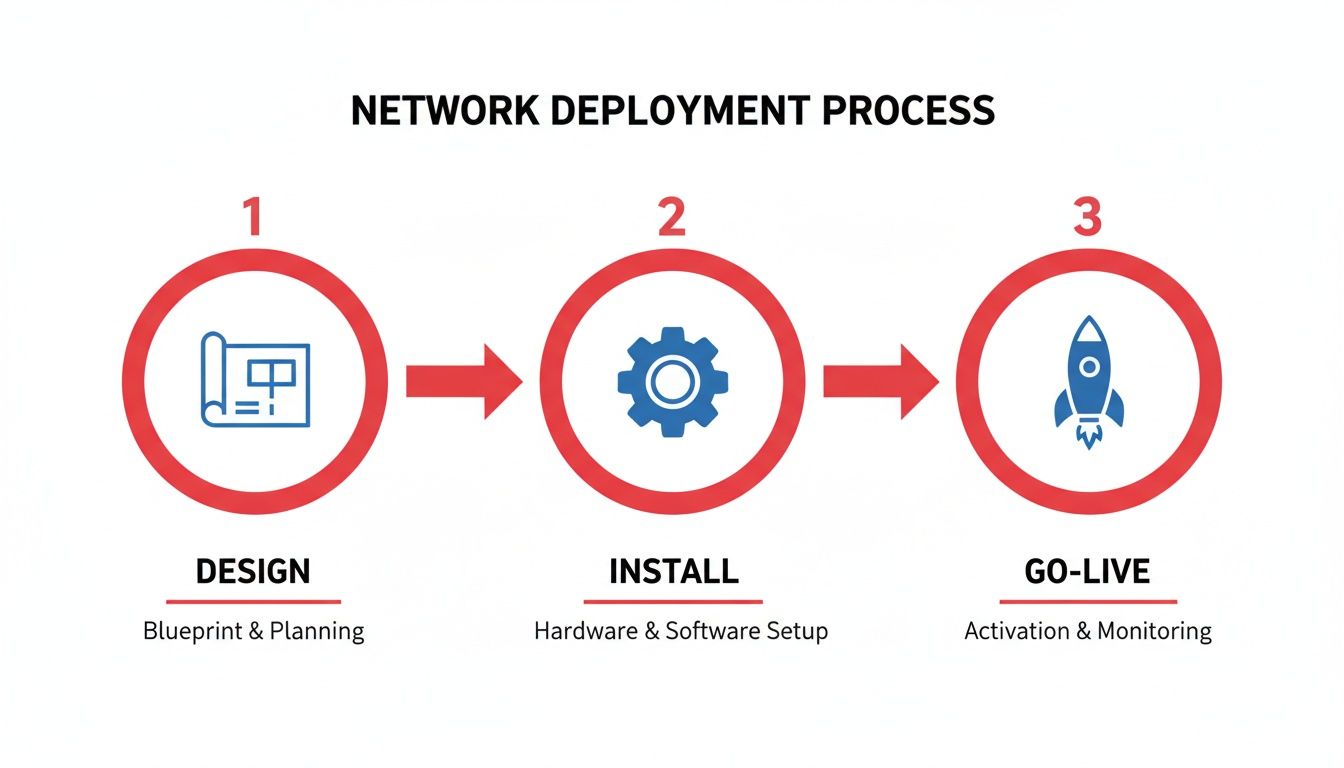
This visual boils the entire process down to its core, showing how a turnkey partner transforms a complex project into a clear, manageable progression.
Phase 3: Integration, Testing, And Handover
Once the physical build is complete, the most critical work begins. System integration is the intricate process of configuring every active component to communicate flawlessly as one cohesive network. This is far more than just plugging things in; it requires deep technical expertise to fine-tune performance and lock down security.
The real objective of the testing phase is to shift the project from "it's built" to "it's proven." A great turnkey partner meticulously validates every single element against the original design, proving it can stand up to real-world operational demands.
This involves running a battery of rigorous tests to catch any potential problems before you go live. Key validation steps include:
- Performance Testing: Checking that speed, latency, and throughput not only meet but hopefully exceed the promised benchmarks.
- Stress Testing: Pushing the network to its absolute limit to ensure it remains stable and reliable even under the heaviest traffic loads.
- Security Audits: Proactively scanning for any vulnerabilities and confirming that all security measures are properly configured and active.
The final step is the official handover. Your turnkey partner provides you with a fully operational and validated network, complete with detailed "as-built" documentation, clear network diagrams, and all configuration files. This thorough knowledge transfer sets your internal team up for success, empowering them to manage the new network with confidence from day one.
Weighing The Benefits And Potential Risks
Deciding to go with a turnkey network solution is a huge strategic move—it's not just a procurement choice. While the "all-in-one" model offers some massive advantages, it's not a silver bullet. You have to be clear-eyed about the potential trade-offs.
Getting a balanced perspective is the only way to know if this single-contract, outcome-based approach really fits your organization. Let's break down the pros and cons so you can make a call that lines up with your budget, your operations, and your long-term goals.
The Clear Advantages Of A Turnkey Model
The biggest win, right out of the gate, is speed. A turnkey partner gets you to market, fast. Instead of juggling a dozen vendors and watching deadlines slip, you have one team driving the entire project forward. This singular focus means your network is built, tested, and ready for customers in a fraction of the time, letting you start seeing a return on your investment sooner.
Another powerful advantage is predictable budgeting. A single, comprehensive contract means no more surprise invoices or budget blowouts from subcontractor scope creep. That kind of financial certainty makes planning a whole lot easier and is a huge plus when you're trying to get stakeholders on board.
You also get instant access to a deep bench of specialists. Your partner brings battle-tested expertise in engineering, project management, and navigating the maze of regulations—skills that would be incredibly expensive and time-consuming to build from scratch. This expertise is usually backed by solid Service Level Agreements (SLAs), giving you performance guarantees from day one.
This model truly shines in large-scale deployments where keeping all the moving parts in sync is everything. Think massive 5G rollouts and hyperscale data center builds. The global 5G infrastructure market, estimated to be worth around USD 43.5 billion in 2025, is growing so quickly precisely because major players are choosing end-to-end packages to slash timelines and avoid integration nightmares. You can explore the dynamics of the 5G infrastructure market to see how this trend is playing out.
Understanding The Potential Risks And Downsides
Of course, no solution is perfect. The most common concern you'll hear about turnkey solutions is the risk of vendor lock-in. When you hand the keys to your entire network lifecycle to one company, it can be tough to switch providers or bring in different technologies later. This kind of dependency means you need to be confident you're choosing a real long-term partner, not just a contractor.
Then there's the initial cost. An all-inclusive proposal is naturally going to have a bigger sticker price than any single, piecemeal contract. While the Total Cost of Ownership (TCO) is often lower—once you factor in saved management time and fewer delays—that upfront capital investment can be a steep hill to climb for some organizations.
At its heart, the turnkey model is a trade-off between control and convenience. You gain incredible efficiency, but you might give up some of the fine-grained control and customization you'd have with a DIY approach.
Finally, you might find your options for very specific customizations are limited. To be efficient, turnkey providers often rely on standardized equipment and repeatable processes. If your project has truly unique or non-standard requirements, you'll need to confirm upfront that your partner is willing and able to accommodate them.
How To Mitigate The Risks
The good news is that these risks are entirely manageable if you're proactive. A smart contract and the right partner can give you the best of both worlds.
Here’s how to protect yourself:
- Combat Vendor Lock-In: Write it into the contract that you own all documentation, network diagrams, and configuration files. Push for open, standards-based technologies to avoid getting stuck with proprietary hardware or software that no one else can support.
- Address High Initial Costs: Don't be afraid to ask for flexible payment schedules. You could also explore a Network-as-a-Service (NaaS) model, which turns a huge capital expense into a predictable operating expense. A detailed TCO analysis will also help make the case to leadership by showing the long-term savings.
- Preserve Flexibility: Be crystal clear about any custom needs in the initial scope of work. Look for a partner who can show you examples of tailored solutions they've built and ask to speak with those clients.
By tackling these issues head-on during your selection process, you can build a partnership that delivers all the upside of a turnkey solution while keeping the potential downsides in check.
How To Choose The Right Turnkey Partner

The ultimate success of your network deployment really comes down to one thing: picking the right partner. A great partner becomes a true extension of your team, bringing deep expertise and a sense of ownership to the table. The wrong choice, however, can quickly spiral into costly delays, budget overruns, and persistent operational headaches.
This decision is too critical to be left to chance. The best way to protect your investment is to follow a structured evaluation process. It's about looking past the polished sales pitches and digging into a provider's real-world capabilities, financial health, and project management discipline. The goal isn't just to complete a project; it's to build a reliable, long-term relationship.
Technical Expertise and Certifications
First things first, you need to verify their technical chops. A provider's team should hold current, industry-recognized certifications that are actually relevant to your project. This could be anything from fiber optics and wireless technologies to specific routing and switching platforms. These credentials aren't just for show—they're proof of a commitment to quality standards and ongoing education.
Beyond individual certs, ask about company-level accreditations and, more importantly, for proof of their hands-on experience with the specific hardware and software you plan to use. This ensures they have a practical, battle-tested understanding of the technology, not just a theoretical one.
When looking at potential partners, you'll also want to gauge their experience in different environments. For example, if your project involves underground cabling, it’s worth understanding their experience working with specialized cable contractor companies and the unique expertise required. This kind of specialized knowledge is a huge indicator of a capable provider.
Project Management Methodologies
How a partner runs a project is just as crucial as their technical skill. You need to ask detailed questions about their project management framework. Do they follow Agile, Waterfall, or a hybrid model? A mature provider will have a well-defined process for everything from communication and risk management to quality assurance.
They should be able to give you clear, real-world examples of how they handle common project curveballs, like scope creep, unexpected site conditions, or equipment delays. Ask to see sample project plans, communication schedules, and progress reports. Transparency here is a must-have, as it gives you a sneak peek into what your day-to-day working relationship will actually feel like.
A partner’s project management methodology isn't just administrative overhead; it's the operational backbone that ensures your project is delivered on time, within budget, and to the quality standards you expect. It transforms a complex deployment into a predictable and manageable process.
Supply Chain and Long-Term Support
A provider’s ability to deliver is directly tied to the strength of its supply chain. In today's world of fluctuating component availability, you need a partner with solid, established relationships with key equipment manufacturers and distributors. You should absolutely ask about their procurement strategies and how they buffer against the risk of supply chain disruptions.
Ask some tough questions to see how resilient they really are:
- Vendor Relationships: Do they have priority status with major hardware vendors that can help secure equipment during shortages?
- Inventory Strategy: How do they stock critical components to prevent project-killing delays?
- Logistical Capabilities: What's their plan for managing the logistics of getting equipment to multiple sites, especially for a large-scale deployment?
Your evaluation shouldn't stop at deployment, either. What does their long-term support structure look like? Make sure they offer comprehensive post-launch services, including maintenance, troubleshooting, and crystal-clear Service Level Agreements (SLAs) for ongoing network management.
Finally, don't overlook the importance of cultural fit and direct experience in your field. Always ask for case studies and references from clients in your specific industry—whether you're an ISP, a data center, or a municipality. Speaking with past clients gives you an unfiltered look at a partner's true performance, communication style, and their ability to deliver on promises. A partner who already understands your unique operational challenges is far better equipped to build a network that truly moves your organization forward.
Vendor Evaluation Checklist
Selecting the right partner requires a methodical approach. Use the following checklist to guide your conversations and compare potential vendors on the criteria that matter most. This structured process helps ensure you're making a well-informed decision based on capabilities, not just promises.
| Evaluation Category | Key Questions To Ask | What To Look For In A Response |
|---|---|---|
| Technical Expertise | Can you provide a list of relevant team certifications (e.g., FOA, BICSI, Cisco)? What is your direct experience with [Your Specific Technology]? | A list of current, relevant certifications. Specific project examples, not just a list of technologies they've heard of. |
| Project Management | What project management framework do you use? How do you handle scope changes and communicate progress? Can we see a sample project plan? | A clear, documented methodology (e.g., Agile, Waterfall). A structured change order process and a transparent communication plan. |
| Supply Chain & Logistics | Who are your primary hardware partners? How do you mitigate supply chain risks? What is your inventory strategy for critical components? | Established, high-level partnerships. A clear risk mitigation plan and evidence of strategic inventory management. |
| Industry Experience | Can you provide 2-3 case studies or references from clients in the [Your Industry] sector? What specific challenges have you solved for them? | Relevant examples that mirror your project's scope and complexity. References who can speak to their problem-solving skills. |
| Post-Deployment Support | What do your standard SLAs cover? What is your process for incident response and management? Who would be our primary point of contact for support? | Clearly defined SLAs with specific response times. A well-documented support process and a dedicated account manager or support team. |
A partner who can confidently and thoroughly answer these questions is one that likely has the experience and processes in place to ensure a successful deployment. This due diligence upfront is the single best investment you can make in the future of your network.
Breaking Down the Costs and Calculating Your Return
Let's talk money. Getting a handle on the financials is obviously a huge part of deciding if a turnkey network solution is the right move. The real story isn't just about the initial quote; it's about the total financial impact on your organization. To see the full picture, you have to look past the upfront price and understand how this approach can fundamentally change how you budget for and manage your network.
Traditionally, building a network is a Capital Expenditure (CapEx)-heavy game. It involves massive, upfront investments in physical hardware and infrastructure. A turnkey model can completely flip that script, introducing predictable costs that look a lot more like an Operating Expenditure (OpEx), especially as subscription-based services become more common.
The Shift from Big Upfront Costs to Predictable Payments
This move toward a more flexible, service-based model is gaining serious momentum, largely thanks to Network-as-a-Service (NaaS) and other cloud-managed options. These services effectively turn your network infrastructure from a one-time capital purchase into an ongoing, managed service.
The market numbers back this up. The global NaaS market was valued at USD 33.22 billion in 2025 and is expected to rocket to roughly USD 115.36 billion by 2030. That's a clear signal that businesses are increasingly choosing turnkey subscription packages over sinking huge amounts of capital into hardware. This trend is all about lowering the barrier to entry and getting access to the latest tech without the sticker shock. You can dig deeper into NaaS market trends here.
Switching to an OpEx model has some powerful advantages:
- No More Budget Surprises: A fixed monthly or annual fee makes budgeting a breeze and kills the anxiety of unexpected maintenance bills.
- Free Up Your Capital: Instead of tying up cash in depreciating assets, you can invest it in core business activities that actually drive growth.
- Future-Proof Your Tech: The provider shoulders the responsibility of keeping your technology up-to-date, so you don't have to worry about your network becoming obsolete.
Thinking Beyond the Sticker Price: Total Cost of Ownership
At first glance, the price tag for a turnkey solution might look higher than just buying the components and doing it yourself. But that's not a fair fight. A true comparison requires looking at the Total Cost of Ownership (TCO), which includes every single direct and indirect cost over the network's entire life.
TCO isn't just about what you buy; it's about what you avoid. It shines a light on all the hidden costs of a traditional deployment—project management headaches, integration nightmares, and the very real cost of delays—that a turnkey solution is built to absorb.
When you're running the TCO numbers for a DIY approach, don't forget to include these often-missed expenses:
- Your Team's Time: What are the salaries of the project managers, engineers, and procurement staff you'll have to dedicate to this project? That's a real cost.
- Making It All Work Together: The time and money spent getting different systems from different vendors to play nicely with each other can be staggering.
- The Cost of Waiting: How much revenue do you lose for every single day your network launch is delayed because of a coordination snafu or supply chain issue?
A turnkey partner rolls all of these potential costs into a single, clear price, giving you a much more honest and accurate view of the investment right from the start.
A Simple Framework for Calculating Your ROI
Your Return on Investment (ROI) is where the rubber meets the road. It’s about measuring the financial gains against the total cost. With a turnkey network, that return comes from two places: direct cost savings and getting to revenue faster.
To build a solid ROI case, you need to put a number on these key benefits:
- Speed to Market: This is often the biggest win. Figure out the daily or monthly revenue your new network will bring in. Then, multiply that by the number of weeks or months a turnkey solution shaves off your timeline compared to a traditional build.
- Lighter Operational Load: Estimate the savings you’ll see by freeing up your internal technical experts. Instead of being bogged down in network deployment, they can get back to focusing on core business innovation.
- Rock-Solid Reliability: What does an hour of downtime cost your business? A turnkey solution backed by a strong SLA drastically reduces that risk, which translates directly into saved revenue and a protected reputation.
When you combine a faster path to revenue with a lower total cost of ownership, the business case for going turnkey becomes incredibly clear. It proves that the real value isn't just in the final product, but in getting to your business goals faster and with far more certainty.
Turnkey Solutions In The Real World
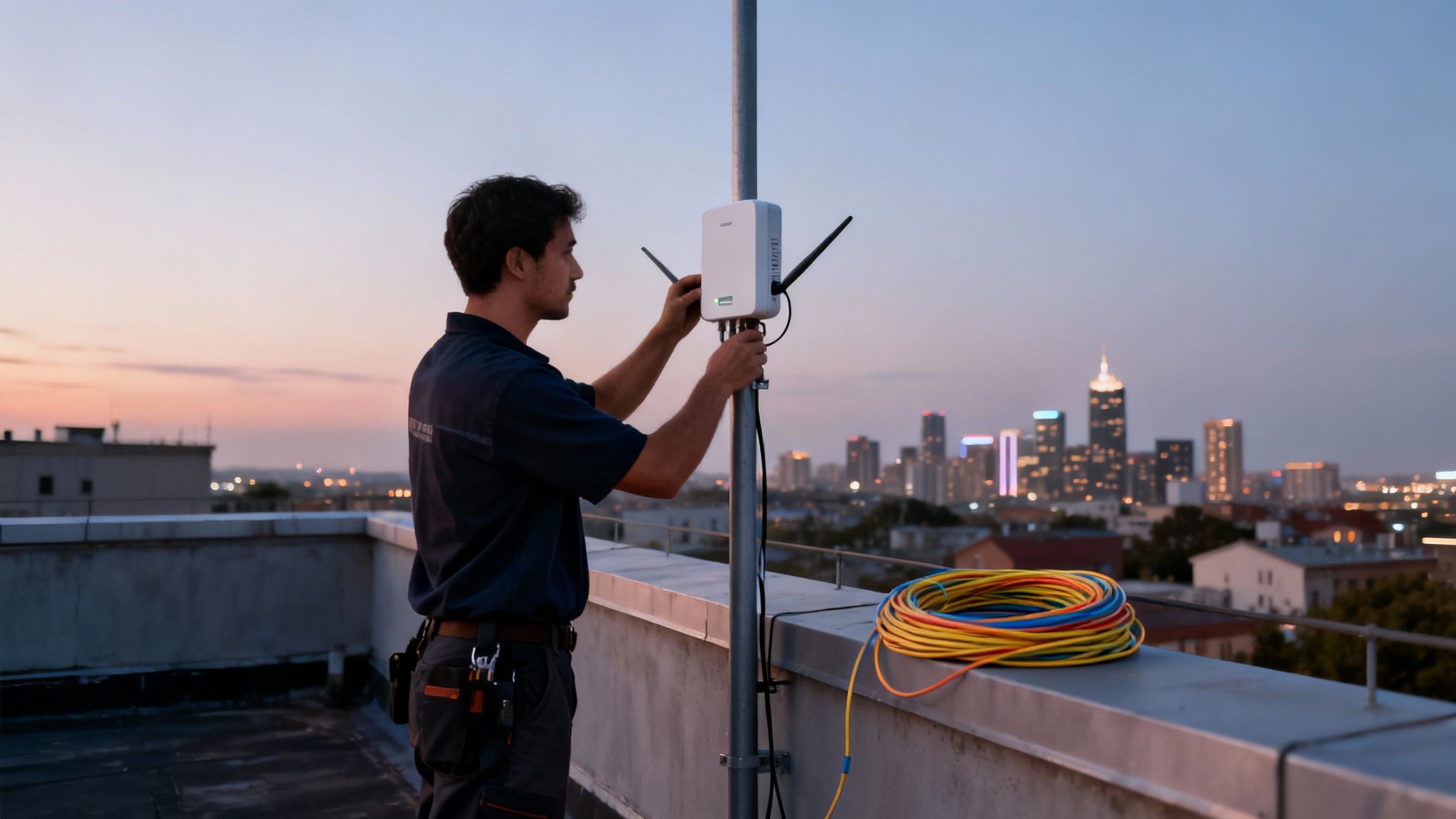
It’s one thing to talk about the theory behind turnkey network solutions, but it’s another to see how they perform in the trenches. These partnerships are more than just a convenience; they’re strategic decisions that help organizations pull off ambitious projects that would otherwise be impossible.
Whether it's bringing high-speed internet to rural towns or building the backbone for a next-gen data center, the results are what really matter. Let’s look at a few examples of how this all-in-one approach has turned huge infrastructure hurdles into game-changing advantages.
Case Study: Regional ISP Challenges The Giants
A growing regional Internet Service Provider (ISP) found itself in a common bind. They had a golden opportunity to roll out a state-of-the-art Fiber-to-the-Home (FTTH) network and take on the big national players, but their in-house team just wasn't big enough for a project of that scope. The thought of managing permitting, civil engineering, and deployment across several towns was a logistical nightmare.
Instead of trying to do it all themselves, they brought in a turnkey partner to run the entire show. This partner handled everything: initial route design, securing rights-of-way, the physical trenching, fiber splicing, and even the final installations at customer homes.
The impact was immediate. The ISP was able to launch its new service a full year ahead of its most optimistic internal projections. This speed allowed them to grab a huge chunk of the market before the bigger competitors even knew what was happening, leading directly to faster revenue and a much quicker return on their investment.
Case Study: Data Center Meets An Impossible Deadline
A hyperscale data center operator had a good problem—they landed a massive client, but the contract came with an aggressive nine-month deadline to get a new facility online. The biggest challenge? The complex network fabric, which required thousands of high-density fiber connections and equipment from several different vendors.
A turnkey network provider was brought in to take full ownership of this critical piece of the puzzle. They managed the entire network deployment, from the structured cabling and hardware installation to the final configuration and a battery of rigorous tests.
By handing the entire network build to a single, accountable partner, the data center operator took a huge amount of risk off the table. Their internal teams could focus on other crucial systems like power and cooling, knowing the network would be ready when they needed it.
The facility went live right on schedule, hitting the client’s deadline and avoiding what could have been millions in contract penalties. Better yet, the network performed perfectly from day one, proving the value of the partner’s integrated testing and validation process.
Case Study: Smart City Powers Public Connectivity
A forward-thinking city wanted to launch a major smart city initiative. The plan included free public Wi-Fi downtown, an IoT sensor network to manage traffic, and better connectivity for emergency services. The only problem was the city’s IT department was already stretched to its limit.
They chose a turnkey network solution that packaged the entire project into a single managed service. The partner designed and built out the city-wide wireless network, installed IoT gateways on light poles, and connected everything to the city’s traffic control center.
The project was a huge success. Not only did the technology work, but it delivered real-world results. For example, the new IoT traffic sensors helped reduce traffic congestion by 15% during rush hour. The turnkey model allowed the city to deliver sophisticated public services far faster and more affordably than if they had tried to piece it all together themselves.
Answering Your Key Questions
Even after mapping out the entire process, you're bound to have some specific questions. That's a good thing. Getting into the details is how you move from understanding a concept to making a confident decision for your organization.
Let's tackle a few of the most common questions that come up when people are considering a turnkey partner.
How Much Customization Is Really Possible?
This is probably the number one question we hear, and the honest answer is: it depends on the provider. Some turnkey companies have a very standardized, cookie-cutter approach that prioritizes speed and efficiency. Others build their entire business on creating completely custom, bespoke networks from the ground up.
The trick is finding a partner whose model fits your project. A genuinely skilled provider won't force you into a box; they'll work with you to tailor everything from the specific hardware they install to the overall network architecture to hit your unique performance and operational targets.
What Should We Actually Look for in the SLA?
Everyone gets drawn to the big uptime number, like 99.999%, but the service level agreement (SLA) is so much more than that. This contract is your safety net, and the real value is in the fine print that dictates how problems are handled.
Don't just glance at the uptime. Dig into these crucial commitments:
- Mean Time to Repair (MTTR): This is the big one. How fast are they contractually obligated to fix a problem once it's been identified?
- Response Time: How quickly will a qualified engineer actually acknowledge an alert and start working on a solution?
- Penalties for Non-Compliance: What happens if they miss these targets? A solid SLA includes clear, meaningful consequences for failing to meet their promises.
A strong SLA moves beyond simple uptime guarantees and provides a clear, time-bound commitment to issue resolution. It reflects a partner's confidence in their ability to deliver a resilient and well-managed network.
How Are Future Upgrades and Scalability Handled?
A network deployment isn't a one-and-done project. Your needs will change, and technology will evolve. The last thing you want is a network that's already obsolete the day it goes live.
A forward-thinking partner builds for tomorrow, not just today. Your contract should explicitly detail the process for handling technology refreshes and expanding capacity. This proactive planning is what separates a short-term vendor from a long-term partner, ensuring your network can grow with your business instead of holding it back.
Ready to eliminate the complexities of network deployment with a single, accountable partner? Southern Tier Resources delivers end-to-end engineering, construction, and maintenance for wireline and wireless networks, ensuring your project is completed on time and to the highest standards. Learn more about our turnkey network solutions.