The budget review is Monday, but the underground fiber installation decision is being made in the field this week. On a greenfield corridor, the aerial option may look cheaper on the bid tab, while a bore proposal appears difficult to defend. Then the project team checks the pole-make-ready queue, reviews the municipal right-of-way rules, and asks what the route must still deliver decades after construction.
That's where the decision changes. Buried fiber isn't automatically the better build, and aerial fiber isn't automatically the economical one. The right choice depends on capital cost, schedule certainty, outage exposure, maintenance access, permitting risk, and the expected life of the route.
Why Underground Fiber Is a Strategic Choice
On Monday, a project manager may see an aerial design with a lower bid and an underground design carrying a much larger civil allowance. The aerial figure is only the starting point. Pole attachments, make-ready construction, vegetation work, storm repairs, and access-approval delays can change the cost and delivery date before the first fiber is installed.
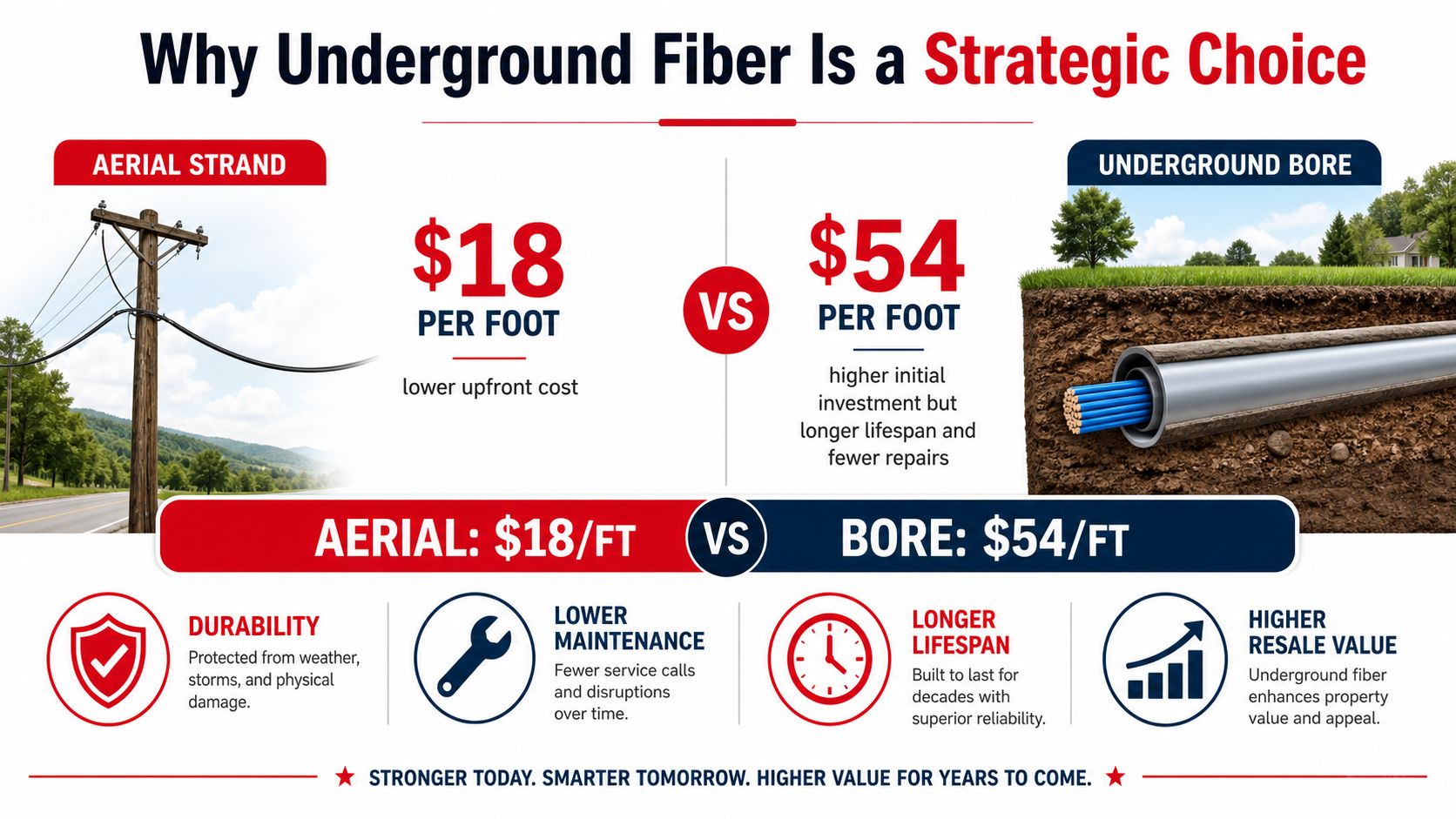
The Fiber Broadband Association and Cartesian cost study places the median underground fiber deployment cost at $16.25 per foot, compared with $6.49 per foot for aerial deployment. The later 2025 report lists median costs of $18.00 per foot underground and $8.00 per foot aerial. Buried construction therefore carries a materially higher direct installation cost.
That premium explains the pushback underground fiber installation receives in budget reviews. It does not settle the total-cost question, because schedule certainty, access to poles, outage exposure, maintenance work, and route longevity also belong in the comparison.
The route strategy matters more than the bid tab
Carriers and municipalities often select underground routes where wind, ice, hurricanes, vehicle contact, visual impact, or pole congestion create unacceptable exposure. Data center operators may also place greater value on protected, diverse pathways than on the lowest initial civil price. Underground reduces some surface hazards, while introducing utility conflicts, drainage problems, difficult access, and restoration obligations.
Aerial construction carries recurring obligations of its own. Pole owners may require attachment reviews and make-ready work, and crews may need to rearrange existing strand before adding a cable. Vegetation cycles add continuing maintenance, while severe weather can turn one damaged span into an emergency restoration event.
Practical rule: Compare the underground premium with the cost and uncertainty of preparing the aerial route, not with the aerial strand price alone.
The 2025 industry report says 92% of respondents reported higher deployment costs, identifying labor, permitting delays, and make-ready work as drivers. It also projects underground construction to represent more than 65% of fiber construction through 2030, citing pole attachment and permitting delays that can constrain aerial deployment. These figures appear in the 2025 Cartesian cost report. For a project team, the useful question is which route reaches service readiness with the least total risk.
Underground often wins in dense, storm-prone, regulation-heavy, or pole-constrained corridors. Aerial can still be the better build across open rural terrain with clear pole access and few civil obstacles. Evaluate the expected operating life, restoration posture, and schedule commitment alongside construction cost. A higher civil allowance can be the more defensible total-cost decision when it buys a route that remains usable and maintainable for decades.
Four Underground Deployment Methods Explained
The four common underground methods address different field constraints. The lowest unit price is not automatically the lowest-cost build once road crossings, restoration, utility conflicts, access, and future maintenance enter the estimate.
Direct burial places the cable, or a suitable buried product, in a trench before the crew backfills it. Direct burial works much like laying conduit in a prepared bed, simple in soft, open ground and impractical where utilities or rock intervene. It fits open land with manageable restoration and few obstructions. Major road crossings, dense utility corridors, hard rock, and the need for future cable replacement make it a weaker choice.
Open-cut conduit creates a protected pathway below the surface. Crews excavate, install the raceway, add warning and separation systems where required, place the cable, and restore the trench. The cable can also be installed later, while spare conduit supports expansion. Surface disruption is greater than with a bore, but the owner gains a replaceable route and a simpler path for cable upgrades.
Microtrenching uses a narrow saw-cut slot in asphalt or another paved surface. It suits urban rights-of-way where full excavation would cause disproportionate disruption. Crews can progress quickly along a paved corridor, but the slot, sealant, pavement condition, and local freeze-thaw behavior need close review. A fast cut does not make a sound installation if water enters the duct or pavement failure exposes it.
Directional boring, also called horizontal directional drilling or HDD, steers a drill beneath roads, driveways, waterways, and other sensitive surfaces. The process reaches beneath an obstacle without opening the surface above it. A pilot bore establishes the route, a reamer enlarges the hole, and the crew pulls conduit or cable through the finished bore. HDD limits surface disruption, but results depend on soil conditions, bore geometry, drilling-fluid management, and accurate utility records.
The 2024 cost study reports median underground method costs of $12.00 per foot for trenching, $15.10 per foot for directional boring, and $17.00 per foot for plowing in the categories it evaluated. Treat those figures as benchmarks rather than contractor quotes. Cable count, duct strategy, soil, restoration, traffic control, and site access can change the actual price by a wide margin.
| Method | Typical Depth | Best Suited For | Key Limitation |
|---|---|---|---|
| Direct burial | Set by owner, utility, and surface requirements | Open, soft, low-conflict corridors | Limited replaceability and poor tolerance for obstructions |
| Open-cut conduit | Set by roadway and utility requirements | Greenfield routes and planned utility corridors | Surface disruption and restoration exposure |
| Microtrenching | Shallow narrow slot where permitted | Paved urban rights-of-way and FTTH access | Pavement, water, and freeze-thaw performance |
| Directional boring | Set by profile, utilities, and cover requirements | Crossings, dense corridors, and sensitive surfaces | Higher drilling complexity and geotechnical risk |
Method selection should remain visible in the plan set, including the assumptions behind depth, restoration, access, and future capacity. For teams managing repeated revisions, spec books and plan printing can help keep field crews, inspectors, and subcontractors working from the same approved documents. That document control supports schedule certainty, but it does not replace a route-specific civil estimate.
Design Limits and Permitting That Shape Every Build
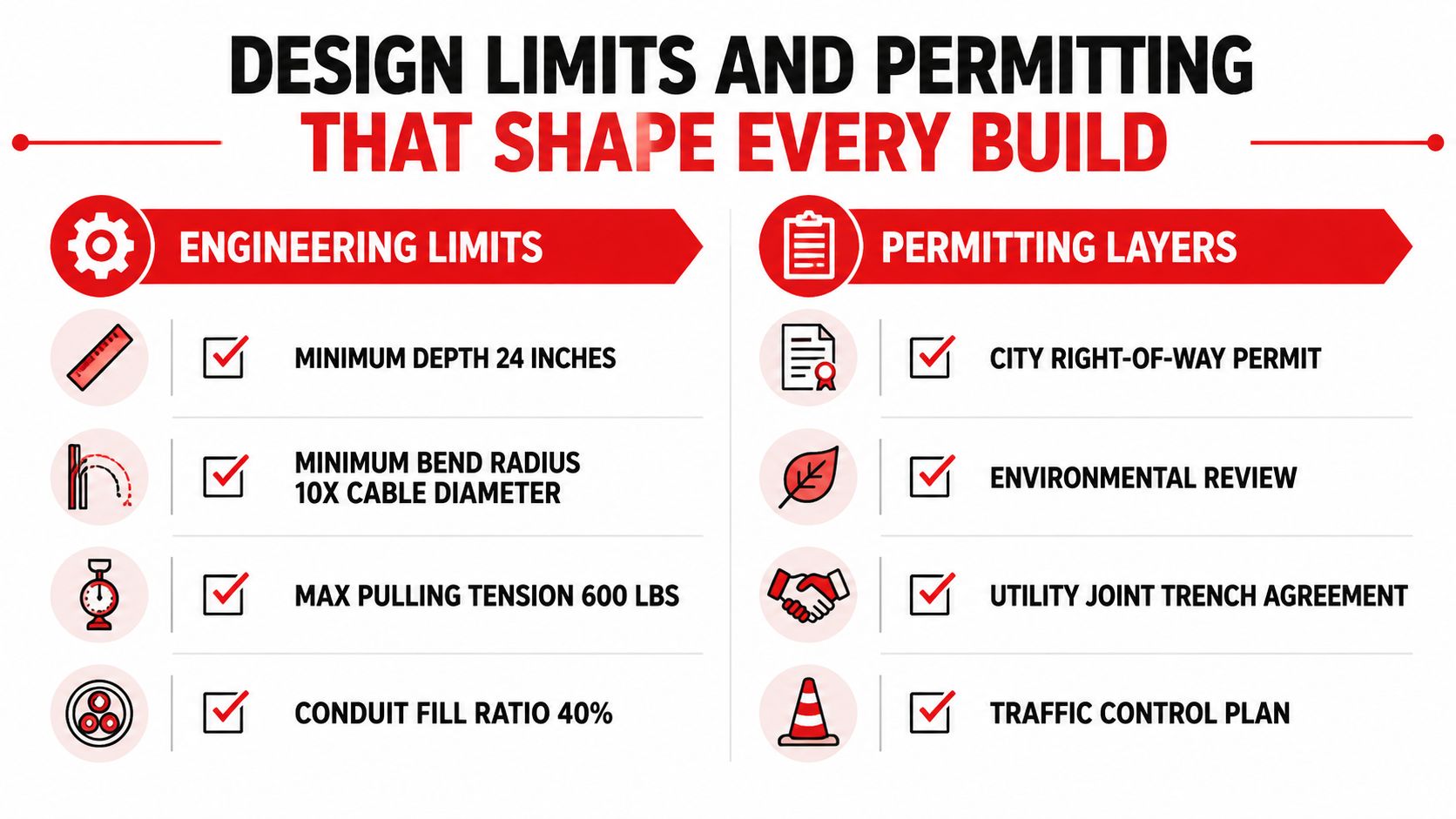
Underground fiber installation is governed by physical limits that crews can't negotiate in the field. Cover protects the cable from surface loads and future disturbance. Bend radius protects the glass from mechanical stress. Separation and crossing clearances reduce the chance that another utility installation, excavation, or repair will damage the route.
Corning guidance cited in an industry installation document recommends 30 inches of cover in soil and 42 inches at roadway crossings. The same guidance identifies a working bend radius of 15 times the cable outside diameter during installation and 10 times the outside diameter at rest. Exceeding those limits can create microbending, macrobending, attenuation, or cable damage. The Corning installation guidance document provides the source for those values.
A separate conduit placement standard specifies a 36-inch minimum conduit bend radius, coupling strength for 125 psi blowing pressure, and 48 inches of minimum depth for that program's field conditions. The municipal conduit placement standard shows why conduit geometry matters during air-assisted cable placement. Tight bends and weak couplings increase friction and pressure losses, which can shorten the practical installation distance or stop a cable placement altogether.
The permit package controls the calendar
A bore plan is only one part of the project schedule. The route may also require utility locates, right-of-way approvals, transportation permits, railroad coordination, environmental review, historic-preservation review, franchise consent, and traffic-control approval. BroadbandUSA's permitting guidance describes the multiple reviews that can affect underground broadband construction.
The project team should treat the permit set as a production deliverable, not an administrative attachment. A strong package normally includes route and profile drawings, utility conflict information, restoration details, traffic-control plans, construction notes, and method-of-procedure documents. Missing details create review comments, and review comments create redesigns, resubmittals, and remobilization.
Field consequence: A small route deviation can invalidate cover, bend, separation, or crossing assumptions. Don't let a crew “solve” a conflict in the trench without engineering and permit approval.
The project manager should assign one owner for permit comments, maintain a conflict register, and confirm that the approved drawings match the construction staking. The permit calendar often determines whether the contractor can mobilize when the bid assumes it can.
Cost and Timeline Factors Side by Side
An underground bid can look competitive until restoration, traffic control, utility locates, engineering, and inspection support appear as change orders. Compare proposals only after every contractor prices the same scope. That is the first step toward a budget the project manager can defend.
The 2024 and 2025 benchmark reports show underground construction carrying higher median costs than aerial construction in both reporting periods. Those figures do not set a universal price for every method or corridor. A project estimate should separate civil work from cable, conduit, splicing, design, permits, and restoration, then assign schedule exposure to each item.
| Method | Installed Cost per Foot | Crew-Days per Mile | Top Schedule Killers |
|---|---|---|---|
| Direct burial | Often the lowest underground method where conditions permit | Driven by trenching production and restoration | Rock, utility conflicts, wet ground, backfill approval |
| Open-cut conduit | Higher than direct burial because it adds raceway and restoration scope | Driven by excavation, conduit placement, and surface repair | Traffic control, pavement matching, inspection holds |
| Microtrenching | Corridor-dependent, with strong sensitivity to pavement and sealing | Can be rapid in suitable paved routes | Pavement restrictions, weather, sealant acceptance, utility density |
| Directional boring | Higher equipment and engineering exposure | Driven by bore length, setup, reaming, and pullback | Unmapped utilities, poor soils, stuck tooling, drilling-fluid issues |
Crew-days per mile have meaning only with production assumptions. A short bore crossing cannot be compared with a long continuous bore. Soft-soil trenching and rock excavation through an active roadway carry different outputs, risks, and restoration demands.
Questions that expose incomplete pricing
Ask every contractor whether the proposal includes:
- Utility coordination: Locates, potholing, conflict resolution, and standby time.
- Restoration: Asphalt depth, concrete replacement, landscaping, striping, and inspection.
- Traffic control: Lane closures, flaggers, signage, and agency requirements.
- Engineering support: Profile changes, bore redesign, and permit resubmittals.
- Testing and records: OTDR traces, splice records, photos, redlines, and GIS updates.
Underground may cost multiple times more than aerial in an uncomplicated greenfield corridor. The difference can narrow when pole access is constrained, make-ready work is extensive, or aerial approvals threaten the schedule. The comparison should therefore include installed cost, delay exposure, redesign risk, restoration obligations, and future access over the route's intended service life.
That total-cost view often changes the decision. A higher civil allowance can buy schedule certainty, avoid pole bottlenecks, and provide a route with fewer access disruptions over decades. Underground is the smarter build when those avoided risks outweigh the added construction cost.
Construction Sequence From Bore to Splice
A reliable underground fiber route is built in a controlled sequence. The work starts before the drill rig arrives, and the quality record should follow the route from the first utility locate through final test acceptance.
Start with what the drawings can't prove
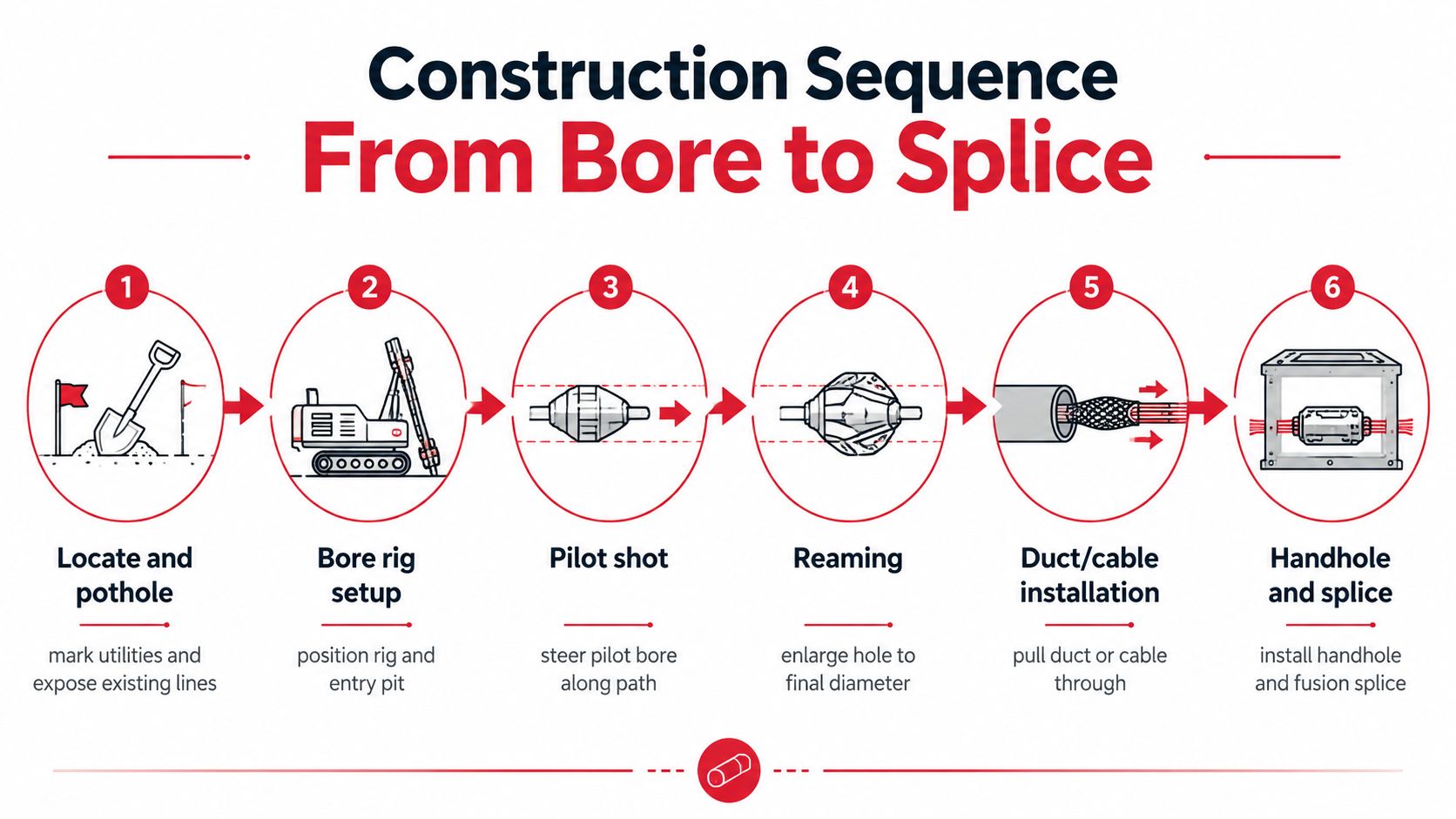
The locate ticket identifies known utility information, but it doesn't replace field verification. Crews mark the route, pothole or daylight critical crossings, record actual utility elevations, and adjust the profile before drilling. A pilot bore that follows an inaccurate utility assumption can create a conflict that no amount of later workmanship can repair.
The drill rig is then positioned at the entry point with enough room for the planned angle, drill string, fluid handling, and pullback. The pilot shot must follow the approved profile while maintaining cover and separation. Operators monitor depth, alignment, steering response, and drilling conditions rather than treating the bore as a straight line between two stakes.
Reaming enlarges the pilot hole to accept the planned duct or conduit. The crew should confirm that the final hole, pullback force, bend geometry, and conduit dimensions match the design. A successful pullback is not just a duct that reaches the receiving pit. It's a pathway that allows cable installation without exceeding mechanical limits.
Protect the cable during placement
After conduit installation, crews may pull or blow the fiber depending on the duct system and cable design. The supervisor should verify pulling tension, sidewall pressure, bend radius, lubricant compatibility, and duct continuity. Handholes must be placed at approved locations, sealed against water and debris, and left accessible for future maintenance.
Fusion splicing comes after cable placement and preparation. Technicians should clean and cleave fibers consistently, protect each splice in its tray, manage slack without tight loops, and record splice loss. OTDR testing and power-meter verification then provide the evidence that the installed link meets its design requirements.
The construction documentation guide from Pinnacle Property Media offers useful context for organizing progress records, site photos, and project documentation. In fiber work, that record should include bore logs, pothole records, duct continuity results, pull data, splice sheets, test traces, and restoration photos.
Here's a concise field sequence:
- Locate and pothole: Expose critical utilities and confirm the route.
- Set up the bore: Establish entry, exit, equipment, containment, and safety controls.
- Drill the pilot: Steer to the approved profile while monitoring conditions.
- Ream the hole: Prepare the path for duct or cable pullback.
- Install duct or cable: Control tension, bends, seals, and placement records.
- Place handholes and splice: Complete closure work, testing, labeling, and acceptance.
Crew habits determine whether the route performs for its intended life. Sharp backfill, unsealed ducts, undocumented deviations, and poorly managed slack can create failures long after the excavation is closed.
Testing, Restoration, and Long-Term Operations
Testing is the point where the owner learns whether the installed route matches the approved design. A cable can look undamaged in a handhole and still contain a high-loss splice, a bend-related defect, or a continuity problem that will complicate future activation.
Acceptance should include OTDR traces from the required directions, power-meter readings, splice-loss records, fiber identification, and end-to-end results against the project's approved loss budget. The test package needs enough detail for an operations team to identify the affected segment without returning to the field to reconstruct what the construction crew did.
Restoration is part of the asset
Surface restoration protects more than public appearance. Correct pavement reconstruction limits water entry, settlement, and future complaints that can jeopardize the owner's next right-of-way request. Landscaping, sidewalks, curbs, striping, and drainage features should be restored to the responsible agency's requirements, with inspection signoff captured in the closeout record.
A weak restoration process can turn a technically sound fiber route into a municipal liability. It also creates a poor relationship with the road owner, which matters when the same operator needs another permit in the corridor.
Build the future locate into today's closeout
The route's operating cost depends heavily on documentation quality. The owner should receive:
- As-built GIS data: Actual alignment, depth records where required, handhole locations, duct occupancy, and crossing details.
- Splice documentation: Fiber assignments, closure identifiers, tray positions, and measured loss.
- Access information: Handhole condition, cover details, working space, and restrictions.
- Capacity records: Occupied ducts, spare ducts, innerducts, and planned expansion pathways.
- Restoration evidence: Photos, inspection approvals, material records, and punch-list closure.
A route with accurate GIS and accessible handholes can support a fast locate, planned maintenance, and controlled expansion. A route with missing records forces technicians to search, expose, and verify conditions under pressure. That difference may not appear in the construction invoice, but it shapes the asset's value for years.
When Underground Becomes the Faster, Smarter Build
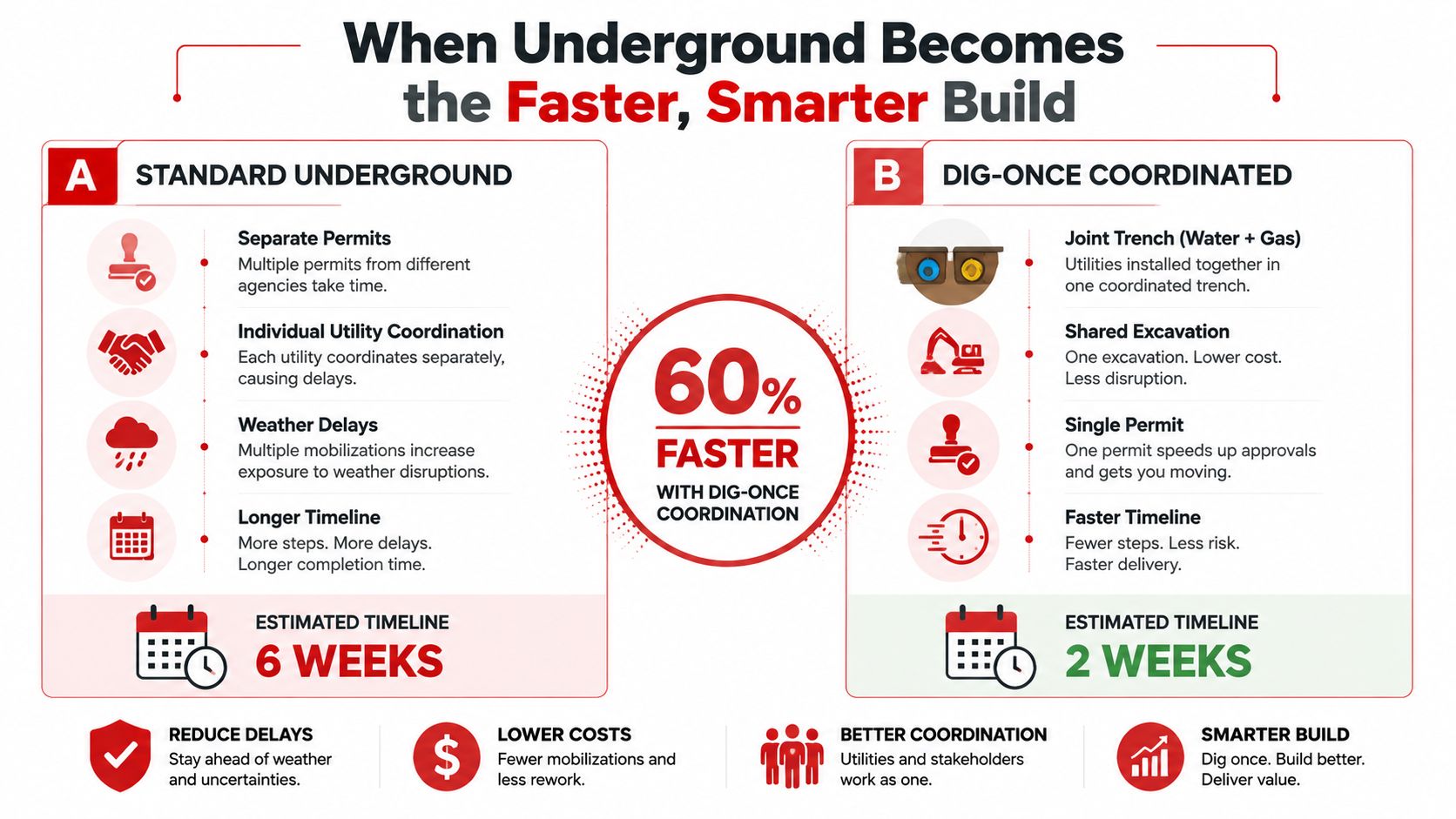
Pole ownership, make-ready construction, attachment reviews, and bans on new overhead facilities can hold an aerial route outside the project's control. In those corridors, underground fiber may deliver the service sooner, even with higher civil costs. The budget decision should account for schedule certainty, access risk, and route life, not only installation cost.
A coordinated excavation can shorten delivery further. Vanderbilt Dig Once research highlights how road projects miss opportunities to place conduit while excavation is already open. If a roadway, water, or utility project has a permitted excavation window, fiber owners should coordinate early, assign responsibilities, and install a usable pathway before restoration begins.
Conditions that favor buried construction
Underground can compress the overall delivery schedule in:
- Dense urban cores: Limited pole space, complex crossings, and strict surface-control requirements favor a planned buried route.
- Pole-constrained corridors: Attachment approvals and make-ready work may outlast the underground civil window.
- Storm-prone regions: Burial can reduce exposure to repeated aerial damage and restoration work.
- Data center campuses: Controlled pathways support route diversity and facility protection.
- Municipal programs: Pre-cleared corridors and joint utility work can avoid repeated excavation and review.
A rural long-haul route with open poles, straightforward attachments, and limited vegetation may still favor aerial construction. Underground earns its premium when it removes a bottleneck, improves schedule confidence, or protects a route expected to operate for decades.
Project governance determines whether that advantage survives construction. Use a locked permit set, one accountable right-of-way contact, an early utility coordination meeting, and a restoration contractor aligned with agency standards. Set access and joint-trench responsibilities before crews mobilize. The Southern Tier Resources team provides engineering, construction, fiber splicing, testing, documentation, and maintenance support for buried networks.
If the budget must withstand more than a per-foot comparison, discuss route engineering, permitting, construction, splicing, testing, and as-built documentation with Southern Tier Resources. Evaluate the corridor as a complete operating asset, including access constraints and long-term route longevity.