When you hear the term “hyperscale data center,” don’t picture a typical server room. It's on a completely different planet. Think of it less as a building and more as a purpose-built digital factory, engineered from the ground up to power the massive cloud platforms run by companies like Amazon, Google, and Microsoft.
These facilities are the engine rooms of the modern internet. Their entire existence is dedicated to one thing: providing compute, storage, and networking resources that can scale almost infinitely, and on a moment's notice.
What Defines a Hyperscale Data Center
So, what really makes a data center "hyperscale"? It comes down to an architecture built for extremes. A traditional enterprise data center is designed to serve one company's specific needs, and a colocation facility rents out space and power to many different customers. A hyperscale facility, on the other hand, is a vast, uniform ecosystem.
It’s almost always designed, built, and operated by a single company for a singular purpose—delivering cloud services at an unbelievable scale. This single-minded focus is its superpower.
Instead of trying to accommodate a mishmash of different server brands and network gear from dozens of clients, everything inside is standardized. The servers, the racks, the network switches, even the power strips are all identical. This uniformity is what unlocks massive automation, allowing software to orchestrate tens of thousands of machines as if they were one giant computer. It’s all about minimizing human touch, driving down costs, and making growth fast and predictable.
Core Differentiating Factors
The difference really snaps into focus when you look at the raw numbers and design principles. A few key traits truly set hyperscale environments apart:
- Massive Physical Footprint: We're talking about facilities that cover hundreds of thousands, sometimes millions, of square feet. They are home to an mind-boggling number of servers—often well over 500,000 in a single location.
- Extreme Power Density: They draw an incredible amount of electricity, frequently measured in hundreds of megawatts. That's easily enough to power a small city.
- Software-Defined Automation: Human hands rarely touch these machines. Everything from deploying a new server to re-routing network traffic and recovering from failures is handled by sophisticated, custom-built software.
- Engineered for Redundancy: These facilities are built with multiple layers of backup for everything—power, cooling, and network links. When your service has millions of global users, even a few seconds of downtime is not an option.
To put it all into perspective, let's look at a direct comparison. The table below breaks down the fundamental differences in scale, architecture, and operational goals.
Hyperscale vs Traditional Data Centers at a Glance
| Characteristic | Hyperscale Data Center | Traditional Enterprise/Colocation Data Center |
|---|---|---|
| Scale | 500,000+ servers; 1,000,000+ sq. ft. | 100s to a few 1,000s of servers; 10,000-100,000 sq. ft. |
| Architecture | Homogenous, standardized commodity hardware | Heterogeneous, multi-vendor hardware |
| Ownership | Single-tenant (e.g., Google, Amazon, Microsoft) | Multi-tenant (colocation) or single-enterprise |
| Automation | Highly automated via software-defined infrastructure | Often requires significant manual intervention |
| Primary Goal | Massive horizontal scalability for cloud services | Reliability and support for specific business applications |
| Efficiency (PUE) | Ultra-low (approaching 1.1) | Typically higher (1.4 to 2.0+) |
As you can see, these aren't just bigger versions of the same thing. They are a fundamentally different breed of infrastructure, designed with a completely different philosophy in mind: massive, efficient, software-driven scale.
The Architectural Pillars of a Hyperscale Facility
A hyperscale data center isn't just a big building packed with servers. It's a precisely engineered ecosystem, a digital factory where five critical pillars—compute, storage, networking, power, and cooling—are designed to work in perfect concert. Every component is built not just to be large, but to scale efficiently and almost instantly. This tightly integrated architecture is what truly separates a hyperscale facility from a standard, large-scale data center.
These five pillars are so intertwined that a bottleneck in one can bring the entire operation to its knees. That’s why hyperscalers invest billions in custom-engineering each element, creating a resilient, high-performance foundation built for near-infinite expansion.
The image below illustrates the core principles of scale, speed, and automation that drive this architectural philosophy.
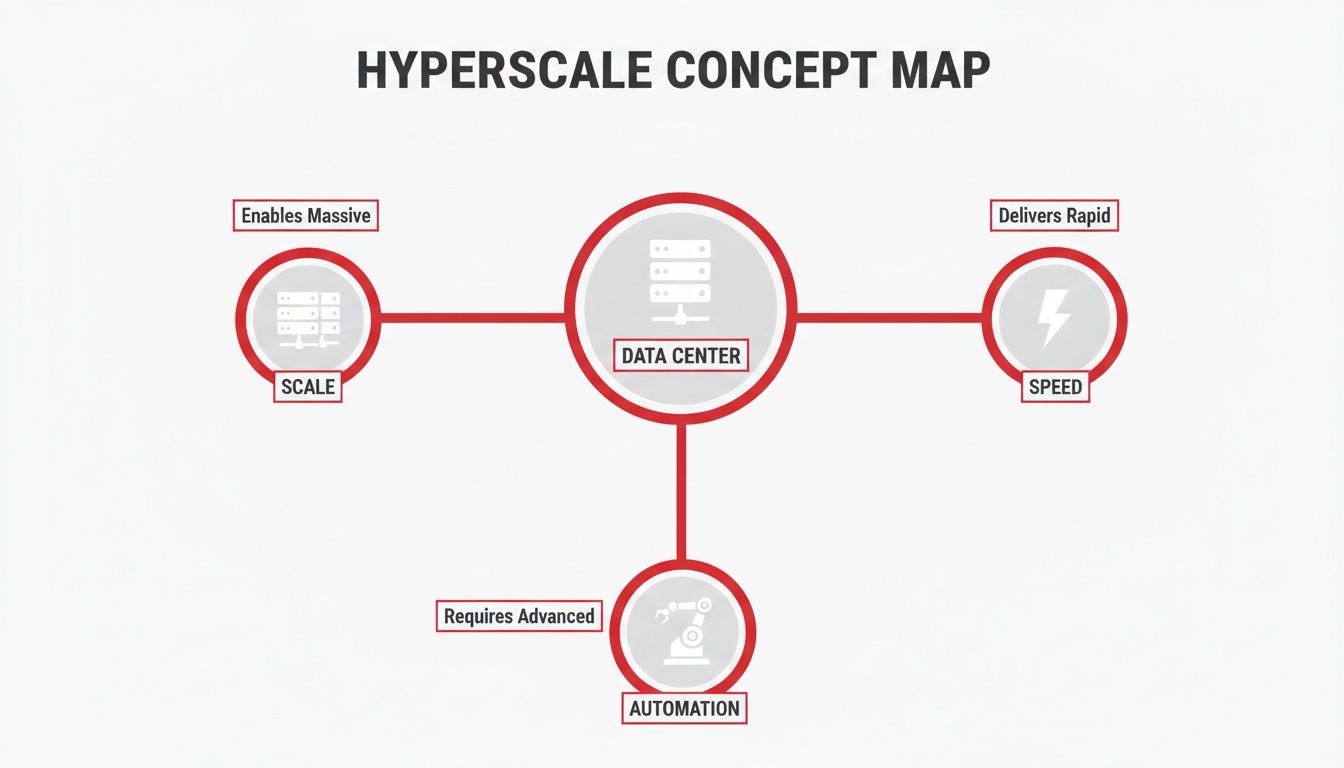
As you can see, the data center is at the center, branching out to the essential goals it must achieve: massive scale, incredible speed, and sophisticated automation to manage it all.
The Compute and Storage Foundation
At the heart of it all is the compute infrastructure. Forget about a collection of high-end, custom-built servers. Instead, picture a massive fleet of standardized, commodity servers designed for one thing: parallel processing. We're talking about tens of thousands of identical, minimalist machines working together as a single, distributed supercomputer.
This uniformity is the secret sauce. It drives down costs and makes scaling a breeze. When a new rack of servers is needed, it's a simple plug-and-play operation managed entirely by software, not a complex, hands-on integration project.
Working hand-in-hand with compute is the storage pillar, which has to manage data on an almost unimaginable scale—petabytes, and often exabytes, of information. Hyperscalers accomplish this with software-defined storage (SDS) systems. Rather than relying on expensive, specialized hardware, SDS uses smart software to manage data across vast pools of commodity drives. This ensures data is always available, protected, and easy to access.
High-Speed Networking Fabric
The third pillar, networking, is the central nervous system connecting everything. In a facility with hundreds of thousands of servers, a traditional network design would crumble under the load. Hyperscalers get around this by building a high-speed "fabric" that links every machine with the lowest possible latency.
This is often done using a "leaf-spine" architecture, a design that ensures any server is only a few short "hops" away from any other in the data center. The setup provides enormous bandwidth and multiple redundant paths, effectively eliminating single points of failure. The goal is to create a network where data flows as freely as electricity.
Power and Cooling on an Industrial Scale
Finally, we have the power and cooling pillars, the lifeblood of this digital factory. A single hyperscale campus can consume over 100 megawatts of electricity—enough to power a small city. This requires an incredibly robust power infrastructure, complete with dedicated substations, multiple utility feeds, and fleets of generators and uninterruptible power supply (UPS) systems for backup.
All that power generates an immense amount of heat, making cooling a monumental engineering challenge. Traditional air conditioning is both insufficient and wildly inefficient at this scale. Instead, hyperscalers rely on advanced cooling strategies:
- Hot/Cold Aisle Containment: Physically separating the cold air intake from the hot air exhaust of server racks to maximize efficiency.
- Liquid Cooling: Circulating liquid directly to server components, which removes heat far more effectively than air ever could.
- Free Air Cooling: Using cool outside air to chill the facility when temperatures permit, dramatically cutting down on energy costs.
For anyone planning the groundwork for such a massive project, understanding the specialized engineering involved is critical. You can learn more about the requirements for a successful data center infrastructure fit-out in our detailed guide. It's the harmonious operation of these five pillars that enables the incredible performance and reliability we've come to expect from the cloud.
Exploring the Drivers of Global Hyperscale Demand
The relentless expansion of hyperscale infrastructure isn’t happening in a vacuum. It’s a direct response to our own digital behaviors, scaled up to a global level.
Every time you stream a movie, join a video call, or use a cloud-based app, you’re tapping into the immense power of a hyperscale data center. These everyday actions, multiplied by billions of users, are the primary forces fueling an unprecedented construction boom.
At its core, the demand is driven by the explosive growth of data and the computational power needed to process it. The initial wave was the massive shift from on-premise servers to cloud computing, but a new set of technologies is now pouring gasoline on the fire.
The Accelerants of Hyperscale Growth
Several key trends are pushing the need for more, larger, and more powerful data centers. These aren't just small, incremental changes; they represent fundamental shifts in how we interact with technology.
- The Rise of Artificial Intelligence: AI and machine learning workloads are incredibly compute-intensive. Training a large language model requires thousands of specialized processors running in parallel for weeks or even months—a task only a hyperscale facility can handle efficiently.
- Big Data and Analytics: Businesses and researchers are collecting and analyzing massive datasets to uncover insights, and that requires vast storage and processing capabilities that can scale on demand.
- The Internet of Things (IoT): Billions of connected devices, from smart home gadgets to industrial sensors, are constantly generating streams of data that must be collected, stored, and processed.
- Global Content Delivery: High-resolution video streaming, online gaming, and immersive virtual reality experiences demand low-latency access to content, which means building data centers closer to population centers worldwide.
These drivers explain why the cloud giants are investing tens of billions of dollars in new facilities. They aren't just building for today's needs; they are building for the exponential growth they see coming tomorrow.
A Market Expanding at Unprecedented Speed
The financial scale of this expansion is simply staggering. It’s a direct reflection of the critical role these facilities now play in the global economy.
Hyperscale data centers are the absolute pinnacle of modern computing infrastructure. They’re designed to scale massively to support cloud giants like AWS, Google Cloud, and Microsoft Azure, handling petabytes of data and millions of users simultaneously.
A striking statistic underscores this explosive growth: the global hyperscale data center market is projected to surge from USD 197.08 billion in 2025 to a staggering USD 1,297.84 billion by 2032. That’s a compound annual growth rate (CAGR) of 30.9%.
This growth creates a powerful ripple effect across the entire technology ecosystem. It’s not just the cloud providers who stand to benefit.
"The AI datacenter is a unique, purpose-built facility designed specifically for AI training as well as running large-scale artificial intelligence models and applications… Unlike typical cloud datacenters… this datacenter is built to work as one massive AI supercomputer."
This insight shows that the demand isn't just for more space, but for highly specialized environments. This specialization creates immense opportunities for telecom carriers, internet service providers, and infrastructure partners who build the foundational fiber networks and power systems that connect these digital powerhouses.
Geographic Trends and Economic Impact
While North America has historically been the epicenter of hyperscale development, the demand is now a truly global phenomenon. We’re seeing rapid expansion across Europe and the Asia-Pacific region as cloud providers race to establish a local presence to reduce latency and comply with data sovereignty regulations.
This global buildout stimulates local economies, creating construction jobs and attracting skilled technology talent. However, it’s not without its challenges—chief among them, the immense power consumption of these facilities.
Given their scale and operational costs, implementing robust industrial energy efficiency strategies has become a critical driver for sustained growth and a key competitive advantage. As our world becomes more connected, the need for the powerful, efficient, and scalable infrastructure found in a what is hyperscale data center guide will only continue to accelerate.
How Modularity and Redundancy Ensure Constant Uptime
Hyperscale data centers manage to achieve near-perfect reliability by embracing two core engineering principles: modularity and redundancy. These aren’t just abstract design concepts; they are the very foundation that allows these massive facilities to grow at an incredible pace while delivering the constant uptime that global services depend on. Without them, the cloud services we use every day simply wouldn't work.
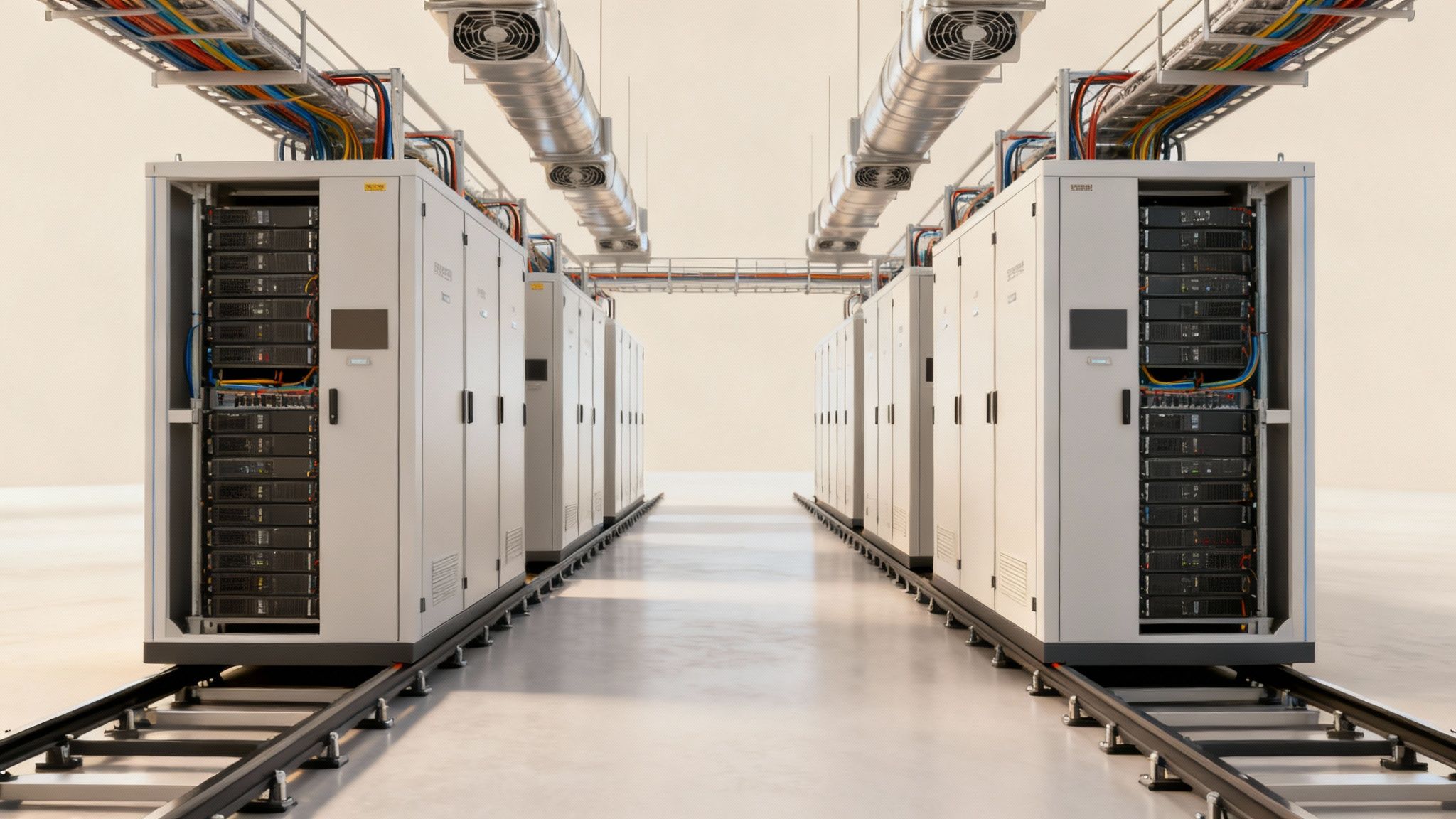
Think of it like building a city with standardized LEGO bricks instead of custom-carved stone. That's the core idea behind modularity in a hyperscale setting. Every single component—from server blades and racks to power distribution units and cooling systems—is a standardized, repeatable block. This approach transforms expansion from a complex, bespoke project into a predictable, almost assembly-line process.
Instead of waiting months for custom engineering, adding capacity becomes as straightforward as rolling in pre-configured racks and plugging them into standardized power and network ports. This "building block" strategy dramatically speeds up deployment, cuts down on costs, and makes maintenance far simpler across a global footprint.
Building Resilience with Redundancy
If modularity is about building fast, then redundancy is about building strong. It ensures the entire system can handle failures without skipping a beat. Imagine having multiple spare tires for your car, but for every single critical piece of equipment. When one part fails, another is already running and takes over instantly, and the switch is completely invisible to the end user.
This principle is woven into every layer of the data center, creating a defense-in-depth against any potential outage. It's an absolute must-have for hyperscale customers whose businesses rely on 100% availability.
At a massive scale, even the most reliable components will eventually fail. The hyperscale design philosophy doesn't aim to prevent every single failure; it assumes failures will happen and engineers a system that is completely resilient to them.
This "design for failure" mindset is what truly sets a hyperscale facility apart from a traditional enterprise data center. It's baked into the DNA of the power, cooling, and network architecture from day one.
Understanding Redundancy Models
To make this resilience a reality, hyperscalers rely on specific, well-defined models to eliminate any single point of failure. The two most common approaches are:
- N+1 Redundancy: This is the "one extra" model. For every group of essential components ("N"), you have at least one backup component ("+1"). For instance, if a system needs four power supplies to run, an N+1 design would have a fifth one standing by, ready to kick in if any of the primary four go down.
- 2N Redundancy: This is a fully mirrored, or "A/B," system. For every primary component, there is an identical, independent backup running in parallel. This means an entire primary power or cooling system could fail, and the facility would continue operating at full capacity on the secondary system without interruption.
This goes beyond just power and cooling. On the networking side, a hyperscale data center will have multiple, physically diverse fiber-optic paths connecting it to the outside world. If a construction crew accidentally severs one cable, network traffic automatically reroutes through the other paths, maintaining seamless connectivity.
In the end, modularity and redundancy are two sides of the same coin. Modularity gives you the scalable, cost-effective building blocks, while redundancy ensures those blocks create a resilient, self-healing structure. This powerful combination is how a what is hyperscale data center guide explains the delivery of the rock-solid reliability that supports our digital lives. For partners who build and operate this infrastructure, mastering these principles is non-negotiable.
Why the US Market Is an Engine for Hyperscale Innovation
When you look at the global map of hyperscale data centers, one country stands out as the undisputed epicenter: the United States. While new facilities are popping up worldwide, the sheer concentration of investment, talent, and raw infrastructure in the US is what really sets the pace for the entire industry. This isn't just a coincidence; it's the product of a unique mix of factors that have created the perfect breeding ground for massive digital expansion.
At its core, the reason is simple. The US is home to the very companies that invented the hyperscale model. Tech titans like Amazon, Google, Microsoft, and Meta are all headquartered here, creating a natural center of gravity for R&D and enormous capital investment. The fierce competition between them to deliver faster, smarter cloud and AI services creates a constant, self-fueling cycle of building bigger, better, and more efficient data centers right on their home turf.
The Foundation of American Hyperscale Dominance
This homegrown innovation doesn't happen in a vacuum. It’s built on top of a mature and incredibly robust digital infrastructure that’s been developing for decades. The US has a sprawling network of long-haul fiber, relatively stable power grids, and a deep pool of skilled labor—all essential ingredients for getting these complex facilities built and running.
This established foundation creates a powerful ecosystem with three key advantages:
- A Rich Partner Network: There's a deep bench of experienced engineering firms, construction companies, and equipment vendors ready to execute on these massive projects.
- Favorable Business Climate: Ready access to capital, sophisticated supply chains, and a business environment that generally supports large-scale development helps get projects off the ground faster.
- Proximity to Innovation Hubs: Major data center clusters are often strategically located near tech hubs, making it easier to attract top-tier engineering talent and collaborate on new ideas.
The immense capital being deployed is a clear signal of long-term strategy. These companies aren't just building for today's cloud demand; they are laying the physical groundwork for the next decade of AI-driven services, creating a boom that reverberates through the entire tech supply chain.
Market Data Paints a Clear Picture
The numbers behind this trend are just staggering. Driven by the relentless growth of cloud adoption and the explosion in AI, the US hyperscale market is on a tear. Industry revenue is projected to reach an estimated USD 111.2 billion by 2025, fueled by a five-year compound annual growth rate (CAGR) of 13.1%. This rapid expansion has sent vacancy rates to historic lows, creating intense, almost desperate, demand for new capacity. You can see a detailed breakdown of these trends in this market analysis from IBISWorld.
This explosive growth creates a very real, on-the-ground need for specialized infrastructure partners. The demand for everything—from pulling new fiber and fitting out data halls to upgrading wireless systems—has never been higher. As hyperscalers race to expand, they depend on partners who can deliver the foundational connectivity and power systems that truly bring these digital factories to life. For any business operating in this ecosystem, understanding the local challenges of these projects is absolutely critical. We've put together some thoughts on this, which you can read by exploring our insights on data center project considerations in the Midwest.
Choosing the Right Partner for a Hyperscale Project
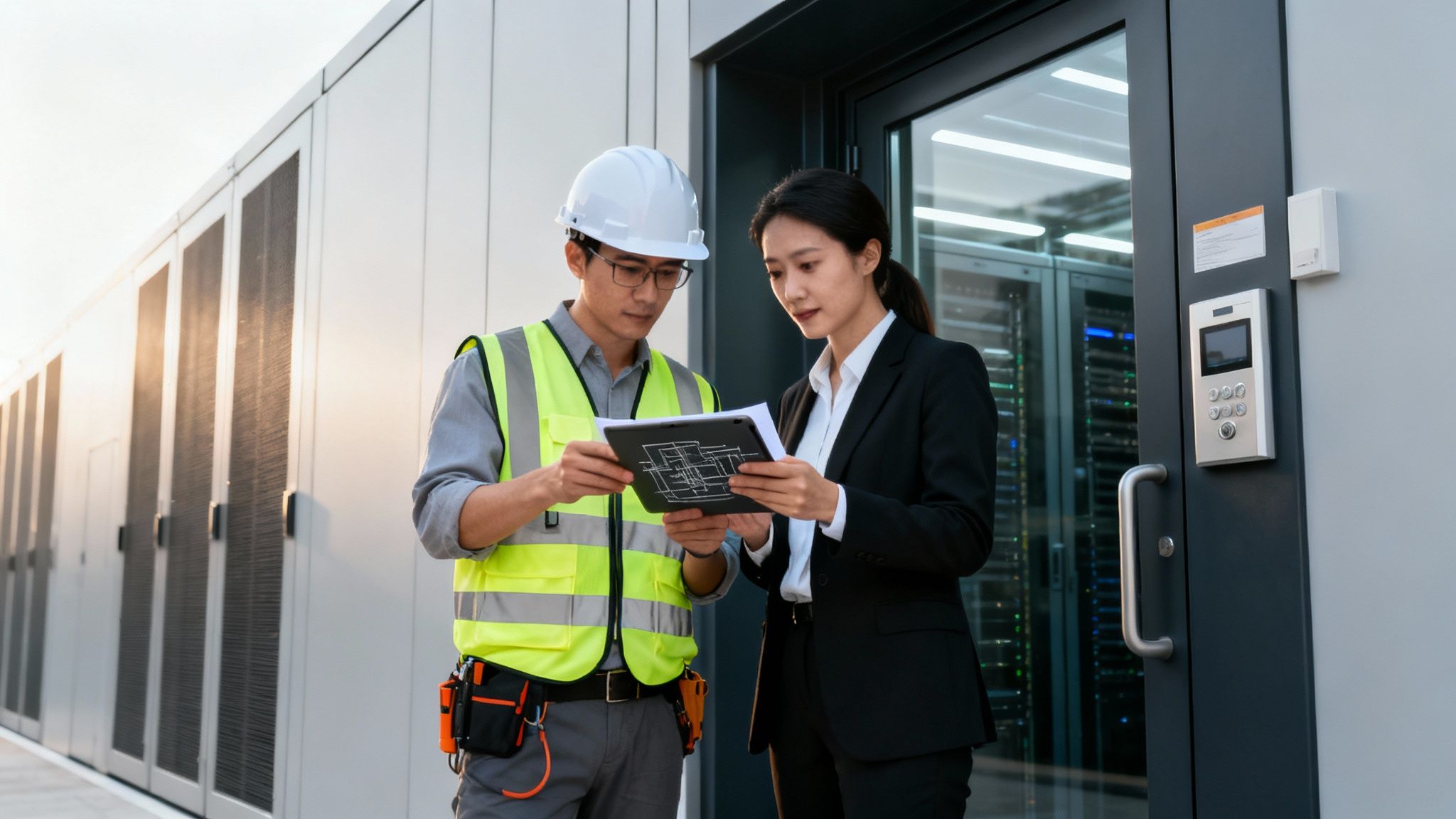
Building or expanding a hyperscale data center isn’t like any other construction job. It’s a massive undertaking where precision, speed, and deep expertise are non-negotiable. One small mistake or delay can ripple into huge financial setbacks, which is why picking the right infrastructure partner is one of the most important calls a telecom carrier or cloud provider will make.
You need more than a contractor; you need an extension of your own team. This partner has to speak the language of hyperscale fluently—from orchestrating massive fiber builds with military-like precision to executing the intricate details of a data hall fit-out. The difference between a smooth, successful project and a costly failure often comes down to their ability to manage everything from the first blueprint to the final system tests.
Core Evaluation Criteria
When you're vetting potential partners, you have to look past the sales pitch and dive deep into their actual track record. The stakes are simply too high for them to learn on your dime.
Build your evaluation process around a few key pillars:
- Proven Large-Scale Experience: Don’t just ask if they can handle it; ask for proof. Request case studies on projects of a similar or even larger scale. A partner who has already managed multi-mile fiber deployments and fitted out multi-megawatt data halls has been in the trenches and knows how to navigate the challenges you're about to face.
- A Culture of Safety: A low Experience Modification Rate (EMR) isn't just a number for an insurance form. It's a clear signal of their professionalism, operational discipline, and commitment to minimizing risk for every single person on site.
- End-to-End Project Ownership: Can they take the project from permitting and route design all the way through to final commissioning and documentation? Having a single, accountable partner to manage the entire process is priceless for keeping the project on track and communication lines clear.
A partner’s commitment to providing detailed, accurate as-built documentation can't be overstated. This isn’t just about closing out the project; it’s the operational bible for your network’s future, critical for maintenance, troubleshooting, and any upgrades down the road.
The Lifecycle Management Perspective
A great partner doesn't just think about the build; they think about the entire lifecycle of the assets being put in the ground and in the building. A critical, and often overlooked, part of planning involves what happens at the end of the hardware's useful life. This requires specialized expertise in secure IT Asset Disposition (ITAD) services to ensure every piece of equipment is handled responsibly and securely from deployment to decommissioning.
This kind of long-term strategic thinking is what really separates the experts from the rest, and it's a key part of understanding what is hyperscale data center infrastructure truly demands. For a closer look at the qualifications that really matter, our team has put together a comprehensive guide. You can get more specific insights by checking out our checklist for selecting a qualified telecom consultant.
In the end, it all comes down to trust and a history of solid execution. The goal is to find a team that will deliver the reliable, high-performance infrastructure you need—on time and on budget—setting your hyperscale project up for success from the very beginning.
Hyperscale Data Center FAQs
The world of hyperscale infrastructure is complex, and it’s natural to have questions. Here, we'll tackle some of the most common ones to clarify the key concepts, practical differences, and trends shaping these massive digital factories.
How Is a Hyperscale Facility Different From a Large Colocation Data Center?
At a glance, both are massive buildings full of servers, but their core business models couldn't be more different. Think of a colocation facility as a high-tech apartment building. It provides the space, power, and cooling, but rents it out to dozens or hundreds of different companies. Each tenant brings in their own gear and manages it independently.
A hyperscale data center, on the other hand, is like a massive, single-owner factory. It’s built and run by one company (like Google or Amazon) for a singular, unified purpose—delivering its cloud services. Every single server, switch, and power supply is standardized, allowing for incredible levels of automation and efficiency that are simply out of reach in a multi-tenant colocation environment.
Why Can't Traditional Data Centers Just Scale Up to Become Hyperscale?
It's not just about size; it's about architecture. Trying to scale a traditional data center is like adding more and more cars to an old city's streets—eventually, the road system itself becomes the bottleneck and you get gridlock. A hyperscale facility is designed from the ground up with a completely different "road system," built specifically for massive, parallel growth.
Their entire architecture is based on homogenous, off-the-shelf hardware and software-defined everything. This design allows them to scale horizontally, where thousands of individual servers work together as a single, massive system. A traditional data center, with its mix of specialized, multi-vendor hardware, is architecturally and economically incapable of pulling this off.
The core philosophy is what truly sets them apart. Traditional data centers are built to prevent individual components from failing. Hyperscale designs assume failure is inevitable and build a resilient, self-healing system that just keeps running right through them.
What Is Driving the Rapid Growth in Hyperscale Construction?
The simple answer is our insatiable demand for data, which is being supercharged by a few key trends. The massive computational power required for artificial intelligence and machine learning is a huge driver. On top of that, the explosive growth of cloud services, big data analytics, and the Internet of Things (IoT) all feed this need.
This isn't just a local trend; it's a global phenomenon, with a significant surge happening in the Asia Pacific region. The market is projected to skyrocket to USD 602.39 billion by 2030, a massive jump from USD 167.34 billion in 2025. This expansion, mostly fueled by AI and cloud adoption, is on track to double global capacity in just five years. You can discover more insights about these market projections to grasp the full scale of this growth.
What Does the Future of Hyperscale Data Centers Look Like?
The future is all about specialization and efficiency. We're already seeing the rise of purpose-built AI data centers, which are engineered from the ground up to handle the extreme power and cooling demands of training large language models. These facilities feature advanced liquid cooling and ultra-dense hardware that looks very different from a standard cloud data center.
Sustainability will also move from a talking point to a critical design principle. Expect to see major innovations in closed-loop liquid cooling (which uses zero operational water) and far more intelligent power management systems. The clear trend is toward more powerful, specialized, and efficient digital infrastructure that can handle the next wave of technology without overwhelming our power grids.
Executing complex infrastructure projects for hyperscale, telecom, and enterprise clients requires a partner with proven, hands-on expertise. Southern Tier Resources provides end-to-end engineering, construction, and maintenance for the nation's most critical wireline and wireless networks. https://southerntierresources.com