Nearly $65 billion flowed into the U.S. wireless infrastructure sector in 2025, supporting 158,500 purpose-built cell towers, over 254,000 macrocell sites, and more than 1 million combined indoor and outdoor small cell nodes according to Wireless Estimator’s coverage of WIA’s 2025 by-the-numbers report. That scale changes how organizations should think about wireless infrastructure services. This is not a narrow construction specialty. It is an operational discipline that affects coverage, customer experience, permitting, uptime, funding eligibility, and time to revenue.
Most users never see the chain of work behind a live wireless site. They see five bars in a hospital corridor, a connected tablet in a warehouse, stable service in a downtown corridor, or broadband reaching a household that had poor options before. Behind that outcome sit engineering packages, lease reviews, utility coordination, make-ready work, fiber paths, test results, punch lists, and maintenance commitments.
From a delivery standpoint, the hard part is rarely one isolated task. The hard part is controlling handoffs. A good RF design can stall in permitting. A clean permit package can stall at make-ready. A finished structure can sit dark if backhaul is late or commissioning documents are incomplete. That is why buyers should evaluate wireless infrastructure services as an end-to-end execution system, not a menu of disconnected field crews.
Organizations planning network expansion need partners that can manage scope from first sketch to final turnover. For carriers, operators, municipalities, and enterprise owners trying to understand that model, Southern Tier Resources sits in the part of the market focused on engineering, construction, and maintenance across the full infrastructure lifecycle.
The Unseen Network Powering Our Connected World
Wireless infrastructure carries daily operations that organizations cannot afford to leave to fragmented vendors or loose project controls.

Scale changes the conversation
By the time a user sees steady service on a phone, tablet, scanner, or fixed wireless receiver, the hard work has already happened across design, permitting, utility coordination, construction, testing, and turnover. At network scale, those activities do not behave like isolated work orders. They behave like a delivery system, and weak handoffs inside that system create schedule slips, change orders, and service delays.
That is why wireless infrastructure deserves business-level attention. The value of these services extends beyond build labor to connect planning, field execution, compliance, and long-term operability. Teams that treat infrastructure as a sequence of contracts often end up managing disputes between engineering firms, civil crews, fiber providers, landlords, and maintenance vendors.
A better model is lifecycle accountability. Providers with wireless engineering, construction, and maintenance capabilities can carry scope from early feasibility through closeout and support, which reduces the number of points where a project can stall.
Why delivery quality matters
Field execution problems show up quickly, and they usually show up in ways that cost money first and technical performance second.
- Permitting gaps: One incomplete package can turn a routine municipal review into a multi-round correction cycle.
- Backhaul misalignment: A radio plan without a confirmed transport path leaves a finished site unable to carry traffic.
- Documentation failures: Missing as-builts, test results, and turnover records make future troubleshooting slower and more expensive.
- Poor mobilization planning: Crews lose productive days when access windows, traffic control, or utility dependencies are still unresolved.
These are not edge cases. They are standard failure points in multi-party deployments.
The business stakes are higher than coverage alone
For carriers and ISPs, wireless infrastructure directly impacts subscriber growth and churn. For data centers, it supports resilient connectivity around high-value facilities and tenant operations. For municipalities, it affects digital access, public safety communications, and confidence that funded projects will reach service goals. For enterprise owners, it determines whether indoor users can work reliably in hospitals, campuses, warehouses, and office buildings.
The common procurement mistake is buying wireless infrastructure as if it were only a technology package. In practice, it is a delivery program with contractual risk, regulatory exposure, schedule dependencies, and long-term maintenance obligations. That is the lens that separates a vendor who can install equipment from a partner who can deliver a working network.
Decoding Wireless Infrastructure Service Categories
The easiest way to understand wireless infrastructure services is to compare the network to a transportation system. Some assets move a lot of traffic over long distances. Others solve congestion at specific intersections. Others bring service inside structures where outside coverage does not reach well.
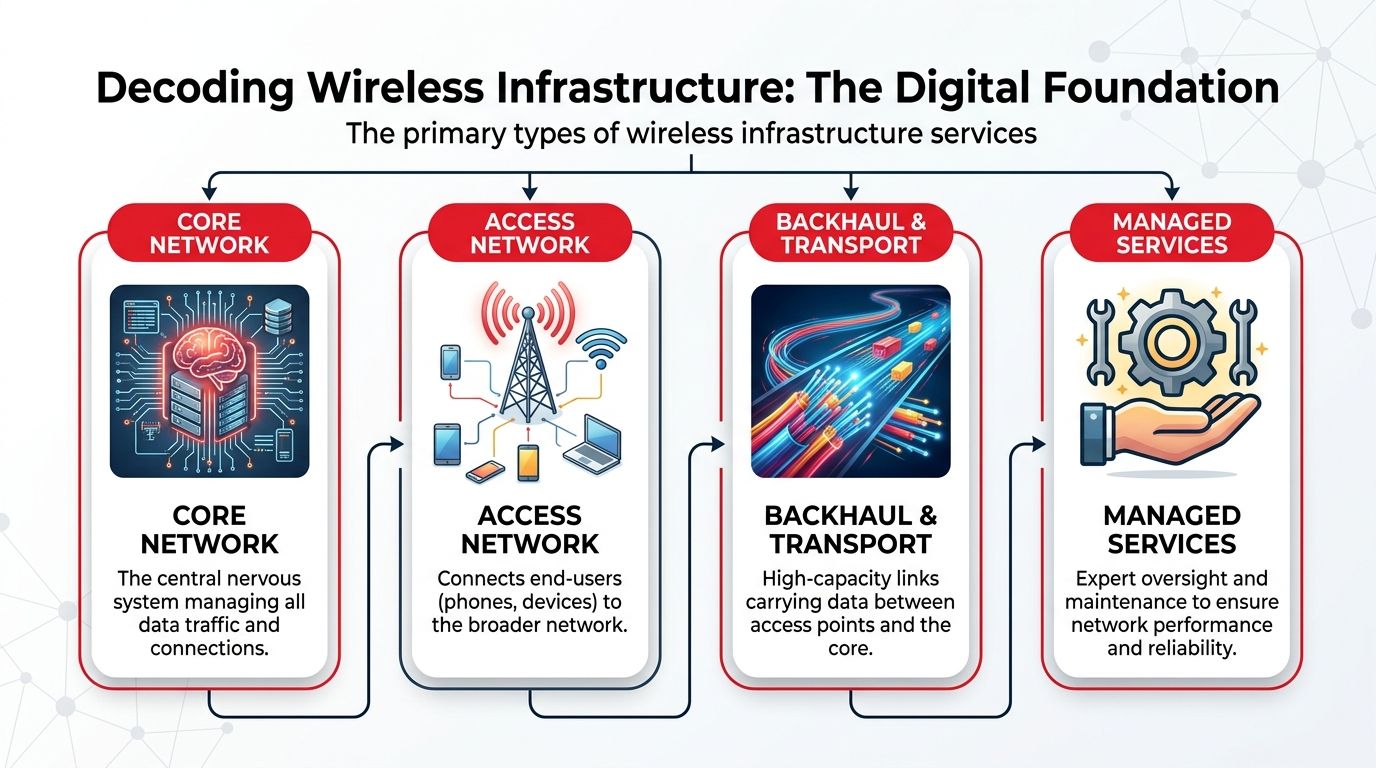
Macro sites are the interstate network
Macrocells are the broad-coverage layer. They are the tall, visible assets that carry service across larger geographic areas and form the backbone of outdoor mobility.
They are not always the answer to every problem. A macro site can provide broad reach, but broad reach alone does not solve density, indoor penetration, or block-by-block congestion. It gives you the regional road system, not the last-mile traffic control.
Small cells handle density where demand occurs
Small cells are the urban streets and busy intersections. They are used where user concentration, building patterns, or traffic demand require more localized capacity and coverage control.
The U.S. wireless ecosystem includes 248,050 macrocell sites, alongside 197,850 outdoor small cells and 802,500 indoor small cell nodes, according to WIA’s 2024 by-the-numbers report. That mix shows how networks are built in layers. Broad coverage and targeted density work together.
In practice, small cells fit places like:
- Downtown corridors: Street furniture, utility poles, and rooftops can host capacity close to users.
- Campus environments: Hospitals, universities, and mixed-use districts often need tighter signal control.
- Transit and public venues: Concentrated peaks strain macro-only designs.
- Industrial sites: Coverage must account for structures, equipment, and operational constraints.
DAS solves difficult indoor environments
Distributed Antenna Systems are the tunnel, station, and interior circulation network. They push signal through large or complex buildings where outside coverage fades or where indoor traffic levels justify dedicated infrastructure.
DAS is usually the right conversation when the facility itself becomes the challenge. Think convention centers, hospitals, stadiums, airports, high-rise properties, or large manufacturing plants. In those environments, outdoor signal strength at the curb tells you very little about user experience at the center of the building.
Fiber backhaul is the supply chain
No access layer performs well without transport behind it. Fiber backhaul feeds towers, small cells, DAS headends, and edge aggregation points. If backhaul is constrained, the radio layer cannot deliver what the design promised.
That is one of the most common planning mistakes in early-stage programs. Teams spend too much time discussing antenna placement and too little time validating transport availability, splice plans, access rights, and testing requirements.
Practical rule: If the backhaul path is uncertain, the site is not ready. RF design and transport design have to move together.
Neutral-host and shared models can unlock difficult projects
A neutral-host approach can make sense when multiple users need service in the same footprint and a single owner or operator wants to avoid multiple parallel builds. This often comes up in venues, campuses, transit facilities, and municipal projects.
The technical work is only part of the decision. The business model matters just as much. Shared infrastructure requires clear governance, access rules, maintenance expectations, and upgrade pathways.
Wireless Service Types at a Glance
| Service Type | Ideal Use Case | Coverage Footprint | Key Advantage |
|---|---|---|---|
| Macro tower | Regional outdoor coverage, corridor expansion, rural reach | Broad | Strong area coverage from fewer sites |
| Outdoor small cell | Urban density, traffic hot spots, street-level infill | Localized | Adds targeted capacity close to users |
| Indoor small cell | Offices, hospitals, multifamily, enterprise campuses | Building or floor level | Improves indoor coverage with flexible placement |
| DAS | Large venues, complex buildings, public facilities | Deep indoor, distributed | Supports challenging indoor environments at scale |
| Fiber backhaul | Any wireless deployment requiring transport | Network-wide | Connects access assets to the broader network reliably |
| Neutral-host infrastructure | Multi-operator venues and shared environments | Varies by design | Reduces duplicate builds and simplifies shared access |
Infrastructure mode matters indoors
For indoor wireless environments, architecture matters as much as hardware. Taoglas explains that Infrastructure Mode removes the requirement for direct line-of-sight between client devices and access points, supports centralized management, and can improve troubleshooting and permission management in large deployments through a single control point, especially when paired with proper RF modeling and heat mapping in larger facilities, as described in Taoglas’s overview of Infrastructure Mode.
That matters for enterprise and carrier environments because stable indoor service depends on disciplined design, not just adding more radios.
The End-to-End Service Delivery Lifecycle
A wireless site starts as a business need on a map. It becomes useful only after a chain of dependent activities lands in the right order, with the right documentation, and with clear accountability at every handoff.
Phase one starts before drawings
The first deliverable is not steel or hardware. It is decision clarity.
Teams need to define what the site must accomplish. Is the objective coverage extension, congestion relief, indoor service, public safety support, or broadband reach? That answer drives the asset type, backhaul plan, utility scope, schedule risk, and permitting path.
The market pressure behind that work is growing. The global wireless infrastructure market is projected to grow from USD 182.73 billion in 2024 to USD 399.47 billion by 2032, at a 10.27% CAGR, according to Future Market Insights. Growth on that scale rewards teams that can move cleanly from planning to activation.
Engineering packages must be buildable
Early engineering often looks complete on paper while still failing in the field. A buildable package accounts for structural realities, power availability, grounding, access methods, mounting details, utility constraints, and transport routing.
At this stage, experienced teams usually pressure-test:
- Structural feasibility: Can the chosen asset support the planned load?
- Civil scope: Is there enough clarity on foundations, trenching, restoration, or rooftop work?
- Power path: Has utility power been confirmed, or is temporary power part of the schedule?
- Transport path: Are fiber routes, handoffs, and test requirements already aligned?
Site acquisition and permitting decide schedule more than crews do
A strong field team cannot recover time lost to a bad lease exhibit or an incomplete permit submission. Wireless deployment lives inside local rules, landlord terms, utility coordination, and public scrutiny. A single accountable delivery partner creates real value by managing these dependencies. Southern Tier Resources is one example of a provider structured around that model for wireless, wireline, and related infrastructure delivery at https://southerntierresources.com/goodscode/deploying/1188944940.
Tip: If a contractor cannot explain its permit resubmittal process, closeout package standards, and escalation path for utility delays, the risk is higher than the bid number suggests.
Make-ready work is where simple projects become slow projects
Pole replacements, attachment coordination, traffic control planning, civil restoration, and access restrictions can stall a deployment even after permits are issued. At this stage, field logistics become operationally visible.
Crew sequencing matters. Material staging matters. So does travel planning. On dispersed programs, disciplined dispatch and route optimization strategies help reduce lost windshield time, improve appointment reliability, and tighten response windows for construction and maintenance teams.
Construction is only one part of delivery
Actual installation includes several overlapping scopes:
- Civil work for pads, foundations, boring, trenching, and restoration.
- Structural work for poles, mounts, frames, or tower modifications.
- Electrical integration for service, disconnects, backup systems, and grounding.
- Fiber work for placement, splicing, labeling, and test validation.
- Equipment installation for radios, antennas, cabinets, headend gear, and associated hardware.
The handoff between these scopes creates more risk than the scopes themselves. If one trade closes before another verifies readiness, teams end up revisiting the same site with added cost and avoidable delay.
Commissioning is where assumptions get tested
A site is not complete when hardware is mounted. It is complete when it passes testing, documentation is accepted, alarms are cleared, and the owner can operate and maintain it without guesswork.
Good commissioning includes more than powering up equipment. It includes labeling, turnover packages, redlines, as-builts, punch resolution, and a clear maintenance baseline. If a site goes live without that discipline, the owner inherits future troubleshooting cost immediately.
Ongoing maintenance protects the original investment
Once the network is active, the work changes but does not end. Operators need inspection routines, emergency response, fault isolation, repair readiness, and current documentation. The quality of the maintenance model often reveals whether the original build was delivered well.
That is why the best wireless infrastructure services are not just construction services. They are lifecycle services. The network has to operate in weather, under load, through upgrades, and across ownership reviews long after the ribbon-cutting.
Key Criteria for Selecting Your Infrastructure Partner
Choosing a wireless partner is closer to choosing a master builder than hiring a commodity subcontractor. The partner will influence schedule certainty, field quality, closeout integrity, and how painful future changes become.

Technical capability is necessary but not sufficient
A provider may be strong on tower work and weak on indoor systems. Another may install small cells well but struggle with utility coordination or backhaul integration. Buyers should ask for evidence tied to the actual asset mix in their program.
Evaluate whether the partner can handle:
- Mixed infrastructure types: Macro, small cell, DAS, fiber-fed access, and related civil work.
- Documentation discipline: Redlines, test records, labeling, as-builts, and turnover packages.
- Safety execution: Daily field controls, training practices, and site-specific hazard management.
- Maintenance readiness: Troubleshooting, restoration workflows, and 24/7 mobilization expectations.
A polished presentation is not proof. Field process is proof.
The contract should reveal how the work will really run
Many infrastructure problems begin in vague scopes of work. If the agreement leaves room for interpretation on closeout, testing, restoration, or response times, disputes arrive later as change orders or warranty arguments.
The stronger agreements define:
- Scope boundaries clearly: Especially where engineering, construction, utility work, and commissioning overlap.
- Service levels plainly: Response expectations, outage escalation, reporting cadence, and acceptance criteria.
- Pricing logic upfront: Unit rates, exclusions, rework terms, and treatment of owner-caused delays.
- Documentation standards: File formats, naming conventions, and what constitutes final acceptance.
Key takeaway: If the contract is fuzzy, execution will be fuzzy. Buyers should insist on clarity before crews mobilize.
Ask how the partner handles the ugly parts
Every provider can describe the ideal project. The better question is what they do when conditions are not ideal.
Ask about permit rejections. Ask about late utility power. Ask about inaccessible rooftops, traffic control changes, failed inspections, and damaged existing records. A serious delivery partner has operational answers, not marketing language.
A useful video overview for teams evaluating infrastructure execution and modernization priorities is below.
Write RFPs that force real answers
Weak RFPs invite generic bids. Better RFPs require vendors to explain actual process.
Include prompts for:
- Escalation structure
- Permit management workflow
- As-built and turnover standards
- Outage response procedures
- Subcontractor management
- Quality hold points before site acceptance
The partner you want is not only the one that can build the site. It is the one that can keep the project coherent when the plan gets tested.
Overcoming Common Implementation Challenges
The hardest wireless projects usually fail in predictable ways. The problem is not that the obstacles are hidden. The problem is that many teams treat them as surprises instead of standard planning items.

Permitting friction is normal, not exceptional
Municipal review timelines vary. So do aesthetic rules, right-of-way standards, historic-area requirements, traffic management expectations, and public meeting dynamics.
The practical response is not optimism. It is preparation. Strong permit packages address site visuals, code compliance, access methods, and restoration details before the first review cycle begins. Teams that treat permitting as paperwork usually spend more time and money on resubmittals.
Utility and make-ready issues can outrun the rest of the schedule
Pole attachments, replacements, service upgrades, and conflicting field conditions can delay a program long after internal approvals are complete. This is the stage where field logistics become operationally visible.
Experienced teams also keep field verification active. Existing records are often incomplete, especially in older corridors and dense urban rights-of-way.
Backhaul problems do not fix themselves later
Many troubled deployments share the same root issue. The access asset was approved before transport certainty existed.
A macro upgrade, small cell node, or indoor system cannot achieve its operational target if fiber access, handoff design, splice planning, or test acceptance remains unresolved. It is cheaper to challenge assumptions in design review than after construction is complete.
CFWA has real limits in underserved-area planning
Cellular fixed wireless access has become part of the funding and coverage conversation, but decision-makers should not treat it as a universal substitute for deeper infrastructure. As Broadband Breakfast reported, CFWA is being approved for BEAD eligibility in some states while still facing reliability challenges tied to network congestion, signal attenuation, and data throttling, which is why fiber-backed hybrid solutions remain important when service levels must hold up in underserved areas.
That trade-off matters in the field. A fast initial deployment path does not automatically produce stable long-term service, especially where foliage, building blockage, terrain, or peak-hour load create variability.
Practical rule: Use CFWA where it fits, but do not let funding logic replace engineering logic.
Community acceptance still matters
Residents and property owners often support better connectivity in principle while resisting visible infrastructure in practice. Projects move faster when teams address design fit, construction disruption, restoration quality, and public communication early.
That is especially true for municipalities and neutral-host programs. The technical design may be sound, but the project still needs a credible local rollout plan.
ROI and Strategic Value for Your Organization
Return on investment in wireless infrastructure is rarely one line item. It comes from faster service activation, fewer remediation cycles, stronger user experience, better asset use, and less operational friction after turnover.
For carriers and ISPs
The most obvious payoff is time to market. If the deployment lifecycle runs cleanly, carriers can light service earlier, expand coverage with fewer stalled sites, and reduce the cost of rework caused by poor documentation or incomplete commissioning.
There is also a customer-experience component. Networks that match the right site type to the right use case create fewer avoidable complaints about indoor dead zones, busy-hour slowdown, and inconsistent edge coverage.
For data centers and hyperscale operators
Wireless infrastructure around data center environments is not a cosmetic add-on. It supports operational communications, contractor coordination, facility mobility, and redundancy planning across large campuses.
The strategic value comes from integration discipline. Data center operators need partners that understand how wireless, fiber, structured cabling, power coordination, and physical build constraints interact inside high-consequence environments.
For tower companies and neutral hosts
Asset owners benefit when infrastructure can support multiple use patterns without constant redesign. That means thinking beyond the initial tenant or first deployment phase.
A strong program improves:
- Asset utilization: More flexible designs support future tenancy and upgrades.
- Change readiness: Better as-builts and labeling reduce friction during modifications.
- Maintenance efficiency: Standardized site conditions simplify inspection and repair workflows.
- Commercial clarity: Shared environments work better when physical design supports contractual sharing rules.
For municipalities and housing-focused programs
One of the strongest examples of strategic value comes from CBRS-based urban connectivity. Kansas City Digital Drive documented how deployments are using CBRS spectrum to deliver affordable, high-speed wireless broadband in underserved urban areas, including affordable housing, as a cost-effective alternative to full fiber-to-the-home builds in some settings.
That example matters because it widens the planning lens. Underserved connectivity is not only a rural problem. Dense urban pockets, multifamily properties, and affordable housing developments often need a practical hybrid model that combines fiber-fed wireless distribution with site-specific engineering.
Municipal leaders should think in terms of outcomes:
- Coverage where residents live
- Reliable connectivity in difficult building environments
- Public-private deployment models that can be maintained
- Infrastructure that supports future smart-city and public-service applications
A traffic-conscious field strategy also affects ROI on municipal and corridor work. For organizations managing distributed projects, this operational view is central to execution planning at https://southerntierresources.com/goodscode/traffic/2560878076.
Key takeaway: ROI in wireless infrastructure services comes from lifecycle performance, not just install completion. The network has to be usable, supportable, and expandable.
The organizations that benefit most
The strongest returns usually go to owners that treat wireless as core infrastructure rather than an isolated technology purchase. They align engineering, contracts, logistics, and maintenance before deployment starts. That lowers friction later, where many programs lose value.
Frequently Asked Questions
What is included in wireless infrastructure services
It usually includes engineering, site acquisition support, permitting, make-ready, civil and structural construction, power integration, fiber work, equipment installation, testing, closeout documentation, and ongoing maintenance. The exact scope depends on whether the program involves macro sites, small cells, DAS, or mixed infrastructure.
How do I know if I need macro sites, small cells, or DAS
Start with the business problem, not the hardware. Broad outdoor reach often points to macro infrastructure. Street-level congestion and urban infill often call for small cells. Difficult indoor environments usually require indoor small cells or DAS. Good partners validate that choice against transport, permitting, and building conditions before the design is finalized.
What makes one infrastructure partner more reliable than another
Look for buildable engineering, strong documentation standards, clear SLAs, transparent scope definitions, and a credible maintenance model. Reliability usually comes from process maturity more than sales claims.
How important is maintenance after deployment
It is critical. A live site still needs inspections, fault response, record updates, and repair coordination. Many organizations borrow ideas from a structured preventive IT maintenance program because the same principle applies in telecom. Planned maintenance is cheaper and less disruptive than reactive restoration.
Can wireless replace fiber in every underserved area
No. Wireless can be highly effective in the right design, especially in hybrid models, but some environments still require fiber-backed solutions to meet long-term reliability and service expectations.
If you are planning a wireless build, expansion, upgrade, or maintenance program, Southern Tier Resources is worth evaluating as a single accountable partner for engineering, construction, testing, documentation, and ongoing support across the network lifecycle.