When you sign up for internet service, you're paying a company like Verizon or Spectrum to manage the flow of data to your home or business. But who actually builds the physical network that data travels on? That's the work of a wireline service provider.
They are the expert engineering and construction firms that lay the fiber optic and copper cables forming the backbone of our digital world. Think of them as the heavy civil construction crews for the information superhighway. Their work is the unseen, foundational layer for everything from your home's high-speed internet to the 5G service on your phone.
The Architects of Connectivity
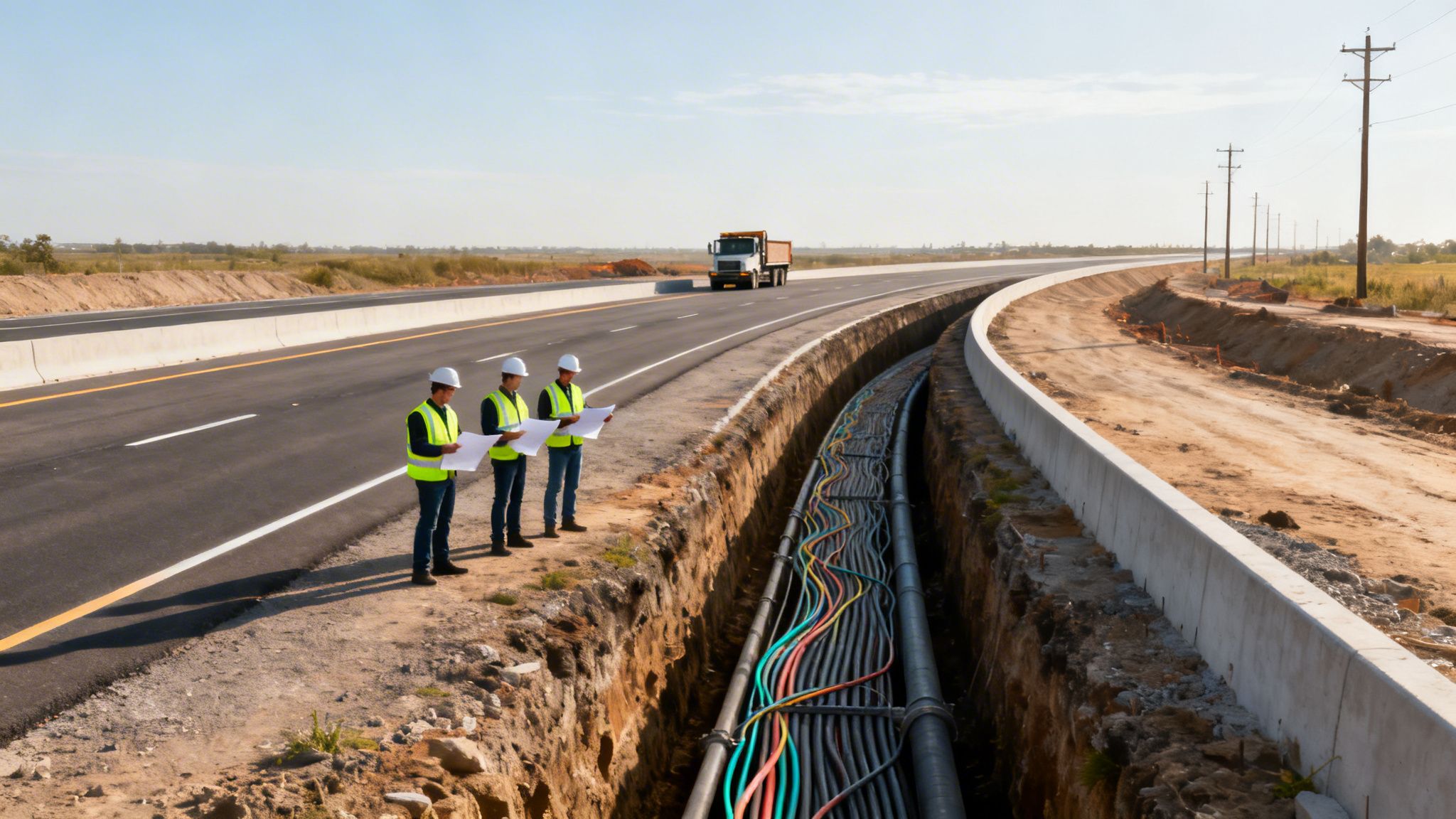
The highway analogy is a good one. If your ISP is the department of transportation managing traffic, a wireline service provider is the company that physically paves the roads, erects the bridges, and bores the tunnels. They are specialists in turning a digital blueprint into a tangible, physical network that carries data packets instead of cars.
These teams are the essential bridge between a plan on paper and a functioning, high-speed reality. Their expertise covers the entire lifecycle of building network infrastructure—a process that goes far beyond simply digging a trench and laying some cable.
From Blueprint to Live Network
It all starts with meticulous engineering and design. Wireline teams survey the terrain, map out the most efficient routes, and navigate a complex web of local, state, and federal regulations to secure all the necessary permits. This upfront planning is mission-critical; it's what keeps a project on schedule and on budget.
With approved plans in hand, the real work begins, requiring a wide array of specialized skills and heavy equipment. In many ways, their work falls into the broader category of Underground Utility Services, but with a singular focus on telecommunications.
A wireline service provider doesn't just install cable; they execute a complex, multi-stage field operation. Their job is to transform a connectivity goal into a reliable, physical asset built to serve a community or enterprise for decades.
The actual construction can happen in a few different ways:
- Aerial Construction: Technicians string fiber optic cables along new or existing utility poles. This often involves "make-ready" engineering to ensure the poles can safely support the new lines.
- Underground Construction: Crews deploy specialized machinery for trenching or directional boring. They place protective conduit and cable safely below ground, out of sight and out of harm's way.
- Fiber Splicing: This is the high-stakes "surgery" of the operation. Expert technicians must perfectly fuse glass fibers thinner than a human hair to create a flawless connection for light-speed data transmission.
Powering the Modern Digital Economy
The need for these services has never been greater. The global market for wireline services is a massive economic engine, driving everything from new fiber-to-the-home rollouts to the colossal data center interconnects that make the cloud work. The financial scale of this sector, which you can read about in this detailed research on wireline telecom services, underscores just how vital these infrastructure partners are.
Whether they're helping a regional ISP connect an underserved town or outfitting a new data center with structured cabling, wireline service providers are the quiet heroes of our connected world. They build the fundamental pathways that allow us all to enjoy the fast, dependable digital services we rely on every single day.
A Look Inside Core Wireline Construction Services
So, what does a professional wireline service provider actually do? It's easy to get lost in the high-level concepts, but the real value is in the hands-on execution. These partners are the builders, the engineers, and the technicians who transform a network plan from a drawing on a screen into a functioning, physical asset.
It's a lot like building a commercial facility. You wouldn't expect one person to handle the architectural design, pour the foundation, run the electrical, and install the plumbing. You rely on a team of specialists. A wireline partner brings that same coordinated, expert-driven approach to constructing your network.
To better understand the scope of their work, let's break down the primary service categories and the tangible benefits they deliver.
Wireline Service Offerings and Their Impact
| Service Category | Description of Activities | Primary Client Benefit |
|---|---|---|
| Network Engineering & Design | Route planning, feasibility studies, right-of-way acquisition, and navigating the complex permitting process with local and state authorities. | A cost-effective, buildable plan that avoids costly surprises, regulatory hurdles, and future rework. |
| Make-Ready Engineering & Construction | Performing Pole Loading Analysis (PLA), pole replacements, and structural upgrades to prepare existing utility poles for new fiber attachments. | Faster and more affordable network deployment by using existing infrastructure, especially in dense areas. |
| Fiber Splicing & Testing | Precisely fusing individual glass strands to create a continuous path and using advanced equipment (like OTDRs) to certify signal strength and quality. | A reliable, high-performance network free of signal degradation, ensuring maximum speed and uptime for end-users. |
| Inside Plant & Data Center Fit-Outs | Installing structured cabling, racks, power distribution, and connectivity within data centers, headends, or enterprise facilities. | A fully operational and scalable internal infrastructure that seamlessly connects the outside network to the core equipment. |
Each of these services represents a critical link in the chain. When executed properly, they come together to create a robust and future-proof network.
End-to-End Network Engineering And Design
Every successful build starts long before the first trench is dug. The engineering and design phase is where the entire project gets its blueprint. This isn't just about drawing a line from Point A to Point B; it's an intensive strategic effort to map out the most efficient and resilient network possible.
This foundational work includes:
- Route Planning: We identify the best path for new fiber, carefully weighing things like terrain, existing utility corridors, and right-of-way access.
- Feasibility Studies: This is our reality check. We analyze the environmental, logistical, and regulatory challenges to make sure the project is truly viable from start to finish.
- Permitting: Our teams handle the maze of municipal, state, and federal paperwork to secure every approval needed to begin construction.
Getting the engineering right from the outset is what prevents budget overruns and frustrating delays down the road. It’s the solid foundation the rest of the project is built on.
Make-Ready Construction And Pole Loading Analysis
One of the fastest ways to deploy fiber is to use the utility poles already lining our streets. But you can't just throw another cable up there. That's where make-ready construction becomes essential—it’s all the prep work needed to ensure those poles can handle the weight and tension of new fiber optic lines.
Make-ready work is the unsung hero of aerial fiber deployment. It involves a detailed Pole Loading Analysis (PLA) to calculate stress and capacity, often requiring structural upgrades or the replacement of older poles to meet modern safety and engineering standards.
This service is a game-changer for expanding networks quickly and affordably, particularly in developed areas where digging is either impossible or outrageously expensive.
Precision Fiber Splicing And Rigorous Testing
If engineering provides the network's brain, then fiber splicing is its delicate heart surgery. This is where our highly skilled technicians fuse individual glass fibers—each thinner than a human hair—to form a perfect, continuous path for data-carrying light. The smallest mistake or piece of dust can cripple performance.
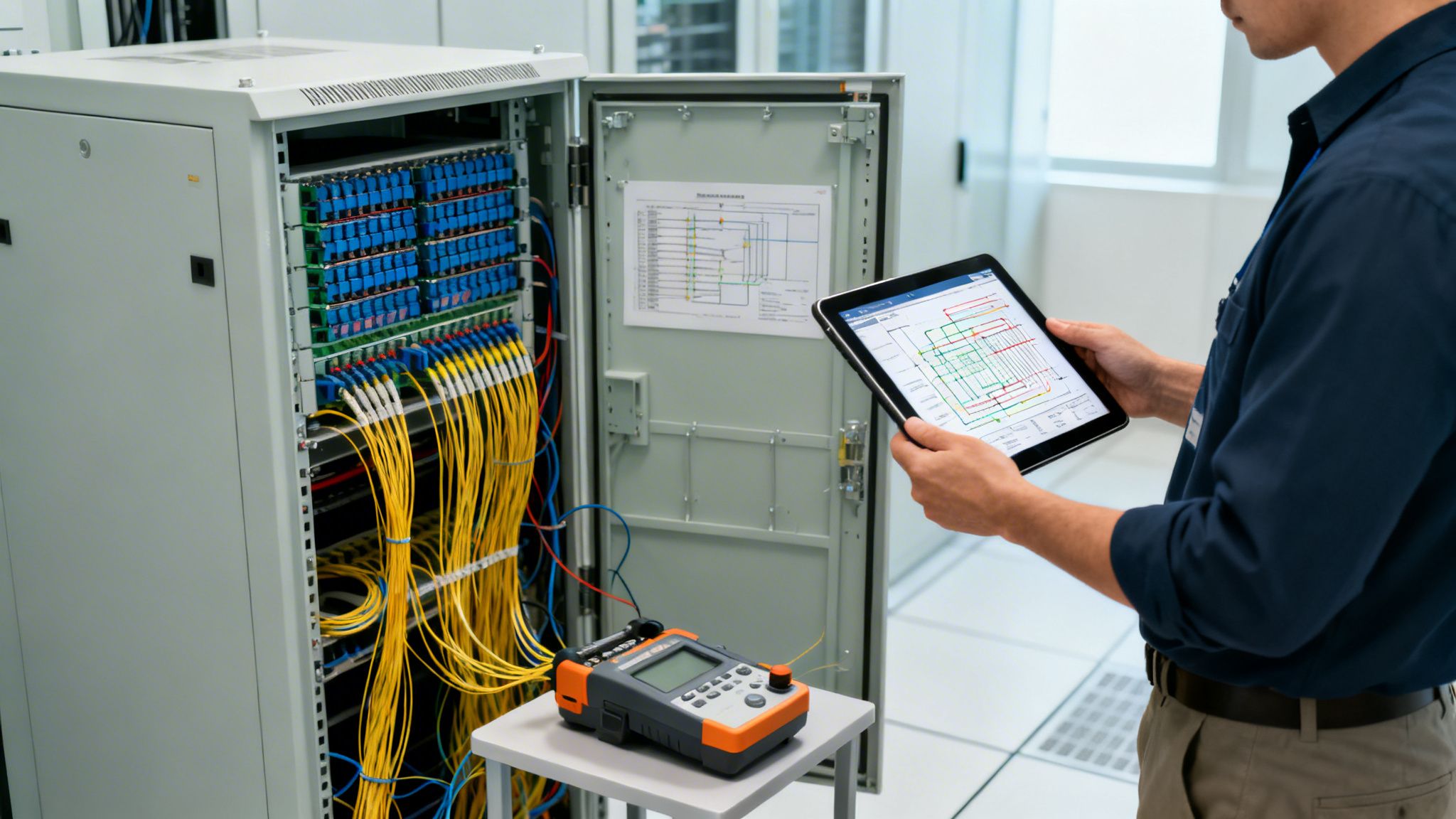
After splicing, the real proof is in the testing. We use specialized equipment like Optical Time-Domain Reflectometers (OTDRs) to verify the integrity of every connection, measure any signal loss, and confirm the network is running at peak performance. For the kind of reliable, high-speed service everyone expects today, meticulous splicing and testing are simply non-negotiable. You can see how this attention to detail fits into the bigger picture in our guide to fiber optic solutions.
Data Center And Commercial Infrastructure Fit-Outs
The work doesn't stop at the building's exterior. Wireline services are also critical inside, especially in the high-stakes environment of a data center. A data center fit-out is the process of installing the structured cabling, power systems, and physical connectivity that are the bedrock of cloud computing and modern business.
It’s also crucial to remember that this high-tech connectivity depends on reliable power. That’s why comprehensive commercial and industrial electrical services are often part of the larger project scope, ensuring the racks and servers have the stable power they need. This holistic view, from the outside pole to the server rack, is what turns an empty room into a fully functional, high-density nerve center.
Who Relies on Wireline Services and Why
When you hear “wireline services,” it’s easy to picture heavy machinery and spools of cable. But the real story isn't about the equipment; it's about what that equipment makes possible. The work of a wireline provider is the unseen foundation for everything from rural connectivity to the global cloud.
Let’s move past the technical jargon and look at four real-world situations. These stories show just how crucial wireline expertise is for organizations of all stripes.
A Regional ISP Bridges the Digital Divide
Imagine a cluster of small towns cut off from the modern economy by slow, spotty internet. A regional Internet Service Provider (ISP) saw the opportunity to change that, but they were facing a massive hurdle: building a brand-new, high-speed fiber network from scratch—a "greenfield" build.
The job was a logistical beast. It meant laying miles of new fiber across all kinds of terrain, and the ISP needed a partner who could run the show from start to finish.
A wireline service provider stepped in, first mapping out the most efficient routes and tackling the mountain of local permits. Their engineers even performed pole loading analysis to make sure existing utility poles could handle the new aerial fiber.
Then, the construction crews got to work. They used directional boring to run conduit under sensitive areas without tearing everything up, while other teams strung fiber along the poles. The final, most delicate phase was the meticulous fiber splicing and testing, guaranteeing every single connection was perfect.
The result? The ISP launched its gigabit service, bringing thousands of homes and businesses up to speed. It was more than just a network expansion; it was an economic lifeline for an entire community.
This is what that end-to-end process typically looks like for a large-scale network build.
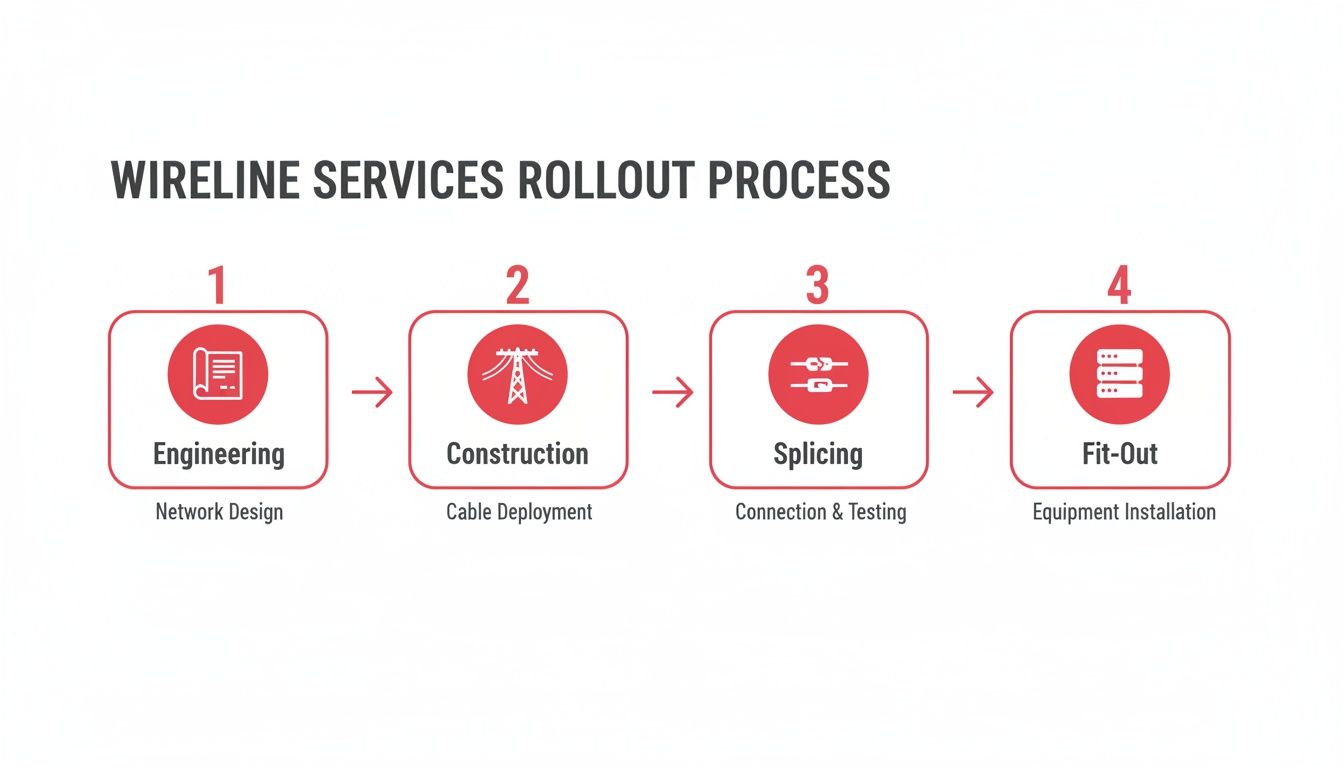
As you can see, a project flows from planning and heavy construction into the highly technical work of splicing and final fit-outs, demanding a huge range of skills.
A Hyperscale Data Center Demands Flawless Execution
A hyperscale cloud giant was building a new data center. The building’s shell was up, but inside, it was just a cavernous empty space. Turning that space into a high-density computing nerve center—a “fit-out”—is a job where 100% uptime isn't a goal; it's a requirement.
The wireline service provider’s mission was to build the data center’s internal skeleton. This involved:
- Structured Cabling: Crews installed thousands of pre-terminated fiber and copper cables, weaving a perfectly organized web to connect endless rows of server racks.
- Power Distribution: They deployed redundant power systems, including Busway power distribution, to guarantee every server had a constant, uninterruptible power source.
- Rack and Stack: Technicians then physically installed and cabled the servers, switches, and routers into the racks, following painstakingly detailed designs.
The entire project was a masterclass in precision. Working alongside dozens of other trades on a non-negotiable schedule, the provider brought the facility online. The final product was a resilient, scalable data center, built and documented to the absolute highest standards.
A Mobile Operator Supercharges Its 5G Network
A major mobile carrier needed to boost its 5G performance in a packed urban core. While 5G is famous for its wireless speeds, the cell sites themselves rely on a high-capacity physical connection—known as fiber backhaul—to keep data flowing without bottlenecks.
In the 5G era, a wireless network is only as strong as its wireline foundation. Without robust fiber backhaul, even the most advanced 5G antennas can't deliver on their promise of ultra-low latency and high speeds.
The carrier hired a wireline provider to run new fiber routes to hundreds of small cell sites scattered across the city. This was incredibly complex work. It meant micro-trenching in busy sidewalks, navigating a tangled mess of underground utilities, and securing permits from one city agency after another. To keep the city moving, crews often worked at night.
By linking these cell sites with dedicated fiber, the carrier massively increased its network capacity. For users on the ground, this meant faster downloads, zero-buffering streams, and incredibly responsive apps—all thanks to the invisible wireline upgrade happening beneath their feet.
A Municipality Builds a Foundation for a Smart City
A forward-thinking city had a vision: a "smart city" network to improve public services. They dreamed of intelligent traffic signals that adapt to flow, free public Wi-Fi in parks, and connected sensors monitoring everything from air quality to infrastructure stress. But a dream isn't a plan. To make it real, they needed a physical fiber network to tie it all together.
The city brought in a wireline service provider to design and build this municipal fiber backbone. The provider engineered a redundant "ring" that circled the city, creating a reliable foundation with multiple connection points. They managed the entire build, from securing rights-of-way to laying the final strands of fiber.
With this backbone in place, the city could start rolling out its smart initiatives one by one. The fiber network became a shared public asset—a platform for innovation that is already improving traffic, enhancing safety, and providing new amenities for its citizens. It was a long-term investment in a more connected and efficient future.
How to Choose the Right Wireline Partner
Let's be honest—choosing a wireline service provider is about more than just comparing bids on a spreadsheet. This decision will define your project's timeline, budget, and the ultimate reliability of your network for years to come. The right team becomes a seamless part of your own, while the wrong one can bring nothing but headaches, risks, and expensive delays.
This choice has become even more critical as the market booms. North America is currently the world's largest market for wireline services, and it's not slowing down. In 2026, the market was valued at a massive USD 15.06 billion. Driven by the relentless expansion of telecom fiber and data centers, it’s expected to grow at an 8.64% CAGR, hitting USD 22.78 billion by 2031. You can get a closer look at the numbers and trends in this detailed wireline services market intelligence report.
All this growth means new players are constantly entering the field, making a disciplined vetting process more crucial than ever.
Evaluate Technical Expertise and In-House Capabilities
A provider's real value is in what they can do themselves. While some subcontracting is a normal part of the business, a partner with strong in-house teams for the core work has far more control over quality, safety, and the project schedule. You need to look past the sales pitch and get into the nitty-gritty of their operations.
Ask them direct questions about who is actually doing the work:
- Engineering and Design: Do you have your own internal engineers for route planning, feasibility studies, and handling the complex world of permitting?
- Construction Crews: Are your aerial and underground construction teams your own employees, or are you just farming that work out to the lowest bidder?
- Splicing and Testing: Is your fiber splicing team properly certified? What kind of advanced testing equipment, like OTDRs, do you own and operate?
A company that has invested in its own people and equipment is better prepared to handle the curveballs every project throws. That self-reliance almost always leads to a smoother project with fewer surprises.
Scrutinize Project Management and Communication
A successful partnership is built on clear and consistent communication. There's simply no substitute for it. A professional wireline provider will have a well-defined project management system, and you should never be left guessing about the status of your build.
A partner’s approach to project management tells you everything you need to know about their accountability. You're looking for a single point of contact, regular and meaningful progress reports, and a clear process for escalating and resolving issues when they pop up.
Before you sign anything, get clarity on their process for handling change orders, how they document progress (with photos and reports), and what their final as-built documentation package looks like. This isn’t about micromanagement; it's about ensuring your project stays on track and that you have the essential records for future network maintenance. To dig deeper into these administrative details, you can review our guide on the importance of proper project licensing and compliance.
Prioritize a Documented Safety Record
In infrastructure construction, safety is paramount. A provider's safety culture is a direct reflection of their operational discipline. If a team cuts corners on safety, you can bet they’re cutting corners on the quality of your network, too.
Don’t just take their word for it. Ask for hard proof of their commitment to safety.
- Ask for their Experience Modification Rate (EMR): This number is a key industry metric. A rate below 1.0 shows their safety performance is better than the industry average.
- Request their safety manual: Take a look at their documented policies. Is their training program comprehensive?
- Inquire about incident reporting: How do they handle reporting and, more importantly, learning from any safety incident, no matter how small?
Choosing a partner with a stellar safety record isn't just about protecting their workers—it's about protecting your project, your reputation, and your investment. It’s one of the most reliable signs of a truly professional organization.
Understanding Project Costs and Long-Term Value
A network build is a major capital investment, but its success isn't just about getting the fiber in the ground. True success is measured over the entire life of the network, balancing the upfront build cost with the long-term reality of operating it.
It's a common mistake to think of a build purely in terms of cost-per-foot. A realistic budget has to wrestle with dozens of variables that can swing the final price tag dramatically. The key is to shift your focus from the initial price to the total cost of ownership—that’s how you truly protect your investment.
Key Cost Drivers in a Wireline Project
So, what actually shapes the budget for a wireline deployment? A professional wireline service provider will dig into these details during the engineering phase to give you an accurate estimate, but it’s critical for you to know what’s driving the numbers.
Several key areas almost always dictate the financial scope of a project:
- Labor and Equipment: This is a big one. The size of the crews, their specific skills, and the specialized machinery needed for aerial or underground work are primary cost components.
- Materials: The price of fiber optic cable, conduit, connectors, and other hardware isn't static. It moves with market supply and demand.
- Permitting Fees: Working through city, county, and state regulations comes with a trail of fees and administrative work that can pile up surprisingly fast.
- Geography and Terrain: The physical environment plays a huge role. Trenching through soft soil is a completely different ballgame—and price point—than directionally boring through solid rock.
- "Make-Ready" Work: If you’re using existing utility poles, they have to be prepared for the new fiber. This can involve costly structural analysis, pole replacements, and shuffling existing attachments around.
Getting a handle on these drivers is your first step toward a realistic budget. A transparent partner will walk you through each of these line items so there are no surprises down the road.
The cheapest bid is rarely the best value. A low upfront cost can easily hide future headaches—poor documentation, lingering permit issues, or shoddy work that leads to network failures and expensive emergency repairs.
Focusing only on the initial build cost is a shortsighted game. The real value of a partner shows up in their commitment to the network's long-term health, which is guaranteed through solid agreements and crystal-clear records.
Protecting Your Investment with SLAs and Documentation
A network that’s built but not properly documented is an operational liability waiting to happen. The real test of a professional wireline service provider comes long after the construction crews are gone. It’s all about making sure your network stays reliable and easy to manage for years to come.
For long-term success, two things are absolutely non-negotiable:
- Service Level Agreements (SLAs): Think of an SLA as your written guarantee. It spells out the expected level of service, covering everything from uptime and performance metrics to, most importantly, how fast your partner will respond to fix a problem. It’s a contract that holds them to a specific standard.
- Meticulous "As-Built" Documentation: "As-builts" are the final, definitive blueprints of your network. They show the exact location of every single conduit, splice case, and fiber strand. This paperwork is gold for future maintenance, repairs, or upgrades, turning a potential day-long hunt for a fault into a quick fix.
A partner's dedication to delivering precise as-built documentation is one of the clearest signs of their professionalism. For a deeper look into the financial side of these large-scale projects, check out our comprehensive guide on infrastructure financing.
In the end, a top-tier wireline partner does more than just build your network; they deliver a fully documented, manageable, and dependable asset. That commitment to quality and support is what protects your investment and ensures your network performs for its entire life.
Frequently Asked Questions About Wireline Services
Once you start digging into a real-world network project, the high-level concepts quickly give way to practical, on-the-ground questions. We get it. Over the years, we've heard them all.
Let's clear up some of the most common points of confusion to help you navigate conversations with potential partners and set the right expectations from the start.
What Is the Difference Between a Wireline Provider and an ISP?
This is a big one, and the distinction is crucial for understanding who does what.
The simplest analogy is a highway system. A wireline service provider is the company that actually designs and builds the physical highway—the trenches, conduits, and fiber optic cables that form the network's foundation. An Internet Service Provider (ISP), on the other hand, is like the logistics company that manages the traffic flowing on that highway, delivering data packages to homes and businesses.
While some massive telecom giants do both, many ISPs and mobile carriers find it much more efficient to lease the "highway" from a specialist. The wireline partner focuses entirely on the physical layer: the complex engineering, construction, and maintenance. This lets the ISP focus on what they do best—delivering great service to their customers over a rock-solid network someone else built and maintains.
How Long Does a Typical Fiber Deployment Project Take?
There’s no simple answer here, because project timelines can vary wildly. Connecting a single office building might take just a few weeks. But a large-scale municipal fiber build-out could easily span many months or even a few years.
The schedule really hinges on a few key variables:
- Permitting and Rights-of-Way: Getting approvals from local, state, and sometimes federal agencies is often the longest pole in the tent. This process alone can take months.
- Geography and Terrain: The ground itself is a huge factor. Trenching through soft soil is one thing; having to use directional boring to get through solid rock or navigate a dense, utility-filled urban corridor is another entirely.
- Network Size and Scope: This one’s straightforward—the more miles of fiber you need to lay, the more time it's going to take.
- "Make-Ready" Construction: If you're running fiber on existing utility poles (aerial construction), those poles often need preparatory work to safely handle the new load. This "make-ready" phase can add significant time.
A professional wireline service provider will always conduct a thorough site survey and engineering assessment before giving you a realistic project schedule.
What Are As-Built Plans and Why Are They So Important?
As-built plans are the final, corrected set of engineering drawings that reflect exactly how the network was constructed in the field. Think of them not as the initial blueprint, but as the official "birth certificate" of your network infrastructure.
As-built documentation is one of the most valuable deliverables you'll receive. It's the definitive map of your network, detailing the precise location of every conduit, handhole, splice case, and fiber strand. This detailed record is absolutely essential for the long-term operational health of your network.
Their importance can't be overstated. When a fiber line is accidentally cut—and it happens—these plans are what allow technicians to pinpoint the break and make repairs quickly. Without them, a simple fix turns into a costly and time-consuming search party. They are also indispensable for planning any future upgrades or expansions. A quality provider always delivers meticulous as-builts; it's a non-negotiable sign of a job done right.
Can One Provider Handle Both Underground and Aerial Construction?
Yes, and you should look for one that can. The most capable wireline service providers have the teams and equipment to handle both construction methods, which gives you a huge advantage.
Underground construction, using methods like trenching or directional boring, offers the ultimate protection from weather and accidents. It’s the gold standard for reliability but is also more expensive and disruptive to install.
Aerial construction, where fiber is strung on utility poles, is typically faster and more cost-effective, especially where a good pole line already exists.
The thing is, most large projects aren't just one or the other. The best route often involves a mix of both. A partner with expertise in underground and aerial work can design the most efficient path for your entire network, strategically blending methods to balance cost, speed, and long-term resilience.
Building and maintaining the physical networks that connect our world requires deep expertise and a commitment to quality. As a leading telecom infrastructure partner, Southern Tier Resources provides the end-to-end engineering, construction, and documentation needed to deliver reliable, high-performance wireline and wireless networks. Learn how our turnkey solutions can support your next infrastructure project.