
You’re probably dealing with one of two situations right now. Either a broadband expansion map just landed on your desk and someone said, “We only need to bury the fiber,” or an existing project is already slipping because underground conditions turned out to be nothing like the prints. Both situations look manageable from a conference room. They stop looking simple the moment field reality shows up.
That’s what work on the underground really is. It isn’t just excavation. It’s permitting, subsurface risk management, traffic control, utility coordination, conduit layout, fiber handling, testing, documentation, and long-term maintainability. The projects that finish cleanly are usually the ones where the team treated underground construction like a full lifecycle program from day one, not a digging task delegated after design was “mostly done.”
From a project management standpoint, the biggest separator isn’t who owns the biggest drill rig or who can mobilize the fastest. It’s who makes the right decisions before crews mobilize, who documents those decisions in the field, and who leaves behind a network another team can safely operate years later.
Foundations for Success Site Assessment and Permitting
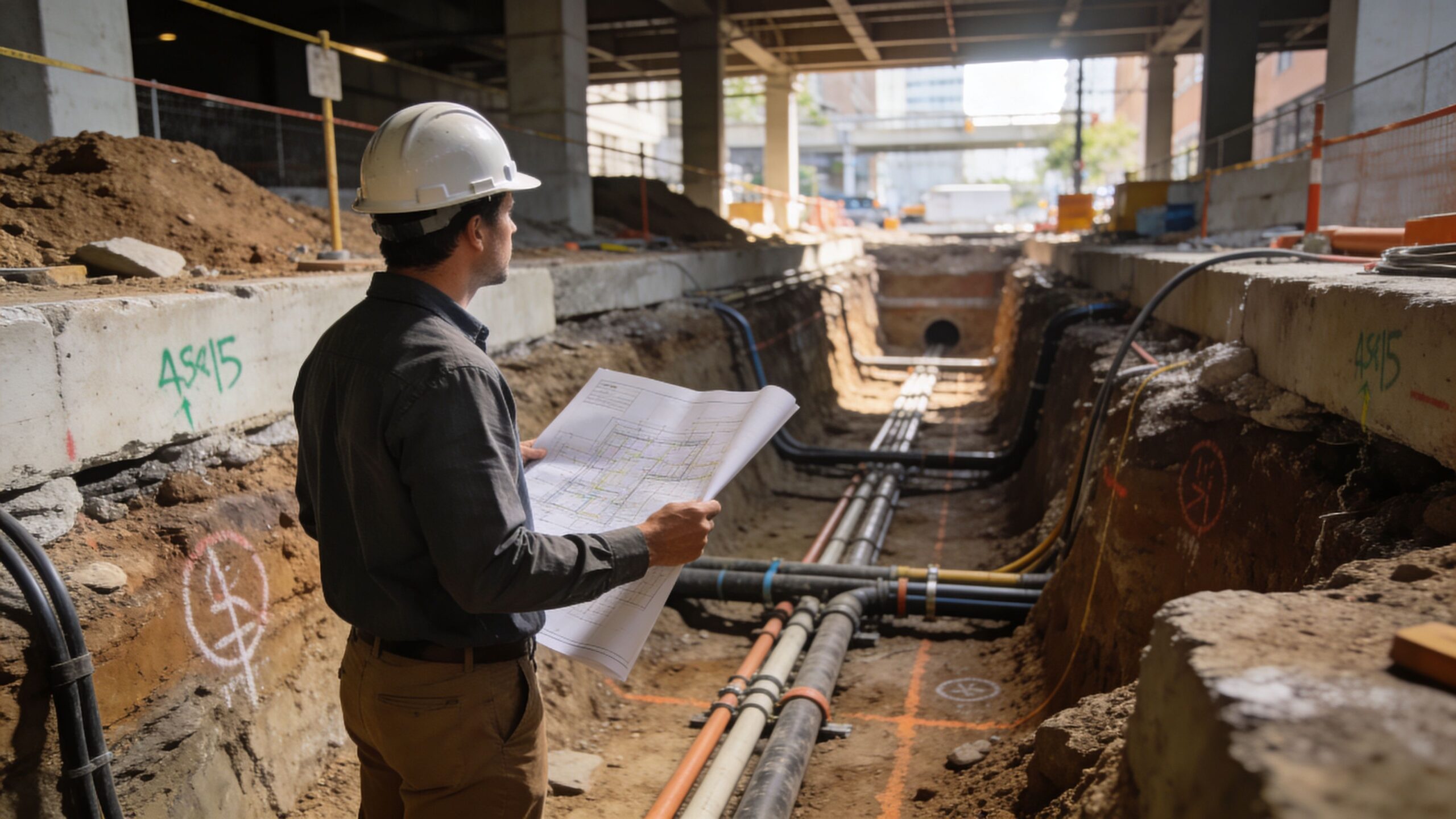
A new underground fiber build usually starts with a bad assumption. Someone sees a route on a map, a few road crossings, maybe a utility easement, and decides the hard part is production. In practice, the hard part is usually what happens before a single bucket tooth touches soil.
If the route crosses municipal streets, private frontage, DOT corridors, railroad influence zones, drainage paths, or older utility districts, pre-construction determines whether the build stays predictable or turns into daily escalation. The first version of the schedule rarely survives contact with permitting requirements that weren’t identified early.
Start with the route, not the drawing
The route package needs to answer four questions before construction planning gets serious:
- Who controls the ground: city, county, state, private owner, utility district, or a mix.
- What already occupies the corridor: electric, gas, water, sanitary, storm, legacy copper, abandoned conduit, traffic signal infrastructure.
- What conditions could change the method: rock, high groundwater, unstable soils, congested intersections, tree protection zones.
- What approvals gate the schedule: ROW permits, lane closure approvals, traffic control review, environmental constraints, restoration requirements.
A lot of project delays come from treating right-of-way research as clerical work. It isn’t. It’s risk forecasting. If one segment requires night work, another requires full restoration, and a third needs agency inspection windows, your production logic changes immediately.
The one-call process is necessary, not sufficient
Every competent team initiates utility locate requests before excavation. That’s baseline discipline, not advanced practice. The field reality is that marks can be incomplete, records can be stale, and buried assets can exist where no one expects them.
A primary risk is striking existing utilities, which causes 25% of project delays and averages $30,000 in repair costs per event, and crews mitigate that by submitting locate requests 48 to 72 hours in advance, using GPR and EM locators, and performing soft digs, achieving a success rate over 95% in avoiding strikes, according to this underground construction risk guidance.
Practical rule: 811 gets the process started. It does not replace field verification.
For dense corridors, crews need more than paint marks. They need a working subsurface model built from electromagnetic locating, ground-penetrating radar, potholing, and visual confirmation at conflict points. If the route goes through older urban blocks, assume at least some of the existing records are wrong until proven otherwise.
What due diligence looks like in the field
A solid pre-construction package usually includes these steps:
Desktop ROW review
Pull franchise limits, parcel boundaries, utility atlas data, permit conditions, and restoration standards. Confirm where you can work and where you only think you can work.Field walk with engineering and operations together
Don’t separate design from constructability. The person planning bore shots should see driveway grades, drainage channels, retaining walls, and access choke points in person.Geotechnical and environmental screening
Bore planning without soil intelligence is guesswork. Wet ground, cobble, debris, and fill material all change tooling, fluid planning, and production assumptions.Conflict verification at critical crossings
Pothole known conflicts before finalizing alignment. The cost of confirming a crossing is small compared to redesigning in traffic with a crew waiting.Permit sequencing
Track permit durations, inspection notice requirements, and agencies that won’t allow work before final approval packets are stamped.
For owners who need a plain-language view of how excavation decisions, costs, and permit obligations connect at the property level, this overview of residential excavation services, costs, and permits is a useful reference even outside telecom. The same basic lesson applies at larger scale. Ground disturbance is never just a field activity.
A project also needs one current source of truth for permit status, route revisions, utility conflicts, and approved traffic control. Internal teams often solve that with a shared construction workflow tied to design and permit tracking, whether that lives in a GIS environment, a PM platform, or a dedicated partner portal such as this permitting and coordination workflow page.
Underground builds are usually won in pre-con. Crews just collect the result.
Trenching vs Boring Choosing Your Excavation Method
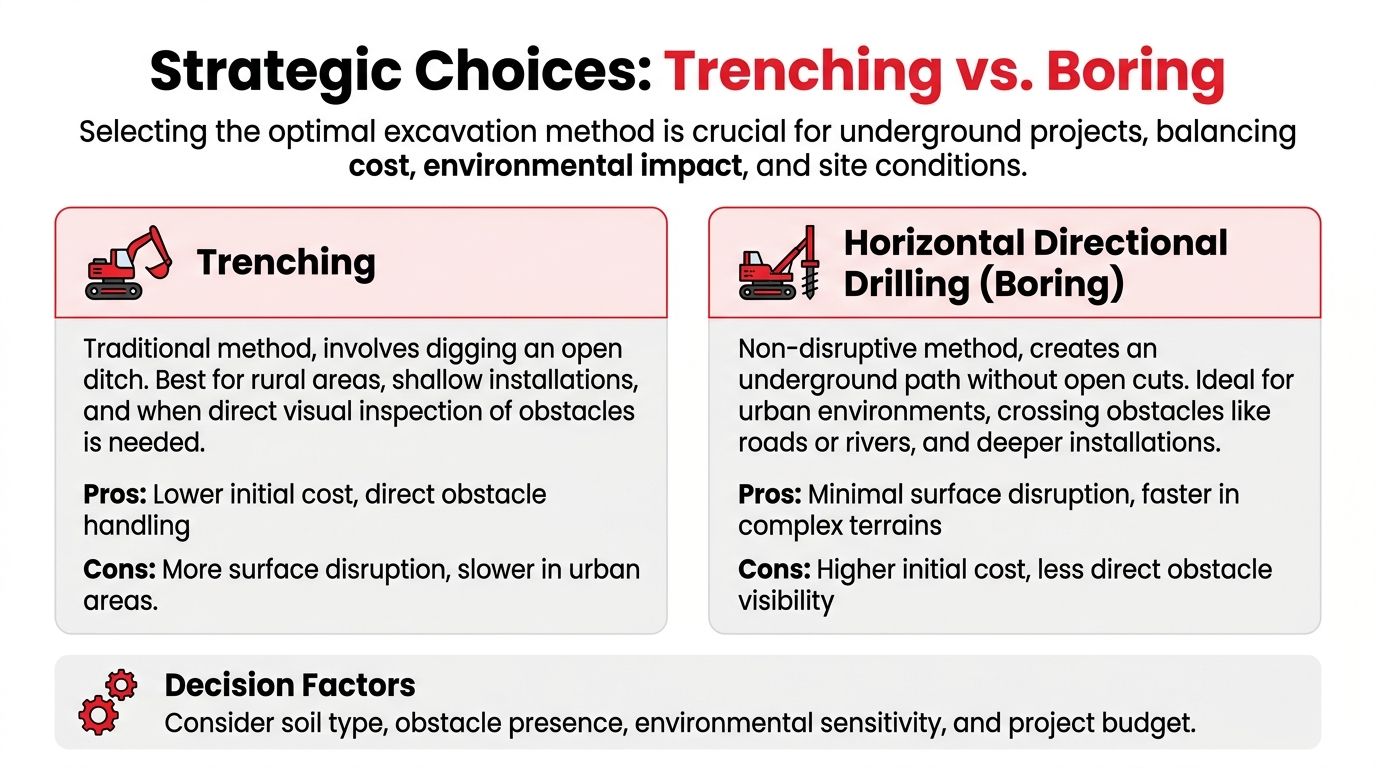
The most common mistake in underground planning is treating trenching and boring like interchangeable means and methods. They aren’t. They solve different problems, create different risks, and fit different business cases.
Open-cut trenching can be the right answer in a greenfield subdivision, a utility easement with clean access, or a shallow install where visual control matters. Horizontal directional drilling can be the only reasonable answer under arterial roads, developed frontage, creek crossings, or high-visibility commercial corridors where surface disruption would be unacceptable. The right decision depends on conditions, not preference.
What trenching does well
Trenching gives crews direct visual access to the work area. That matters when obstacle handling is expected, when conduit banks need careful placement, or when the route is simple enough that open excavation won’t create a traffic or restoration problem.
In greenfield and low-density suburban work, trenching often simplifies production. Crews can react quickly to shallow conflicts, adjust spacing, place tracer wire cleanly, and inspect bedding and backfill in real time. If future handholes, service stubs, or branch points are planned, an open trench also makes those assemblies easier to build consistently.
The trade-off is surface impact. Pavement cuts, restoration, traffic disruption, driveway access, landscaping damage, and public complaints all rise quickly when the route moves out of open space and into active streetscape.
What HDD does well
HDD is a strategic method, not just a specialty tool. It allows the team to cross roads, avoid major surface disturbance, and keep critical areas operational while the install moves below grade.
For trenchless HDD projects in difficult soils, success rates can reach 90% to 95% with proper geotechnical surveys and mud management, but can drop to 70% without those controls. Inadequate mud management alone accounts for 15% to 20% of project failures, based on this HDD construction guidance.
That’s the trade. HDD reduces visible disruption, but it raises the technical burden. The team has to understand bore path geometry, drilling fluid behavior, tooling selection, pullback loads, exit constraints, and how soil variability changes every one of those decisions.
Comparison of Underground Excavation Methods
| Factor | Open-Cut Trenching | Horizontal Directional Drilling (HDD) |
|---|---|---|
| Best-fit environment | Greenfield, open easements, shallow utility corridors | Urban streets, road crossings, constrained sites |
| Surface disruption | High | Low |
| Obstacle visibility | Direct | Indirect, based on locating and tracking |
| Restoration burden | Higher | Lower at surface, but planning is more technical |
| Crew skill profile | Excavation, grading, utility placement | Bore planning, rig operation, fluid management, tracking |
| Traffic impact | More difficult in active corridors | Often easier to manage |
| Reaction to unknowns | Immediate visual adjustment possible | Unknowns can force redesign mid-shot |
| Typical decision driver | Cost control and direct access | Access preservation and reduced surface disturbance |
The decision should be defended, not assumed
A suburban FTTH route through undeveloped shoulder can justify trenching even if HDD is technically possible. You may gain better installation visibility, easier vault placement, and simpler restoration. A downtown intersection with traffic signal loops, water services, gas laterals, and business access constraints points the other way. There, boring usually protects the schedule and the relationship with the jurisdiction.
The cheapest method on paper often becomes the most expensive method once restoration, traffic control, and rework enter the picture.
At this stage, project managers need to challenge generic recommendations. Ask these questions before approving the method:
- How reliable is the soil information? HDD without credible subsurface data is gambling.
- What’s the public impact if we open-cut this segment? Lane closure hours, storefront access, pedestrian routing, and restoration all have cost.
- Where are the true conflict zones? Long clean sections may trench well while a few key crossings should be bored.
- What does failure look like? A bad trench section creates restoration pain. A failed bore can create fluid release, lost tooling time, and redesign.
For owners comparing methods outside telecom, this practical piece on choosing between trenchless or traditional pipe replacement frames the same decision logic well. The technology changes by asset type, but the project trade-offs are familiar.
Some projects also benefit from mixed delivery. One contractor may trench long runs while a specialized bore crew handles crossings and constrained segments. The key is integrated planning, not method loyalty. If the route includes multiple bores, stakeholders usually need a construction package built around bore logs, access pits, and shot sequencing, which is exactly the kind of coordination reflected in this directional boring service overview.
What doesn’t work
Three habits drive bad excavation decisions.
Picking the method before field review
If procurement locks in trenching or HDD too early, the field team spends the rest of the job forcing reality to fit the bid.Ignoring restoration in the cost model
Pavement, concrete, site features, and traffic impacts belong in the same conversation as production rate.Separating bore design from utility risk
A technically clean drill path on a drawing can still be a bad field choice if locates are uncertain or congestion is high.
Good underground management isn’t about proving one method is superior. It’s about assigning the right method to each segment and building a schedule around what the ground will allow.
From Conduit to Cable The Installation Process
Once the route is cleared for construction and the method is set, execution becomes a discipline problem. At this stage, field quality either protects the network for decades or bakes in future trouble.
Conduit placement looks straightforward until you start seeing what causes service calls later. Improper depth, poor bedding, crushed duct, missing tracer wire, bad sweeps, inaccessible handholes, and overcrowded vault entries all come from teams moving too fast or building only for turnover.
Conduit placement sets the future maintenance burden
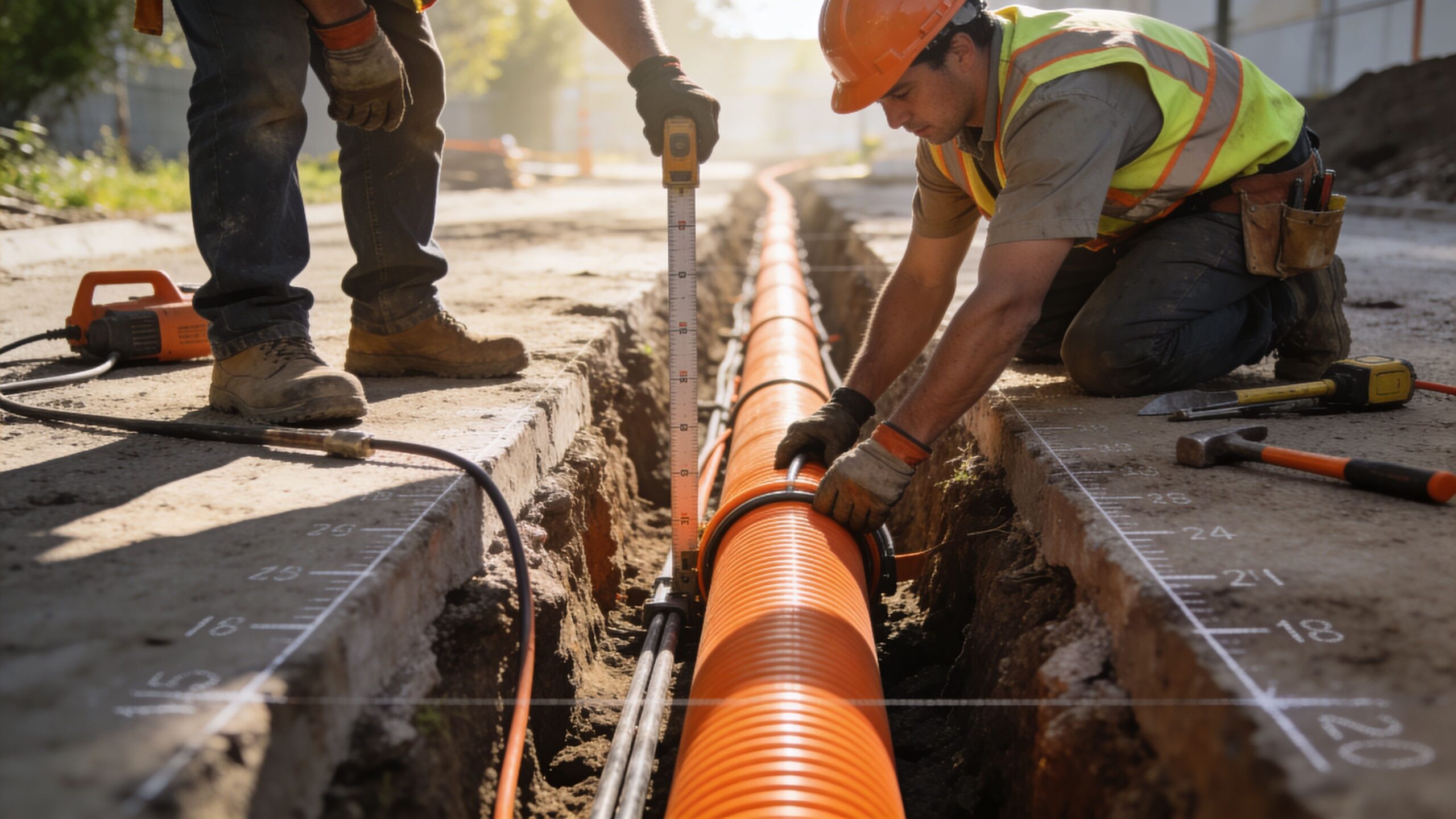
A conduit run should be built for the second crew, not just the first. That means consistent depth, clean transitions, acceptable bend geometry, sealed entries, and room for future use.
At the installation stage, crews should be checking for:
- Depth consistency so future locates and maintenance crews don’t encounter unpredictable cover.
- Tracer wire continuity so the route can be found without relying on memory or old prints.
- Separation and spacing that support future overbuilds, parallel routes, or additional service laterals.
- Handhole and vault placement that allows technicians to work safely without blocking traffic or fighting poor access.
If a team places handholes based only on footage intervals and not on splice strategy, turn points, and access conditions, they usually regret it later. Every access point should solve an operational need. It shouldn’t just satisfy a drawing.
One practical way to keep crews aligned is to use a standard field package for conduit sections, handhole schedules, and restoration notes, then tie daily installs back to a central construction record such as this underground conduit construction workflow.
Fiber installation is where rough handling gets expensive
After conduit passes proofing and cleaning, the cable phase begins. The two most common methods are pulling and blowing.
Pulling works well on shorter runs and for layouts where the route geometry is controlled. It’s familiar, straightforward, and effective when crews can manage tension carefully.
Blowing uses compressed air to install cable through longer duct sections with less mechanical stress on the fiber. It’s often the better choice when route lengths grow, bends accumulate, or the project wants to reduce handling risk.
What matters isn’t only the method. It’s whether the team respects the cable’s limitations. If they exceed allowable tension, drag cable through contaminated duct, ignore lubricant compatibility, or rush around tight sweeps, they can create microscopic damage that won’t always show up immediately. Those are the failures that appear later as loss, intermittency, or unexplained troubleshooting headaches.
Clean duct, controlled tension, and disciplined handling beat speed every time.
Crews also need to think past the install day. Slack storage has to be deliberate. Cable identification has to be durable. Entry points must be sealed against moisture and contamination. If the route serves a high-priority customer or supports ring architecture, those details aren’t cosmetic. They directly affect recoverability during outages.
A short field demonstration helps clarify what careful handling and routing discipline look like in practice:
Splicing is precision work, not cleanup work
Poorly managed projects treat splicing as the last activity before closeout. Strong projects treat it as a controlled production discipline with quality gates.
Fusion splicing demands cleanliness, correct prep, stable environmental conditions, proper tray organization, and technicians who understand more than the machine prompts. A good splice plan accounts for fiber counts, route redundancy, handhole access, enclosure capacity, labeling logic, and future maintenance.
Here’s where experienced field leadership makes a visible difference:
- A rushed splicer can technically complete the task while leaving behind poor tray management and hard-to-service closures.
- A disciplined splicer leaves a closure that tests clean, documents clean, and can be reopened without confusion.
The same applies to vault and handhole buildout. If slack loops are jammed, trays are overcrowded, and labels don’t match route records, maintenance crews will pay for it later. Underground work should reduce future uncertainty, not create it.
What strong installation management looks like
A well-run underground fiber build usually includes daily acceptance checks before the crew leaves the segment:
- Conduit verification with proofing, continuity, and visible review of transitions
- Access structure inspection for placement, grade, drainage, and workability
- Cable handling review covering tension control, duct condition, slack storage, and identification
- Splice package check confirming labeling consistency and closure organization
This phase looks like production from the outside. In reality, it’s where the network either becomes maintainable infrastructure or buried rework.
Verifying Performance Testing QA and As-Built Documentation
A buried network isn’t complete because the route is in the ground. It’s complete when the installed plant performs to design and someone can prove what was built.
That last part matters more than many teams admit. Plenty of underground systems operate for a while with weak documentation because the route was “close enough” to the drawing and the fibers “lit up.” That approach doesn’t hold when another crew has to troubleshoot a fault, add capacity, relocate around another utility, or answer a locate ticket years later.
Testing proves the plant, not just the splice
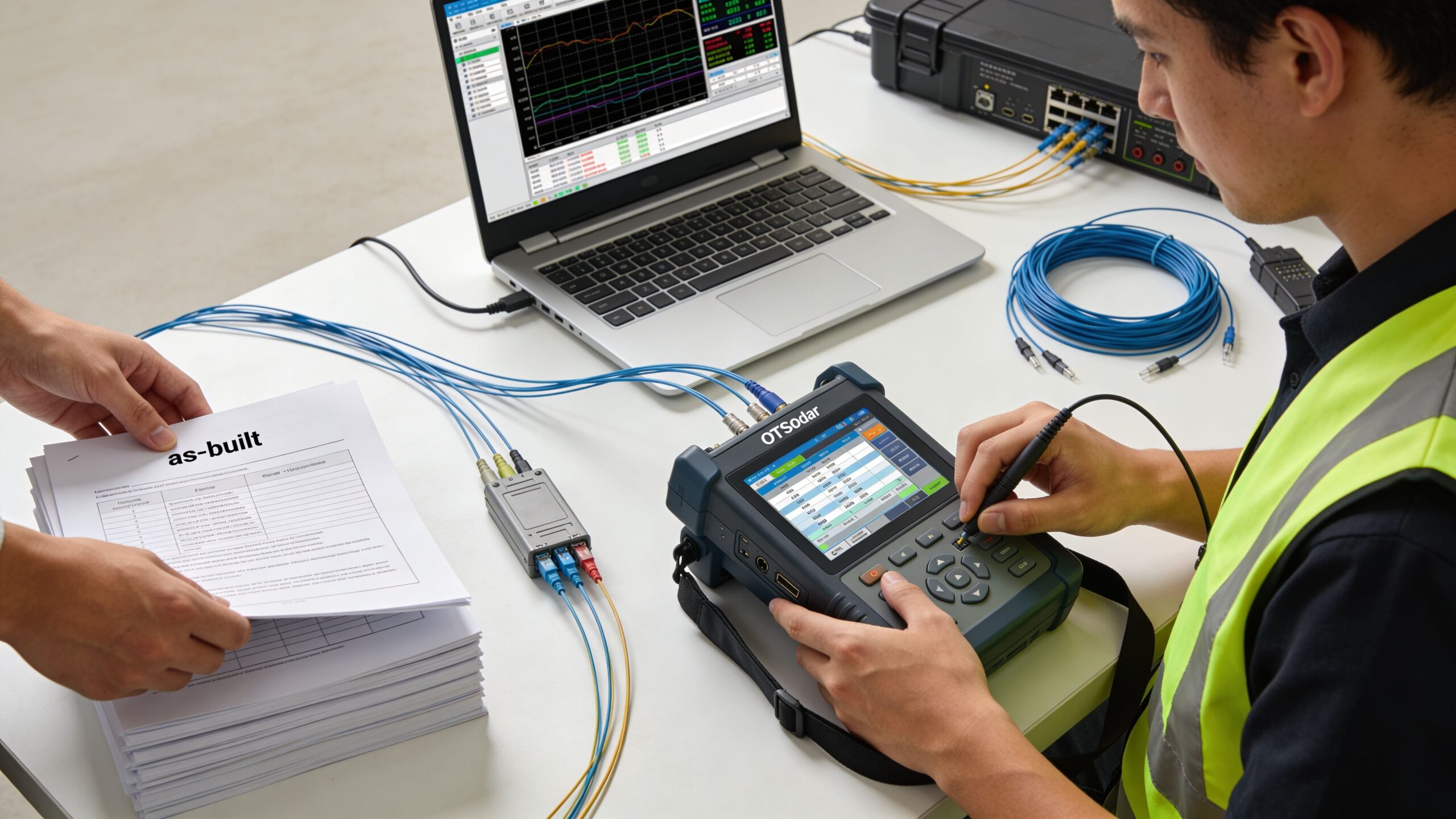
The core post-installation testing package usually includes OTDR traces and end-to-end loss testing with a light source and power meter. These aren’t paperwork exercises. They answer different questions.
OTDR testing helps the team identify reflective events, splice points, abnormal attenuation, and possible defects along the route. It creates a fingerprint of the link that becomes far more valuable later, especially during fault isolation.
Power meter testing confirms whether the installed path stays within the intended loss budget from end to end. If the OTDR says the route looks clean but the total loss doesn’t make sense, the team knows to keep digging into connectors, polarity, contamination, or hidden handling damage.
A passing light test is good. A passing light test with traceable event data is what protects operations later.
Testing discipline also depends on timing. If crews wait until the full route is closed up to discover a problem, diagnosis gets slower and costlier. Segment-based QA catches issues while access is still practical and field memory is fresh.
As-builts should work for the next crew
The older model of as-built documentation relied on redlines, field notebooks, and loosely updated PDFs. That might satisfy turnover. It doesn’t support efficient operations.
Modernizing documentation with AI and drone-assisted underground mapping can reduce survey errors by 40%, while only 12% of US ISPs had adopted digital twin technology as of 2026 even though it has been shown to cut deployment times by up to 35%, according to this industry mapping discussion.
That gap matters because underground infrastructure is only as manageable as its records. A useful as-built package should include actual route geometry, access structure locations, bore path information where relevant, splice locations, cable IDs, duct assignments, and enough spatial accuracy that future crews can trust it.
What belongs in a closeout package
A reliable turnover set usually includes:
- Georeferenced route records tied to GIS, not just markup sketches
- Access point details for handholes, vaults, and enclosure identifiers
- Test results linked to cable segments and splice locations
- Revision history showing what changed from design during construction
Some teams are also moving toward living records instead of static closeout files. That’s the better direction. Networks change. Documentation should be able to change with them without losing traceability.
Why documentation is a financial control
Accurate as-builts reduce future engineering uncertainty. They shorten outage diagnosis, improve locate confidence, support overbuild planning, and lower the odds that another project damages your plant because no one could verify where it really sits.
Bad documentation pushes cost into the future. The budget may look clean at turnover, but maintenance, troubleshooting, emergency response, and upgrade work become slower and riskier. That’s not a paperwork issue. It’s an asset management issue.
Beyond the Hard Hat A Deep Dive into Project Safety
Safety on underground work gets discussed too often as compliance language. In practice, it’s a production control system. Crews that operate safely usually build more predictably because they force discipline around planning, excavation limits, utility exposure, and response protocols.
The highest-risk moments are rarely dramatic at the start. They look routine. A trench gets a little deeper. A marked utility seems farther away than expected. A crew member decides a quick machine movement will save time. That’s when projects go sideways.
The real hazards are specific
Trench collapse prevention starts with excavation awareness, soil assessment, and the right protective system for the conditions. If the cut requires sloping, benching, shielding, or engineered shoring, the decision should be made before the crew improvises in the field.
Utility exposure near marked lines needs its own discipline. Within 18 to 24 inches of confirmed lines, crews should hand-dig per OSHA-oriented guidance cited earlier in the article, and many teams also use hydro-excavation or vacuum excavation to expose assets without mechanical contact. That extra step protects workers, the public, and the client’s existing infrastructure.
Emergency response has to be preplanned
Every crew should know what happens if they strike electric, gas, water, or communications infrastructure. Not in theory. In sequence.
- Stop work immediately and secure the area.
- Protect the public by controlling access and traffic movement.
- Notify the utility owner and project chain of command with no delay.
- Document field conditions while preserving safety priorities.
- Resume only after clearance from the appropriate authority and project leadership.
Safety isn't a line item you trim. It’s the system that keeps one bad minute from turning into a shutdown, a claim, or an injury.
Culture shows up in small decisions
The strongest underground crews don’t rely on slogans. They hold tailboards that matter, question locate confidence, and pause when conditions differ from the plan. They also understand that schedule pressure doesn’t excuse poor judgment.
A project owner should pay attention to simple indicators. Does the foreman re-check field conditions before digging? Does the crew keep exposed utilities protected and visible? Does the supervisor know the strike response procedure without opening a binder? Those signs tell you whether safety is embedded or performative.
When a contractor treats safety as overhead, quality usually degrades too. The same habits that produce shortcuts around trench protection also produce shortcuts in conduit placement, restoration, and documentation. Underground work punishes that mindset quickly.
Lessons Learned and Building for Tomorrow
Successful work on the underground comes down to a chain of decisions that starts well before excavation and continues long after backfill. Site assessment controls risk. Method selection controls constructability. Installation discipline protects the asset. Testing and documentation determine whether the network remains serviceable when conditions change.
That lifecycle view matters more now because labor pressure is becoming a project risk of its own. The telecom industry faces a critical skilled labor shortage, with a 2025 FCC report noting that 30% of project delays are due to workforce gaps, and underground roles in the Southern US saw 18% year-over-year growth in vacancies in Q1 2026, based on this workforce snapshot. Owners feel that shortage most in HDD crews, splicing teams, field supervision, and project managers who can coordinate the whole chain instead of only one task.
That’s why the right underground partner isn’t just a contractor with equipment. It’s a team that can carry route risk, utility coordination, production planning, QA, and documentation as one accountable program. Southern Tier Resources is one example of that model, handling engineering, construction, splicing, testing, and maintenance across fiber and wireless infrastructure as a single delivery chain.
The network you build now has to support future customers, future maintenance crews, and future expansion. If the underground portion is rushed, under-documented, or assigned to disconnected teams, those problems don’t stay buried. They surface later, usually at the worst possible time.
If you need an accountable partner for fiber construction, directional boring, splicing, testing, and long-term infrastructure support, Southern Tier Resources can help you plan and execute underground network builds with the discipline they require.