A fiber route, a 45-site macro expansion, and a data-center fit-out can all look affordable on paper until the estimate meets field reality. A route-mile assumption misses make-ready work. A site count hides foundation conditions and access constraints. A fit-out budget can remain within its physical construction allowance while a delayed energization date postpones network activation and revenue.
The right cost estimation techniques change as scope, design maturity, and risk information improve. Early estimates support go or no-go decisions. Later estimates support procurement, contract commitments, change control, and delivery planning. Treating every estimate as a permanent price creates false confidence.
This roundup ranks ten practical methods by the project stage and telecom asset type where each pays off. It shows how analogous, parametric, bottom-up, vendor-based, reserve, and probabilistic approaches work, where each fails, and how to adjust the contingency logic without hiding uncertainty. For a broader view of monitoring costs in public tenders, connect the estimate to the commercial controls that will track it after award.
1. Analogous Estimating and Expert Judgment
Analogous estimating is the fastest useful method when a project has limited definition but the team has credible completed work to reference. A project manager can compare a proposed 180-mile rural fiber route in Oklahoma with a completed 200-mile rural fiber build in Texas, then adjust for terrain, labor availability, permitting environment, restoration requirements, and construction method.
The method works best when the comparison is truly comparable. A rural aerial route isn't a sound analogue for an urban underground build just because both contain fiber. Likewise, a small cell deployment shouldn't borrow a macro-site rate without separating access, power, civil work, radio equipment, and integration.
Where it pays off
Use analogous estimating at the concept and feasibility stage for fiber, macro sites, and small cell programs. It also provides a valuable reasonableness check against a detailed data-center fit-out estimate. A team estimating a new 45-site macro expansion can start with completed tower deployment costs, then isolate differences in structural loading, foundations, compound work, transport, permitting, and installation sequencing.
The contingency adjustment should follow the differences, not a blanket percentage. Add explicit allowances for known geographic or scope gaps, and identify unknowns that the historical project didn't contain. Keep a short basis-of-estimate record with the source project, completed actuals, exclusions, productivity assumptions, and reasons for each adjustment.
Practical rule: Use the project manager or crew lead who delivered the reference job. Their knowledge of access problems, rework, and hidden scope is often more valuable than an unqualified average.
Analogous estimates improve when teams capture lessons learned after closeout. They shouldn't replace a later quantity-based estimate, but they can expose an implausible result before procurement or bid submission.
2. Parametric Estimating
Parametric estimating turns recurring relationships into a scalable model. For telecom work, the drivers might include route miles, aerial and underground quantities, pole attachments, splice counts, small cell sites, macro sites, cabinets, racks, cable runs, or commissioning tasks. The model applies historical relationships to the measurable scope rather than relying only on personal memory.
A fiber program with a well-maintained history can estimate a new build by separating route type, geography, construction method, permitting conditions, and restoration requirements. A small cell program can use site-level drivers, provided the database distinguishes simple street furniture connections from locations requiring new power, traffic control, structural reinforcement, or complex traffic management.
Build the model around real drivers
A single unit rate is rarely enough. A data-center fit-out model based only on cost per cabinet can mislead if one project has standard structured cabling and another includes major power distribution, cooling changes, integration, testing, and commissioning. The same issue appears in macro work, where site count alone says little about foundation design, tower loading, compound construction, equipment modernization, or access.
Maintain historical actuals by asset type, geography, construction method, and complexity. Update the relationships when completed costs become available, and validate the output against an analogous estimate and a detailed sample of line items. If the model has weak data for a particular jurisdiction or asset type, widen the uncertainty range instead of presenting the output as precise.
For the contingency adjustment, assign more reserve to the parameters with poor data quality. A strong route-mile relationship may need little adjustment for ordinary construction, while a weak permitting or make-ready relationship deserves a separate risk allowance. GAO guidance supports collecting historical data, selecting appropriate estimating methods, analyzing sensitivity and risk, documenting assumptions, validating results, and updating estimates as conditions change, as described in its cost estimating and assessment guidance.
Parametric estimating pays off most during feasibility, portfolio planning, and budget authorization. It isn't a substitute for vendor quotes or a bill of quantities when the project is ready for a fixed-price commitment.
3. Ratio and Index-Based Estimating
Historical costs become unreliable when the estimator ignores time, location, or scope composition. Ratio and index-based estimating corrects the historical baseline by separating cost components and applying relevant escalation or geographic adjustments. It can bring an old fiber, wireless, or data-center estimate into a current planning context, but only if the original assumptions are still visible.
The first step is to identify what the historical amount includes. Labor, fiber or cable, electronics, equipment, freight, subcontractor work, engineering, and overhead won't necessarily move at the same rate. Applying one index to the entire project can overstate some components and understate others.
Apply adjustments to the right layer
Suppose a prior fiber build is being used to frame a new opportunity. The estimator should document its base year, route conditions, aerial or underground mix, crew productivity, material specification, permitting status, and commercial exclusions. A Colorado mountain route shouldn't inherit a flat-terrain rate without an explicit adjustment for access, weather exposure, rock, restoration, or logistics.
The contingency adjustment belongs around residual uncertainty, not around a known index movement. If labor and material escalation are already modeled, don't add them again inside a generic reserve. Add a separate allowance for uncertain future prices, schedule exposure, or scope differences that the index can't represent.
This technique pays off during concept development and multi-year program planning, particularly for fiber portfolios and network modernization. It can also support a macro-site or small-cell budget when the team has an old, comparable rate but no current supplier quote.
A cost index updates a price level. It doesn't make an incomparable project comparable.
Use published construction or labor references where appropriate, then test them against local procurement data. Contract documents should state the base date, selected index, adjustment formula, and treatment of extraordinary changes. Procurement leads should also record quote validity periods, because a mathematically current estimate can still rely on commercially expired pricing.
Index-based estimating fails when teams use a convenient factor to conceal incomplete scope. It should translate known historical costs, not manufacture confidence where route design, site surveys, or equipment selections remain unresolved.
4. Three-Point Estimating with PERT
Three-point estimating is effective when a cost driver has a clear best case, most likely case, and adverse case. The team doesn't pretend that one number captures weather, permitting, difficult terrain, foundation conditions, code changes, or access constraints. Instead, it records three defensible scenarios and uses a weighted expectation.
For a fiber installation package, the optimistic case might assume normal productivity and no unusual restoration. The most likely case can include ordinary traffic control, routine inspections, and expected crew output. The pessimistic case should describe a specific adverse condition, such as difficult terrain, prolonged weather disruption, or rework after inspection. The familiar PERT expression is Expected Cost = (O + 4M + P) / 6, but the formula is only as credible as the assumptions behind each input.
Make the pessimistic case actionable
A pessimistic value shouldn't be a fear-based number selected to make the budget look safe. Ask what would cause it, how likely the cause is, who owns the response, and whether early action can reduce the exposure. For a macro site, foundation uncertainty might trigger additional geotechnical work before award. For a data-center fit-out, late code or design changes might require an earlier design review and procurement hold point.
The contingency adjustment should reflect the spread between scenarios. A narrow spread supports a smaller reserve for that work package. A wide spread signals that the team needs more investigation, a risk response, or a probabilistic analysis rather than a larger unexplained percentage.
Use PERT during preliminary design and risk review for fiber, macro, small cell, and data-center work. It works especially well in workshops with estimators, field supervisors, designers, procurement leads, and commissioning specialists. Their separate views often reveal that the “most likely” case has assumed away the very risk the pessimistic case was meant to expose.
Document the reason for every scenario. If conditions change, update the three values instead of changing the contingency without an audit trail.
5. Bottom-Up Estimating
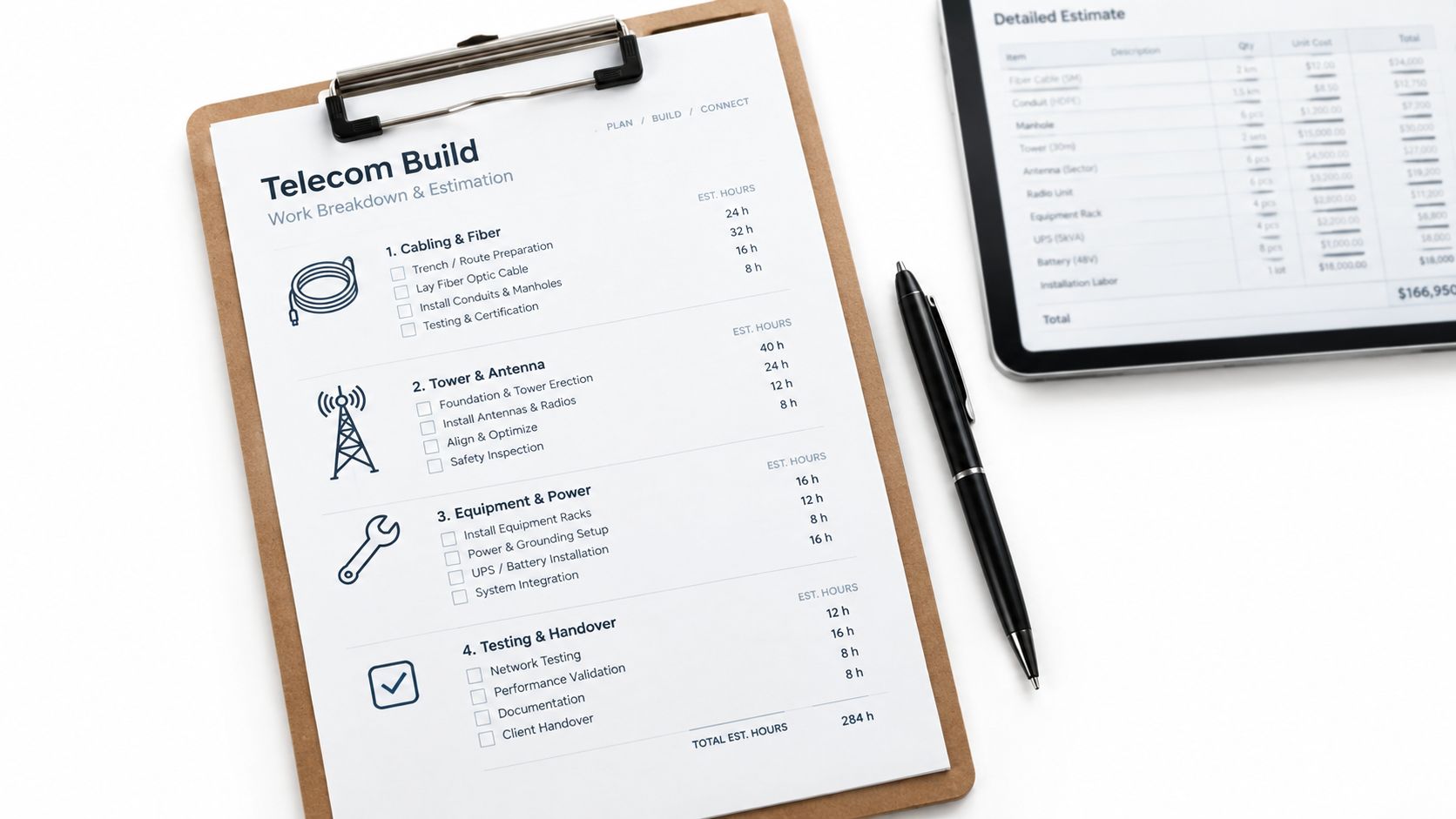
Bottom-up estimating earns its accuracy by forcing the team to price the work that will occur. The estimator decomposes the project into work packages and line items, assigns quantities and resources, and rolls the components into a total. It takes more time than an analogous estimate, but it gives project managers a budget they can connect to procurement packages, crew plans, schedules, and invoices.
For a fiber build, the estimate should distinguish survey work, environmental and permitting activities, engineering, pole make-ready, underground construction, aerial installation, splicing, testing, restoration, documentation, traffic control, project management, and closeout. A data-center fit-out needs separate treatment for power distribution, cooling interfaces, racks, structured cabling, containment, integration, testing, and commissioning.
Price the items teams often forget
Testing and documentation are common omissions because they occur near the end of delivery. Engineering, site access, inspection, restoration, temporary facilities, freight, and mobilization can disappear for the same reason. A bottom-up estimate exposes those omissions before the commercial baseline is approved.
For a macro site, estimate foundation, structural work, equipment installation, RF cable, antennas, grounding, electrical work, safety controls, engineering, inspection, optimization, and turnover separately. For small cells, distinguish site acquisition, utility coordination, pole or street-furniture work, civil construction, power, radios, backhaul, integration, and restoration.
The contingency adjustment should sit at the work-package level. Add a specific allowance for uncertain boring, foundation conditions, make-ready, or commissioning rework. Don't bury a scope change inside contingency. If the client adds a new cabinet or radio, process it through change control and update the estimate baseline.
Bottom-up estimating pays off at detailed design, procurement readiness, and bid submission. It works poorly when the design is too immature to support credible quantities. In that case, use a higher-level method temporarily and mark the missing inputs that must be resolved before the estimate is treated as a commitment.
6. Work Breakdown Structure Based Estimating
A Work Breakdown Structure, or WBS, gives the estimate a repeatable architecture. Bottom-up estimating prices the components, while the WBS defines how the team organizes those components, assigns ownership, maps them to schedule activities, and tracks actuals. The distinction matters because a detailed list without a consistent structure becomes difficult to reconcile after award.
A fiber WBS might move from project level to design, permitting, procurement, construction, splicing and testing, commissioning, documentation, and handover. Under construction, the team can separate route segments, make-ready, aerial work, underground work, restoration, and traffic control. A data-center WBS can separate power, cooling, structured cabling, equipment installation, systems integration, testing, and commissioning.
Keep the hierarchy commercially useful
Each work package should be estimable, schedulable, assignable, and measurable. If a package combines design, permitting, civil work, and testing, the project manager won't know whether a variance comes from a supplier, a crew, a jurisdiction, or an incomplete scope decision.
For a macro-site program, align the WBS with site acquisition, permitting, engineering, foundation, structure, antenna systems, electrical work, integration, optimization, and turnover. Small-cell programs often need a jurisdiction or site-cluster breakdown because access and permitting conditions can differ sharply from one location to the next.
The contingency adjustment should map to WBS ownership. A permitting reserve belongs with the relevant permitting package. A productivity reserve belongs with the affected construction activity. A commissioning reserve belongs with integration and test. This approach makes reserve consumption visible and prevents a general budget cushion from becoming an informal fund for unrelated scope.
Use WBS-based estimating from preliminary design through execution control. Link WBS codes to project accounting, purchase orders, change requests, and schedule milestones. The structure should evolve as information improves, but it shouldn't be casually renamed after commitments are made. Stable coding lets the team compare estimate, commitment, actual cost, and estimate to complete without rebuilding the history.
7. Vendor Quote and Procurement Based Estimating
Supplier and subcontractor quotes replace assumptions with current commercial evidence. This is the strongest method for equipment, materials, freight, specialist installation, and other items where the market price matters more than an internal unit rate. It pays off most when the bill of materials and delivery requirements are sufficiently defined.
A fiber project may require quotes for cable type, fiber count, reels, closures, splice hardware, cabinets, electronics, freight, and installation support. A small-cell deployment may need radio, antenna, mounting, power, backhaul, street-furniture, and civil subcontractor pricing. A data-center fit-out should obtain configured quotes for racks, patch panels, cable systems, power equipment, containment, testing, and specialist integration.
Make every quote comparable
Send suppliers the same specification, quantity, delivery location, requested delivery date, warranty requirements, and commercial terms. Ask what freight includes, whether pricing expires, how substitutions are handled, and whether commissioning or field support is excluded. A low quote that omits testing or delivery isn't lower. It's incomplete.
Obtain competing quotations where the market supports it, but don't treat quote count as a substitute for technical comparability. A supplier may price a different grade, lead time, warranty, or installation boundary. Procurement should normalize those differences before the estimator selects a baseline.
The contingency adjustment should address quote validity, lead-time risk, substitutions, freight uncertainty, and scope gaps. Don't add a general material contingency to an item that already has a firm, valid, fully scoped quotation unless a specific exposure remains. For long-lead electrical equipment, the schedule risk may matter more than the unit price. A delayed delivery can create redesign, expediting, temporary works, idle crews, or commissioning disruption.
Use this approach during design development and procurement planning, especially for data-center fit-outs and equipment-heavy wireless sites. Revalidate quotes when the project schedule or configuration changes. Procurement evidence loses value when the team carries it forward without checking availability, terms, and technical compliance.
8. Phased and Rolling Wave Estimating
Phased estimating accepts that an early estimate should be broad and that precision must be earned through design, surveys, permitting, procurement, and field verification. The team estimates near-term work in detail and keeps later work at the level supported by current information. As the project advances, the next wave becomes detailed and the remaining uncertainty is reclassified.
This approach suits a long fiber program, network modernization effort, multi-site wireless rollout, or data-center expansion with staged releases. A concept estimate may rely on route assumptions, site counts, standard configurations, and historical analogues. A design-stage estimate can incorporate surveys, quantities, equipment selections, and jurisdiction-specific requirements. Procurement and execution estimates should increasingly reflect committed prices and confirmed installation conditions.
Let uncertainty narrow for a reason
Each phase needs a defined basis of estimate, accuracy expectation, approval gate, and list of assumptions. The team should explain what must be learned before advancing, such as pole-owner responses, utility capacity, geotechnical results, access agreements, final equipment configuration, or commissioning requirements.
The contingency adjustment should change with the risk profile. Early reserve covers broad scope and design uncertainty. Later reserve should focus on remaining identified risks, pending changes, and execution variability. Don't reduce contingency just because the calendar moved forward. Reduce it when evidence has removed uncertainty.
Rolling waves are especially useful for fiber portfolios and network modernization, where later route segments often have different construction and permitting profiles from earlier segments. They also help data-center operators release procurement packages before every design detail is complete, provided interfaces and change boundaries are controlled.
A phase gate should require more than a revised total. Review scope, quantities, assumptions, commitments, schedule, risk register, estimate to complete, and changes from the prior forecast. This makes estimate evolution visible to finance, procurement, engineering, and delivery teams.
9. Reserve Analysis and Contingency Estimating
Contingency is useful only when it has a defined purpose. Reserve analysis separates the base estimate from allowances for identified uncertainty and distinguishes those allowances from management reserve for unforeseen conditions. It should never serve as a quiet place to hide omitted scope, commercial margin, or an unapproved design change.
The first control is a risk register tied to estimate components. For fiber, risks may include make-ready, permitting, boring, restoration, traffic control, access, productivity, material availability, and rework. For small cells and macro sites, include utility coordination, site acquisition, structural findings, foundation conditions, inspections, equipment changes, and integration. Data-center fit-outs need specific treatment for power availability, design interfaces, long-lead equipment, testing, commissioning, and energization.
Replace blanket contingency with risk layers
The AACE cost estimate classification guidance describes the historical movement from broad early estimate types toward numbered classes as project definition improves. Its central lesson is practical: an estimate is a staged decision instrument, not one permanent price. The reserve should therefore evolve with scope maturity, design information, complexity, market conditions, and data quality.
A useful reserve record names the risk, affected WBS package, probability or scenario logic, cost consequence, owner, response, and release condition. If a permit is secured, the related allowance can be reduced. If a geotechnical report reveals rock, the foundation risk should be reforecast and tied to the affected scope.
Modern guidance increasingly treats uncertainty as a distribution rather than an arbitrary percentage. GAO describes Monte Carlo simulation as a way to model possible total costs and calculate contingency at a selected confidence level. That doesn't mean every estimate needs a complex model. It means the team should communicate both an expected cost and the confidence associated with the funding decision.
Use reserve analysis from budget authorization through execution, with formal change control and regular reserve-burn reviews. A reserve that has no owner, trigger, or release rule isn't risk management. It's an unexplained variance waiting to happen.
10. Monte Carlo Simulation and Probabilistic Analysis
Monte Carlo simulation is the right tool when multiple uncertain cost drivers interact and a point estimate no longer gives decision-makers enough information. The team assigns probability distributions to inputs, runs many combined scenarios, and produces a distribution of total cost. The result can show what the project might cost at different confidence levels instead of presenting one supposedly exact number.
For a large fiber program, inputs might include route segmentation, labor productivity, permitting duration, make-ready, boring conditions, material pricing, restoration, traffic control, design changes, and schedule escalation. A data-center fit-out can model equipment delivery, labor productivity, integration, testing, commissioning, utility upgrades, and energization timing. A wireless portfolio can include site acquisition, structural findings, utility connection, civil work, and equipment configuration.
Model correlation and commercial impact
Independent input assumptions can understate risk. Labor availability may affect both productivity and schedule. A delayed transformer can affect energization, commissioning, temporary power, financing, and revenue timing. The model should document those relationships rather than treating every variable as isolated.
The contingency adjustment comes from the selected percentile and the decision's risk tolerance. GAO's illustrative example increases a point estimate to $1,096,000 at the 70th percentile, with contingency of approximately $271,000 above the original point estimate, demonstrating why a “most likely” value can understate the funding needed for a defined probability of avoiding an overrun. That example is a funding illustration, not a telecom benchmark, so the model's own project history must drive the inputs.
Reference class forecasting provides an external check. It compares the proposed project with a sufficiently similar population of completed projects, establishes the empirical distribution of overruns, and applies a risk-based uplift. Guidance recommends starting with approximately 20 to 30 comparable projects, with larger samples improving reliability, as described in the reference class forecasting guidelines.
Use Monte Carlo for major fiber portfolios, complex wireless programs, and data-center fit-outs where the decision justifies the effort. Don't simulate weak assumptions to create impressive charts. Start with historical distributions, test sensitivity, validate against analogous projects, and show executives which drivers move the result.
Comparison of 10 Cost Estimation Techniques
| Method | 🔄 Implementation Complexity | ⚡ Resource & Data Requirements | ⭐📊 Expected Outcomes / Accuracy | 📊 Ideal Use Cases | 💡 Key Advantages & Tips |
|---|---|---|---|---|---|
| Analogous Estimating (Expert Judgment) | Low–Moderate, quick expert-driven process | Low formal data; relies on senior PMs and tacit knowledge | ⭐⭐⭐, Fast, early-stage estimate; lower precision for unique work | Early-phase bids, repeated similar fiber/tower builds | Leverages institutional knowledge; document lessons and adjust for geography |
| Parametric Estimating | Moderate, model development and validation needed | Medium–High: comprehensive historical database, statistical tools | ⭐⭐⭐⭐, Consistent and scalable when data is recent/relevant | Greenfield fiber, large tower expansions, $/mile or $/site scenarios | Fast and repeatable; keep models updated and segment by region |
| Ratio & Index-Based Estimating (Cost Escalation) | Low, formulaic adjustments to historical costs | Low–Medium: published indices (ENR, RS Means), base-year data | ⭐⭐⭐, Good for escalation and geographic adjustments; moderate precision | Multi-year projects, inflation adjustments, portfolio updates | Simple and defensible; separate labor/material escalation and document base year |
| Three-Point Estimating (PERT) | Moderate, requires 3 scenarios and weighted calc | Medium: expert inputs for O/M/P and basic stats | ⭐⭐⭐⭐, Produces expected value and uncertainty bands (stdev) | Projects with weather, permit, or schedule uncertainty | Quantifies risk via (O+4M+P)/6; define assumptions clearly |
| Bottom-Up Estimating (Detailed Estimation) | High, granular WBS and task-level estimating | High: detailed WBS, crew inputs, time tracking, BOMs | ⭐⭐⭐⭐⭐, Highest accuracy for well-defined scopes | Fixed-price contracts, detailed fiber/data center builds | Best visibility into cost drivers; involve crew leads and separate cost categories |
| WBS-Based Estimating | High, hierarchical decomposition and discipline required | High: cross-functional input, linkage to accounting/schedule | ⭐⭐⭐⭐⭐, Comprehensive scope coverage and control | Complex infrastructure, integrated design-build-operate projects | Reduces missing items, supports EVM; use standard templates and naming |
| Vendor Quote & Procurement-Based Estimating | Moderate, procurement cycle dependent | High: spec-driven RFQs, supplier engagement, lead-time data | ⭐⭐⭐⭐⭐ for materials/subcontracts, market-accurate pricing | Equipment-intensive projects, long-lead items, fixed-price bids | Provides firm pricing and lead times; get 2–3 quotes, specify terms clearly |
| Phased & Rolling Wave Estimating | Moderate, iterative refinement across phases | Medium: staged data updates and formal review gates | ⭐⭐⭐⭐, Improves accuracy over time; early ranges may be wide | Large, long-duration network builds and modernizations | Manages uncertainty by stage; set accuracy ranges and formal re-estimates |
| Reserve Analysis & Contingency Estimating | Low–Moderate, risk-based reserve allocation | Medium: historical variance, risk register, risk quantification | ⭐⭐⭐⭐, Reduces overruns; clarifies contingency vs base cost | Projects with permit/weather risk, first-time implementations | Allocate contingency to identified risks; define reserve release rules |
| Monte Carlo Simulation & Probabilistic Analysis | High, advanced modeling and correlation handling | Very High: simulation software, statistical expertise, detailed inputs | ⭐⭐⭐⭐⭐, Probabilistic cost distributions (P10/P50/P90), sensitivity insights | Large, complex multi‑risk projects ($20M+), high-stakes decisions | Best for quantifying interdependent risks; validate distributions and run sensitivity analysis |
Matching Each Technique to Your Next Decision
No single method wins every bid. The strongest estimate changes as the project moves from an opportunity to a defined design, then from a design to a procurement commitment and an execution forecast. The mistake isn't using a simple method early. The mistake is carrying that simple method forward after the project has generated better evidence.
For a fiber route or early wireless portfolio, start with analogous and parametric estimating. Use completed projects and measurable drivers to decide whether the opportunity deserves design spend, surveys, permitting work, or a bid response. Keep the comparison honest by separating route type, site complexity, geography, access, power, and construction method.
As scope develops, use index adjustments, WBS structure, bottom-up quantities, and supplier quotations. Ratio-based adjustments bring historical costs into the right time and location, while a WBS makes ownership and cost tracking possible. Bottom-up estimating then prices the work packages, and procurement evidence tests whether internal assumptions match the market. For data-center fit-outs and equipment-heavy macro sites, vendor and subcontractor quotes often deserve early attention because configuration, lead time, delivery terms, and installation boundaries can change the commercial result.
Uncertainty needs its own discipline. Three-point estimating helps field teams describe realistic scenarios. Reserve analysis maps allowances to identifiable risks. Monte Carlo simulation becomes valuable when many uncertain drivers interact and the approval decision depends on a confidence level. Reference class forecasting can provide an external reasonableness check against completed projects, rather than allowing the internal estimate to reinforce its own optimism. Evidence on hybrid reference-class and risk-based approaches reports historical cost overruns ranging from 5% to 88%, with a mean of 34.7%, while one hybrid sample reported a mean estimate error of -9.71% and a standard deviation of 14.48%, as summarized in this reference-class forecasting analysis. Treat those figures as evidence about infrastructure forecasting, not as a guaranteed outcome for a specific telecom job.
Power and schedule deserve separate treatment in data-center and connectivity projects. A project can remain within its physical construction allowance and still become economically over budget if an uncertain energization date delays migration, commissioning, network activation, or service revenue. Model temporary power, redesign, expediting, idle crews, financing, liquidated damages, and lost service revenue as commercial consequences of schedule risk, not just as an afterthought to the construction contingency. Recent data-center construction reporting highlights how power constraints, transformer shortages, and schedule pressure can affect delivery planning.
For teams planning fiber, small cell, macro site, or data-center fit-out work, Southern Tier Resources at southerntierresources.com can support estimate reviews across design, permitting, and construction. Document the basis of estimate, source projects, quantities, quotes, assumptions, risks, confidence level, and change history now. That record is what keeps the budget defensible when field conditions challenge the original number.
Southern Tier Resources supports telecom infrastructure budgeting through engineering, permitting, construction, testing, and maintenance for fiber, small cell, macro, and data-center projects. Visit Southern Tier Resources to discuss an estimate review that connects work packages, procurement assumptions, risk reserves, and delivery controls.