A fiber crew can arrive at a rural roadside with a clear production target, then discover that the conditions have changed. A bucket truck is positioned near moving traffic, a splice enclosure is open, a ladder is needed for access, and a trench segment has collected water overnight. The crew's OSHA safety compliance program is being tested before anyone opens a binder.
The same pressure appears on a tower upgrade, where a technician transitions between climbing and work-positioning systems, or in a data center fit-out, where contractors work around energized equipment, lifting operations, temporary power, and multiple employers. Compliance lives in those decisions, not in a policy that nobody uses.
OSHA reports that since the Occupational Safety and Health Act of 1970, workplace deaths have declined by nearly 66%, while occupational injury and illness rates decreased by 67%. The same historical record estimates approximately 24,882 injuries and as many as 36 fatalities each year from falls on construction stairways and ladders. These figures are documented in the Bureau of Labor Statistics history of OSHA. For telecom contractors, the lesson is practical. Enforceable standards matter when they become repeatable field controls.
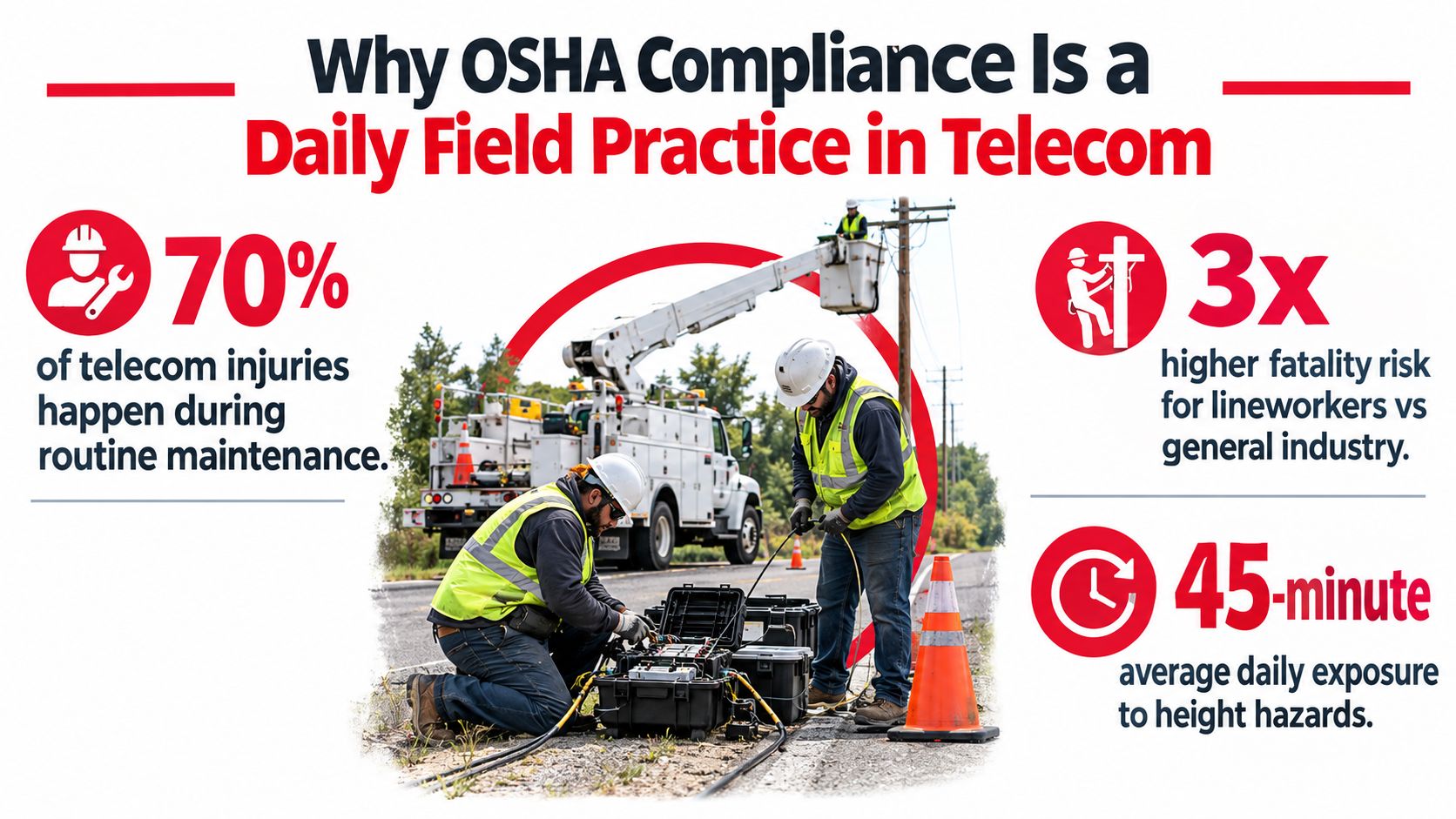
Why OSHA Compliance Is a Daily Field Practice in Telecom
A splice crew's pre-task briefing should identify more than the work order. It should address vehicle positioning, traffic exposure, overhead utilities, ladder or aerial-lift access, weather, electrical conditions, equipment inspection, and the rescue path if a worker becomes injured. The briefing becomes useful only when the supervisor connects each hazard to a person, a control, and a verification step.
That same discipline applies when a tower technician starts a climb. The approved route, anchor compatibility, connection sequence, rescue capability, and daily equipment inspection must be clear before ascent. On a broadband build, a competent person must evaluate the trench before entry, account for soil and water conditions, and confirm that workers can exit safely.
What the Act changed for field employers
The Occupational Safety and Health Act created a national enforcement framework for hazards across industries, including construction, utilities, telecommunications, and industrial facilities. That framework means a contractor's safety system must work across changing crews and locations, not just at a headquarters or during an annual review.
OSHA's enforcement record also shows why inspection readiness must be continuous. In fiscal year 2023, federal OSHA conducted 34,221 inspections, with approximately 46% programmed and 54% unprogrammed. The agency recorded 952 fatality or catastrophe inspections and 8,221 complaint inspections that year, while fiscal year 2024 totaled 34,696 federal inspections, according to OSHA's enforcement summary.
Field test: If a supervisor can't explain the hazard, show the control, and produce the record, the program isn't operating reliably.
A practical safety culture also benefits from outside perspectives, especially when crews work across jurisdictions. Teams looking for additional field-oriented ideas can review these NZ safety compliance tips, then adapt useful practices to the applicable U.S. requirements and project conditions.
Applicable OSHA Standards for Telecom Projects
Before mobilization, classify the work as construction or general industry and document the decision in the site safety plan. A greenfield fiber build, tower modification, new conduit installation, or data center fit-out will often use 29 CFR 1926 construction standards. Ongoing maintenance and some activities inside operating facilities may fall under 29 CFR 1910. The activity controls the classification, not the employer's industry label.
The same contractor may apply construction rules to a new cable route and general-industry rules while maintaining equipment in an operating facility. Supervisors should confirm the classification for each task, especially on multi-employer sites where different employers control adjacent exposures.
| Activity | Controlling Standard | Key Trigger |
|---|---|---|
| Tower construction, modification, or installation | 29 CFR 1926, including Subpart M | Work exposes employees to falls during climbing, positioning, or elevated tasks |
| Fiber trenching and conduit installation | 29 CFR 1926 Subpart P | Employees enter or work beside an excavation |
| Temporary power, electrical installation, and construction wiring | 29 CFR 1926 Subpart K | Construction electrical equipment or temporary systems are in use |
| Work near power transmission and distribution systems | 29 CFR 1926 Subpart V | Crews work near energized lines or utility attachments |
| Maintenance inside an operating facility | 29 CFR 1910 Subpart S | Electrical hazards arise during general-industry maintenance |
| Hazard communication | 29 CFR 1910.1200 and applicable construction requirements | Employees may encounter chemicals, fuels, adhesives, coatings, or other hazardous substances |
| Heat and other hazards without a specific standard | General Duty Clause | A recognized serious hazard lacks a more specific controlling rule |
Keep this table in the truck or project folder, but do not treat it as a substitute for a task review. A data center fit-out may require construction electrical controls in one area and maintenance controls in another. A make-ready project may combine construction activities with utility-system exposures governed by additional requirements.
Use the standard to drive the task
A standard becomes useful in the field when it changes the pre-task analysis and the evidence supervisors collect. Subpart P should prompt soil evaluation, protective-system selection, access planning, and competent-person inspections. Subpart M should produce a fall-exposure assessment, approved systems, training verification, equipment checks, and a rescue plan.
Subpart K or Subpart V should define electrical boundaries, qualified-person decisions, utility coordination, and energy-control procedures. Heat work also needs an operational record showing planned water, rest, acclimatization, weather review, and supervisor checks, even where no single table entry captures the full exposure.
For supervisors assembling an evidence file, these inspection-ready safety tips reinforce a practical rule: records must connect to the work performed. The controlling standard belongs in the plan, while daily documentation should show how the crew applied it, who verified the control, and what changed when site conditions shifted.
The Four Hazard Families Telecom Crews Face Most
Telecom work changes location constantly, but its most serious exposures repeat. Falls, electrical contact, excavation collapse, and confined-space hazards require different controls, yet they share one management principle: the crew must identify the trigger before work begins and verify the control at the point of use.
Falls from elevation
A tower technician can be protected at the work position and still face danger while climbing, descending, or transferring. NIOSH guidance cited by OSHA recommends 100% fall protection at 25 feet or more above the ground or another working surface, including ascent, descent, and movement between points. It also calls for a properly configured work-positioning system and daily equipment inspection, as described in the NIOSH guidance cited by OSHA.
The field record should include the climbing route, connection method, anchor compatibility, equipment inspection, rescue arrangement, and worker competency. Ladder and scaffold inspections belong in the same discipline. A ladder that is acceptable in the yard may be unsuitable after the crew changes grade, access, or work position.
Electrical contact
Make-ready work, cabinet installation, data center fit-outs, and utility attachments create different forms of electrical exposure. The control begins with identifying the source, determining whether it can be de-energized, defining the approach boundary, and confirming who is qualified to perform the work.
A job hazard analysis should identify nearby conductors, temporary power, induced voltage, damaged equipment, and coordination responsibilities between the carrier, utility, general contractor, and subcontractor. A verbal warning alone isn't a substitute for an energy-control process.
Excavation and trenching
A competent person must evaluate soil conditions and select sloping, benching, shoring, or shielding before employees enter a trench. Cave-in protection is generally required at 5 feet or deeper, unless the excavation is entirely in stable rock. Trenches 4 feet or deeper require a ladder, stairway, ramp, or another safe egress route positioned so workers travel no more than 25 feet laterally, according to OSHA's trenching requirements.
The inspection record should capture soil classification, protective-system selection, access points, water accumulation, nearby equipment loads, and changing conditions. GPS-tagged daily records are particularly useful when a broadband crew moves through multiple trench segments.
Confined spaces
Vaults, manholes, and some indoor infrastructure spaces can present atmospheric, engulfment, access, and rescue hazards. A gas reading without a response plan is not enough. The entry process should identify the space, test conditions, control access, define attendant duties, establish communications, and confirm how rescue will occur.
The evidence should travel with the entry. Keep the permit or equivalent entry record, atmospheric results, equipment checks, worker roles, and closeout documentation together. A plan that assumes an outside rescue team will solve every emergency should be challenged against actual access, response time, and equipment limitations.
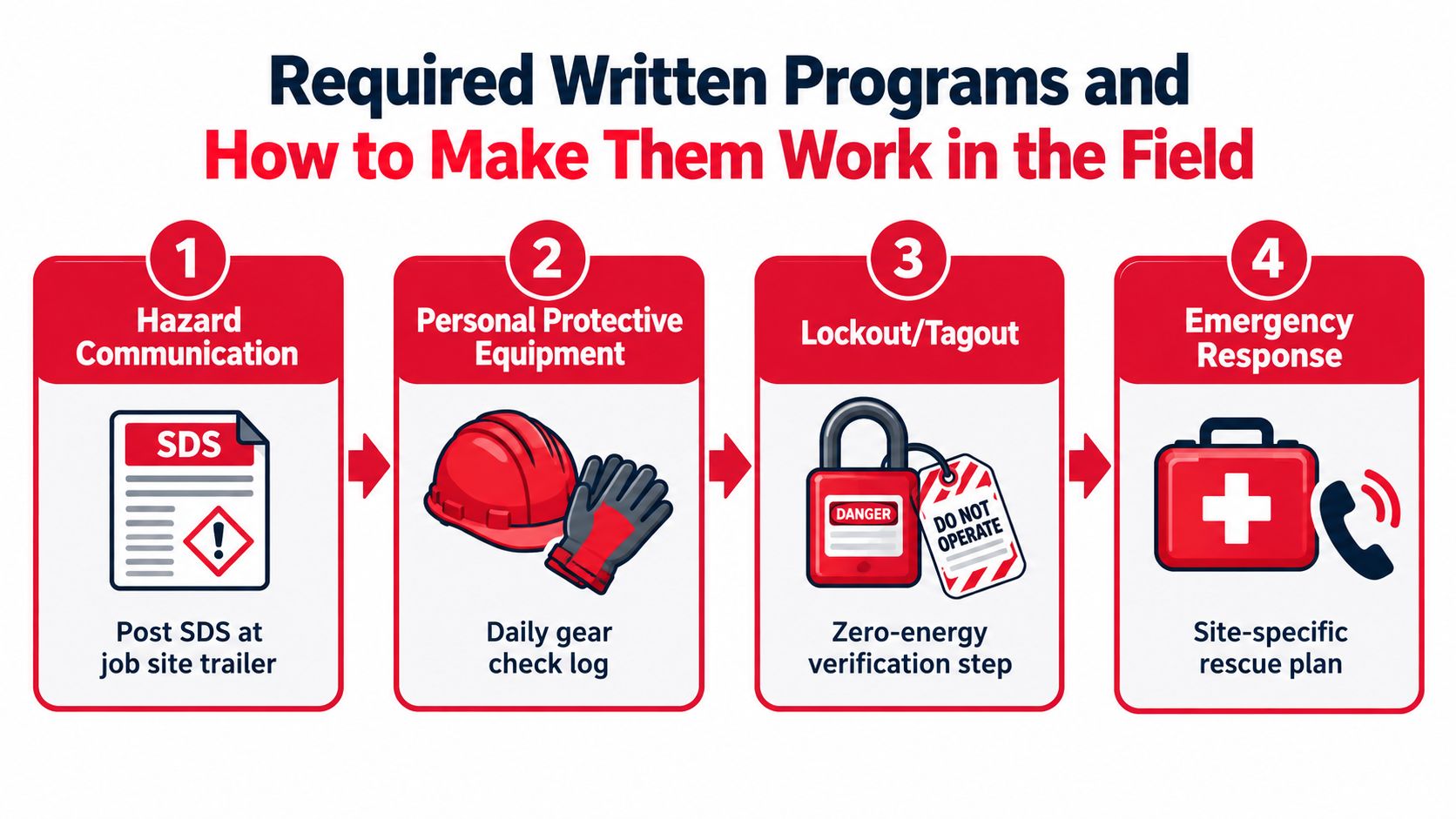
Required Written Programs and How to Make Them Work in the Field
A written program earns its place when a supervisor can use it during a tailboard. The controlled master document may be detailed, but the crew needs a current field summary that answers four questions: what can hurt us, what control applies, who verifies it, and what happens if the control fails?
Hazard communication and personal protective equipment
The hazard communication program should identify products used on the job, make safety data sheets accessible, explain labels and warnings, and document employee training. A fiber crew may use cleaners, solvents, adhesives, fuels, and coatings. The supervisor should verify that the products present at the site match the records.
PPE procedures should connect each task to equipment, inspection, adjustment, replacement, and storage. A daily gear check should cover harnesses, lanyards, helmets, eye protection, gloves, high-visibility garments, hearing protection, and any respiratory equipment required by the hazard assessment.
Lockout and emergency response
Lockout/tagout must describe the energy source, authorized employees, isolation steps, verification, and restoration process. Fiber work can occur near active electrical systems, generators, cabinets, and temporary power. The procedure should require a zero-energy verification step rather than relying on an assumption that a switch position means the equipment is safe.
Emergency response has to match the work. A tower rescue plan is different from a trench rescue plan, and neither is interchangeable with a confined-space rescue plan. Include site access, coordinates, communications, responsible roles, first-aid resources, utility contacts, and escalation steps.
A field-ready document set usually contains:
- One-page summary: The supervisor's quick reference for the day's hazards and controls.
- Controlled master program: The approved version, with revision ownership and change history.
- Training matrix: The employee, required competency, training status, and task authorization.
- Field reference card: The short procedure a worker can carry or access on a tablet.
Practical rule: A signature proves that someone signed a form. It doesn't prove that the crew understood the hazard or used the control.
For tower work, the briefing should specifically verify continuous attachment, dual-connection transfers, equipment condition, approved anchors, and rescue capability. Daily inspection records should identify the equipment and the person who inspected it, then document what happened to defective gear.
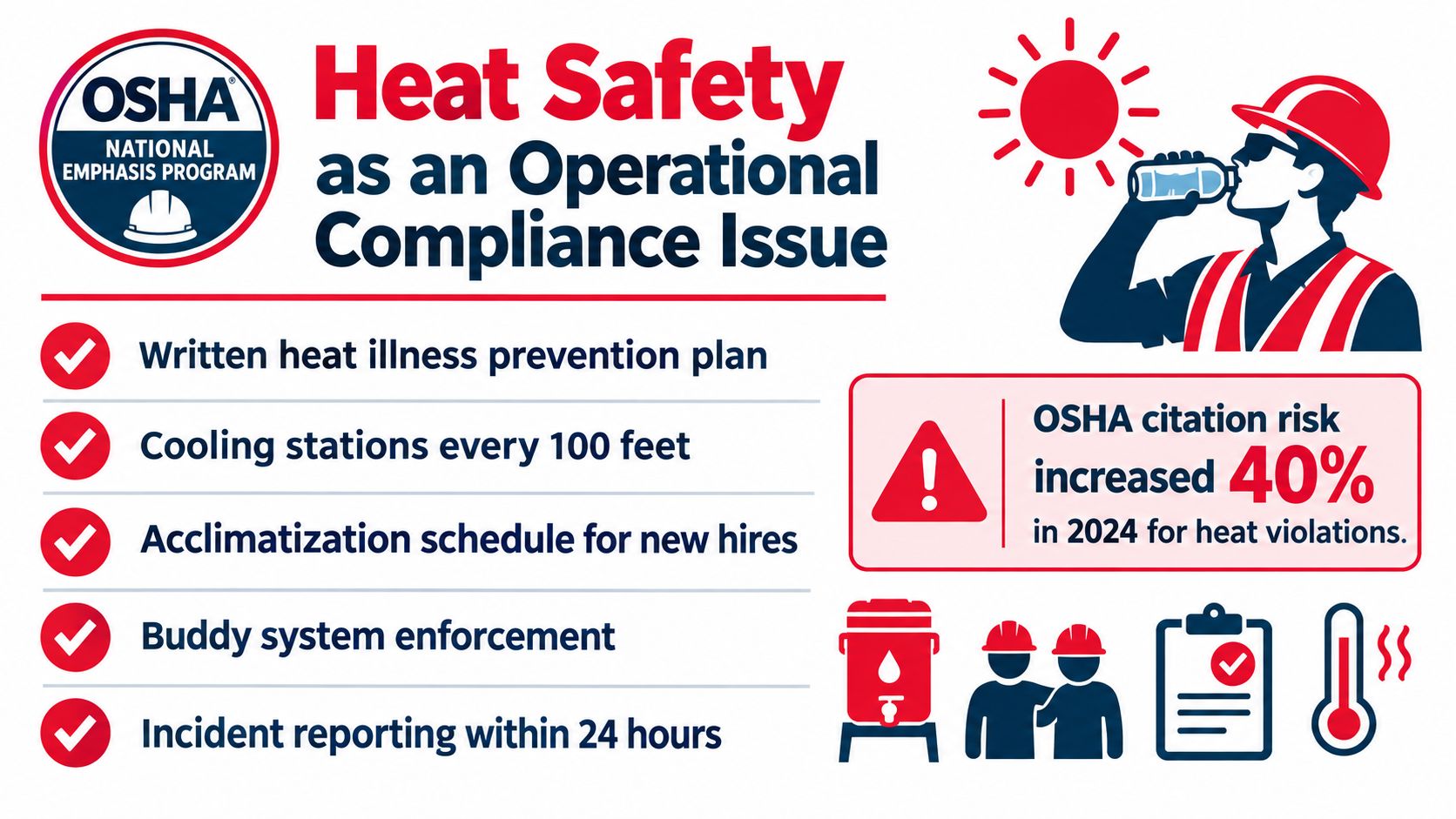
Heat Safety as an Operational Compliance Issue
A written heat plan sitting in a project folder won't protect a crew during a hot roadside shift. Heat compliance is an operating problem because conditions change during the workday, crews may be remote, and supervisors must adjust production expectations when workers show signs of heat stress.
OSHA's proposed heat framework would use temperature thresholds, including heightened controls at 90°F, and would require written prevention plans. Federal rulemaking remains pending, while OSHA continues addressing recognized heat hazards through the General Duty Clause and its National Emphasis Program, as explained in the agency's heat exposure rulemaking materials.
What an inspector can actually evaluate
A plan is a starting point. Implementation records are stronger evidence that the employer recognized and controlled the hazard. The daily heat operations log should capture:
- Site conditions: Weather readings, sun exposure, humidity considerations, surface conditions, and indoor heat sources.
- Crew readiness: Acclimatization status for new or returning workers and the supervisor's pre-shift briefing.
- Controls in use: Water, cooling areas, shade, adjusted work-rest periods, buddy monitoring, and communication access.
- Supervisor observations: Changes in worker condition, work pace, breaks taken, and corrective action.
- Emergency response: Symptoms observed, first-aid steps, medical escalation, transportation, and incident follow-up.
The log should be completed at the tailboard and updated when conditions change. A remote tower crew may need a check-in process that confirms water, communications, shelter options, and the supervisor's ability to reach the site.
Manage the multi-state overlay
Multi-state contractors shouldn't assume one federal plan covers every location. Build a state overlay into the project launch process, then identify which controls, training, records, and reporting duties apply to that crew and worksite.
The strongest approach is operational rather than decorative. Supervisors must be able to show that they changed the work-rest plan, briefed the crew, supplied cooling and hydration, and responded when conditions or worker symptoms required intervention. Heat plans fail when production schedules remain fixed while the field conditions move beyond what the written procedure anticipated.
PPE Fit and Multi-Employer Site Accountability
PPE procurement is only the starting point. OSHA's construction PPE rule, effective January 13, 2025, requires protective equipment to fit each affected employee. The requirement, discussed in this PPE fit analysis, makes individual fit a documented field control rather than a purchasing assumption.
On a tower job, a properly approved harness can still restrict movement or reduce protection if adjusted incorrectly. Respirators can conflict with facial hair or eyewear. High-visibility garments may limit movement or fail to fit over required layers. Gloves, hearing protection, helmets, and eye protection must also suit the worker, task, and other equipment worn at the same time.
Assign ownership before mobilization
Multi-employer sites create predictable accountability gaps. The carrier may set work requirements, the general contractor may control site access, the subcontractor may employ the worker, and a staffing firm may manage part of the workforce. Without a named owner, each party can assume another employer completed the fit review.
The site-specific plan should identify the responsible employer and the verification point. Onboarding records should capture the worker's task, required PPE, fit review, training, and compatibility concerns. Supervisors should confirm during field checks that equipment remains adjusted, available, and serviceable.
Use a simple verification workflow
Tie each record to the worker and task, not to a generic equipment list:
- Identify the hazard: Determine the protection required by the task assessment.
- Select the equipment: Confirm the model, size range, compatibility, and manufacturer instructions.
- Verify individual fit: Have the worker wear and adjust the equipment, then identify conflicts or discomfort.
- Record the result: Capture the equipment, worker, date, reviewer, and corrective action.
- Recheck in the field: Repeat the review after replacement, reassignment, damage, or a task change.
Crews evaluating head protection can use this guide to compare full brim vs cap style hard hats. The final selection still belongs in the site hazard assessment and fit verification record. Auditors look for evidence that the process followed the worker across employers, tasks, and changing field conditions.
Recordkeeping, Reporting, and Inspection Readiness
Records should let a project manager answer three questions quickly: what the crew knew, what it did, and how the company corrected problems. Store training rosters, job hazard analyses, inspection forms, permits, incident records, corrective actions, and subcontractor documents under a consistent project and crew structure. Use the same naming and access rules across fiber, tower, and data center work.
The OSHA 300, 300A, and 301 forms belong in the company's injury and illness recordkeeping process when applicable. Severe injury and fatality reporting also needs a named escalation owner. A field supervisor may identify the event first, but the office must know which facts to collect and how quickly to act.
Build the evidence file before an inspection
A usable digital evidence file contains:
- Project profile: Site address, contacts, scope, applicable standards, and emergency access information.
- Crew qualifications: Training, competent-person designations, qualified-person status, and task authorization.
- Daily controls: Tailboard records, JHAs, ladder and equipment inspections, excavation checks, heat operations logs, and PPE fit confirmations.
- Incident and correction history: Initial report, investigation, assigned owner, due date, completion evidence, and verification.
- Subcontractor controls: Orientation, insurance and qualification records, site rules, coordination notes, and corrective actions.
An inspector may arrive after a complaint, incident, referral, or other event. Someone who was not present for the work should still be able to understand the file. Keep critical evidence out of personal phones and email accounts. Store it in a controlled project system with clear ownership, backup, and retrieval permissions.
Plan for both kinds of inspection
Unprogrammed inspections can follow complaints, fatalities, catastrophes, or other events. Programmed inspections target recognized hazards and industries. Contractors therefore need field records that support routine work and inspection records that withstand outside review. The OSHA enforcement summary provides federal inspection context.
Evidence standard: The record should show the hazard, the control, the responsible person, the date, and how the company closed each deficiency.
Run an evidence retrieval exercise during internal audits. Ask a project manager to produce one crew's complete records from one site without help from the safety department. Test whether the file shows daily controls, heat operations, PPE verification, incidents, subcontractor coordination, and corrective-action closure. If retrieval fails, improve naming, ownership, access controls, or supervisor training. A compliance system earns trust when the evidence is available before an inspector asks for it.
A 90-Day Implementation Roadmap for STR Projects
A practical refresh can run in three sprints.
Days 1 through 30
Inventory written programs, training records, recent inspections, incident files, subcontractor packages, and open corrective actions. Review one fiber project, one tower scope, and one data center or facility activity. Identify gaps in heat operations records, PPE fit verification, excavation documentation, rescue planning, and energy control.
Days 31 through 60
Deploy field artifacts that supervisors can use without interpretation:
- Daily JHA and tailboard form
- Ladder, scaffold, tower, and vehicle inspection records
- Excavation competent-person checklist
- Heat operations log
- PPE fit verification record
- Rescue plan template
- Corrective-action tracker with owner and closure evidence
Days 61 through 90
Run internal audits, close findings, and rehearse incident response. Verify that competent persons can demonstrate their inspection duties and that qualified climbers can explain connection and rescue procedures. Test whether the office can retrieve a complete evidence file quickly.
Use Southern Tier Resources as an example of the type of end-to-end telecom infrastructure partner that can coordinate engineering, construction, maintenance, fiber deployment, wireless work, and data center fit-outs under a safety-first operating model.
Southern Tier Resources supports carriers, ISPs, wireless operators, data center teams, and other infrastructure owners with engineering, construction, maintenance, fiber splicing, tower services, and data center fit-outs. Visit Southern Tier Resources to discuss a dependable infrastructure partner that treats OSHA compliance as part of daily field execution, not as a binder kept after the work is done.