Say the same fiber route is cut for the third time in a year. Your crew restores service, the optical tests pass, and the ticket closes. Nobody has established whether the recurring damage comes from inaccurate records, missed locate coordination, inadequate protection, or a construction handoff that leaves everyone assuming someone else checked.
You've repaired the cable. You haven't solved the recurring problem.
The gap usually isn't a missing technique. It's a mismatch between the problem and the method: a brainstorming session for a defect that needs test evidence, a lengthy statistical project for an obvious handoff failure, or another corrective-action meeting while customers still need containment.
Problem solving methods should change what your team does next. They should help you decide which evidence to collect, who needs to participate, what you can safely test, and what would justify closing the issue.
That applies whether you're reviewing a tower outage, recovering a make-ready schedule, investigating splice failures, or addressing a capacity forecast gap. Even teams using implementation patterns for enterprise AIOps need a disciplined way to turn detected anomalies into verified corrections.
Use these eight methods as a practical toolkit, not a mandatory sequence. Choose the lightest approach that can explain the problem, support a defensible action, and verify the result.
1. PDCA (Plan-Do-Check-Act) Cycle
PDCA earns its keep when you have a plausible improvement but shouldn't deploy it everywhere yet. A revised splice-closure installation procedure is a good example. The engineering intent may be sound, but crews still need to prove that the procedure works under field conditions without creating new workmanship or access problems.

Plan the change around a specific hypothesis. For example, a revised fiber-routing and closure inspection process should reduce acceptance failures without making future maintenance harder.
Run a bounded field trial
- Plan: Record current defects, define acceptance criteria, and specify which route segment and crews will participate.
- Do: Trial the procedure within approved engineering requirements, keeping unrelated process changes out of the pilot.
- Check: Compare optical time-domain reflectometer traces, insertion-loss results, workmanship inspections, and installation effort against the baseline.
- Act: Standardize the procedure, revise it, or reject it based on the evidence.
A passing optical test alone doesn't prove the change worked. Inspect bend management, sealing, labeling, and technician access because a closure can pass acceptance while remaining difficult to maintain.
Assign someone to update the work instruction and brief the remaining crews. Without that handoff, the team has completed a pilot, not implemented an improvement.
Practical rule: Define what would make you stop or reverse the trial before you begin it.
Skip PDCA as the lead method during an uncontrolled outage. Restore service through approved incident procedures first. Use the cycle afterward to test the process change that should prevent a repeat.
2. Six Sigma DMAIC
A splicing program can meet its average loss target while still generating unacceptable rework. If one crew, machine, material batch, or operating condition produces a wider spread of results, an average conceals the problem you need to solve.
DMAIC fits measurable, recurring variation. Its stages, Define, Measure, Analyze, Improve, and Control, give quality and operations teams a disciplined path from an observed defect to a sustained correction.
Start by defining the business problem narrowly. Reducing failed splice acceptance is actionable; improving fiber quality across the company is too broad to investigate efficiently.
Make the measurements comparable
During Measure, agree on test direction, wavelength, equipment settings, calibration status, and acceptance rules. Keep splice measurements distinct from complete-link insertion loss, and don't compare crews using inconsistent test methods.
During Analyze, separate results by relevant conditions:
- Crew and equipment: Look for associations with splicer maintenance, cleaver condition, setup, and operator technique.
- Materials and environment: Check fiber compatibility, contamination, temperature exposure, and working conditions.
- Test process: Investigate whether apparent failures reflect measurement differences rather than installation defects.
Include technicians in that review. A spreadsheet won't tell you that a work location prevents stable equipment setup or that the cleaning supplies changed.
In Improve, test the suspected correction rather than replacing every tool at once. In Control, retain acceptance records and use appropriately designed control charts to detect process drift; distinguish statistical control limits from engineering specifications.
Skip DMAIC for an isolated, understood failure. A damaged patch cord doesn't need a statistical project. Use it when repeated defects justify the measurement effort and when you have enough comparable observations to evaluate variation meaningfully.
3. Root Cause Analysis Using the 5 Whys
For a repeated fiber cut, start with a precise event statement: excavation damaged the route at a particular location during an identified activity. Then work backward through evidence, not through whatever explanation sounds most familiar.
The 5 Whys is useful when the causal chain is relatively contained. Each supported answer becomes the starting point for the next question. The name isn't a requirement to stop questioning at a fixed count.
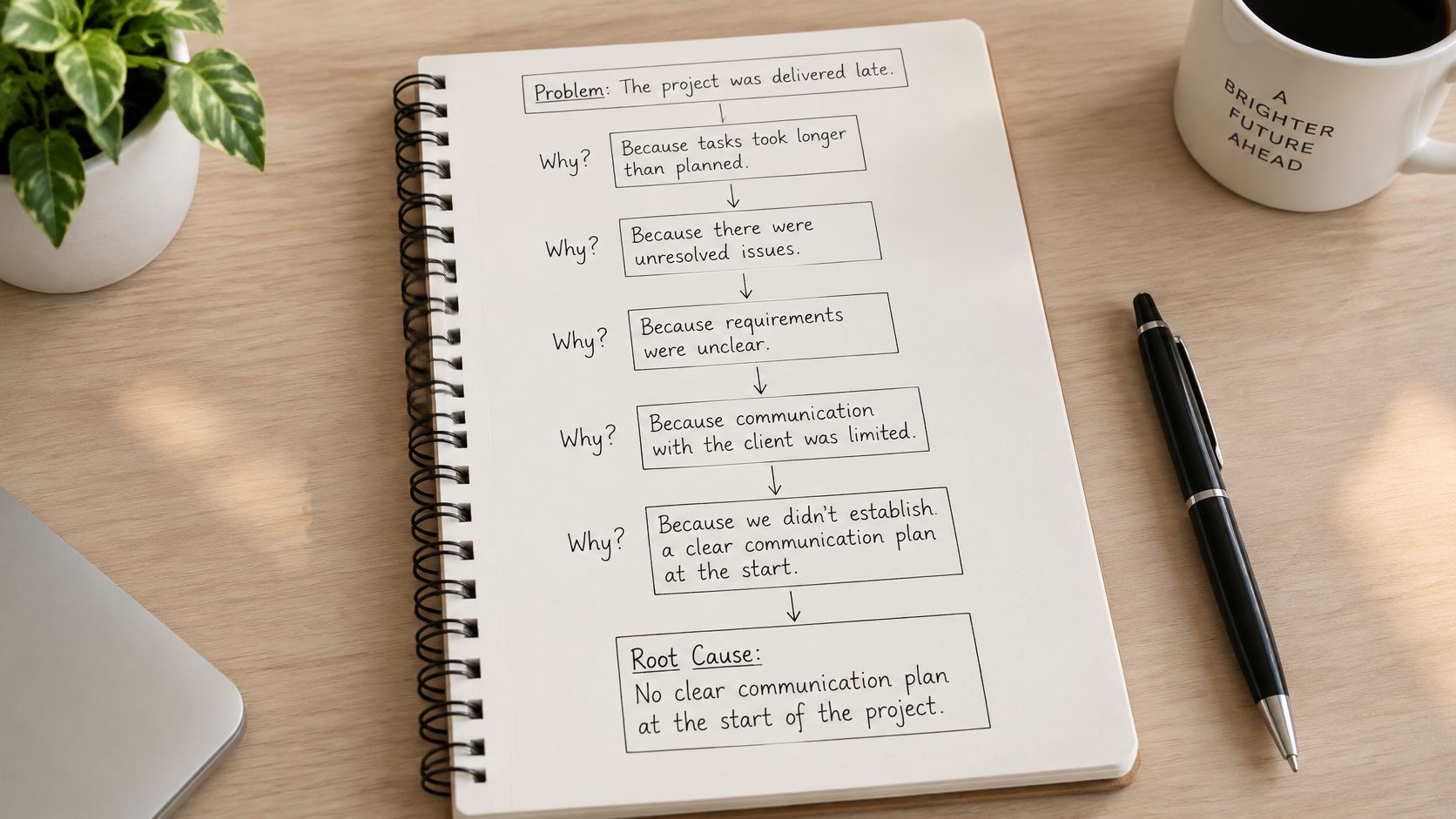
Say the excavation crew relied on markings that didn't match the installed alignment. You'd inspect the locate record, approved drawings, field changes, and as-built submission before deciding whether the failure involved record accuracy, locate execution, or construction practices.
Keep the chain testable
A useful chain might move from an incorrect route record to an unprocessed field change, then to a handoff process that allowed project closeout without updating the asset system. Each connection needs supporting records or physical evidence.
Don't stop at technician error. Ask what information, supervision, equipment, and controls were available when the decision was made.
- Validate each answer: Use alarm histories, photographs, maintenance records, test results, and interviews.
- Branch when necessary: Incorrect records and inadequate excavation controls can both contribute.
- Choose an actionable control: If another party caused the damage, identify coordination or protection measures your team can influence.
A plausible story isn't a root cause until the evidence supports the connections.
Skip a single-chain investigation when several systems interact. A tower outage involving utility loss, battery condition, generator controls, and alarm suppression needs a broader cause map. Use the 5 Whys on specific branches after you've established that broader picture.
4. Ishikawa (Fishbone) Cause-and-Effect Diagram
Use a fishbone diagram when different teams have different explanations and nobody has tested them yet. It helps organize candidate causes without prematurely choosing the most persuasive speaker's theory.
For intermittent latency, put a specific symptom at the head of the diagram. Identify the affected service, path, operating condition, and observed deviation rather than writing a vague statement about poor network performance.
Choose branches that reflect the network. Useful categories include traffic, routing, interfaces, physical layer, measurement, and change activity. For construction schedule slippage, replace those with labor, permits, materials, equipment, and site conditions.
Turn branches into evidence requests
Say the network team suspects congestion while the field team suspects optical degradation. Put both on the diagram, then assign checks against interface utilization, queue drops, optical levels, error counters, path changes, and timestamped incident records.
Keep hypotheses separate from verified causes. A crowded branch means the group generated many possibilities, not that the branch explains the fault.
- Name the test: Specify what observation would support or reject each candidate cause.
- Assign the investigator: Give each promising branch an owner with access to the necessary records.
- Narrow deliberately: Apply the 5 Whys to supported branches instead of repeatedly expanding the diagram.
You can compare real-world Ishikawa diagram examples to choose a layout, but adapt the categories to the work rather than forcing network faults into manufacturing labels.
The visual format is demonstrated below.
Skip the workshop when the failure is already confirmed and the repair is straightforward. Fishbone analysis is for broadening an investigation, not delaying an authorized correction or treating group agreement as proof.
5. 8D (Eight Disciplines) Problem Solving
A connector defect that has reached deployed equipment creates separate obligations: protect customers now and prevent the next shipment from carrying the same problem. 8D is suited to that combination of containment, technical investigation, and accountable corrective action.
Build a team with field operations, engineering, quality, procurement, and the supplier. Describe the failure precisely enough to distinguish affected equipment from unaffected equipment, including installation conditions and available traceability records.
The disciplines provide a working sequence:
- D1 and D2, establish the team and problem: Define authority, scope, customer impact, and the evidence required.
- D3, contain exposure: Quarantine suspect inventory, identify deployed exposure, and apply approved temporary protections.
- D4, establish causes: Investigate both why the defect occurred and why existing checks failed to detect it.
- D5 and D6, verify and implement corrections: Test the proposed permanent action before releasing it.
- D7 and D8, prevent recurrence and recognize contributions: Update standards, training, supplier controls, and acceptance practices, then acknowledge the people who completed the work.
For a suspected crimping defect, don't jump from failed connector to retrain technicians. Inspect tooling condition, material compatibility, assembly instructions, and test coverage before selecting the correction.
Keep containment separate from closure
Temporary monitoring or inventory screening may reduce customer exposure without removing the cause. Track containment as an active control with an owner and a clear condition for retirement.
Use the 8D report to communicate what's confirmed, what remains uncertain, and what evidence will support closure. That's more useful to a carrier or data center customer than an action list marked complete.
Skip full 8D for minor internal issues with limited exposure. Its coordination burden is justified when recurrence, supplier involvement, or customer consequences require formal accountability.
6. Failure Mode and Effects Analysis (FMEA)
FMEA belongs before deployment, when you can still change the design or workflow cheaply relative to installed civil works. It asks how a component or process could fail, what would happen, and whether your controls would detect the failure before service is affected.
For an outdoor cabinet, examine the complete power path rather than reviewing the battery alone. Include utility supply, protective devices, rectification, distribution, battery connections, environmental control, and remote alarming.
Score consistently, then use engineering judgment
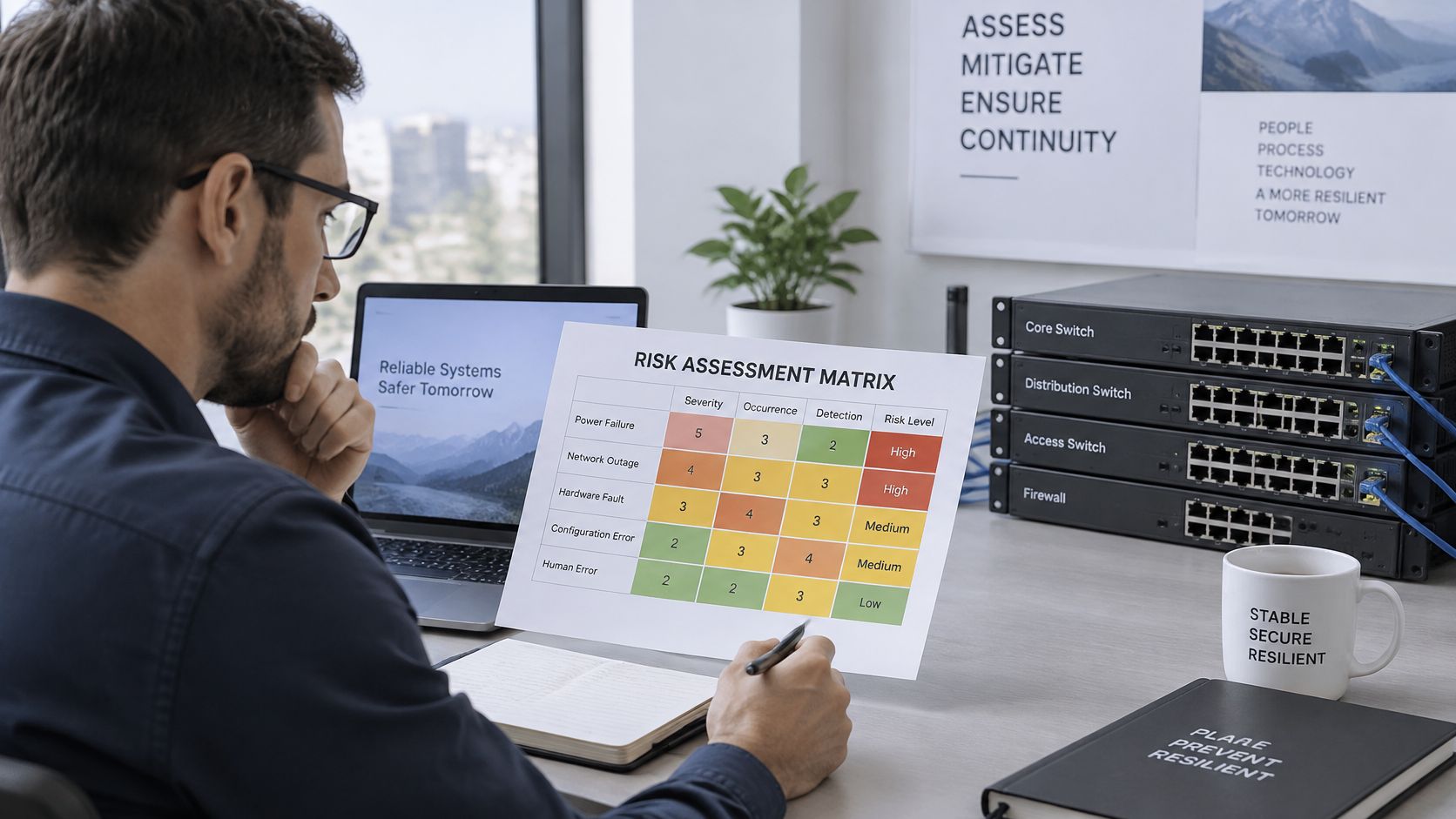
Record each failure mode, its effect, its potential causes, existing prevention and detection controls, and the required action. Teams commonly calculate a Risk Priority Number by multiplying severity, occurrence, and detection ratings.
Document the rating definitions before scoring. A detection rating must mean the same thing to the designer, field technician, and operations reviewer.
Don't let the combined score override a severe consequence. A serious safety or service-continuity risk deserves explicit review even when the team believes it's unlikely.
For the cabinet example, useful actions might include:
- Reduce exposure: Correct thermal design or eliminate an unsuitable connection arrangement.
- Improve detection: Verify alarm delivery through to the operations console, not just at the cabinet.
- Limit consequences: Review redundancy, isolation, and maintenance access.
- Verify completion: Assign an owner and acceptance evidence for each design change.
Bring technicians into the review before drawings are frozen. They can identify inaccessible terminals, difficult battery replacement paths, and inspection tasks that won't be practical in the installed configuration.
Skip FMEA as the primary response to an active fault. It predicts and prioritizes risk; it doesn't establish what caused yesterday's outage. Update it afterward with confirmed failure information.
7. A3 Problem Solving
A3 is useful when the problem crosses teams but the reasoning needs to remain easy to review. The compact Lean format captures background, current condition, target, root-cause analysis, countermeasures, implementation, and follow-up on a shared problem-solving record.
Consider repeated truck rolls for fiber drop installations. Dispatch may blame customer access, technicians may identify missing pathway information, and planning may point to incomplete surveys. An A3 makes the team establish which conditions explain failed first-time installations.
Start with the baseline and break failures into meaningful categories. Separate unavailable customers, blocked pathways, missing materials, incorrect service records, and failed acceptance tests rather than treating every return visit as the same defect.
Make the reasoning visible
For every countermeasure, record:
- Ownership: Name the person responsible for implementation.
- Completion condition: State what must change in the workflow.
- Test criterion: Define how you'll distinguish improvement from normal variation.
- Follow-up: Schedule a review of results and recurrence.
The format only works if the team completes the reasoning. In an organizational study of 18 cases, cases following every prescribed A3 step achieved improvements ranging from 77% to 100%, while cases skipping steps achieved 17% to 60%, according to the A3 metaroutines working paper.
Those findings aren't a telecom performance forecast. They support treating A3 as a complete process rather than a presentation template.
Closure test: Can a reviewer connect the original condition, the validated cause, the chosen action, and the measured result?
Skip A3 when you only need a routine work order. Use it when a recurring operational issue needs shared reasoning, management support, and an auditable record of what changed.
8. Design Thinking
A municipality may want fewer street disruptions, residents may need clear access arrangements, and the carrier may need a route that supports future expansion. Design thinking fits when the problem includes competing user needs, not just a technical defect.
Its working stages are Empathize, Define, Ideate, Prototype, and Test. In telecom, that means interviewing the people who approve, build, operate, and live alongside the infrastructure before committing to the final design.
For a broadband build, test alternative route drawings, access plans, and resident notices. For a data center fit-out, use rack elevations and cable-routing mockups with the technicians who will install and maintain the system.
Prototype the coordination process too
A blocked permit isn't always a drawing problem. The NTIA guide to local permitting challenges and strategies identifies jurisdictional differences, overlapping approvals, access rights, and limited government personnel as deployment obstacles.
Build a shared approval record that identifies the dependency, required evidence, decision-maker, responsible applicant, and unresolved question. Agree on escalation conditions and the next review date so a status meeting produces decisions rather than another round of updates.
- Test understanding: Ask reviewers to work through a sample submission and identify missing information.
- Protect decision rights: Separate consultation from formal approval authority.
- Record trade-offs: Document why the team accepted a route, access arrangement, or construction sequence.
For teams coordinating iterative delivery, integrating design thinking into Agile workflows offers a useful connection between stakeholder learning and incremental execution.
Skip design thinking for a known equipment failure with an approved repair. User interviews won't replace electrical testing. Its value is in defining the right problem early, before the team commits to a technically valid solution that stakeholders can't use or approve.
How the eight problem solving methods compare on fit, strength, and limitation
| Item | Best For | Main Strength | Main Limitation |
|---|---|---|---|
| PDCA (Plan-Do-Check-Act) Cycle | Process improvement and validating new procedures | Enables low-risk, continuous improvement through small-scale tests | Can be too slow for urgent outages |
| Six Sigma DMAIC | Quality improvement, defect reduction, and process standardization | Delivers measurable results and helps sustain gains | Requires training, time, and reliable baseline data |
| Root Cause Analysis Using the 5 Whys | Incident investigation and quick troubleshooting | Fast, simple way to trace symptoms toward underlying causes | May oversimplify problems with multiple causes |
| Ishikawa (Fishbone) Cause-and-Effect Diagram | Collaborative brainstorming of potential causes | Helps teams consider a broad range of contributing factors | Does not verify which cause is correct |
| 8D (Eight Disciplines) Problem Solving | Recurring defects and client-facing corrective actions | Combines immediate containment with lasting corrective measures | Documentation and execution can be burdensome |
| Failure Mode and Effects Analysis (FMEA) | Proactive risk management and reliability planning | Identifies and prioritizes potential failures before they occur | Risk scores depend on consistent team judgment |
| A3 Problem Solving | Lean improvement, team communication, and coaching | Makes analysis concise, visible, and easy to review | The one-page format can oversimplify complex issues |
| Design Thinking | Early-stage design and stakeholder alignment | Centers solutions on user needs and rapid testing | Can be open-ended for well-defined technical problems |
Matching the Method to the Moment
Choose the method according to the decision in front of you, not the framework your team used last time. An active incident requires safe stabilization and service restoration; a recurring incident requires an investigation that survives scrutiny after the alarms clear.
Use 5 Whys when you can trace a contained causal chain. Use Ishikawa when competing explanations span systems or disciplines, then validate the strongest branches with records and tests.
For recurring defects that reach customers, 8D adds containment and formal corrective-action accountability. For infrastructure that hasn't been deployed, FMEA helps you challenge the design and acceptance controls before crews install it.
Match the evidence to the work
PDCA and A3 suit controlled process changes, but they serve different purposes. PDCA organizes the trial and learning cycle; A3 makes the problem, reasoning, ownership, and results visible across teams.
Choose DMAIC when the objective is measurable reduction in recurring defects or variation. Choose design thinking when stakeholders still disagree about what a successful outcome should look like.
Whatever you select, retain the evidence appropriate to the problem:
- Fiber faults: Preserve test traces, physical findings, repair details, and updated route records.
- Construction delays: Track approval dependencies, incomplete submissions, material readiness, and release conditions.
- Capacity gaps: Separate forecast assumptions from observed utilization and document the trigger for expansion.
Don't assume the bottleneck will stay in the same place. In the 2025 NTCA Broadband Internet Availability Report, 41.3% of respondents cited permitting delays and 22.2% reported difficulty procuring required equipment, fiber, or other resources as deployment challenges.
Treat those as different constraints requiring different decisions. A cleared permit won't make missing equipment arrive, and available crews won't resolve an unapproved route.
Preserve flexibility while you solve
Distinguish reversible decisions, such as crew sequencing, from expensive commitments, such as civil works. Set explicit triggers for resequencing, evaluating approved substitute materials, or revisiting aerial versus underground design, with engineering and approval requirements kept intact.
You don't need to run every method on every issue. Start with the least burdensome method that can establish the cause or clarify the decision, and add structure only when complexity or consequences justify it.
Select an open recurring outage or fiber fault at your next operations review. Name an owner, preserve the baseline evidence, choose a method, and carry it through verification and follow-up before closing the corrective action.
Southern Tier Resources provides end-to-end engineering, construction, and maintenance for wireline and wireless networks, along with fiber splicing, testing, documentation, and data center infrastructure fit-outs. Visit Southern Tier Resources to discuss a recurring network fault, a constrained build, or an upcoming deployment and connect the investigation to accountable field execution.